SUBSCRIBE TO OUR FREE NEWSLETTER
Daily news & progressive opinion—funded by the people, not the corporations—delivered straight to your inbox.
5
#000000
#FFFFFF
To donate by check, phone, or other method, see our More Ways to Give page.
Daily news & progressive opinion—funded by the people, not the corporations—delivered straight to your inbox.
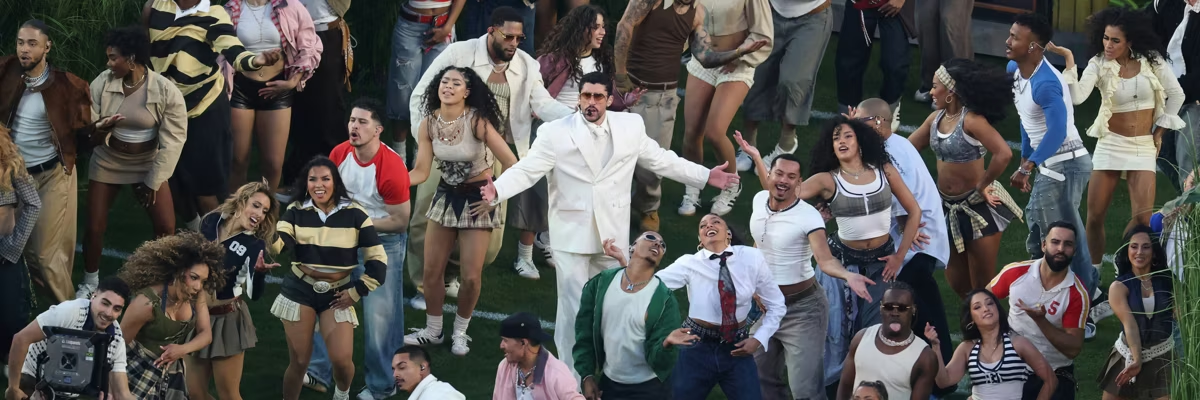
Bad Bunny performs onstage during the Apple Music Super Bowl LX Halftime Show at Levi's Stadium on February 8, 2026 in Santa Clara, California.
Bad Bunny reminded millions of people of connection, of shared humanity, of a hemisphere bound together by history and responsibility, just as the Trump administration tightened the screws on Cuba. What comes next is on us.
For 13 minutes on the most-watched stage in American culture, Bad Bunny made the United States feel expansive, uncontained, Caribbean rhythm-centered, and alive with a sense of belonging that crossed borders without asking permission. As a Venezuelan-American, I felt chills from the very first second to the last. I was a child again, asleep across two chairs pushed together at a family party that refused to end, the music still playing, adults laughing loudly in the background, grandparents locked into a serious game of dominoes as if nothing outside that table mattered. I could feel the dancing in the living room, smell the food that took all day to make, remember that deep sense of togetherness you can’t explain or translate—you simply grow up inside it.
And then came Bad Bunny’s ending—loud, defiant, and unmistakably intentional. When he said, “God bless America,” naming Chile, Argentina, Uruguay, Paraguay, Bolivia, Peru, Ecuador, Colombia, Brazil, Venezuela, Guyana, Panama, Costa Rica, Nicaragua, Honduras, El Salvador, Guatemala, Mexico, Cuba, the Dominican Republic, Jamaica, Haiti, las Antillas, the United States, Canada, and Puerto Rico, it felt like calling family members into the room, reminding everyone that America has always been bigger than the version that those in power are comfortable with, and that it has always belonged to more people than it is willing to treat with dignity.
At that very same moment, offstage, untelevised, and unacknowledged, the US government was tightening the screws on Cuba. Under Donald Trump, US policy toward the island has moved from long-standing hostility into something closer to an open siege. Sanctions have been escalated, fuel deliberately cut off, and third countries threatened with tariffs and sanctions for daring to trade with Cuba. The consequences are immediate and devastating: rolling blackouts shutting down hospitals, universities forced to suspend classes, factories and farms unable to operate, and entire transportation systems paralyzed. The US fuel blockade has grounded flights, stopped buses from running, and forced ambulances to be rationed.
The US embargo on Cuba itself is illegal under international law and is condemned year after year by the overwhelming majority of the world’s nations. Yet the United States continues to enforce it unilaterally, using its navy, its financial system, and its political power to prevent oil shipments from reaching Cuba, to intimidate shipping companies, and to punish any country that dares to trade. US pressure doesn’t stop at its own borders; it extends outward, telling the rest of the world who they are allowed to sell fuel to, who they are allowed to insure, and which economies must be starved into compliance. When ships are blocked, oil is cut off, and a civilian population is plunged into darkness, this is a blockade. And under international law, that is an act of war.
If those 13 minutes meant anything, they must move us toward demanding a foreign policy that treats our neighbors as equals.
Washington then claims humanitarian concern, offering small, tightly controlled aid packages while maintaining the very sanctions that created the emergency. The crisis is manufactured first, then weaponized as proof that Cuba is “failing.” Scarcity becomes both the method and the message. This is collective punishment, designed to exhaust a population into submission through hunger, darkness, and isolation.
We need to be honest: This is not just Trump. Trump is blunt, crude, and unapologetic, but he did not invent this. For decades, US administrations have treated Latin America and the Caribbean as a sphere to be managed, disciplined, or reordered, operating from the same assumption: that the United States has a providential right to decide who governs and who must be punished into compliance. But ask yourself, really sit with it, can you imagine the humiliation of entire nations being told, again and again, that their future will be decided elsewhere? Imagine living under the constant threat that your economy can be strangled, your leaders removed, your people starved simply for refusing obedience. Who gave the United States this right? Who decided that Latin America’s sovereignty was conditional?
Two centuries ago, Simón Bolívar warned that the United States seemed destined “to plague America with misery in the name of liberty.” His vision was not domination but dignity: nations free to determine their own paths, bound by solidarity rather than submission. Nuestra América, the America of José Martí, Simón Bolívar, Augusto Sandino, Frantz Fanon, Fidel Castro, and Hugo Chávez, is land, people, language, and resistance that still exist and insist on sovereignty.
This is the choice in front of us. You can accept Trump’s America, the America that governs through sieges, blockades, sanctions, and humiliation, deciding from afar who may rule, who may eat, and who must be punished into submission. Or you can stand with Nuestra América, the America Martí and Bolívar imagined, and that Bad Bunny echoed when he held up a football, reading “Together we are America.” This is an America that refuses domination, that believes no nation is a backyard, and that insists the future of this hemisphere belongs to its peoples, not to an empire. There is no neutral ground between those two Americas.
This is why the moment demands more than applause. It demands that we look past the spectacle and confront the systems that decide who gets to thrive and who is forced to flee. A real Good Neighbor Policy would respect sovereignty, stop weaponizing hunger and instability, and recognize that dignity does not end at the US border. Bad Bunny reminded millions of people of connection, of shared humanity, of a hemisphere bound together by history and responsibility. What comes next is on us. If those 13 minutes meant anything, they must move us toward demanding a foreign policy that treats our neighbors as equals. Because in the end, the message is simple and uncompromising: The only thing more powerful than hate is love.
If this article moved you, don’t let it end here. Right now, US policy is manufacturing hunger in Cuba and then pretending to solve it with crumbs. We can choose a different path. Join CODEPINK’s call to feed Cuba during this man-made crisis by supporting efforts that respect dignity, sovereignty, and life itself. Take action now: https://www.codepink.org/wck
Dear Common Dreams reader, It’s been nearly 30 years since I co-founded Common Dreams with my late wife, Lina Newhouser. We had the radical notion that journalism should serve the public good, not corporate profits. It was clear to us from the outset what it would take to build such a project. No paid advertisements. No corporate sponsors. No millionaire publisher telling us what to think or do. Many people said we wouldn't last a year, but we proved those doubters wrong. Together with a tremendous team of journalists and dedicated staff, we built an independent media outlet free from the constraints of profits and corporate control. Our mission has always been simple: To inform. To inspire. To ignite change for the common good. Building Common Dreams was not easy. Our survival was never guaranteed. When you take on the most powerful forces—Wall Street greed, fossil fuel industry destruction, Big Tech lobbyists, and uber-rich oligarchs who have spent billions upon billions rigging the economy and democracy in their favor—the only bulwark you have is supporters who believe in your work. But here’s the urgent message from me today. It's never been this bad out there. And it's never been this hard to keep us going. At the very moment Common Dreams is most needed, the threats we face are intensifying. We need your support now more than ever. We don't accept corporate advertising and never will. We don't have a paywall because we don't think people should be blocked from critical news based on their ability to pay. Everything we do is funded by the donations of readers like you. When everyone does the little they can afford, we are strong. But if that support retreats or dries up, so do we. Will you donate now to make sure Common Dreams not only survives but thrives? —Craig Brown, Co-founder |
For 13 minutes on the most-watched stage in American culture, Bad Bunny made the United States feel expansive, uncontained, Caribbean rhythm-centered, and alive with a sense of belonging that crossed borders without asking permission. As a Venezuelan-American, I felt chills from the very first second to the last. I was a child again, asleep across two chairs pushed together at a family party that refused to end, the music still playing, adults laughing loudly in the background, grandparents locked into a serious game of dominoes as if nothing outside that table mattered. I could feel the dancing in the living room, smell the food that took all day to make, remember that deep sense of togetherness you can’t explain or translate—you simply grow up inside it.
And then came Bad Bunny’s ending—loud, defiant, and unmistakably intentional. When he said, “God bless America,” naming Chile, Argentina, Uruguay, Paraguay, Bolivia, Peru, Ecuador, Colombia, Brazil, Venezuela, Guyana, Panama, Costa Rica, Nicaragua, Honduras, El Salvador, Guatemala, Mexico, Cuba, the Dominican Republic, Jamaica, Haiti, las Antillas, the United States, Canada, and Puerto Rico, it felt like calling family members into the room, reminding everyone that America has always been bigger than the version that those in power are comfortable with, and that it has always belonged to more people than it is willing to treat with dignity.
At that very same moment, offstage, untelevised, and unacknowledged, the US government was tightening the screws on Cuba. Under Donald Trump, US policy toward the island has moved from long-standing hostility into something closer to an open siege. Sanctions have been escalated, fuel deliberately cut off, and third countries threatened with tariffs and sanctions for daring to trade with Cuba. The consequences are immediate and devastating: rolling blackouts shutting down hospitals, universities forced to suspend classes, factories and farms unable to operate, and entire transportation systems paralyzed. The US fuel blockade has grounded flights, stopped buses from running, and forced ambulances to be rationed.
The US embargo on Cuba itself is illegal under international law and is condemned year after year by the overwhelming majority of the world’s nations. Yet the United States continues to enforce it unilaterally, using its navy, its financial system, and its political power to prevent oil shipments from reaching Cuba, to intimidate shipping companies, and to punish any country that dares to trade. US pressure doesn’t stop at its own borders; it extends outward, telling the rest of the world who they are allowed to sell fuel to, who they are allowed to insure, and which economies must be starved into compliance. When ships are blocked, oil is cut off, and a civilian population is plunged into darkness, this is a blockade. And under international law, that is an act of war.
If those 13 minutes meant anything, they must move us toward demanding a foreign policy that treats our neighbors as equals.
Washington then claims humanitarian concern, offering small, tightly controlled aid packages while maintaining the very sanctions that created the emergency. The crisis is manufactured first, then weaponized as proof that Cuba is “failing.” Scarcity becomes both the method and the message. This is collective punishment, designed to exhaust a population into submission through hunger, darkness, and isolation.
We need to be honest: This is not just Trump. Trump is blunt, crude, and unapologetic, but he did not invent this. For decades, US administrations have treated Latin America and the Caribbean as a sphere to be managed, disciplined, or reordered, operating from the same assumption: that the United States has a providential right to decide who governs and who must be punished into compliance. But ask yourself, really sit with it, can you imagine the humiliation of entire nations being told, again and again, that their future will be decided elsewhere? Imagine living under the constant threat that your economy can be strangled, your leaders removed, your people starved simply for refusing obedience. Who gave the United States this right? Who decided that Latin America’s sovereignty was conditional?
Two centuries ago, Simón Bolívar warned that the United States seemed destined “to plague America with misery in the name of liberty.” His vision was not domination but dignity: nations free to determine their own paths, bound by solidarity rather than submission. Nuestra América, the America of José Martí, Simón Bolívar, Augusto Sandino, Frantz Fanon, Fidel Castro, and Hugo Chávez, is land, people, language, and resistance that still exist and insist on sovereignty.
This is the choice in front of us. You can accept Trump’s America, the America that governs through sieges, blockades, sanctions, and humiliation, deciding from afar who may rule, who may eat, and who must be punished into submission. Or you can stand with Nuestra América, the America Martí and Bolívar imagined, and that Bad Bunny echoed when he held up a football, reading “Together we are America.” This is an America that refuses domination, that believes no nation is a backyard, and that insists the future of this hemisphere belongs to its peoples, not to an empire. There is no neutral ground between those two Americas.
This is why the moment demands more than applause. It demands that we look past the spectacle and confront the systems that decide who gets to thrive and who is forced to flee. A real Good Neighbor Policy would respect sovereignty, stop weaponizing hunger and instability, and recognize that dignity does not end at the US border. Bad Bunny reminded millions of people of connection, of shared humanity, of a hemisphere bound together by history and responsibility. What comes next is on us. If those 13 minutes meant anything, they must move us toward demanding a foreign policy that treats our neighbors as equals. Because in the end, the message is simple and uncompromising: The only thing more powerful than hate is love.
If this article moved you, don’t let it end here. Right now, US policy is manufacturing hunger in Cuba and then pretending to solve it with crumbs. We can choose a different path. Join CODEPINK’s call to feed Cuba during this man-made crisis by supporting efforts that respect dignity, sovereignty, and life itself. Take action now: https://www.codepink.org/wck
For 13 minutes on the most-watched stage in American culture, Bad Bunny made the United States feel expansive, uncontained, Caribbean rhythm-centered, and alive with a sense of belonging that crossed borders without asking permission. As a Venezuelan-American, I felt chills from the very first second to the last. I was a child again, asleep across two chairs pushed together at a family party that refused to end, the music still playing, adults laughing loudly in the background, grandparents locked into a serious game of dominoes as if nothing outside that table mattered. I could feel the dancing in the living room, smell the food that took all day to make, remember that deep sense of togetherness you can’t explain or translate—you simply grow up inside it.
And then came Bad Bunny’s ending—loud, defiant, and unmistakably intentional. When he said, “God bless America,” naming Chile, Argentina, Uruguay, Paraguay, Bolivia, Peru, Ecuador, Colombia, Brazil, Venezuela, Guyana, Panama, Costa Rica, Nicaragua, Honduras, El Salvador, Guatemala, Mexico, Cuba, the Dominican Republic, Jamaica, Haiti, las Antillas, the United States, Canada, and Puerto Rico, it felt like calling family members into the room, reminding everyone that America has always been bigger than the version that those in power are comfortable with, and that it has always belonged to more people than it is willing to treat with dignity.
At that very same moment, offstage, untelevised, and unacknowledged, the US government was tightening the screws on Cuba. Under Donald Trump, US policy toward the island has moved from long-standing hostility into something closer to an open siege. Sanctions have been escalated, fuel deliberately cut off, and third countries threatened with tariffs and sanctions for daring to trade with Cuba. The consequences are immediate and devastating: rolling blackouts shutting down hospitals, universities forced to suspend classes, factories and farms unable to operate, and entire transportation systems paralyzed. The US fuel blockade has grounded flights, stopped buses from running, and forced ambulances to be rationed.
The US embargo on Cuba itself is illegal under international law and is condemned year after year by the overwhelming majority of the world’s nations. Yet the United States continues to enforce it unilaterally, using its navy, its financial system, and its political power to prevent oil shipments from reaching Cuba, to intimidate shipping companies, and to punish any country that dares to trade. US pressure doesn’t stop at its own borders; it extends outward, telling the rest of the world who they are allowed to sell fuel to, who they are allowed to insure, and which economies must be starved into compliance. When ships are blocked, oil is cut off, and a civilian population is plunged into darkness, this is a blockade. And under international law, that is an act of war.
If those 13 minutes meant anything, they must move us toward demanding a foreign policy that treats our neighbors as equals.
Washington then claims humanitarian concern, offering small, tightly controlled aid packages while maintaining the very sanctions that created the emergency. The crisis is manufactured first, then weaponized as proof that Cuba is “failing.” Scarcity becomes both the method and the message. This is collective punishment, designed to exhaust a population into submission through hunger, darkness, and isolation.
We need to be honest: This is not just Trump. Trump is blunt, crude, and unapologetic, but he did not invent this. For decades, US administrations have treated Latin America and the Caribbean as a sphere to be managed, disciplined, or reordered, operating from the same assumption: that the United States has a providential right to decide who governs and who must be punished into compliance. But ask yourself, really sit with it, can you imagine the humiliation of entire nations being told, again and again, that their future will be decided elsewhere? Imagine living under the constant threat that your economy can be strangled, your leaders removed, your people starved simply for refusing obedience. Who gave the United States this right? Who decided that Latin America’s sovereignty was conditional?
Two centuries ago, Simón Bolívar warned that the United States seemed destined “to plague America with misery in the name of liberty.” His vision was not domination but dignity: nations free to determine their own paths, bound by solidarity rather than submission. Nuestra América, the America of José Martí, Simón Bolívar, Augusto Sandino, Frantz Fanon, Fidel Castro, and Hugo Chávez, is land, people, language, and resistance that still exist and insist on sovereignty.
This is the choice in front of us. You can accept Trump’s America, the America that governs through sieges, blockades, sanctions, and humiliation, deciding from afar who may rule, who may eat, and who must be punished into submission. Or you can stand with Nuestra América, the America Martí and Bolívar imagined, and that Bad Bunny echoed when he held up a football, reading “Together we are America.” This is an America that refuses domination, that believes no nation is a backyard, and that insists the future of this hemisphere belongs to its peoples, not to an empire. There is no neutral ground between those two Americas.
This is why the moment demands more than applause. It demands that we look past the spectacle and confront the systems that decide who gets to thrive and who is forced to flee. A real Good Neighbor Policy would respect sovereignty, stop weaponizing hunger and instability, and recognize that dignity does not end at the US border. Bad Bunny reminded millions of people of connection, of shared humanity, of a hemisphere bound together by history and responsibility. What comes next is on us. If those 13 minutes meant anything, they must move us toward demanding a foreign policy that treats our neighbors as equals. Because in the end, the message is simple and uncompromising: The only thing more powerful than hate is love.
If this article moved you, don’t let it end here. Right now, US policy is manufacturing hunger in Cuba and then pretending to solve it with crumbs. We can choose a different path. Join CODEPINK’s call to feed Cuba during this man-made crisis by supporting efforts that respect dignity, sovereignty, and life itself. Take action now: https://www.codepink.org/wck