

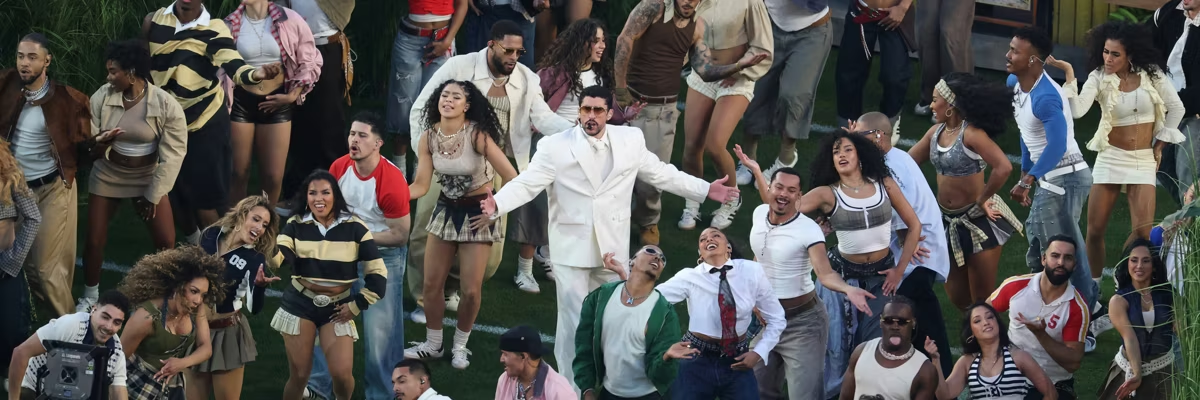
Bad Bunny performs onstage during the Apple Music Super Bowl LX Halftime Show at Levi's Stadium on February 8, 2026 in Santa Clara, California.
An Invitation to Dance: How Bad Bunny Builds a Movement
Most of us don’t reason our way into a larger sense of “us.” We feel our way there. Bad Bunny understands that.
When Bad Bunny was announced as the Super Bowl halftime performer, critics predicted backlash. He’d be too Spanish. Too political. Not “American” enough. The assumption was that in a country this polarized, cultural borders were fixed—and he stood on the wrong side of them.
Instead, one of the largest audiences in National Football League history tuned in. Streams surged. Album sales climbed. Millions of viewers who didn’t understand every lyric found themselves moving anyway.
Maybe nothing flipped overnight. Maybe hardened partisans didn’t suddenly renounce their politics. What happened was subtler—and more powerful. The borders didn’t collapse. They became more permeable. How did Benito Antonio Martinez Ocasio pull that off?
His Music Is a Joyful Invitation, Not a Grievance
Bad Bunny’s Puerto Rico has endured over 400 years of exploitation. And yet his music is uplifting; his community feels resilient, not defeated. Political messaging, especially among progressives, often starts with what communications strategist Anat Shenker-Osorio describes as, “Boy, have I got a problem for you.” Bad Bunny flips the sequence. He invites us to dance first. To celebrate music and food and love and family. It feels like the greatest party on Earth.
Without lecturing, Bad Bunny’s show gave us a history lesson on over 125 years of US colonization.
When I told my husband to check out Debi Tirar Más Photos, Bad Bunny’s Grammy Album of the Year (the first Spanish language winner ever), he was reluctant. The next day, though, the album was blasting through the house. The music is so accessible because there’s something for everyone. Even within a single song, he moves across genres and generations. Having grown up in the Bronx, I was drawn to the salsa rhythms of “Baile Inolvidable.” But then the dembow pulse of “Tití Me Preguntó” had me moving too—despite years of thinking that I didn’t like reggaeton because it all sounded the same. Bad Bunny’s music loosened assumptions I hadn’t even realized I’d been carrying.
He Uses Curiosity as a Teacher
Viewers who tuned in for the spectacle of the halftime show noticed people dressed as sugar cane plants, workers climbing electrical poles, empty white plastic chairs scattered across the stage. What did it mean? I know I wasn't the only one burning a hole on the internet that evening. People don’t resist information they discover themselves, especially if they’re being entertained.
Without lecturing, Bad Bunny’s show gave us a history lesson on over 125 years of US colonization: the dismantling of Puerto Rico’s agricultural economy; environmental catastrophes; and gentrification driven by tax breaks for wealthy developers. The result: a diaspora in which 2 out of 3 Puerto Ricans now live off the island.
That’s not persuasion through argument. It’s softening through exposure.
His Call to Connect Counters the Us-Versus-Them Narrative Used to Divide Us
Bad Bunny’s music is more than about Puerto Rico. It’s about countering the fear and anger-mongering being used to pit us against each other. The deliberate cultivation of suspicion that someone else is taking what’s yours—when the real plundering is happening from the top.
His approach isn’t just entertainment. It’s strategy. Not a bid to crush opponents overnight, but a patient expansion of belonging—joyful, magnetic—until the line between “us” and “them” begins to dissolve.
Instead, Bad Bunny’s jumbotron message called on people to view each other through a loving lens instead of a hateful one. Former President Barack Obama praised the performance for conveying a simple message: There is room for everyone here. Contrast that to Turning Point’s All-American Halftime Show, the alternative created for those who preferred a narrower definition of who is an American.
Some observers have compared Bad Bunny to John Lennon who also insisted that love could be politically disruptive. Lennon’s “Imagine” wasn’t about changing policy; it was a call to picture the world differently. That imaginative shift is what unsettles power. Fear-based politics relies on narrowing who counts, on who gets to define the nation. Benito is all about expansion.
He Doesn’t Shrink to Widen His Audience
The NFL executives may have worried that Americans wouldn’t understand Bad Bunny if he didn’t sing in English, but he refused to change himself to accommodate a fractured country. He made the audience stretch instead. (Duolingo reported a 35% surge in Spanish learners following his show.) Understanding doesn’t always begin with translation. It can begin with proximity.
The anger directed at Bad Bunny, writes journalist Jim Heath, is about losing control over identity. “Latino culture is framed as divisive,” writes Heath, “only because its permanence challenges an older mythology about who America is.”
Changing Heart and Minds
We often assume persuasion begins with argument—that we must win debates before we can win anyone over. But most of us don’t reason our way into a larger sense of “us.” We feel our way there. Bad Bunny understands that. His work is an invitation: to learn about his culture, to experience joy together, to recognize how much we share. Not to contort ourselves to fit in, but to widen the circle without losing who we are. And before long, we’re dancing beside people we were warned to fear.
His approach isn’t just entertainment. It’s strategy. Not a bid to crush opponents overnight, but a patient expansion of belonging—joyful, magnetic—until the line between “us” and “them” begins to dissolve.
That’s how movements grow.
We are at a crossroads
This country and this world are at a monumental crossroads. In a few short weeks, US voters will have an opportunity to beat back the forces of fascism and confront the billionaires who are rigging the economy, our media system, and our democracy, making it increasingly impossible for ordinary people to get by. We’re not just talking about the election. We’re talking about what must be done once these fascist elements are vanquished from power. We need a bolder set of solutions than what either major party has so far been willing to offer and a working-class movement ready to fight like hell for it. Trump didn't emerge from nowhere. The conditions that fueled MAGA authoritarianism were created by decades of radical neoliberal economic policies and a corrupt political system dominated by corporate interests. They slashed taxes on the super-rich, promising that the benefits would trickle down. They said giveaways to the corporate titans would make life more affordable for the rest of us. It was all bullshit. And when a bitter, betrayed populace searches for someone to blame, right-wing demagogues have little trouble finding scapegoats. People know when they're being lied to, but you won't hear any of this from the corporate media. Only independent journalism—powered and funded by people who believe in building a better world—can deliver truly trustworthy daily news. Our Fall Campaign is underway, and we need your help. To power our newsroom through the rest of the year, we need to raise $125,000 by midnight on October 31. So if you share our vision, please contribute whatever you can to sustain our work. |
When Bad Bunny was announced as the Super Bowl halftime performer, critics predicted backlash. He’d be too Spanish. Too political. Not “American” enough. The assumption was that in a country this polarized, cultural borders were fixed—and he stood on the wrong side of them.
Instead, one of the largest audiences in National Football League history tuned in. Streams surged. Album sales climbed. Millions of viewers who didn’t understand every lyric found themselves moving anyway.
Maybe nothing flipped overnight. Maybe hardened partisans didn’t suddenly renounce their politics. What happened was subtler—and more powerful. The borders didn’t collapse. They became more permeable. How did Benito Antonio Martinez Ocasio pull that off?
His Music Is a Joyful Invitation, Not a Grievance
Bad Bunny’s Puerto Rico has endured over 400 years of exploitation. And yet his music is uplifting; his community feels resilient, not defeated. Political messaging, especially among progressives, often starts with what communications strategist Anat Shenker-Osorio describes as, “Boy, have I got a problem for you.” Bad Bunny flips the sequence. He invites us to dance first. To celebrate music and food and love and family. It feels like the greatest party on Earth.
Without lecturing, Bad Bunny’s show gave us a history lesson on over 125 years of US colonization.
When I told my husband to check out Debi Tirar Más Photos, Bad Bunny’s Grammy Album of the Year (the first Spanish language winner ever), he was reluctant. The next day, though, the album was blasting through the house. The music is so accessible because there’s something for everyone. Even within a single song, he moves across genres and generations. Having grown up in the Bronx, I was drawn to the salsa rhythms of “Baile Inolvidable.” But then the dembow pulse of “Tití Me Preguntó” had me moving too—despite years of thinking that I didn’t like reggaeton because it all sounded the same. Bad Bunny’s music loosened assumptions I hadn’t even realized I’d been carrying.
He Uses Curiosity as a Teacher
Viewers who tuned in for the spectacle of the halftime show noticed people dressed as sugar cane plants, workers climbing electrical poles, empty white plastic chairs scattered across the stage. What did it mean? I know I wasn't the only one burning a hole on the internet that evening. People don’t resist information they discover themselves, especially if they’re being entertained.
Without lecturing, Bad Bunny’s show gave us a history lesson on over 125 years of US colonization: the dismantling of Puerto Rico’s agricultural economy; environmental catastrophes; and gentrification driven by tax breaks for wealthy developers. The result: a diaspora in which 2 out of 3 Puerto Ricans now live off the island.
That’s not persuasion through argument. It’s softening through exposure.
His Call to Connect Counters the Us-Versus-Them Narrative Used to Divide Us
Bad Bunny’s music is more than about Puerto Rico. It’s about countering the fear and anger-mongering being used to pit us against each other. The deliberate cultivation of suspicion that someone else is taking what’s yours—when the real plundering is happening from the top.
His approach isn’t just entertainment. It’s strategy. Not a bid to crush opponents overnight, but a patient expansion of belonging—joyful, magnetic—until the line between “us” and “them” begins to dissolve.
Instead, Bad Bunny’s jumbotron message called on people to view each other through a loving lens instead of a hateful one. Former President Barack Obama praised the performance for conveying a simple message: There is room for everyone here. Contrast that to Turning Point’s All-American Halftime Show, the alternative created for those who preferred a narrower definition of who is an American.
Some observers have compared Bad Bunny to John Lennon who also insisted that love could be politically disruptive. Lennon’s “Imagine” wasn’t about changing policy; it was a call to picture the world differently. That imaginative shift is what unsettles power. Fear-based politics relies on narrowing who counts, on who gets to define the nation. Benito is all about expansion.
He Doesn’t Shrink to Widen His Audience
The NFL executives may have worried that Americans wouldn’t understand Bad Bunny if he didn’t sing in English, but he refused to change himself to accommodate a fractured country. He made the audience stretch instead. (Duolingo reported a 35% surge in Spanish learners following his show.) Understanding doesn’t always begin with translation. It can begin with proximity.
The anger directed at Bad Bunny, writes journalist Jim Heath, is about losing control over identity. “Latino culture is framed as divisive,” writes Heath, “only because its permanence challenges an older mythology about who America is.”
Changing Heart and Minds
We often assume persuasion begins with argument—that we must win debates before we can win anyone over. But most of us don’t reason our way into a larger sense of “us.” We feel our way there. Bad Bunny understands that. His work is an invitation: to learn about his culture, to experience joy together, to recognize how much we share. Not to contort ourselves to fit in, but to widen the circle without losing who we are. And before long, we’re dancing beside people we were warned to fear.
His approach isn’t just entertainment. It’s strategy. Not a bid to crush opponents overnight, but a patient expansion of belonging—joyful, magnetic—until the line between “us” and “them” begins to dissolve.
That’s how movements grow.
- At the Super Bowl, Bad Bunny's Defiant Joy Beat Trump's Knockoff Eugenics ›
- Bad Bunny, Good Neighbor ›
- Bad Bunny Is An Environmental Justice Educator: Here’s What His Music Can Teach Us ›
- Opinion | Bad Bunny Turned the Super Bowl Into a Call for Land Sovereignty | Common Dreams ›
- Lula Teams With Bad Bunny to Highlight Dangers of Trump’s Colonial Ambitions Across Latin America | Common Dreams ›
When Bad Bunny was announced as the Super Bowl halftime performer, critics predicted backlash. He’d be too Spanish. Too political. Not “American” enough. The assumption was that in a country this polarized, cultural borders were fixed—and he stood on the wrong side of them.
Instead, one of the largest audiences in National Football League history tuned in. Streams surged. Album sales climbed. Millions of viewers who didn’t understand every lyric found themselves moving anyway.
Maybe nothing flipped overnight. Maybe hardened partisans didn’t suddenly renounce their politics. What happened was subtler—and more powerful. The borders didn’t collapse. They became more permeable. How did Benito Antonio Martinez Ocasio pull that off?
His Music Is a Joyful Invitation, Not a Grievance
Bad Bunny’s Puerto Rico has endured over 400 years of exploitation. And yet his music is uplifting; his community feels resilient, not defeated. Political messaging, especially among progressives, often starts with what communications strategist Anat Shenker-Osorio describes as, “Boy, have I got a problem for you.” Bad Bunny flips the sequence. He invites us to dance first. To celebrate music and food and love and family. It feels like the greatest party on Earth.
Without lecturing, Bad Bunny’s show gave us a history lesson on over 125 years of US colonization.
When I told my husband to check out Debi Tirar Más Photos, Bad Bunny’s Grammy Album of the Year (the first Spanish language winner ever), he was reluctant. The next day, though, the album was blasting through the house. The music is so accessible because there’s something for everyone. Even within a single song, he moves across genres and generations. Having grown up in the Bronx, I was drawn to the salsa rhythms of “Baile Inolvidable.” But then the dembow pulse of “Tití Me Preguntó” had me moving too—despite years of thinking that I didn’t like reggaeton because it all sounded the same. Bad Bunny’s music loosened assumptions I hadn’t even realized I’d been carrying.
He Uses Curiosity as a Teacher
Viewers who tuned in for the spectacle of the halftime show noticed people dressed as sugar cane plants, workers climbing electrical poles, empty white plastic chairs scattered across the stage. What did it mean? I know I wasn't the only one burning a hole on the internet that evening. People don’t resist information they discover themselves, especially if they’re being entertained.
Without lecturing, Bad Bunny’s show gave us a history lesson on over 125 years of US colonization: the dismantling of Puerto Rico’s agricultural economy; environmental catastrophes; and gentrification driven by tax breaks for wealthy developers. The result: a diaspora in which 2 out of 3 Puerto Ricans now live off the island.
That’s not persuasion through argument. It’s softening through exposure.
His Call to Connect Counters the Us-Versus-Them Narrative Used to Divide Us
Bad Bunny’s music is more than about Puerto Rico. It’s about countering the fear and anger-mongering being used to pit us against each other. The deliberate cultivation of suspicion that someone else is taking what’s yours—when the real plundering is happening from the top.
His approach isn’t just entertainment. It’s strategy. Not a bid to crush opponents overnight, but a patient expansion of belonging—joyful, magnetic—until the line between “us” and “them” begins to dissolve.
Instead, Bad Bunny’s jumbotron message called on people to view each other through a loving lens instead of a hateful one. Former President Barack Obama praised the performance for conveying a simple message: There is room for everyone here. Contrast that to Turning Point’s All-American Halftime Show, the alternative created for those who preferred a narrower definition of who is an American.
Some observers have compared Bad Bunny to John Lennon who also insisted that love could be politically disruptive. Lennon’s “Imagine” wasn’t about changing policy; it was a call to picture the world differently. That imaginative shift is what unsettles power. Fear-based politics relies on narrowing who counts, on who gets to define the nation. Benito is all about expansion.
He Doesn’t Shrink to Widen His Audience
The NFL executives may have worried that Americans wouldn’t understand Bad Bunny if he didn’t sing in English, but he refused to change himself to accommodate a fractured country. He made the audience stretch instead. (Duolingo reported a 35% surge in Spanish learners following his show.) Understanding doesn’t always begin with translation. It can begin with proximity.
The anger directed at Bad Bunny, writes journalist Jim Heath, is about losing control over identity. “Latino culture is framed as divisive,” writes Heath, “only because its permanence challenges an older mythology about who America is.”
Changing Heart and Minds
We often assume persuasion begins with argument—that we must win debates before we can win anyone over. But most of us don’t reason our way into a larger sense of “us.” We feel our way there. Bad Bunny understands that. His work is an invitation: to learn about his culture, to experience joy together, to recognize how much we share. Not to contort ourselves to fit in, but to widen the circle without losing who we are. And before long, we’re dancing beside people we were warned to fear.
His approach isn’t just entertainment. It’s strategy. Not a bid to crush opponents overnight, but a patient expansion of belonging—joyful, magnetic—until the line between “us” and “them” begins to dissolve.
That’s how movements grow.
- At the Super Bowl, Bad Bunny's Defiant Joy Beat Trump's Knockoff Eugenics ›
- Bad Bunny, Good Neighbor ›
- Bad Bunny Is An Environmental Justice Educator: Here’s What His Music Can Teach Us ›
- Opinion | Bad Bunny Turned the Super Bowl Into a Call for Land Sovereignty | Common Dreams ›
- Lula Teams With Bad Bunny to Highlight Dangers of Trump’s Colonial Ambitions Across Latin America | Common Dreams ›