SUBSCRIBE TO OUR FREE NEWSLETTER
Daily news & progressive opinion—funded by the people, not the corporations—delivered straight to your inbox.
5
#000000
#FFFFFF
To donate by check, phone, or other method, see our More Ways to Give page.
Daily news & progressive opinion—funded by the people, not the corporations—delivered straight to your inbox.
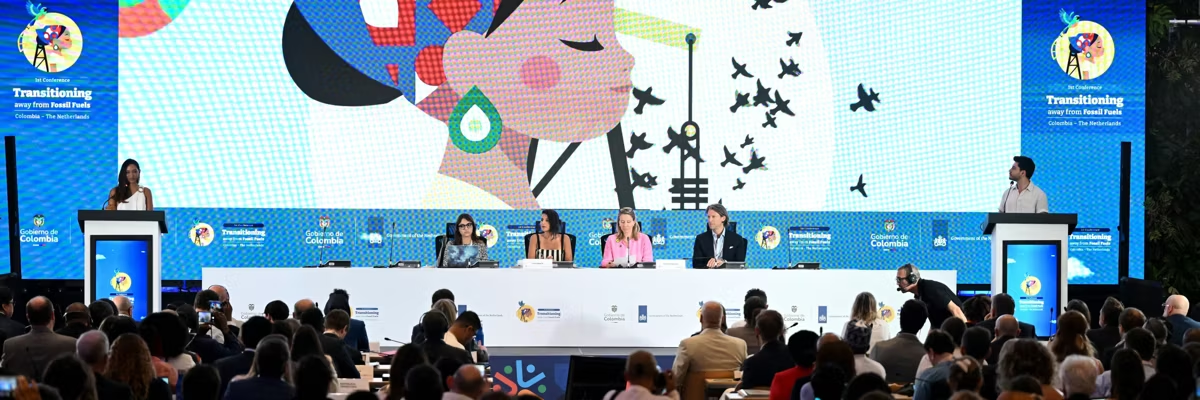
A general view of a plenary session is shown during the International Conference on the Just Transition Away from Fossil Fuels in Santa Marta, Colombia, on April 28, 2026.
A global conference on transitioning away from fossil fuels has coincided with rising gas prices caused by Trump's Iran War, motivating many leaders to embrace renewables. Unfortunately, US policymakers aren't following their example.
Many of the people who’ve been working for years on climate issues assembled this week in Santa Marta, Colombia for a conference on how to get off fossil fuels. Sponsored by the Colombians and the Dutch, it was an outgrowth of December’s unhappy COP negotiations in Brazil: the 50 or so nations that actually wanted to move decisively past coal, gas, and oil scheduled a meeting of their own. By all accounts it was a kinder, gentler version of the regular climate talks, in part because fossil fuel lobbyists (who have become the largest “country” at the regular negotiations) were not welcome. The wonderful Irish diplomat Mary Robinson put it well: “COPs are more formal, negotiators have their lines and they will not cross them and it’s so different here,” she said, adding that participants “have felt more human together.”
By lucky accident, the gathering took on extra meaning because it coincided with President Donald Trump’s absurd misadventure in Iran. All of a sudden there was a new reason, past the destruction of the planet, for getting off fossil fuel: Gas is too damn expensive, assuming you can get it all. What we’ve done in the Strait of Hormuz is one of those accidents that changes history: As the head of the International Energy Agency, the venerable Fatih Birol, said last week:
The vase is broken, the damage is done—it will be very difficult to put the pieces back together. This will have permanent consequences for the global energy markets for years to come.
The pieces of that broken vase are scattered across the planet, especially in Asia and Africa, where fuel prices are soaring and fertilizer made with fossil fuel is suddenly either unavailable or ruinously expensive. As Reuters reported this week:
Agricultural bodies, including the International Grains Council, are already cutting their forecasts for the next harvests. And the United Nations, which is trying to negotiate shipping access for fertiliser through the Gulf, has sounded the alarm over food security in developing nations.
In 2022, after the invasion of Ukraine, high fertiliser costs contributed to exacerbated hunger in poor, import-dependent countries, and analysts say regions like East Africa are again vulnerable.
Australia may offer an early indication of the impact on production of global staples.
In the bread-basket state of Western Australia, one industry group now expects the wheat planting area to drop by 14% as growers shift away from the fertiliser-intensive, low-margin grain.
But the good news, of course, is that these countries are rapidly putting together a new and sturdier vase, this time based on energy from the sun and wind that doesn’t need importing. The Santa Marta conference focused on the financing needed to make this switch work—a very real problem, but in the face of the desperation caused by events in the Mideast those who can are going ahead. As Wing Kuang reported, “Chinese EV manufacturers reported an 82.6% rise in month-on-month sales in March.” As the business pages of the India Times reported yesterday:
Increasing penetration of EVs, especially two- and three-wheelers, and rapid deployment of Battery Electric Solar Systems across Southeast Asia and South Asia is now viewed as guaranteed by those in the industry.
The optimism was palpable at this week's Asia Battery Raw Materials & Recycling Conference in Hanoi, where much of the discussion among delegates was more how the region was going to source sufficient raw materials to make batteries, rather than how to increase demand from current levels.
That all this counts as irony is the one delicious lining to all the pain and suffering. Donald Trump, purchased underling of the fossil fuel industry, has managed through his own colossal incompetence and ego to nip the hand that feeds his bank account. Yes, at the moment the industry is soaring: BP reported the kind of grotesque returns Thursday that should have any rational government reaching for a windfall profits tax:
Maja Darlington, a climate campaigner for Greenpeace UK, said the war had been “an entirely predictable disaster for everyone except the oil industry. BP’s profits are booming, with Trump’s bombs bringing billions for them and bigger bills for us.”
But those billions are in the here and now; in the slightly longer term the opposite is happening. Big Oil’s only real growth strategy has been exporting liquefied natural gas to Asia. Bloomberg checked in the other day on how that’s going:
The near-closure of the Strait of Hormuz and the serious damage sustained by Qatar’s LNG export plant has sent prices higher and buyers scrambling for alternatives. Gas’ reputation as a reliable and affordable energy source has taken a serious hit, and plans for its speedy adoption in Asia’s developing nations have been derailed, with potentially long-lasting consequences.
“Every day this is extended, prices elevate, the market tightens, and demand destruction happens,” said Masanori Odaka, an analyst at Rystad Energy. “The longer this lasts, the more structural it becomes.”
Bloomberg News spoke to more than two dozen executives, traders, and analysts across Asia, who painted a picture of a region that had been thought of as the future of LNG, but is now rapidly losing faith in the super-chilled fuel. Most requested anonymity because they weren’t authorized to speak to media.
Importers in India and Bangladesh are already rethinking whether to keep the fuel as a center piece in future strategies. Countries like Vietnam and the Philippines that were expected to become large growth markets, are looking alternatives. A planned gas power project in Vietnam is looking to switch to wind and solar plus batteries. In Thailand policymakers are pushing for more renewables.
This is an appropriate reaction. Cheap renewable energy had already begun to fuel the remarkable energy transition I’ve been chronicling over the last four years in these pages. Now it’s been supercharged by events, and responsible leaders around the world are drawing the obvious conclusions. As Selwin Hart, the UN’s envoy to the Santa Marta talks, put it in his address to the gathering:
Renewables offer something fossil fuels never did: stability and sovereignty. There are no embargoes, price shocks, or tariffs.
But that’s not been the reaction, of course, in this country, where energy policy just keeps getting stupider. Read, for instance, Elizabeth Kolbert’s masterful takedown of Environmental Protection Agency commissioner Lee Zeldin:
In a little more than a year, Zeldin has transformed the EPA from an agency devoted to protecting human health and the environment into one that, more or less openly, sides with polluters…The EPA has not only abandoned its own efforts to rein in greenhouse-gas emissions; it has stepped in to prevent states from taking action. It has come out officially, if astonishingly, as pro-coal.
But here’s what’s astonishing. The person that Zeldin very nearly beat for governor of New York, Kathy Hochul, has been embarked on an environmental demolition project of her own. At the precise moment that gas prices are soaring, and as a new and supercharged El Niño brings climate concerns back to the center of public consciousness, Hochul is doing her very best to sink New York’s landmark climate law and stick the Empire State with more expensive gas. She’s not showing the policymaking chops of her peers in far poorer places like Pakistan or Bangladesh.
Donald Trump, purchased underling of the fossil fuel industry, has managed through his own colossal incompetence and ego to nip the hand that feeds his bank account.
The background here is long, and like all things in New York politics, opaque. Suffice it to say that New Yorkers passed a reasonably ambitious climate law, and that the governor has not done much to enact it. If you want some background, the redoubtable David Roberts interviewed the equally redoubtable Pete Sikora, who explains:
The governor just took everything that the Climate Action Council came up with—her own appointees—and ignored it. That’s the capsule summary. They didn’t do the policies, they didn’t do the regulations, they didn’t do the things that would have implemented the law. They did a few things here and there, but by and large, nothing that would have implemented the law correctly was done. Little bits and pieces. For example, the state passed ending oil and gas in all new construction. That’s fantastic. That’s really good.
As you pointed out, distributed solar is a real bright spot. The numbers are moving there. It’s good. The CHPE project is about to connect. That’s a big transmission project from Canadian hydropower to New York City. Very cool too. There’s good things happening. But by and large, the long list of things in the climate plan was not done—90% of it not done. The centerpiece was Cap and Invest. The governor pulled that back at the last second the same way she did on congestion pricing. It’s in this weird limbo where it’s paused now.
If you want a comprehensive list of the opportunities she’s missed, try here. Most political pros I’ve talked to—and I talked to some more this week because I was in New York this week to lobby on the state’s solar laws—seem baffled by what Hochul’s up to. She’s not in a tough election fight—after Trump pushed Rep. Elise Stefanik (R-NY) out of the GOP primary she faces only a Zeldin-lite Long Island pol, and in a year when an onion bialy could win in blue New York. My guess is that she’s about a year behind on her talking points; in the wake of Kamala Harris’ loss, a certain kind of moderate Dem decided that “affordability” was the new watchword and brought the idea that talking about climate was a mistake. (Not everyone went along—Gov. JB Pritzker in Illinois, for instance, has kept up the state’s clean energy momentum).
In New York’s case this may have been magnified by the sudden rise of Zohran Mamdani, who talked about affordability—but with a particular set of policies attached to it that made it more than rhetorical. For Hochul, an all-out push for wind and solar and batteries would have been wise since they are in fact affordable, but it was easier to go with the fracked gas lobby. So she’s fast-tracking new pipelines—in essence building the very infrastructure that New Yorkers rejected when they shut down fracking in the state. It’s all a tragic muddle, benefiting only Big Oil. Indeed, as Colin Kinniburgh reported last month:
A national industry group, led by some of the country’s largest pipeline builders and a slew of other gas interests, has recently entered the fray, tapping former state politicians to help advance Gov. Kathy Hochul’s “all of the above” energy strategy. Top of their agenda: pressing pause on the state’s climate targets.
New Yorkers can do a couple of things. One is press their state legislators to resist Hochul’s gutting of the climate law. The other is to lobby those same legislators to pass the ASAP and SUNNY laws, which would at least speed up solar permitting and allow balcony solar in the state.
And all of us can do a better job of demanding real action from our blue state leaders. Because this drift is not confined to New York—in Hawaii, for instance, Democratic Gov. Josh Green has called for a huge new liquefied natural gas project to supply the state’s electricity, ignoring the fact that the Aloha State is bathed in sunlight and washed by the steady trade winds that make it so delightful. Again, this is exactly the opposite tack that leaders across the rest of the world are taking, and in both states it will saddle residents with gas projects for decades to come.
I wrote about “climate-hushing” last week, and decisions like this are the inevitable result—on purely political grounds alone they surrender the high ground on what will be the most important issue of our century. And they surrender the gift that cheap renewables provide to both planet and consumer. They are exactly the opposite of what scientists told the Santa Marta conference was required—an end to new fossil fuel expansion. The next time a climate disaster strikes these states their governors will mouth the usual pieties, but they won’t mean much.
Dear Common Dreams reader, It’s been nearly 30 years since I co-founded Common Dreams with my late wife, Lina Newhouser. We had the radical notion that journalism should serve the public good, not corporate profits. It was clear to us from the outset what it would take to build such a project. No paid advertisements. No corporate sponsors. No millionaire publisher telling us what to think or do. Many people said we wouldn't last a year, but we proved those doubters wrong. Together with a tremendous team of journalists and dedicated staff, we built an independent media outlet free from the constraints of profits and corporate control. Our mission has always been simple: To inform. To inspire. To ignite change for the common good. Building Common Dreams was not easy. Our survival was never guaranteed. When you take on the most powerful forces—Wall Street greed, fossil fuel industry destruction, Big Tech lobbyists, and uber-rich oligarchs who have spent billions upon billions rigging the economy and democracy in their favor—the only bulwark you have is supporters who believe in your work. But here’s the urgent message from me today. It's never been this bad out there. And it's never been this hard to keep us going. At the very moment Common Dreams is most needed, the threats we face are intensifying. We need your support now more than ever. We don't accept corporate advertising and never will. We don't have a paywall because we don't think people should be blocked from critical news based on their ability to pay. Everything we do is funded by the donations of readers like you. When everyone does the little they can afford, we are strong. But if that support retreats or dries up, so do we. Will you donate now to make sure Common Dreams not only survives but thrives? —Craig Brown, Co-founder |
Many of the people who’ve been working for years on climate issues assembled this week in Santa Marta, Colombia for a conference on how to get off fossil fuels. Sponsored by the Colombians and the Dutch, it was an outgrowth of December’s unhappy COP negotiations in Brazil: the 50 or so nations that actually wanted to move decisively past coal, gas, and oil scheduled a meeting of their own. By all accounts it was a kinder, gentler version of the regular climate talks, in part because fossil fuel lobbyists (who have become the largest “country” at the regular negotiations) were not welcome. The wonderful Irish diplomat Mary Robinson put it well: “COPs are more formal, negotiators have their lines and they will not cross them and it’s so different here,” she said, adding that participants “have felt more human together.”
By lucky accident, the gathering took on extra meaning because it coincided with President Donald Trump’s absurd misadventure in Iran. All of a sudden there was a new reason, past the destruction of the planet, for getting off fossil fuel: Gas is too damn expensive, assuming you can get it all. What we’ve done in the Strait of Hormuz is one of those accidents that changes history: As the head of the International Energy Agency, the venerable Fatih Birol, said last week:
The vase is broken, the damage is done—it will be very difficult to put the pieces back together. This will have permanent consequences for the global energy markets for years to come.
The pieces of that broken vase are scattered across the planet, especially in Asia and Africa, where fuel prices are soaring and fertilizer made with fossil fuel is suddenly either unavailable or ruinously expensive. As Reuters reported this week:
Agricultural bodies, including the International Grains Council, are already cutting their forecasts for the next harvests. And the United Nations, which is trying to negotiate shipping access for fertiliser through the Gulf, has sounded the alarm over food security in developing nations.
In 2022, after the invasion of Ukraine, high fertiliser costs contributed to exacerbated hunger in poor, import-dependent countries, and analysts say regions like East Africa are again vulnerable.
Australia may offer an early indication of the impact on production of global staples.
In the bread-basket state of Western Australia, one industry group now expects the wheat planting area to drop by 14% as growers shift away from the fertiliser-intensive, low-margin grain.
But the good news, of course, is that these countries are rapidly putting together a new and sturdier vase, this time based on energy from the sun and wind that doesn’t need importing. The Santa Marta conference focused on the financing needed to make this switch work—a very real problem, but in the face of the desperation caused by events in the Mideast those who can are going ahead. As Wing Kuang reported, “Chinese EV manufacturers reported an 82.6% rise in month-on-month sales in March.” As the business pages of the India Times reported yesterday:
Increasing penetration of EVs, especially two- and three-wheelers, and rapid deployment of Battery Electric Solar Systems across Southeast Asia and South Asia is now viewed as guaranteed by those in the industry.
The optimism was palpable at this week's Asia Battery Raw Materials & Recycling Conference in Hanoi, where much of the discussion among delegates was more how the region was going to source sufficient raw materials to make batteries, rather than how to increase demand from current levels.
That all this counts as irony is the one delicious lining to all the pain and suffering. Donald Trump, purchased underling of the fossil fuel industry, has managed through his own colossal incompetence and ego to nip the hand that feeds his bank account. Yes, at the moment the industry is soaring: BP reported the kind of grotesque returns Thursday that should have any rational government reaching for a windfall profits tax:
Maja Darlington, a climate campaigner for Greenpeace UK, said the war had been “an entirely predictable disaster for everyone except the oil industry. BP’s profits are booming, with Trump’s bombs bringing billions for them and bigger bills for us.”
But those billions are in the here and now; in the slightly longer term the opposite is happening. Big Oil’s only real growth strategy has been exporting liquefied natural gas to Asia. Bloomberg checked in the other day on how that’s going:
The near-closure of the Strait of Hormuz and the serious damage sustained by Qatar’s LNG export plant has sent prices higher and buyers scrambling for alternatives. Gas’ reputation as a reliable and affordable energy source has taken a serious hit, and plans for its speedy adoption in Asia’s developing nations have been derailed, with potentially long-lasting consequences.
“Every day this is extended, prices elevate, the market tightens, and demand destruction happens,” said Masanori Odaka, an analyst at Rystad Energy. “The longer this lasts, the more structural it becomes.”
Bloomberg News spoke to more than two dozen executives, traders, and analysts across Asia, who painted a picture of a region that had been thought of as the future of LNG, but is now rapidly losing faith in the super-chilled fuel. Most requested anonymity because they weren’t authorized to speak to media.
Importers in India and Bangladesh are already rethinking whether to keep the fuel as a center piece in future strategies. Countries like Vietnam and the Philippines that were expected to become large growth markets, are looking alternatives. A planned gas power project in Vietnam is looking to switch to wind and solar plus batteries. In Thailand policymakers are pushing for more renewables.
This is an appropriate reaction. Cheap renewable energy had already begun to fuel the remarkable energy transition I’ve been chronicling over the last four years in these pages. Now it’s been supercharged by events, and responsible leaders around the world are drawing the obvious conclusions. As Selwin Hart, the UN’s envoy to the Santa Marta talks, put it in his address to the gathering:
Renewables offer something fossil fuels never did: stability and sovereignty. There are no embargoes, price shocks, or tariffs.
But that’s not been the reaction, of course, in this country, where energy policy just keeps getting stupider. Read, for instance, Elizabeth Kolbert’s masterful takedown of Environmental Protection Agency commissioner Lee Zeldin:
In a little more than a year, Zeldin has transformed the EPA from an agency devoted to protecting human health and the environment into one that, more or less openly, sides with polluters…The EPA has not only abandoned its own efforts to rein in greenhouse-gas emissions; it has stepped in to prevent states from taking action. It has come out officially, if astonishingly, as pro-coal.
But here’s what’s astonishing. The person that Zeldin very nearly beat for governor of New York, Kathy Hochul, has been embarked on an environmental demolition project of her own. At the precise moment that gas prices are soaring, and as a new and supercharged El Niño brings climate concerns back to the center of public consciousness, Hochul is doing her very best to sink New York’s landmark climate law and stick the Empire State with more expensive gas. She’s not showing the policymaking chops of her peers in far poorer places like Pakistan or Bangladesh.
Donald Trump, purchased underling of the fossil fuel industry, has managed through his own colossal incompetence and ego to nip the hand that feeds his bank account.
The background here is long, and like all things in New York politics, opaque. Suffice it to say that New Yorkers passed a reasonably ambitious climate law, and that the governor has not done much to enact it. If you want some background, the redoubtable David Roberts interviewed the equally redoubtable Pete Sikora, who explains:
The governor just took everything that the Climate Action Council came up with—her own appointees—and ignored it. That’s the capsule summary. They didn’t do the policies, they didn’t do the regulations, they didn’t do the things that would have implemented the law. They did a few things here and there, but by and large, nothing that would have implemented the law correctly was done. Little bits and pieces. For example, the state passed ending oil and gas in all new construction. That’s fantastic. That’s really good.
As you pointed out, distributed solar is a real bright spot. The numbers are moving there. It’s good. The CHPE project is about to connect. That’s a big transmission project from Canadian hydropower to New York City. Very cool too. There’s good things happening. But by and large, the long list of things in the climate plan was not done—90% of it not done. The centerpiece was Cap and Invest. The governor pulled that back at the last second the same way she did on congestion pricing. It’s in this weird limbo where it’s paused now.
If you want a comprehensive list of the opportunities she’s missed, try here. Most political pros I’ve talked to—and I talked to some more this week because I was in New York this week to lobby on the state’s solar laws—seem baffled by what Hochul’s up to. She’s not in a tough election fight—after Trump pushed Rep. Elise Stefanik (R-NY) out of the GOP primary she faces only a Zeldin-lite Long Island pol, and in a year when an onion bialy could win in blue New York. My guess is that she’s about a year behind on her talking points; in the wake of Kamala Harris’ loss, a certain kind of moderate Dem decided that “affordability” was the new watchword and brought the idea that talking about climate was a mistake. (Not everyone went along—Gov. JB Pritzker in Illinois, for instance, has kept up the state’s clean energy momentum).
In New York’s case this may have been magnified by the sudden rise of Zohran Mamdani, who talked about affordability—but with a particular set of policies attached to it that made it more than rhetorical. For Hochul, an all-out push for wind and solar and batteries would have been wise since they are in fact affordable, but it was easier to go with the fracked gas lobby. So she’s fast-tracking new pipelines—in essence building the very infrastructure that New Yorkers rejected when they shut down fracking in the state. It’s all a tragic muddle, benefiting only Big Oil. Indeed, as Colin Kinniburgh reported last month:
A national industry group, led by some of the country’s largest pipeline builders and a slew of other gas interests, has recently entered the fray, tapping former state politicians to help advance Gov. Kathy Hochul’s “all of the above” energy strategy. Top of their agenda: pressing pause on the state’s climate targets.
New Yorkers can do a couple of things. One is press their state legislators to resist Hochul’s gutting of the climate law. The other is to lobby those same legislators to pass the ASAP and SUNNY laws, which would at least speed up solar permitting and allow balcony solar in the state.
And all of us can do a better job of demanding real action from our blue state leaders. Because this drift is not confined to New York—in Hawaii, for instance, Democratic Gov. Josh Green has called for a huge new liquefied natural gas project to supply the state’s electricity, ignoring the fact that the Aloha State is bathed in sunlight and washed by the steady trade winds that make it so delightful. Again, this is exactly the opposite tack that leaders across the rest of the world are taking, and in both states it will saddle residents with gas projects for decades to come.
I wrote about “climate-hushing” last week, and decisions like this are the inevitable result—on purely political grounds alone they surrender the high ground on what will be the most important issue of our century. And they surrender the gift that cheap renewables provide to both planet and consumer. They are exactly the opposite of what scientists told the Santa Marta conference was required—an end to new fossil fuel expansion. The next time a climate disaster strikes these states their governors will mouth the usual pieties, but they won’t mean much.
Many of the people who’ve been working for years on climate issues assembled this week in Santa Marta, Colombia for a conference on how to get off fossil fuels. Sponsored by the Colombians and the Dutch, it was an outgrowth of December’s unhappy COP negotiations in Brazil: the 50 or so nations that actually wanted to move decisively past coal, gas, and oil scheduled a meeting of their own. By all accounts it was a kinder, gentler version of the regular climate talks, in part because fossil fuel lobbyists (who have become the largest “country” at the regular negotiations) were not welcome. The wonderful Irish diplomat Mary Robinson put it well: “COPs are more formal, negotiators have their lines and they will not cross them and it’s so different here,” she said, adding that participants “have felt more human together.”
By lucky accident, the gathering took on extra meaning because it coincided with President Donald Trump’s absurd misadventure in Iran. All of a sudden there was a new reason, past the destruction of the planet, for getting off fossil fuel: Gas is too damn expensive, assuming you can get it all. What we’ve done in the Strait of Hormuz is one of those accidents that changes history: As the head of the International Energy Agency, the venerable Fatih Birol, said last week:
The vase is broken, the damage is done—it will be very difficult to put the pieces back together. This will have permanent consequences for the global energy markets for years to come.
The pieces of that broken vase are scattered across the planet, especially in Asia and Africa, where fuel prices are soaring and fertilizer made with fossil fuel is suddenly either unavailable or ruinously expensive. As Reuters reported this week:
Agricultural bodies, including the International Grains Council, are already cutting their forecasts for the next harvests. And the United Nations, which is trying to negotiate shipping access for fertiliser through the Gulf, has sounded the alarm over food security in developing nations.
In 2022, after the invasion of Ukraine, high fertiliser costs contributed to exacerbated hunger in poor, import-dependent countries, and analysts say regions like East Africa are again vulnerable.
Australia may offer an early indication of the impact on production of global staples.
In the bread-basket state of Western Australia, one industry group now expects the wheat planting area to drop by 14% as growers shift away from the fertiliser-intensive, low-margin grain.
But the good news, of course, is that these countries are rapidly putting together a new and sturdier vase, this time based on energy from the sun and wind that doesn’t need importing. The Santa Marta conference focused on the financing needed to make this switch work—a very real problem, but in the face of the desperation caused by events in the Mideast those who can are going ahead. As Wing Kuang reported, “Chinese EV manufacturers reported an 82.6% rise in month-on-month sales in March.” As the business pages of the India Times reported yesterday:
Increasing penetration of EVs, especially two- and three-wheelers, and rapid deployment of Battery Electric Solar Systems across Southeast Asia and South Asia is now viewed as guaranteed by those in the industry.
The optimism was palpable at this week's Asia Battery Raw Materials & Recycling Conference in Hanoi, where much of the discussion among delegates was more how the region was going to source sufficient raw materials to make batteries, rather than how to increase demand from current levels.
That all this counts as irony is the one delicious lining to all the pain and suffering. Donald Trump, purchased underling of the fossil fuel industry, has managed through his own colossal incompetence and ego to nip the hand that feeds his bank account. Yes, at the moment the industry is soaring: BP reported the kind of grotesque returns Thursday that should have any rational government reaching for a windfall profits tax:
Maja Darlington, a climate campaigner for Greenpeace UK, said the war had been “an entirely predictable disaster for everyone except the oil industry. BP’s profits are booming, with Trump’s bombs bringing billions for them and bigger bills for us.”
But those billions are in the here and now; in the slightly longer term the opposite is happening. Big Oil’s only real growth strategy has been exporting liquefied natural gas to Asia. Bloomberg checked in the other day on how that’s going:
The near-closure of the Strait of Hormuz and the serious damage sustained by Qatar’s LNG export plant has sent prices higher and buyers scrambling for alternatives. Gas’ reputation as a reliable and affordable energy source has taken a serious hit, and plans for its speedy adoption in Asia’s developing nations have been derailed, with potentially long-lasting consequences.
“Every day this is extended, prices elevate, the market tightens, and demand destruction happens,” said Masanori Odaka, an analyst at Rystad Energy. “The longer this lasts, the more structural it becomes.”
Bloomberg News spoke to more than two dozen executives, traders, and analysts across Asia, who painted a picture of a region that had been thought of as the future of LNG, but is now rapidly losing faith in the super-chilled fuel. Most requested anonymity because they weren’t authorized to speak to media.
Importers in India and Bangladesh are already rethinking whether to keep the fuel as a center piece in future strategies. Countries like Vietnam and the Philippines that were expected to become large growth markets, are looking alternatives. A planned gas power project in Vietnam is looking to switch to wind and solar plus batteries. In Thailand policymakers are pushing for more renewables.
This is an appropriate reaction. Cheap renewable energy had already begun to fuel the remarkable energy transition I’ve been chronicling over the last four years in these pages. Now it’s been supercharged by events, and responsible leaders around the world are drawing the obvious conclusions. As Selwin Hart, the UN’s envoy to the Santa Marta talks, put it in his address to the gathering:
Renewables offer something fossil fuels never did: stability and sovereignty. There are no embargoes, price shocks, or tariffs.
But that’s not been the reaction, of course, in this country, where energy policy just keeps getting stupider. Read, for instance, Elizabeth Kolbert’s masterful takedown of Environmental Protection Agency commissioner Lee Zeldin:
In a little more than a year, Zeldin has transformed the EPA from an agency devoted to protecting human health and the environment into one that, more or less openly, sides with polluters…The EPA has not only abandoned its own efforts to rein in greenhouse-gas emissions; it has stepped in to prevent states from taking action. It has come out officially, if astonishingly, as pro-coal.
But here’s what’s astonishing. The person that Zeldin very nearly beat for governor of New York, Kathy Hochul, has been embarked on an environmental demolition project of her own. At the precise moment that gas prices are soaring, and as a new and supercharged El Niño brings climate concerns back to the center of public consciousness, Hochul is doing her very best to sink New York’s landmark climate law and stick the Empire State with more expensive gas. She’s not showing the policymaking chops of her peers in far poorer places like Pakistan or Bangladesh.
Donald Trump, purchased underling of the fossil fuel industry, has managed through his own colossal incompetence and ego to nip the hand that feeds his bank account.
The background here is long, and like all things in New York politics, opaque. Suffice it to say that New Yorkers passed a reasonably ambitious climate law, and that the governor has not done much to enact it. If you want some background, the redoubtable David Roberts interviewed the equally redoubtable Pete Sikora, who explains:
The governor just took everything that the Climate Action Council came up with—her own appointees—and ignored it. That’s the capsule summary. They didn’t do the policies, they didn’t do the regulations, they didn’t do the things that would have implemented the law. They did a few things here and there, but by and large, nothing that would have implemented the law correctly was done. Little bits and pieces. For example, the state passed ending oil and gas in all new construction. That’s fantastic. That’s really good.
As you pointed out, distributed solar is a real bright spot. The numbers are moving there. It’s good. The CHPE project is about to connect. That’s a big transmission project from Canadian hydropower to New York City. Very cool too. There’s good things happening. But by and large, the long list of things in the climate plan was not done—90% of it not done. The centerpiece was Cap and Invest. The governor pulled that back at the last second the same way she did on congestion pricing. It’s in this weird limbo where it’s paused now.
If you want a comprehensive list of the opportunities she’s missed, try here. Most political pros I’ve talked to—and I talked to some more this week because I was in New York this week to lobby on the state’s solar laws—seem baffled by what Hochul’s up to. She’s not in a tough election fight—after Trump pushed Rep. Elise Stefanik (R-NY) out of the GOP primary she faces only a Zeldin-lite Long Island pol, and in a year when an onion bialy could win in blue New York. My guess is that she’s about a year behind on her talking points; in the wake of Kamala Harris’ loss, a certain kind of moderate Dem decided that “affordability” was the new watchword and brought the idea that talking about climate was a mistake. (Not everyone went along—Gov. JB Pritzker in Illinois, for instance, has kept up the state’s clean energy momentum).
In New York’s case this may have been magnified by the sudden rise of Zohran Mamdani, who talked about affordability—but with a particular set of policies attached to it that made it more than rhetorical. For Hochul, an all-out push for wind and solar and batteries would have been wise since they are in fact affordable, but it was easier to go with the fracked gas lobby. So she’s fast-tracking new pipelines—in essence building the very infrastructure that New Yorkers rejected when they shut down fracking in the state. It’s all a tragic muddle, benefiting only Big Oil. Indeed, as Colin Kinniburgh reported last month:
A national industry group, led by some of the country’s largest pipeline builders and a slew of other gas interests, has recently entered the fray, tapping former state politicians to help advance Gov. Kathy Hochul’s “all of the above” energy strategy. Top of their agenda: pressing pause on the state’s climate targets.
New Yorkers can do a couple of things. One is press their state legislators to resist Hochul’s gutting of the climate law. The other is to lobby those same legislators to pass the ASAP and SUNNY laws, which would at least speed up solar permitting and allow balcony solar in the state.
And all of us can do a better job of demanding real action from our blue state leaders. Because this drift is not confined to New York—in Hawaii, for instance, Democratic Gov. Josh Green has called for a huge new liquefied natural gas project to supply the state’s electricity, ignoring the fact that the Aloha State is bathed in sunlight and washed by the steady trade winds that make it so delightful. Again, this is exactly the opposite tack that leaders across the rest of the world are taking, and in both states it will saddle residents with gas projects for decades to come.
I wrote about “climate-hushing” last week, and decisions like this are the inevitable result—on purely political grounds alone they surrender the high ground on what will be the most important issue of our century. And they surrender the gift that cheap renewables provide to both planet and consumer. They are exactly the opposite of what scientists told the Santa Marta conference was required—an end to new fossil fuel expansion. The next time a climate disaster strikes these states their governors will mouth the usual pieties, but they won’t mean much.