SUBSCRIBE TO OUR FREE NEWSLETTER
Daily news & progressive opinion—funded by the people, not the corporations—delivered straight to your inbox.
5
#000000
#FFFFFF
To donate by check, phone, or other method, see our More Ways to Give page.
Daily news & progressive opinion—funded by the people, not the corporations—delivered straight to your inbox.
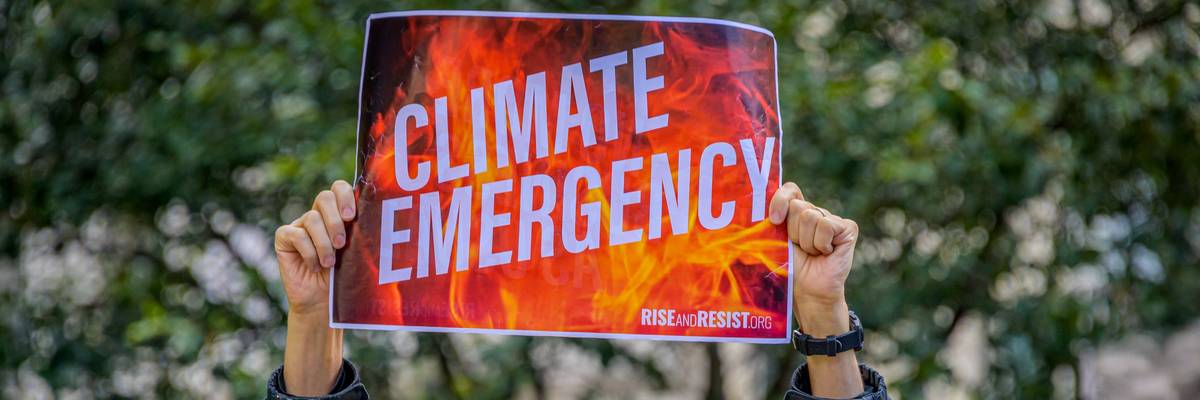
Participant holding a sign at the climate march. A coalition of climate, Indigenous and racial justice groups gathered at Columbus Circle to kick off Climate Week with the Climate Justice Through Racial Justice march.
It is easy to lose hope for combating the climate crisis in times like these. But while the US government has relinquished its leadership, others are stepping forward.
It can feel like a lifetime ago, but I grew up in an era of hope for combating the climate crisis. It was an era filled with energy to fight against fossil fuels—and leaders who seemed like they might finally listen to us. An era in which a livable future for all of us seemed almost feasible.
I’ve been organizing climate strikes since I was 12.
I began by protesting outside Brooklyn Borough Hall, not far from my house in Brooklyn, New York. Then I started attending meetings with Fridays For Future NYC, the New York City chapter of Greta Thunberg’s organization. I quickly became enraptured with the energy of the youth climate movement. Through it, I met some of my best friends, as we organized six strikes together in middle and high school.
In my senior year of high school, I was a core organizer for the March To End Fossil Fuels, a 70,000 person march in September 2023, that brought together a diverse cast of organizers—from the Center for Biological Diversity to the NAACP. I felt lucky to be a part of such a massive effort.
The United States may not be there, but Canada, Australia, and Brazil, among other countries, will be.
Actually phasing out fossil fuels, a topic older organizers told me had once been fringe, was now in the front and center of New York City streets and on the front page of The New York Times. By the end of 2023, I was Fridays For Future’s North American Delegate to COP28 in Dubai, an international climate conference that zeroed in on fossil fuels. It was all anyone was talking about, from grassroots organizers to the US negotiators.
Other fossil fuel phaseout activists and I were actually able to meet multiple times with the lead negotiators for the US, Trigg Talley and Sue Biniaz. The negotiators seemed receptive to adopting fossil fuel phaseout language in the COP28 Global Stocktake Text. We didn’t achieve that, but the phrase “transition away from fossil fuels” did appear in the final text. It was the first time the words “fossil fuels” had ever been included in the final text in the history of COPs.
When we got home from COP28, we were able to meet with John Podesta, who was then President Joe Biden’s top climate advisor. We urged him against allowing the construction of the CP2 liquefied natural gas (LNG) export terminal. Biden announced a pause on pending decisions for new LNG export projects, including CP2, on January 26, 2024. Finally, it felt like we were winning.
Looking at the news today, that era feels so far away.
Trump administration officials recently gathered in my hometown of Brooklyn to announce their plan to swiftly construct a $1 billion natural gas pipeline in New Jersey and New York Harbor. Construction on CP2 began this past June, and the Trump administration has pulled out of the Paris Agreement. While I still attended COP30 this past year in Belem, Brazil, the US federal government did not send a single negotiator, much less a delegation.
It is easy to lose hope for combating the climate crisis in times like these. But while the US government has relinquished its leadership, others are stepping forward.
In late April, Colombia and the Netherlands are convening the first-ever Conference on Transitioning Away from Fossil Fuels in Santa Marta, Colombia. This will be the biggest step away from fossil fuels we’ve seen since the March to End Fossil Fuels.
The United States may not be there, but Canada, Australia, and Brazil, among other countries, will be. This is a crucial first step toward formal Fossil Fuel Treaty negotiations, and it is just the beginning of Fossil Fuel phaseout policy becoming the center of attention again.
We need a fast, fair, fossil fuel phaseout—and I have hope for it now, because of Santa Marta.
Dear Common Dreams reader, It’s been nearly 30 years since I co-founded Common Dreams with my late wife, Lina Newhouser. We had the radical notion that journalism should serve the public good, not corporate profits. It was clear to us from the outset what it would take to build such a project. No paid advertisements. No corporate sponsors. No millionaire publisher telling us what to think or do. Many people said we wouldn't last a year, but we proved those doubters wrong. Together with a tremendous team of journalists and dedicated staff, we built an independent media outlet free from the constraints of profits and corporate control. Our mission has always been simple: To inform. To inspire. To ignite change for the common good. Building Common Dreams was not easy. Our survival was never guaranteed. When you take on the most powerful forces—Wall Street greed, fossil fuel industry destruction, Big Tech lobbyists, and uber-rich oligarchs who have spent billions upon billions rigging the economy and democracy in their favor—the only bulwark you have is supporters who believe in your work. But here’s the urgent message from me today. It's never been this bad out there. And it's never been this hard to keep us going. At the very moment Common Dreams is most needed, the threats we face are intensifying. We need your support now more than ever. We don't accept corporate advertising and never will. We don't have a paywall because we don't think people should be blocked from critical news based on their ability to pay. Everything we do is funded by the donations of readers like you. When everyone does the little they can afford, we are strong. But if that support retreats or dries up, so do we. Will you donate now to make sure Common Dreams not only survives but thrives? —Craig Brown, Co-founder |
It can feel like a lifetime ago, but I grew up in an era of hope for combating the climate crisis. It was an era filled with energy to fight against fossil fuels—and leaders who seemed like they might finally listen to us. An era in which a livable future for all of us seemed almost feasible.
I’ve been organizing climate strikes since I was 12.
I began by protesting outside Brooklyn Borough Hall, not far from my house in Brooklyn, New York. Then I started attending meetings with Fridays For Future NYC, the New York City chapter of Greta Thunberg’s organization. I quickly became enraptured with the energy of the youth climate movement. Through it, I met some of my best friends, as we organized six strikes together in middle and high school.
In my senior year of high school, I was a core organizer for the March To End Fossil Fuels, a 70,000 person march in September 2023, that brought together a diverse cast of organizers—from the Center for Biological Diversity to the NAACP. I felt lucky to be a part of such a massive effort.
The United States may not be there, but Canada, Australia, and Brazil, among other countries, will be.
Actually phasing out fossil fuels, a topic older organizers told me had once been fringe, was now in the front and center of New York City streets and on the front page of The New York Times. By the end of 2023, I was Fridays For Future’s North American Delegate to COP28 in Dubai, an international climate conference that zeroed in on fossil fuels. It was all anyone was talking about, from grassroots organizers to the US negotiators.
Other fossil fuel phaseout activists and I were actually able to meet multiple times with the lead negotiators for the US, Trigg Talley and Sue Biniaz. The negotiators seemed receptive to adopting fossil fuel phaseout language in the COP28 Global Stocktake Text. We didn’t achieve that, but the phrase “transition away from fossil fuels” did appear in the final text. It was the first time the words “fossil fuels” had ever been included in the final text in the history of COPs.
When we got home from COP28, we were able to meet with John Podesta, who was then President Joe Biden’s top climate advisor. We urged him against allowing the construction of the CP2 liquefied natural gas (LNG) export terminal. Biden announced a pause on pending decisions for new LNG export projects, including CP2, on January 26, 2024. Finally, it felt like we were winning.
Looking at the news today, that era feels so far away.
Trump administration officials recently gathered in my hometown of Brooklyn to announce their plan to swiftly construct a $1 billion natural gas pipeline in New Jersey and New York Harbor. Construction on CP2 began this past June, and the Trump administration has pulled out of the Paris Agreement. While I still attended COP30 this past year in Belem, Brazil, the US federal government did not send a single negotiator, much less a delegation.
It is easy to lose hope for combating the climate crisis in times like these. But while the US government has relinquished its leadership, others are stepping forward.
In late April, Colombia and the Netherlands are convening the first-ever Conference on Transitioning Away from Fossil Fuels in Santa Marta, Colombia. This will be the biggest step away from fossil fuels we’ve seen since the March to End Fossil Fuels.
The United States may not be there, but Canada, Australia, and Brazil, among other countries, will be. This is a crucial first step toward formal Fossil Fuel Treaty negotiations, and it is just the beginning of Fossil Fuel phaseout policy becoming the center of attention again.
We need a fast, fair, fossil fuel phaseout—and I have hope for it now, because of Santa Marta.
It can feel like a lifetime ago, but I grew up in an era of hope for combating the climate crisis. It was an era filled with energy to fight against fossil fuels—and leaders who seemed like they might finally listen to us. An era in which a livable future for all of us seemed almost feasible.
I’ve been organizing climate strikes since I was 12.
I began by protesting outside Brooklyn Borough Hall, not far from my house in Brooklyn, New York. Then I started attending meetings with Fridays For Future NYC, the New York City chapter of Greta Thunberg’s organization. I quickly became enraptured with the energy of the youth climate movement. Through it, I met some of my best friends, as we organized six strikes together in middle and high school.
In my senior year of high school, I was a core organizer for the March To End Fossil Fuels, a 70,000 person march in September 2023, that brought together a diverse cast of organizers—from the Center for Biological Diversity to the NAACP. I felt lucky to be a part of such a massive effort.
The United States may not be there, but Canada, Australia, and Brazil, among other countries, will be.
Actually phasing out fossil fuels, a topic older organizers told me had once been fringe, was now in the front and center of New York City streets and on the front page of The New York Times. By the end of 2023, I was Fridays For Future’s North American Delegate to COP28 in Dubai, an international climate conference that zeroed in on fossil fuels. It was all anyone was talking about, from grassroots organizers to the US negotiators.
Other fossil fuel phaseout activists and I were actually able to meet multiple times with the lead negotiators for the US, Trigg Talley and Sue Biniaz. The negotiators seemed receptive to adopting fossil fuel phaseout language in the COP28 Global Stocktake Text. We didn’t achieve that, but the phrase “transition away from fossil fuels” did appear in the final text. It was the first time the words “fossil fuels” had ever been included in the final text in the history of COPs.
When we got home from COP28, we were able to meet with John Podesta, who was then President Joe Biden’s top climate advisor. We urged him against allowing the construction of the CP2 liquefied natural gas (LNG) export terminal. Biden announced a pause on pending decisions for new LNG export projects, including CP2, on January 26, 2024. Finally, it felt like we were winning.
Looking at the news today, that era feels so far away.
Trump administration officials recently gathered in my hometown of Brooklyn to announce their plan to swiftly construct a $1 billion natural gas pipeline in New Jersey and New York Harbor. Construction on CP2 began this past June, and the Trump administration has pulled out of the Paris Agreement. While I still attended COP30 this past year in Belem, Brazil, the US federal government did not send a single negotiator, much less a delegation.
It is easy to lose hope for combating the climate crisis in times like these. But while the US government has relinquished its leadership, others are stepping forward.
In late April, Colombia and the Netherlands are convening the first-ever Conference on Transitioning Away from Fossil Fuels in Santa Marta, Colombia. This will be the biggest step away from fossil fuels we’ve seen since the March to End Fossil Fuels.
The United States may not be there, but Canada, Australia, and Brazil, among other countries, will be. This is a crucial first step toward formal Fossil Fuel Treaty negotiations, and it is just the beginning of Fossil Fuel phaseout policy becoming the center of attention again.
We need a fast, fair, fossil fuel phaseout—and I have hope for it now, because of Santa Marta.