

5
#000000
#FFFFFF
To donate by check, phone, or other method, see our More Ways to Give page.
Daily news & progressive opinion—funded by the people, not the corporations—delivered straight to your inbox.
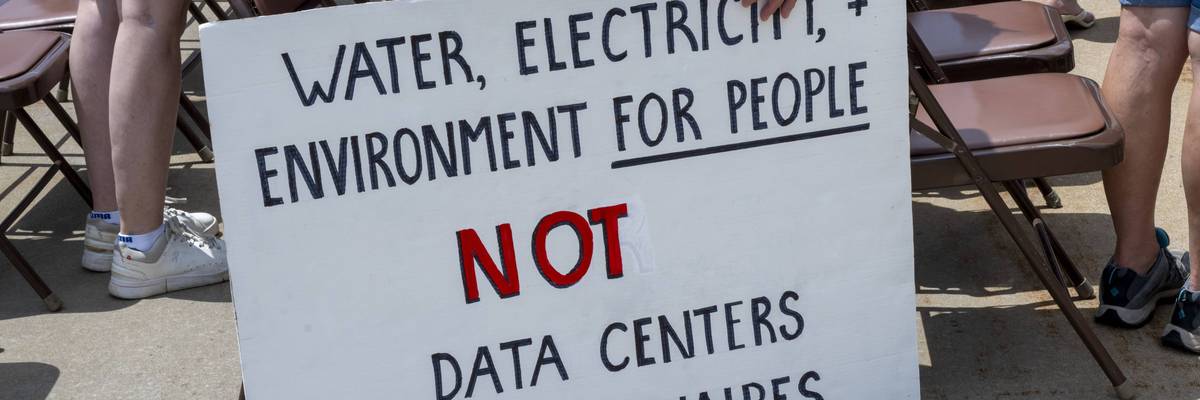
A demonstrator holds a sign at the Mother Earth Vs Big Tech Petition rally in Saint Paul, Minnesota.
As 200 countries meet at COP31 in Türkiye to discuss reducing greenhouse gases, a serious new menace is driving carbon emissions sharply higher—AI data centers.
Recent US polling indicates that data centers are massively unpopular, with 75% saying they wouldn’t want one in their neighborhood. As shown below, the reasons are compelling.
To support data centers, “tech firms are driving construction of new generation supersized, gas-fired power plants that could lock in hundreds of millions of tons of climate pollution for decades to come,” explains The Washington Post. “It’s a disaster from a climate perspective… We’re seeing more and more of them, with no end in sight.”
For example, Meta bought 3,650 acres of land in Louisiana, the equivalent of 2,700 football fields, to build an AI complex so large it’s 10 power plants could power 5 million homes.
Data center superclusters being built today are on a scale unimaginable a few years ago, and it’s unclear where all the energy will come from.
The federal Energy Information Administration reports that proposals for grid-connected natural gas power plants for data centers have virtually tripled since early 2023 and increased by almost half in the last eight months: “The trend toward more power production from fossil fuels is a reversal from decades of progress toward a cleaner grid.”
Burning gas in power plants creates unhealthy air pollution; extraction of gas from the ground and its transport by pipelines threaten water quality and wildlife, with both natural gas production and combustion contributing to global warming. By 2030, if grid and off-grid gas plants (those built only for the data centers) are combined, they could increase power emissions by 20%.
Moreover, “Methane leaks from the drilling, processing, and transportation of natural gas are a significant contributor to climate change (packing a per-ton warming impact 34 times greater than carbon dioxide).” Clearing land for well pads, roads, and pipelines strip vegetation, create soil erosion, and disrupt wildlife corridors, while fracking for natural gas pollutes water.
Data center superclusters being built today are on a scale unimaginable a few years ago, and it’s unclear where all the energy will come from. In addition, “The data center boom is putting severe strain on efforts to move the country toward renewable energy sources, often by prolonging the use of fossil fuel plants that have been slated for closure.”
A study of 6,000 data centers shows that they also generate “heat islands,” which warm the land around them by an average of 3.6°F, and up to 16°F in some cases. Temperature increases extended to 6.2 miles—affecting more than 340 million people. This is a concern since AI centers are expected to boom over the next few years and climate change is already making heatwaves more frequent and extreme.
Another overlooked factor is the minerals and metals required for semiconductors and data storage components: “Mining for these raw materials, often in the Global South, is linked to air and water pollution, deforestation, human health risks, and climate pollution.”
Burning natural gas also creates “nitrogen oxides that contribute to ozone ‘smog’ as well as particulate matter that harms human health.” Some of this pollution travels hundreds of miles, degrading air quality downwind.
“Air pollution from gas-fired power plants to run data centers is expected to add at least $20 billion in annual healthcare costs by 2028.” Under the Trump administration, however, the Environmental Protection Agency and other government agencies have significantly weakened safeguards that protect people from pollution.
Electronic waste from data centers is another issue: “The ongoing campaign to build thousands of massive data centers for AI will create a tsunami of discarded electronics, putting the world on a course to triple its annual toxic e-waste in the next 25 years.” This electronic trash would fill enough shipping containers to encircle the globe six times. Yet there is no plan to deal with this waste, which contains toxins like lead, mercury, cadmium, and forever chemicals. Some electronic waste is dumped overseas, but most is added to domestic landfills, leaching toxic waste into water and soil.
Training the initial version of ChatGPT is estimated to have required 185,000 gallons of water, and every extended conversation with a chatbot or email we ask it to write is equivalent to us pouring a bottle of water down the drain.
To make matters worse, the heavy racks of computer servers, switches, and miles of cables aren’t designed for repair and reuse, and require replacement every two to five years, leading to an estimated 13 million metric tons of waste per year. As data centers proliferate, so will the tons of waste.
Per- and polyfluoroalkyl substances (PFAS) are also an issue: “PFA companies are launching a ‘tidal wave’ of forever chemicals production to meet demand from the AI industry.” PFAS are increasingly used for a new form of data center cooling, “touted as more water- and energy-efficient.” In “two-phase immersion cooling,” servers are immersed in a pool of PFAS with a low boiling point. As the hardware gets hot, the fluid boils, drawing heat away as vapor. Research has linked PFAS to cancer, liver disease, kidney disorders, high cholesterol, and birth defects and they are found in the blood of nearly every living person.
For those living in the same community as a data center, water consumption is another major problem, especially when water is scarce. As Paris Marx explains in his recent book, Hyperscale: The Ambition and Excess of Big Tech’s Data Empires: “The United States has the largest number of data centers of any country in the world. They’re among the top 10 most water-consuming industries in the country, and two-thirds of the new data centers that were built or began development between 2022 and early 2025 were in parts of the country already experiencing high levels of water stress.”
Water is used to cool servers—with air-conditioning used in smaller centers, while larger facilities typically employ evaporative cooling. Water from an aquifer or water reserve is piped into the building and run along the servers which warm the water until it turns to steam. Most is lost to evaporation, with about 20% deposited as wastewater, containing high levels of minerals and salt, making it non-potable.
In essence, everything is being pushed aside to please the tech companies.
Data centers require clean water to ensure their equipment and pipes are not damaged, so they compete with communities for the potable water supply. A hyperscale data center can suck between “1 and 5 million gallons of water a day, comparable to the amount used by a city of 10 thousand to 50 thousand people.” When companies cluster data centers together, demands on reservoirs are staggering.
Training the initial version of ChatGPT is estimated to have required 185,000 gallons of water, and every extended conversation with a chatbot or email we ask it to write is equivalent to us pouring a bottle of water down the drain.
Many data centers are near residential areas and have a real effect on people where they live. Approximately 42% of US adults live within five miles of an existing or planned data center: “That means that inhabitants have to deal with tremors through their homes during the construction period followed by the incessant hum of air-conditioning units once they’re up and running. Some have to contend with bright lights that stay on all night to illuminate the exteriors of the facilities.”
“These systems, and the noise disturbances, run continuously and are even louder on hot days when extra cooling is required.” The noise leads to emotional distress and lower property values.
This huge amount of electricity generation also leads to an increasing number of high-voltage power lines that transport electricity atop towering steel pylons alongside freeways or through communities. No one wants these ugly structures in their view or crossing their land.
Moreover, data centers are creating competition for land for other commercial uses and housing. In essence, everything is being pushed aside to please the tech companies.
Marx recounts the process by which data centers are imposed on local communities: “Major tech companies often use shell companies to hide their involvement in a data center project until it’s too late for locals to stop them. Those shell companies are designed to keep the spotlight off secret negotiations that happen between the companies behind the data centers and the governments of the jurisdictions where they want to locate.” In many cases, companies ask local officials to sign non-disclosure agreements to keep the negotiations quiet.
It’s not always easy to know when a data center will be built or who is behind it until it starts rising out of the ground. In Grand Rapids, Michigan, residents learned a new data center was planned and that local leaders were moving fast to rezone, but no one would reveal which company would run it. After many angry residents crowded into a planning commission meeting, officials were forced to put the project on ice—and only then did Microsoft come out from behind the curtain to reveal itself.
Although over 1,000 people may be employed to build a center, once completed, employment typically drops to a few dozen to maintain it.
When the public becomes aware that a data center is to be built, it often causes conflict between those who support the idea and those who oppose it, leading to long-lasting hard feelings among neighbors.
Typically, companies scout out jurisdictions where there are significant tax breaks or other financial incentives: “The lack of state income tax is an attractive sweetener for companies, but they also seek out sales tax exemptions, property tax abatements at the local level, and any other tax credits or subsidies they can get their hands on.” In fact, 38 states have laws that provide tax incentives for data centers and 21 don’t report the total value of these tax breaks.
Local officials also think data centers will create more jobs than they do. Although over 1,000 people may be employed to build a center, once completed, employment typically drops to a few dozen to maintain it.
The Harvard Gazette concludes: “Unfortunately, there’s just very little economic development that plays out on the local level. There is some tax revenue, but even that is reduced because of tax break policies.” This ends up benefiting the AI industry and depriving the local community of public funds for infrastructure, schools, and healthcare.
As of October 2026, there are 13,030 active data centers in 181 countries. Demand is predicted to nearly triple by 2030 and, between now and 2030, companies are expected to invest nearly $7 trillion in building and upgrading them. Data centers on average cover 100,000 square feet, but hyperscale centers can be as large as 10 million square feet. As the scale, capacity, and value of data centers grow exponentially, the consequences for cities and towns increase accordingly.
The release of ChatGPT in November 2022 forced the industry into overdrive. ChatGPT and the generative artificial intelligence applications that came after it require immense amounts of computation. In fact, “the giants of Silicon Valley have been continually making the digital services we depend on more computationally intensive for years… their ambition to add advanced AI tools into every facet of our lives has necessitated a massive, global buildout of hyperscale data centers, costing them hundreds of billions of dollars with every passing year.”
We can decide that we already have too many data centers and lobby our local governments, state legislatures, and governors, as well as Congress, to impose a moratorium on data center development.
Amazon, Microsoft, and Google control 59% of the hyperscale data centers around the world: “They’ve cast their climate targets aside in the pursuit of AI-fueled growth and have no interest in acknowledging the social harm caused by the rapid proliferation of technologies known to generate false information and designed to keep users engaged at all costs.”
Given the backlash to data centers, the Trump administration has made an “aggressive push to find public lands to use for building artificial intelligence data centers.” The US Department of the Interior has pushed the Bureau of Land Management to “identify public land ripe for data center development” and provide lists to department leadership.
Frustration with data centers has been growing in the US and around the world. When data center construction ramped up in 2024-25, people began to feel the effects—and as more information became available on water use, electricity demands, and increased prices, “people were finally waking up to what was going on around them.”
“In the first three months of 2026, local or political opposition was credited with blocking 75 data center projects worth about $130 billion.” In July 2026, New York became the first state to issue a moratorium on hyperscale data centers, announcing that the state would pause permits to spend time developing a framework to protect the energy grid, the environment, and the citizens of New York.
The results of the recent election in the US are a clear demonstration of what we can collectively accomplish if we join together to make a difference. We must act on this issue and act quickly.
As reported in Common Dreams, data centers were a major factor in the outcome of the midterms: “The results of both ballot initiatives and legislative elections Tuesday night underscored what numerous polls have shown for months... Americans don’t want data centers in their communities and are demanding that Big Tech, including artificial intelligence companies, be reined in… In all, communities across the US passed 43 out of 44 initiatives that proposed banning or pausing construction on data centers or infrastructure of a certain size.”
“It’s been impressive just how well communities have organized around this, how educated they have gotten about the topic, and how many of these projects they have been able to stop," wrote Liz Mineo of The Harvard Gazette. "It’s a David and Goliath fight; local communities are pushing back against some of the wealthiest companies in the world.”
As Environment America contends:
Ultimately, we face a fundamental choice: Will we allow tech companies and utilities to commit us to decades of fossil fuel reliance, or will we demand a cleaner and more sustainable path. The current scale and speed of data center buildout is fundamentally incompatible with protecting our climate and achieving clean air and water for all Americans—especially if it is powered largely with dirty fossil fuels… Delaying the retirement of polluting coal-fired power plants, rapidly building out new natural gas power capacity, and slowing the growth of renewables—all of which is happening now—puts our health, our planet and future generations at risk.
Marx warns: “For several decades, we’ve sat back and allowed the billionaires of Silicon Valley to chart our collective future. If we don’t take back the wheel soon, there may not be a future left to chart.”
Hopefully, when the new US Congress is seated on January 3, it will give immediate consideration to regulating AI data centers—given their existential threat to the climate and the intense public backlash. One concern is that those in Congress may struggle to understand the complexities of AI. Fortunately, organizations such as Americans for Responsible Innovation, which focus on governance related to AI and advancing bipartisan legislation, should be able to assist.
We in the public can also act. We can refrain from investing in AI companies that are behind the massive buildout of data centers. If we’ve been AI users ourselves without thinking through the extensive power demands of our usage, we can make a decision to discontinue that use in favor of preserving the environment. We can join with others in our communities to work toward a more sustainable future where continued data center development is not a given and where regulation can be adopted and applied to those that already exist to limit the extensive damage they’re already causing. We can decide that we already have too many data centers and lobby our local governments, state legislatures, and governors, as well as Congress, to impose a moratorium on data center development.
The results of the recent election in the US are a clear demonstration of what we can collectively accomplish if we join together to make a difference. We must act on this issue and act quickly. This is too important to ignore.
This country and this world are at a monumental crossroads. US voters have an opportunity to beat back the forces of fascism and confront the billionaires who are rigging the economy, our media system, and our democracy, making it increasingly impossible for ordinary people to get by. We’re not just talking about the election. We’re talking about what must be done once these fascist elements are vanquished from power. We need a bolder set of solutions than what either major party has so far been willing to offer and a working-class movement ready to fight like hell for it. Trump didn't emerge from nowhere. The conditions that fueled MAGA authoritarianism were created by decades of radical neoliberal economic policies and a corrupt political system dominated by corporate interests. They slashed taxes on the super-rich, promising that the benefits would trickle down. They said giveaways to the corporate titans would make life more affordable for the rest of us. It was all bullshit. And when a bitter, betrayed populace searches for someone to blame, right-wing demagogues have little trouble finding scapegoats. People know when they're being lied to, but you won't hear any of this from the corporate media. Only independent journalism—powered and funded by people who believe in building a better world—can deliver truly trustworthy daily news. If you share our vision, please contribute whatever you can to sustain our work. |
Recent US polling indicates that data centers are massively unpopular, with 75% saying they wouldn’t want one in their neighborhood. As shown below, the reasons are compelling.
To support data centers, “tech firms are driving construction of new generation supersized, gas-fired power plants that could lock in hundreds of millions of tons of climate pollution for decades to come,” explains The Washington Post. “It’s a disaster from a climate perspective… We’re seeing more and more of them, with no end in sight.”
For example, Meta bought 3,650 acres of land in Louisiana, the equivalent of 2,700 football fields, to build an AI complex so large it’s 10 power plants could power 5 million homes.
Data center superclusters being built today are on a scale unimaginable a few years ago, and it’s unclear where all the energy will come from.
The federal Energy Information Administration reports that proposals for grid-connected natural gas power plants for data centers have virtually tripled since early 2023 and increased by almost half in the last eight months: “The trend toward more power production from fossil fuels is a reversal from decades of progress toward a cleaner grid.”
Burning gas in power plants creates unhealthy air pollution; extraction of gas from the ground and its transport by pipelines threaten water quality and wildlife, with both natural gas production and combustion contributing to global warming. By 2030, if grid and off-grid gas plants (those built only for the data centers) are combined, they could increase power emissions by 20%.
Moreover, “Methane leaks from the drilling, processing, and transportation of natural gas are a significant contributor to climate change (packing a per-ton warming impact 34 times greater than carbon dioxide).” Clearing land for well pads, roads, and pipelines strip vegetation, create soil erosion, and disrupt wildlife corridors, while fracking for natural gas pollutes water.
Data center superclusters being built today are on a scale unimaginable a few years ago, and it’s unclear where all the energy will come from. In addition, “The data center boom is putting severe strain on efforts to move the country toward renewable energy sources, often by prolonging the use of fossil fuel plants that have been slated for closure.”
A study of 6,000 data centers shows that they also generate “heat islands,” which warm the land around them by an average of 3.6°F, and up to 16°F in some cases. Temperature increases extended to 6.2 miles—affecting more than 340 million people. This is a concern since AI centers are expected to boom over the next few years and climate change is already making heatwaves more frequent and extreme.
Another overlooked factor is the minerals and metals required for semiconductors and data storage components: “Mining for these raw materials, often in the Global South, is linked to air and water pollution, deforestation, human health risks, and climate pollution.”
Burning natural gas also creates “nitrogen oxides that contribute to ozone ‘smog’ as well as particulate matter that harms human health.” Some of this pollution travels hundreds of miles, degrading air quality downwind.
“Air pollution from gas-fired power plants to run data centers is expected to add at least $20 billion in annual healthcare costs by 2028.” Under the Trump administration, however, the Environmental Protection Agency and other government agencies have significantly weakened safeguards that protect people from pollution.
Electronic waste from data centers is another issue: “The ongoing campaign to build thousands of massive data centers for AI will create a tsunami of discarded electronics, putting the world on a course to triple its annual toxic e-waste in the next 25 years.” This electronic trash would fill enough shipping containers to encircle the globe six times. Yet there is no plan to deal with this waste, which contains toxins like lead, mercury, cadmium, and forever chemicals. Some electronic waste is dumped overseas, but most is added to domestic landfills, leaching toxic waste into water and soil.
Training the initial version of ChatGPT is estimated to have required 185,000 gallons of water, and every extended conversation with a chatbot or email we ask it to write is equivalent to us pouring a bottle of water down the drain.
To make matters worse, the heavy racks of computer servers, switches, and miles of cables aren’t designed for repair and reuse, and require replacement every two to five years, leading to an estimated 13 million metric tons of waste per year. As data centers proliferate, so will the tons of waste.
Per- and polyfluoroalkyl substances (PFAS) are also an issue: “PFA companies are launching a ‘tidal wave’ of forever chemicals production to meet demand from the AI industry.” PFAS are increasingly used for a new form of data center cooling, “touted as more water- and energy-efficient.” In “two-phase immersion cooling,” servers are immersed in a pool of PFAS with a low boiling point. As the hardware gets hot, the fluid boils, drawing heat away as vapor. Research has linked PFAS to cancer, liver disease, kidney disorders, high cholesterol, and birth defects and they are found in the blood of nearly every living person.
For those living in the same community as a data center, water consumption is another major problem, especially when water is scarce. As Paris Marx explains in his recent book, Hyperscale: The Ambition and Excess of Big Tech’s Data Empires: “The United States has the largest number of data centers of any country in the world. They’re among the top 10 most water-consuming industries in the country, and two-thirds of the new data centers that were built or began development between 2022 and early 2025 were in parts of the country already experiencing high levels of water stress.”
Water is used to cool servers—with air-conditioning used in smaller centers, while larger facilities typically employ evaporative cooling. Water from an aquifer or water reserve is piped into the building and run along the servers which warm the water until it turns to steam. Most is lost to evaporation, with about 20% deposited as wastewater, containing high levels of minerals and salt, making it non-potable.
In essence, everything is being pushed aside to please the tech companies.
Data centers require clean water to ensure their equipment and pipes are not damaged, so they compete with communities for the potable water supply. A hyperscale data center can suck between “1 and 5 million gallons of water a day, comparable to the amount used by a city of 10 thousand to 50 thousand people.” When companies cluster data centers together, demands on reservoirs are staggering.
Training the initial version of ChatGPT is estimated to have required 185,000 gallons of water, and every extended conversation with a chatbot or email we ask it to write is equivalent to us pouring a bottle of water down the drain.
Many data centers are near residential areas and have a real effect on people where they live. Approximately 42% of US adults live within five miles of an existing or planned data center: “That means that inhabitants have to deal with tremors through their homes during the construction period followed by the incessant hum of air-conditioning units once they’re up and running. Some have to contend with bright lights that stay on all night to illuminate the exteriors of the facilities.”
“These systems, and the noise disturbances, run continuously and are even louder on hot days when extra cooling is required.” The noise leads to emotional distress and lower property values.
This huge amount of electricity generation also leads to an increasing number of high-voltage power lines that transport electricity atop towering steel pylons alongside freeways or through communities. No one wants these ugly structures in their view or crossing their land.
Moreover, data centers are creating competition for land for other commercial uses and housing. In essence, everything is being pushed aside to please the tech companies.
Marx recounts the process by which data centers are imposed on local communities: “Major tech companies often use shell companies to hide their involvement in a data center project until it’s too late for locals to stop them. Those shell companies are designed to keep the spotlight off secret negotiations that happen between the companies behind the data centers and the governments of the jurisdictions where they want to locate.” In many cases, companies ask local officials to sign non-disclosure agreements to keep the negotiations quiet.
It’s not always easy to know when a data center will be built or who is behind it until it starts rising out of the ground. In Grand Rapids, Michigan, residents learned a new data center was planned and that local leaders were moving fast to rezone, but no one would reveal which company would run it. After many angry residents crowded into a planning commission meeting, officials were forced to put the project on ice—and only then did Microsoft come out from behind the curtain to reveal itself.
Although over 1,000 people may be employed to build a center, once completed, employment typically drops to a few dozen to maintain it.
When the public becomes aware that a data center is to be built, it often causes conflict between those who support the idea and those who oppose it, leading to long-lasting hard feelings among neighbors.
Typically, companies scout out jurisdictions where there are significant tax breaks or other financial incentives: “The lack of state income tax is an attractive sweetener for companies, but they also seek out sales tax exemptions, property tax abatements at the local level, and any other tax credits or subsidies they can get their hands on.” In fact, 38 states have laws that provide tax incentives for data centers and 21 don’t report the total value of these tax breaks.
Local officials also think data centers will create more jobs than they do. Although over 1,000 people may be employed to build a center, once completed, employment typically drops to a few dozen to maintain it.
The Harvard Gazette concludes: “Unfortunately, there’s just very little economic development that plays out on the local level. There is some tax revenue, but even that is reduced because of tax break policies.” This ends up benefiting the AI industry and depriving the local community of public funds for infrastructure, schools, and healthcare.
As of October 2026, there are 13,030 active data centers in 181 countries. Demand is predicted to nearly triple by 2030 and, between now and 2030, companies are expected to invest nearly $7 trillion in building and upgrading them. Data centers on average cover 100,000 square feet, but hyperscale centers can be as large as 10 million square feet. As the scale, capacity, and value of data centers grow exponentially, the consequences for cities and towns increase accordingly.
The release of ChatGPT in November 2022 forced the industry into overdrive. ChatGPT and the generative artificial intelligence applications that came after it require immense amounts of computation. In fact, “the giants of Silicon Valley have been continually making the digital services we depend on more computationally intensive for years… their ambition to add advanced AI tools into every facet of our lives has necessitated a massive, global buildout of hyperscale data centers, costing them hundreds of billions of dollars with every passing year.”
We can decide that we already have too many data centers and lobby our local governments, state legislatures, and governors, as well as Congress, to impose a moratorium on data center development.
Amazon, Microsoft, and Google control 59% of the hyperscale data centers around the world: “They’ve cast their climate targets aside in the pursuit of AI-fueled growth and have no interest in acknowledging the social harm caused by the rapid proliferation of technologies known to generate false information and designed to keep users engaged at all costs.”
Given the backlash to data centers, the Trump administration has made an “aggressive push to find public lands to use for building artificial intelligence data centers.” The US Department of the Interior has pushed the Bureau of Land Management to “identify public land ripe for data center development” and provide lists to department leadership.
Frustration with data centers has been growing in the US and around the world. When data center construction ramped up in 2024-25, people began to feel the effects—and as more information became available on water use, electricity demands, and increased prices, “people were finally waking up to what was going on around them.”
“In the first three months of 2026, local or political opposition was credited with blocking 75 data center projects worth about $130 billion.” In July 2026, New York became the first state to issue a moratorium on hyperscale data centers, announcing that the state would pause permits to spend time developing a framework to protect the energy grid, the environment, and the citizens of New York.
The results of the recent election in the US are a clear demonstration of what we can collectively accomplish if we join together to make a difference. We must act on this issue and act quickly.
As reported in Common Dreams, data centers were a major factor in the outcome of the midterms: “The results of both ballot initiatives and legislative elections Tuesday night underscored what numerous polls have shown for months... Americans don’t want data centers in their communities and are demanding that Big Tech, including artificial intelligence companies, be reined in… In all, communities across the US passed 43 out of 44 initiatives that proposed banning or pausing construction on data centers or infrastructure of a certain size.”
“It’s been impressive just how well communities have organized around this, how educated they have gotten about the topic, and how many of these projects they have been able to stop," wrote Liz Mineo of The Harvard Gazette. "It’s a David and Goliath fight; local communities are pushing back against some of the wealthiest companies in the world.”
As Environment America contends:
Ultimately, we face a fundamental choice: Will we allow tech companies and utilities to commit us to decades of fossil fuel reliance, or will we demand a cleaner and more sustainable path. The current scale and speed of data center buildout is fundamentally incompatible with protecting our climate and achieving clean air and water for all Americans—especially if it is powered largely with dirty fossil fuels… Delaying the retirement of polluting coal-fired power plants, rapidly building out new natural gas power capacity, and slowing the growth of renewables—all of which is happening now—puts our health, our planet and future generations at risk.
Marx warns: “For several decades, we’ve sat back and allowed the billionaires of Silicon Valley to chart our collective future. If we don’t take back the wheel soon, there may not be a future left to chart.”
Hopefully, when the new US Congress is seated on January 3, it will give immediate consideration to regulating AI data centers—given their existential threat to the climate and the intense public backlash. One concern is that those in Congress may struggle to understand the complexities of AI. Fortunately, organizations such as Americans for Responsible Innovation, which focus on governance related to AI and advancing bipartisan legislation, should be able to assist.
We in the public can also act. We can refrain from investing in AI companies that are behind the massive buildout of data centers. If we’ve been AI users ourselves without thinking through the extensive power demands of our usage, we can make a decision to discontinue that use in favor of preserving the environment. We can join with others in our communities to work toward a more sustainable future where continued data center development is not a given and where regulation can be adopted and applied to those that already exist to limit the extensive damage they’re already causing. We can decide that we already have too many data centers and lobby our local governments, state legislatures, and governors, as well as Congress, to impose a moratorium on data center development.
The results of the recent election in the US are a clear demonstration of what we can collectively accomplish if we join together to make a difference. We must act on this issue and act quickly. This is too important to ignore.

