SUBSCRIBE TO OUR FREE NEWSLETTER
Daily news & progressive opinion—funded by the people, not the corporations—delivered straight to your inbox.
5
#000000
#FFFFFF
To donate by check, phone, or other method, see our More Ways to Give page.
Daily news & progressive opinion—funded by the people, not the corporations—delivered straight to your inbox.
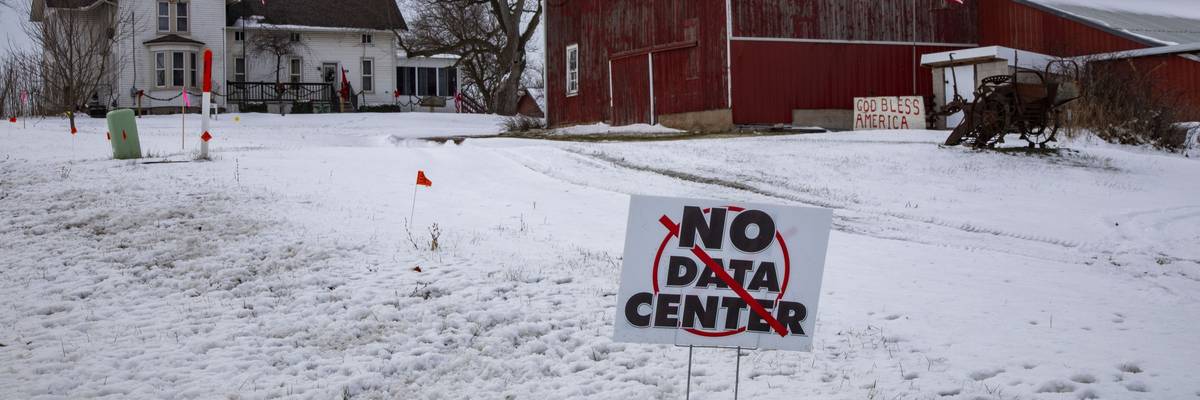
A sign on a rural Michigan road opposes a planned $7 billion data center on southeast Michigan farmland in Saline, Michigan, on December 1, 2025.
One Michigan state legislator said data centers are emblematic of the divide between "tech billionaires who are seizing power and… the working and middle classes."
As voters across the country begin to rally against the unchecked construction of data centers, artificial intelligence companies are panicking and investing millions into propaganda to paint the energy-sucking facilities in a more positive light.
By 2030, the amount of energy demanded by US data centers is expected to more than double, according to the International Energy Agency.
Energy costs have spiked considerably in the states with the most data centers. And as the industry continues its breakneck expansion, one watchdog report found that consumers on America's largest electric grid are expected to pay hundreds of dollars more to meet increased power demand from now until 2027.
These costs became an unexpected point of emphasis for Democrats in November, whose calls for greater transparency from tech companies seeking to build data centers propelled them to victory in elections from New Jersey to Virginia.
But tech companies want to keep building, and as AI threatens to become a central villain of the 2026 midterm elections, Politico reports that companies are putting the wheels in motion to portray themselves "as job creators and economic drivers rather than resource-hungry land hogs."
As Gabby Miller wrote on Wednesday:
A new AI trade group is distributing talking points to members of Congress and organizing local data center field trips to better pitch voters on their value. Another trade association, the Data Center Coalition, nearly tripled its lobbying spend in the third quarter of this year from the previous quarter, according to US lobbying disclosures.
The social media giant Meta, with billions invested in its own fleet of data centers from Stanton Springs, Georgia, to Richland Parish, Louisiana, has been running a multimillion-dollar ad campaign depicting data centers as a boon to agricultural towns in Iowa and New Mexico. It has spent at least $5 million nationally in the past month on TV ads plugging Meta’s $600 billion pledged investment in tech infrastructure and jobs.“
"There’s a very bad connotation around data centers. And this is something that, frankly, the data center industry needs to figure out,” said Caleb Max, president and CEO of the National Artificial Intelligence Association, a new trade group established in January to accelerate AI infrastructure development.
Tech giants are also putting focus on swaying policymakers. Max told Politico that his group has been making the rounds to talk with elected officials in critical battlegrounds for the AI future, like Georgia, Ohio, and Texas, to craft a "positive pro-data center campaign message for elected officials, for businesses, for current lawmakers who are going to be up for reelection in 2026."
Meanwhile, Meta reportedly aired its 30-second TV spots "featuring small-town imagery of farming equipment and mom-and-pop diners" in Washington, DC, and nine state capitals. Miller says this suggests "that policymakers might be Meta’s real target audience, rather than the rural Americans impacted by these energy-hungry server hubs."
AI and tech firms plan to ramp up the lobbying and ad blitzes as the next election draws nearer, and their attempt to reframe the narrative about data centers comes as no surprise, as communities across the US in recent months have increasingly come out in force to push their representatives to halt the construction of the facilities.
In Saline Township, a small community just outside Ann Arbor, Michigan, more than 800 residents descended upon a public input session earlier this month to protest against the construction of a $7 billion center—predicted to consume as much energy as the entire city of Detroit—fearing it would raise energy costs, pollute groundwater, and force the state to abandon its nation-leading climate policies.
The town initially blocked the plans, but reversed course following a lawsuit from a real-estate billionaire closely aligned with President Donald Trump, whose administration has backed the $500 billion "Stargate" initiative by OpenAI, SoftBank, and Oracle to expand data centers.
On Tuesday, Michigan Attorney General Dana Nessel joined Saline residents at a gathering outside the state Capitol, where they called for a statewide moratorium on data centers.
Data center projects have run into similar resistance nationwide. As of March, the group Data Center Watch found that more than $64 billion worth of projects had been blocked or delayed due to local opposition since May 2024. This opposition has reached a fever pitch in recent months.
Last week, after it received hundreds of angry comments from residents, the city council of Chandler, Arizona, unanimously rejected plans for a $2.5 billion data center that had been pushed by former US Sen.-turned lobbyist Kyrsten Sinema (D-Ariz.).
Even in Trump country, backlash has been fierce. Last week, the planning commission of Starke County, Indiana, voted unanimously to recommend a one-year moratorium on the construction of centers bigger than 5,000 square feet after residents flooded a meeting to raise concerns about water pollution and energy costs.
"In Memphis, Tennessee, Elon Musk's AI company has built a data center whose energy demands have outgrown the region's energy capabilities," said one resident, Sophia Parker. "We've heard from everyone else saying that our infrastructure does not have the capacity to support a data center. And as a result, gas turbines are emitting nitrogen oxide to the point where residents cannot breathe. Their community is being used as a sacrifice for others to get rich. We cannot allow that to happen to us."
Last month in Montour County, Pennsylvania—a state where electric prices have surged by 15% this year, double the national average—environmentalists formed an uncommon alliance with conservative farmers and the Amish to stop the county planning commission from rezoning 1,300 acres of agricultural land for a massive new center.
“Stay out. We wouldn’t even be having this conversation without federal involvement,” said Craig High, a 39-year-old Trump supporter quoted by Reuters. “Both parties are pushing data centers and giving regulatory relief—water permits, permitting, all of it.”
“This is part of an experience that America and the world is having around tech billionaires who are seizing power and widening the gap between those who have much too much… and the working and middle classes,” Yousef Rabhi, a former Democratic state legislative leader from Michigan and clean energy advocate who opposes the construction of data centers, told The Guardian. “That’s what these data centers are symbolic of, and they’re the vehicle for the furtherance of this divide."
Dear Common Dreams reader, It’s been nearly 30 years since I co-founded Common Dreams with my late wife, Lina Newhouser. We had the radical notion that journalism should serve the public good, not corporate profits. It was clear to us from the outset what it would take to build such a project. No paid advertisements. No corporate sponsors. No millionaire publisher telling us what to think or do. Many people said we wouldn't last a year, but we proved those doubters wrong. Together with a tremendous team of journalists and dedicated staff, we built an independent media outlet free from the constraints of profits and corporate control. Our mission has always been simple: To inform. To inspire. To ignite change for the common good. Building Common Dreams was not easy. Our survival was never guaranteed. When you take on the most powerful forces—Wall Street greed, fossil fuel industry destruction, Big Tech lobbyists, and uber-rich oligarchs who have spent billions upon billions rigging the economy and democracy in their favor—the only bulwark you have is supporters who believe in your work. But here’s the urgent message from me today. It's never been this bad out there. And it's never been this hard to keep us going. At the very moment Common Dreams is most needed, the threats we face are intensifying. We need your support now more than ever. We don't accept corporate advertising and never will. We don't have a paywall because we don't think people should be blocked from critical news based on their ability to pay. Everything we do is funded by the donations of readers like you. When everyone does the little they can afford, we are strong. But if that support retreats or dries up, so do we. Will you donate now to make sure Common Dreams not only survives but thrives? —Craig Brown, Co-founder |
As voters across the country begin to rally against the unchecked construction of data centers, artificial intelligence companies are panicking and investing millions into propaganda to paint the energy-sucking facilities in a more positive light.
By 2030, the amount of energy demanded by US data centers is expected to more than double, according to the International Energy Agency.
Energy costs have spiked considerably in the states with the most data centers. And as the industry continues its breakneck expansion, one watchdog report found that consumers on America's largest electric grid are expected to pay hundreds of dollars more to meet increased power demand from now until 2027.
These costs became an unexpected point of emphasis for Democrats in November, whose calls for greater transparency from tech companies seeking to build data centers propelled them to victory in elections from New Jersey to Virginia.
But tech companies want to keep building, and as AI threatens to become a central villain of the 2026 midterm elections, Politico reports that companies are putting the wheels in motion to portray themselves "as job creators and economic drivers rather than resource-hungry land hogs."
As Gabby Miller wrote on Wednesday:
A new AI trade group is distributing talking points to members of Congress and organizing local data center field trips to better pitch voters on their value. Another trade association, the Data Center Coalition, nearly tripled its lobbying spend in the third quarter of this year from the previous quarter, according to US lobbying disclosures.
The social media giant Meta, with billions invested in its own fleet of data centers from Stanton Springs, Georgia, to Richland Parish, Louisiana, has been running a multimillion-dollar ad campaign depicting data centers as a boon to agricultural towns in Iowa and New Mexico. It has spent at least $5 million nationally in the past month on TV ads plugging Meta’s $600 billion pledged investment in tech infrastructure and jobs.“
"There’s a very bad connotation around data centers. And this is something that, frankly, the data center industry needs to figure out,” said Caleb Max, president and CEO of the National Artificial Intelligence Association, a new trade group established in January to accelerate AI infrastructure development.
Tech giants are also putting focus on swaying policymakers. Max told Politico that his group has been making the rounds to talk with elected officials in critical battlegrounds for the AI future, like Georgia, Ohio, and Texas, to craft a "positive pro-data center campaign message for elected officials, for businesses, for current lawmakers who are going to be up for reelection in 2026."
Meanwhile, Meta reportedly aired its 30-second TV spots "featuring small-town imagery of farming equipment and mom-and-pop diners" in Washington, DC, and nine state capitals. Miller says this suggests "that policymakers might be Meta’s real target audience, rather than the rural Americans impacted by these energy-hungry server hubs."
AI and tech firms plan to ramp up the lobbying and ad blitzes as the next election draws nearer, and their attempt to reframe the narrative about data centers comes as no surprise, as communities across the US in recent months have increasingly come out in force to push their representatives to halt the construction of the facilities.
In Saline Township, a small community just outside Ann Arbor, Michigan, more than 800 residents descended upon a public input session earlier this month to protest against the construction of a $7 billion center—predicted to consume as much energy as the entire city of Detroit—fearing it would raise energy costs, pollute groundwater, and force the state to abandon its nation-leading climate policies.
The town initially blocked the plans, but reversed course following a lawsuit from a real-estate billionaire closely aligned with President Donald Trump, whose administration has backed the $500 billion "Stargate" initiative by OpenAI, SoftBank, and Oracle to expand data centers.
On Tuesday, Michigan Attorney General Dana Nessel joined Saline residents at a gathering outside the state Capitol, where they called for a statewide moratorium on data centers.
Data center projects have run into similar resistance nationwide. As of March, the group Data Center Watch found that more than $64 billion worth of projects had been blocked or delayed due to local opposition since May 2024. This opposition has reached a fever pitch in recent months.
Last week, after it received hundreds of angry comments from residents, the city council of Chandler, Arizona, unanimously rejected plans for a $2.5 billion data center that had been pushed by former US Sen.-turned lobbyist Kyrsten Sinema (D-Ariz.).
Even in Trump country, backlash has been fierce. Last week, the planning commission of Starke County, Indiana, voted unanimously to recommend a one-year moratorium on the construction of centers bigger than 5,000 square feet after residents flooded a meeting to raise concerns about water pollution and energy costs.
"In Memphis, Tennessee, Elon Musk's AI company has built a data center whose energy demands have outgrown the region's energy capabilities," said one resident, Sophia Parker. "We've heard from everyone else saying that our infrastructure does not have the capacity to support a data center. And as a result, gas turbines are emitting nitrogen oxide to the point where residents cannot breathe. Their community is being used as a sacrifice for others to get rich. We cannot allow that to happen to us."
Last month in Montour County, Pennsylvania—a state where electric prices have surged by 15% this year, double the national average—environmentalists formed an uncommon alliance with conservative farmers and the Amish to stop the county planning commission from rezoning 1,300 acres of agricultural land for a massive new center.
“Stay out. We wouldn’t even be having this conversation without federal involvement,” said Craig High, a 39-year-old Trump supporter quoted by Reuters. “Both parties are pushing data centers and giving regulatory relief—water permits, permitting, all of it.”
“This is part of an experience that America and the world is having around tech billionaires who are seizing power and widening the gap between those who have much too much… and the working and middle classes,” Yousef Rabhi, a former Democratic state legislative leader from Michigan and clean energy advocate who opposes the construction of data centers, told The Guardian. “That’s what these data centers are symbolic of, and they’re the vehicle for the furtherance of this divide."
As voters across the country begin to rally against the unchecked construction of data centers, artificial intelligence companies are panicking and investing millions into propaganda to paint the energy-sucking facilities in a more positive light.
By 2030, the amount of energy demanded by US data centers is expected to more than double, according to the International Energy Agency.
Energy costs have spiked considerably in the states with the most data centers. And as the industry continues its breakneck expansion, one watchdog report found that consumers on America's largest electric grid are expected to pay hundreds of dollars more to meet increased power demand from now until 2027.
These costs became an unexpected point of emphasis for Democrats in November, whose calls for greater transparency from tech companies seeking to build data centers propelled them to victory in elections from New Jersey to Virginia.
But tech companies want to keep building, and as AI threatens to become a central villain of the 2026 midterm elections, Politico reports that companies are putting the wheels in motion to portray themselves "as job creators and economic drivers rather than resource-hungry land hogs."
As Gabby Miller wrote on Wednesday:
A new AI trade group is distributing talking points to members of Congress and organizing local data center field trips to better pitch voters on their value. Another trade association, the Data Center Coalition, nearly tripled its lobbying spend in the third quarter of this year from the previous quarter, according to US lobbying disclosures.
The social media giant Meta, with billions invested in its own fleet of data centers from Stanton Springs, Georgia, to Richland Parish, Louisiana, has been running a multimillion-dollar ad campaign depicting data centers as a boon to agricultural towns in Iowa and New Mexico. It has spent at least $5 million nationally in the past month on TV ads plugging Meta’s $600 billion pledged investment in tech infrastructure and jobs.“
"There’s a very bad connotation around data centers. And this is something that, frankly, the data center industry needs to figure out,” said Caleb Max, president and CEO of the National Artificial Intelligence Association, a new trade group established in January to accelerate AI infrastructure development.
Tech giants are also putting focus on swaying policymakers. Max told Politico that his group has been making the rounds to talk with elected officials in critical battlegrounds for the AI future, like Georgia, Ohio, and Texas, to craft a "positive pro-data center campaign message for elected officials, for businesses, for current lawmakers who are going to be up for reelection in 2026."
Meanwhile, Meta reportedly aired its 30-second TV spots "featuring small-town imagery of farming equipment and mom-and-pop diners" in Washington, DC, and nine state capitals. Miller says this suggests "that policymakers might be Meta’s real target audience, rather than the rural Americans impacted by these energy-hungry server hubs."
AI and tech firms plan to ramp up the lobbying and ad blitzes as the next election draws nearer, and their attempt to reframe the narrative about data centers comes as no surprise, as communities across the US in recent months have increasingly come out in force to push their representatives to halt the construction of the facilities.
In Saline Township, a small community just outside Ann Arbor, Michigan, more than 800 residents descended upon a public input session earlier this month to protest against the construction of a $7 billion center—predicted to consume as much energy as the entire city of Detroit—fearing it would raise energy costs, pollute groundwater, and force the state to abandon its nation-leading climate policies.
The town initially blocked the plans, but reversed course following a lawsuit from a real-estate billionaire closely aligned with President Donald Trump, whose administration has backed the $500 billion "Stargate" initiative by OpenAI, SoftBank, and Oracle to expand data centers.
On Tuesday, Michigan Attorney General Dana Nessel joined Saline residents at a gathering outside the state Capitol, where they called for a statewide moratorium on data centers.
Data center projects have run into similar resistance nationwide. As of March, the group Data Center Watch found that more than $64 billion worth of projects had been blocked or delayed due to local opposition since May 2024. This opposition has reached a fever pitch in recent months.
Last week, after it received hundreds of angry comments from residents, the city council of Chandler, Arizona, unanimously rejected plans for a $2.5 billion data center that had been pushed by former US Sen.-turned lobbyist Kyrsten Sinema (D-Ariz.).
Even in Trump country, backlash has been fierce. Last week, the planning commission of Starke County, Indiana, voted unanimously to recommend a one-year moratorium on the construction of centers bigger than 5,000 square feet after residents flooded a meeting to raise concerns about water pollution and energy costs.
"In Memphis, Tennessee, Elon Musk's AI company has built a data center whose energy demands have outgrown the region's energy capabilities," said one resident, Sophia Parker. "We've heard from everyone else saying that our infrastructure does not have the capacity to support a data center. And as a result, gas turbines are emitting nitrogen oxide to the point where residents cannot breathe. Their community is being used as a sacrifice for others to get rich. We cannot allow that to happen to us."
Last month in Montour County, Pennsylvania—a state where electric prices have surged by 15% this year, double the national average—environmentalists formed an uncommon alliance with conservative farmers and the Amish to stop the county planning commission from rezoning 1,300 acres of agricultural land for a massive new center.
“Stay out. We wouldn’t even be having this conversation without federal involvement,” said Craig High, a 39-year-old Trump supporter quoted by Reuters. “Both parties are pushing data centers and giving regulatory relief—water permits, permitting, all of it.”
“This is part of an experience that America and the world is having around tech billionaires who are seizing power and widening the gap between those who have much too much… and the working and middle classes,” Yousef Rabhi, a former Democratic state legislative leader from Michigan and clean energy advocate who opposes the construction of data centers, told The Guardian. “That’s what these data centers are symbolic of, and they’re the vehicle for the furtherance of this divide."