SUBSCRIBE TO OUR FREE NEWSLETTER
Daily news & progressive opinion—funded by the people, not the corporations—delivered straight to your inbox.
5
#000000
#FFFFFF
To donate by check, phone, or other method, see our More Ways to Give page.
Daily news & progressive opinion—funded by the people, not the corporations—delivered straight to your inbox.
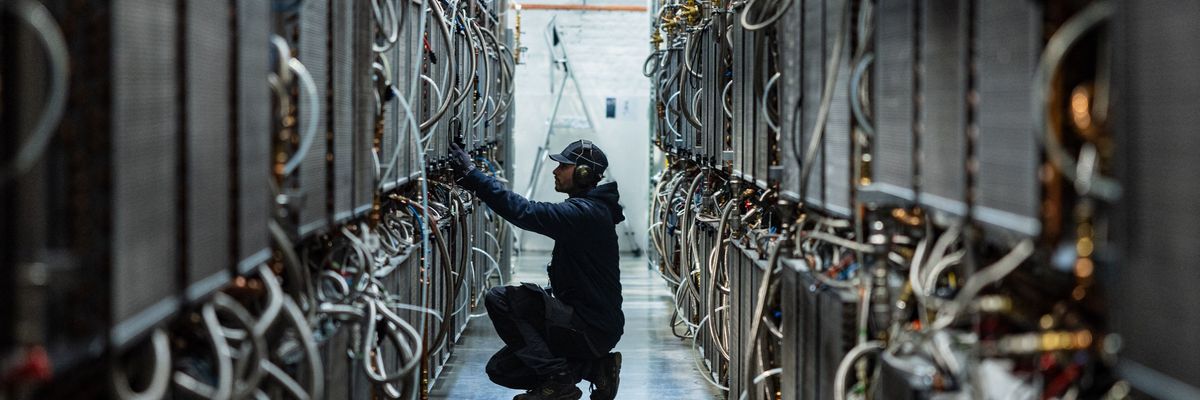
An operator works at the data centre of French company OVHcloud in Roubaix, northern France on April 3, 2025.
"For any Democrat who wants to think politically, what an opportunity,” said Faiz Shakir, a longtime adviser to US Sen. Bernie Sanders. “The people are way ahead of the politicians.”
America's biggest tech firms are facing an increasing backlash over the energy-devouring data centers they are building to power artificial intelligence.
Semafor reported on Monday that opposition to data center construction has been bubbling up in communities across the US, as both Republican and Democratic local officials have been campaigning on promises to clamp down on Silicon Valley's most expensive and ambitious projects.
In Virginia's 30th House of Delegates district, for example, both Republican incumbent Geary Higgins and Democratic challenger John McAuliff have been battling over which one of them is most opposed to AI data center construction in their region.
In an interview with Semafor, McAuliff said that opposition to data centers in the district has swelled up organically, as voters recoil at both the massive amount of resources they consume and the impact that consumption is having on both the environment and their electric bills.
"We’re dealing with the biggest companies on the planet,” he explained. “So we need to make sure Virginians are benefiting off of what they do here, not just paying for it.”
NPR on Tuesday similarly reported that fights over data center construction are happening nationwide, as residents who live near proposed construction sites have expressed concerns about the amount of water and electricity they will consume at the expense of local communities.
"A typical AI data center uses as much electricity as 100,000 households, and the largest under development will consume 20 times more," NPR explained, citing a report from the International Energy Agency. "They also suck up billions of gallons of water for systems to keep all that computer hardware cool."
Data centers' massive water use has been a consistent concern across the US. The Philadelphia Inquirer reported on Monday that residents of the township of East Vincent, Pennsylvania have seen their wells dry up recently, and they are worried that a proposed data center would significantly exacerbate water shortages.
This is what has been happening in Mansfield, Georgia, a community that for years has experienced problems with its water supply ever since tech giant Meta began building a data center there in 2018.
As BBC reported back in August, residents in Mansfield have resorted to buying bottled water because their wells have been delivering murky water, which they said wasn't a problem before the Meta data center came online. Although Meta has commissioned a study that claims to show its data center hasn't affected local groundwater quality, Mansfield resident Beverly Morris told BBC she isn't buying the company's findings.
"My everyday life, everything has been affected," she said, in reference to the presence of the data center. "I've lived through this for eight years. This is not just today, but it is affecting me from now on."
Anxieties about massive power consumption are also spurring the backlash against data centers, and recent research shows these fears could be well founded.
Mike Jacobs, a senior energy manager at the Union of Concerned Scientists, last month released an analysis estimating that data centers had added billions of dollars to Americans' electric bills across seven different states in recent years. In Virginia alone, for instance, Jacobs found that household electric bills had subsidized data center transmission costs to the tune of $1.9 billion in 2024.
"The big tech companies rushing to build out massive data centers are worth trillions of dollars, yet they’re successfully exploiting an outdated regulatory process to pawn billions of dollars of costs off on families who may never even use their products," Jacobs explained. "People deserve to understand the full extent of how data centers in their communities may affect their lives and wallets. This is a clear case of the public unknowingly subsidizing private companies' profits."
While the backlash to data centers hasn't yet become a national issue, Faiz Shakir, a longtime adviser to US Sen. Bernie Sanders (I-Vt.), predicted in an interview with Semafor that opposition to their construction would be a winning political issue for any politician savvy enough to get ahead of it.
“For any Democrat who wants to think politically, what an opportunity,” he said. “The people are way ahead of the politicians.”
Dear Common Dreams reader, It’s been nearly 30 years since I co-founded Common Dreams with my late wife, Lina Newhouser. We had the radical notion that journalism should serve the public good, not corporate profits. It was clear to us from the outset what it would take to build such a project. No paid advertisements. No corporate sponsors. No millionaire publisher telling us what to think or do. Many people said we wouldn't last a year, but we proved those doubters wrong. Together with a tremendous team of journalists and dedicated staff, we built an independent media outlet free from the constraints of profits and corporate control. Our mission has always been simple: To inform. To inspire. To ignite change for the common good. Building Common Dreams was not easy. Our survival was never guaranteed. When you take on the most powerful forces—Wall Street greed, fossil fuel industry destruction, Big Tech lobbyists, and uber-rich oligarchs who have spent billions upon billions rigging the economy and democracy in their favor—the only bulwark you have is supporters who believe in your work. But here’s the urgent message from me today. It's never been this bad out there. And it's never been this hard to keep us going. At the very moment Common Dreams is most needed, the threats we face are intensifying. We need your support now more than ever. We don't accept corporate advertising and never will. We don't have a paywall because we don't think people should be blocked from critical news based on their ability to pay. Everything we do is funded by the donations of readers like you. When everyone does the little they can afford, we are strong. But if that support retreats or dries up, so do we. Will you donate now to make sure Common Dreams not only survives but thrives? —Craig Brown, Co-founder |
America's biggest tech firms are facing an increasing backlash over the energy-devouring data centers they are building to power artificial intelligence.
Semafor reported on Monday that opposition to data center construction has been bubbling up in communities across the US, as both Republican and Democratic local officials have been campaigning on promises to clamp down on Silicon Valley's most expensive and ambitious projects.
In Virginia's 30th House of Delegates district, for example, both Republican incumbent Geary Higgins and Democratic challenger John McAuliff have been battling over which one of them is most opposed to AI data center construction in their region.
In an interview with Semafor, McAuliff said that opposition to data centers in the district has swelled up organically, as voters recoil at both the massive amount of resources they consume and the impact that consumption is having on both the environment and their electric bills.
"We’re dealing with the biggest companies on the planet,” he explained. “So we need to make sure Virginians are benefiting off of what they do here, not just paying for it.”
NPR on Tuesday similarly reported that fights over data center construction are happening nationwide, as residents who live near proposed construction sites have expressed concerns about the amount of water and electricity they will consume at the expense of local communities.
"A typical AI data center uses as much electricity as 100,000 households, and the largest under development will consume 20 times more," NPR explained, citing a report from the International Energy Agency. "They also suck up billions of gallons of water for systems to keep all that computer hardware cool."
Data centers' massive water use has been a consistent concern across the US. The Philadelphia Inquirer reported on Monday that residents of the township of East Vincent, Pennsylvania have seen their wells dry up recently, and they are worried that a proposed data center would significantly exacerbate water shortages.
This is what has been happening in Mansfield, Georgia, a community that for years has experienced problems with its water supply ever since tech giant Meta began building a data center there in 2018.
As BBC reported back in August, residents in Mansfield have resorted to buying bottled water because their wells have been delivering murky water, which they said wasn't a problem before the Meta data center came online. Although Meta has commissioned a study that claims to show its data center hasn't affected local groundwater quality, Mansfield resident Beverly Morris told BBC she isn't buying the company's findings.
"My everyday life, everything has been affected," she said, in reference to the presence of the data center. "I've lived through this for eight years. This is not just today, but it is affecting me from now on."
Anxieties about massive power consumption are also spurring the backlash against data centers, and recent research shows these fears could be well founded.
Mike Jacobs, a senior energy manager at the Union of Concerned Scientists, last month released an analysis estimating that data centers had added billions of dollars to Americans' electric bills across seven different states in recent years. In Virginia alone, for instance, Jacobs found that household electric bills had subsidized data center transmission costs to the tune of $1.9 billion in 2024.
"The big tech companies rushing to build out massive data centers are worth trillions of dollars, yet they’re successfully exploiting an outdated regulatory process to pawn billions of dollars of costs off on families who may never even use their products," Jacobs explained. "People deserve to understand the full extent of how data centers in their communities may affect their lives and wallets. This is a clear case of the public unknowingly subsidizing private companies' profits."
While the backlash to data centers hasn't yet become a national issue, Faiz Shakir, a longtime adviser to US Sen. Bernie Sanders (I-Vt.), predicted in an interview with Semafor that opposition to their construction would be a winning political issue for any politician savvy enough to get ahead of it.
“For any Democrat who wants to think politically, what an opportunity,” he said. “The people are way ahead of the politicians.”
America's biggest tech firms are facing an increasing backlash over the energy-devouring data centers they are building to power artificial intelligence.
Semafor reported on Monday that opposition to data center construction has been bubbling up in communities across the US, as both Republican and Democratic local officials have been campaigning on promises to clamp down on Silicon Valley's most expensive and ambitious projects.
In Virginia's 30th House of Delegates district, for example, both Republican incumbent Geary Higgins and Democratic challenger John McAuliff have been battling over which one of them is most opposed to AI data center construction in their region.
In an interview with Semafor, McAuliff said that opposition to data centers in the district has swelled up organically, as voters recoil at both the massive amount of resources they consume and the impact that consumption is having on both the environment and their electric bills.
"We’re dealing with the biggest companies on the planet,” he explained. “So we need to make sure Virginians are benefiting off of what they do here, not just paying for it.”
NPR on Tuesday similarly reported that fights over data center construction are happening nationwide, as residents who live near proposed construction sites have expressed concerns about the amount of water and electricity they will consume at the expense of local communities.
"A typical AI data center uses as much electricity as 100,000 households, and the largest under development will consume 20 times more," NPR explained, citing a report from the International Energy Agency. "They also suck up billions of gallons of water for systems to keep all that computer hardware cool."
Data centers' massive water use has been a consistent concern across the US. The Philadelphia Inquirer reported on Monday that residents of the township of East Vincent, Pennsylvania have seen their wells dry up recently, and they are worried that a proposed data center would significantly exacerbate water shortages.
This is what has been happening in Mansfield, Georgia, a community that for years has experienced problems with its water supply ever since tech giant Meta began building a data center there in 2018.
As BBC reported back in August, residents in Mansfield have resorted to buying bottled water because their wells have been delivering murky water, which they said wasn't a problem before the Meta data center came online. Although Meta has commissioned a study that claims to show its data center hasn't affected local groundwater quality, Mansfield resident Beverly Morris told BBC she isn't buying the company's findings.
"My everyday life, everything has been affected," she said, in reference to the presence of the data center. "I've lived through this for eight years. This is not just today, but it is affecting me from now on."
Anxieties about massive power consumption are also spurring the backlash against data centers, and recent research shows these fears could be well founded.
Mike Jacobs, a senior energy manager at the Union of Concerned Scientists, last month released an analysis estimating that data centers had added billions of dollars to Americans' electric bills across seven different states in recent years. In Virginia alone, for instance, Jacobs found that household electric bills had subsidized data center transmission costs to the tune of $1.9 billion in 2024.
"The big tech companies rushing to build out massive data centers are worth trillions of dollars, yet they’re successfully exploiting an outdated regulatory process to pawn billions of dollars of costs off on families who may never even use their products," Jacobs explained. "People deserve to understand the full extent of how data centers in their communities may affect their lives and wallets. This is a clear case of the public unknowingly subsidizing private companies' profits."
While the backlash to data centers hasn't yet become a national issue, Faiz Shakir, a longtime adviser to US Sen. Bernie Sanders (I-Vt.), predicted in an interview with Semafor that opposition to their construction would be a winning political issue for any politician savvy enough to get ahead of it.
“For any Democrat who wants to think politically, what an opportunity,” he said. “The people are way ahead of the politicians.”