SUBSCRIBE TO OUR FREE NEWSLETTER
Daily news & progressive opinion—funded by the people, not the corporations—delivered straight to your inbox.
5
#000000
#FFFFFF
To donate by check, phone, or other method, see our More Ways to Give page.
Daily news & progressive opinion—funded by the people, not the corporations—delivered straight to your inbox.

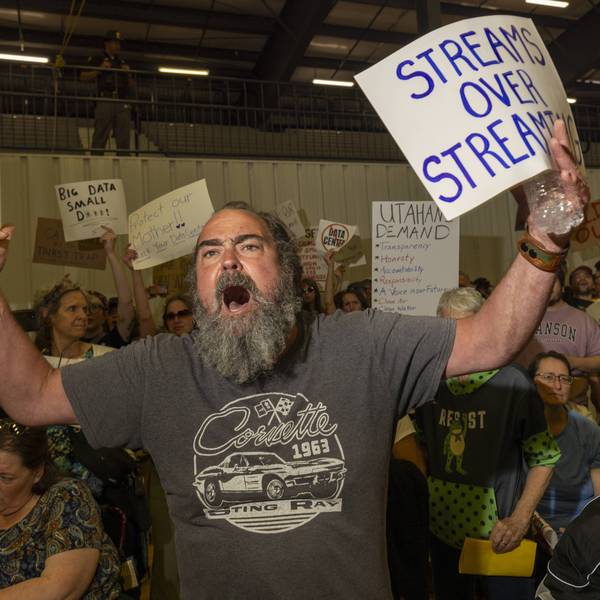
Demonstrators wave signs during a nationwide protest against artificial intelligence data center expansion in Imperial, California on July 18, 2026.
"If voters' perceptions of data centers are not fixed quickly, the campaign against them will expand far beyond Ohio."
A leaked memo written by the National Republican Senatorial Committee is warning Silicon Valley that its artificial intelligence data firms are becoming a massive political liability.
Axios reported on Wednesday that the GOP memo centers on the US Senate race in Ohio, where former Democratic Sen. Sherrod Brown has made opposition to data centers central to his campaign against incumbent Republican Sen. Jon Husted.
The memo argues that if Brown's campaign is successful in a state that President Donald Trump won by double digits in 2024, it will send a signal that support for data centers is a losing position across the US.
"If he loses and data centers get the blame, politicians across the country will take notice—and they will not go near the next one," the memo says. "This has become a sleeper issue for the entire election cycle."
The memo goes on to argue that the tech industry needs to do more to show Americans the benefits they will get from data centers, which have been criticized for raising people's utility bills and generating large amounts of pollution.
"If voters' perceptions of data centers are not fixed quickly," the memo cautions, "the campaign against them will expand far beyond Ohio."
According to Axios, AI CEOs and GOP insiders have become unnerved by internal polls showing that "data centers are as popular as spent nuclear waste, and more broadly have become a proxy for feelings about AI."
A poll released in June by Echelon Insights found that only 27% of Americans said they would want an AI data center built in their nieghborhood, with 62% opposed. This made data centers even less popular than nuclear power plants, which 34% of Americans said they would welcome in their neighborhoods.
A separate Axios report published Wednesday described AI CEOs being in "full panic mode" over the backlash to data centers. What's more, reported Axios, tech insiders privately acknowledge that "they can't find a compelling message to shift opinion fast enough" ahead of the 2026 midterm elections.
In fact, noted Axios, Wisconsin Republican gubernatorial nominee Tom Tiffany has even come out against AI data center construction in his state, which the report described as "a striking crack" in President Donald Trump's "pro-AI coalition."
In a Wednesday social media post, pollster Adam Carlson predicted that any Big Tech public relations campaign to change Americans' minds about data centers was likely doomed.
"Charm offensives from tech firms... would’ve been more effective if they did them proactively instead of in response to (very predictable) local backlash," Carlson explained. "They got greedy. Now they’re trying to play catch-up and it's probably too late. No one to blame but themselves."
Dear Common Dreams reader, It’s been nearly 30 years since I co-founded Common Dreams with my late wife, Lina Newhouser. We had the radical notion that journalism should serve the public good, not corporate profits. It was clear to us from the outset what it would take to build such a project. No paid advertisements. No corporate sponsors. No millionaire publisher telling us what to think or do. Many people said we wouldn't last a year, but we proved those doubters wrong. Together with a tremendous team of journalists and dedicated staff, we built an independent media outlet free from the constraints of profits and corporate control. Our mission has always been simple: To inform. To inspire. To ignite change for the common good. Building Common Dreams was not easy. Our survival was never guaranteed. When you take on the most powerful forces—Wall Street greed, fossil fuel industry destruction, Big Tech lobbyists, and uber-rich oligarchs who have spent billions upon billions rigging the economy and democracy in their favor—the only bulwark you have is supporters who believe in your work. But here’s the urgent message from me today. It's never been this bad out there. And it's never been this hard to keep us going. At the very moment Common Dreams is most needed, the threats we face are intensifying. We need your support now more than ever. We don't accept corporate advertising and never will. We don't have a paywall because we don't think people should be blocked from critical news based on their ability to pay. Everything we do is funded by the donations of readers like you. When everyone does the little they can afford, we are strong. But if that support retreats or dries up, so do we. Will you donate now to make sure Common Dreams not only survives but thrives? —Craig Brown, Co-founder |
A leaked memo written by the National Republican Senatorial Committee is warning Silicon Valley that its artificial intelligence data firms are becoming a massive political liability.
Axios reported on Wednesday that the GOP memo centers on the US Senate race in Ohio, where former Democratic Sen. Sherrod Brown has made opposition to data centers central to his campaign against incumbent Republican Sen. Jon Husted.
The memo argues that if Brown's campaign is successful in a state that President Donald Trump won by double digits in 2024, it will send a signal that support for data centers is a losing position across the US.
"If he loses and data centers get the blame, politicians across the country will take notice—and they will not go near the next one," the memo says. "This has become a sleeper issue for the entire election cycle."
The memo goes on to argue that the tech industry needs to do more to show Americans the benefits they will get from data centers, which have been criticized for raising people's utility bills and generating large amounts of pollution.
"If voters' perceptions of data centers are not fixed quickly," the memo cautions, "the campaign against them will expand far beyond Ohio."
According to Axios, AI CEOs and GOP insiders have become unnerved by internal polls showing that "data centers are as popular as spent nuclear waste, and more broadly have become a proxy for feelings about AI."
A poll released in June by Echelon Insights found that only 27% of Americans said they would want an AI data center built in their nieghborhood, with 62% opposed. This made data centers even less popular than nuclear power plants, which 34% of Americans said they would welcome in their neighborhoods.
A separate Axios report published Wednesday described AI CEOs being in "full panic mode" over the backlash to data centers. What's more, reported Axios, tech insiders privately acknowledge that "they can't find a compelling message to shift opinion fast enough" ahead of the 2026 midterm elections.
In fact, noted Axios, Wisconsin Republican gubernatorial nominee Tom Tiffany has even come out against AI data center construction in his state, which the report described as "a striking crack" in President Donald Trump's "pro-AI coalition."
In a Wednesday social media post, pollster Adam Carlson predicted that any Big Tech public relations campaign to change Americans' minds about data centers was likely doomed.
"Charm offensives from tech firms... would’ve been more effective if they did them proactively instead of in response to (very predictable) local backlash," Carlson explained. "They got greedy. Now they’re trying to play catch-up and it's probably too late. No one to blame but themselves."
A leaked memo written by the National Republican Senatorial Committee is warning Silicon Valley that its artificial intelligence data firms are becoming a massive political liability.
Axios reported on Wednesday that the GOP memo centers on the US Senate race in Ohio, where former Democratic Sen. Sherrod Brown has made opposition to data centers central to his campaign against incumbent Republican Sen. Jon Husted.
The memo argues that if Brown's campaign is successful in a state that President Donald Trump won by double digits in 2024, it will send a signal that support for data centers is a losing position across the US.
"If he loses and data centers get the blame, politicians across the country will take notice—and they will not go near the next one," the memo says. "This has become a sleeper issue for the entire election cycle."
The memo goes on to argue that the tech industry needs to do more to show Americans the benefits they will get from data centers, which have been criticized for raising people's utility bills and generating large amounts of pollution.
"If voters' perceptions of data centers are not fixed quickly," the memo cautions, "the campaign against them will expand far beyond Ohio."
According to Axios, AI CEOs and GOP insiders have become unnerved by internal polls showing that "data centers are as popular as spent nuclear waste, and more broadly have become a proxy for feelings about AI."
A poll released in June by Echelon Insights found that only 27% of Americans said they would want an AI data center built in their nieghborhood, with 62% opposed. This made data centers even less popular than nuclear power plants, which 34% of Americans said they would welcome in their neighborhoods.
A separate Axios report published Wednesday described AI CEOs being in "full panic mode" over the backlash to data centers. What's more, reported Axios, tech insiders privately acknowledge that "they can't find a compelling message to shift opinion fast enough" ahead of the 2026 midterm elections.
In fact, noted Axios, Wisconsin Republican gubernatorial nominee Tom Tiffany has even come out against AI data center construction in his state, which the report described as "a striking crack" in President Donald Trump's "pro-AI coalition."
In a Wednesday social media post, pollster Adam Carlson predicted that any Big Tech public relations campaign to change Americans' minds about data centers was likely doomed.
"Charm offensives from tech firms... would’ve been more effective if they did them proactively instead of in response to (very predictable) local backlash," Carlson explained. "They got greedy. Now they’re trying to play catch-up and it's probably too late. No one to blame but themselves."