SUBSCRIBE TO OUR FREE NEWSLETTER
Daily news & progressive opinion—funded by the people, not the corporations—delivered straight to your inbox.
5
#000000
#FFFFFF
To donate by check, phone, or other method, see our More Ways to Give page.
Daily news & progressive opinion—funded by the people, not the corporations—delivered straight to your inbox.
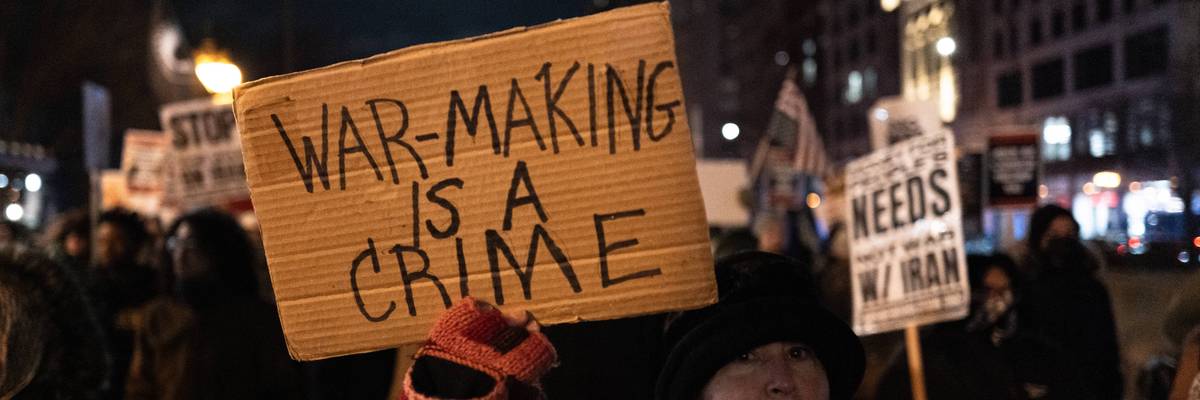
A protester holds placards reading ''war making is a crime'' during a demonstration against the war in Iran, in Chicago, Illinois, on February 28, 2026
If there’s been a better opportunity in the entire post-World War II era to chart a course away from our permanent war footing, I can’t think of it.
Amidst the tragifarce of President Donald Trump’s apparently off-the-top-of-his-head war on Iran may lie a silver lining for the 2028 presidential election—a silver lining that comes with two big ifs. One, of course, is the if that goes with everything involved with the race: If there is a fair election. The if specific to the hoped-for silver lining is if there is a candidate willing and able to make use of it.
Ever since Gallup started public opinion polls, when it has come to questions of war, they’ve shown the American public favoring every one at the start—until now, with Donald Trump launching the first war to encounter immediate objection from a majority of the American public. A man who exults in doing things that no president has ever done before has certainly done it up proud with this one—ending a more than 85-year stretch when the American people gave the government the benefit of the doubt at the beginning of every military action, no matter how much they may have come to regret it later.
Not surprisingly, the Second World War—the first one ever polled—enjoyed the broadest support, with 97% backing the declaration of war following the attack on Pearl Harbor, Hawaii. And all these years later, World War II is still widely thought of as the “good war.” Not so much with the war that was the next most broadly supported at the outset—the Afghanistan War then enjoyed 92% support from a population that could never have imagined it dragging on for two decades. Eighty-two percent supported the first George Bush’s Iraq War, now remembered as the Gulf War. And even though Americans would eventually turn against all three of them, the (Second) Iraq War, Korean War, and Vietnam War started out with76%, 75%, and 65% support respectively. (Public polling only on the Vietnam War began in 1965, as America started coming to grips with the fact that we were actually in a war there.)
Much less remembered conflicts that also found initial approval included Bush's 1989 Panama invasion, with 82%favorable; Clinton’s 1999 Kosovo War bombing of Yugoslavia, at 58 percent; and 53 percent for Reagan’s 1983 invasion of the Caribbean island of Grenada. In fact, the only American military operation not enjoying majority support from the start was Obama’s 2011 bombing of Libya, favored by only 47 percent. But even then, only 37 percent outright opposed it—You others perhaps not even considering us to be at war (a stance that the Administration would subsequently adopt in arguing that it did not qualify as war under the War Powers Act.)
So far as Trump’s current Iran War, Gallup encountered only 34 percent immediate support. This then, would seem to qualify as what political scientists might call, “a really big deal.” Despite a solid history of uniting behind the flag first and asking questions later, the American people have decided to believe their own eyes, seeing a president aid and abet the Israeli assassination a foreign head of state; bomb a population half a world away, threatening that "a whole civilization will die tonight, never to be brought back again;" and deploy the American military seemingly at whim, with little apparent concern as to cause or effect—all this in a war that he has several times claimed to have already won. In short, for the first time in living memory, the American people have concluded that a Commander-in-Chief—and his Department of War—has betrayed their trust. If there’s been a better opportunity in the entire post-World War II era to chart a course away from our permanent war footing, I can’t think of it. That is, if we can find the right candidate.
We can probably safely assume that all 2028 Democratic presidential candidates will have opposed the Iran War and will in some sense claim title to any “silver lining” that may come with public rejection of that war. Not all, however, will be able to credibly argue that they offer the prospect of any real change in this arena, should they become president. After all, opposing a war entered into by “the other party’s” president may not be the norm, but it is common enough; opposing “your own party’s” president’s war is, however, quite another thing. That type of opposition, which would seem reasonable evidence of intent to buck the everlasting-war trend, is virtually non-existent among Republicans and rare among Democrats. For the latter, their foreign policy stances during the Biden Administration would logically seem more telling as to how they might operate in the White House.
The obvious touchstone in this realm is Israel’s Gaza War, continuous through both Biden and Trump Administrations. The questions for many Democratic primary voters will probably run along the lines of: “When did you recognize that the Israeli response to the October 7, 2023 Hamas attrocity—1,200 Israelis killed, 250 hostages—had become a campaign of destruction of just the sort that Trump threatened Iran with? And what did you do when you came to that realization—assuming you ever did?”
From that vantage point, the field currently in the 2028 presidential discussion mix seems to run the full gamut of plausibly in regard to taking advantage of any Iran War “silver lining.” On the less plausible end, we have Kamala Harris. The most recent Democratic nominee, now said to be considering another run, comes with a Biden Administration record that seems to offer scant ground to argue that a vote for her would be a vote for a significant foreign policy shift: As Vice President she supported arming the Israeli military through the end of her term, as the estimated Palestinian death toll reached 48,000 (out of a current total of 74,000), with the overwhelming majority being civilian, and a substantial portion children.
At the other end, we have Rep. Alexandria Ocasio-Cortez (D-NY), who says she hasn’t ruled out a presidential run. By late October, 2023, with the Palestinian death toll already at 7,000, Ocasio-Cortez was one of only nine House Democrats both sponsoring an immediate cease fire resolution and voting against support of continued Israeli military action. At the moment, the only other currently chatted-about potential candidate to stake out a firm anti-Gaza War position that dates back to the Democratic Biden administration is Rep. Ro Khanna (D-Calif.).
While these wars, and foreign policy in general, may not command center stage in the next presidential election, it’s been generally recognized that—Pete Hegseth notwithstanding—one facet of Trump’s appeal to some has been the belief that he was less committed to continual overseas wars than his recent predecessors—of both parties. While he arguably was no worse than they during his first term, his Iran War has shattered any illusion of that—both for him and the Republican Party that has backed him all the way. The challenge will be to produce a Democratic nominee who can credibly appeal to the antiwar sentiment within the Trump electorate. Although we are in no position to say exactly how the presidential primary field will ultimately shake out, the current snapshot does give us a sense of the hard reckoning we will have make as to which candidate would actually pursue altering our course of continuous conflict and spiraling military expenditure.
Foreign wars are, of course, neither the only, nor even the principal cause of Donald Trump’s disapproval ratings now running over 60 percent. So, given that no prominent Republican has bucked Trump in any significant way during his second Administration – and politically survived to talk about it—any imaginable 2028 Republican presidential candidate will likely have plenty of unpopular positions to talk their way around. All of which may eventually make it conventional wisdom that the race for the White House is the Democrats’ to lose—again if we assume a fair election.
But these foreign policy questions do provide an early, clear example of the type of choices that lie in front of us. More broadly, will the next Democratic presidential campaign be largely confined to—rightly—attacking the Republican Party for its support of a corrupt and stupid administration, on the assumption that simply being not-Trump will be good enough? Or will it attempt to deliver a candidate capable of credibly addressing the growing economic inequality, the unaffordabilty of healthcare, the concentration of corporate power, and the host of other issues closer to home that have sent a significant part of the American working class looking for love in all the wrong places?
Dear Common Dreams reader, It’s been nearly 30 years since I co-founded Common Dreams with my late wife, Lina Newhouser. We had the radical notion that journalism should serve the public good, not corporate profits. It was clear to us from the outset what it would take to build such a project. No paid advertisements. No corporate sponsors. No millionaire publisher telling us what to think or do. Many people said we wouldn't last a year, but we proved those doubters wrong. Together with a tremendous team of journalists and dedicated staff, we built an independent media outlet free from the constraints of profits and corporate control. Our mission has always been simple: To inform. To inspire. To ignite change for the common good. Building Common Dreams was not easy. Our survival was never guaranteed. When you take on the most powerful forces—Wall Street greed, fossil fuel industry destruction, Big Tech lobbyists, and uber-rich oligarchs who have spent billions upon billions rigging the economy and democracy in their favor—the only bulwark you have is supporters who believe in your work. But here’s the urgent message from me today. It's never been this bad out there. And it's never been this hard to keep us going. At the very moment Common Dreams is most needed, the threats we face are intensifying. We need your support now more than ever. We don't accept corporate advertising and never will. We don't have a paywall because we don't think people should be blocked from critical news based on their ability to pay. Everything we do is funded by the donations of readers like you. When everyone does the little they can afford, we are strong. But if that support retreats or dries up, so do we. Will you donate now to make sure Common Dreams not only survives but thrives? —Craig Brown, Co-founder |
Amidst the tragifarce of President Donald Trump’s apparently off-the-top-of-his-head war on Iran may lie a silver lining for the 2028 presidential election—a silver lining that comes with two big ifs. One, of course, is the if that goes with everything involved with the race: If there is a fair election. The if specific to the hoped-for silver lining is if there is a candidate willing and able to make use of it.
Ever since Gallup started public opinion polls, when it has come to questions of war, they’ve shown the American public favoring every one at the start—until now, with Donald Trump launching the first war to encounter immediate objection from a majority of the American public. A man who exults in doing things that no president has ever done before has certainly done it up proud with this one—ending a more than 85-year stretch when the American people gave the government the benefit of the doubt at the beginning of every military action, no matter how much they may have come to regret it later.
Not surprisingly, the Second World War—the first one ever polled—enjoyed the broadest support, with 97% backing the declaration of war following the attack on Pearl Harbor, Hawaii. And all these years later, World War II is still widely thought of as the “good war.” Not so much with the war that was the next most broadly supported at the outset—the Afghanistan War then enjoyed 92% support from a population that could never have imagined it dragging on for two decades. Eighty-two percent supported the first George Bush’s Iraq War, now remembered as the Gulf War. And even though Americans would eventually turn against all three of them, the (Second) Iraq War, Korean War, and Vietnam War started out with76%, 75%, and 65% support respectively. (Public polling only on the Vietnam War began in 1965, as America started coming to grips with the fact that we were actually in a war there.)
Much less remembered conflicts that also found initial approval included Bush's 1989 Panama invasion, with 82%favorable; Clinton’s 1999 Kosovo War bombing of Yugoslavia, at 58 percent; and 53 percent for Reagan’s 1983 invasion of the Caribbean island of Grenada. In fact, the only American military operation not enjoying majority support from the start was Obama’s 2011 bombing of Libya, favored by only 47 percent. But even then, only 37 percent outright opposed it—You others perhaps not even considering us to be at war (a stance that the Administration would subsequently adopt in arguing that it did not qualify as war under the War Powers Act.)
So far as Trump’s current Iran War, Gallup encountered only 34 percent immediate support. This then, would seem to qualify as what political scientists might call, “a really big deal.” Despite a solid history of uniting behind the flag first and asking questions later, the American people have decided to believe their own eyes, seeing a president aid and abet the Israeli assassination a foreign head of state; bomb a population half a world away, threatening that "a whole civilization will die tonight, never to be brought back again;" and deploy the American military seemingly at whim, with little apparent concern as to cause or effect—all this in a war that he has several times claimed to have already won. In short, for the first time in living memory, the American people have concluded that a Commander-in-Chief—and his Department of War—has betrayed their trust. If there’s been a better opportunity in the entire post-World War II era to chart a course away from our permanent war footing, I can’t think of it. That is, if we can find the right candidate.
We can probably safely assume that all 2028 Democratic presidential candidates will have opposed the Iran War and will in some sense claim title to any “silver lining” that may come with public rejection of that war. Not all, however, will be able to credibly argue that they offer the prospect of any real change in this arena, should they become president. After all, opposing a war entered into by “the other party’s” president may not be the norm, but it is common enough; opposing “your own party’s” president’s war is, however, quite another thing. That type of opposition, which would seem reasonable evidence of intent to buck the everlasting-war trend, is virtually non-existent among Republicans and rare among Democrats. For the latter, their foreign policy stances during the Biden Administration would logically seem more telling as to how they might operate in the White House.
The obvious touchstone in this realm is Israel’s Gaza War, continuous through both Biden and Trump Administrations. The questions for many Democratic primary voters will probably run along the lines of: “When did you recognize that the Israeli response to the October 7, 2023 Hamas attrocity—1,200 Israelis killed, 250 hostages—had become a campaign of destruction of just the sort that Trump threatened Iran with? And what did you do when you came to that realization—assuming you ever did?”
From that vantage point, the field currently in the 2028 presidential discussion mix seems to run the full gamut of plausibly in regard to taking advantage of any Iran War “silver lining.” On the less plausible end, we have Kamala Harris. The most recent Democratic nominee, now said to be considering another run, comes with a Biden Administration record that seems to offer scant ground to argue that a vote for her would be a vote for a significant foreign policy shift: As Vice President she supported arming the Israeli military through the end of her term, as the estimated Palestinian death toll reached 48,000 (out of a current total of 74,000), with the overwhelming majority being civilian, and a substantial portion children.
At the other end, we have Rep. Alexandria Ocasio-Cortez (D-NY), who says she hasn’t ruled out a presidential run. By late October, 2023, with the Palestinian death toll already at 7,000, Ocasio-Cortez was one of only nine House Democrats both sponsoring an immediate cease fire resolution and voting against support of continued Israeli military action. At the moment, the only other currently chatted-about potential candidate to stake out a firm anti-Gaza War position that dates back to the Democratic Biden administration is Rep. Ro Khanna (D-Calif.).
While these wars, and foreign policy in general, may not command center stage in the next presidential election, it’s been generally recognized that—Pete Hegseth notwithstanding—one facet of Trump’s appeal to some has been the belief that he was less committed to continual overseas wars than his recent predecessors—of both parties. While he arguably was no worse than they during his first term, his Iran War has shattered any illusion of that—both for him and the Republican Party that has backed him all the way. The challenge will be to produce a Democratic nominee who can credibly appeal to the antiwar sentiment within the Trump electorate. Although we are in no position to say exactly how the presidential primary field will ultimately shake out, the current snapshot does give us a sense of the hard reckoning we will have make as to which candidate would actually pursue altering our course of continuous conflict and spiraling military expenditure.
Foreign wars are, of course, neither the only, nor even the principal cause of Donald Trump’s disapproval ratings now running over 60 percent. So, given that no prominent Republican has bucked Trump in any significant way during his second Administration – and politically survived to talk about it—any imaginable 2028 Republican presidential candidate will likely have plenty of unpopular positions to talk their way around. All of which may eventually make it conventional wisdom that the race for the White House is the Democrats’ to lose—again if we assume a fair election.
But these foreign policy questions do provide an early, clear example of the type of choices that lie in front of us. More broadly, will the next Democratic presidential campaign be largely confined to—rightly—attacking the Republican Party for its support of a corrupt and stupid administration, on the assumption that simply being not-Trump will be good enough? Or will it attempt to deliver a candidate capable of credibly addressing the growing economic inequality, the unaffordabilty of healthcare, the concentration of corporate power, and the host of other issues closer to home that have sent a significant part of the American working class looking for love in all the wrong places?
Amidst the tragifarce of President Donald Trump’s apparently off-the-top-of-his-head war on Iran may lie a silver lining for the 2028 presidential election—a silver lining that comes with two big ifs. One, of course, is the if that goes with everything involved with the race: If there is a fair election. The if specific to the hoped-for silver lining is if there is a candidate willing and able to make use of it.
Ever since Gallup started public opinion polls, when it has come to questions of war, they’ve shown the American public favoring every one at the start—until now, with Donald Trump launching the first war to encounter immediate objection from a majority of the American public. A man who exults in doing things that no president has ever done before has certainly done it up proud with this one—ending a more than 85-year stretch when the American people gave the government the benefit of the doubt at the beginning of every military action, no matter how much they may have come to regret it later.
Not surprisingly, the Second World War—the first one ever polled—enjoyed the broadest support, with 97% backing the declaration of war following the attack on Pearl Harbor, Hawaii. And all these years later, World War II is still widely thought of as the “good war.” Not so much with the war that was the next most broadly supported at the outset—the Afghanistan War then enjoyed 92% support from a population that could never have imagined it dragging on for two decades. Eighty-two percent supported the first George Bush’s Iraq War, now remembered as the Gulf War. And even though Americans would eventually turn against all three of them, the (Second) Iraq War, Korean War, and Vietnam War started out with76%, 75%, and 65% support respectively. (Public polling only on the Vietnam War began in 1965, as America started coming to grips with the fact that we were actually in a war there.)
Much less remembered conflicts that also found initial approval included Bush's 1989 Panama invasion, with 82%favorable; Clinton’s 1999 Kosovo War bombing of Yugoslavia, at 58 percent; and 53 percent for Reagan’s 1983 invasion of the Caribbean island of Grenada. In fact, the only American military operation not enjoying majority support from the start was Obama’s 2011 bombing of Libya, favored by only 47 percent. But even then, only 37 percent outright opposed it—You others perhaps not even considering us to be at war (a stance that the Administration would subsequently adopt in arguing that it did not qualify as war under the War Powers Act.)
So far as Trump’s current Iran War, Gallup encountered only 34 percent immediate support. This then, would seem to qualify as what political scientists might call, “a really big deal.” Despite a solid history of uniting behind the flag first and asking questions later, the American people have decided to believe their own eyes, seeing a president aid and abet the Israeli assassination a foreign head of state; bomb a population half a world away, threatening that "a whole civilization will die tonight, never to be brought back again;" and deploy the American military seemingly at whim, with little apparent concern as to cause or effect—all this in a war that he has several times claimed to have already won. In short, for the first time in living memory, the American people have concluded that a Commander-in-Chief—and his Department of War—has betrayed their trust. If there’s been a better opportunity in the entire post-World War II era to chart a course away from our permanent war footing, I can’t think of it. That is, if we can find the right candidate.
We can probably safely assume that all 2028 Democratic presidential candidates will have opposed the Iran War and will in some sense claim title to any “silver lining” that may come with public rejection of that war. Not all, however, will be able to credibly argue that they offer the prospect of any real change in this arena, should they become president. After all, opposing a war entered into by “the other party’s” president may not be the norm, but it is common enough; opposing “your own party’s” president’s war is, however, quite another thing. That type of opposition, which would seem reasonable evidence of intent to buck the everlasting-war trend, is virtually non-existent among Republicans and rare among Democrats. For the latter, their foreign policy stances during the Biden Administration would logically seem more telling as to how they might operate in the White House.
The obvious touchstone in this realm is Israel’s Gaza War, continuous through both Biden and Trump Administrations. The questions for many Democratic primary voters will probably run along the lines of: “When did you recognize that the Israeli response to the October 7, 2023 Hamas attrocity—1,200 Israelis killed, 250 hostages—had become a campaign of destruction of just the sort that Trump threatened Iran with? And what did you do when you came to that realization—assuming you ever did?”
From that vantage point, the field currently in the 2028 presidential discussion mix seems to run the full gamut of plausibly in regard to taking advantage of any Iran War “silver lining.” On the less plausible end, we have Kamala Harris. The most recent Democratic nominee, now said to be considering another run, comes with a Biden Administration record that seems to offer scant ground to argue that a vote for her would be a vote for a significant foreign policy shift: As Vice President she supported arming the Israeli military through the end of her term, as the estimated Palestinian death toll reached 48,000 (out of a current total of 74,000), with the overwhelming majority being civilian, and a substantial portion children.
At the other end, we have Rep. Alexandria Ocasio-Cortez (D-NY), who says she hasn’t ruled out a presidential run. By late October, 2023, with the Palestinian death toll already at 7,000, Ocasio-Cortez was one of only nine House Democrats both sponsoring an immediate cease fire resolution and voting against support of continued Israeli military action. At the moment, the only other currently chatted-about potential candidate to stake out a firm anti-Gaza War position that dates back to the Democratic Biden administration is Rep. Ro Khanna (D-Calif.).
While these wars, and foreign policy in general, may not command center stage in the next presidential election, it’s been generally recognized that—Pete Hegseth notwithstanding—one facet of Trump’s appeal to some has been the belief that he was less committed to continual overseas wars than his recent predecessors—of both parties. While he arguably was no worse than they during his first term, his Iran War has shattered any illusion of that—both for him and the Republican Party that has backed him all the way. The challenge will be to produce a Democratic nominee who can credibly appeal to the antiwar sentiment within the Trump electorate. Although we are in no position to say exactly how the presidential primary field will ultimately shake out, the current snapshot does give us a sense of the hard reckoning we will have make as to which candidate would actually pursue altering our course of continuous conflict and spiraling military expenditure.
Foreign wars are, of course, neither the only, nor even the principal cause of Donald Trump’s disapproval ratings now running over 60 percent. So, given that no prominent Republican has bucked Trump in any significant way during his second Administration – and politically survived to talk about it—any imaginable 2028 Republican presidential candidate will likely have plenty of unpopular positions to talk their way around. All of which may eventually make it conventional wisdom that the race for the White House is the Democrats’ to lose—again if we assume a fair election.
But these foreign policy questions do provide an early, clear example of the type of choices that lie in front of us. More broadly, will the next Democratic presidential campaign be largely confined to—rightly—attacking the Republican Party for its support of a corrupt and stupid administration, on the assumption that simply being not-Trump will be good enough? Or will it attempt to deliver a candidate capable of credibly addressing the growing economic inequality, the unaffordabilty of healthcare, the concentration of corporate power, and the host of other issues closer to home that have sent a significant part of the American working class looking for love in all the wrong places?