

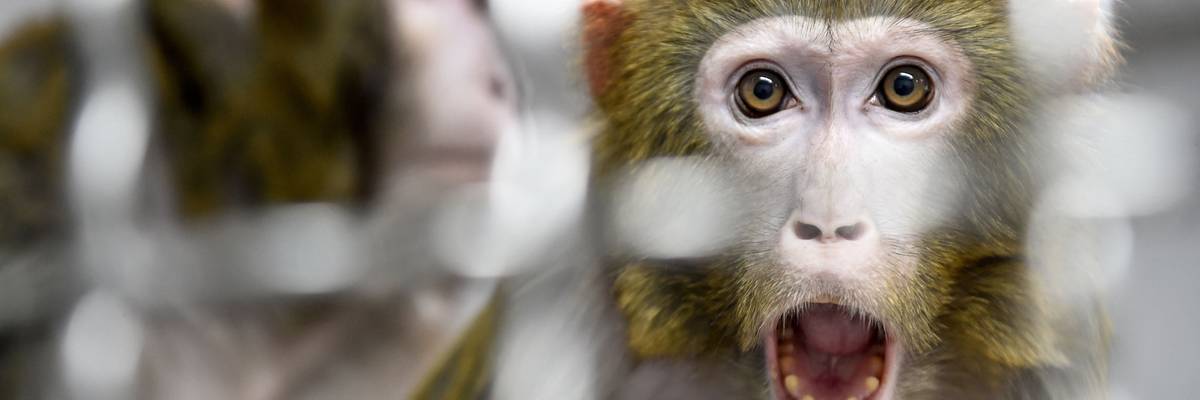
A Rhesus macaque, part of the 11 rescued monkeys from research laboratories, looks on from the quarantine room of the future animal shelter "La Taniere," in Nogent-le-Phaye near Chartres, on March 13, 2019.
Envisioning a Pro-Animal Foreign Policy
Various animal activists and thinkers answer the question: What would a pro-animal foreign policy, that we could plausibly get politicians to adopt, look like?
Some years back, I was toying with the idea of writing a book-length history of World War II from the perspective of wild and domesticated animals. I bought a number of relevant texts for research, like The Long Shadows: A Global Environmental History of the Second World War, edited by Simo Laakkonen, Richard P. Tucker, and Timo Vuorisalo. Ultimately, the project was more ambitious than what I was capable of, so I set it aside.
Still, I remained interested in the question which, at least partially, inspired my focus on the topic—namely, what would a pro-animal foreign policy, that we could plausibly get politicians to adopt, look like? Recently, I sought to ask various animal activists and thinkers that question. I had hoped to feature a broader range of figures. Nevertheless, I’m very grateful to all of the people who took the time to answer.
pattrice jones is a co-founder of VINE Sanctuary as well as an ecofeminist scholar and writer. VINE Sanctuary is an LGBTQ-led farmed animal refuge working for social and environmental justice as well as animal liberation. Prior to co-founding the sanctuary, jones worked as a tenant organizer and anti-racist educator. Her books include The Oxen at the Intersection and Bird’s-Eye Views: Queer Queries About Activism, Animals, and Identity.
“Countless animals are facing literally existential crises due to climate change, so the easiest animal-friendly foreign policy to promote would be to rejoin and rejuvenate international efforts to cooperatively do everything possible to address the climate emergency,” jones said. “I say ‘easiest’ because many—perhaps the majority—of people in the US already support efforts in that direction. Bonus points for bringing (a) diet and (b) the viewpoints of animals themselves into high-level international conversations about climate solutions.”
She pointed out wars kill animals and destroy their habitats, so a pro-animal foreign policy would necessarily be pro-peace. jones called for an end to giving or selling weapons to all countries and groups, aside from those engaged in legitimate self-defense. She wants to prohibit war unless the conflict was approved by domestic supermajorities and a majority of members of the United Nations.
“A vaccine for bird flu exists but has been blocked by international trade concerns of the poultry industry,” jones continued. “Not only farmed birds but also wild birds by the billions have died and will die. The risk for some wild bird species is, again, existential. The US should broker an international agreement so that this vaccine is available to all, including wild bird rehabbers who could begin to make a difference by vaccinating every bird who comes in for care for any reason. Foreign aid should include funds for the manufacture and distribution of this vaccine at scale.”
Martin Smedjeback is the chairperson of Animal Save Sweden. He campaigns for animal rights and the climate by giving presentations, facilitating workshops, participating in open rescues of animals, blockading oil transports, occasionally spending time in prison, taking photos, and shooting videos. Smedjeback argued the European Union should help accelerate the development of cultivated meat and levy higher taxes on traditional animal products.
“We need significantly more investment in alternative protein research,” he said. “Our environment, health, and animal welfare depend on a new food system where protein no longer originates from animals. We must develop plant-based foods and cultivated meat—produced from animal cells without harming the animal—that compete directly with conventional meat on taste and price. This transition is essential to tackling the climate crisis, reducing the risk of future pandemics, and curbing antibiotic overuse.”
Emilia A. Leese is an author, rewilder, and podcast host exploring the intersections of morality, food, and our relationship with the environment. She wrote Think Like a Vegan: Embracing Ethics in a Plant-Powered World. Leese believes a pro-animal foreign policy would be indistinguishable from a pro-animal domestic policy, and pushed back on the notion nonhuman activists should take into consideration existing political reality.
“We must abandon the mirage of ‘plausible’ reform within a system which is actively hostile against other animals,” she said, “Instead, we must demand radical change and reframe our current property-based utility to co-existence. This can be achieved by ascribing legal personhood to all other animals, such as is given to people and corporate or other legal entities. Or through a non-anthropocentric standard of beingness, like that developed by Professor Maneesha Deckha.”
Barry Kent MacKay is an artist, writer, and conservationist who has worked in different capacities for Born Free USA, the Animal Alliance of Canada, Zoocheck, the Animal Protection Party of Canada, Species Survival Network, the Toronto Humane Society, the Canadian Federation of Humane Societies, and others groups.
“History shows that while great reforms may seem fairly spontaneous—the result of a tipping point having been reached—there are incremental steps to get there,” MacKay said, putting forward a number of potential foreign policy goals. “I think the connection between Covid-19 and mustelids opens an opportunity for bans on mink farming, locally, and the import of live mustelids from other countries.”
Merritt Clifton is editor of the Animals 24-7 blog. Previously, he was news editor of the Animals’ Agenda magazine, editor of the Animal People newspaper, and editor of the annual Watchdog Report on Animal Charities. Working as a journalist since 1968, Clifton has reported as a foreign correspondent from approximately 40 different countries.
“The simplest, easiest thing to do would be to enforce [the Convention on International Trade in Endangered Species of Wild Fauna and Flora] and other relevant international treaties as written,” he said. “There are so many UN-brokered treaties relevant to animal welfare that I can’t even remember them all off the top of my head, also including the [International Whaling Commission] treaty, Treaty of Sea, several on various aspects of zoonotic disease, etc., but the US, though a signatory to practically all of them, has a terrible enforcement record.”
Moritz Stumpe is the executive director of Animal Advocacy Africa, which is trying to stop the spread of factory farming on the continent. He is based in Germany but travels regularly. Stumpe views his organization as a capacity builder and a bridge between the African and international animal protection movements.
He argued the same welfare standards should be applied to imported and domestic products. “This kind of policy should have broad support since it protects domestic farmers,” Stumpe said. “A similar principle applies to equipment that was used for practices that are prohibited in the Global North, like battery cages in Europe, not being exported to the Global South, where battery cages are still permitted.” He added Global North countries shouldn’t finance development projects in the Global South that promote factory farms.
S. Marek Muller is an associate professor of Communication Studies at Texas State University. They are the author of Impersonating Animals: Rhetoric, Ecofeminism, and Animal Rights Law and the forthcoming Soy Boy Beta Cuck: Primal Rhetoric and the Rise of Right-Wing Carnivorism. Their research centers discourses of animal rights and welfare as well as alt-protein biotechnologies.
“Sometimes imperialist tendencies get combined with genuine devotion to animal welfare and protection such that ‘our’ kind of animal relations are considered superior to ‘theirs’ in a way that ends up quite problematic in practice,” Muller said. “Take zoonotic disease in the cases of Ebola and Covid-19 and how, respectively, bushmeat and wet markets became the subjects of international scrutiny and denizens of non-Western countries were villainized as unsanitary, deviant, and cruel to animals.”
Muller noted there wasn’t much introspection in Western countries about industrial agriculture and its ties to zoonotic diseases and animal suffering. They added the far-right has used arguments about animal cruelty to demonize various human populations, for instance, by framing specific forms of religious slaughter as evidence of the inferiority of adherents to that faith.
“I'd say an important element of a pro-animal foreign policy involves the nation-state having humbleness about its own complicity in the animal-industrial complex, noting how being ‘pro’ animal will involve work from all parties in a foreign policy relationship, not a top-down relationship where the ‘civilized’ country ‘teaches’ the other country how to be,” Muller said. “I'm not talking about simplified cultural relativism, but rather an understanding of mutuality and dialogue where individual nations' individual contexts allow for distinct forms of animal protection that may not be a one-size-fits all situation.”
John Patrick is a co-founder of Scotland for Animals, a former member of the Scottish Parliament Cross-Party Animal Welfare Group, and a former Scottish Socialist Party animal-rights spokesman. He thinks foreign cooperation and assistance should be dependent on basic nonhuman welfare reforms with effective deterrents.
“Governments and alliances are able and willing to sanction other nations for a multitude of reasons,” he said. “They are also very keen to intervene at a diplomatic level on behalf of wealth and industry. They can and should apply this same pressure and zeal for failing or refusing to act on [the issue of animal protection].”
A longtime nonhuman activist, who previously founded Animal Outlook and worked at Humane World for Animals, Paul Shapiro is the author of Clean Meat: How Growing Meat Without Animals Will Revolutionize Dinner and the World. He believes the three most consequential pro-animal foreign policy goals would be to end United States financing for the global expansion of intensive animal agriculture, make the development of alternative proteins a food-security priority, and put enforceable animal-welfare provisions into trade agreements.
“Those would likely help vastly more animals than the symbolically attractive approach of concentrating foreign policy on dog meat, trophy hunting, or a handful of notorious festivals,” Shapiro said. “A pro-animal foreign policy would use American money and market access to change systems.”
Matthew A. King is the president and co-founder of the Christian Animal Rights Association. He has written a growing number of books which address nonhuman ethics from a faith-based perspective. His latest text is Pride Goes Before Destruction: Human Vanity, Animal Agriculture, and the New Covenant Solution.
“A pro-animal foreign policy would mirror the legal framework established domestically by measures like California’s Prop 12 and Massachusetts' Question 3, ensuring that international trade and imports of animal products are permitted only when they meet rigorous, humane welfare standards,” King said. “Additionally, a practical step would be redirecting US Agency for International Development funds away from industrial factory farming models and instead investing in sustainable, plant-based agricultural infrastructure abroad.”
Katherine Perlo is the author of Kinship and Killing: The Animal in World Religions. She has worked as a typist, typesetter, accompanist, piano teacher, and academic proofreader. Later in life, Perlo earned a doctoral degree in philosophy, choosing the subject in order to promote animal rights. While born in the United States, she lives in Scotland.
“Veganism can be promoted, using standard foreign policy mechanisms, through the perspective of land,” Perlo said. “Agricultural support, through subsidies, import-export policies, and aid, could go to stock-free food production along with human-socially beneficial land projects, as an essential part of land reform and land management.”
Itai Roffman, PhD, an evolutionary anthropologist and conservationist, is a senior lecturer, researcher, and co-executive director of the Jane Goodall Institute Israel. He established the Mali Chimpanzee Cultural Preservation, Rehabilitation and Tribal Heritage League, dedicated to initiation of tribal protected reservations for chimpanzees and other critically endangered species, via community-led ecological restoration.
“Rainforest destruction is a global catastrophe, as they are Earth's lungs,” Roffman said. “Factory farming as cause of zoonotic pathogens and spread of lethal epidemics is also a global concern. It pollutes ground water and rivers. Governments should work together to find technological alternatives to meat from slaughter, such as promoting commercially sound cultured meat from cells."
Marco Maurizi wrote Beyond Nature: Animal Liberation, Marxism, and Critical Theory. He is particularly interested in attempts to understand nonhuman protection as part of a wider left-wing project, rather than an isolated ethical issue. Maurizi teaches philosophy and history in Italian high schools, while collaborating with the University of Rome Tor Vergata.
“A plausible pro-animal foreign policy,” he said, “could include ending subsidies and other forms of state support for industrial animal agriculture; incorporating strong restrictions on animal exploitation into international trade agreements; opposing the expansion of factory farming through international development and investment programs; strengthening international action against wildlife trafficking and industrial fishing; and redirecting development aid toward plant-based and ecologically sustainable forms of agriculture.”
Spencer Roberts is a science writer, ecologist, musician, and engineer. In his journalistic work, he focuses on the climate crisis, marine life, and animal agriculture. Roberts’ work has been published in Wired, The Intercept, Jacobin, and elsewhere. He pointed out fishing is the largest source of human-caused animal suffering and premature death.
“Ending the subsidization of high seas and distant water fishing would not only save countless billions of animals, but would extend an olive branch in foreign policy, deescalating the ‘arms race‘ of competition for catch and hegemony of the high seas,” Roberts said. “These subsidies could be redirected to countries who endured United States military occupations, many to this day, particularly in the Pacific. Many small island nations derive a majority of their national revenue from licenses to foreign fleets to plunder their waters.”
We are at a crossroads
This country and this world are at a monumental crossroads. In a few short weeks, US voters will have an opportunity to beat back the forces of fascism and confront the billionaires who are rigging the economy, our media system, and our democracy, making it increasingly impossible for ordinary people to get by. We’re not just talking about the election. We’re talking about what must be done once these fascist elements are vanquished from power. We need a bolder set of solutions than what either major party has so far been willing to offer and a working-class movement ready to fight like hell for it. Trump didn't emerge from nowhere. The conditions that fueled MAGA authoritarianism were created by decades of radical neoliberal economic policies and a corrupt political system dominated by corporate interests. They slashed taxes on the super-rich, promising that the benefits would trickle down. They said giveaways to the corporate titans would make life more affordable for the rest of us. It was all bullshit. And when a bitter, betrayed populace searches for someone to blame, right-wing demagogues have little trouble finding scapegoats. People know when they're being lied to, but you won't hear any of this from the corporate media. Only independent journalism—powered and funded by people who believe in building a better world—can deliver truly trustworthy daily news. Our Fall Campaign is underway, and we need your help. To power our newsroom through the rest of the year, we need to raise $125,000 by midnight on October 31. So if you share our vision, please contribute whatever you can to sustain our work. |
Some years back, I was toying with the idea of writing a book-length history of World War II from the perspective of wild and domesticated animals. I bought a number of relevant texts for research, like The Long Shadows: A Global Environmental History of the Second World War, edited by Simo Laakkonen, Richard P. Tucker, and Timo Vuorisalo. Ultimately, the project was more ambitious than what I was capable of, so I set it aside.
Still, I remained interested in the question which, at least partially, inspired my focus on the topic—namely, what would a pro-animal foreign policy, that we could plausibly get politicians to adopt, look like? Recently, I sought to ask various animal activists and thinkers that question. I had hoped to feature a broader range of figures. Nevertheless, I’m very grateful to all of the people who took the time to answer.
pattrice jones is a co-founder of VINE Sanctuary as well as an ecofeminist scholar and writer. VINE Sanctuary is an LGBTQ-led farmed animal refuge working for social and environmental justice as well as animal liberation. Prior to co-founding the sanctuary, jones worked as a tenant organizer and anti-racist educator. Her books include The Oxen at the Intersection and Bird’s-Eye Views: Queer Queries About Activism, Animals, and Identity.
“Countless animals are facing literally existential crises due to climate change, so the easiest animal-friendly foreign policy to promote would be to rejoin and rejuvenate international efforts to cooperatively do everything possible to address the climate emergency,” jones said. “I say ‘easiest’ because many—perhaps the majority—of people in the US already support efforts in that direction. Bonus points for bringing (a) diet and (b) the viewpoints of animals themselves into high-level international conversations about climate solutions.”
She pointed out wars kill animals and destroy their habitats, so a pro-animal foreign policy would necessarily be pro-peace. jones called for an end to giving or selling weapons to all countries and groups, aside from those engaged in legitimate self-defense. She wants to prohibit war unless the conflict was approved by domestic supermajorities and a majority of members of the United Nations.
“A vaccine for bird flu exists but has been blocked by international trade concerns of the poultry industry,” jones continued. “Not only farmed birds but also wild birds by the billions have died and will die. The risk for some wild bird species is, again, existential. The US should broker an international agreement so that this vaccine is available to all, including wild bird rehabbers who could begin to make a difference by vaccinating every bird who comes in for care for any reason. Foreign aid should include funds for the manufacture and distribution of this vaccine at scale.”
Martin Smedjeback is the chairperson of Animal Save Sweden. He campaigns for animal rights and the climate by giving presentations, facilitating workshops, participating in open rescues of animals, blockading oil transports, occasionally spending time in prison, taking photos, and shooting videos. Smedjeback argued the European Union should help accelerate the development of cultivated meat and levy higher taxes on traditional animal products.
“We need significantly more investment in alternative protein research,” he said. “Our environment, health, and animal welfare depend on a new food system where protein no longer originates from animals. We must develop plant-based foods and cultivated meat—produced from animal cells without harming the animal—that compete directly with conventional meat on taste and price. This transition is essential to tackling the climate crisis, reducing the risk of future pandemics, and curbing antibiotic overuse.”
Emilia A. Leese is an author, rewilder, and podcast host exploring the intersections of morality, food, and our relationship with the environment. She wrote Think Like a Vegan: Embracing Ethics in a Plant-Powered World. Leese believes a pro-animal foreign policy would be indistinguishable from a pro-animal domestic policy, and pushed back on the notion nonhuman activists should take into consideration existing political reality.
“We must abandon the mirage of ‘plausible’ reform within a system which is actively hostile against other animals,” she said, “Instead, we must demand radical change and reframe our current property-based utility to co-existence. This can be achieved by ascribing legal personhood to all other animals, such as is given to people and corporate or other legal entities. Or through a non-anthropocentric standard of beingness, like that developed by Professor Maneesha Deckha.”
Barry Kent MacKay is an artist, writer, and conservationist who has worked in different capacities for Born Free USA, the Animal Alliance of Canada, Zoocheck, the Animal Protection Party of Canada, Species Survival Network, the Toronto Humane Society, the Canadian Federation of Humane Societies, and others groups.
“History shows that while great reforms may seem fairly spontaneous—the result of a tipping point having been reached—there are incremental steps to get there,” MacKay said, putting forward a number of potential foreign policy goals. “I think the connection between Covid-19 and mustelids opens an opportunity for bans on mink farming, locally, and the import of live mustelids from other countries.”
Merritt Clifton is editor of the Animals 24-7 blog. Previously, he was news editor of the Animals’ Agenda magazine, editor of the Animal People newspaper, and editor of the annual Watchdog Report on Animal Charities. Working as a journalist since 1968, Clifton has reported as a foreign correspondent from approximately 40 different countries.
“The simplest, easiest thing to do would be to enforce [the Convention on International Trade in Endangered Species of Wild Fauna and Flora] and other relevant international treaties as written,” he said. “There are so many UN-brokered treaties relevant to animal welfare that I can’t even remember them all off the top of my head, also including the [International Whaling Commission] treaty, Treaty of Sea, several on various aspects of zoonotic disease, etc., but the US, though a signatory to practically all of them, has a terrible enforcement record.”
Moritz Stumpe is the executive director of Animal Advocacy Africa, which is trying to stop the spread of factory farming on the continent. He is based in Germany but travels regularly. Stumpe views his organization as a capacity builder and a bridge between the African and international animal protection movements.
He argued the same welfare standards should be applied to imported and domestic products. “This kind of policy should have broad support since it protects domestic farmers,” Stumpe said. “A similar principle applies to equipment that was used for practices that are prohibited in the Global North, like battery cages in Europe, not being exported to the Global South, where battery cages are still permitted.” He added Global North countries shouldn’t finance development projects in the Global South that promote factory farms.
S. Marek Muller is an associate professor of Communication Studies at Texas State University. They are the author of Impersonating Animals: Rhetoric, Ecofeminism, and Animal Rights Law and the forthcoming Soy Boy Beta Cuck: Primal Rhetoric and the Rise of Right-Wing Carnivorism. Their research centers discourses of animal rights and welfare as well as alt-protein biotechnologies.
“Sometimes imperialist tendencies get combined with genuine devotion to animal welfare and protection such that ‘our’ kind of animal relations are considered superior to ‘theirs’ in a way that ends up quite problematic in practice,” Muller said. “Take zoonotic disease in the cases of Ebola and Covid-19 and how, respectively, bushmeat and wet markets became the subjects of international scrutiny and denizens of non-Western countries were villainized as unsanitary, deviant, and cruel to animals.”
Muller noted there wasn’t much introspection in Western countries about industrial agriculture and its ties to zoonotic diseases and animal suffering. They added the far-right has used arguments about animal cruelty to demonize various human populations, for instance, by framing specific forms of religious slaughter as evidence of the inferiority of adherents to that faith.
“I'd say an important element of a pro-animal foreign policy involves the nation-state having humbleness about its own complicity in the animal-industrial complex, noting how being ‘pro’ animal will involve work from all parties in a foreign policy relationship, not a top-down relationship where the ‘civilized’ country ‘teaches’ the other country how to be,” Muller said. “I'm not talking about simplified cultural relativism, but rather an understanding of mutuality and dialogue where individual nations' individual contexts allow for distinct forms of animal protection that may not be a one-size-fits all situation.”
John Patrick is a co-founder of Scotland for Animals, a former member of the Scottish Parliament Cross-Party Animal Welfare Group, and a former Scottish Socialist Party animal-rights spokesman. He thinks foreign cooperation and assistance should be dependent on basic nonhuman welfare reforms with effective deterrents.
“Governments and alliances are able and willing to sanction other nations for a multitude of reasons,” he said. “They are also very keen to intervene at a diplomatic level on behalf of wealth and industry. They can and should apply this same pressure and zeal for failing or refusing to act on [the issue of animal protection].”
A longtime nonhuman activist, who previously founded Animal Outlook and worked at Humane World for Animals, Paul Shapiro is the author of Clean Meat: How Growing Meat Without Animals Will Revolutionize Dinner and the World. He believes the three most consequential pro-animal foreign policy goals would be to end United States financing for the global expansion of intensive animal agriculture, make the development of alternative proteins a food-security priority, and put enforceable animal-welfare provisions into trade agreements.
“Those would likely help vastly more animals than the symbolically attractive approach of concentrating foreign policy on dog meat, trophy hunting, or a handful of notorious festivals,” Shapiro said. “A pro-animal foreign policy would use American money and market access to change systems.”
Matthew A. King is the president and co-founder of the Christian Animal Rights Association. He has written a growing number of books which address nonhuman ethics from a faith-based perspective. His latest text is Pride Goes Before Destruction: Human Vanity, Animal Agriculture, and the New Covenant Solution.
“A pro-animal foreign policy would mirror the legal framework established domestically by measures like California’s Prop 12 and Massachusetts' Question 3, ensuring that international trade and imports of animal products are permitted only when they meet rigorous, humane welfare standards,” King said. “Additionally, a practical step would be redirecting US Agency for International Development funds away from industrial factory farming models and instead investing in sustainable, plant-based agricultural infrastructure abroad.”
Katherine Perlo is the author of Kinship and Killing: The Animal in World Religions. She has worked as a typist, typesetter, accompanist, piano teacher, and academic proofreader. Later in life, Perlo earned a doctoral degree in philosophy, choosing the subject in order to promote animal rights. While born in the United States, she lives in Scotland.
“Veganism can be promoted, using standard foreign policy mechanisms, through the perspective of land,” Perlo said. “Agricultural support, through subsidies, import-export policies, and aid, could go to stock-free food production along with human-socially beneficial land projects, as an essential part of land reform and land management.”
Itai Roffman, PhD, an evolutionary anthropologist and conservationist, is a senior lecturer, researcher, and co-executive director of the Jane Goodall Institute Israel. He established the Mali Chimpanzee Cultural Preservation, Rehabilitation and Tribal Heritage League, dedicated to initiation of tribal protected reservations for chimpanzees and other critically endangered species, via community-led ecological restoration.
“Rainforest destruction is a global catastrophe, as they are Earth's lungs,” Roffman said. “Factory farming as cause of zoonotic pathogens and spread of lethal epidemics is also a global concern. It pollutes ground water and rivers. Governments should work together to find technological alternatives to meat from slaughter, such as promoting commercially sound cultured meat from cells."
Marco Maurizi wrote Beyond Nature: Animal Liberation, Marxism, and Critical Theory. He is particularly interested in attempts to understand nonhuman protection as part of a wider left-wing project, rather than an isolated ethical issue. Maurizi teaches philosophy and history in Italian high schools, while collaborating with the University of Rome Tor Vergata.
“A plausible pro-animal foreign policy,” he said, “could include ending subsidies and other forms of state support for industrial animal agriculture; incorporating strong restrictions on animal exploitation into international trade agreements; opposing the expansion of factory farming through international development and investment programs; strengthening international action against wildlife trafficking and industrial fishing; and redirecting development aid toward plant-based and ecologically sustainable forms of agriculture.”
Spencer Roberts is a science writer, ecologist, musician, and engineer. In his journalistic work, he focuses on the climate crisis, marine life, and animal agriculture. Roberts’ work has been published in Wired, The Intercept, Jacobin, and elsewhere. He pointed out fishing is the largest source of human-caused animal suffering and premature death.
“Ending the subsidization of high seas and distant water fishing would not only save countless billions of animals, but would extend an olive branch in foreign policy, deescalating the ‘arms race‘ of competition for catch and hegemony of the high seas,” Roberts said. “These subsidies could be redirected to countries who endured United States military occupations, many to this day, particularly in the Pacific. Many small island nations derive a majority of their national revenue from licenses to foreign fleets to plunder their waters.”
Some years back, I was toying with the idea of writing a book-length history of World War II from the perspective of wild and domesticated animals. I bought a number of relevant texts for research, like The Long Shadows: A Global Environmental History of the Second World War, edited by Simo Laakkonen, Richard P. Tucker, and Timo Vuorisalo. Ultimately, the project was more ambitious than what I was capable of, so I set it aside.
Still, I remained interested in the question which, at least partially, inspired my focus on the topic—namely, what would a pro-animal foreign policy, that we could plausibly get politicians to adopt, look like? Recently, I sought to ask various animal activists and thinkers that question. I had hoped to feature a broader range of figures. Nevertheless, I’m very grateful to all of the people who took the time to answer.
pattrice jones is a co-founder of VINE Sanctuary as well as an ecofeminist scholar and writer. VINE Sanctuary is an LGBTQ-led farmed animal refuge working for social and environmental justice as well as animal liberation. Prior to co-founding the sanctuary, jones worked as a tenant organizer and anti-racist educator. Her books include The Oxen at the Intersection and Bird’s-Eye Views: Queer Queries About Activism, Animals, and Identity.
“Countless animals are facing literally existential crises due to climate change, so the easiest animal-friendly foreign policy to promote would be to rejoin and rejuvenate international efforts to cooperatively do everything possible to address the climate emergency,” jones said. “I say ‘easiest’ because many—perhaps the majority—of people in the US already support efforts in that direction. Bonus points for bringing (a) diet and (b) the viewpoints of animals themselves into high-level international conversations about climate solutions.”
She pointed out wars kill animals and destroy their habitats, so a pro-animal foreign policy would necessarily be pro-peace. jones called for an end to giving or selling weapons to all countries and groups, aside from those engaged in legitimate self-defense. She wants to prohibit war unless the conflict was approved by domestic supermajorities and a majority of members of the United Nations.
“A vaccine for bird flu exists but has been blocked by international trade concerns of the poultry industry,” jones continued. “Not only farmed birds but also wild birds by the billions have died and will die. The risk for some wild bird species is, again, existential. The US should broker an international agreement so that this vaccine is available to all, including wild bird rehabbers who could begin to make a difference by vaccinating every bird who comes in for care for any reason. Foreign aid should include funds for the manufacture and distribution of this vaccine at scale.”
Martin Smedjeback is the chairperson of Animal Save Sweden. He campaigns for animal rights and the climate by giving presentations, facilitating workshops, participating in open rescues of animals, blockading oil transports, occasionally spending time in prison, taking photos, and shooting videos. Smedjeback argued the European Union should help accelerate the development of cultivated meat and levy higher taxes on traditional animal products.
“We need significantly more investment in alternative protein research,” he said. “Our environment, health, and animal welfare depend on a new food system where protein no longer originates from animals. We must develop plant-based foods and cultivated meat—produced from animal cells without harming the animal—that compete directly with conventional meat on taste and price. This transition is essential to tackling the climate crisis, reducing the risk of future pandemics, and curbing antibiotic overuse.”
Emilia A. Leese is an author, rewilder, and podcast host exploring the intersections of morality, food, and our relationship with the environment. She wrote Think Like a Vegan: Embracing Ethics in a Plant-Powered World. Leese believes a pro-animal foreign policy would be indistinguishable from a pro-animal domestic policy, and pushed back on the notion nonhuman activists should take into consideration existing political reality.
“We must abandon the mirage of ‘plausible’ reform within a system which is actively hostile against other animals,” she said, “Instead, we must demand radical change and reframe our current property-based utility to co-existence. This can be achieved by ascribing legal personhood to all other animals, such as is given to people and corporate or other legal entities. Or through a non-anthropocentric standard of beingness, like that developed by Professor Maneesha Deckha.”
Barry Kent MacKay is an artist, writer, and conservationist who has worked in different capacities for Born Free USA, the Animal Alliance of Canada, Zoocheck, the Animal Protection Party of Canada, Species Survival Network, the Toronto Humane Society, the Canadian Federation of Humane Societies, and others groups.
“History shows that while great reforms may seem fairly spontaneous—the result of a tipping point having been reached—there are incremental steps to get there,” MacKay said, putting forward a number of potential foreign policy goals. “I think the connection between Covid-19 and mustelids opens an opportunity for bans on mink farming, locally, and the import of live mustelids from other countries.”
Merritt Clifton is editor of the Animals 24-7 blog. Previously, he was news editor of the Animals’ Agenda magazine, editor of the Animal People newspaper, and editor of the annual Watchdog Report on Animal Charities. Working as a journalist since 1968, Clifton has reported as a foreign correspondent from approximately 40 different countries.
“The simplest, easiest thing to do would be to enforce [the Convention on International Trade in Endangered Species of Wild Fauna and Flora] and other relevant international treaties as written,” he said. “There are so many UN-brokered treaties relevant to animal welfare that I can’t even remember them all off the top of my head, also including the [International Whaling Commission] treaty, Treaty of Sea, several on various aspects of zoonotic disease, etc., but the US, though a signatory to practically all of them, has a terrible enforcement record.”
Moritz Stumpe is the executive director of Animal Advocacy Africa, which is trying to stop the spread of factory farming on the continent. He is based in Germany but travels regularly. Stumpe views his organization as a capacity builder and a bridge between the African and international animal protection movements.
He argued the same welfare standards should be applied to imported and domestic products. “This kind of policy should have broad support since it protects domestic farmers,” Stumpe said. “A similar principle applies to equipment that was used for practices that are prohibited in the Global North, like battery cages in Europe, not being exported to the Global South, where battery cages are still permitted.” He added Global North countries shouldn’t finance development projects in the Global South that promote factory farms.
S. Marek Muller is an associate professor of Communication Studies at Texas State University. They are the author of Impersonating Animals: Rhetoric, Ecofeminism, and Animal Rights Law and the forthcoming Soy Boy Beta Cuck: Primal Rhetoric and the Rise of Right-Wing Carnivorism. Their research centers discourses of animal rights and welfare as well as alt-protein biotechnologies.
“Sometimes imperialist tendencies get combined with genuine devotion to animal welfare and protection such that ‘our’ kind of animal relations are considered superior to ‘theirs’ in a way that ends up quite problematic in practice,” Muller said. “Take zoonotic disease in the cases of Ebola and Covid-19 and how, respectively, bushmeat and wet markets became the subjects of international scrutiny and denizens of non-Western countries were villainized as unsanitary, deviant, and cruel to animals.”
Muller noted there wasn’t much introspection in Western countries about industrial agriculture and its ties to zoonotic diseases and animal suffering. They added the far-right has used arguments about animal cruelty to demonize various human populations, for instance, by framing specific forms of religious slaughter as evidence of the inferiority of adherents to that faith.
“I'd say an important element of a pro-animal foreign policy involves the nation-state having humbleness about its own complicity in the animal-industrial complex, noting how being ‘pro’ animal will involve work from all parties in a foreign policy relationship, not a top-down relationship where the ‘civilized’ country ‘teaches’ the other country how to be,” Muller said. “I'm not talking about simplified cultural relativism, but rather an understanding of mutuality and dialogue where individual nations' individual contexts allow for distinct forms of animal protection that may not be a one-size-fits all situation.”
John Patrick is a co-founder of Scotland for Animals, a former member of the Scottish Parliament Cross-Party Animal Welfare Group, and a former Scottish Socialist Party animal-rights spokesman. He thinks foreign cooperation and assistance should be dependent on basic nonhuman welfare reforms with effective deterrents.
“Governments and alliances are able and willing to sanction other nations for a multitude of reasons,” he said. “They are also very keen to intervene at a diplomatic level on behalf of wealth and industry. They can and should apply this same pressure and zeal for failing or refusing to act on [the issue of animal protection].”
A longtime nonhuman activist, who previously founded Animal Outlook and worked at Humane World for Animals, Paul Shapiro is the author of Clean Meat: How Growing Meat Without Animals Will Revolutionize Dinner and the World. He believes the three most consequential pro-animal foreign policy goals would be to end United States financing for the global expansion of intensive animal agriculture, make the development of alternative proteins a food-security priority, and put enforceable animal-welfare provisions into trade agreements.
“Those would likely help vastly more animals than the symbolically attractive approach of concentrating foreign policy on dog meat, trophy hunting, or a handful of notorious festivals,” Shapiro said. “A pro-animal foreign policy would use American money and market access to change systems.”
Matthew A. King is the president and co-founder of the Christian Animal Rights Association. He has written a growing number of books which address nonhuman ethics from a faith-based perspective. His latest text is Pride Goes Before Destruction: Human Vanity, Animal Agriculture, and the New Covenant Solution.
“A pro-animal foreign policy would mirror the legal framework established domestically by measures like California’s Prop 12 and Massachusetts' Question 3, ensuring that international trade and imports of animal products are permitted only when they meet rigorous, humane welfare standards,” King said. “Additionally, a practical step would be redirecting US Agency for International Development funds away from industrial factory farming models and instead investing in sustainable, plant-based agricultural infrastructure abroad.”
Katherine Perlo is the author of Kinship and Killing: The Animal in World Religions. She has worked as a typist, typesetter, accompanist, piano teacher, and academic proofreader. Later in life, Perlo earned a doctoral degree in philosophy, choosing the subject in order to promote animal rights. While born in the United States, she lives in Scotland.
“Veganism can be promoted, using standard foreign policy mechanisms, through the perspective of land,” Perlo said. “Agricultural support, through subsidies, import-export policies, and aid, could go to stock-free food production along with human-socially beneficial land projects, as an essential part of land reform and land management.”
Itai Roffman, PhD, an evolutionary anthropologist and conservationist, is a senior lecturer, researcher, and co-executive director of the Jane Goodall Institute Israel. He established the Mali Chimpanzee Cultural Preservation, Rehabilitation and Tribal Heritage League, dedicated to initiation of tribal protected reservations for chimpanzees and other critically endangered species, via community-led ecological restoration.
“Rainforest destruction is a global catastrophe, as they are Earth's lungs,” Roffman said. “Factory farming as cause of zoonotic pathogens and spread of lethal epidemics is also a global concern. It pollutes ground water and rivers. Governments should work together to find technological alternatives to meat from slaughter, such as promoting commercially sound cultured meat from cells."
Marco Maurizi wrote Beyond Nature: Animal Liberation, Marxism, and Critical Theory. He is particularly interested in attempts to understand nonhuman protection as part of a wider left-wing project, rather than an isolated ethical issue. Maurizi teaches philosophy and history in Italian high schools, while collaborating with the University of Rome Tor Vergata.
“A plausible pro-animal foreign policy,” he said, “could include ending subsidies and other forms of state support for industrial animal agriculture; incorporating strong restrictions on animal exploitation into international trade agreements; opposing the expansion of factory farming through international development and investment programs; strengthening international action against wildlife trafficking and industrial fishing; and redirecting development aid toward plant-based and ecologically sustainable forms of agriculture.”
Spencer Roberts is a science writer, ecologist, musician, and engineer. In his journalistic work, he focuses on the climate crisis, marine life, and animal agriculture. Roberts’ work has been published in Wired, The Intercept, Jacobin, and elsewhere. He pointed out fishing is the largest source of human-caused animal suffering and premature death.
“Ending the subsidization of high seas and distant water fishing would not only save countless billions of animals, but would extend an olive branch in foreign policy, deescalating the ‘arms race‘ of competition for catch and hegemony of the high seas,” Roberts said. “These subsidies could be redirected to countries who endured United States military occupations, many to this day, particularly in the Pacific. Many small island nations derive a majority of their national revenue from licenses to foreign fleets to plunder their waters.”