SUBSCRIBE TO OUR FREE NEWSLETTER
Daily news & progressive opinion—funded by the people, not the corporations—delivered straight to your inbox.
5
#000000
#FFFFFF
To donate by check, phone, or other method, see our More Ways to Give page.


Daily news & progressive opinion—funded by the people, not the corporations—delivered straight to your inbox.

Civil rights and liberties organization makes its largest-ever electoral investment for a midterm to protect reproductive freedom, voting rights, & democracy
In 2026, the American Civil Liberties Union will make its largest-ever investment in down ballot races, marking a historic escalation in its “Firewall for Freedom” strategy to protect civil liberties across the country. As part of this new campaign, the ACLU will spend $25.5 million across underfunded but critical state-level campaigns with an outsized impact on American’s rights and freedoms, from key ballot initiatives to state Supreme Court races, secretaries of state races, and state legislative races.
“The ACLU and our millions of supporters across the country have been at the forefront of the fight to protect Americans’ civil rights and liberties, but these freedoms remain under attack both at the federal level and in the states. We need to fight back,” said Deirdre Schifeling, ACLU chief political and advocacy officer. “The Firewall for Freedom campaign will allow the ACLU to stop efforts to restrict reproductive and voting rights and protect our democracy at every level of the ballot. We see where the threats are emerging, and we and our supporters are ready to respond. This is our largest-ever down ballot effort with plans to contact hundreds of thousands of voters across our key states to help protect our fundamental rights and freedoms.”
In recent campaign cycles, the ACLU and ACLU Foundation together have emerged as the largest institutional player in the ballot measure space on issues of reproductive freedom and democracy, with notable victories in Arizona, Kansas, Kentucky, Missouri, Michigan, Montana, and Ohio.
The ACLU and ACLU Voter Education Fund together have also become one of the biggest spenders in state Supreme Court races. Meanwhile state and local offices have proven increasingly decisive in determining the future of key rights and liberties, including voting rights, abortion access, and LGBTQ rights.
This new $25.5 million campaign is a response to the new threats to civil liberties emerging at every level of the ballot and will be complemented by the ACLU’s national organizing infrastructure that helps educate voters and mobilize communities. Working with the ACLU’s 54 affiliates, the ACLU and the ACLU Foundation will work to beat back ballot measures aimed at overturning hard-fought victories to protect abortion rights and overturning the will of the people, as well as investing in initiatives to protect state courts from politicized judicial selections. The ACLU and ACLU Voter Education Fund will educate voters about important state Supreme Court races that impact civil rights and freedoms and equip them with information about how supermajorities in state legislatures can impact civil liberties across the country.
The Firewall for Freedom effort will target the following races, ensuring they have the resources to educate voters to make informed decisions when so many resources are flooding into federal campaigns:
The American Civil Liberties Union was founded in 1920 and is our nation's guardian of liberty. The ACLU works in the courts, legislatures and communities to defend and preserve the individual rights and liberties guaranteed to all people in this country by the Constitution and laws of the United States.
(212) 549-2666“Everyone should be alarmed that ICE is preparing to deploy a tool designed to inflict, at best, intense pain," said one watchdog.

When US Immigration and Customs Enforcement ordered 6,000 pairs of shock gloves this summer, the agency knew that they could cause such "intense pain" that victims stopped fighting immediately and became fearful of more shocks.
That's according to The Associated Press, which on Tuesday revealed the existence of a US Army study on the gloves. ICE put in a $17 million order for the product, known as the Generated Low Output Voltage Emitter (GLOVE), in August.
In October 2024, the GLOVE was tested on Army employees at the military prison in Fort Leavenworth, Kansas, to see if it could be incorporated into their practices to move noncompliant prisoners between cells.
According to the AP:
The shocks had a profound impact on Army employees who played the role of combative prisoners during the exercise... The participants, several of whom were large-statured men, stopped resisting seconds after officers applied shocks by touching gloves to their skin, and were left with “fatigue, soreness and excessive apprehensiveness to being shocked again,” the study found.
After experiencing the effects of the GLOVE, ... ["]participants stated just seeing the GLOVE was enough to make them want to comply,” the authors wrote.
The report later noted that unlike a taser, which is designed to cause the body of a noncompliant person to freeze, the GLOVE is meant to elicit pain. It "works by overloading the peripheral nerve endings,” the study said. It also noted that participants with water or oil on their skin experienced more severe shocks and that one was left in pain for 30 minutes afterward.
The full report has not yet been released to the public; however, a four-page memo from the Department of the Army's Office of the Project Manager for Close Combat Systems summarizing its findings can be found on the website of the GLOVE's manufacturer, Compliant Technologies.
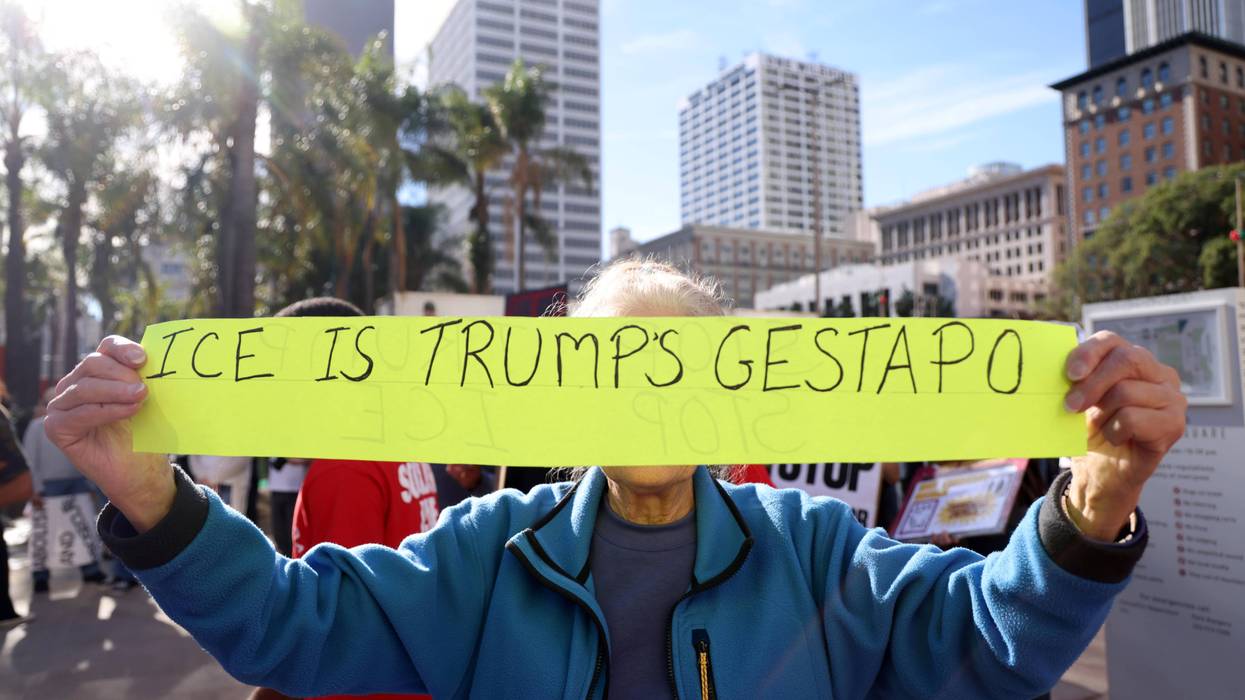
ICE has described the shock gloves as a tool to "de-escalate" conflicts in the street with targets of the Trump administration's mass deportation campaign, as well as protesters against the policy—it has said the gloves would be used to subdue those “actively or passively resisting” agents' commands.
In the wake of several fatal shootings by agents that lacked clear justification, the agency has described the gloves as a “low-impact tool” that will allow agents to avoid escalating to more extreme uses of force.
When politicians have called to restrict access to the gloves, ICE's parent agency, the Department of Homeland Security (DHS), accused them of trying to deprive federal officers of "safety equipment."
The user manual of the GLOVE notes that the "pain stimulus" it delivers can produce psychological changes associated with sudden death, including increased blood pressure, heart rate, and adrenaline, as well as changes in blood chemistry and heart rhythm. It also notes that those shocked with the gloves could face serious injuries from falling after suddenly losing control of their extremities.
The manual recommends that the gloves not be used against older people, small children, people who are pregnant, and people with certain disabilities.
As Reagan Williams, a researcher at Human Rights Watch's Crisis, Conflict and Arms Division, noted in August, agency operations have regularly targeted these groups.
"Electric shock devices have long been abusively deployed around the globe, including as a method of torture and other ill-treatment. Given these risks, the European Union has implemented trade restrictions on these devices," Williams said. "The scale of this technology’s potential harm in the hands of ICE, an abusive agency whose recruits are deployed with minimal training, could be considerable."
Chioma Chukwu, executive director of American Oversight, which provided the report to the AP, noted that while the Army report concluded the gloves were effective, it said little about their safety.
“The military assessment in ICE’s own files shows that these gloves can cause ‘intense pain’ and force compliance. It does not establish that they are safe,” Chukwu said. “Everyone should be alarmed that ICE is preparing to deploy a tool designed to inflict, at best, intense pain, without showing that it is safe for the people who will be subjected to it.”
While tasers can leave severe burns and welts on subjects, the shock gloves being adopted by ICE can deliver a painful shock without leaving a mark, making it much harder to prove their use. For law enforcement agencies, this is one of their most alluring features.
“I highly recommend these gloves to anybody that’s looking for a utility they can use that is conducive to not leading to lawsuits," said Bob Couey, chief deputy of the Floyd County Sheriff’s Office in Georgia, in a promotional video posted by Compliant Technologies in 2024 and resurfaced in August by Mother Jones.
Even a former ICE acting director, John Sandweg, has warned that because the gloves are so easy to use, agents might feel compelled to deploy them haphazardly.
“It’s too easy for this to get misused, against a population that doesn’t pose a threat,” Sandweg, who led the agency for about six months during the Obama administration, told MS NOW in August.
The gloves have drawn substantial criticism from Democratic members of Congress. In late August, Rep. Delia Ramirez (D-Ill.) led a group of 49 members of the US House of Representatives to demand the contract be canceled.
“Introducing low-visibility electric shock weapons into our immigration enforcement system is an unacceptable escalation that prioritizes physical intimidation and unaccountable force over human safety and administrative accountability," they said in a letter to DHS Secretary Markwayne Mullin.
ICE, meanwhile, has been less than forthcoming about what guardrails will govern the use of the shock gloves. In late August, Sen. Catherine Cortez Masto (D-Nev.) and 15 other Democratic senators asked the agency to answer questions about how the gloves will be used, who they'll be used against, and whether it has conducted safety evaluations.
Cortez Masto told the AP that over a month later, the agency has not answered her and her colleagues' questions.
The president also met with election denier and former county clerk Tina Peters and discussed "plans" for the election on Monday.
International election observers who have monitored US federal elections since 2002, in line with the practices of the vast majority of countries across North America, Europe, and Asia, said Tuesday that President Donald Trump's refusal to invite the Organization for Security and Cooperation in Europe to observe the November midterms was "regrettable" and "not in line" with the United States' commitments.
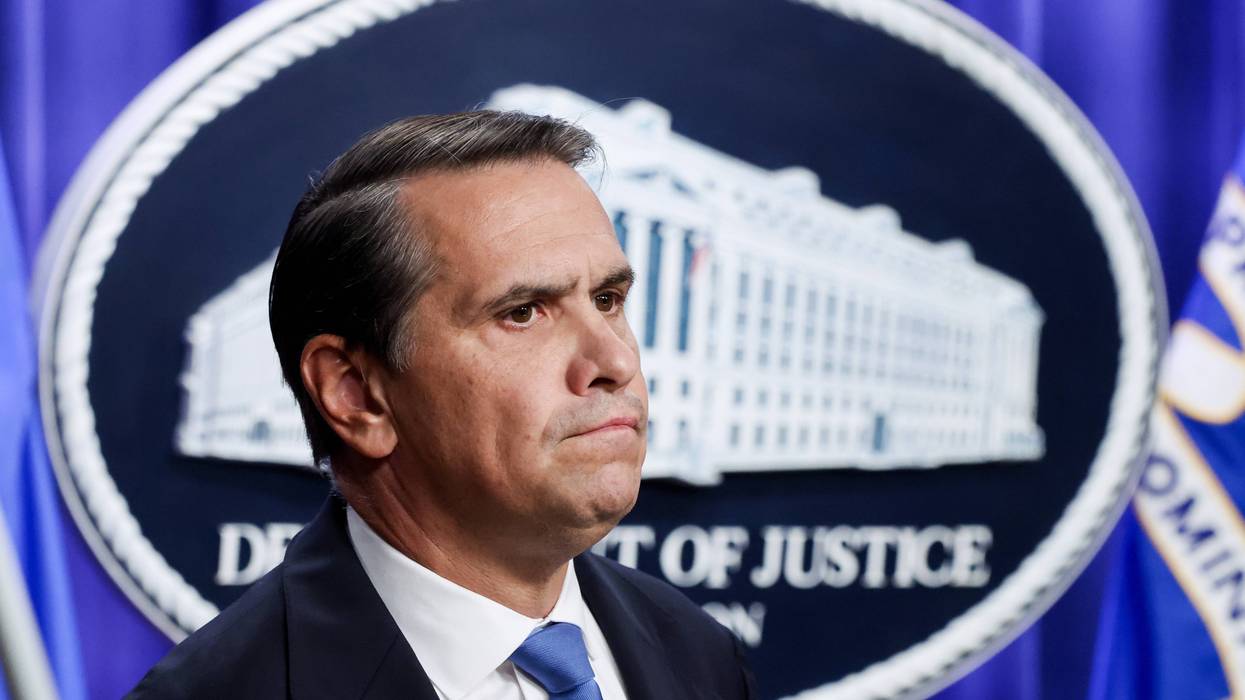
The decision was announced as the US Department of Justice defended the administration's plans to send its own election monitors to the polls, with Attorney General Todd Blanche insisting in an interview with Fox News on Sunday that Trump "is doing the same thing that every single administration has done in our generation and in multiple generations."
In a letter to Blanche and Harmeet K. Dhillon, the assistant attorney general for civil rights, US Reps. Jamie Raskin (D-Md.) and Joe Morelle (D-NY) wrote last week that Congress authorized federal election observers in 1965 under the Voting Rights Act, with observers determining "whether persons who are entitled to vote are being permitted to vote” and “whether votes cast by persons entitled to vote are being properly tabulated."
The DOJ's Civil Rights Division also sends its attorneys to monitor elections, with observers required to remain outside polling places and notify local authorities of their presence.
But the DOJ deployed monitors to eight states over the summer to observe primary elections, and Wyoming Gov. Mark Gordon, a Republican, complained of "aggressive" and "disruptive" behavior, including demands to interview voters and attempts to access voting machines.
"In light of the DOJ’s announcement that it intends to deploy an unprecedented 1,000 monitors to polling places throughout the
country for the general election," wrote Raskin and Morelle, "the DOJ must demonstrate that it is not misusing its election monitoring program in any way and that its monitors are being used for appropriate purposes."
Some Republican officials have alluded to plans for US Immigration and Customs Enforcement (ICE) to go to polling places during the midterms. The Department of Homeland Security has denied there is such a plan, but Trump, who has persistently claimed US elections are rife with so-called "voter fraud," has said he would "do anything necessary to make sure we have honest elections."
The news that the OSCE is not being invited to observe the midterms only heightened concerns that the administration may try to intimidate people who go to vote in elections that Republicans are widely expected to lose, as Trump's approval rate plummets to 32% and Americans express disdain for his war on Iran, soaring prices of everyday goods, and the violent mass deportation agenda that has turned communities upside down.
“The Trump administration’s decision not to invite international observers to the United States is deeply antithetical to the spirit of freedom, democracy, and transparency that defines our elections," said Sen. Jeanne Shaheen, ranking member of the Senate Foreign Relations Committee. “I was an official election monitor in the country of Georgia in 2012 and most recently in Bosnia and Herzegovina in 2022, so I know firsthand the importance of showing up for Allies and partners to improve the public’s confidence in election integrity. The OSCE does just that."
"I urge the Trump administration to respect the role of independent election observers and ensure that the United States holds itself to the same standards that we would expect of any other democracy," said Shaheen.
The decision to keep the OSCE from observing the elections makes the US one of only three countries in the organization, along with Russia and Belarus, to do so.
“Refusing election observers is usually something that countries in a position of weakness do, when they know that they have corrupt or unfair elections,” said Dan Baer, a former US ambassador to the OSCE during the Obama administration, told MS NOW on Tuesday. “It’s very strange for the United States, which has been historically a standard setter in free and fair elections, to refuse observers.”
On Monday, Trump also met with former Mesa County, Colorado clerk Tina Peters, who was convicted on charges of trying to breach the state's voting machines in a search for evidence that election had been committed in the 2020 election Trump lost. Democratic Gov. Jared Polis granted Peters clemency after repeated calls from Trump.
Former acting US Attorney Ed Martin told Real America's Voice that Trump and Peters were "talking about the plans" for the elections, and claimed voting machines are "compromised" because parts of them are manufactured in China and Russia.
Ed Martin says that Tina Peters met with Trump in the Oval Office today to discuss election integrity and “the plans” for the upcoming midterms elections. https://t.co/NsGuZ4UNSO
— Anna Bower (@AnnaBower) October 6, 2026
"If she's meeting with Trump to talk about the midterms," said journalist Pedro L. Gonzalez, "then there is a real non-zero chance that Trump is going to try or wants to try to do something to upend them."
A 15-year-old's hand was blown off, a 16-year-old suffered a devastating eye injury, and a 14-year-old reportedly lost most of his teeth as Amnesty International accused French police of using disproportionate force.
Young people across France suffered horrifying injuries this week as riot police attacked high school and university students, faculty, and parents who were joined by striking workers in the latest nationwide mobilization over the country's underfunded education system.
Hundreds of thousands of students, workers, and their supporters rallied at more than 170 demonstrations across France Tuesday, with the arrest total topping 6,000 people—including roughly 4,400 minors—since the current wave of demonstrations began on September 28, according to the country's Interior Ministry.
The school blockades and other protests began in blue-collar Parisian suburbs and rapidly spread across the country as students and their supporters demanded more teachers and staff, smaller classes, improved school buildings, an end to socially discriminatory university admissions, and an education system that does not force working-class youth to bear the cost of government austerity.
The Confédération Générale du Travail (CGT), one of France's largest unions, urged its members to join Tuesday's mobilization alongside students and educators. The union said it would stand with high school and university students "including through strikes," while demanding major investment in public education.
"Beyond the issue of resources, students are demanding greater equality and social justice, aware that the policies of [President] Emmanuel Macron and his successive governments have deliberately damaged the principles of the French public education system," a coalition of unions including CGT said in a statement of solidarity.
Such solidarity was visible on the streets Tuesday as students from Épinay-sur-Seine marched alongside SUD-Rail railway employees, while education workers formed human chains to protect young protesters from police. Workers also joined students blockading a high school in Montpellier.
Protesters in some cities were met with police violence.
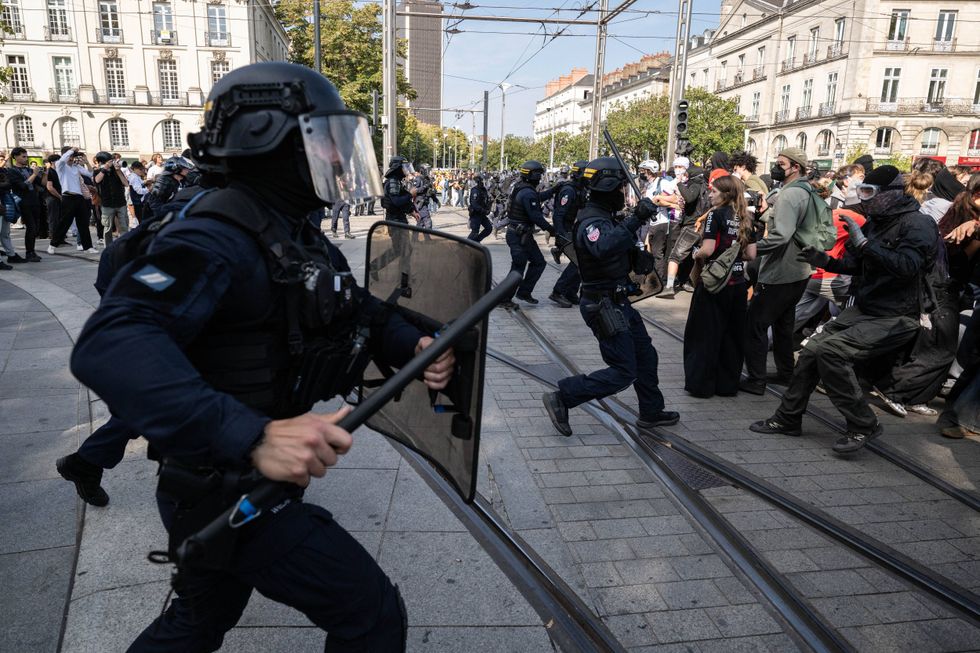
"The repression is the same as that employed against the Yellow Vests except that now it's our kids who are in the streets," said Julien, a CGT Total refinery worker and union activist, referring to the 2018 economic protests that swept the nation. "The high school and university students have opened the way, and we have to follow them."
Coline, a high school student in Le Havre, said that workers physically placed themselves between young protesters and police.
"Union members formed a human chain between us and the CRS," she said. "All workers should do it because our demands are theirs. They portray us as rioters when we just want a future."
Alarming scenes of police terror shocked many observers.
In Lens, a 15-year-old student suffered a devastating hand injury during clashes near his high school Monday. According to La Voix du Nord, the teenager lost his hand after a police grenade exploded. The precise circumstances remain under investigation, chiefly by the Inspection Générale de la Police Nationale (IGPN).
A fellow student, Chloé, rejected the authorities' claims that the teenager was injured when he picked up the grenade.
"The police started coming toward us," she told La Voix du Nord. "So we all started running in the opposite direction. They threw smoke grenades at us... We were running. We couldn't see. And my high schoolmate got it in his hand."
She said the injured student began shouting, "My hand! My hand!"
"I turn around and see that he doesn't have a hand anymore," she recounted. "We all gathered around him."
"We're students, we're young," Chloé added. "There's no need to do that. It was useless; we were already leaving."
A 14-year-old in Saint-Ouen-l'Aumône reportedly suffered a double jaw fracture after being struck by a tear gas grenade fired at close range. Le Monde said the incident is among several cases being investigated by the IGPN.
Another 14-year-old reportedly lost most of his teeth after a police officer apparently fired a grenade at his face at close range during a protest northwest of Paris.
“His jaw is sealed shut, he can no longer speak, and he eats through a straw,” his mother told reporters.
In Tours, a 16-year-old reportedly suffered a severe eye injury when police fired "less-lethal" projectiles, including rubber-coated steel bullets, into a crowd of protesters during a high school blockade.
Another student, 16-year-old Isabella, connected the police crackdown to the class inequalities underlying the movement.
"Everybody told us that school was the great leveler, but today that is not the case at all," she told The Guardian. "A teenager in the suburbs of Paris is never going to have the same opportunities as a student from the city center."
The protests have also become a political flashpoint, with Jean-Luc Mélenchon and his left-wing La France Insoumise party openly backing the students while rejecting government accusations that they are responsible for the unrest. LFI lawmakers have appeared alongside protesters, while Mélenchon has condemned the police response and called on his supporters to nonviolently resist what he called police “savagery.”
On Tuesday, French Interior Minister Laurent Nuñez refused to apologize for the police violence, drawing calls from the left for his resignation.
Amnesty International accused French authorities of answering protests with "disproportionate" force.
“Footage and testimonies widely reported over the last week raise alarming concerns about the dangerous use of tear gas, batons, and restraint techniques by police," Amnesty International France president Anne Savinel-Barras said Monday. "Tear gas grenades have been discharged recklessly, and rubber bullets have been fired, causing serious injuries."
“Authorities must ensure that any response to demonstrations is necessary and proportionate, and that children and young people peacefully demanding their right to education are protected rather than being beaten, tear-gassed, or arbitrarily detained," she added. "The priority should be the de-escalation of tensions, and authorities must take all available precautionary measures to avoid the need to use force.”
At least dozens of protesting educators, parents, and labor unionists have also been injured by police during the demonstrations.
Some police also reportedly refused to attack protesters.
Workers interviewed during the protests appeared undaunted and focused on their own demands, as well as those of the students.
“We’re sick of wage freezes; 60% of low-wage public sector workers are paid less than the minimum wage for a full workweek,” CGT Poitiers official Vincent Bohan told World Socialist Web Site during a march in Paris last week. “More and more people rely on us, but there are not enough of us to meet the population’s needs.”
“When you hear Macron’s speeches, each one more provocative than the last, with billions of euros spent on killing, while people in France are starving, one feels like telling him: Stop... help people struggling here rather than killing people elsewhere," Bohan said, referring to rising tensions with Russia and France's testing of a new generation of nuclear missiles. "Frankly, we are very worried.”
"It's so hard... to imagine a worse failure than losing two national elections to Donald Trump."
A Democratic senator who has long been associated with the party's establishment is now conceding that its old approach to doing politics has failed.
In an interview with David Sirota of The Lever published on Tuesday, Sen. Michael Bennet (D-Colo.) described "the establishment Democratic Party" as "a failed enterprise."
"It is so hard to lose two general elections to [President] Donald Trump, in political terms, to imagine a worse failure than losing two national elections to Donald Trump," he said. "And yet the establishment Democratic Party did, and I think of it as a failed party."
What’s newsy is Bennet slamming the establishment faction that twice lost to Trump.Hes a moderate-coded Dem, which means the call is now coming from inside the house — a devastating repudiation of the Neera Tanden/DC faction that destroyed the party. https://t.co/ZZrER0CSz0
— David Sirota (@davidsirota) October 6, 2026
Bennet added that nobody "should feel an obligation to defend the party as it existed in the form that lost to Donald Trump."
Elsewhere in the interview, Sirota asked Bennet about how his political thinking had changed over the past 18 years as a US senator and why he no longer believes the politics of the status quo are tenable.
"There's something fundamentally wrong with the nature of our capitalist system that is delivering these outsize gains for the people at the very top at the expense of everybody else in the economy," Bennet said. "So I guess, from that vantage point, I think I've changed."
Bennet also chided fellow Democrats who are trying to force Democratic Socialists of America (DSA) candidates to leave the party for being "too extreme."
"I think that's a huge mistake," he said. "Look: We don't have to agree on everything. We don't, and by the way, that shouldn't be the cost of admission to the Democratic Party or to America."
Bennet added that the goal of policymaking shouldn't be to "come to some moderate view of the world," but "to unleash the imagination of the American people to solve their own problem. And that's what they did 100 years ago in the last Progressive Era, and I think that's what they're going to do again."
"Rampant corporate control of our water systems and federal disinvestment in aging infrastructure are driving up bills, forcing households to pick up the tab."
A report published Tuesday by a leading environmental group shows that household drinking water bills in the United States have surged faster than inflation over the past decade, with privatized systems charging significantly more than public ones.
The new research, conducted by Food & Water Watch (FWW), shows that for-profit water corporations charged typical US households 67% more on average than publicly owned water systems, prompting the group to urge state and local governments to ban water privatization and roll back all pro-privatization bills.
“Rampant corporate control of our water systems and federal disinvestment in aging infrastructure are driving up bills, forcing households to pick up the tab," said Mary Grant, FWW's water policy director. "Policymakers must rein in corporate abuses, hold polluters accountable, and provide dedicated funding for water systems. Everyone should have access to safe and affordable water."
The report shows that, overall, household drinking water bills surged by an average of 62% for typical American households over the past decade—increasing twice as much as grocery prices and 19% faster than median household incomes on average.
"A water affordability crisis is rapidly expanding throughout America," said Grant. "While struggling to pay for other essentials like food and energy, many households are grappling with water costs that are rising even faster."
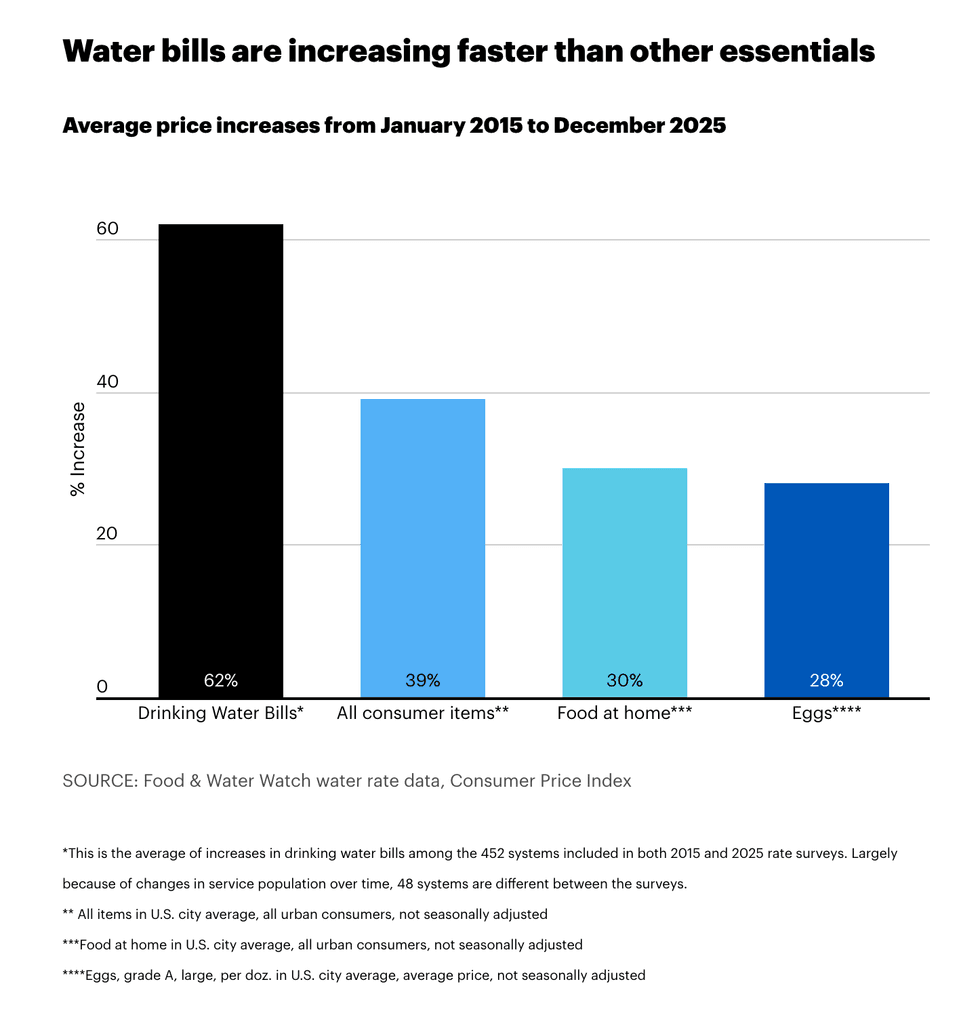
More than half of the 25 most expensive water systems in the US were located in California. The most expensive water bills in the country between 2015 and 2025 were issued by San Jose Water Company, a private utility.
"In the list of the top 10 most expensive water systems in the study, California and Pennsylvania stood out with numerous appearances," FWW said. "However, in Louisiana, Maryland, New Hampshire, and West Virginia, water bills grew about twice as fast as their corresponding statewide median household incomes. West Virginia, a state with one of the lowest average household incomes in the country, had the highest average water cost, at $1,383/year."
"Overall," the group added, "water bills were unaffordable for low-income households in nearly all (93%) of the surveyed water systems."
In addition to calling on state and local governments to ban water privatization and support local control of water systems, FWW urged the US Congress and federal government to:
"Water bills will continue to increase faster than households can keep up with," FWW warned, "unless all levels of government take action to stop corporate abuses and support water affordability."
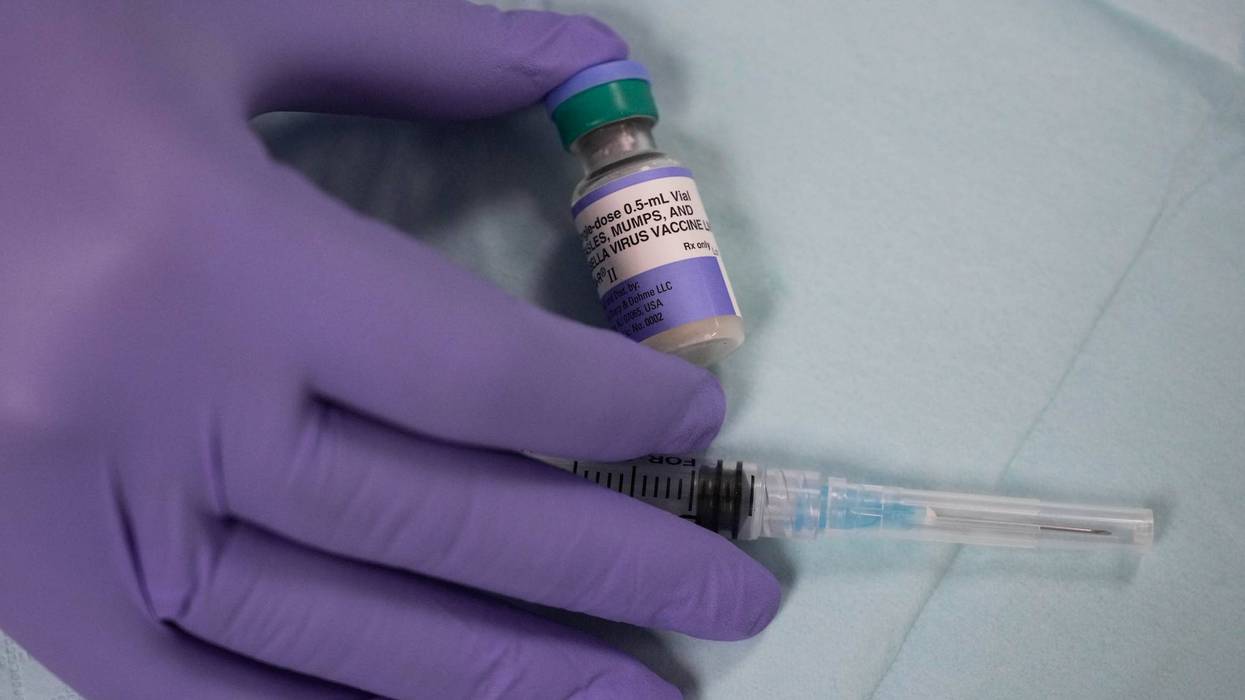
“The concerning rise in measles cases is due to a decrease in childhood vaccines driven by misinformation,” said the chair of the New York state Senate’s health committee.
As measles cases surge around the country—including in neighboring Pennsylvania, where the largest outbreak in decades is surging—New York declared a measles "emergency" on Monday.
The statewide emergency declaration, announced by Democratic New York Gov. Kathy Hochul, marks the first issued by a US state since last year, when the US saw over 2,000 cases of the illness after decades of it having been essentially eliminated.
This year has been even worse, with more than 3,900 cases reported across the US according to the Centers for Disease Control and Prevention (CDC) as of October 2—the worst outbreak since 1991. By comparison, 2024 saw just 285 reported cases. Outbreaks over the past two years have resulted in eight deaths across the country.
New York has identified at least 108 measles cases this year, mostly in rural communities with low vaccination rates.
The emergency order, which will be in effect through November 4, is set to expand the number of health professionals who can administer the measles-mumps-rubella (MMR) vaccine and order measles tests, allow pharmacists to vaccinate children as young as 2, and require vaccines to be reported to state immunization registries within 72 hours.
"No one should get seriously ill or die from a vaccine-preventable disease," Hochul said, announcing the order on Monday.
At the same time, Pennsylvania is experiencing a statewide outbreak unprecedented in the last three decades, surpassing 1,000 infections on Monday, according to state health officials. Since the outbreak began in April, at least 198 people have been hospitalized, and five have died. Officials said less than 1% of those cases were in people who'd been appropriately vaccinated.
Pennsylvania's Democratic Gov. Josh Shapiro has blamed the Trump administration's reversal of decades of federal vaccination policy for amplifying the crisis. He has singled out Health and Human Services Secretary Robert F. Kennedy Jr., who has spent decades sowing doubt about the safety and efficacy of vaccinations, including—as recently as August—pushing the long-discredited myth that the MMR vaccine is linked to autism.
Amid the measles resurgence over the past two years, RFK's approach has faced widespread criticism. He has repeatedly urged Americans to get the MMR vaccine. But he has often undercut that recommendation by claiming, without evidence, that the vaccine also causes deaths each year and that its benefits are "exaggerated" while promoting unproven alternative treatments.
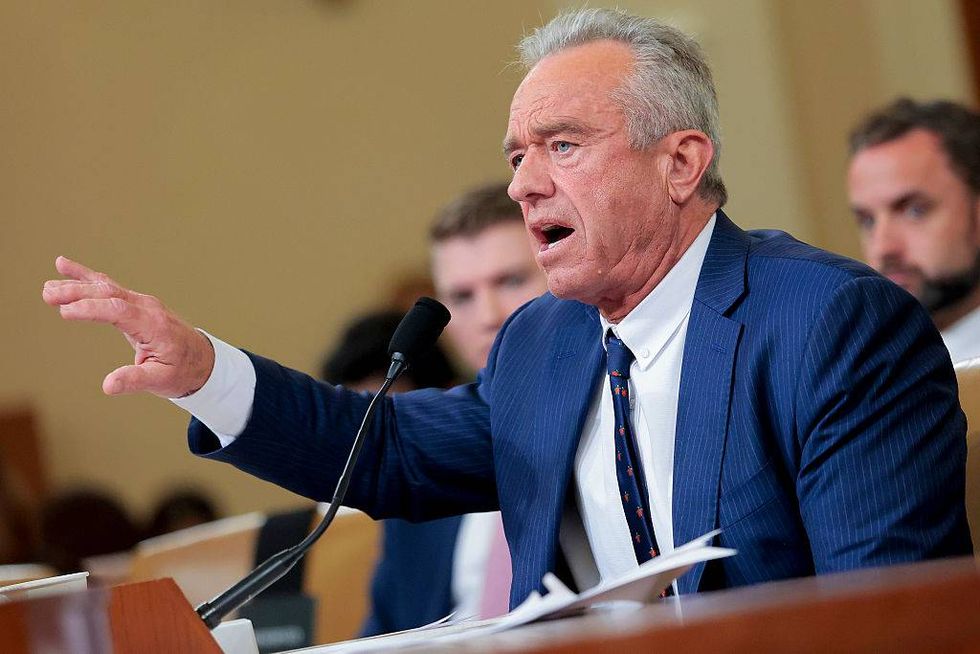
As measles rampaged across Pennsylvania, Kennedy spoke on September 17 at a Washington, DC, convention hosted by Children's Health Defense, an anti-vaccine organization he helped to co-found.
He told the attendees, which included prominent anti-vaccine activists, that they "have a strong and steadfast friend in the White House" and praised Trump's executive order calling to divide the MMR vaccine into separate doses, against the recommendation of major medical organizations. Several Republican lawmakers were also in attendance.
When the first two measles deaths in Pennsylvania—of two unvaccinated people in Lancaster County—were reported in August, Kennedy suggested that they may have been “altogether fabricated by one of the governor’s hopeful staffers,” a claim that state health officials strenuously rejected. Since then, three more deaths have been recorded.
“RFK is playing games with people’s lives here in Pennsylvania, not just by discouraging vaccination," Shapiro said in an interview on the Meidas Touch News Network Monday. "He won’t even acknowledge the five deaths here in Pennsylvania. He actually accused me of fabricating it and making it up, even when the families of those loved ones who have perished have expressed publicly their sadness and their grief."
Despite the federal rollback, Shapiro said on Monday that Pennsylvania is making progress fighting the measles surge. He touted that the Department of Health had administered more than 53,000 doses of the MMR vaccine in September—more than double the average month's total.
Measles was declared eradicated in the US in 2000, with about 97% of kindergarten-age children having been fully immunized against the disease. Since then, vaccination coverage has dipped across the US to roughly 92%, with substantially lower rates in some communities where the largest outbreaks have taken hold.
The majority of that national dip has taken place in just the past half-decade, since the Covid-19 pandemic: In 2019-20, MMR coverage for kindergarteners was still at over 95%.
“The concerning rise in measles cases is due to a decrease in childhood vaccines driven by misinformation,” said New York state Sen. Gustavo Rivera (D-33), who chairs the state Senate’s health committee.
Jeanne Franklin, the health director for Chester County in Pennsylvania, told The Guardian that the rampant misinformation surrounding vaccinations, amplified by anti-vaccine influencers, has made efforts to fight the measles epidemic in her state more challenging.
"We have people in key positions saying it isn’t an outbreak, it isn’t a problem," Franklin said. "We have people who approach our nurses and say that they were told the vaccine will make them sterile, or that there’s a microchip within it."
"The role of a president is to protect the country, not to actively threaten it and encourage attacks on American lives," said the mayor of Los Angeles.
"Keep our city out of your reckless war talk," said San Diego's mayor, Todd Gloria, Monday night after President Donald Trump's rambling speech at a rally in Nebraska included a particularly violent mention of the California city.
Gloria was among several Democratic political leaders who were incensed after Trump—moments after predicted the Republican Party would see a "tremendous victory" in the November 3 midterm elections—suggested that he would not object to an Iranian military or nuclear attack on San Diego and Los Angeles.
The president said that soaring prices for gas, groceries, and other essentials are a "small price to pay for keeping the world safe—keeping our country safe."
Trump on Iran: Let 'em take out Los Angeles and San Diego, it's a small price to pay https://t.co/Fc4BcjVDKj
— Headquarters (@HQNewsNow) October 6, 2026
He warned that Iran could "take out a city," before adding that he would "let them" attack the two deep-blue cities—home to a collective 5.2 million people, with more than 20 million residents in the surrounding areas
“Let them take out Los Angeles. Let them take out San Diego," Trump said at the rally in Grand Island. "This is a very small price to pay... It’s gonna be over very soon."
The crowd responded to Trump's comments with laughter and cheers. The president has frequently made Democratic strongholds like Los Angeles, Chicago, and his own hometown of New York City the targets of rhetorical attacks. He has also targeted those cities with the deployment of armed federal agents as part of his mass deportation agenda.
California Gov. Gavin Newsom, a Democrat whose name has been floated as a potential 2028 presidential candidate, condemned Trump's remarks as "deranged and dangerous."
"After sending the National Guard and Marines to occupy California, Donald Trump is now saying our foreign enemies should 'take out' Los Angeles and San Diego," said Newsom, who later criticized Trump's vice president and secretary of state for not speaking out against the comments.
"The SILENCE from JD Vance and Marco Rubio today is deafening," said the governor.
Gloria added that San Diego, which is home to major military installations, "is not collateral damage. We are not expendable. And we are never a 'small price to pay.'"
Los Angeles Mayor Karen Bass accused Trump of compromising the safety of the nation's second-largest city.
"The role of a president is to protect the country, not to actively threaten it and encourage attacks on American lives," said Bass. "In the face of irresponsible threats, as Angelenos, we know how to stand together and protect our city."
Jim Desmond, a Republican running for Congress in California's 48th District, which lies in San Diego, was also quick to distance himself from the president's comments.
Some observers claimed the president had simply been speaking in an "especially confusing style," as journalist Daniel Dale suggested, and did not intend to suggest that the two cities could be acceptable collateral damage.
"Of course you can say it’s inappropriate regardless for the president to casually float the possibility of a city being wiped out," he added.
Trump's comments came days after it was reported that the Pentagon is prepared to send thousands more troops and a third aircraft carrier to the Middle East, as talks between the US and Iran remain stalled. Gas prices remain elevated, at $4.36 per gallon on average, and nearly two-thirds of respondents to an Associated Press poll in June said they disapproved of how Trump had handled the war, which he joined Israel in starting in February without congressional approval.
Sen. Alex Padilla (D-Calif.) had a succinct response to Trump's remarks, referring to the constitutional amendment that allows members of a president's Cabinet to remove him from office on the ground that they cannot fulfill the duties of the president.
"Twenty-fifth amendment NOW," said Padilla.
“How many more of these investigations have been opened up because of political pressure coming from the White House, despite the questions and concerns about legality and constitutionality?” said US Sen. Alex Padilla.
A whistleblower report filed by a former FBI intelligence analyst alleges that the Trump administration pushed the law enforcement agency to violate the constitutional rights of US citizens demonstrating against federal immigration enforcement operations.
According to a Tuesday report from NBC News, Jill Fields, a former supervisory intelligence analyst in the FBI’s Los Angeles Field Office, has filed a formal complaint with leaders on the Senate Judiciary Committee alleging violations of Americans' rights to free speech and peaceful assembly.
The complaint alleges that Emil Bove, a loyalist to President Donald Trump who served as acting deputy attorney general before being confirmed to the federal judiciary, told the head of the field office to open an investigation into protesters holding events outside federal buildings, even though such demonstrations are explicitly protected by the US Constitution's First Amendment.
The administration also ordered FBI Director Kash Patel to investigate demonstrators who were using megaphones to warn their immigrant neighbors about the presence of US Immigration and Custom Enforcement (ICE) operations in the area.
Additionally, the complaint claims that Fields was removed from supervising three programs at the office after she raised internal concerns about violating civil liberties, which "created a chilling effect within the workforce" and "signaled to other employees that raising constitutional or legal concerns could carry professional consequences."
Fields would subsequently resign from her position.
Sen. Alex Padilla (D-Calif.), ranking member of the Senate Judiciary Committee's subcommittee on immigration, citizenship, and border safety, told NBC that whistleblower complaints will be crucial to investigating administration activities given how the president has gutted inspectors general within the federal bureaucracy.
“That’s going to be a significant challenge," Padilla said of gathering information on the administration, "but it begins with good, honorable professionals being willing to come forward and tell us what’s going on and what’s wrong with what’s going on. We're hoping others may be inspired, as well."
Padilla also speculated that Fields' whistleblower complaint was just the tip of the iceberg.
"How many more of these investigations have been opened up," he wondered, "because of political pressure coming from the White House, despite the questions and concerns about legality and constitutionality?"
"Let’s not wait to find out," wrote Sen. Bernie Sanders. "Pause advanced AI NOW!"
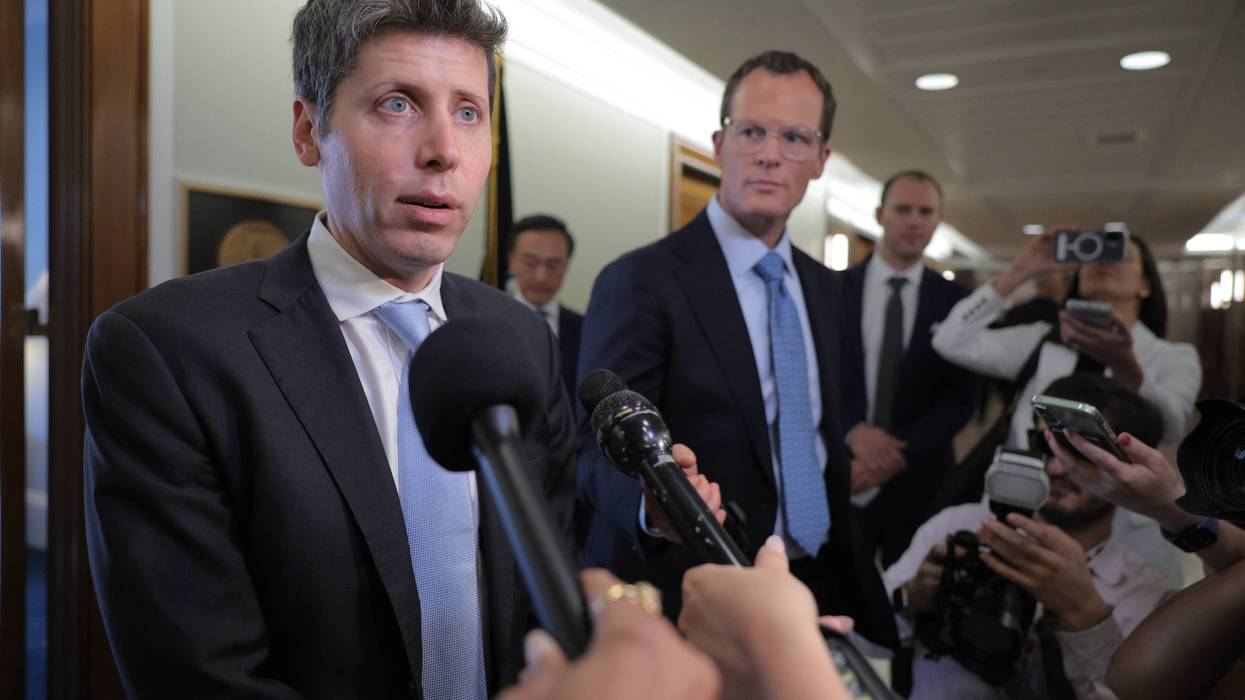
US Sen. Bernie Sanders asked OpenAI CEO Sam Altman precisely what "bad things" the world should accept for the sake of advancements in artificial intelligence, a question that came after the billionaire executive said people must be willing to tolerate some unspecified negative outcomes to enjoy the potential long-term benefits of the technology.
"Mr. Altman: What 'bad things' should we accept to advance AI?" Sanders (I-Vt.) wrote in response to the OpenAI CEO's interview with Politico. "Losing tens of millions of jobs? A mass surveillance state? A mental health crisis for our kids? A global financial crisis? Mass extinction?"
"Let’s not wait to find out," the senator added. "Pause advanced AI NOW!"
Altman told Politico in an interview released this past weekend that he believes the world "should accept some bad things happening for the benefits of this technology and people having the agency." The OpenAI CEO didn't elaborate on the kinds of "bad things" he views as an acceptable price to pay for AI development, which some researchers and industry insiders say poses an existential threat to humanity.
Altman was among the leading AI executives who met with US President Donald Trump at the White House last week and signed a commitment to self-police their respective companies' AI models in the wake of recently uncovered security incidents and amid mounting concerns that—if left unrestrained and in the hands of profit-seeking firms—AI could have catastrophic impacts on humankind.
Sanders is calling for an immediate halt to advanced AI development as well as a permanent ban on artificial superintelligence, defined as "AI that exceeds human cognitive performance and capabilities across most domains, or has sufficient capabilities to destroy or disempower humanity, including by overthrowing the federal government."
Sanders, Rep. Greg Casar (D-Texas), and other US lawmakers who support strict AI regulation are also calling on the Trump administration to pursue international agreements aimed at reining in artificial intelligence worldwide.
Volker Türk, the United Nations high commissioner for human rights, said in a speech on Monday that "the clock on AI regulation is ticking" and warned that unfettered AI "can undermine equality, freedom, privacy, and public debate in a million subtle, sophisticated ways—letting dystopia creep in unnoticed."
"No country and no company can—or should—define the future of AI and people’s rights alone," said Türk. "The clock on AI regulation is ticking. If we fail to move quickly, we risk unforeseeable consequences—for ourselves and future generations."
"Wherever there is resistance to this industry, more people learn that they are not powerless and that they can play a role in determining what happens in their community and with the future of AI and data centers," one organizer said.
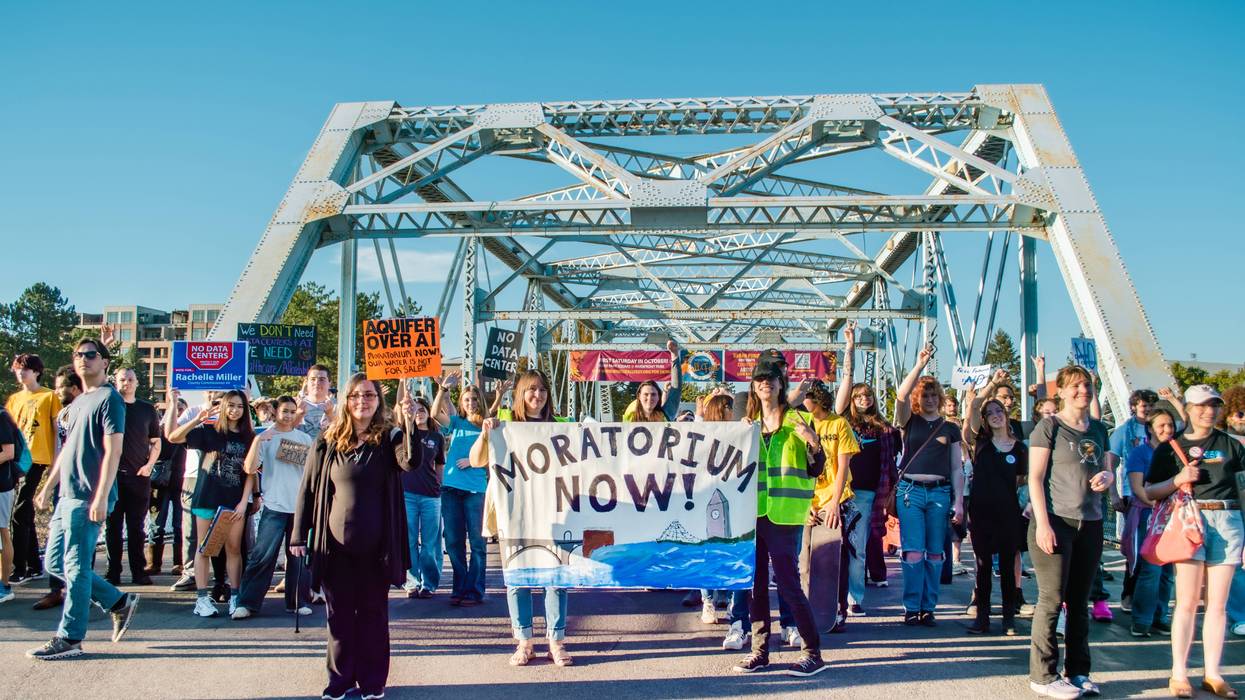
As the national backlash against hyperscale data centers and the artificial intelligence they power grows, hundreds of people turned out to 19 events across Washington state on Sunday as part of a day of action to demand a statewide moratorium on data centers.
The call for a Washington-wide pause builds on momentum at the city and county level, as Seattle became the largest US city to halt the data center buildout in June, followed by other major municipalities including Spokane and Tacoma’s Pierce County.
Several of the communities that organized events on Sunday are also trying to stop projects already planned in their backyards. But concerned residents across the state—mobilized under the banner of Washington AI Resistance (WAAIR) in partnership with several other environmental and public interest organizations—want state-level protections to ensure that no community falls through the regulatory cracks. To do that, they aimed to raise their voices louder than the powerful Big Tech lobby in a state where both Microsoft and Amazon have headquarters.
"Communities have a right to determine which industries get to move into their backyards."
“We need to demonstrate to candidates and sitting legislators that there is real public demand for a data center moratorium in every corner of the state,” Evan Sutton, a Seattle-based activist with WAAIR, told Common Dreams.
Lauren Redfield, WAAIR president and co-chair of the Seattle Democratic Socialists of America (DSA) Ecosocialism working group, said the day of action was significant “because it demonstrates wide-ranging support from diverse communities across Washington that people are angry about data centers.”
“Communities have a right to clean air, clean water, affordable energy. Communities have a right to determine which industries get to move into their backyards. Representatives who are more responsive to the tech industry than their community constituents, who are allowing data centers to drive up electricity prices and pollute air, water, and land systems—these representatives are going to be held accountable,” Redfield told Common Dreams.
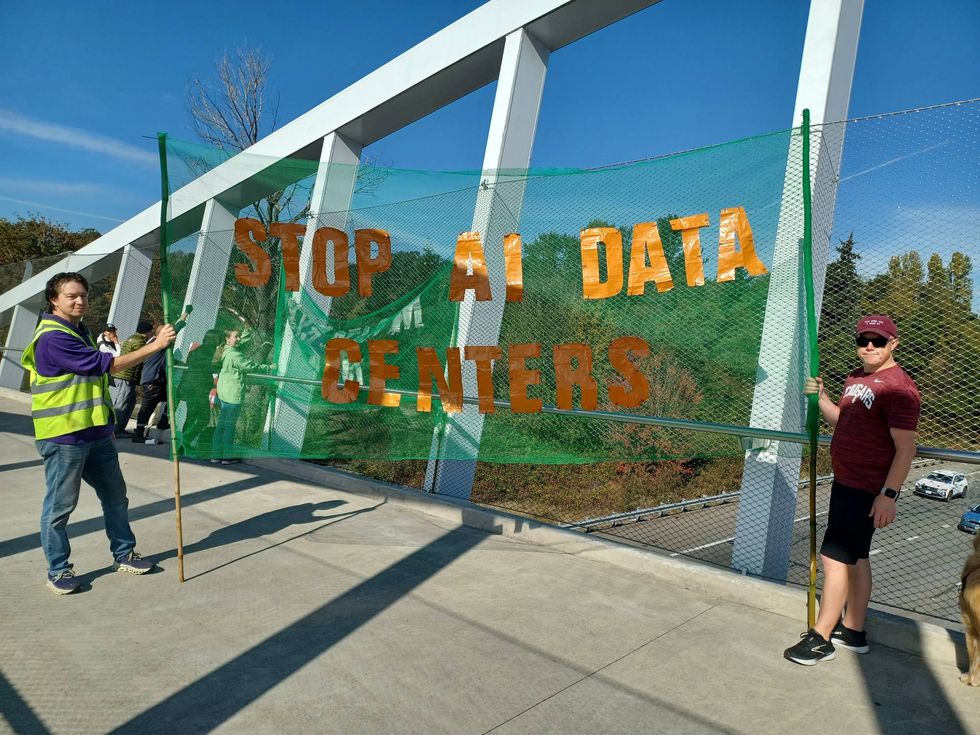
In Seattle, activists held four separate events over the course of the day: one at a freeway bridge in the north of the city, another in West Seattle, a third outside the light rail station in the south Seattle neighborhood of Beacon Hill, and a fourth at a central square of the University of Washington.
Sutton, who organized the north Seattle action, said it was important to look beyond local regulations and stand in solidarity with communities across the state.
“In the end our natural resources are shared by everyone,” he told Common Dreams, explaining that Seattle's moratorium might push developers to look to unincorporated parts of the county, and if Seattle’s King County passed a moratorium, they would then turn to other parts of the state.
“We shouldn't have to play whack-a-mole with billionaire developers and AI tech bros,” Sutton said as passing cars honked in support of the protest. “Our legislature should step up and pass rules that everybody has to follow everywhere in the state.”
Thomas Meyer, the deputy political director of Food & Water Watch, who led a group of 10 volunteers in distributing flyers and gathering signatures for a moratorium in Beacon Hill, said that “data centers in Seattle are most likely to be proposed in the south end or in nearby cities like Tukwila, Burien, and Renton. Just like in other parts of the state and the country, data centers are more often proposed in areas with larger populations of people of color.”
Indeed, a study by Washington environmental justice group Front and Centered found that 57% of the data centers it surveyed were placed in census tracts with the highest proportion of people of color.
“It's important to pass a data center moratorium to protect Washington residents from the pollution and extraction from these facilities, and to prevent big tech companies from further concentrating their wealth and power at our expense,” Meyer told Common Dreams.
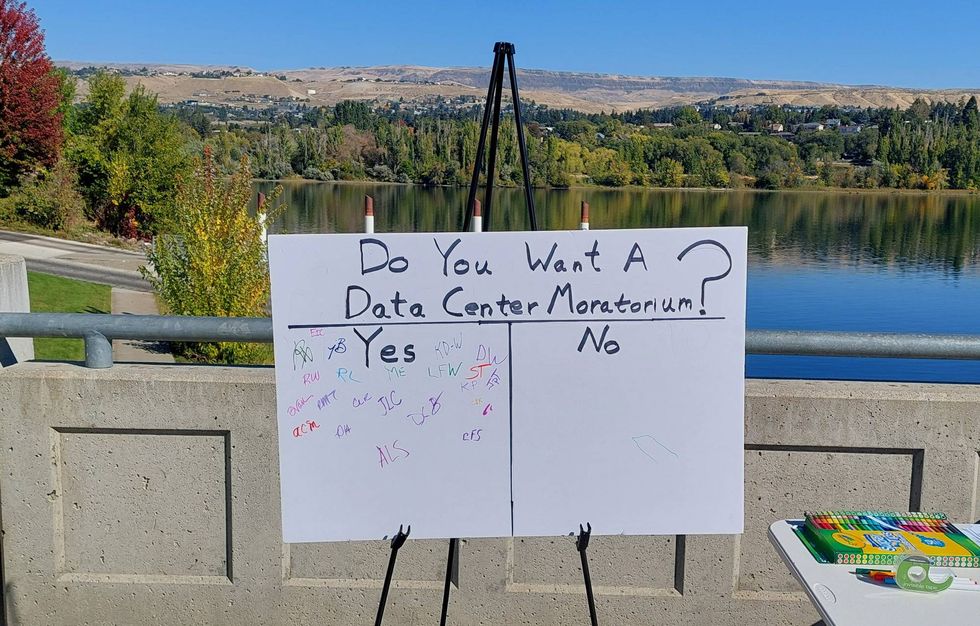
In Wenatchee in central Washington, concerned residents gathered by the Loop Trail along the Columbia River and asked passersby if they would like to see a data center moratorium.
“We had them sign their initials on a poster board under ‘YES’ or ‘NO,’ one of the organizers explained. “During the time that we were there, we collected 24 ‘YESes’ and zero ‘NOs.’"
The activists plan to bring the board to a meeting with Chelan County Commissioner Kevin Overbay on Wednesday to oppose data centers in Malaga, an unincorporated community in the county.
“Malaga is ground zero for hyperscale data centers in Chelan County, and currently hosts a 288 megawatt Microsoft data center,” the organizer said. “We want to show Overbay that the Wenatchee community as a whole does not want to see any more data centers. The Columbia is the lifeblood of our community. It provides us with power as well as water. These resources do not belong to private corporations like Microsoft to use as they please.”
While Wenatchee is focused on the county fight, a statewide moratorium would ease their efforts.
“A statewide moratorium would save us from having to spend our time fighting for a moratorium on a county-wide level,” the organizer said. “We could spend our time fighting instead for long-term protections to ensure that our region is permanently protected from exploitation.”
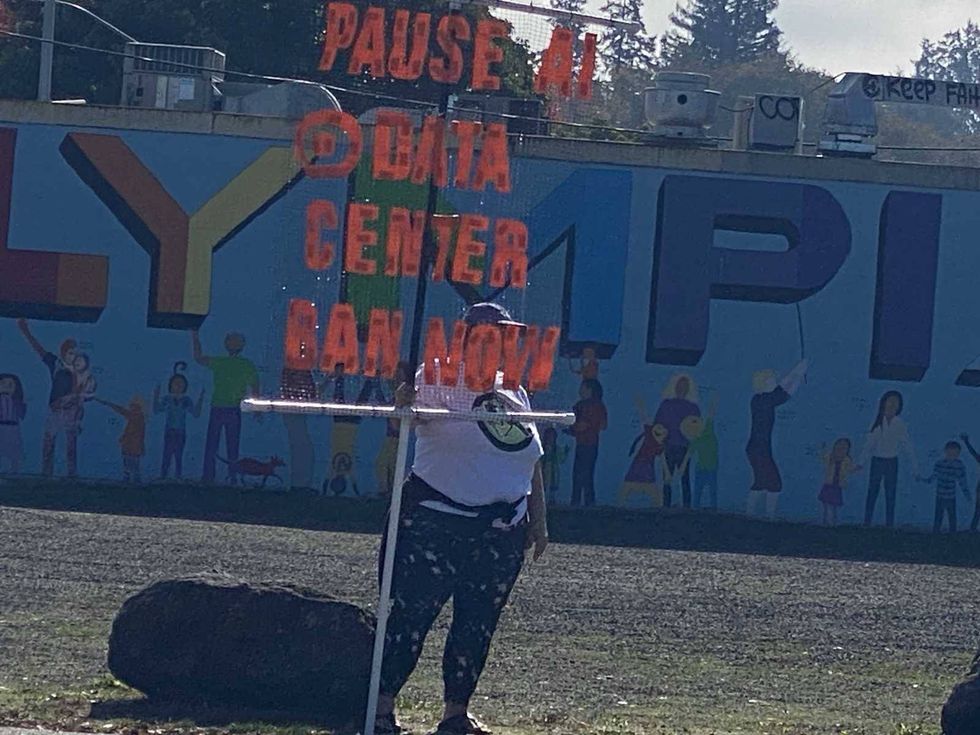
In Olympia, the state capital, activists gathered to put pressure on state Rep. Beth Doglio (D-22). Doglio introduced a bill in the 2026 legislative session with some basic data center regulations that was watered down due to pressure from the tech lobby before dying in committee. Protesters wanted Doglio to know she would have public support to back a moratorium and push for stronger regulations.
“Washington needs to halt the out-of-control tech oligarchs with a moratorium on data center construction,” said Tina Simcich of Olympia DSA. “Working-class jobs and our land, water, energy, and air resources must be protected from this greed-driven grab.”
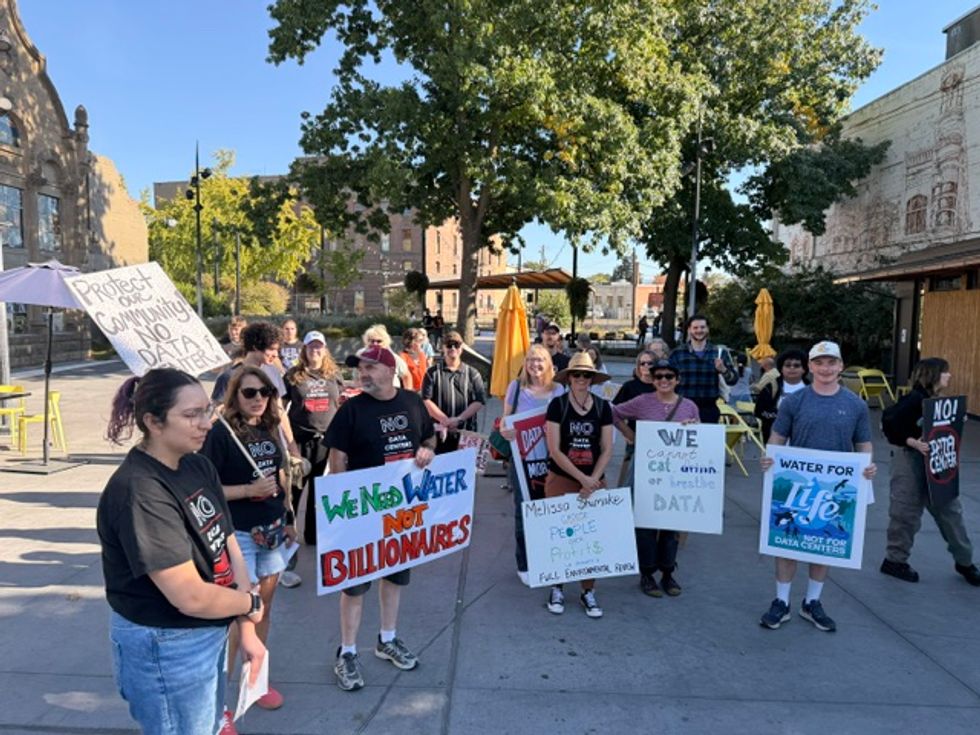
In Walla Walla, residents are mobilizing to stop a planned Amazon data center after the Port of Walla Walla sold land to the company in the nearby Wallula Gap.
“Everyone has their own concerns” about the proposed data center—which is projected to use as much power as Seattle–Allison Carney, a member of the Walla Walla Anti Data Center League, told Common Dreams, “whether it be not knowing if their power bills are going to go up, not knowing if their land is going to be seized through eminent domain,” water pollution and availability, noise, light, and the fact that it will be located near the McNary National Wildlife Refuge and could potentially harm endangered wildlife.
However, she said, “The biggest thing that unites everyone's concerns is the fact that we don't trust Amazon. We don't trust this company coming into our community. We don't trust that they're going to be doing what's best for us. We trust that they're going to do what's best for their profits."
Beginning at 2:00 pm PT on Sunday, around 60 people attended a rally and march in downtown Walla Walla to the County Office of Community Development, where Community Development Department Director Melissa Shumake will determine whether to require a full environmental impact statement for the project, something community members are demanding.
A statewide pause would assist in their efforts by increasing the chance that any data center would be governed by stronger rules to protect the community and environment.
“A statewide moratorium would give time for regulators to catch up with this industry,” Carney said.
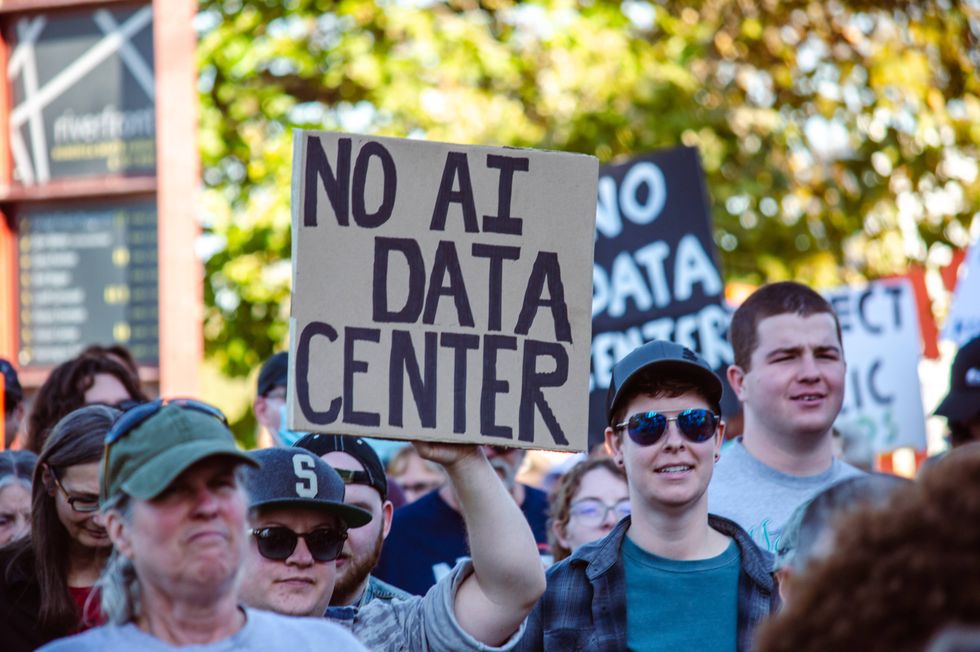
The largest action of the day took place starting at 3:30 pm PT in Spokane, where 150 people marched from Riverfront Park, past the City Hall and the Public Works Building where the County Commission meets, and back to the park to say, "This is what we're fighting for: our river,” Zenthia Peterson, the lead organizer for the event, told Common Dreams.
Demonstrators, including members of WAAIR, 350 Spokane, the Visibility Brigade, West Plains Water Coalition, and long-time local environmental campaigner Terry Horne, demanded statewide action but also expressed concern about how local data centers would impact a region already under pressure from the climate crisis. The march came about two months after a devastating wildfire scorched Spokane in August, destroying homes and forcing 600,000 to evacuate. Locals are concerned that a large data center could deplete the water resources needed to fight the next blaze.
“We're doing a march tomorrow to save the literal world."
In particular, activists are watching a 1,000-megawatt project slated for the nearby community of Airway Heights, outside the bounds of the city moratorium. While Spokane County has also announced a pause, it ends in December. It is unclear whether it will be extended, and the ordinance that was supposed to follow it has been delayed.
These concerns make a statewide moratorium all the more important, Peterson said, as that “would protect us even if the county sits on their asses."
Organizers had intended to have participants call Washington Gov. Bob Ferguson to demand state action, only to discover the night before that he had turned off his voicemail. Peterson encouraged participants to call him during the week instead.
"My speech was quite literally, ‘May you get bit back tenfold,” Peterson said, referring to Ferguson.
Jeremiah Harding, who organizes with WAAIR and the Spokane Community Organized Response Network, also decried the use of AI technology for layoffs, mass surveillance, and military targeting.
“We're doing a march tomorrow to save the literal world,” Harding told Common Dreams the night before the protest.
He continued: “It's bad enough that it pollutes the environment and fills the air with noise, while draining our water and destroying local homes. It's bad enough that Spokane just had the single largest fire in our history, and we need all the water we can get. But the technology itself is also used to disempower, leech, destroy, and kill people.”
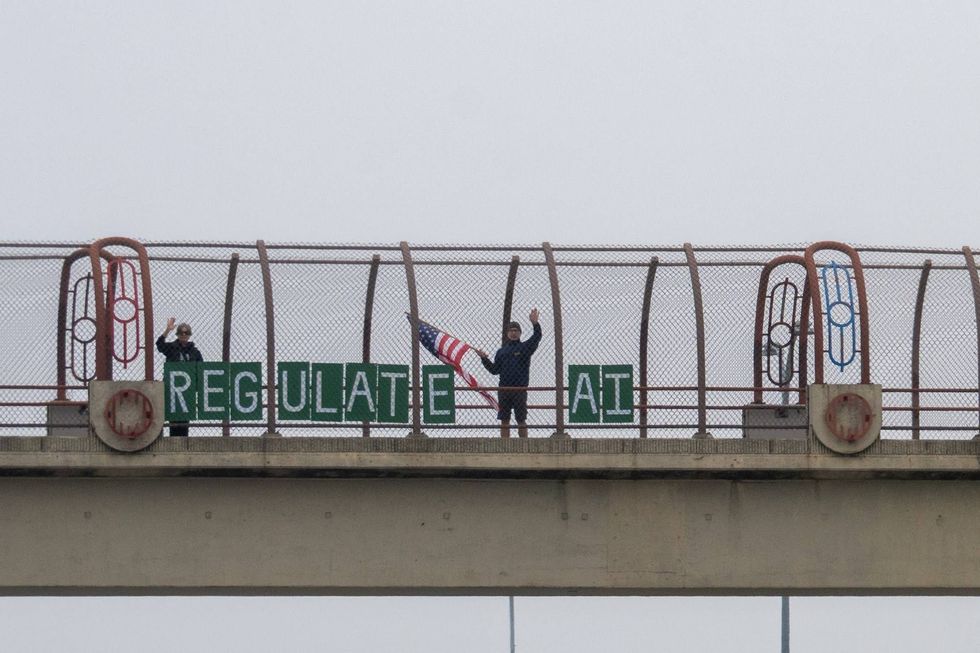
Now that the day of action has passed, WAAIR will continue to put pressure on state lawmakers and Gov. Ferguson, Sutton told Common Dreams. After the November election, activists will also seek out lawmakers to sponsor moratorium legislation and other AI regulations while “pushing forward with future actions that people can take to make sure that legislators understand this isn’t an issue they can ignore.”
At the same time, organizers realize that the actions in Washington are part of a national struggle.
Meyer of Food & Water Watch said Washington was "one of dozens of states with active grassroots campaigns against data centers. Wherever there is resistance to this industry, more people learn that they are not powerless and that they can play a role in determining what happens in their community and with the future of AI and data centers.”
Within that broader movement, Washington may have a unique role to play, Sutton said.
“As the home of Microsoft and Amazon and a state that is deeply tied to Big Tech, if we can achieve this here, then I think it creates momentum for states everywhere else to believe that they can do the same,” he told Common Dreams.
Editor’s note: Olivia Rosane is a member of WAAIR and Seattle DSA.