SUBSCRIBE TO OUR FREE NEWSLETTER
Daily news & progressive opinion—funded by the people, not the corporations—delivered straight to your inbox.
5
#000000
#FFFFFF
To donate by check, phone, or other method, see our More Ways to Give page.
Daily news & progressive opinion—funded by the people, not the corporations—delivered straight to your inbox.

Statement of Nasima Hossain, U.S. PIRG Public Health Advocate, on the USDA's decision to buy 7 million pounds of ammonia treated meats for school lunches.
An article in the Huffington Post on March 5, 2012 cites the USDA buying 7 million pounds of pink slime for the national school lunch program. It is blended into hamburger patties and sausages and is being used to feed the nation's children. Pink slim is ammonia-treated meat trimmings, that are the connective tissue, intestines and parts of the animal not used in regular beef cuts, instead of muscle; and food experts say it is not nutritionally equivalent to ground beef. It was even rejected recently by fast food corporations like McDonalds, Burger King and Taco Bell.
"Does the USDA really think this is the type of product that parents would knowingly want their children to eat? Parents have a right to know what is in their children's school lunches; and the USDA should ensure that meats used for the program are high quality meats that are nutritious."
"As a parent I would be extremely concerned to hear that my child was being fed hamburgers using meat trimmings that even fast food giants like McDonalds, Burger King and Taco Bell do not use anymore. The USDA should immediately re-examine their practice of using lean beef trimmings in school lunches."
U.S. PIRG, the federation of state Public Interest Research Groups (PIRGs), stands up to powerful special interests on behalf of the American public, working to win concrete results for our health and our well-being. With a strong network of researchers, advocates, organizers and students in state capitols across the country, we take on the special interests on issues, such as product safety,political corruption, prescription drugs and voting rights,where these interests stand in the way of reform and progress.
One foreign policy expert noted that fears of a "mass exodus" of refugees come "as the US starves Cuba of energy and food."
As the Trump administration sows chaos with a crushing fuel blockade of Cuba, a general told Congress that the military will "set up a camp" at Guantánamo Bay to detain those who try to flee the humanitarian crisis inflicted by the United States.
The phrase "humanitarian crisis" was used by Sen. Tom Cotton (R-Ark.) to describe the situation in Cuba during a Senate Armed Services Committee hearing on Thursday, as he questioned US Marine Corps Gen. Francis Donovan, the commander of the US Southern Command (SOUTHCOM).
Donovan, a 37-year Marine veteran, took command of SOUTHCOM in February after being tapped by President Donald Trump. His predecessor, Adm. Alvin Holsey, abruptly resigned in December reportedly after he'd raised concerns about the Trump administration's bombings of alleged drug trafficking boats in the Caribbean, which have been widely described as illegal under international law.
On Thursday, Cotton asked Donovan, "Are we prepared for any kind of humanitarian crisis in Cuba—the possible flow of refugees, other civil disorder that may threaten our interests, especially if the decrepit, corrupt Castro regime finally falls or flees?"
"Senator, yes we are," Donovan responded. "SOUTHCOM... We have an [executive] order to be prepared to support [the Department of Homeland Security] (DHS) in a mass migration event. They would take the lead, we would follow."
Donovan said this would include using the US military base at Guantánamo Bay, "where we would set up a camp to deal with those migrants or any overflow from any situation in Cuba itself."
Trump signed an executive order during his first month in office last year directing DHS and the Pentagon to “expand the Migrant Operations Center at Naval Station Guantánamo Bay to full capacity," which the administration said meant scaling the facility up to more than 30,000 beds.
The base, which houses a prison infamous for the extrajudicial torture of detainees during the global War on Terror, was designated under Trump's order to hold "high‑priority criminal aliens unlawfully present in the United States.”
But Donovan suggested it may now be used to hold Cubans fleeing chaos and deprivation following Trump's own acts of economic warfare.
Cotton's question followed a warning that same day from Republican Florida Gov. Ron DeSantis of a "possible mass exodus out of Cuba," which experienced an island-wide electricity blackout earlier this week following the Trump administration's blockade of fuel entering the island, which a group of UN rapporteurs said in January was “a serious violation of international law and a grave threat to a democratic and equitable international order.”
DeSantis, whose state is home to about 1.6 million Cuban-Americans, said, "[W]e don’t want to see a massive armada of people showing up on the shores of the Florida Keys."
He said he believed the Trump administration "would rather see people in Florida go help… hopefully get a new government going" in Cuba, possibly referring to the long-held hope of some right-wing Cuban exiles to take over the island.
Following more than 60 years of an embargo that has strangled Cuba's economic development, the Trump administration tightened the noose even more in January, signing an executive order that would slap harsh tariffs on any country that provides oil to Cuba.
As a result of the blockade, explained Juanita Goebertus, Americas director at Human Rights Watch, "people don’t have reliable access to drinking water, hospitals can’t operate safely, basic goods are becoming increasingly difficult to obtain, and garbage is piling up in the streets.”
Trump first described his blockade as part of an effort to carry out regime change against Cuba's Communist Party leadership, but this week, he made the imperialist declaration that he may seek to outright "take" the island and that he could "do anything I want" with the "weakened nation."
Erik Sperling, the executive director of Just Foreign Policy, emphasized that the possible "mass migration event" described by Donovan was only coming "as the US starves Cuba of energy and food."
"Trump and [Secretary of State Marco] Rubio are to blame for any refugee crisis from Cuba, as the US intentionally harms civilians with an oil blockade," said Just Foreign Policy in a social media post responding to Republican warnings of Cuban mass migration. "US sanctions and meddling in Latin America have always been a leading cause of migrant flows."
Immigration journalist Arturo Dominguez explained that "What [Donovan] essentially said was, 'We're ready to accommodate the flow of refugees by putting them in camps.'" He added that "the way these military goons jump right in to 'accommodate' atrocity is beyond the pale."
Trump's blockade of Cuba is unpopular with the American public, according to a YouGov poll released earlier this week. Just 28% of adult US citizens said they approved of the US blocking oil shipments to the country, while 46% said they opposed it. The same survey found that just 13% want the US to use military force to attack Cuba, while 61% would oppose it.
Just Foreign Policy said, "The American people do not want their government to starve Cubans and cause a 'mass migration event.'"
One analyst said the Nexstar-Tegna merger was "yet another threat to our democracy, with fewer media companies controlling what gets reported on and how."
Free press advocates warned Thursday that the Federal Communications Commission’s decision to greenlight Nexstar’s takeover of Tegna further imperils US democracy by accelerating the consolidation of broadcast media and extending the reach of right-wing propaganda.
According to The New York Times, the $6.2 billion deal will form a conglomerate that will "oversee 265 television stations in 44 states and Washington, reaching about 80% of US households," making it by far the largest owner of local TV news in the country. Nexstar is headed by megamillionaire Perry Sook.
Commissioner Anna Gomez, the lone Democrat currently serving on the FCC, accused her colleagues of rushing approval of the Nexstar-Tegna merger while keeping the general public completely in the dark.
"This merger was approved behind closed doors with no open process, no full commission vote, and no transparency for the consumers and communities who will bear the consequences," said Gomez, who added that the entire process was "meant to avoid public scrutiny."
Several critics echoed Gomez's concerns in denouncing approval of the merger.
Matt Wood, general counsel and vice president of policy at Free Press, accused the FCC of ignoring its own rules limiting broadcast TV station ownership to create a right-wing propaganda machine aimed at pushing the agenda of President Donald Trump and his allies.
"This deal would create a massive broadcast conglomerate willing to put the political agenda of Donald Trump over the needs of the communities local television serves," said Wood. "[FCC Chairman Brendan] Carr and his allies in Nexstar’s executive suites have put up a smokescreen of rhetoric designed to dupe people into believing that these national conglomerates are truly local stations."
John Bergmayer, legal director at Public Knowledge, described the FCC's merger approval as "a betrayal of the agency’s legal obligations and the public it is supposed to serve." He predicted the deal would have a devastating impact on the quality of local TV news.
“In every market where Nexstar already operates multiple stations, it has consolidated news operations, merged newsrooms, and cut staff," Bergmayer said. "Nexstar’s CEO told investors the company analyzed the overlap markets ‘line by line, person by person’ to determine where to make cuts. Fewer owners means fewer reporters, fewer editorial voices, and fewer checks on local power."
Bergmayer added that the merger is "yet another threat to our democracy, with fewer media companies controlling what gets reported on and how."
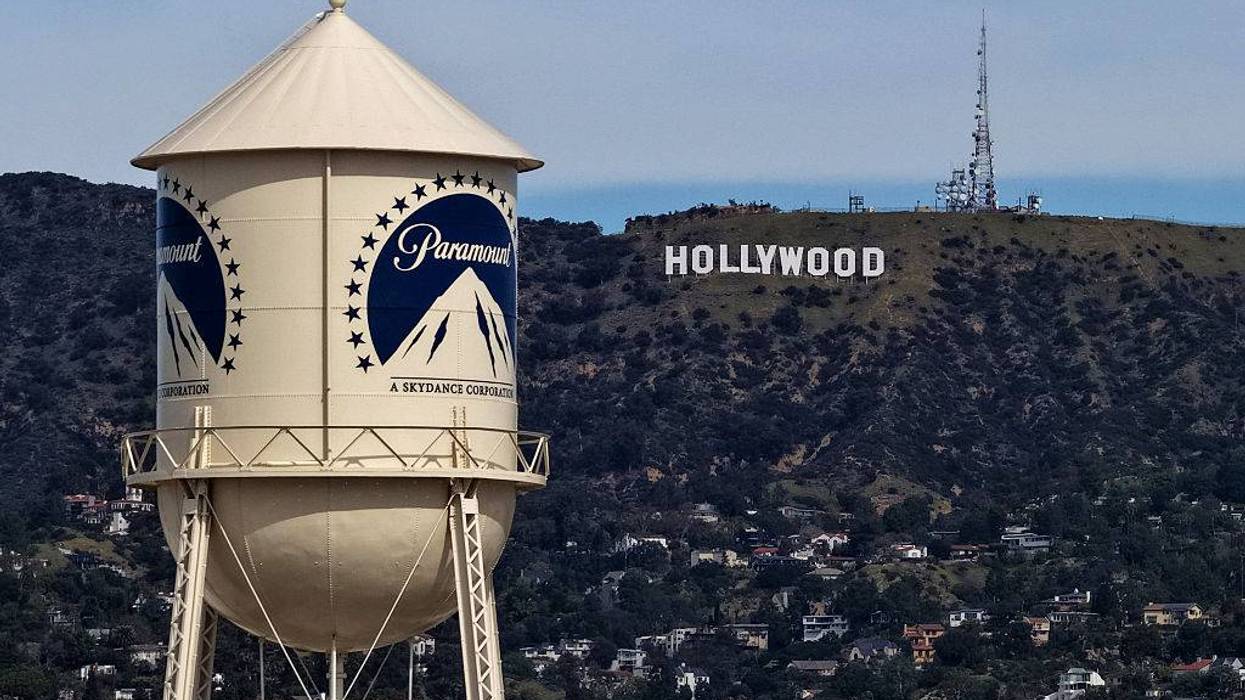
Jeff Jarvis, professor emeritus at the CUNY Graduate School of Journalism, warned that the merger is part of "the creation of state media" under the Trump administration, and described it as "even more dangerous than Ellison Inc.," a reference to the proposed mega-merger between Paramount Skydance—a company controlled by the son of billionaire Trump donor Larry Ellison—and Warner Bros. Discovery.
Even with FCC approval, Nexstar's acquisition of Tegna is not yet a done deal, as eight state attorneys general this week filed an antitrust lawsuit to block the merger.
California Attorney General Rob Bonta, one of the state AGs involved in the lawsuit, described the Nexstar-Tegna deal as "illegal, plain and simple."
"When broadcast media is owned by a handful of companies, we get fewer voices, less competition," said Bonta, "and communities lose the critical check on power that local journalism delivers."
"Trump doesn't need Israel's permission to end this war," said one observer. "The longer he waits, the more Americans pay."
Israeli Prime Minister Benjamin Netanyahu said Thursday that "there has to be a ground component" to the war on Iran as a new survey of US voters showed just 7% support for a large-scale invasion involving American forces.
"It is often said that you can't win, you can't do revolutions from the air. That is true," Netanyahu told reporters during a press conference in Jerusalem. "You can do a lot of things from the air... but there has to be a ground component, as well. There are many possibilities for this ground component. And I take the liberty of not sharing with you all of those possibilities."
Netanyahu's insistence on the necessity of ground operations in Iran came as US President Donald Trump declared to reporters in the White House on Thursday, "I'm not putting troops anywhere."
"If I were," he added, "I certainly wouldn't tell you."
A Reuters/Ipsos poll released Thursday found that just 7% of US voters support the idea of a large-scale ground invasion of Iran—but 65% of Americans believe that Trump will order such an operation anyway.
Just 34% of US voters would support "deploying a small number of special forces troops" to Iran, the survey found, while 55% said they would oppose the use of any ground troops.
The survey came days after Reuters reported that the Trump administration is "considering deploying thousands of US troops to reinforce its operation in the Middle East, as the US military prepares for possible next steps in its campaign against Iran."
The Pentagon's push for $200 billion in supplemental funding from the US Congress, which did not authorize the Iran war, amplified concerns that the Trump administration is gearing up for a prolonged conflict that could involve American troops on the ground, despite Trump's repeated public insistence that the war will be over "very soon."
Both US and Israeli intelligence agencies have reportedly assessed that Iran's regime is not on the verge of collapse after nearly three weeks of relentless bombing.
"Western officials and analysts who study Iran said they see little near-term prospect of a 'regime change' end to the 47-year-old Islamic republic or the rise of a more democratic government," The Washington Post reported earlier this week. "The latter is a goal cited by Israeli Prime Minister Benjamin Netanyahu and sometimes by President Donald Trump, who has said he’ll know the war is over 'when I feel it in my bones.'"
Raed Jarrar, advocacy director at the pro-democracy group DAWN, said Thursday that "the United States and Israel are not fighting the same war," pointing to recent Israeli strikes on Iranian energy infrastructure. The strikes drew a public rebuke from Trump, who is facing soaring gas prices at home due to the illegal war he launched in partnership with Netanyahu.
"Trump wants a quick exit. Netanyahu wants to permanently destroy Iran as a regional power," said Shakir. "There is an exit. Trump doesn't need Israel's permission to end this war. He's done it before in Yemen. The longer he waits, the more Americans pay."
Trita Parsi, executive vice president of the Quincy Institute for Responsible Statecraft, warned Thursday that Trump may be running out of time to "convincingly declare victory and provide himself a face-saving exit."
"Israel will do all it can to sabotage any such off-ramp, including killing Iranian's negotiators," Parsi wrote. "But it will become increasingly clear—if it hasn't already—to Trump that all his escalatory options only deepen the lose-lose situation he has put himself in."
"That's why Trump should never have listened to Netanyahu in the first place," he added.