SUBSCRIBE TO OUR FREE NEWSLETTER
Daily news & progressive opinion—funded by the people, not the corporations—delivered straight to your inbox.
5
#000000
#FFFFFF
To donate by check, phone, or other method, see our More Ways to Give page.
Daily news & progressive opinion—funded by the people, not the corporations—delivered straight to your inbox.
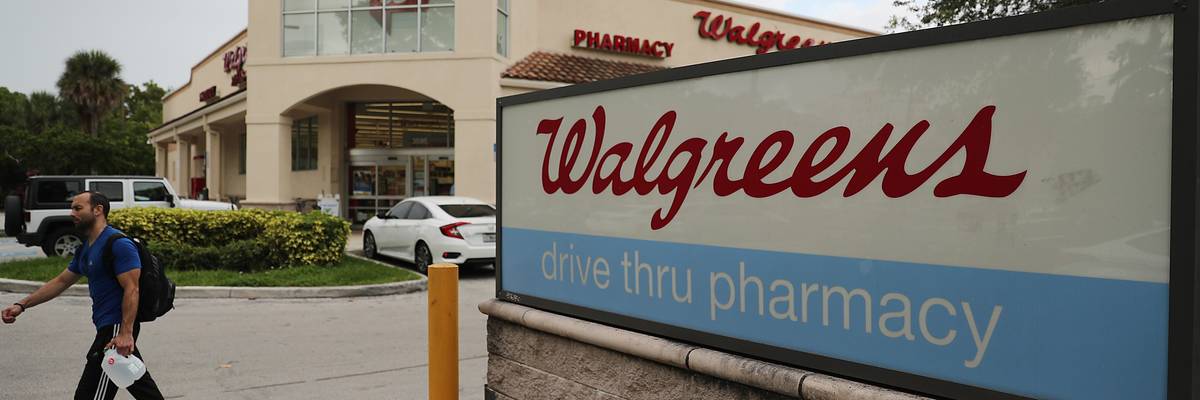
A Walgreens store is seen on August 7, 2019 in Miami, Florida.
The man who oversaw massive store closures and job cuts at Staples is now in charge of one of America’s most important companies.
Sycamore Partners finalized its $18.8 billion acquisition of Walgreens this summer, relying on a staggering amount of debt to close the deal. However, a more innocuous decision may be the real warning sign that could spell doom for Walgreens and its workers: Sycamore installed Mike Motz, the CEO of Staples US Retail—another company it owns—as Walgreens’ new chief executive.
That appointment should alarm every patient, pharmacist, and community that depends on Walgreens. Motz took over at Staples US Retail in April 2019, the same month that Sycamore Partners added debt to Staples’ balance sheet to extract a $1 billion dividend for itself. Under Sycamore’s ownership, Staples has shuttered a third of its US stores, cutting tens of thousands of jobs. Just this September, Staples subsidiary Essendant announced hundreds of layoffs in Ohio, North Carolina, Florida, Texas, New Jersey. If 33% of Walgreens stores were to close, the fallout could be catastrophic: more than 70,000 layoffs and communities losing access to pharmacies and essential medications.
Sycamore Partners has developed a reputation for squeezing cash out of its acquisitions at the expense of long-term stability. The firm's history already contains documented, high-profile bankruptcies and mass layoffs. Belk and Nine West both went bankrupt while under Sycamore’s control. At Nine West, bankruptcy meant the closure of 70 stores and widespread layoffs. Belk, which Sycamore Partners acquired in a leveraged buyout in 2015, filed for bankruptcy in 2021 with $1.9 billion in funded debt. Aeropostale, meanwhile, claimed that onerous terms from Sycamore’s apparel sourcing arm helped drive it into bankruptcy.
Staples, one of Sycamore’s best-known acquisitions, has endured years of store closures since being taken private in 2017. With Sycamore in control, Staples closed roughly 33% of its stores. The decision to put the Staples CEO in charge of Walgreens signals that the same corporate strategy of mass closures may now be applied to one of America’s most important healthcare access points. The problem is not only who is running Walgreens, but also the strategy that the new executive represents.
The Walgreens acquisition is one of the largest private equity healthcare buyouts in history. That makes its outcome a bellwether for how Wall Street’s debt-fueled model could continue to reshape the healthcare sector.
Sycamore’s portfolio companies have also been cited repeatedly for workplace safety failures. Staples alone has had 37 Occupational Safety and Health Administration violations totaling more than $192,000 in fines since Sycamore acquired it—23 of them classified as serious, meaning hazards that could cause severe injury or death. Across Sycamore’s retail holdings, the absence of significant union representation has left workers without a collective voice to push back against these conditions.
Beyond leadership, the financial engineering behind this deal sets Walgreens up for trouble. Sycamore Partners relied on more than 70% debt ($13.33 billion out of $18.8 billion) to fund its acquisition of Walgreens, which is an unusually high level, compared to recent private equity buyouts. That level of leverage puts Walgreens on unstable footing from day one.
The risks of the usage of high levels of debt in private equity takeovers is well-documented. In the first quarter of this year alone, 70% of large US corporate bankruptcies involved private equity-owned companies. These bankruptcies followed a familiar script: Firms borrowed heavily to finance buyouts, extracted value from their portfolio companies, and left them unable to withstand market pressures or economic downturns. Walgreens now carries those same risks.
Sycamore Partners’ acquisitions have amassed it a portfolio of mostly retail companies, but now the Walgreens buyout brings the firm directly in contact with a public health system that hundreds of millions of Americans rely on daily. Many communities, particularly rural towns, low-income areas, and minority neighborhoods, have limited access to pharmacies.
Store closures in those communities wouldn’t just mean inconvenience; they could mean patients losing access to lifesaving medications, routine vaccinations, and basic health consultations. The potential job losses are equally severe. If tens of thousands more workers are laid off, that kind of shock would ripple across local economies, cutting off benefits and wages for tens of thousands of families.
The Walgreens acquisition is one of the largest private equity healthcare buyouts in history. That makes its outcome a bellwether for how Wall Street’s debt-fueled model could continue to reshape the healthcare sector. Unfortunately, the early warning signs are clear. A heavily indebted company, led by an executive imported from another Sycamore-owned retailer, looks less like a turnaround story and more like the setup for another collapse.
Sycamore Partners insists it can manage Walgreens successfully. But the history of the firm’s operation of its portfolio companies tells a different story. From bankruptcies at Belk and Nine West to sweeping layoffs at Staples, the firm’s track record speaks for itself. Local communities, workers, and patients may once again pay the price for Wall Street’s short-term gains.
Walgreens is more than just a household brand. For millions of Americans, it is a vital link to the healthcare system. By wresting control of Walgreens, and importing the same leadership that oversaw Staples’ store closures and job cuts, Sycamore Partners has put that link at risk. Unless something changes, the consequences could be measured not just in balance sheets, but in lost jobs, shuttered stores, and diminished access to care.
Dear Common Dreams reader, It’s been nearly 30 years since I co-founded Common Dreams with my late wife, Lina Newhouser. We had the radical notion that journalism should serve the public good, not corporate profits. It was clear to us from the outset what it would take to build such a project. No paid advertisements. No corporate sponsors. No millionaire publisher telling us what to think or do. Many people said we wouldn't last a year, but we proved those doubters wrong. Together with a tremendous team of journalists and dedicated staff, we built an independent media outlet free from the constraints of profits and corporate control. Our mission has always been simple: To inform. To inspire. To ignite change for the common good. Building Common Dreams was not easy. Our survival was never guaranteed. When you take on the most powerful forces—Wall Street greed, fossil fuel industry destruction, Big Tech lobbyists, and uber-rich oligarchs who have spent billions upon billions rigging the economy and democracy in their favor—the only bulwark you have is supporters who believe in your work. But here’s the urgent message from me today. It's never been this bad out there. And it's never been this hard to keep us going. At the very moment Common Dreams is most needed, the threats we face are intensifying. We need your support now more than ever. We don't accept corporate advertising and never will. We don't have a paywall because we don't think people should be blocked from critical news based on their ability to pay. Everything we do is funded by the donations of readers like you. When everyone does the little they can afford, we are strong. But if that support retreats or dries up, so do we. Will you donate now to make sure Common Dreams not only survives but thrives? —Craig Brown, Co-founder |
Sycamore Partners finalized its $18.8 billion acquisition of Walgreens this summer, relying on a staggering amount of debt to close the deal. However, a more innocuous decision may be the real warning sign that could spell doom for Walgreens and its workers: Sycamore installed Mike Motz, the CEO of Staples US Retail—another company it owns—as Walgreens’ new chief executive.
That appointment should alarm every patient, pharmacist, and community that depends on Walgreens. Motz took over at Staples US Retail in April 2019, the same month that Sycamore Partners added debt to Staples’ balance sheet to extract a $1 billion dividend for itself. Under Sycamore’s ownership, Staples has shuttered a third of its US stores, cutting tens of thousands of jobs. Just this September, Staples subsidiary Essendant announced hundreds of layoffs in Ohio, North Carolina, Florida, Texas, New Jersey. If 33% of Walgreens stores were to close, the fallout could be catastrophic: more than 70,000 layoffs and communities losing access to pharmacies and essential medications.
Sycamore Partners has developed a reputation for squeezing cash out of its acquisitions at the expense of long-term stability. The firm's history already contains documented, high-profile bankruptcies and mass layoffs. Belk and Nine West both went bankrupt while under Sycamore’s control. At Nine West, bankruptcy meant the closure of 70 stores and widespread layoffs. Belk, which Sycamore Partners acquired in a leveraged buyout in 2015, filed for bankruptcy in 2021 with $1.9 billion in funded debt. Aeropostale, meanwhile, claimed that onerous terms from Sycamore’s apparel sourcing arm helped drive it into bankruptcy.
Staples, one of Sycamore’s best-known acquisitions, has endured years of store closures since being taken private in 2017. With Sycamore in control, Staples closed roughly 33% of its stores. The decision to put the Staples CEO in charge of Walgreens signals that the same corporate strategy of mass closures may now be applied to one of America’s most important healthcare access points. The problem is not only who is running Walgreens, but also the strategy that the new executive represents.
The Walgreens acquisition is one of the largest private equity healthcare buyouts in history. That makes its outcome a bellwether for how Wall Street’s debt-fueled model could continue to reshape the healthcare sector.
Sycamore’s portfolio companies have also been cited repeatedly for workplace safety failures. Staples alone has had 37 Occupational Safety and Health Administration violations totaling more than $192,000 in fines since Sycamore acquired it—23 of them classified as serious, meaning hazards that could cause severe injury or death. Across Sycamore’s retail holdings, the absence of significant union representation has left workers without a collective voice to push back against these conditions.
Beyond leadership, the financial engineering behind this deal sets Walgreens up for trouble. Sycamore Partners relied on more than 70% debt ($13.33 billion out of $18.8 billion) to fund its acquisition of Walgreens, which is an unusually high level, compared to recent private equity buyouts. That level of leverage puts Walgreens on unstable footing from day one.
The risks of the usage of high levels of debt in private equity takeovers is well-documented. In the first quarter of this year alone, 70% of large US corporate bankruptcies involved private equity-owned companies. These bankruptcies followed a familiar script: Firms borrowed heavily to finance buyouts, extracted value from their portfolio companies, and left them unable to withstand market pressures or economic downturns. Walgreens now carries those same risks.
Sycamore Partners’ acquisitions have amassed it a portfolio of mostly retail companies, but now the Walgreens buyout brings the firm directly in contact with a public health system that hundreds of millions of Americans rely on daily. Many communities, particularly rural towns, low-income areas, and minority neighborhoods, have limited access to pharmacies.
Store closures in those communities wouldn’t just mean inconvenience; they could mean patients losing access to lifesaving medications, routine vaccinations, and basic health consultations. The potential job losses are equally severe. If tens of thousands more workers are laid off, that kind of shock would ripple across local economies, cutting off benefits and wages for tens of thousands of families.
The Walgreens acquisition is one of the largest private equity healthcare buyouts in history. That makes its outcome a bellwether for how Wall Street’s debt-fueled model could continue to reshape the healthcare sector. Unfortunately, the early warning signs are clear. A heavily indebted company, led by an executive imported from another Sycamore-owned retailer, looks less like a turnaround story and more like the setup for another collapse.
Sycamore Partners insists it can manage Walgreens successfully. But the history of the firm’s operation of its portfolio companies tells a different story. From bankruptcies at Belk and Nine West to sweeping layoffs at Staples, the firm’s track record speaks for itself. Local communities, workers, and patients may once again pay the price for Wall Street’s short-term gains.
Walgreens is more than just a household brand. For millions of Americans, it is a vital link to the healthcare system. By wresting control of Walgreens, and importing the same leadership that oversaw Staples’ store closures and job cuts, Sycamore Partners has put that link at risk. Unless something changes, the consequences could be measured not just in balance sheets, but in lost jobs, shuttered stores, and diminished access to care.
Sycamore Partners finalized its $18.8 billion acquisition of Walgreens this summer, relying on a staggering amount of debt to close the deal. However, a more innocuous decision may be the real warning sign that could spell doom for Walgreens and its workers: Sycamore installed Mike Motz, the CEO of Staples US Retail—another company it owns—as Walgreens’ new chief executive.
That appointment should alarm every patient, pharmacist, and community that depends on Walgreens. Motz took over at Staples US Retail in April 2019, the same month that Sycamore Partners added debt to Staples’ balance sheet to extract a $1 billion dividend for itself. Under Sycamore’s ownership, Staples has shuttered a third of its US stores, cutting tens of thousands of jobs. Just this September, Staples subsidiary Essendant announced hundreds of layoffs in Ohio, North Carolina, Florida, Texas, New Jersey. If 33% of Walgreens stores were to close, the fallout could be catastrophic: more than 70,000 layoffs and communities losing access to pharmacies and essential medications.
Sycamore Partners has developed a reputation for squeezing cash out of its acquisitions at the expense of long-term stability. The firm's history already contains documented, high-profile bankruptcies and mass layoffs. Belk and Nine West both went bankrupt while under Sycamore’s control. At Nine West, bankruptcy meant the closure of 70 stores and widespread layoffs. Belk, which Sycamore Partners acquired in a leveraged buyout in 2015, filed for bankruptcy in 2021 with $1.9 billion in funded debt. Aeropostale, meanwhile, claimed that onerous terms from Sycamore’s apparel sourcing arm helped drive it into bankruptcy.
Staples, one of Sycamore’s best-known acquisitions, has endured years of store closures since being taken private in 2017. With Sycamore in control, Staples closed roughly 33% of its stores. The decision to put the Staples CEO in charge of Walgreens signals that the same corporate strategy of mass closures may now be applied to one of America’s most important healthcare access points. The problem is not only who is running Walgreens, but also the strategy that the new executive represents.
The Walgreens acquisition is one of the largest private equity healthcare buyouts in history. That makes its outcome a bellwether for how Wall Street’s debt-fueled model could continue to reshape the healthcare sector.
Sycamore’s portfolio companies have also been cited repeatedly for workplace safety failures. Staples alone has had 37 Occupational Safety and Health Administration violations totaling more than $192,000 in fines since Sycamore acquired it—23 of them classified as serious, meaning hazards that could cause severe injury or death. Across Sycamore’s retail holdings, the absence of significant union representation has left workers without a collective voice to push back against these conditions.
Beyond leadership, the financial engineering behind this deal sets Walgreens up for trouble. Sycamore Partners relied on more than 70% debt ($13.33 billion out of $18.8 billion) to fund its acquisition of Walgreens, which is an unusually high level, compared to recent private equity buyouts. That level of leverage puts Walgreens on unstable footing from day one.
The risks of the usage of high levels of debt in private equity takeovers is well-documented. In the first quarter of this year alone, 70% of large US corporate bankruptcies involved private equity-owned companies. These bankruptcies followed a familiar script: Firms borrowed heavily to finance buyouts, extracted value from their portfolio companies, and left them unable to withstand market pressures or economic downturns. Walgreens now carries those same risks.
Sycamore Partners’ acquisitions have amassed it a portfolio of mostly retail companies, but now the Walgreens buyout brings the firm directly in contact with a public health system that hundreds of millions of Americans rely on daily. Many communities, particularly rural towns, low-income areas, and minority neighborhoods, have limited access to pharmacies.
Store closures in those communities wouldn’t just mean inconvenience; they could mean patients losing access to lifesaving medications, routine vaccinations, and basic health consultations. The potential job losses are equally severe. If tens of thousands more workers are laid off, that kind of shock would ripple across local economies, cutting off benefits and wages for tens of thousands of families.
The Walgreens acquisition is one of the largest private equity healthcare buyouts in history. That makes its outcome a bellwether for how Wall Street’s debt-fueled model could continue to reshape the healthcare sector. Unfortunately, the early warning signs are clear. A heavily indebted company, led by an executive imported from another Sycamore-owned retailer, looks less like a turnaround story and more like the setup for another collapse.
Sycamore Partners insists it can manage Walgreens successfully. But the history of the firm’s operation of its portfolio companies tells a different story. From bankruptcies at Belk and Nine West to sweeping layoffs at Staples, the firm’s track record speaks for itself. Local communities, workers, and patients may once again pay the price for Wall Street’s short-term gains.
Walgreens is more than just a household brand. For millions of Americans, it is a vital link to the healthcare system. By wresting control of Walgreens, and importing the same leadership that oversaw Staples’ store closures and job cuts, Sycamore Partners has put that link at risk. Unless something changes, the consequences could be measured not just in balance sheets, but in lost jobs, shuttered stores, and diminished access to care.