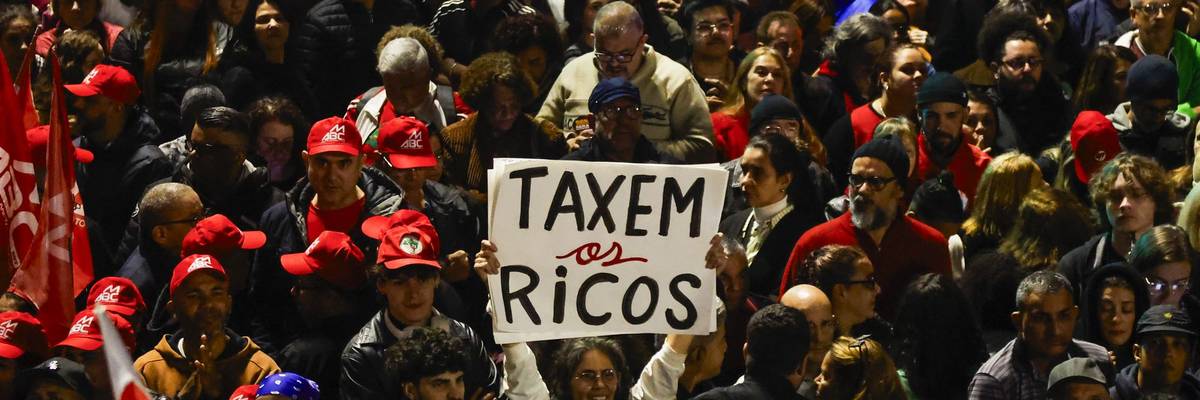
People attend a demonstration in support of taxing the super-rich in São Paulo, Brazil on July 10, 2025.
Richest 0.001% Now Own Three Times More Wealth Than Poorest Half of Humanity Combined
"The choices we make in the coming years will determine whether the global economy continues down a path of extreme concentration or moves toward shared prosperity."
A landmark report on global inequality published Wednesday shows that the chasm between the richest slice of humanity and everyone else continued to expand this year, leaving the top 0.001%—fewer than 60,000 multimillionaires—with three times more wealth than the poorest half of the world's population combined.
The global wealth gap has become so staggering, and its impact on economies and democratic institutions so corrosive, that policymakers should treat it as an emergency, argues the third edition of the World Inequality Report, a comprehensive analysis that draws on the work of hundreds of scholars worldwide. Ricardo Gómez-Carrera, a researcher at the World Inequality Lab, is the report's lead author.
"Inequality has long been a defining feature of the global economy, but by 2025, it has reached levels that demand urgent attention," reads the new report. "The benefits of globalization and economic growth have flowed disproportionately to a small minority, while much of the world’s population still face difficulties in achieving stable livelihoods. These divides are not inevitable. They are the outcome of political and institutional choices."
The richest 10% of the global population, according to the latest data, own three-quarters of the world's wealth and capture more income than the rest of humanity. Within most countries, it is rare for the bottom 50% to control more than 5% of national wealth.
"This concentration is not only persistent, but it is also accelerating," the report observes. "Since the 1990s, the wealth of billionaires and centimillionaires has grown at approximately 8% annually, nearly twice the rate of growth experienced by the bottom half of the population. The poorest have made modest gains, but these are overshadowed by the extraordinary accumulation at the very top."
"The result," the report adds, "is a world in which a tiny minority commands unprecedented financial power, while billions remain excluded from even basic economic stability."
The report comes as the world's richest and most powerful nation, led by President Donald Trump, abandons international cooperation on climate and taxation and works to supercharge inequality by slashing domestic and foreign aid programs while delivering massive handouts to the wealthiest Americans.
Jayati Ghosh, a member of the G20 Extraordinary Committee of Independent Experts on Global Inequality and co-author of the forward to the new report, said in a statement that "we live in a system where resources extracted from labor and nature in low-income countries continue to sustain the prosperity and the unsustainable lifestyle of people in high-income economies and rich elites across countries."
"These patterns are not accidents of markets," said Ghosh. "They reflect the legacy of history and the functioning of institutions, regulations and policies—all of which are related to unequal power relations that have yet to be rebalanced.”
Reversing the decadeslong trend of exploding inequality will require the political will to pursue obvious solutions, including fair taxation of the mega-rich and bold investments in social programs and climate action, which is disproportionately fueled by the wealthy.
"The choices we make in the coming years," the report says, "will determine whether the global economy continues down a path of extreme concentration or moves toward shared prosperity."
We are at a crossroads
This country and this world are at a monumental crossroads. In a few short weeks, US voters will have an opportunity to beat back the forces of fascism and confront the billionaires who are rigging the economy, our media system, and our democracy, making it increasingly impossible for ordinary people to get by. We’re not just talking about the election. We’re talking about what must be done once these fascist elements are vanquished from power. We need a bolder set of solutions than what either major party has so far been willing to offer and a working-class movement ready to fight like hell for it. Trump didn't emerge from nowhere. The conditions that fueled MAGA authoritarianism were created by decades of radical neoliberal economic policies and a corrupt political system dominated by corporate interests. They slashed taxes on the super-rich, promising that the benefits would trickle down. They said giveaways to the corporate titans would make life more affordable for the rest of us. It was all bullshit. And when a bitter, betrayed populace searches for someone to blame, right-wing demagogues have little trouble finding scapegoats. People know when they're being lied to, but you won't hear any of this from the corporate media. Only independent journalism—powered and funded by people who believe in building a better world—can deliver truly trustworthy daily news. Our Fall Campaign is underway, and we need your help. To power our newsroom through the rest of the year, we need to raise $125,000 by midnight on October 31. So if you share our vision, please contribute whatever you can to sustain our work. |
A landmark report on global inequality published Wednesday shows that the chasm between the richest slice of humanity and everyone else continued to expand this year, leaving the top 0.001%—fewer than 60,000 multimillionaires—with three times more wealth than the poorest half of the world's population combined.
The global wealth gap has become so staggering, and its impact on economies and democratic institutions so corrosive, that policymakers should treat it as an emergency, argues the third edition of the World Inequality Report, a comprehensive analysis that draws on the work of hundreds of scholars worldwide. Ricardo Gómez-Carrera, a researcher at the World Inequality Lab, is the report's lead author.
"Inequality has long been a defining feature of the global economy, but by 2025, it has reached levels that demand urgent attention," reads the new report. "The benefits of globalization and economic growth have flowed disproportionately to a small minority, while much of the world’s population still face difficulties in achieving stable livelihoods. These divides are not inevitable. They are the outcome of political and institutional choices."
The richest 10% of the global population, according to the latest data, own three-quarters of the world's wealth and capture more income than the rest of humanity. Within most countries, it is rare for the bottom 50% to control more than 5% of national wealth.
"This concentration is not only persistent, but it is also accelerating," the report observes. "Since the 1990s, the wealth of billionaires and centimillionaires has grown at approximately 8% annually, nearly twice the rate of growth experienced by the bottom half of the population. The poorest have made modest gains, but these are overshadowed by the extraordinary accumulation at the very top."
"The result," the report adds, "is a world in which a tiny minority commands unprecedented financial power, while billions remain excluded from even basic economic stability."
The report comes as the world's richest and most powerful nation, led by President Donald Trump, abandons international cooperation on climate and taxation and works to supercharge inequality by slashing domestic and foreign aid programs while delivering massive handouts to the wealthiest Americans.
Jayati Ghosh, a member of the G20 Extraordinary Committee of Independent Experts on Global Inequality and co-author of the forward to the new report, said in a statement that "we live in a system where resources extracted from labor and nature in low-income countries continue to sustain the prosperity and the unsustainable lifestyle of people in high-income economies and rich elites across countries."
"These patterns are not accidents of markets," said Ghosh. "They reflect the legacy of history and the functioning of institutions, regulations and policies—all of which are related to unequal power relations that have yet to be rebalanced.”
Reversing the decadeslong trend of exploding inequality will require the political will to pursue obvious solutions, including fair taxation of the mega-rich and bold investments in social programs and climate action, which is disproportionately fueled by the wealthy.
"The choices we make in the coming years," the report says, "will determine whether the global economy continues down a path of extreme concentration or moves toward shared prosperity."
- '100% Completely Unsustainable': Billionaire Wealth Manager Issues New Warning About US Inequality | Common Dreams ›
- Opinion | Workers Are Fighting Back Against Silicon Valley's Race to the Lowest Wage | Common Dreams ›
- Not Just AI and Climate—Inequality Also an 'Existential' Threat That Demands Global Cooperation: UN Chief | Common Dreams ›
- Opinion | The Wealthy Hold More Power Than Ever—Can We Take It Back? | Common Dreams ›
A landmark report on global inequality published Wednesday shows that the chasm between the richest slice of humanity and everyone else continued to expand this year, leaving the top 0.001%—fewer than 60,000 multimillionaires—with three times more wealth than the poorest half of the world's population combined.
The global wealth gap has become so staggering, and its impact on economies and democratic institutions so corrosive, that policymakers should treat it as an emergency, argues the third edition of the World Inequality Report, a comprehensive analysis that draws on the work of hundreds of scholars worldwide. Ricardo Gómez-Carrera, a researcher at the World Inequality Lab, is the report's lead author.
"Inequality has long been a defining feature of the global economy, but by 2025, it has reached levels that demand urgent attention," reads the new report. "The benefits of globalization and economic growth have flowed disproportionately to a small minority, while much of the world’s population still face difficulties in achieving stable livelihoods. These divides are not inevitable. They are the outcome of political and institutional choices."
The richest 10% of the global population, according to the latest data, own three-quarters of the world's wealth and capture more income than the rest of humanity. Within most countries, it is rare for the bottom 50% to control more than 5% of national wealth.
"This concentration is not only persistent, but it is also accelerating," the report observes. "Since the 1990s, the wealth of billionaires and centimillionaires has grown at approximately 8% annually, nearly twice the rate of growth experienced by the bottom half of the population. The poorest have made modest gains, but these are overshadowed by the extraordinary accumulation at the very top."
"The result," the report adds, "is a world in which a tiny minority commands unprecedented financial power, while billions remain excluded from even basic economic stability."
The report comes as the world's richest and most powerful nation, led by President Donald Trump, abandons international cooperation on climate and taxation and works to supercharge inequality by slashing domestic and foreign aid programs while delivering massive handouts to the wealthiest Americans.
Jayati Ghosh, a member of the G20 Extraordinary Committee of Independent Experts on Global Inequality and co-author of the forward to the new report, said in a statement that "we live in a system where resources extracted from labor and nature in low-income countries continue to sustain the prosperity and the unsustainable lifestyle of people in high-income economies and rich elites across countries."
"These patterns are not accidents of markets," said Ghosh. "They reflect the legacy of history and the functioning of institutions, regulations and policies—all of which are related to unequal power relations that have yet to be rebalanced.”
Reversing the decadeslong trend of exploding inequality will require the political will to pursue obvious solutions, including fair taxation of the mega-rich and bold investments in social programs and climate action, which is disproportionately fueled by the wealthy.
"The choices we make in the coming years," the report says, "will determine whether the global economy continues down a path of extreme concentration or moves toward shared prosperity."
- '100% Completely Unsustainable': Billionaire Wealth Manager Issues New Warning About US Inequality | Common Dreams ›
- Opinion | Workers Are Fighting Back Against Silicon Valley's Race to the Lowest Wage | Common Dreams ›
- Not Just AI and Climate—Inequality Also an 'Existential' Threat That Demands Global Cooperation: UN Chief | Common Dreams ›
- Opinion | The Wealthy Hold More Power Than Ever—Can We Take It Back? | Common Dreams ›