SUBSCRIBE TO OUR FREE NEWSLETTER
Daily news & progressive opinion—funded by the people, not the corporations—delivered straight to your inbox.
5
#000000
#FFFFFF
To donate by check, phone, or other method, see our More Ways to Give page.
Daily news & progressive opinion—funded by the people, not the corporations—delivered straight to your inbox.
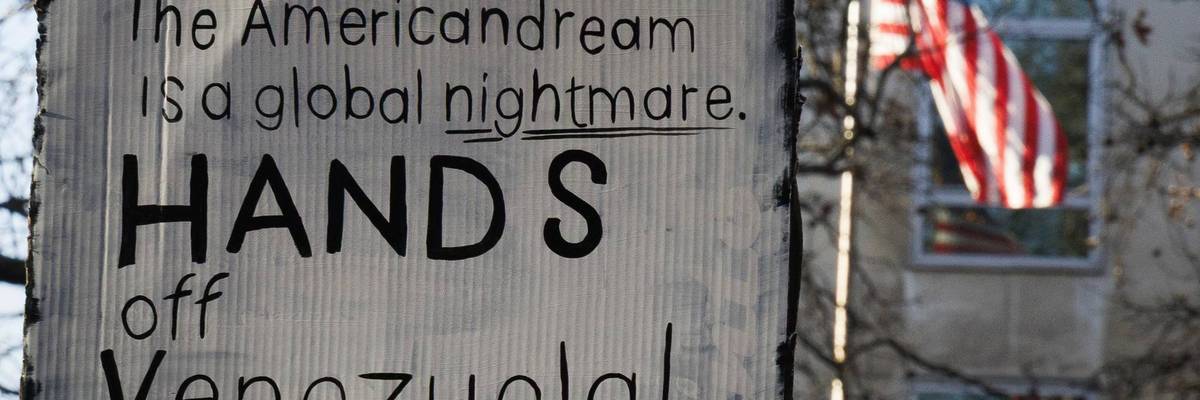
A photograph taken on January 4, 2026 shows a placard with a message reading, "American dream is a global nightmare, hands off Venezuela" during a demonstration against the US operation in Venezuela to capture the Venezuelan president, in front of the US Embassy in Brussels.
In Venezuela, Cuba, and Nicaragua, both parties agree with the assumption that Washington has the right to shape the political future of other nations.
Donald Trump’s second term has precipitated a tsunami of criticism from Democrats over his foreign policy. Yet when it comes to Washington's efforts to dominate Latin America and the Caribbean, the substantive dispute—if there is any substance remaining, once stripped of partisan bickering—is less about ends than means.
Beneath the rhetoric of inter-party conflict lies a broad bipartisan consensus in favor of promoting US hemispheric hegemony and crushing governments that resist it—with Venezuela, Cuba, and Nicaragua at the forefront. While Democrats frequently portray Trump as reckless, they generally accept the underlying premises of economic coercion, political intervention, and regime-change pressure. Their objections mainly focus on the execution of policy rather than its legitimacy.
Under Democratic administrations, the US forged and institutionalized what may be its most effective instrument of hegemony. Coercive economic measures, commonly called “sanctions,” were first deployed by Franklin D. Roosevelt against Mexico in the 1930s. They were used by Dwight D. Eisenhower to pressure Guatemala in 1954 and then—most drastically—against Cuba by both Eisenhower and John F. Kennedy in 1960. Today, one-third of the world’s nations are under US sanctions.
Sanctions—a form of collective punishment—are held by legal experts to be contrary to international law. Paradoxically, not only does Washington disregard international law in imposing sanctions, but the US then behaves as if they are applying the law when, for example, they pirate a ship delivering humanitarian supplies to a sanctioned country.
The shared strategic objective of the bipartisan Washington consensus is the projection of US hemispheric dominance.
Use of sanctions has accelerated because successive administrations have seen their unique advantages. Compared with “forever wars,” they are more easily justified to US voters as cost free and as not imperiling US lives. If sanctions are the precursor to military intervention—as in Guatemala in 1954, Cuba in 1961, Grenada in 1983, Panama in 1989 and, of course, Venezuela in 2026—the interventions have usually been limited, with few US casualties.
Yet sanctions are very potent: Between 2010 and 2021, they caused around 560,000 deaths globally each year—more than five times the number of people killed annually in direct armed combat.
While sanctions are made more palatable by being described as “targeted” at governments or individuals seen as undesirable by Washington, in practice the “targeting” is deliberately far wider. Sanctions do most damage to the poorest sectors of societies—the sectors most likely to support progressive governments. The barely veiled message is that only by withdrawing this support will such communities be able to prosper and avoid the threat of even greater US intervention.
The frequent description of sanctions as “targeted” carries another implication—that they are intended to have a precise and conclusive effect. However, while sanctions cause severe economic damage, there is little evidence that they achieve intended regime change. Even so, sanctions on countries which refuse to change are maintained and—very frequently—intensified. Democrats are as guilty of this folly as Republicans.
Indeed, US sanctions have imperial utility through their “demonstration effect”: attempting to cripple progressive alternatives to the neoliberal world order. Recently subjected to draconian sanctions, Cuban President Miguel Díaz-Canel proclaimed, “Cuba is not a failed state; Cuba is a besieged state.” Still, infant mortality in Cuba is lower than among African Americans.
In the case of Venezuela, the Democrats have criticized the Republicans from the right, complaining that the cudgel of imperial power against essentially defenseless small states has not been wielded with sufficient malice.
Washington has imposed illegal unilateral coercive measures on Venezuela since 2015 in efforts to asphyxiate its Bolivarian Revolution. The transparently false rationale for continuing sanctions is that Venezuela poses an “extraordinary threat” to the national security of the US. Although the threat is obviously the other way around, mainstream Democrats have not exposed this lie. How could they, when it originated with President Barack Obama and was subsequently echoed by President Joe Biden and then Trump?
Despite the horrific toll of an estimated 100,000 excess deaths attributed to US-imposed sanctions, Venezuela has resisted and maintained an unbroken continuity of leadership from Hugo Chávez to Nicolás Maduro and to now Delcy Rodríguez. And that’s the rub for the Democrats.
Ranking Democrat members of the House and Senate foreign affairs committees, Rep. Gregory W. Meeks (D-NY) and Senator Jeanne Shaheen (D-NH), issued a “request [for] a clear explanation” of Trump’s Venezuela policy. Their meek missive came a full five months after the abduction of the Venezuelan president, an operation that resulted in more than 100 collateral deaths. Meanwhile, more than 200 occupants of small boats in the Caribbean and eastern Pacific have been subjected to extrajudicial murder by the Trump administration.
Yet these inconvenient facts are absent from the June 8 Democratic Party congressional foreign-policy leadership’s statement on Venezuela. Their complaint is that Trump’s White House has failed to sufficiently “exercise its leverage.” As they put it, “As of today, the [state] department has yet to provide any evidence the Trump administration is doing any of this hard work.”
The contradiction of kidnapping a lawful head of state in the name of restoring democracy does not trouble the Democrats. Rather, they “strongly support the Venezuelan people’s right to choose their leaders”… after the US abducts their president.
These Democrat leaders are also troubled that Venezuelan authorities were allowed to appoint a new attorney general and defense minister without apparent US interference. In addition, they express impatience with Trump’s lethargy in not yet overhauling Venezuela’s supreme court and electoral council.
To the extent that they make any concrete demand, the putative opposition party wants Trump to impose an “electoral timeline” on Venezuela. Yet, the same party has no problem with Volodymyr Zelenskyy in Ukraine who suspended elections after his legal term in office expired two years ago, banned opposition parties, shuttered critical media, and arrested political opponents.
Democratic Party policy toward Cuba is perhaps best exemplified by Biden’s retention of the State Sponsor of Terrorism designation, which he inherited from Trump. Then, just six days before leaving office, Biden rescinded the designation with full certainty that the incoming Republican would—and did—reverse his decision.
Former National Security Council officer Ricardo Zúñiga was Obama’s adviser for the Americas and Biden’s special envoy for the Northern Triangle. He writes in Foreign Affairs offering advice on, rather than criticism of, Trump’s Cuba policy.
Republicans may be more inclined toward overt confrontation, selective military assaults, and maximal pressure; Democrats typically prefer a combination of inhumane sanctions, diplomatic isolation, and multilateral coercion.
Zúñiga advocates achieving regime change in Cuba through “diplomacy” rather than “force.” Scare quotes are used because, for this Democrat, brute economic strangulation is regarded as diplomacy. Zúñiga would “forswear military action,” but only if Cuba submits to US dictates. And so long as “pro-market reforms” are adopted, “democracy” can wait.
Without a hint of opprobrium, Zúñiga casually references the US invasion of Iran and the kidnapping of the Venezuelan president as policy options that would not be effective in Cuba. Given these examples, he then complains that Cubans remain resistant to “American views on democracy and human rights.”
He acknowledges that even if Trump wished to selectively roll back the murderous sanctions currently imposed on Cuba, he would face opposition not only from Republicans but also from Democrats. Where this Democrat differs from Republicans is in his supremely hypocritical conclusion: “It is ultimately Cuban citizens who will determine their country’s future”… after the US overthrows their government.
Tiny Nicaragua is also labelled an “extraordinary threat” to the US. While the harshest and most successful sanctions against it were applied during the Reagan administrations, when an economic blockade and the US-financed Contra war eventually unseated the Sandinista government in 1990, economic pressure quickly resumed once the Sandinistas returned to power in 2007. Both the Bush and then Obama administrations made cuts in aid, and it was under Obama that Democrats joined with Republicans to launch the NICA Act, eventually implemented (under Trump) in 2018.
While Trump signed the NICA Act and sanctioned various Nicaraguan functionaries, Democrat senators took the lead in formulating stronger measures in the RENACER Act, signed by Biden in 2021. This led to an estimated loss of $500 million annually in development finance that would have been directed at Nicaragua’s poorest communities. Sen. Tim Kaine (D-Va.), with Marco Rubio, put forward new legislation in 2023 that was intended to strengthen the RENACER Act and ensure even greater damage.
Biden officials were consistently aggressive toward Nicaragua. In 2022, his nominee for ambassador to Managua, Hugo Rodríguez, promised the US Congress that he would “support using all economic and diplomatic tools to bring about a change in direction in Nicaragua.” As a result, Rodríguez was never accepted as ambassador and the post remains unfilled.
In 2024, Biden’s trade representative launched a hostile investigation clearly aimed at disrupting trade with Nicaragua and possibly at excluding it from the regional trade treaty, CAFTA. When it eventually reported in late 2025 it recommended punitive tariffs, but only relatively mild penalties were actually implemented by Trump.
Marco Rubio regularly imposes sanctions on individual Nicaraguans, including 100 more just this month. More than 2,300 have now been sanctioned by successive administrations. Nevertheless, hard-line Democrats, as well as Republicans, are pushing Rubio to do far more.
The shared strategic objective of the bipartisan Washington consensus is the projection of US hemispheric dominance. The two major parties differ mainly in messaging and, to a lesser extent, on tactics. Their theatrical contention is neither between intervention and nonintervention, nor between coercion and diplomacy. More often, it is between competing methods for achieving the same strategic objective.
Republicans may be more inclined toward overt confrontation, selective military assaults, and maximal pressure; Democrats typically prefer a combination of inhumane sanctions, diplomatic isolation, and multilateral coercion. But both approaches rest on the assumption that Washington has the right to shape the political future of other nations.
Despite differences in tone and tactics, the supposed opposition party offers not an articulated alternative to the Trump Corollary to the Monroe Doctrine but, at the very most, a variation of it.
Dear Common Dreams reader, It’s been nearly 30 years since I co-founded Common Dreams with my late wife, Lina Newhouser. We had the radical notion that journalism should serve the public good, not corporate profits. It was clear to us from the outset what it would take to build such a project. No paid advertisements. No corporate sponsors. No millionaire publisher telling us what to think or do. Many people said we wouldn't last a year, but we proved those doubters wrong. Together with a tremendous team of journalists and dedicated staff, we built an independent media outlet free from the constraints of profits and corporate control. Our mission has always been simple: To inform. To inspire. To ignite change for the common good. Building Common Dreams was not easy. Our survival was never guaranteed. When you take on the most powerful forces—Wall Street greed, fossil fuel industry destruction, Big Tech lobbyists, and uber-rich oligarchs who have spent billions upon billions rigging the economy and democracy in their favor—the only bulwark you have is supporters who believe in your work. But here’s the urgent message from me today. It's never been this bad out there. And it's never been this hard to keep us going. At the very moment Common Dreams is most needed, the threats we face are intensifying. We need your support now more than ever. We don't accept corporate advertising and never will. We don't have a paywall because we don't think people should be blocked from critical news based on their ability to pay. Everything we do is funded by the donations of readers like you. When everyone does the little they can afford, we are strong. But if that support retreats or dries up, so do we. Will you donate now to make sure Common Dreams not only survives but thrives? —Craig Brown, Co-founder |
Donald Trump’s second term has precipitated a tsunami of criticism from Democrats over his foreign policy. Yet when it comes to Washington's efforts to dominate Latin America and the Caribbean, the substantive dispute—if there is any substance remaining, once stripped of partisan bickering—is less about ends than means.
Beneath the rhetoric of inter-party conflict lies a broad bipartisan consensus in favor of promoting US hemispheric hegemony and crushing governments that resist it—with Venezuela, Cuba, and Nicaragua at the forefront. While Democrats frequently portray Trump as reckless, they generally accept the underlying premises of economic coercion, political intervention, and regime-change pressure. Their objections mainly focus on the execution of policy rather than its legitimacy.
Under Democratic administrations, the US forged and institutionalized what may be its most effective instrument of hegemony. Coercive economic measures, commonly called “sanctions,” were first deployed by Franklin D. Roosevelt against Mexico in the 1930s. They were used by Dwight D. Eisenhower to pressure Guatemala in 1954 and then—most drastically—against Cuba by both Eisenhower and John F. Kennedy in 1960. Today, one-third of the world’s nations are under US sanctions.
Sanctions—a form of collective punishment—are held by legal experts to be contrary to international law. Paradoxically, not only does Washington disregard international law in imposing sanctions, but the US then behaves as if they are applying the law when, for example, they pirate a ship delivering humanitarian supplies to a sanctioned country.
The shared strategic objective of the bipartisan Washington consensus is the projection of US hemispheric dominance.
Use of sanctions has accelerated because successive administrations have seen their unique advantages. Compared with “forever wars,” they are more easily justified to US voters as cost free and as not imperiling US lives. If sanctions are the precursor to military intervention—as in Guatemala in 1954, Cuba in 1961, Grenada in 1983, Panama in 1989 and, of course, Venezuela in 2026—the interventions have usually been limited, with few US casualties.
Yet sanctions are very potent: Between 2010 and 2021, they caused around 560,000 deaths globally each year—more than five times the number of people killed annually in direct armed combat.
While sanctions are made more palatable by being described as “targeted” at governments or individuals seen as undesirable by Washington, in practice the “targeting” is deliberately far wider. Sanctions do most damage to the poorest sectors of societies—the sectors most likely to support progressive governments. The barely veiled message is that only by withdrawing this support will such communities be able to prosper and avoid the threat of even greater US intervention.
The frequent description of sanctions as “targeted” carries another implication—that they are intended to have a precise and conclusive effect. However, while sanctions cause severe economic damage, there is little evidence that they achieve intended regime change. Even so, sanctions on countries which refuse to change are maintained and—very frequently—intensified. Democrats are as guilty of this folly as Republicans.
Indeed, US sanctions have imperial utility through their “demonstration effect”: attempting to cripple progressive alternatives to the neoliberal world order. Recently subjected to draconian sanctions, Cuban President Miguel Díaz-Canel proclaimed, “Cuba is not a failed state; Cuba is a besieged state.” Still, infant mortality in Cuba is lower than among African Americans.
In the case of Venezuela, the Democrats have criticized the Republicans from the right, complaining that the cudgel of imperial power against essentially defenseless small states has not been wielded with sufficient malice.
Washington has imposed illegal unilateral coercive measures on Venezuela since 2015 in efforts to asphyxiate its Bolivarian Revolution. The transparently false rationale for continuing sanctions is that Venezuela poses an “extraordinary threat” to the national security of the US. Although the threat is obviously the other way around, mainstream Democrats have not exposed this lie. How could they, when it originated with President Barack Obama and was subsequently echoed by President Joe Biden and then Trump?
Despite the horrific toll of an estimated 100,000 excess deaths attributed to US-imposed sanctions, Venezuela has resisted and maintained an unbroken continuity of leadership from Hugo Chávez to Nicolás Maduro and to now Delcy Rodríguez. And that’s the rub for the Democrats.
Ranking Democrat members of the House and Senate foreign affairs committees, Rep. Gregory W. Meeks (D-NY) and Senator Jeanne Shaheen (D-NH), issued a “request [for] a clear explanation” of Trump’s Venezuela policy. Their meek missive came a full five months after the abduction of the Venezuelan president, an operation that resulted in more than 100 collateral deaths. Meanwhile, more than 200 occupants of small boats in the Caribbean and eastern Pacific have been subjected to extrajudicial murder by the Trump administration.
Yet these inconvenient facts are absent from the June 8 Democratic Party congressional foreign-policy leadership’s statement on Venezuela. Their complaint is that Trump’s White House has failed to sufficiently “exercise its leverage.” As they put it, “As of today, the [state] department has yet to provide any evidence the Trump administration is doing any of this hard work.”
The contradiction of kidnapping a lawful head of state in the name of restoring democracy does not trouble the Democrats. Rather, they “strongly support the Venezuelan people’s right to choose their leaders”… after the US abducts their president.
These Democrat leaders are also troubled that Venezuelan authorities were allowed to appoint a new attorney general and defense minister without apparent US interference. In addition, they express impatience with Trump’s lethargy in not yet overhauling Venezuela’s supreme court and electoral council.
To the extent that they make any concrete demand, the putative opposition party wants Trump to impose an “electoral timeline” on Venezuela. Yet, the same party has no problem with Volodymyr Zelenskyy in Ukraine who suspended elections after his legal term in office expired two years ago, banned opposition parties, shuttered critical media, and arrested political opponents.
Democratic Party policy toward Cuba is perhaps best exemplified by Biden’s retention of the State Sponsor of Terrorism designation, which he inherited from Trump. Then, just six days before leaving office, Biden rescinded the designation with full certainty that the incoming Republican would—and did—reverse his decision.
Former National Security Council officer Ricardo Zúñiga was Obama’s adviser for the Americas and Biden’s special envoy for the Northern Triangle. He writes in Foreign Affairs offering advice on, rather than criticism of, Trump’s Cuba policy.
Republicans may be more inclined toward overt confrontation, selective military assaults, and maximal pressure; Democrats typically prefer a combination of inhumane sanctions, diplomatic isolation, and multilateral coercion.
Zúñiga advocates achieving regime change in Cuba through “diplomacy” rather than “force.” Scare quotes are used because, for this Democrat, brute economic strangulation is regarded as diplomacy. Zúñiga would “forswear military action,” but only if Cuba submits to US dictates. And so long as “pro-market reforms” are adopted, “democracy” can wait.
Without a hint of opprobrium, Zúñiga casually references the US invasion of Iran and the kidnapping of the Venezuelan president as policy options that would not be effective in Cuba. Given these examples, he then complains that Cubans remain resistant to “American views on democracy and human rights.”
He acknowledges that even if Trump wished to selectively roll back the murderous sanctions currently imposed on Cuba, he would face opposition not only from Republicans but also from Democrats. Where this Democrat differs from Republicans is in his supremely hypocritical conclusion: “It is ultimately Cuban citizens who will determine their country’s future”… after the US overthrows their government.
Tiny Nicaragua is also labelled an “extraordinary threat” to the US. While the harshest and most successful sanctions against it were applied during the Reagan administrations, when an economic blockade and the US-financed Contra war eventually unseated the Sandinista government in 1990, economic pressure quickly resumed once the Sandinistas returned to power in 2007. Both the Bush and then Obama administrations made cuts in aid, and it was under Obama that Democrats joined with Republicans to launch the NICA Act, eventually implemented (under Trump) in 2018.
While Trump signed the NICA Act and sanctioned various Nicaraguan functionaries, Democrat senators took the lead in formulating stronger measures in the RENACER Act, signed by Biden in 2021. This led to an estimated loss of $500 million annually in development finance that would have been directed at Nicaragua’s poorest communities. Sen. Tim Kaine (D-Va.), with Marco Rubio, put forward new legislation in 2023 that was intended to strengthen the RENACER Act and ensure even greater damage.
Biden officials were consistently aggressive toward Nicaragua. In 2022, his nominee for ambassador to Managua, Hugo Rodríguez, promised the US Congress that he would “support using all economic and diplomatic tools to bring about a change in direction in Nicaragua.” As a result, Rodríguez was never accepted as ambassador and the post remains unfilled.
In 2024, Biden’s trade representative launched a hostile investigation clearly aimed at disrupting trade with Nicaragua and possibly at excluding it from the regional trade treaty, CAFTA. When it eventually reported in late 2025 it recommended punitive tariffs, but only relatively mild penalties were actually implemented by Trump.
Marco Rubio regularly imposes sanctions on individual Nicaraguans, including 100 more just this month. More than 2,300 have now been sanctioned by successive administrations. Nevertheless, hard-line Democrats, as well as Republicans, are pushing Rubio to do far more.
The shared strategic objective of the bipartisan Washington consensus is the projection of US hemispheric dominance. The two major parties differ mainly in messaging and, to a lesser extent, on tactics. Their theatrical contention is neither between intervention and nonintervention, nor between coercion and diplomacy. More often, it is between competing methods for achieving the same strategic objective.
Republicans may be more inclined toward overt confrontation, selective military assaults, and maximal pressure; Democrats typically prefer a combination of inhumane sanctions, diplomatic isolation, and multilateral coercion. But both approaches rest on the assumption that Washington has the right to shape the political future of other nations.
Despite differences in tone and tactics, the supposed opposition party offers not an articulated alternative to the Trump Corollary to the Monroe Doctrine but, at the very most, a variation of it.
Donald Trump’s second term has precipitated a tsunami of criticism from Democrats over his foreign policy. Yet when it comes to Washington's efforts to dominate Latin America and the Caribbean, the substantive dispute—if there is any substance remaining, once stripped of partisan bickering—is less about ends than means.
Beneath the rhetoric of inter-party conflict lies a broad bipartisan consensus in favor of promoting US hemispheric hegemony and crushing governments that resist it—with Venezuela, Cuba, and Nicaragua at the forefront. While Democrats frequently portray Trump as reckless, they generally accept the underlying premises of economic coercion, political intervention, and regime-change pressure. Their objections mainly focus on the execution of policy rather than its legitimacy.
Under Democratic administrations, the US forged and institutionalized what may be its most effective instrument of hegemony. Coercive economic measures, commonly called “sanctions,” were first deployed by Franklin D. Roosevelt against Mexico in the 1930s. They were used by Dwight D. Eisenhower to pressure Guatemala in 1954 and then—most drastically—against Cuba by both Eisenhower and John F. Kennedy in 1960. Today, one-third of the world’s nations are under US sanctions.
Sanctions—a form of collective punishment—are held by legal experts to be contrary to international law. Paradoxically, not only does Washington disregard international law in imposing sanctions, but the US then behaves as if they are applying the law when, for example, they pirate a ship delivering humanitarian supplies to a sanctioned country.
The shared strategic objective of the bipartisan Washington consensus is the projection of US hemispheric dominance.
Use of sanctions has accelerated because successive administrations have seen their unique advantages. Compared with “forever wars,” they are more easily justified to US voters as cost free and as not imperiling US lives. If sanctions are the precursor to military intervention—as in Guatemala in 1954, Cuba in 1961, Grenada in 1983, Panama in 1989 and, of course, Venezuela in 2026—the interventions have usually been limited, with few US casualties.
Yet sanctions are very potent: Between 2010 and 2021, they caused around 560,000 deaths globally each year—more than five times the number of people killed annually in direct armed combat.
While sanctions are made more palatable by being described as “targeted” at governments or individuals seen as undesirable by Washington, in practice the “targeting” is deliberately far wider. Sanctions do most damage to the poorest sectors of societies—the sectors most likely to support progressive governments. The barely veiled message is that only by withdrawing this support will such communities be able to prosper and avoid the threat of even greater US intervention.
The frequent description of sanctions as “targeted” carries another implication—that they are intended to have a precise and conclusive effect. However, while sanctions cause severe economic damage, there is little evidence that they achieve intended regime change. Even so, sanctions on countries which refuse to change are maintained and—very frequently—intensified. Democrats are as guilty of this folly as Republicans.
Indeed, US sanctions have imperial utility through their “demonstration effect”: attempting to cripple progressive alternatives to the neoliberal world order. Recently subjected to draconian sanctions, Cuban President Miguel Díaz-Canel proclaimed, “Cuba is not a failed state; Cuba is a besieged state.” Still, infant mortality in Cuba is lower than among African Americans.
In the case of Venezuela, the Democrats have criticized the Republicans from the right, complaining that the cudgel of imperial power against essentially defenseless small states has not been wielded with sufficient malice.
Washington has imposed illegal unilateral coercive measures on Venezuela since 2015 in efforts to asphyxiate its Bolivarian Revolution. The transparently false rationale for continuing sanctions is that Venezuela poses an “extraordinary threat” to the national security of the US. Although the threat is obviously the other way around, mainstream Democrats have not exposed this lie. How could they, when it originated with President Barack Obama and was subsequently echoed by President Joe Biden and then Trump?
Despite the horrific toll of an estimated 100,000 excess deaths attributed to US-imposed sanctions, Venezuela has resisted and maintained an unbroken continuity of leadership from Hugo Chávez to Nicolás Maduro and to now Delcy Rodríguez. And that’s the rub for the Democrats.
Ranking Democrat members of the House and Senate foreign affairs committees, Rep. Gregory W. Meeks (D-NY) and Senator Jeanne Shaheen (D-NH), issued a “request [for] a clear explanation” of Trump’s Venezuela policy. Their meek missive came a full five months after the abduction of the Venezuelan president, an operation that resulted in more than 100 collateral deaths. Meanwhile, more than 200 occupants of small boats in the Caribbean and eastern Pacific have been subjected to extrajudicial murder by the Trump administration.
Yet these inconvenient facts are absent from the June 8 Democratic Party congressional foreign-policy leadership’s statement on Venezuela. Their complaint is that Trump’s White House has failed to sufficiently “exercise its leverage.” As they put it, “As of today, the [state] department has yet to provide any evidence the Trump administration is doing any of this hard work.”
The contradiction of kidnapping a lawful head of state in the name of restoring democracy does not trouble the Democrats. Rather, they “strongly support the Venezuelan people’s right to choose their leaders”… after the US abducts their president.
These Democrat leaders are also troubled that Venezuelan authorities were allowed to appoint a new attorney general and defense minister without apparent US interference. In addition, they express impatience with Trump’s lethargy in not yet overhauling Venezuela’s supreme court and electoral council.
To the extent that they make any concrete demand, the putative opposition party wants Trump to impose an “electoral timeline” on Venezuela. Yet, the same party has no problem with Volodymyr Zelenskyy in Ukraine who suspended elections after his legal term in office expired two years ago, banned opposition parties, shuttered critical media, and arrested political opponents.
Democratic Party policy toward Cuba is perhaps best exemplified by Biden’s retention of the State Sponsor of Terrorism designation, which he inherited from Trump. Then, just six days before leaving office, Biden rescinded the designation with full certainty that the incoming Republican would—and did—reverse his decision.
Former National Security Council officer Ricardo Zúñiga was Obama’s adviser for the Americas and Biden’s special envoy for the Northern Triangle. He writes in Foreign Affairs offering advice on, rather than criticism of, Trump’s Cuba policy.
Republicans may be more inclined toward overt confrontation, selective military assaults, and maximal pressure; Democrats typically prefer a combination of inhumane sanctions, diplomatic isolation, and multilateral coercion.
Zúñiga advocates achieving regime change in Cuba through “diplomacy” rather than “force.” Scare quotes are used because, for this Democrat, brute economic strangulation is regarded as diplomacy. Zúñiga would “forswear military action,” but only if Cuba submits to US dictates. And so long as “pro-market reforms” are adopted, “democracy” can wait.
Without a hint of opprobrium, Zúñiga casually references the US invasion of Iran and the kidnapping of the Venezuelan president as policy options that would not be effective in Cuba. Given these examples, he then complains that Cubans remain resistant to “American views on democracy and human rights.”
He acknowledges that even if Trump wished to selectively roll back the murderous sanctions currently imposed on Cuba, he would face opposition not only from Republicans but also from Democrats. Where this Democrat differs from Republicans is in his supremely hypocritical conclusion: “It is ultimately Cuban citizens who will determine their country’s future”… after the US overthrows their government.
Tiny Nicaragua is also labelled an “extraordinary threat” to the US. While the harshest and most successful sanctions against it were applied during the Reagan administrations, when an economic blockade and the US-financed Contra war eventually unseated the Sandinista government in 1990, economic pressure quickly resumed once the Sandinistas returned to power in 2007. Both the Bush and then Obama administrations made cuts in aid, and it was under Obama that Democrats joined with Republicans to launch the NICA Act, eventually implemented (under Trump) in 2018.
While Trump signed the NICA Act and sanctioned various Nicaraguan functionaries, Democrat senators took the lead in formulating stronger measures in the RENACER Act, signed by Biden in 2021. This led to an estimated loss of $500 million annually in development finance that would have been directed at Nicaragua’s poorest communities. Sen. Tim Kaine (D-Va.), with Marco Rubio, put forward new legislation in 2023 that was intended to strengthen the RENACER Act and ensure even greater damage.
Biden officials were consistently aggressive toward Nicaragua. In 2022, his nominee for ambassador to Managua, Hugo Rodríguez, promised the US Congress that he would “support using all economic and diplomatic tools to bring about a change in direction in Nicaragua.” As a result, Rodríguez was never accepted as ambassador and the post remains unfilled.
In 2024, Biden’s trade representative launched a hostile investigation clearly aimed at disrupting trade with Nicaragua and possibly at excluding it from the regional trade treaty, CAFTA. When it eventually reported in late 2025 it recommended punitive tariffs, but only relatively mild penalties were actually implemented by Trump.
Marco Rubio regularly imposes sanctions on individual Nicaraguans, including 100 more just this month. More than 2,300 have now been sanctioned by successive administrations. Nevertheless, hard-line Democrats, as well as Republicans, are pushing Rubio to do far more.
The shared strategic objective of the bipartisan Washington consensus is the projection of US hemispheric dominance. The two major parties differ mainly in messaging and, to a lesser extent, on tactics. Their theatrical contention is neither between intervention and nonintervention, nor between coercion and diplomacy. More often, it is between competing methods for achieving the same strategic objective.
Republicans may be more inclined toward overt confrontation, selective military assaults, and maximal pressure; Democrats typically prefer a combination of inhumane sanctions, diplomatic isolation, and multilateral coercion. But both approaches rest on the assumption that Washington has the right to shape the political future of other nations.
Despite differences in tone and tactics, the supposed opposition party offers not an articulated alternative to the Trump Corollary to the Monroe Doctrine but, at the very most, a variation of it.