SUBSCRIBE TO OUR FREE NEWSLETTER
Daily news & progressive opinion—funded by the people, not the corporations—delivered straight to your inbox.
5
#000000
#FFFFFF
To donate by check, phone, or other method, see our More Ways to Give page.
The latest report by The Cornucopia Institute, an organic industry watchdog, uncovers serious problems in cosmetics industry regulations. Regulatory weaknesses and loopholes allow for the use of questionable, even harmful ingredients in personal care products, such as toothpastes, that could negatively impact the health of the users.
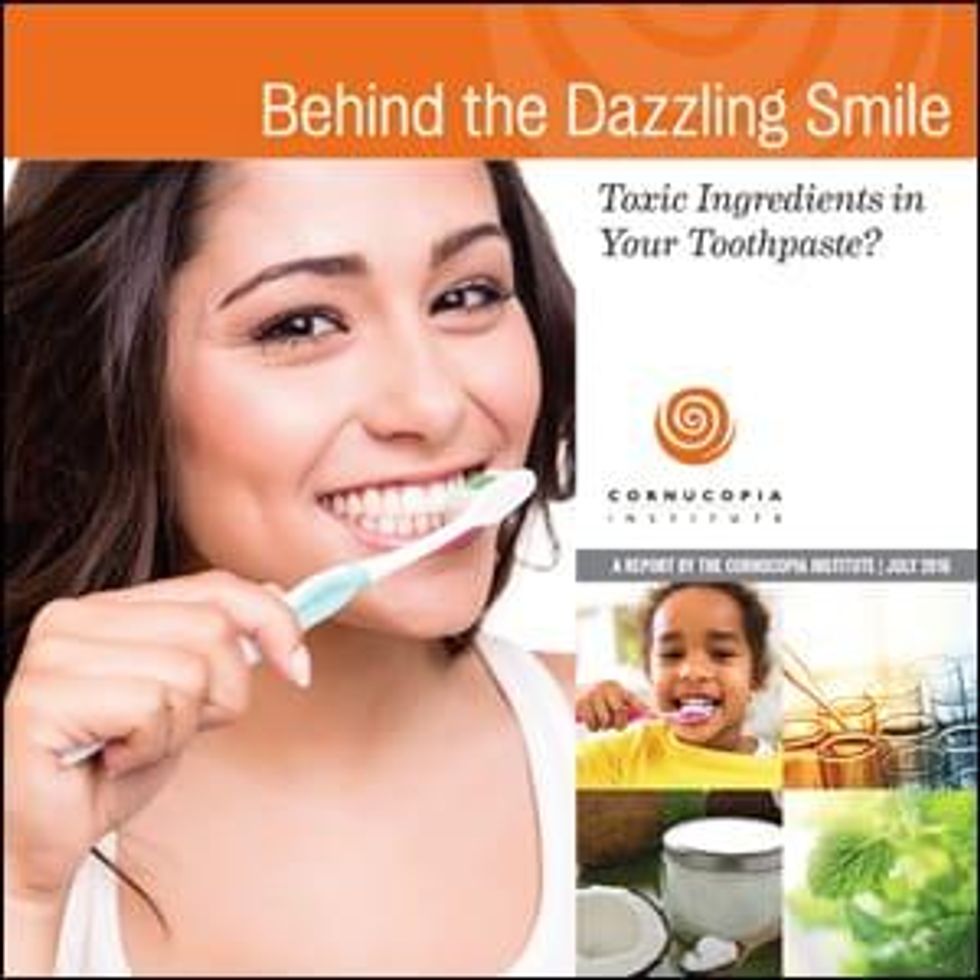 |
Behind the Dazzling Smile: Toxic Ingredients in Your Toothpaste, describes how the quality of "natural" toothpastes varies significantly between brands and how these personal oral care products commonly include nonessential ingredients that may be harmful.
"The cosmetics industry is no different, and may be worse, than leading food companies when it comes to gimmicky ingredients and misleading health claims," asserts the report's lead author Jerome Rigot, PhD, a policy analyst at The Cornucopia Institute. "However, we have created a useful web-based tool to help discriminating consumers see through marketing hype and make the best decision for their family when buying toothpaste."
The report spotlights dangerous endocrine disruptors, inflammatory agents, and carcinogens found in popular toothpastes, even many marketed as "natural."
Cornucopia delivered its study on dangerous compounds in toothpaste to the desks of Dianne Feinstein (D-California) and Susan Collins (R-Maine), urging passage of important legislation proposed by the senators that would require the Food and Drug Administration to evaluate the safety of ingredients in everyday personal care items, like deodorant, shampoo and toothpaste.
 |
Following the sweeping overhaul of chemical regulation signed into law last month with the Chemical Safety for the 21st Century Act (updating the Toxic Substance Control Act), consumers might expect that shampoo, lotion, and toothpaste will be free of toxics soon, but they would be wrong. The new law only applies to products regulated by the Environmental Protection Agency (EPA). All cosmetics and personal care products, such as toothpaste, fall under the Food and Drug Administration and remain essentially unregulated.
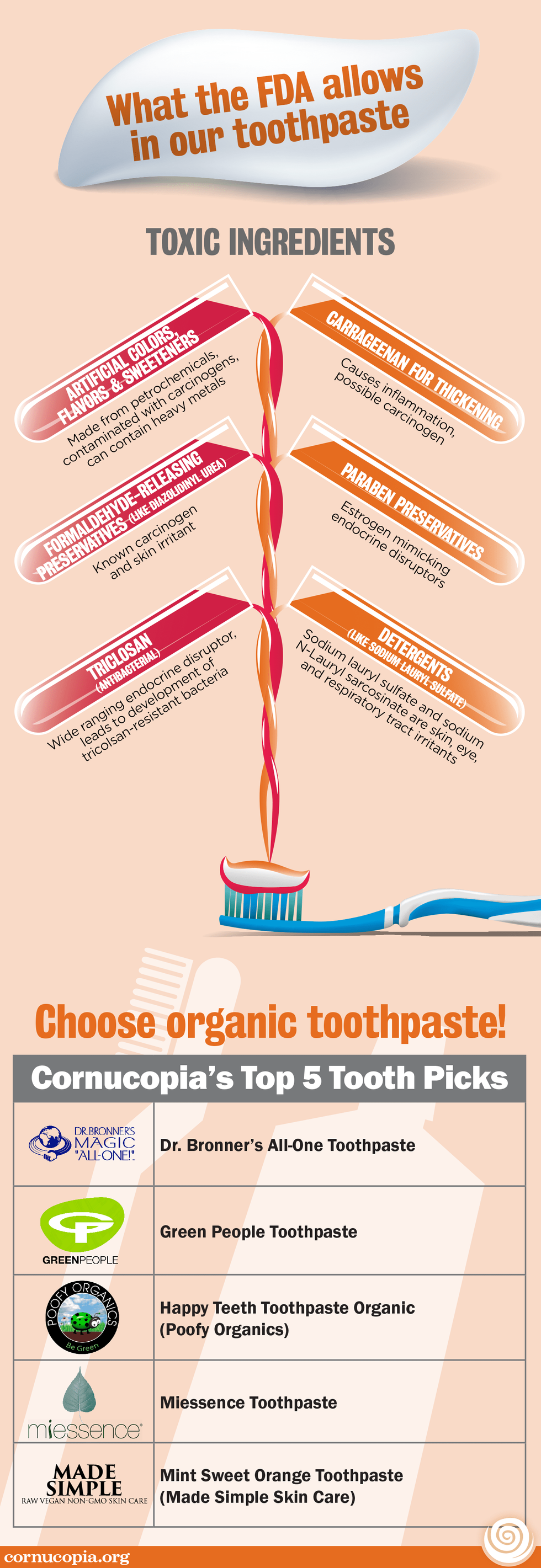
Cornucopia's new report and scorecard educate consumers on the potential risks of common toothpaste ingredients. The online scorecard is easy to use while shopping, highlighting some of the best toothpaste brands, many of which contain organic ingredients.
The Institute, an organic industry watchdog, began investigating toothpaste as an extension of their work focusing on the potentially carcinogenic food additive carrageenan. Carrageenan is a non-necessary additive that reliably produces inflammation in the body and yet it is still commonly found in organic foods, like cream, chocolate milk, and yogurt. Carrageenan is also found in natural brands of toothpaste.
Cornucopia found that even many of the toothpastes that claim to be "natural," and sold at premium prices, contain dangerous chemicals including endocrine disrupters and carcinogens, including carrageenan.
This investigation reveals toothless governmental oversight that asks the cosmetics industry to self-regulate. In fact, the FDA readily admits it:
"Firms and individuals who market cosmetics have a legal responsibility to make sure their products and ingredients...are safe under labeled and customary conditions for use, and that they are properly labeled. Under U.S. law, cosmetics products and ingredients do not need FDA approval before they go on the market. The one exception is color additives, ...which must be approved for their intended use."1
"The FDA does not require impurities, including several potential contaminants such as 1,4-dioxane or ethylene oxide, both carcinogens, to be listed as ingredients on the labels of personal care products because these toxic chemicals are produced during manufacturing," confirmed Rigot. "Even though technology (such as vacuum striping) to remove them exists, many companies don't use it, because regulators do not force them to do so!"
The FDA restricts or prohibits just 11 synthetic ingredients in cosmetics2. Compared to that, the European Union (EU) prohibits over 1,300 ingredients and restricts an additional 250 ingredients for use in personal care products3. As a result, the U.S. lags significantly behind other countries on cosmetics safety, allowing many hazardous chemicals that are banned in Canada, Japan and Europe4.
In fact, many toothpastes sold in Europe, and other countries, by American corporations are created with different, safer formulations for international markets than the same products sold in the U.S., to accommodate stricter cosmetics laws.
"If a company truly cared about the safety of its products, or the health of its customers, it would formulate its products not according to a given country's regulations, but rather to ensure the safest possible product with the highest quality ingredients regardless of where the products are sold," asserts Mark Kastel, Senior Policy Analyst at The Cornucopia Institute.
Slick packaging and misleading health claims are among a variety of marketing ploys used to induce customers to purchase oral care products that, in reality, may be detrimental to their health. Some of the hazardous ingredients and contaminants found in toothpastes are irritants, allergens, endocrine disruptors, or carcinogens.
Furthermore, a majority of "natural" brands don't include any certified organic ingredients in their formulations. Too often the "natural" depiction of a toothpaste brand does not guarantee that the highest quality and safest ingredients were used or that it does not contain potentially toxic compounds. Also of concern, "natural" herbal extracts, if not certified organic, likely contain pesticide residues.
"How 'natural' is a flavor when it is obtained by concentrating ingredients obtained from pesticide-intensive agriculture?" asks Terry Shistar, PhD, member of Beyond Pesticides' board of directors.
The natural label is often used as a marketing strategy to appeal to the increasing number of consumers expressing interest in healthier products, from food to drinks to personal care items.
"Consumers are increasingly choosing a certified organic diet to reduce their overall toxic load and to secure food that is nutritionally superior," stated Kastel. "Many are now realizing that anything they put on their skin, or use in their mouths like mouthwash and toothpaste, will end up in their bloodstream. And many of these synthetic compounds are the last thing we want to expose our families to, especially children."
Cornucopia's extensively researched report and toothpaste brand scorecard spotlight the most problematic ingredients to be avoided, which are commonly present in some of the most popular "natural" and premium brands as well as familiar mass-market brands like Colgate and Crest. These include synthetic preservatives such as sodium benzoate and potassium sorbate, surfactants like sodium laureth sulfate, which may contain a toxic, cancer-causing contaminant5, and artificial flavors and colors that have been tied to behavioral problems in children.
Scientists at Cornucopia found that a majority of well-known "natural" toothpaste brands, such as Tom's of Maine, Jason, Desert Essence, and Kiss My Face, contain carrageenan, a non-nutritive thickening and emulsifying agent extracted from seaweed. "Peer-reviewed published research has established that food-grade carrageenan has the potential to cause intestinal inflammation, diabetes and even cancer," says Linley Dixon, PhD, scientist at The Cornucopia Institute.
The report emphasizes, "Considering that the oral mucosa is one of the most absorbent areas of the body, it is certainly not desirable to use toothpastes containing potentially toxic contaminants that may pass directly into the bloodstream from the mouth environment."
The Cornucopia scorecard rated Dr. Bronner's line of toothpaste at the top of the "five-brush" category (on a scale of 1-5), finding it to be among the best and safest products available in the market. "In addition to Dr. Bronner's, whose formulation is based on certified organic coconut oil, there are number of other excellent products that depend primarily on organic ingredients and/or natural clay, that would contribute to oral health without posing unnecessary risks," concluded Rigot.
The Cornucopia Institute's report and scorecard, Behind the Dazzling Smile: Toxic Ingredients in Your Toothpaste, is available at: www.cornucopia.org.
The Cornucopia Institute, a Wisconsin-based nonprofit farm policy research group, is dedicated to the fight for economic justice for the family-scale farming community. Their Organic Integrity Project acts as a corporate and governmental watchdog assuring that no compromises to the credibility of organic farming methods and the food it produces are made in the pursuit of profit.






The program is administered at the state level, and under the abandoned rule that was enacted in 2024, all states were required to begin phasing in the 7% cap, which is considered a federal affordability benchmark.
Under the Trump policy change, states will not be required to cap parents' copayments as long as they continue to use a sliding scale based on income level and don't present a "barrier” to receiving assistance, though it's not specified what that means.
As of March 2026, 19 states had not lowered their maximum copayment to 7%.
An April analysis by the Center for American Progress found that, by eliminating the federal cap, families in 10 states that have not enacted it would lose between $450 and more than $15,000 in potential annual savings, depending on how high their state sets the threshold.
In Ohio, which caps copayments at 27% of household income, families could lose up to $15,482 in annual savings under the maximum copayment. In Vermont, which caps copayments at 14.9% of household income, families could lose up to $11,712.
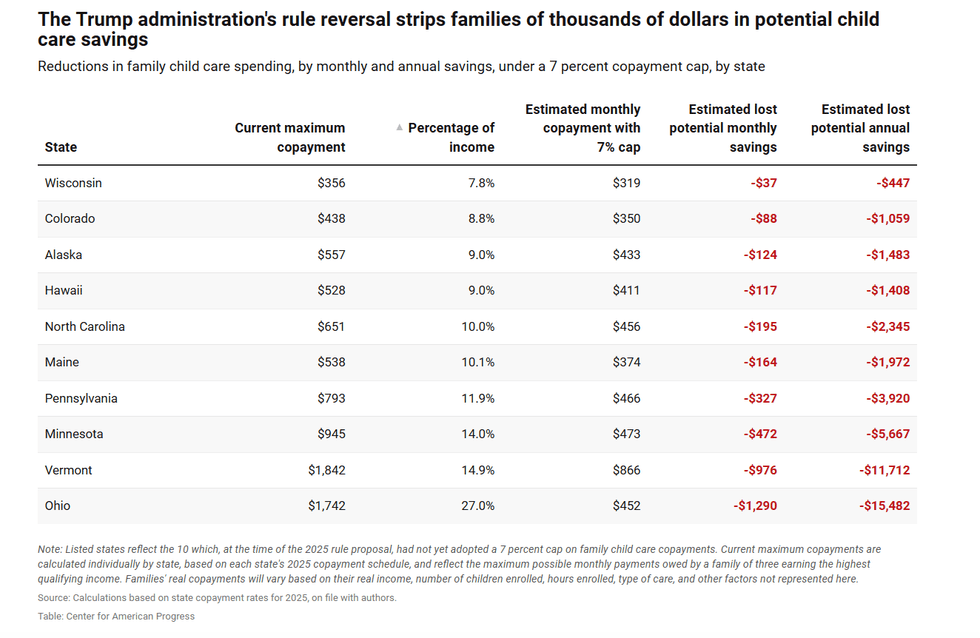 (Graphic from the Center for American Progress)
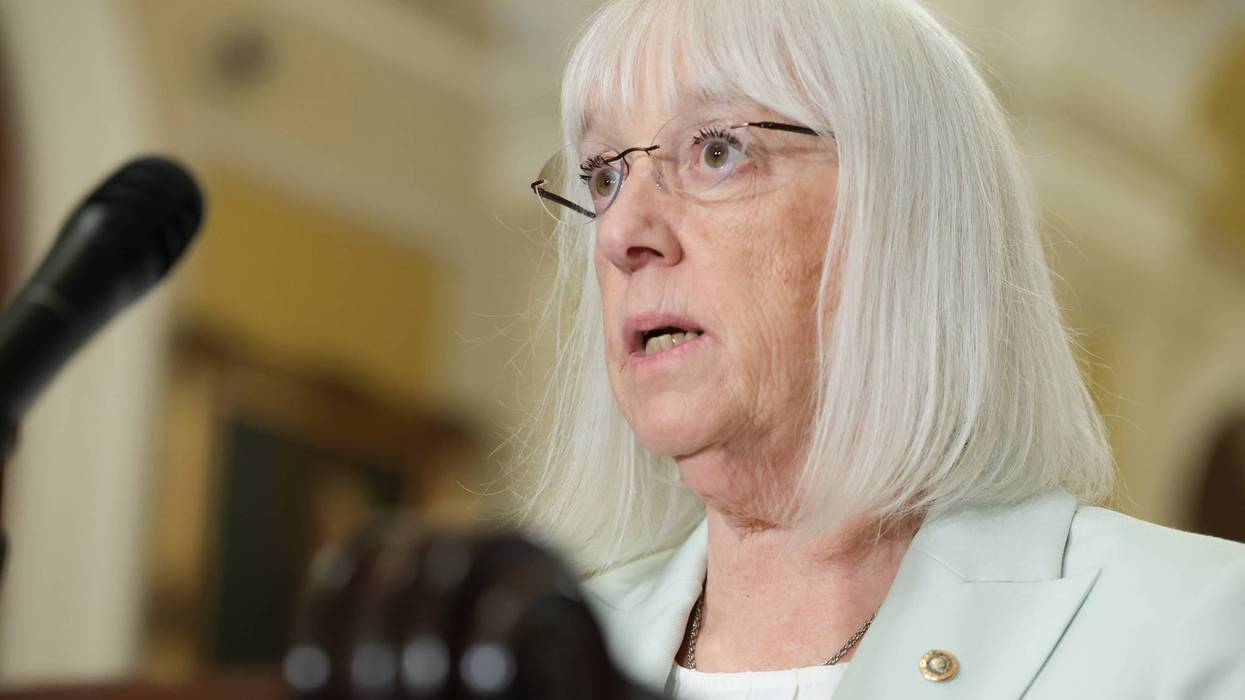
Murray (D-Wash), the former chair of the Senate Committee on Health, Education, Labor, and Pensions (HELP), introduced a resolution last month under the Congressional Review Act, which would have nullified the administration's elimination of the 7% cap.
It also would have restored other Biden-era requirements that were reversed under the same rule, including requirements that states pay childcare providers based on enrollment rather than attendance, pay them in advance, and use grants and contracts to fund childcare for infants, children with disabilities, and those in underserved communities.
In a speech on the Senate floor before the resolution came to a procedural vote on Thursday, she told her colleagues bluntly, “You are either voting to lower childcare costs or to increase them.”
She challenged the senators who planned to vote against the resolution to “go home and tell the parents in your state you voted to raise their childcare bill,” adding that “you cannot call yourself pro-family while voting to make it more expensive to raise one.”
In a party-line vote on Friday, the bill was blocked from advancing by a margin of 52-47, with every Republican voting against it except for Sen. Mitch McConnell (R-Ky.), who is absent after being hospitalized in June.
After the vote failed, Murray described it as an example of Republicans taking money away from American families struggling to afford the basics of life while pushing for lavish spending on war and tax cuts for corporations and the wealthy.
“How about instead of a $1.5 trillion war budget, we make sure every working family in America can afford childcare?” Murray said. “If Trump had simply done nothing, and left the 7% cap in place, some of these families would have ended up saving as much as $15,000 a year for their family.”
According to a Century Foundation analysis of Bureau of Labor Statistics data, childcare costs increased by 5% from August 2024 to August 2025 and now average more than $13,000 per child per year across age groups.
Trump has been surprisingly open about the fact that, under his control, and in direct contrast with his campaign promises, the federal government is prioritizing spending on his war in Iran instead of providing government subsidies for Americans’ basic needs, including daycare.
"We’re fighting wars. We can’t take care of daycare," he said during a speech in April. "You gotta let a state take care of daycare, and they should pay for it too. It’s not possible for us to take care of daycare, Medicaid, Medicare, all these individual things.”
“Trump says we can’t afford childcare. But he is wrong,” said Murray, who has co-introduced legislation to expand federal childcare subsidies and cover nearly all costs for low-income families. “The truth is we can’t afford to ignore childcare.”