

5
#000000
#FFFFFF
To donate by check, phone, or other method, see our More Ways to Give page.
Daily news & progressive opinion—funded by the people, not the corporations—delivered straight to your inbox.
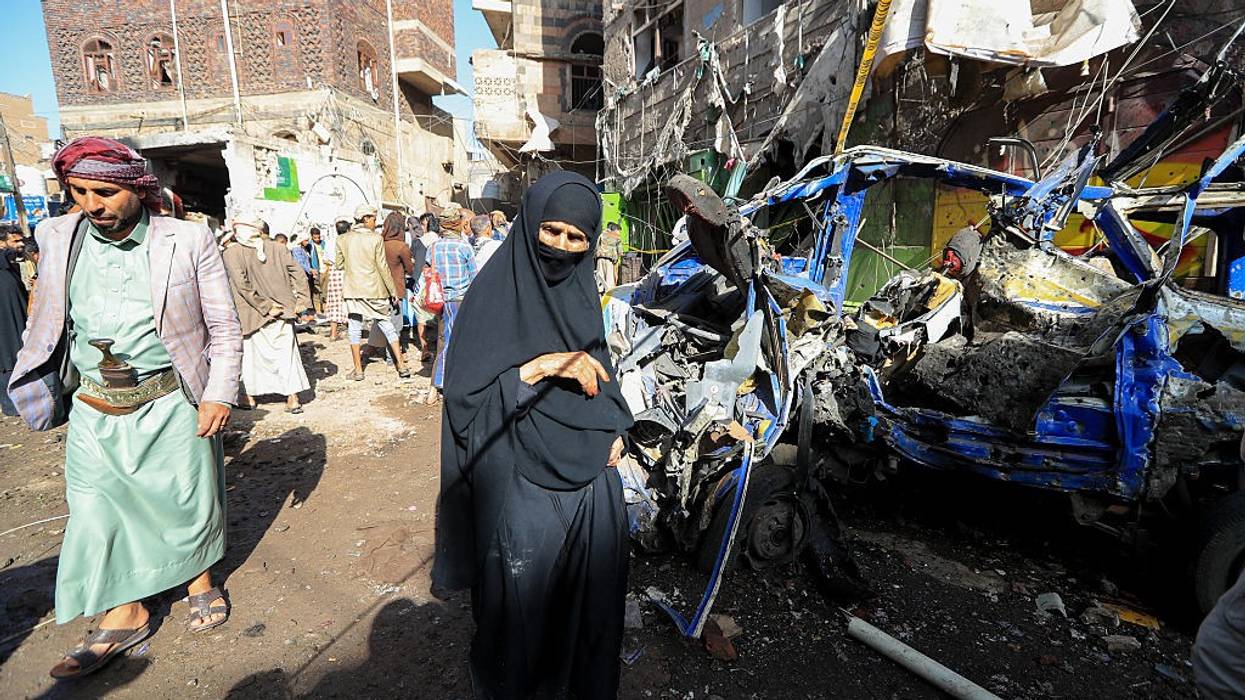
"The so-called 'War on Terror' never ended in Yemen," said Costs of War Project director Stephanie Savell. "This report will allow people to hold the US government accountable for the deaths and destruction it has caused."
A report released Thursday examines the more than 500 Yemeni civilians its authors said were killed or wounded by US airstrikes in the Middle East nation during a recent 17-month period amid the open-ended so-called "War on Terror" that has left nearly one million people dead in around half a dozen nations over the past 25 years.
The report—authored by the Yemen-based group Mwatana for Human Rights and published by the Costs of War Project at Brown University's Watson Institute for International and Public Affairs—documents 46 US airstrikes that took place between December 2023 and May 2025 that caused at least 576 civilian casualties, including 213 deaths and 363 injuries. Among the casualties were at least 50 children and 25 women.
"The so-called 'War on Terror' never ended in Yemen," Costs of War Project director Stephanie Savell contended.
"It's important that we continue to account for the civilian lives lost, harmed, and disrupted in Yemen and other US war zones," she added. "This report will allow people to hold the US government accountable for the deaths and destruction it has caused in Yemen in support of the Israeli government's wars since 2023."
The overwhelming majority of the casualties covered by the publication occurred during President Donald Trump’s 2025 "Operation Rough Rider" campaign. Mwatana estimates that the operation killed 208 civilians and wounded 341, while the Pentagon has acknowledged a smaller toll of 153 killed and 243 wounded.
Seven of the 46 strikes took place between December of 2023 and January of 2025 during former President Joe Biden's "Operation Prosperity Guardian," a military campaign that came amid Houthi rebel attacks on shipping lanes in the Red Sea and the Bab al-Mandab Strait during Israel's genocidal war on Gaza.
Among the deadliest attacks covered by the report was the April 2025 bombardment of Ras Isa oil port ordered by Trump, in which US strikes killed scores of people and wounded more than 150 others. Human Rights Watch called the bombing an “apparent war crime,” saying the destruction of the civilian oil facility also threatened vital fuel supplies in a country already devastated by years of war and humanitarian crisis.
The campaign also included the April 28 bombing of a detention center in Saada while jailed African migrants were sleeping. Amnesty International has called for a war crimes investigation into that attack, in which scores of migrants were killed.
Mwatana researchers conducted site visits and 59 interviews with survivors, relatives, eyewitnesses, first responders, and other sources for the new report.
"The first strike hit while we were in deep sleep. I could not believe what I saw—30 of my fellow detainees died; their bodies were charred, and the smell of burned flesh filled the air," one 25-year-old Ethiopian survivor of the Saada attack recounted. "The place was crowded with bodies, while others were screaming and calling for help and rescue... we could do nothing for them."
In addition to physical harm, survivors described the deep psychological trauma suffered by victims. One mother said her 8-year-old son Taha "saw his father after he was hit by shrapnel—how he was bleeding, and how his intestines were coming out."
"His father was screaming: ‘Run… leave me and run before the American aircraft strikes again and finishes me off,'" she continued. "Taha still cannot sleep; when he does, he wakes up terrified. Whenever he hears thunder or any loud noise, he runs in fear, his whole body trembling."
Overall, US strikes covered by the report "hit civilian structures such as homes, shops, farms, residential neighborhoods, and infrastructure," the publication notes, adding that airstrikes "also caused severe damage to infrastructure and critical facilities, compounding the humanitarian suffering of local populations by striking essential service facilities, particularly in rural areas that already face acute shortages of clean water, electricity, and health services."
"Given Yemen’s economic deterioration and the catastrophic humanitarian situation produced by the armed conflict that has been ongoing since September 2014, it is likely that the US strikes expanded the cycle of poverty in Yemen by increasing unemployment and multiplying the number of households that lost breadwinners and sources of income," the report adds.
Hundreds of thousands of Yemenis have died during the civil war that began in 2014, with international experts attributing more than 150,000 Yemeni deaths to a US-backed, Saudi-led bombing campaign and blockade. According to the UK-based casualty monitor Airwars, an estimated 445-643 Yemeni civilians have been killed by US forces during the George W. Bush, Obama, Trump, and Biden administrations.
The Costs of War Project says that in the first two decades following the September 11, 2001 attacks on the United States, "between 363,939 and 387,072 civilians were killed by multiple warring parties in post-9/11 war zones, including 12,690 civilians in Yemen."
Mwatana for Human Rights chair Radhya Al-Mutawakel said Thursday that "the losses caused by US airstrikes against civilians cannot be regarded as temporary harm that ends when military operations cease. Civilians who have lost loved ones, homes, or sources of income continue to bear the consequences of these attacks, amid economic and humanitarian conditions that do not provide them with even the minimum capacity to recover.”
"Protecting civilians is not limited to avoiding killing or injuring them; it also includes respecting civilian objects and livelihoods," Al-Mutawakel added. "The United States must assume its legal and moral responsibility to recognize the civilian victims of its military operations in Yemen, provide them with redress and reparation, and hold accountable those responsible for the violations inflicted upon them.”

The increased fighting is putting even more pressure on global energy markets, with the price of Brent crude topping $107 per barrel during Thursday trading.
Houthi fighters on Thursday took control of a key port city on the west coast of Yemen, putting them in a stronger position to disrupt commercial shipping—and to potentially send oil prices rocketing even higher.
According to Reuters, the Houthis seized the city of Mocha from Saudi-backed forces before moving toward the Hanish Islands, located to the northeast.
Reuters further reported that Iran's Islamic Revolutionary Guard Corps provided the Houthi fighters with weapons and guidance ahead of their successful assault.
The Houthis' seizure of more territory along the Red Sea gives the militant group a greater ability to launch attacks on vessels trying to transport oil through the Bab el-Mandeb Strait.
Petroleum exporters in the region have had to rely more heavily on the Bab el-Mandeb Strait ever since Iran shut down shipping traffic in the Strait of Hormuz in retaliation for President Donald Trump's illegal war of choice, which he launched in February without authorization from Congress.
Restricting shipments through both straits would put even greater pressure on global oil markets, which have already been under strain since the start of the Iran War.
A Thursday report from Bloomberg noted that Saudi Arabia, whose ships have been targets of Houthi attacks, revealed that its oil output has dropped to 6.24 million barrels per a day, its lowest level of oil production since 1990.
The price of Brent crude topped $107 during Thursday trading, a 6% increase from the day before. Data released Thursday by the American Automobile Association showed that the average price of gas in the US has reached $4.28 per gallon while the average price of diesel has reached a record high of $5.98 per gallon.
Fawaz Gerges, professor at the London School of Economics, said in an interview with The New York Times that the Houthis, despite receiving assistance from Iran, have their own distinct goals and see Trump's illegal war as a "golden opportunity" to make advances against Yemen's Saudi-backed government.
Additionally, said Gerges, "Iran directly and indirectly benefits from what the Houthis have been doing," since "all-out war could have major implications for the global energy supply."
Brett Erickson, managing partner at Obsidian Risk Advisors, wrote in a social media post that Iran and the Houthis have all the incentive in the world to keep the pressure on global petroleum shipping.
"Brent Crude just spiked over $107 per barrel," Erickson wrote. "Just a mere month ago, it was trading at $85. That’s a 25.9% increase in a month. And with no off-ramp for Trump until at least the midterms are over, we’re looking at a long period of elevated oil prices now."
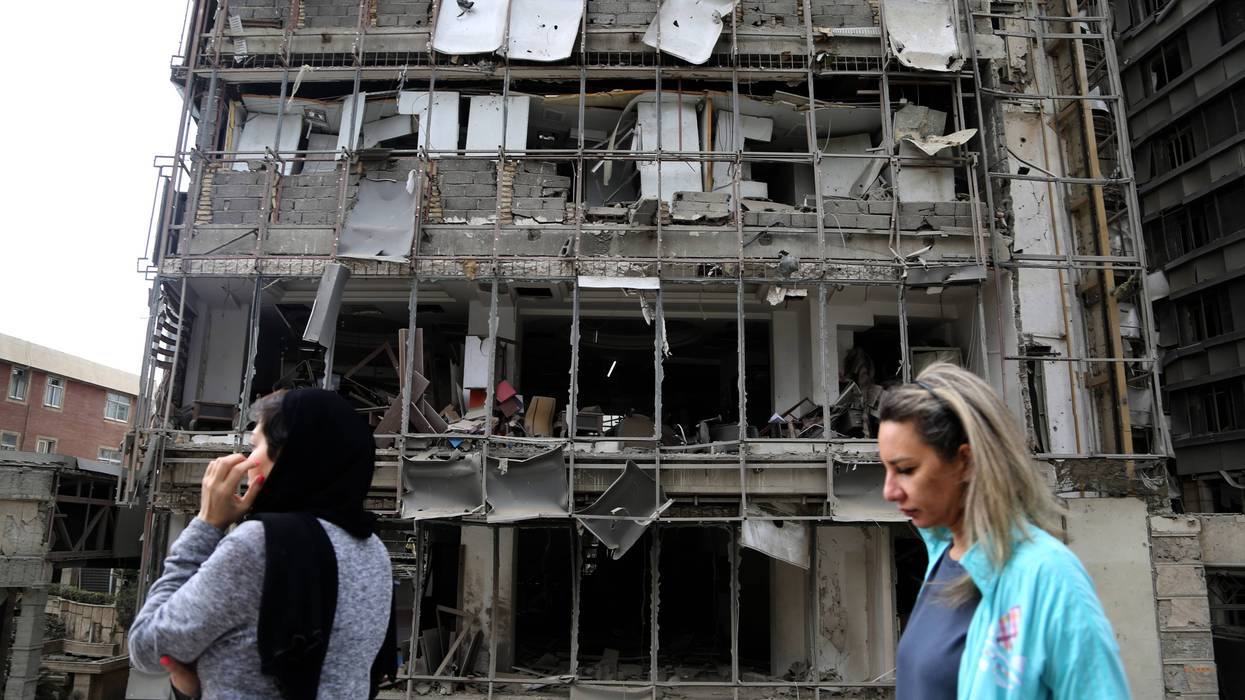
"The most serious risk is premature death," said one physician.
A senior Iranian health official on Tuesday accused the United States of deliberately targeting Iran's medical infrastructure amid a worsening shortage of critical medicines as President Donald Trump's illegal US-Israeli war of choice against Iran drags on.
Iran's pharmaceutical system is straining under US bombing, blockade, and sanctions that have severely disrupted trade and transportation in the Middle East nation of around 90 million people. Iranian officials say shortages of roughly 800 medicines—including dozens of essential drugs—are affecting the treatment of cancer and other serious illnesses.
“The enemy has identified medicine as one of the sensitive areas of the country, and is trying to denigrate and portray Iran’s conditions as unfavorable by releasing content in the press and social media," Deputy Health Minister Mahdi Pirsalehi, who also heads Iran's Food and Drug Administration, told Al Jazeera.
Pirsalehi has said that more than 50 factories and pharmacies have been damaged or destroyed by US and Israeli bombing during the six-month war. The attacks have exacerbated existing shortages.
One gastroenterologist and university professor in Tehran, who spoke to Al Jazeera on condition of anonymity, sounded the alarm on what she called a "staggering" rise in drug prices—including for domestically produced generic medications—caused in significant part by the US naval blockade.
“Reports that rotavirus vaccine imports have been halted because of the maritime blockade—and that influenza vaccines may soon face the same problem—represent a serious and alarming threat to nationwide efforts to prevent vaccine-preventable communicable diseases,” she said.
“Runaway inflation, poverty, and inadequate access to essential food groups among vulnerable populations, including infants, children, and pregnant women, signal the onset and spread of malnutrition,” she added, warning of the risk “of both communicable and noncommunicable diseases, creating a vicious cycle in which malnutrition develops and progressively worsens."
For ordinary Iranians, empty pharmacy shelves, delayed treatments, and prohibitively expensive prescription drugs have become the new normal.
One Iranian pharmaceutical company recently announced price increases for scores of drugs, including a 543% rise in the price of the Alzheimer's medication donepezil, a 308% higher cost for the antibiotic clarithromycin, and a 135% spike in acetaminophen and diphenhydramine syrups, according to reporting by Tasnim News Agency.
Dr. Hassan Nayeb Hashem told Deutsche Welle last month that "for many specific diseases, there is effectively no substitute" for prescribed drugs.
"If the medicine becomes inaccessible, patients can develop complications much sooner," he said. "The most serious risk is premature death."
One patient requiring testing for an abdominal and pelvic mass recently told Iran International that CT and MRI scans now cost over $100, even with Social Security insurance—the equivalent of a month's pay for many Iranians.
“How are we supposed to pay these costs with such meager incomes?” they asked.
A 33-year-old man said the exorbitant cost of dental treatment has left him without half of his teeth.
“I feel like I’m 60,” he said. “The bitter part is that this humiliating way of life has become normal for me.”
Another Iranian said they feared what would happen if anyone in their family got sick this winter.
“We’re stressed about where we would get the money for treatment," they said, "if God forbid we or our children even catch a cold."
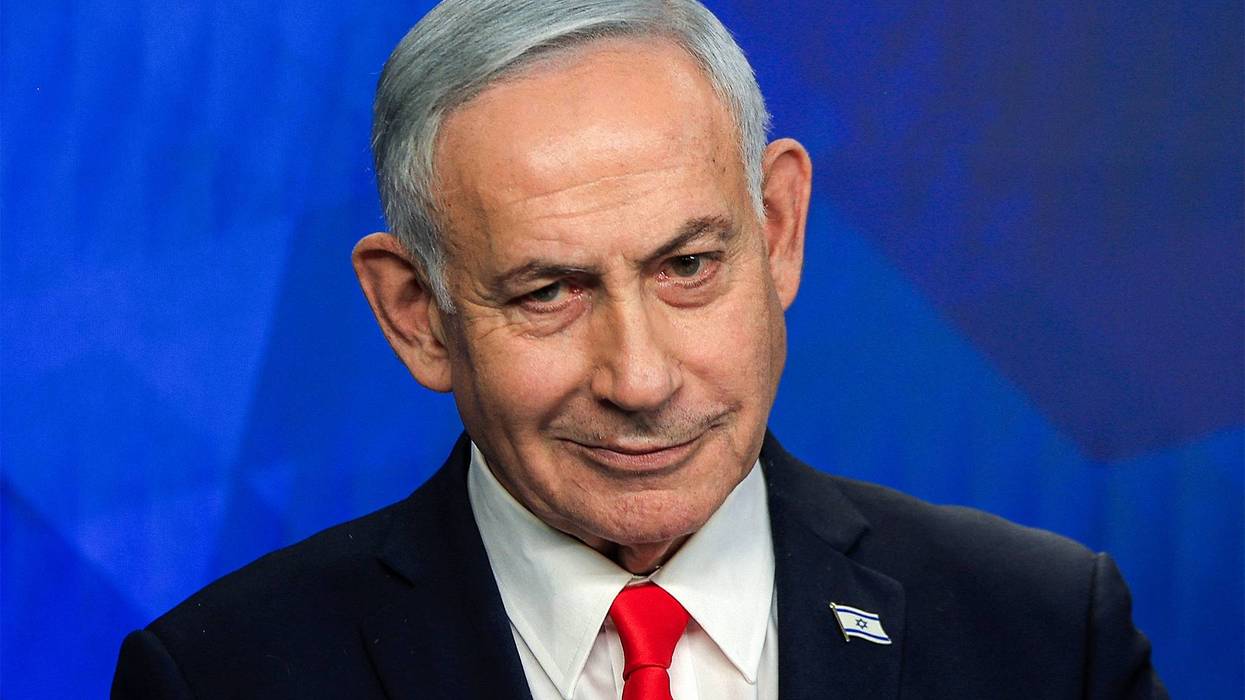
"As always when a story really hits home, Netanyahu threatens to sue," said one researcher.
The Israeli newspaper Haaretz did not appear alarmed by Prime Minister Benjamin Netanyahu's threat on Wednesday to sue the outlet over its new reporting that Netanyahu was explicitly warned about the Hamas-led October 7, 2023 attack that killed more than 1,200 Israelis and led to the Israel Defense Forces' destruction of Gaza.
After Netanyahu sent a "warning letter" saying he would file a libel lawsuit against Haaretz and journalists Shlomi Eldar and Ruth Yuval over their Tuesday report, the newspaper said simply in a post on social media, "Haaretz stands by its reporting."
The newspaper based its reporting on accounts from three senior foreign sources, reporting that in September 2023, now-deceased Hamas leader Yahya Sinwar had told an intermediary trusted by both Hamas and Israeli intelligence agencies that an "earthquake" would be coming to Israel.
The warning reportedly came after Sinwar had grown frustrated with deadlocked talks over an exchange of Israeli and Palestinian prisoners.
Sinwar told the intermediary to convey a message to the United Arab Emirates, with whom Netanyahu had developed close ties, "that I am preparing the mother of all surprises. A terrifying operation. Something extraordinary."
UAE President Mohammed bin Zayed then gave a warning to Netanyahu in a 45-minute phone call weeks before the attack, according to Haaretz.
Netanyahu lashed out at the newspaper in a social media post, saying the reporters "fabricated a false story against the prime minister that never happened and was never created."
"The Prime Minister's Office, the National Security Council, and the military secretary meticulously reviewed the prime minister's call log for those days—and found no trace of it whatsoever," said Netanyahu, who is behind his top opponent, former military chief of staff Gadi Eisenkot, in polls ahead of legislative elections set for October 27.
Netanyahu's official social media account also confirmed he had instructed his lawyers to file the libel lawsuit. He blamed security officials for failing to alert him to the October 7 attack early enough after it had begun, repeating a recent claim that they feared he would launch an aggressive response to the attack and set off a war.
"If, instead of fearing a miscalculation, they had instructed the IDF, the Shin Bet, and the standby units to preempt the blow, and if they had updated Prime Minister Netanyahu in time, the terrible massacre could have been prevented," said Netanyahu's official account.
Netanyahu has been attempting to account for his actions on October 7 recently, releasing his full schedule from the day of the attacks last week. The log showed he did not speak to IDF officials until several hours after the attack began.
Researcher Shaiel Ben-Ephraim compared Netanyahu's threat to sue Haaretz to his angry response earlier this year to a report by New York Times columnist Nicholas Kristof, which included testimony from 14 Palestinians who said they had been sexually assaulted in Israeli prisons or during attacks by the IDF or Israeli settlers.
Netanyahu claimed the Times' reporting was "blood libel" as he threatened to take legal action in May. Thus far, he has not followed through on the threat.
"This will likely end up just like the time he threatened to sue The New York Times," said Ben-Ephraim, "and didn't because every word was true."
On Tuesday, four Israeli opposition leaders called for an independent commission to investigate the October 7 attacks, citing a "series" of revelations about Netanyahu's actions and reported inaction ahead of the assault.
“Netanyahu and his partners in the October 7 government are unfit to continue in office,” they wrote. “We will work in coordination and with the required responsibility to prevent them from leading to another disaster.”
The prime minister has long resisted calls for an independent investigation, agreeing earlier this year only to a proposal in which half of the commission's members would be selected by Netanyahu's own government, in violation of Israeli law—a suggestion that one opposition leader, Yair Lapid, called a "shameful farce" that was meant to "help the prime minister duck responsibility."
"The use of explosive weapons with wide-area effects in the vicinity of concentrations of civilians has foreseeably indiscriminate effects and as such is prohibited under international humanitarian law."
The recent resumption of US airstrikes in Iran, including on a wedding party where at least 25 civilians were killed last week, made Amnesty International's Tuesday report on previous suspected US-Israeli attacks in Tehran in the early days of the war all the more urgent, said the organization as it pointed to new evidence of potential war crimes by the American and Israeli militaries in the densely populated Iranian capital.
Amnesty analyzed US-Israeli airstrikes on three residential neighborhoods—Resalat, Niloufar, and Javadieh—between March 1-13, in which the coalition used "explosive weapons with wide-area effects," killing at least 41 civilians and damaging multiple homes, a school, businesses, and other civilian infrastructure.
“Amid the resumption of US strikes in Iran and renewed threats by US President Donald Trump to target civilian infrastructure, it is imperative that the US and Israel end all unlawful attacks and strictly comply with international humanitarian law, including by taking all feasible precautions to avoid, and in any event minimize, incidental loss of civilian life, injury to civilians, and damage to civilian objects during the planning and execution of military operations," said Agnès Callamard, secretary general of Amnesty International.
The group noted that military infrastructure and police stations—which could be considered legitimate military targets in Iran, as the police forces are part of the broader armed forces there—were struck in the attacks in question. Israel and the US have not publicly claimed responsibility for the three specific attacks, but they announced strikes against Iranian "regime" targets in Tehran at the time of the airstrikes.
Amnesty emphasized that even if military and police buildings were the primary targets, "a large presence of civilians was clearly foreseeable" when the US and Israel evidently carried out the attacks in the three neighborhoods, which "resulted in devastating and yet entirely predictable consequences for civilians."
International law demands that warring parties do not carry out "indiscriminate or disproportionate attacks" that could harm civilians across the surrounding area, said the group.
Military leaders, said Amnesty, are also obligated to "choose weapon types and attack methods that reduce the risk of harming civilians and destroying civilian objects."
"The use of explosive weapons with wide-area effects in the vicinity of concentrations of civilians has foreseeably indiscriminate effects and as such is prohibited under international humanitarian law," the group stated. "Additionally, an attacking party remains at all times bound by the principle of proportionality, weighing the concrete and direct military advantage anticipated from an attack against the expected harm to civilians and civilian objects, including the reverberating humanitarian consequences resulting from the attack."
"Launching indiscriminate attacks that kill or injure civilians and disproportionate attacks are war crimes," said Amnesty.
The group analyzed satellite imagery and verified 60 videos of the three attacks, as well as reviewing public statements from officials in the US, Israel, and Iran to reach the determination that US and Israeli forces had potentially committed war crimes in the Tehran neighborhoods—a possibility the group said must be independently investigation.
In Niloufar, where at least 20 civilians were killed on March 1, eyewitness accounts described two explosions at around 9:00 pm local time, when restaurants and other businesses were open in the bustling neighborhood.
The attack directly struck a police station, but residential buildings and businesses were also struck.
A shop owner told Etemad Online that "before the attack… dozens of people were sitting in front of the cafés in the square. All the shops were open... When the police station was struck, those who were sitting on the pavement in front of the cafés were killed."
"The whole street was full of blood," they added. "I saw one person whose chest had been pierced by broken glass. Many children, women, and young people were killed here that night."
Callamard said that "the civilian death toll, the scale of destruction, the timing of the attacks, the impact on nearby civilian structures, and the lack of effective advance warnings point to alarming failures by the US-Israeli coalition to abide by the obligations to take all feasible precautions to minimize civilian harm and spare civilian objects."
At least 16 people were killed in Resalat on March 9, in an attack that heavily damaged a building belonging to the Basij battalion of the Islamic Revolutionary Guard Corps (IRGC), as well as three buildings adjacent to the facility. Amnesty International confirmed that at least one of the buildings, known as Number 12, was a residence.
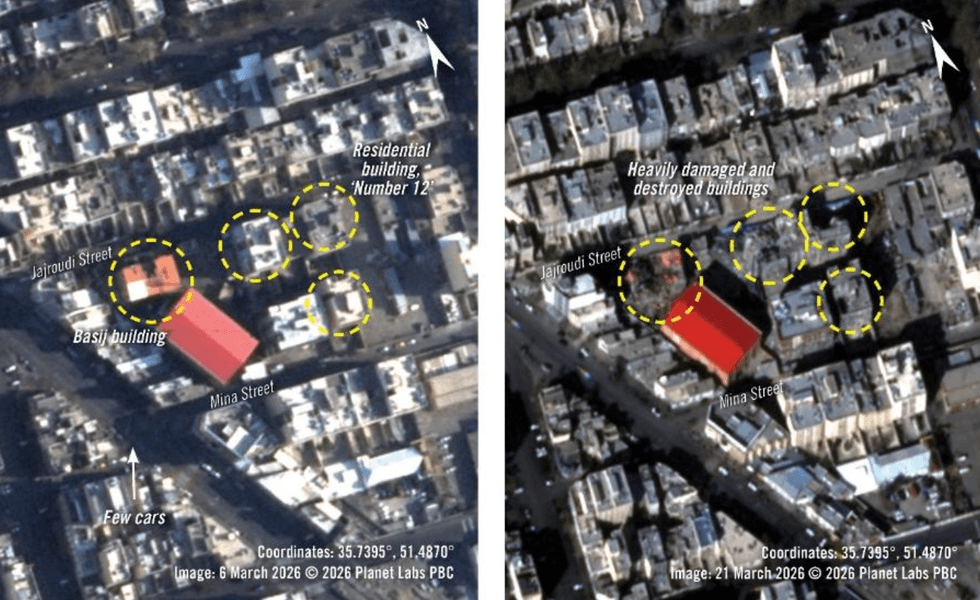 Satellite imagery from March 6, 2026 (left) shows the Basij facility and nearby buildings in the Resalat neighborhood. On March 21, 2026 (right), imagery shows four distinct buildings with heavy damage and destruction. (Photo by ©Planet Labs PBC)
Twelve members of the same family were killed when Number 12 was struck, and an informed source identified as Payam told Amnesty that "there were no military people, no special individuals, no one connected to the government, no important person" in the building.
"Everyone living [in Number 12] was ordinary civilians," he said. "The whole building was families.”
The husband of a 26-year-old woman who was killed in the attack told Etemad Online that the scene of the bombing was "so horrific that they will never leave my mind. Body parts were found separately... A hand had been thrown to the entrance of the road or onto the roof of a house."
The attack in Javadieh, a densely populated low-income neighborhood in Tehran, took place on March 13 and killed at least five civilians, with a police station on Ghorbani Street a possible target.
"The destruction and damage extended well beyond the police station, and affected homes, businesses, and other civilian structures across the surrounding neighborhood," said Amnesty. "State media reported that several nearby residential buildings were also destroyed and many others severely damaged."
Videos verified by Amnesty show the impact of the blast extending up to more than 50 meters (164 feet) away from the police station. A restaurant, bakery, and motorcycle shop were all damaged, as well as a number of residential buildings.
Amnesty called on the US, Israel, and Iran to coordinate inquiries by the International Humanitarian Fact-Finding Commission regarding allegations of "serious violations of international humanitarian law by all parties."
Tens of thousands of US and Israeli attacks on Iran have killed at least 1,469 civilians, including hundreds of children. Israel has also killed at least 4,333 people in Lebanon since early March, in retaliation for Hezbollah's strikes in response to the assault on Iran. In retaliatory strikes across the region, Iran has killed at least 50 people civilians, according to Amnesty.
“The US/Israeli strikes in Tehran investigated by Amnesty International may constitute indiscriminate attacks and amount to war crimes," said Callamard. "They must be the object of independent, impartial, effective, and transparent investigations."
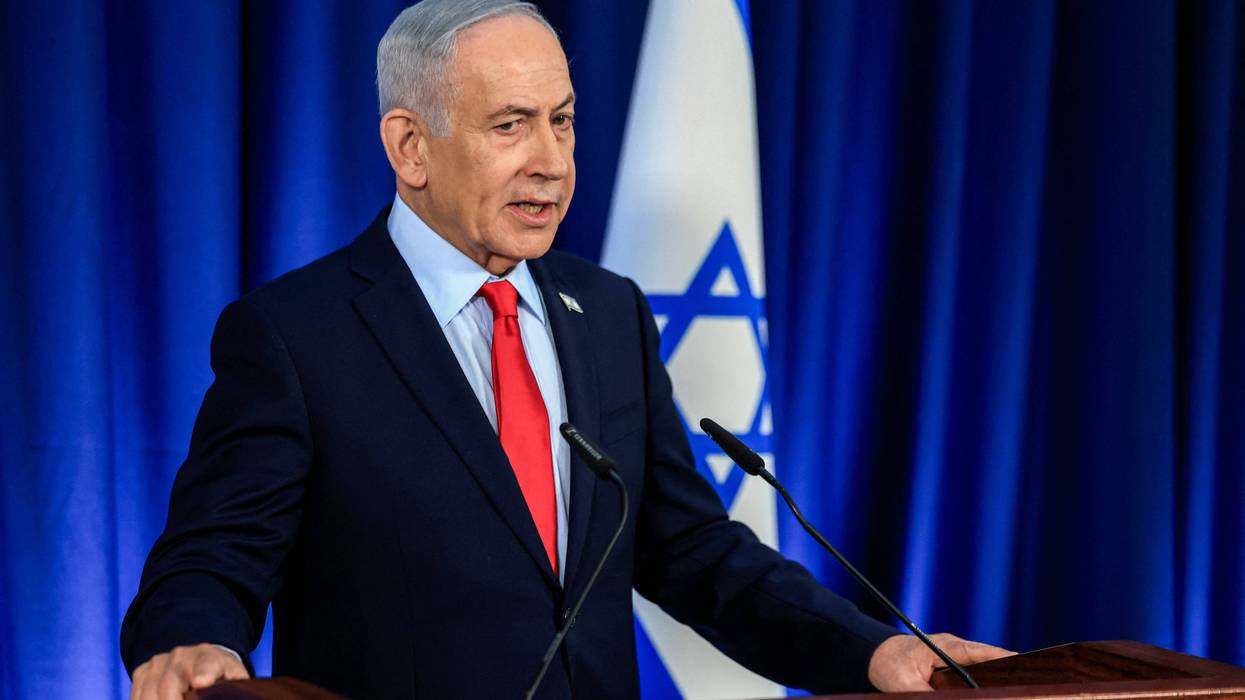
Haaretz also reported that Hamas immediately offered to release all the Israeli hostages it had taken in the attack, demanding nothing in return, but Israel refused the deal.
Policy experts in the US and Middle East on Tuesday were among those responding to an "astonishing" new investigation from Haaretz, which detailed how Israeli Prime Minister Benjamin Netanyahu was alerted weeks before the Hamas-led October 7, 2023 attack that a "major event" was being planned by the Palestinian group—an assault that killed more than 1,200 Israelis and which Israel has responded to by slaughtering more than 73,000 Palestinians so far in Gaza.
Highlighting revelations contained in an upcoming book called Hostages: 843 Days of Abandonment, by journalists Shlomi Eldar and Ruth Yuval, the Israeli newspaper reported that Netanayahu dismissed a warning about the attack from United Arab Emirates President Mohammed bin Zayed, which came in a phone call in September 2023.
An adviser to bin Zayed said that according to the president, Hamas leader Yahya Sinwar "was preparing for a major event" and "Israel should be ready."
The UAE leader advised Netanyahu to "find an economic solution" for Gaza and to calm tensions in the West Bank to "prevent escalation."
At the time, Hamas had been holding talks for months with intermediaries in hopes of pushing Israel to lift its blockade on Gaza, which it had imposed at varying levels of intensity for nearly two decades, since Hamas won legislative elections in 2006. Before the 2023 attack and Israel's retaliatory assault on Gaza—which has been called a genocide by human rights groups and Holocaust experts—Israel's blockade had left 80% of Palestinians in Gaza dependent on aid and had raised the poverty rate from 40% in 2005 to 61.6% in 2023.
Hamas' talks had also focused on exchanging four Israeli prisoners who had been held in Gaza for several years for Palestinian prisoners, more than 5,200 of whom were being held in Israel at the time.
Haaretz reported that an intermediary known as "coal eyes," a member of the Fatah political party in Palestine who was trusted by both Hamas and the Israeli security agency Shin Bet, was told by Sinwar: "Convey a message to them that I am preparing the mother of all surprises. A terrifying operation. Something extraordinary."
The intermediary then conveyed the message to bin Zayed, who spoke directly to Netanyahu.
The Israeli prime minister, who is facing several opponents as he aims to hold onto power in Israel's upcoming elections, scheduled for October 27, reportedly told the UAE president that Israel was prepared for any attack and that the government believed Hamas was planning to operate in the West Bank.
He did not inform security or intelligence leaders about the information he received from the bin Zayed, Haaretz reported.
Netanyahu called the Haaretz report an "absolute lie" on Tuesday, while his top rival in the elections, former military commander Gadi Eisenkot, said on social media that the prime minister "received dozens of warnings for October 7 and ignored them all."
"His is unfit," said Eisenkot.
As Middle East Eye noted Tuesday, it has previously been reported by media outlets in Israel and elsewhere that Netanyahu had received a warning from Egyptian intelligence in the days before the Hamas-led attack.
Haaretz also reported that Hamas offered to release all the civilians it had taken captive during the October 7 attack, in the immediate aftermath of the attack. The group did not demand anything in return, but Israeli officials reportedly rejected the offer.
The Israel Defense Forces have bombed schools, hospitals, and refugee camps and have killed thousands of children as well as journalists and aid workers in Gaza—all while claiming to be targeting Hamas. Attacks have continued, killing hundreds of Palestinians, even after a ceasefire deal was reached last October.
Settler attacks have also ramped up in the West Bank as Israeli officials have pushed to further annex the territory and make the creation of a Palestinian state impossible.

"As always, he is telling us what the plan is," said one critic. "We must take it seriously."
US President Donald Trump has spent his second term threatening takeovers of various other countries, from Canada and Cuba to Greenland, and on Monday he shared on social media a map that fueled fresh fears of his imperialist "Donroe Doctrine."
The map on Trump's Truth Social platform shows the US flag over not only the United States but also Canada, Greenland, Iceland, Mexico, and multiple countries in Central America and the Caribbean.
The post was swiftly condemned across platforms, with Congressman Jonathan Jackson (D-Ill.) declaring that "this is unacceptable."
Journalist Stephen Robinson wrote on X that "another world leader posting something like this would have to apologize before their immediate removal."
Amy McGrath, a retired Marine fighter pilot and former Democratic US Senate candidate from Kentucky, wondered, "What would we do and say if the Chinese president posted a map of China taking over the Western Pacific?"
Carl Bildt, co-chair of the European Council on Foreign Relations and former prime minister of Sweden, similarly said: "What would happen if Xi Jinping posted a map where [China] has taken over all of East Asia, and [President Vladimir] Putin one of [Russia] having absorbed all of Western Europe? It would have been seen as either insane or dangerous—or both."
While some critics called Trump "absolutely bonkers" and "f*cking insane," Dr. Brian Goldman, a Canadian emergency physician who's also an author and broadcaster, asserted: "That's not insanity. That's intention."
Democratic strategist Michelle Kinney agreed, saying: "As always, he is telling us what the plan is. We must take it seriously."
Melanie D'Arrigo, executive director of the Campaign for New York Health, suggested that "the reason why Republicans attack education is so that people don't recognize the history that repeats itself."
Without directly mentioning Trump or his map, Mexican President Sheinbaum said in Spanish on Monday, "We reaffirm that Mexico is neither nor will be a colony or protectorate of any foreign country. Proudly we are a free, independent, and sovereign nation."
While Trump is a prolific poster, the map followed a series of posts from Sunday—including other maps and images produced with artificial intelligence—that led progressive influencer Harry Sisson to conclude that the president was "having a mental health episode online" and call for his removal from office.
"This man is unwell. 25th Amendment NOW," Sisson said, cataloging posts on a range of topics, from Trump's recent renaming of Lake Ontario amid tough trade talks with Canada, to the suggestion that New Mexico should be dubbed "New America."
The latter was ripped by several Democratic officials, including New Mexico's governor, Michelle Lujan Grisham, who responded that her state's name "isn't up for debate—it's been ours since before the United States existed."
"What is up for debate? Who's showing up for working families," she continued. "While the president tries to distract Americans from his disastrous war in Iran, gas prices keep soaring. Americans are also spending more at the grocery store, losing access to healthcare and wondering if they'll ever be able to afford a home. Under Democratic leadership here in New Mexico, we're providing families with free childcare and college, protecting access to healthcare, and investing in housing. While the White House wastes time coloring on maps, Nuevo México is busy doing the work."
In addition to waging an illegal war on Iran, Trump this term has invaded Venezuela to abduct President Nicolás Maduro and take control of the country's oil reserves, become the US commander-in-chief to bomb the most countries, and killed over 225 people by blowing up boats allegedly smuggling drugs through international waters. He's also threatened to seize the Panama Canal and possibly attack nations including Colombia and Mexico.
As Iran has responded to Trump's war by restricting traffic through the Strait of Hormuz, the president has teased declaring the key waterway a US territory and naming it after himself. He's also dubbed the Gulf of Mexico "the Gulf of America" and fought to put his name on the John F. Kennedy Center for the Performing Arts in Washington, DC.
With the US midterm elections less than two months away, some Democrats in Congress have stepped up their critiques of Trump's foreign policy—including a delegation of progressive congressional lawmakers and candidates who headed to Uruguay last month for the third Pan-American Congress.
Shortly after that gathering, delegation member Congressman Jesús “Chuy” García (D-Ill.) stressed that "progressives reject the violent, imperialistic Donroe Doctrine, and believe in a foreign policy rooted in cooperation, diplomacy, and sovereign equality."

Israeli Prime Minister Benjamin Netanyahu's "apologists have to explain why killing kids happens so regularly and effortlessly," said one congressman who noted growing support for blocking US weapons to Israel.
A series of Israeli strikes across southern Lebanon since Friday night have killed and wounded dozens of people, including women, children, and paramedics, despite a US-brokered ceasefire.
On Monday, Israeli strikes in Kfar Rumman killed 12 people: a paramedic and 11 people in a targeted residential building, including at least four women and two children, according to Lebanon's Ministry of Public Health.
Al Jazeera reported that the attack on the targeted home killed three generations of one family, including a 2-month-old baby.
Another 11 people were killed in Lebanon on Sunday, and four others before that, bringing the death toll to 27, with at least 69 civilians wounded, according to the ministry. Women, children, medics, and journalists were among those harmed.
Those casualties followed Israeli Defense Minister Israel Katz claiming Friday that the IDF had taken control of Lebanon's Ali al-Taher ridge, about six miles from the border, and vowing that his country's military "will not withdraw from the security zone in Lebanon until Hezbollah is disarmed."
Since Hamas led the October 7, 2023 attack on Israel, resulting in the Israel Defense Forces' genocidal war on the Gaza Strip, the Lebanese political and militant group Hezbollah has sided with Palestinians in the besieged exclave, and the IDF has been attacking southern Lebanon.
Hezbollah has also backed Iran since the US and Israel began bombing the country in February, leading to renewed Israeli violence in Lebanon. In addition to slaughtering at least 73,658 Palestinians in Gaza since October 2023, the IDF has killed more than 8,900 Lebanese and injured over 30,6000, according to the ministry.
That bloodshed over the past few years has fueled calls for cutting off the billions of dollars in military aid that the United States gives Israel annually. US Congressman Mark Pocan (D-Wis.) issued one such call after the attacks on Monday, stressing on social media that "Israel strikes Lebanon and kills kids. They continue to strike Gaza and kill kids."
Israeli Prime Minister Benjamin Netanyahu's "apologists have to explain why killing kids happens so regularly and effortlessly," Pocan continued. "More and more members of Congress are saying it's time to #BlocktheBombs."
Although a June ceasefire brought some relief to the people of Lebanon, hundreds of thousands remain displaced by Israeli occupation and attacks. Agence France-Presse reported Monday that after the June ceasefire deal was reached, villagers returned home to Kfar Rumman.
Following the attack after midnight Monday, "an AFP photographer saw the building that was hit in Kfar Rumman had been destroyed, with school books and remnants of furniture strewn across the rubble," the agency detailed. It continued:
"Since we returned here, we've lived in fear," Fouad Chakaron told AFP.
He insisted the targeted building was inhabited by "peaceful people with no connection to anyone."
Neighbors fled after the strike, which also damaged nearby buildings, AFP's photographer said.
Multiple outlets noted that the IDF didn't issue an evacuation warning before the strikes on Kfar Rumman. Reuters pointed out that the IDF claimed steps had been taken to mitigate harm "to uninvolved individuals, including the use of precise munitions and aerial surveillance," and it is now reviewing the reported casualties.
The IDF said on social media Monday that it hit "several Hezbollah terrorist infrastructure sites across southern Lebanon, including a weapons storage facility. Additionally, the IDF struck terrorists who were identified transferring weapons in the area of Kfar Rumman, in order to remove the threat they posed. The strikes were in response to Hezbollah’s launch of two explosive drones toward IDF troops in the security zone."
The deadly strikes on Monday came after Lebanon's Ministry of Public Health announced Sunday that "the Israeli raids launched by the occupation forces this morning led to the complete destruction of the Ghandour Hospital in Nabatieh, which constitutes an additional serious violation of international humanitarian law that provides for the protection of health facilities."
Lebanese President Joseph Aoun condemned the destruction of the hospital, which was reportedly emptied of patients and staff, and highlighted that attacks in the area also "resulted in the fall of innocent victims and caused severe damage to the building of the Ministry of Finance there."
Israel's assault on the Nabatieh region is "a dangerous escalation," the president said, and "reveals a persistent pattern of attacks that goes beyond the alleged military targets to purely civilian administrations and health centers, reflecting a clear intent to strike the continuity of Lebanese institutions' operations and disrupt people's daily interests."
While Aoun said he holds "the Israeli side fully responsible for this ongoing escalation," he is also "calling on the United States of America and the international community to take urgent action to stop these violations and hold their perpetrators accountable, affirming that Lebanon, despite all these attacks, is committed to upholding its sovereignty, the stability of its south, and the safety of its citizens."

Dozens of officers were grilled on whether they leaked classified information about the Iran War leaving the US with critical shortages in key munitions, The New York Times reported.
The US Department of Defense last month forced roughly 50 members of the military's Joint Staff to undergo polygraph exams as part of an effort to discover who leaked damaging information about President Donald Trump's illegal war with Iran, The New York Times reported on Friday.
According to the Times' sources, dozens of officers were strapped into polygraph machines and grilled on whether they leaked classified information about the war leaving the US with critical shortages in key munitions, including long-range missiles and Patriot interceptors.
The polygraph campaign "appeared aimed at not just ferreting out anyone who may have shared information, but intimidating others who might do so in the future," the Times reported.
The Times reported that the hunt for leakers has "intensified an atmosphere of deep distrust and paranoia inside the Pentagon" under the leadership of Defense Secretary Pete Hegseth, who has purged multiple top military officials during his tenure leading the department.
Ret. Rear Adm. Donald J. Guter told the Times that he has "never seen polygraphs employed this broadly or at this seniority level," adding that "in my experience, it’s unprecedented."
In a separate report published Friday, the Times revealed that a recent US intelligence assessment has determined that Iran is digging in for a long conflict with the American military, as it feels confident it can "exacerbate President Trump’s political problems ahead of the US midterm elections."
In fact, the intelligence indicates that Iran could be planning to escalate its campaign against the US in the coming weeks by attacking American bases in the Middle East and targeting ships in the Strait of Hormuz.
Trump unlawfully attacked Iran more than six months ago without any authorization from the US Congress. The war sent energy prices surging after Iran shut down shipping traffic in the Strait of Hormuz, through which roughly 20% of the world’s oil supply travels.
High gas prices have become a major political headache for Trump, and a recent analysis estimated that Americans have paid $71.5 billion more to fill up their cars thanks to the president’s war.
The cost of diesel fuel has also spiked since the start of the war, and data published by the American Automobile Association on Saturday showed the average price for diesel in the US now stands at a record $5.88 per gallon.

"The American people do not want American military integration with a country responsible for war crimes, international law violations, and mass killings amounting to genocide."
A coalition of over 50 rights groups on Thursday wrote to leaders in Congress to "strongly urge" them to reject not only specific proposals in each chamber's version of the next Pentagon budget, but also "any legislation seeking to intertwine US and Israeli defense or intelligence capabilities."
The provision in the House-approved National Defense Authorization Act for Fiscal Year 2027 (HR 8800) is Section 219—previously titled Section 224—and the related but slightly different proposal in the pending Senate bill (S. 4784) is Section 1217. Congressional leadership is expected to negotiate a version of the full NDAA that can pass both GOP-controlled chambers.
"The provisions would establish a new US Israel Defense Technology Cooperation Initiative aimed at accelerating joint research, development, and integration of Israeli-origin and jointly developed defense technologies into US military systems and programs of record," says the new letter to the chairs and ranking members of both Armed Services committees: Sens. Roger Wicker (R-Miss.) and Jack Reed (D-RI) and Reps. Mike Rogers (R-Mich.) and Adam Smith (D-Wash.).
"This would expand US-Israeli military integration across some of the most sensitive domains of emerging technology, including quantum computing, AI and autonomous systems, cyber and electronic warfare, directed energy, and defense industrial base co-production, while expediting pathways from R&D into procurement," notes the letter, first reported by Reuters.
Congressional consideration of the provision comes nearly three years into US-armed Israeli forces' campaign in the Gaza Strip—decried as genocide by many activists, experts, and governments around the world—in response to the Hamas-led October 2023 attack on Israel. The violence has claimed over 73,000 Palestinian lives and continues, despite a nearly year-old ceasefire.
"Israel's grievous violations of US and international law and its other human rights violations include the use of US-supplied weapons in killing Palestinian civilians, extrajudicial killings by Israeli soldiers, the systemic use of torture and sexual abuse by Israeli security forces, and policies such as the withholding of humanitarian assistance, other forms of collective punishment, ethnic cleansing, apartheid, and genocide," the coalition highlighted in its letter to lawmakers.
"These facts alone should prevent even the discussion of deepening military ties, especially given the complete inability of the United States to apply existing laws, such as the Foreign Assistance Act or the Arms Export Control Act, that would require the suspension of US military aid and arms transfers to Israel," the groups argued. "The American people do not want American military integration with a country responsible for war crimes, international law violations, and mass killings amounting to genocide."
Pointing to polling that has shown growing opposition to US military aid to Israel "across the political spectrum," the coalition wrote that "Section 219/1217 works to hide continuing US military support to Israel from public scrutiny and congressional oversight and involvement. Far from working to shift the US-Israel relationship in line with American public opinion, this section encourages the direct use of Israeli-manufactured technology into the US' systems, which may render the United States dependent on Israel’s provision of such technologies, and make disentangling the relationship in the future ever more difficult."
"At a time in which American interests are increasingly diverging from those of Israel, and American public opinion is turning increasingly against unconditional support to Israel, creating new points of influence for Israel in the U.S. defense-technology ecosystem is exceptionally dangerous," stresses the letter.
It also sounds the alarm about Section 622 of the 2027 Intelligence Authorization Act, which was introduced in May by Sen. Tom Cotton (R-Ark.) and "would limit the president's ability to restrict America's intelligence-sharing and military collaboration with Israel by requiring the president to identify and document a specific national security concern that necessitates any changes, and expand intelligence sharing and cooperation with countries that have normalized relations with Israel under the Abraham Accords."
"Governments have an obligation to ensure the protection of human rights and fundamental freedoms when advancing their national security interests, including countering threats to their populations' right to privacy or other freedoms," the letter declares. "Intertwining US and Israeli information-gathering and defense raises significant concerns given the recent evidence of Israeli espionage against people in the US, including government officials."
Signatories include A New Policy, Amnesty International USA, Demand Progress, IfNotNow Movement, Jewish Voice for Peace, Just Foreign Policy, National Lawyers Guild, National Nurses United, Peace Action, Quincy Institute for Responsible Statecraft, RootsAction, Win Without War, and dozens of other organizations.

"Any states providing assistance to Israel’s expansion of illegal settlements or other war crimes risk complicity in international crimes against Palestinians."
Amnesty International said Thursday that the far-right Israeli government's recent flurry of land confiscation orders in the illegally occupied West Bank "deepens Israel’s illegal settlement enterprise and further undermines the rights of Palestinians," who are facing an increasingly destructive and deadly wave of settler violence.
The new Amnesty report noted that in July alone, the Israeli military signed "at least 15 land confiscation orders covering approximately 200 dunams (20 hectares) of land in Areas A and C in the Jenin governorate in the north of the occupied West Bank, with the apparent goal of connecting two planned Israeli settlements in the area: Emek Dotan and Noa." Those two settlements are among the more than 30 approved this year by the government of Prime Minister Benjamin Netanyahu.
"These latest confiscation orders from Area A show how Israel is now brazenly expanding its annexation agenda to areas that have been under the control of the Palestinian authorities since the Oslo Accords," said Heba Morayef, Amnesty's region director for the Middle East and North Africa. "States with close trade and political relationships with the Israeli government must urgently take action to pressure Israel to rescind these land confiscation orders. Any states providing assistance to Israel’s expansion of illegal settlements or other war crimes risk complicity in international crimes against Palestinians."
"Alongside Israel’s forcible transfer and ethnic cleansing of Palestinians in Area C," Morayef added, "these measures illustrate in action the Israeli authorities’ determination to intensify its formal annexation of Palestinian land across the occupied West Bank.”
Amnesty's analysis came amid another wave of settler violence in the West Bank over the past 24 hours. The BBC reported early Thursday that "funerals have taken place for two Palestinian teenagers who local officials say were killed by Israeli settlers and soldiers in an attack on their village in the occupied West Bank on Wednesday."
"The village council in al-Mughayyir told the BBC that Omar al-Nassan, 19, and Khalil Abu Alia, 16, were killed as they tried to stop Israeli settlers stealing sheep and that confrontations broke out," the outlet noted. "The Israeli military stated that its forces had entered the village to provide security for an Israeli civilian and police trying to retrieve livestock. It said they fired on and struck what it called 'key instigators' of a 'violent disturbance,' in which Palestinians threw stones at its troops."
The United Nations has tallied an average of nearly seven settler attacks per day in the West Bank this year, the highest number on record.
Amid the settler rampages as well as the ongoing genocidal assault on the Gaza Strip, the Israeli government has advanced "its controversial E1 settlement plan in violation of international law with an announcement that it has opened tenders for the construction of 1,234 Israeli homes in the occupied West Bank," Amnesty noted on Thursday.
"If implemented, the plan would isolate East Jerusalem from the rest of Palestinian territory and will effectively divide the West Bank in two, making Palestinian movement across these areas of the occupied Palestinian territory more difficult and further fragmenting Palestinian communities," the group said.
Last last month, the European Union's diplomatic service called on the Israeli government to "withdraw the tender, halt its E1 plans as well as all other settlement expansion projects, and ensure accountability for settler violence."
But Morayef said Thursday that the international community must do much more than issue statements condemning the Israeli government's actions.
"States with close trade and political relationships with the Israeli government must urgently take action to pressure Israel to rescind these land confiscation orders," said Morayef. "Any states providing assistance to Israel’s expansion of illegal settlements or other war crimes risk complicity in international crimes against Palestinians."