SUBSCRIBE TO OUR FREE NEWSLETTER
Daily news & progressive opinion—funded by the people, not the corporations—delivered straight to your inbox.
5
#000000
#FFFFFF
To donate by check, phone, or other method, see our More Ways to Give page.
Daily news & progressive opinion—funded by the people, not the corporations—delivered straight to your inbox.
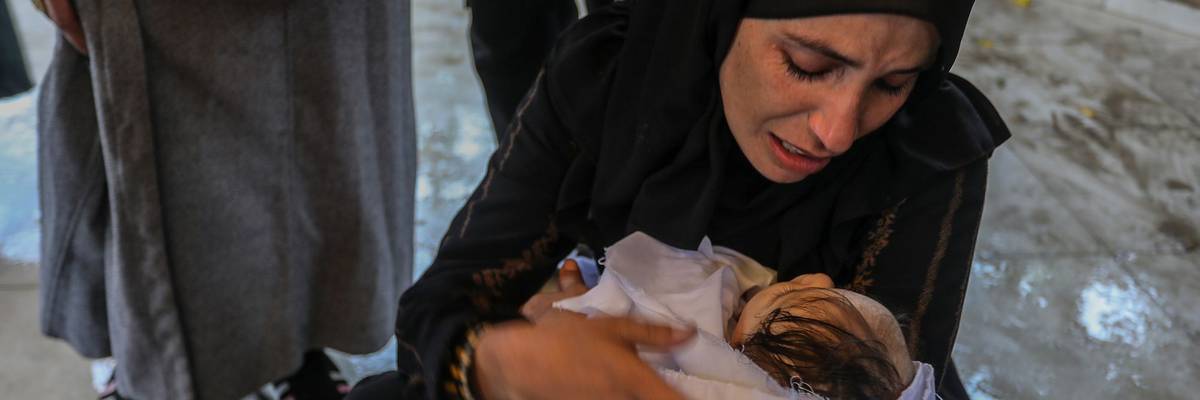
People mourn Rahaf Abu Jazar, a baby who died in cold weather conditions in Khan Younis, Gaza, on December 11, 2025. Her body was brought to Nasser Hospital for funeral arrangements.
"The pattern is clear—malnourished mothers, giving birth to underweight or premature babies, who die in Gaza's neonatal intensive care units or survive, only to face malnutrition themselves," said a UNICEF spokesperson.
Over two years into Israel's genocidal assault on and blockade of the Gaza Strip, the death toll continued to rise on Thursday, with local health officials and relatives confirming that 8-month-old Rahaf Abu Jazar died of exposure after floodwaters hit her family's tent in Khan Younis.
Her death came as the United Nations Children's Fund (UNICEF) and the UN Human Rights Office in the occupied Palestinian territory continued to sound the alarm about conditions for mothers and children, including infants like Abu Jazar.
As CNN reported Thursday:
Weeping and caressing the lifeless Rahaf in her arms, the baby's mother, Hejar Abu Jazar, kept ululating in despair. She said she had fed her daughter the previous night.
"She was completely fine. I breastfed her last night. Then all of a sudden, I found her freezing and shivering. She was healthy, my sweetheart," she cried.
"When we woke up, we found the rain over her and the wind on her, and the girl died of cold suddenly," the mother told Reuters. "There was nothing wrong with her. Oh, the fire in my heart, the fire in my heart, oh my life."
Citing municipal and civil defense officials, the news agency also noted that the storm flooded most tent encampments across Gaza, leading to thousands of calls for help that largely went unanswered due to fuel shortages and damage to equipment such as bulldozers tied to Israel's blockade and bombardment of the exclave since the Hamas-led October 7, 2023 attack.
After more than two years of war, Hamas and Israel struck a ceasefire deal this past October, though hundreds of alleged Israeli violations have resulted in at least 383 Palestinian deaths and 1,002 injuries. As of Thursday, the Gaza Ministry of Health put the totals at 70,373 dead and 171,079 injured, though with thousands missing, those are likely undercounts.
In addition to killing over 70,000 Palestinians, Israel "has also damaged or destroyed 94% of Gaza's hospitals, largely denying women access to essential healthcare, including reproductive healthcare," the UN Human Rights Office noted in a Thursday statement. "The Israeli blockade has also prevented the entry of objects indispensable to the survival of civilians, including medical supplies and nutrients required to sustain pregnancies and ensure safe childbirth."
"As a result, women were three times more likely to die from childbirth and three times more likely to miscarry in Gaza by October 2024 compared to before October 7, 2023," the office said. "Newborn deaths have increased, including at least 21 babies who died on their first day of life as of June 30, 2025. And births have dropped by a staggering 41% in the first half of 2025 compared to the same period in 2022."
Dr. Ambereen Sleemi, an American gynecologist, told the UN office about her experience volunteering in July at Nasser Hospital in Khan Younis, the largest medical facility in southern Gaza.
"As we did our rounds, bombs were going off in the background. One time, a nurse was shot in the head through the window in Nasser," she said. "Sometimes quadcopters would come in and try to shoot nurses or literally chase them through the hospital corridors."
"I cared for pregnant women who had been shot in various locations, including the abdomen," the doctor continued. "Many women were simply too injured to survive. If their injuries did not claim their lives, then sepsis often did, as there were not enough medical supplies or antibiotics to treat the preventable infections that followed."
"Almost every pregnant woman I treated who had other children said she had already lost a child in the war," Sleemi added. "The collective pain and sorrow were overwhelming and ever-present."
Some of them have died of hunger. While speaking with reporters at UN headquarters in Geneva earlier this week, Tess Ingram, UNICEF communication manager, highlighted how the hunger crisis in Gaza is impacting mothers and young kids.
"At least 165 children are reported to have died painful, preventable deaths related to malnutrition during the war," Ingram said. "But far less reported has been the scale of malnutrition among pregnant and breastfeeding women, and the devastating domino effect that has had on thousands of newborns."
"The pattern is clear—malnourished mothers, giving birth to underweight or premature babies, who die in Gaza's neonatal intensive care units or survive, only to face malnutrition themselves or potential lifelong medical complications," she continued, recalling some of the newborns she saw in the strip's hospitals, "their tiny chests heaving with the effort of staying alive."
Ingram stressed that "low birth weight infants are about 20 times more likely to die than infants of normal weight. They need special care, which many of the hospitals in Gaza have struggled to provide due to the destruction of the health system, the death and displacement of staff, and impediments by Israeli authorities that prevented some essential medical supplies from entering the strip."
She also shared the story of meeting a mother at a neonatal intensive care unit in Gaza City two weeks ago. The woman, Fatma, was there to see her baby, Mohammed, who was born premature and weighed only 3.3 pounds.
According to Ingram:
Fatma told me that unlike her first pregnancy, when she had access to antenatal checkups, vitamins, and nutritious food, "this pregnancy has been full of displacement, lack of food, malnutrition, war, and fear." She said she was malnourished for three months of the pregnancy, displaced three times, and her young daughter and husband were killed, two months apart, by airstrikes.
I have spent many months in Gaza over the past two years, and I see and hear the generational impacts of the conflict on mothers and their infants almost every day; in hospitals, nutrition clinics, and family tents. It is less visible than blood or injury, but it is ubiquitous. It is everywhere.
I have lost count of the number of parents like Fatma who have sobbed while telling me what happened to them, wrecked by how powerless they are to protect their children in the face of indiscriminate destruction and deprivation. Generations of families, including those born into the ceasefire, have been forever altered by what was inflicted upon them.
"And the fear must end," she declared. "This ceasefire should offer families safety, not more loss. More than 70 children have been killed in the eight weeks since the ceasefire began. The ongoing attacks and the killing of children must stop immediately."
Dear Common Dreams reader, It’s been nearly 30 years since I co-founded Common Dreams with my late wife, Lina Newhouser. We had the radical notion that journalism should serve the public good, not corporate profits. It was clear to us from the outset what it would take to build such a project. No paid advertisements. No corporate sponsors. No millionaire publisher telling us what to think or do. Many people said we wouldn't last a year, but we proved those doubters wrong. Together with a tremendous team of journalists and dedicated staff, we built an independent media outlet free from the constraints of profits and corporate control. Our mission has always been simple: To inform. To inspire. To ignite change for the common good. Building Common Dreams was not easy. Our survival was never guaranteed. When you take on the most powerful forces—Wall Street greed, fossil fuel industry destruction, Big Tech lobbyists, and uber-rich oligarchs who have spent billions upon billions rigging the economy and democracy in their favor—the only bulwark you have is supporters who believe in your work. But here’s the urgent message from me today. It's never been this bad out there. And it's never been this hard to keep us going. At the very moment Common Dreams is most needed, the threats we face are intensifying. We need your support now more than ever. We don't accept corporate advertising and never will. We don't have a paywall because we don't think people should be blocked from critical news based on their ability to pay. Everything we do is funded by the donations of readers like you. When everyone does the little they can afford, we are strong. But if that support retreats or dries up, so do we. Will you donate now to make sure Common Dreams not only survives but thrives? —Craig Brown, Co-founder |
Over two years into Israel's genocidal assault on and blockade of the Gaza Strip, the death toll continued to rise on Thursday, with local health officials and relatives confirming that 8-month-old Rahaf Abu Jazar died of exposure after floodwaters hit her family's tent in Khan Younis.
Her death came as the United Nations Children's Fund (UNICEF) and the UN Human Rights Office in the occupied Palestinian territory continued to sound the alarm about conditions for mothers and children, including infants like Abu Jazar.
As CNN reported Thursday:
Weeping and caressing the lifeless Rahaf in her arms, the baby's mother, Hejar Abu Jazar, kept ululating in despair. She said she had fed her daughter the previous night.
"She was completely fine. I breastfed her last night. Then all of a sudden, I found her freezing and shivering. She was healthy, my sweetheart," she cried.
"When we woke up, we found the rain over her and the wind on her, and the girl died of cold suddenly," the mother told Reuters. "There was nothing wrong with her. Oh, the fire in my heart, the fire in my heart, oh my life."
Citing municipal and civil defense officials, the news agency also noted that the storm flooded most tent encampments across Gaza, leading to thousands of calls for help that largely went unanswered due to fuel shortages and damage to equipment such as bulldozers tied to Israel's blockade and bombardment of the exclave since the Hamas-led October 7, 2023 attack.
After more than two years of war, Hamas and Israel struck a ceasefire deal this past October, though hundreds of alleged Israeli violations have resulted in at least 383 Palestinian deaths and 1,002 injuries. As of Thursday, the Gaza Ministry of Health put the totals at 70,373 dead and 171,079 injured, though with thousands missing, those are likely undercounts.
In addition to killing over 70,000 Palestinians, Israel "has also damaged or destroyed 94% of Gaza's hospitals, largely denying women access to essential healthcare, including reproductive healthcare," the UN Human Rights Office noted in a Thursday statement. "The Israeli blockade has also prevented the entry of objects indispensable to the survival of civilians, including medical supplies and nutrients required to sustain pregnancies and ensure safe childbirth."
"As a result, women were three times more likely to die from childbirth and three times more likely to miscarry in Gaza by October 2024 compared to before October 7, 2023," the office said. "Newborn deaths have increased, including at least 21 babies who died on their first day of life as of June 30, 2025. And births have dropped by a staggering 41% in the first half of 2025 compared to the same period in 2022."
Dr. Ambereen Sleemi, an American gynecologist, told the UN office about her experience volunteering in July at Nasser Hospital in Khan Younis, the largest medical facility in southern Gaza.
"As we did our rounds, bombs were going off in the background. One time, a nurse was shot in the head through the window in Nasser," she said. "Sometimes quadcopters would come in and try to shoot nurses or literally chase them through the hospital corridors."
"I cared for pregnant women who had been shot in various locations, including the abdomen," the doctor continued. "Many women were simply too injured to survive. If their injuries did not claim their lives, then sepsis often did, as there were not enough medical supplies or antibiotics to treat the preventable infections that followed."
"Almost every pregnant woman I treated who had other children said she had already lost a child in the war," Sleemi added. "The collective pain and sorrow were overwhelming and ever-present."
Some of them have died of hunger. While speaking with reporters at UN headquarters in Geneva earlier this week, Tess Ingram, UNICEF communication manager, highlighted how the hunger crisis in Gaza is impacting mothers and young kids.
"At least 165 children are reported to have died painful, preventable deaths related to malnutrition during the war," Ingram said. "But far less reported has been the scale of malnutrition among pregnant and breastfeeding women, and the devastating domino effect that has had on thousands of newborns."
"The pattern is clear—malnourished mothers, giving birth to underweight or premature babies, who die in Gaza's neonatal intensive care units or survive, only to face malnutrition themselves or potential lifelong medical complications," she continued, recalling some of the newborns she saw in the strip's hospitals, "their tiny chests heaving with the effort of staying alive."
Ingram stressed that "low birth weight infants are about 20 times more likely to die than infants of normal weight. They need special care, which many of the hospitals in Gaza have struggled to provide due to the destruction of the health system, the death and displacement of staff, and impediments by Israeli authorities that prevented some essential medical supplies from entering the strip."
She also shared the story of meeting a mother at a neonatal intensive care unit in Gaza City two weeks ago. The woman, Fatma, was there to see her baby, Mohammed, who was born premature and weighed only 3.3 pounds.
According to Ingram:
Fatma told me that unlike her first pregnancy, when she had access to antenatal checkups, vitamins, and nutritious food, "this pregnancy has been full of displacement, lack of food, malnutrition, war, and fear." She said she was malnourished for three months of the pregnancy, displaced three times, and her young daughter and husband were killed, two months apart, by airstrikes.
I have spent many months in Gaza over the past two years, and I see and hear the generational impacts of the conflict on mothers and their infants almost every day; in hospitals, nutrition clinics, and family tents. It is less visible than blood or injury, but it is ubiquitous. It is everywhere.
I have lost count of the number of parents like Fatma who have sobbed while telling me what happened to them, wrecked by how powerless they are to protect their children in the face of indiscriminate destruction and deprivation. Generations of families, including those born into the ceasefire, have been forever altered by what was inflicted upon them.
"And the fear must end," she declared. "This ceasefire should offer families safety, not more loss. More than 70 children have been killed in the eight weeks since the ceasefire began. The ongoing attacks and the killing of children must stop immediately."
Over two years into Israel's genocidal assault on and blockade of the Gaza Strip, the death toll continued to rise on Thursday, with local health officials and relatives confirming that 8-month-old Rahaf Abu Jazar died of exposure after floodwaters hit her family's tent in Khan Younis.
Her death came as the United Nations Children's Fund (UNICEF) and the UN Human Rights Office in the occupied Palestinian territory continued to sound the alarm about conditions for mothers and children, including infants like Abu Jazar.
As CNN reported Thursday:
Weeping and caressing the lifeless Rahaf in her arms, the baby's mother, Hejar Abu Jazar, kept ululating in despair. She said she had fed her daughter the previous night.
"She was completely fine. I breastfed her last night. Then all of a sudden, I found her freezing and shivering. She was healthy, my sweetheart," she cried.
"When we woke up, we found the rain over her and the wind on her, and the girl died of cold suddenly," the mother told Reuters. "There was nothing wrong with her. Oh, the fire in my heart, the fire in my heart, oh my life."
Citing municipal and civil defense officials, the news agency also noted that the storm flooded most tent encampments across Gaza, leading to thousands of calls for help that largely went unanswered due to fuel shortages and damage to equipment such as bulldozers tied to Israel's blockade and bombardment of the exclave since the Hamas-led October 7, 2023 attack.
After more than two years of war, Hamas and Israel struck a ceasefire deal this past October, though hundreds of alleged Israeli violations have resulted in at least 383 Palestinian deaths and 1,002 injuries. As of Thursday, the Gaza Ministry of Health put the totals at 70,373 dead and 171,079 injured, though with thousands missing, those are likely undercounts.
In addition to killing over 70,000 Palestinians, Israel "has also damaged or destroyed 94% of Gaza's hospitals, largely denying women access to essential healthcare, including reproductive healthcare," the UN Human Rights Office noted in a Thursday statement. "The Israeli blockade has also prevented the entry of objects indispensable to the survival of civilians, including medical supplies and nutrients required to sustain pregnancies and ensure safe childbirth."
"As a result, women were three times more likely to die from childbirth and three times more likely to miscarry in Gaza by October 2024 compared to before October 7, 2023," the office said. "Newborn deaths have increased, including at least 21 babies who died on their first day of life as of June 30, 2025. And births have dropped by a staggering 41% in the first half of 2025 compared to the same period in 2022."
Dr. Ambereen Sleemi, an American gynecologist, told the UN office about her experience volunteering in July at Nasser Hospital in Khan Younis, the largest medical facility in southern Gaza.
"As we did our rounds, bombs were going off in the background. One time, a nurse was shot in the head through the window in Nasser," she said. "Sometimes quadcopters would come in and try to shoot nurses or literally chase them through the hospital corridors."
"I cared for pregnant women who had been shot in various locations, including the abdomen," the doctor continued. "Many women were simply too injured to survive. If their injuries did not claim their lives, then sepsis often did, as there were not enough medical supplies or antibiotics to treat the preventable infections that followed."
"Almost every pregnant woman I treated who had other children said she had already lost a child in the war," Sleemi added. "The collective pain and sorrow were overwhelming and ever-present."
Some of them have died of hunger. While speaking with reporters at UN headquarters in Geneva earlier this week, Tess Ingram, UNICEF communication manager, highlighted how the hunger crisis in Gaza is impacting mothers and young kids.
"At least 165 children are reported to have died painful, preventable deaths related to malnutrition during the war," Ingram said. "But far less reported has been the scale of malnutrition among pregnant and breastfeeding women, and the devastating domino effect that has had on thousands of newborns."
"The pattern is clear—malnourished mothers, giving birth to underweight or premature babies, who die in Gaza's neonatal intensive care units or survive, only to face malnutrition themselves or potential lifelong medical complications," she continued, recalling some of the newborns she saw in the strip's hospitals, "their tiny chests heaving with the effort of staying alive."
Ingram stressed that "low birth weight infants are about 20 times more likely to die than infants of normal weight. They need special care, which many of the hospitals in Gaza have struggled to provide due to the destruction of the health system, the death and displacement of staff, and impediments by Israeli authorities that prevented some essential medical supplies from entering the strip."
She also shared the story of meeting a mother at a neonatal intensive care unit in Gaza City two weeks ago. The woman, Fatma, was there to see her baby, Mohammed, who was born premature and weighed only 3.3 pounds.
According to Ingram:
Fatma told me that unlike her first pregnancy, when she had access to antenatal checkups, vitamins, and nutritious food, "this pregnancy has been full of displacement, lack of food, malnutrition, war, and fear." She said she was malnourished for three months of the pregnancy, displaced three times, and her young daughter and husband were killed, two months apart, by airstrikes.
I have spent many months in Gaza over the past two years, and I see and hear the generational impacts of the conflict on mothers and their infants almost every day; in hospitals, nutrition clinics, and family tents. It is less visible than blood or injury, but it is ubiquitous. It is everywhere.
I have lost count of the number of parents like Fatma who have sobbed while telling me what happened to them, wrecked by how powerless they are to protect their children in the face of indiscriminate destruction and deprivation. Generations of families, including those born into the ceasefire, have been forever altered by what was inflicted upon them.
"And the fear must end," she declared. "This ceasefire should offer families safety, not more loss. More than 70 children have been killed in the eight weeks since the ceasefire began. The ongoing attacks and the killing of children must stop immediately."