SUBSCRIBE TO OUR FREE NEWSLETTER
Daily news & progressive opinion—funded by the people, not the corporations—delivered straight to your inbox.
5
#000000
#FFFFFF
To donate by check, phone, or other method, see our More Ways to Give page.
Daily news & progressive opinion—funded by the people, not the corporations—delivered straight to your inbox.
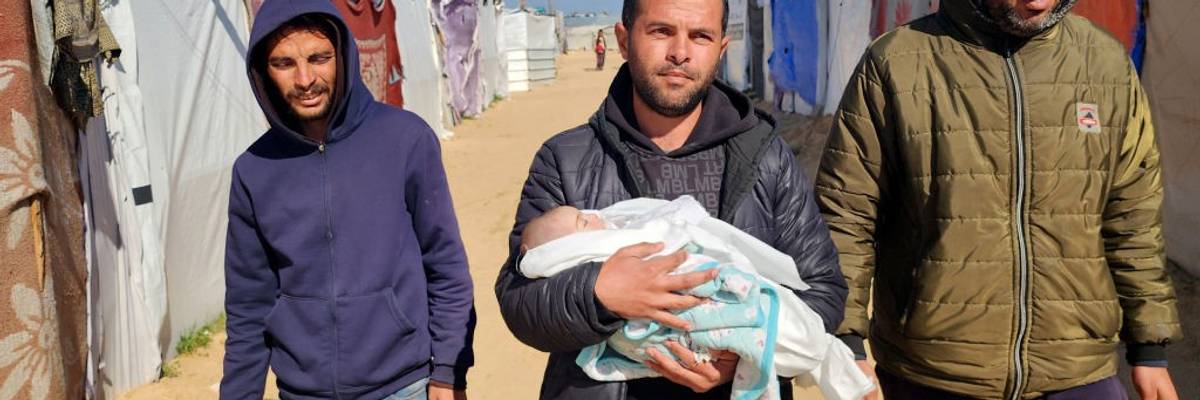
Relatives of the 2-month-old Sham al-Shanbari, who died from extreme cold in the makeshift tent where she stayed with his family, carry his dead body to the cemetery before burying him in Khan Younis, Gaza on February 25, 2025.
"Newborns should not be dying of hypothermia in Gaza," said one campaigner. "This is not a tragedy of nature but a man-made crisis."
Local medical professionals said Tuesday that at least half a dozen babies have died this week in Gaza amid winter weather and Israel's ongoing blockade of the obliterated Palestinian enclave, where hundreds of thousands of people are living in tent encampments and other unheated makeshift structures.
Dr. Saeed Salah, the medical director at Patients' Friends Benevolent Society Hospital in Gaza City, told reporters that three infants died on Monday and three more on Tuesday from complications due to exposure to the cold.
"In the past two weeks, we admitted eight newborns suffering from severe cold injuries," Salah said. "Three of them died within hours of arrival. They were only a day or two old, weighing between 1.7 and 2 kilograms (3.7-4.4 lbs.)."
"All of these children arrived with low temperatures, shortness of breath, and cold extremities that reached the point of freezing," Salah told The Washington Post by phone Tuesday. "These children live with their families in tents and destroyed homes and suffer from a lack of supplies that help provide them with the necessary warmth, especially with the Israeli intransigence in bringing in the necessary fuel."
Gaza experiences cold, wet, and windy winters, with temperatures often dipping well below 50°F (10°C) at night. Hypothermia can be deadly at temperatures over 60°F (15°C) in overexposed conditions such as those existing in Gaza, where the overwhelming majority of the strip's 2.3 million residents have been forcibly displaced, most homes have been destroyed or damaged, and bodies have been weakened from more than 500 days of an Israeli siege for which the country is facing genocide charges at the International Court of Justice.
The sixth reported infant death of the week was of 2-month-old Sham Yousef al-Shanbari, who died in her family's tent in the Mawasi area of Khan Younis in southern Gaza.
"Her body turned into a piece of ice... and her heartbeat stopped," uncle-in-law Obaida al-Shanbari told the Post by phone Tuesday.
Yusuf al-Shanbari, Sham's father, told The Associated Press: "Yesterday, I was playing with her. I was happy with her. She was a beautiful child, like the moon."
(Warning: The following video contains images of death.)
Dr. Ahmed al-Farah, the head of the pediatric department at Nasser Hospital in Khan Younis, told the AP that al-Shanbari did not have any illness but died from exposure because she lived in a tent. Al-Farah also said the hospital has treated two other infants for frostbite.
At least three Palestinian infants died from exposure to cold conditions earlier this winter, when Israeli forces were still carrying out their assault on Gaza that left more than 170,000 people dead, wounded, or missing.
Hamas, whose political wing rules the Gaza Strip, has accused Israel of violating the terms of a fragile monthlong cease-fire, not only by killing and wounding Palestinian civilians and postponing a scheduled prisoner release, but also by delaying the delivery of mobile homes, tents, and other lifesaving humanitarian aid. Israeli officials deny the allegations.
"If adequate aid, including shelter supplies, were allowed to reach civilians and hospitals, these deaths would be entirely preventable."
"Newborns should not be dying of hypothermia in Gaza. This is not a tragedy of nature but a man-made crisis," Fikr Shalltoot, Gaza director for the London-based charity Medical Aid for Palestinians, told the Post.
"If adequate aid, including shelter supplies, were allowed to reach civilians and hospitals, these deaths would be entirely preventable," Shalltoot added. "This suffering is the direct result of Israel's restrictions on essential humanitarian aid."
Edward Ahmed Mitchell, deputy executive director at the Washington, D.C.-based Council on American-Islamic Relations, said in a statement Tuesday: "The Israeli government's genocidal campaign in Gaza has left most of its population homeless. To block the entry of temporary housing so that returning Palestinians, including infants, die of exposure is entirely unconscionable."
"The Trump administration and the international community must take immediate action to force the Israeli government to allow desperately needed housing supplies to enter Gaza," Mitchell added.
Dear Common Dreams reader, It’s been nearly 30 years since I co-founded Common Dreams with my late wife, Lina Newhouser. We had the radical notion that journalism should serve the public good, not corporate profits. It was clear to us from the outset what it would take to build such a project. No paid advertisements. No corporate sponsors. No millionaire publisher telling us what to think or do. Many people said we wouldn't last a year, but we proved those doubters wrong. Together with a tremendous team of journalists and dedicated staff, we built an independent media outlet free from the constraints of profits and corporate control. Our mission has always been simple: To inform. To inspire. To ignite change for the common good. Building Common Dreams was not easy. Our survival was never guaranteed. When you take on the most powerful forces—Wall Street greed, fossil fuel industry destruction, Big Tech lobbyists, and uber-rich oligarchs who have spent billions upon billions rigging the economy and democracy in their favor—the only bulwark you have is supporters who believe in your work. But here’s the urgent message from me today. It's never been this bad out there. And it's never been this hard to keep us going. At the very moment Common Dreams is most needed, the threats we face are intensifying. We need your support now more than ever. We don't accept corporate advertising and never will. We don't have a paywall because we don't think people should be blocked from critical news based on their ability to pay. Everything we do is funded by the donations of readers like you. When everyone does the little they can afford, we are strong. But if that support retreats or dries up, so do we. Will you donate now to make sure Common Dreams not only survives but thrives? —Craig Brown, Co-founder |
Local medical professionals said Tuesday that at least half a dozen babies have died this week in Gaza amid winter weather and Israel's ongoing blockade of the obliterated Palestinian enclave, where hundreds of thousands of people are living in tent encampments and other unheated makeshift structures.
Dr. Saeed Salah, the medical director at Patients' Friends Benevolent Society Hospital in Gaza City, told reporters that three infants died on Monday and three more on Tuesday from complications due to exposure to the cold.
"In the past two weeks, we admitted eight newborns suffering from severe cold injuries," Salah said. "Three of them died within hours of arrival. They were only a day or two old, weighing between 1.7 and 2 kilograms (3.7-4.4 lbs.)."
"All of these children arrived with low temperatures, shortness of breath, and cold extremities that reached the point of freezing," Salah told The Washington Post by phone Tuesday. "These children live with their families in tents and destroyed homes and suffer from a lack of supplies that help provide them with the necessary warmth, especially with the Israeli intransigence in bringing in the necessary fuel."
Gaza experiences cold, wet, and windy winters, with temperatures often dipping well below 50°F (10°C) at night. Hypothermia can be deadly at temperatures over 60°F (15°C) in overexposed conditions such as those existing in Gaza, where the overwhelming majority of the strip's 2.3 million residents have been forcibly displaced, most homes have been destroyed or damaged, and bodies have been weakened from more than 500 days of an Israeli siege for which the country is facing genocide charges at the International Court of Justice.
The sixth reported infant death of the week was of 2-month-old Sham Yousef al-Shanbari, who died in her family's tent in the Mawasi area of Khan Younis in southern Gaza.
"Her body turned into a piece of ice... and her heartbeat stopped," uncle-in-law Obaida al-Shanbari told the Post by phone Tuesday.
Yusuf al-Shanbari, Sham's father, told The Associated Press: "Yesterday, I was playing with her. I was happy with her. She was a beautiful child, like the moon."
(Warning: The following video contains images of death.)
Dr. Ahmed al-Farah, the head of the pediatric department at Nasser Hospital in Khan Younis, told the AP that al-Shanbari did not have any illness but died from exposure because she lived in a tent. Al-Farah also said the hospital has treated two other infants for frostbite.
At least three Palestinian infants died from exposure to cold conditions earlier this winter, when Israeli forces were still carrying out their assault on Gaza that left more than 170,000 people dead, wounded, or missing.
Hamas, whose political wing rules the Gaza Strip, has accused Israel of violating the terms of a fragile monthlong cease-fire, not only by killing and wounding Palestinian civilians and postponing a scheduled prisoner release, but also by delaying the delivery of mobile homes, tents, and other lifesaving humanitarian aid. Israeli officials deny the allegations.
"If adequate aid, including shelter supplies, were allowed to reach civilians and hospitals, these deaths would be entirely preventable."
"Newborns should not be dying of hypothermia in Gaza. This is not a tragedy of nature but a man-made crisis," Fikr Shalltoot, Gaza director for the London-based charity Medical Aid for Palestinians, told the Post.
"If adequate aid, including shelter supplies, were allowed to reach civilians and hospitals, these deaths would be entirely preventable," Shalltoot added. "This suffering is the direct result of Israel's restrictions on essential humanitarian aid."
Edward Ahmed Mitchell, deputy executive director at the Washington, D.C.-based Council on American-Islamic Relations, said in a statement Tuesday: "The Israeli government's genocidal campaign in Gaza has left most of its population homeless. To block the entry of temporary housing so that returning Palestinians, including infants, die of exposure is entirely unconscionable."
"The Trump administration and the international community must take immediate action to force the Israeli government to allow desperately needed housing supplies to enter Gaza," Mitchell added.
Local medical professionals said Tuesday that at least half a dozen babies have died this week in Gaza amid winter weather and Israel's ongoing blockade of the obliterated Palestinian enclave, where hundreds of thousands of people are living in tent encampments and other unheated makeshift structures.
Dr. Saeed Salah, the medical director at Patients' Friends Benevolent Society Hospital in Gaza City, told reporters that three infants died on Monday and three more on Tuesday from complications due to exposure to the cold.
"In the past two weeks, we admitted eight newborns suffering from severe cold injuries," Salah said. "Three of them died within hours of arrival. They were only a day or two old, weighing between 1.7 and 2 kilograms (3.7-4.4 lbs.)."
"All of these children arrived with low temperatures, shortness of breath, and cold extremities that reached the point of freezing," Salah told The Washington Post by phone Tuesday. "These children live with their families in tents and destroyed homes and suffer from a lack of supplies that help provide them with the necessary warmth, especially with the Israeli intransigence in bringing in the necessary fuel."
Gaza experiences cold, wet, and windy winters, with temperatures often dipping well below 50°F (10°C) at night. Hypothermia can be deadly at temperatures over 60°F (15°C) in overexposed conditions such as those existing in Gaza, where the overwhelming majority of the strip's 2.3 million residents have been forcibly displaced, most homes have been destroyed or damaged, and bodies have been weakened from more than 500 days of an Israeli siege for which the country is facing genocide charges at the International Court of Justice.
The sixth reported infant death of the week was of 2-month-old Sham Yousef al-Shanbari, who died in her family's tent in the Mawasi area of Khan Younis in southern Gaza.
"Her body turned into a piece of ice... and her heartbeat stopped," uncle-in-law Obaida al-Shanbari told the Post by phone Tuesday.
Yusuf al-Shanbari, Sham's father, told The Associated Press: "Yesterday, I was playing with her. I was happy with her. She was a beautiful child, like the moon."
(Warning: The following video contains images of death.)
Dr. Ahmed al-Farah, the head of the pediatric department at Nasser Hospital in Khan Younis, told the AP that al-Shanbari did not have any illness but died from exposure because she lived in a tent. Al-Farah also said the hospital has treated two other infants for frostbite.
At least three Palestinian infants died from exposure to cold conditions earlier this winter, when Israeli forces were still carrying out their assault on Gaza that left more than 170,000 people dead, wounded, or missing.
Hamas, whose political wing rules the Gaza Strip, has accused Israel of violating the terms of a fragile monthlong cease-fire, not only by killing and wounding Palestinian civilians and postponing a scheduled prisoner release, but also by delaying the delivery of mobile homes, tents, and other lifesaving humanitarian aid. Israeli officials deny the allegations.
"If adequate aid, including shelter supplies, were allowed to reach civilians and hospitals, these deaths would be entirely preventable."
"Newborns should not be dying of hypothermia in Gaza. This is not a tragedy of nature but a man-made crisis," Fikr Shalltoot, Gaza director for the London-based charity Medical Aid for Palestinians, told the Post.
"If adequate aid, including shelter supplies, were allowed to reach civilians and hospitals, these deaths would be entirely preventable," Shalltoot added. "This suffering is the direct result of Israel's restrictions on essential humanitarian aid."
Edward Ahmed Mitchell, deputy executive director at the Washington, D.C.-based Council on American-Islamic Relations, said in a statement Tuesday: "The Israeli government's genocidal campaign in Gaza has left most of its population homeless. To block the entry of temporary housing so that returning Palestinians, including infants, die of exposure is entirely unconscionable."
"The Trump administration and the international community must take immediate action to force the Israeli government to allow desperately needed housing supplies to enter Gaza," Mitchell added.