SUBSCRIBE TO OUR FREE NEWSLETTER
Daily news & progressive opinion—funded by the people, not the corporations—delivered straight to your inbox.
5
#000000
#FFFFFF
To donate by check, phone, or other method, see our More Ways to Give page.
Daily news & progressive opinion—funded by the people, not the corporations—delivered straight to your inbox.
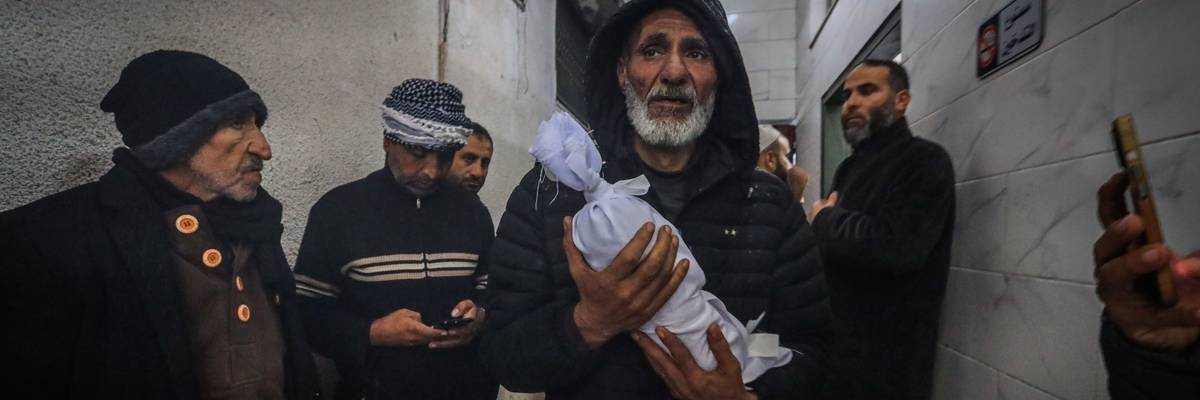
A Palestinian man carries the shrouded body of Taim Al-Khawaja, an infant who died of hypothermia in the Shati refugee camp in the Gaza Strip, on December 12, 2025.
"Palestinian babies freeze to death as shelters and lifesaving humanitarian aid—located just a few miles away—for 1 million civilians is blocked by Israel," noted one journalist.
A second Palestinian infant and a young girl died of hypothermia in Gaza as heavy rains and flooding—whose effects are exacerbated by Israel's genocidal annihilation and ongoing siege of the coastal strip—raised the death toll from Storm Byron to at least 16.
Taim Al-Khawaja—who was several months old—died in the Shati refugee camp in northern Gaza, while 9-year-old Hadeel al-Masri died in a shelter west of Gaza City, according to local officials. Their deaths follow that of Rahaf Abu Jazar, an 8-month-old who died Thursday of exposure after floodwaters inundated her family’s tent in Khan Younis.
At least five other people were killed when a building in Beit Lahia collapsed amid the storm, and two others were killed when a wall collapsed onto tents housing displaced Palestinians in the Remal neighorhood of Gaza City. According to Gaza's Government Media Office (GMO), at least 13 buildings have collapsed and more than 27,000 tents have been destroyed or left uninhabitable by Byron's winds, rain, and floodwater.
While farmers in neighboring Israel welcomed the torrential rains, which delivered relief from drought conditions, the storm is devastating Palestinians already reeling and weakened from nearly 800 days of war and siege. Israel's US-backed onslaught has left more than 250,000 Gazans dead, maimed, or missing and 2 million more starved, sickened, or displaced. Roughly 1.5 million Palestinians are currently living in tents or other makeshift shelters.
The recent hypothermia deaths evoked horrific memories of the past two winters in Gaza, when more than a dozen Palestinians—most of them infants and children—died from hypothermia caused by exposure. While many Israelis and their supporters abroad point to the relatively mild Mediterranean winters in an effort to deny these deaths, experts note that hypothermia can be deadly at temperatures over 60°F (15°C) in overexposed conditions such as those in Gaza.
Reporting from Gaza, Al Jazeera's Ibrahim al-Khalili said Friday that genocide-ravaged Gazans are now enduring “an added layer of suffering."
“The tents are collapsing. The cold is unbearable. Basically, they don’t have anywhere to go. What is unfolding is devastating,” he said. “It’s not just a storm; it’s a new wave of displacement even after the war has stopped. Many people here told me that a new war has really begun after this flooding, and people are being forced to flee whatever fragile shelters they had.”
Hamas spokesperson Hazem Qassem on Friday called the recent exposure deaths a "continuation of the war of extermination."
“The successive collapses of homes bombed during the war of extermination on the Gaza Strip, caused by the storm, and the resulting deaths, reflect the unprecedented scale of the humanitarian disaster left by this criminal Zionist war,” he said.
Jonathan Crickx, chief of communications for the United Nations Children's Fund (UNICEF), told Agence France-Presse Friday that Gazans are also enduring "absolutely appalling hygiene and sanitary conditions."
"There aren't enough toilets; there are places—I saw some in Gaza City—where large pools of water are essentially open sewers right next to the displacement camps," he added.
While the shaky two-month ceasefire between Israel and Hamas has somewhat eased the Israeli blockade on Gaza, the GMO said Friday that “the occupation continues to close crossings and prevent the entry of humanitarian aid and materials that could provide shelter."
“This includes blocking the entry of 300,000 tents, prefabricated mobile homes, and caravans," the agency added.
The #Gaza Strip has been left flooded by #StormByron, destroying already damaged buildings and causing additional loss of life.MSF is concerned about the upcoming winter and heavy rain.Caroline Seguin, Emergency Coordinator, updates:
[image or embed]
— Doctors Without Borders / Médecins Sans Frontières (MSF) (@msf.ca) December 12, 2025 at 2:02 PM
In a statement Friday, Doctors Without Borders Gaza emergency coordinator Caroline Seguin said that the charity is "very, very worried about the next month with the winter coming and the heavy rain."
"Last year we saw a huge increase in respiratory infections for children, diarrhea as well, and of course all the wounded that are living inside the tents will have big difficulties to heal their wounds and will have probably an increase of infection for the wound of the wounded," Seguin noted. "It's near to be not possible to live in this conditions."
Dear Common Dreams reader, It’s been nearly 30 years since I co-founded Common Dreams with my late wife, Lina Newhouser. We had the radical notion that journalism should serve the public good, not corporate profits. It was clear to us from the outset what it would take to build such a project. No paid advertisements. No corporate sponsors. No millionaire publisher telling us what to think or do. Many people said we wouldn't last a year, but we proved those doubters wrong. Together with a tremendous team of journalists and dedicated staff, we built an independent media outlet free from the constraints of profits and corporate control. Our mission has always been simple: To inform. To inspire. To ignite change for the common good. Building Common Dreams was not easy. Our survival was never guaranteed. When you take on the most powerful forces—Wall Street greed, fossil fuel industry destruction, Big Tech lobbyists, and uber-rich oligarchs who have spent billions upon billions rigging the economy and democracy in their favor—the only bulwark you have is supporters who believe in your work. But here’s the urgent message from me today. It's never been this bad out there. And it's never been this hard to keep us going. At the very moment Common Dreams is most needed, the threats we face are intensifying. We need your support now more than ever. We don't accept corporate advertising and never will. We don't have a paywall because we don't think people should be blocked from critical news based on their ability to pay. Everything we do is funded by the donations of readers like you. When everyone does the little they can afford, we are strong. But if that support retreats or dries up, so do we. Will you donate now to make sure Common Dreams not only survives but thrives? —Craig Brown, Co-founder |
A second Palestinian infant and a young girl died of hypothermia in Gaza as heavy rains and flooding—whose effects are exacerbated by Israel's genocidal annihilation and ongoing siege of the coastal strip—raised the death toll from Storm Byron to at least 16.
Taim Al-Khawaja—who was several months old—died in the Shati refugee camp in northern Gaza, while 9-year-old Hadeel al-Masri died in a shelter west of Gaza City, according to local officials. Their deaths follow that of Rahaf Abu Jazar, an 8-month-old who died Thursday of exposure after floodwaters inundated her family’s tent in Khan Younis.
At least five other people were killed when a building in Beit Lahia collapsed amid the storm, and two others were killed when a wall collapsed onto tents housing displaced Palestinians in the Remal neighorhood of Gaza City. According to Gaza's Government Media Office (GMO), at least 13 buildings have collapsed and more than 27,000 tents have been destroyed or left uninhabitable by Byron's winds, rain, and floodwater.
While farmers in neighboring Israel welcomed the torrential rains, which delivered relief from drought conditions, the storm is devastating Palestinians already reeling and weakened from nearly 800 days of war and siege. Israel's US-backed onslaught has left more than 250,000 Gazans dead, maimed, or missing and 2 million more starved, sickened, or displaced. Roughly 1.5 million Palestinians are currently living in tents or other makeshift shelters.
The recent hypothermia deaths evoked horrific memories of the past two winters in Gaza, when more than a dozen Palestinians—most of them infants and children—died from hypothermia caused by exposure. While many Israelis and their supporters abroad point to the relatively mild Mediterranean winters in an effort to deny these deaths, experts note that hypothermia can be deadly at temperatures over 60°F (15°C) in overexposed conditions such as those in Gaza.
Reporting from Gaza, Al Jazeera's Ibrahim al-Khalili said Friday that genocide-ravaged Gazans are now enduring “an added layer of suffering."
“The tents are collapsing. The cold is unbearable. Basically, they don’t have anywhere to go. What is unfolding is devastating,” he said. “It’s not just a storm; it’s a new wave of displacement even after the war has stopped. Many people here told me that a new war has really begun after this flooding, and people are being forced to flee whatever fragile shelters they had.”
Hamas spokesperson Hazem Qassem on Friday called the recent exposure deaths a "continuation of the war of extermination."
“The successive collapses of homes bombed during the war of extermination on the Gaza Strip, caused by the storm, and the resulting deaths, reflect the unprecedented scale of the humanitarian disaster left by this criminal Zionist war,” he said.
Jonathan Crickx, chief of communications for the United Nations Children's Fund (UNICEF), told Agence France-Presse Friday that Gazans are also enduring "absolutely appalling hygiene and sanitary conditions."
"There aren't enough toilets; there are places—I saw some in Gaza City—where large pools of water are essentially open sewers right next to the displacement camps," he added.
While the shaky two-month ceasefire between Israel and Hamas has somewhat eased the Israeli blockade on Gaza, the GMO said Friday that “the occupation continues to close crossings and prevent the entry of humanitarian aid and materials that could provide shelter."
“This includes blocking the entry of 300,000 tents, prefabricated mobile homes, and caravans," the agency added.
The #Gaza Strip has been left flooded by #StormByron, destroying already damaged buildings and causing additional loss of life.MSF is concerned about the upcoming winter and heavy rain.Caroline Seguin, Emergency Coordinator, updates:
[image or embed]
— Doctors Without Borders / Médecins Sans Frontières (MSF) (@msf.ca) December 12, 2025 at 2:02 PM
In a statement Friday, Doctors Without Borders Gaza emergency coordinator Caroline Seguin said that the charity is "very, very worried about the next month with the winter coming and the heavy rain."
"Last year we saw a huge increase in respiratory infections for children, diarrhea as well, and of course all the wounded that are living inside the tents will have big difficulties to heal their wounds and will have probably an increase of infection for the wound of the wounded," Seguin noted. "It's near to be not possible to live in this conditions."
A second Palestinian infant and a young girl died of hypothermia in Gaza as heavy rains and flooding—whose effects are exacerbated by Israel's genocidal annihilation and ongoing siege of the coastal strip—raised the death toll from Storm Byron to at least 16.
Taim Al-Khawaja—who was several months old—died in the Shati refugee camp in northern Gaza, while 9-year-old Hadeel al-Masri died in a shelter west of Gaza City, according to local officials. Their deaths follow that of Rahaf Abu Jazar, an 8-month-old who died Thursday of exposure after floodwaters inundated her family’s tent in Khan Younis.
At least five other people were killed when a building in Beit Lahia collapsed amid the storm, and two others were killed when a wall collapsed onto tents housing displaced Palestinians in the Remal neighorhood of Gaza City. According to Gaza's Government Media Office (GMO), at least 13 buildings have collapsed and more than 27,000 tents have been destroyed or left uninhabitable by Byron's winds, rain, and floodwater.
While farmers in neighboring Israel welcomed the torrential rains, which delivered relief from drought conditions, the storm is devastating Palestinians already reeling and weakened from nearly 800 days of war and siege. Israel's US-backed onslaught has left more than 250,000 Gazans dead, maimed, or missing and 2 million more starved, sickened, or displaced. Roughly 1.5 million Palestinians are currently living in tents or other makeshift shelters.
The recent hypothermia deaths evoked horrific memories of the past two winters in Gaza, when more than a dozen Palestinians—most of them infants and children—died from hypothermia caused by exposure. While many Israelis and their supporters abroad point to the relatively mild Mediterranean winters in an effort to deny these deaths, experts note that hypothermia can be deadly at temperatures over 60°F (15°C) in overexposed conditions such as those in Gaza.
Reporting from Gaza, Al Jazeera's Ibrahim al-Khalili said Friday that genocide-ravaged Gazans are now enduring “an added layer of suffering."
“The tents are collapsing. The cold is unbearable. Basically, they don’t have anywhere to go. What is unfolding is devastating,” he said. “It’s not just a storm; it’s a new wave of displacement even after the war has stopped. Many people here told me that a new war has really begun after this flooding, and people are being forced to flee whatever fragile shelters they had.”
Hamas spokesperson Hazem Qassem on Friday called the recent exposure deaths a "continuation of the war of extermination."
“The successive collapses of homes bombed during the war of extermination on the Gaza Strip, caused by the storm, and the resulting deaths, reflect the unprecedented scale of the humanitarian disaster left by this criminal Zionist war,” he said.
Jonathan Crickx, chief of communications for the United Nations Children's Fund (UNICEF), told Agence France-Presse Friday that Gazans are also enduring "absolutely appalling hygiene and sanitary conditions."
"There aren't enough toilets; there are places—I saw some in Gaza City—where large pools of water are essentially open sewers right next to the displacement camps," he added.
While the shaky two-month ceasefire between Israel and Hamas has somewhat eased the Israeli blockade on Gaza, the GMO said Friday that “the occupation continues to close crossings and prevent the entry of humanitarian aid and materials that could provide shelter."
“This includes blocking the entry of 300,000 tents, prefabricated mobile homes, and caravans," the agency added.
The #Gaza Strip has been left flooded by #StormByron, destroying already damaged buildings and causing additional loss of life.MSF is concerned about the upcoming winter and heavy rain.Caroline Seguin, Emergency Coordinator, updates:
[image or embed]
— Doctors Without Borders / Médecins Sans Frontières (MSF) (@msf.ca) December 12, 2025 at 2:02 PM
In a statement Friday, Doctors Without Borders Gaza emergency coordinator Caroline Seguin said that the charity is "very, very worried about the next month with the winter coming and the heavy rain."
"Last year we saw a huge increase in respiratory infections for children, diarrhea as well, and of course all the wounded that are living inside the tents will have big difficulties to heal their wounds and will have probably an increase of infection for the wound of the wounded," Seguin noted. "It's near to be not possible to live in this conditions."