

SUBSCRIBE TO OUR FREE NEWSLETTER
Daily news & progressive opinion—funded by the people, not the corporations—delivered straight to your inbox.
5
#000000
#FFFFFF
To donate by check, phone, or other method, see our More Ways to Give page.
Daily news & progressive opinion—funded by the people, not the corporations—delivered straight to your inbox.
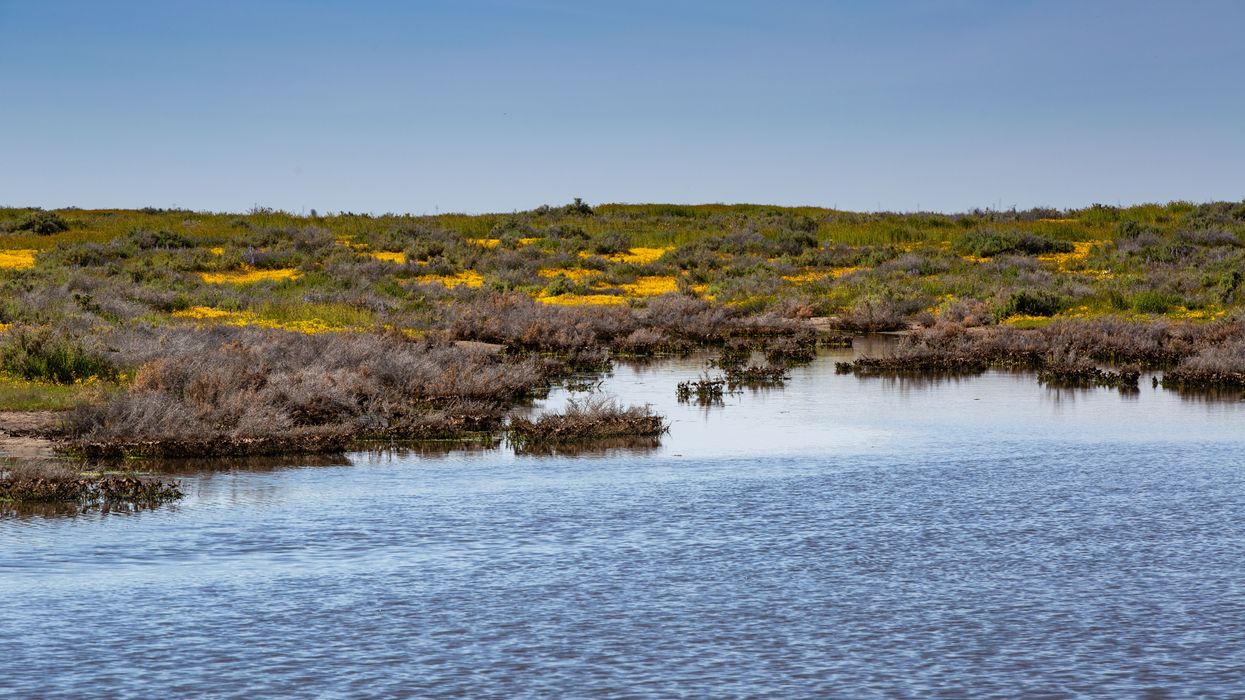
"Eliminating protections from small streams and wetlands will mean more pollution downstream—in our drinking water, at our beaches, and in our rivers," said one advocate.
Environmental justice campaigners on Monday said the Trump administration's latest rollback of wetland protections was "a gift to developers and polluters at the expense of communities" and demanded permanent protections for waterways.
“Clean water protections shouldn’t change with each administration,” said Betsy Southerland, former director of the Office of Science and Technology in the US Environmental Protection Agency’s (EPA) Office of Water. “Every family deserves the same right to safe water, no matter where they live or who’s in office.”
EPA Administrator Lee Zeldin proposed changes to the rule known as "Waters of the United States" (WOTUS), which has been the subject of debate and legal challenges in recent decades. Under the Trump administration, as in President Donald Trump's first term, the EPA will focus on regulating permanent bodies of water like oceans, lakes, rivers, and streams.
The administration would more closely follow a 2023 Supreme Court decision, Sackett v. EPA, which the Natural Resources Defense Council (NRDC) found this year would remove federal protections from 60-95% of wetlands across the nation.
The Zeldin rule would eliminate protections for most wetlands without visible surface water, going even further than Sackett v. EPA in codifying a narrower definition of wetlands that should be protected, said the Environmental Protection Network (EPN). The rule comes after pressure from industry groups that have bristled over past requirements to protect all waterways.
Wetlands provide critical wildlife habitats, replenish groundwater, control flooding, and protect clean water by filtering pollution.
The Biden administration required the Clean Water Act to protect “traditional navigable waters, the territorial seas, interstate waters, as well as upstream water resources that significantly affect those waters," but was constrained by the Sackett ruling in 2023.
“This proposed rule is unnecessary and damaging, and ignores the scientific reality of what is happening to our nation’s water supply."
Tarah Heinzen, legal director for Food and Water Watch, said the new rule "weakens the bedrock Clean Water Act, making it easier to fill, drain, and pollute sensitive waterways from coast to coast."
“Clean water is under attack in America, as polluting profiteers plunder our waters—Trump’s EPA is openly aiding and abetting this destruction," said Heinzen. “This rule flies in the face of science and commonsense. Eliminating protections from small streams and wetlands will mean more pollution downstream—in our drinking water, at our beaches, and in our rivers."
The "critical functions" of wetlands, she added, "will only become more important as worsening climate change makes extreme weather more frequent. EPA must reverse course."
Leda Huta, vice president of government relations for American Rivers, added that the change to WOTUS will "likely make things worse for flood-prone communities and industries dependent on clean, reliable water."
“This proposed rule is unnecessary and damaging, and ignores the scientific reality of what is happening to our nation’s water supply,” said Huta. "The EPA is taking a big swipe at the Clean Water Act, our greatest tool for ensuring clean water nationwide.”
The proposal was applauded by the National Association of Manufacturers, whose president, Jay Timmins, said companies' "ability to invest and build across the country" has been "undermined" by the Obama and Biden administration's broader interpretation of WOTUS.
But Southerland said Zeldin's proposal "ignores decades of science showing that wetlands and intermittent streams are essential to maintaining the health of our rivers, lakes, and drinking water supplies."
“This is one of the most significant setbacks to clean water protections in half a century,” she said. "It’s a direct assault on the clean water Americans rely on.”
Drew Caputo, vice president of litigation for lands, wildlife, and oceans at Earthjustice, said the group was evaluating the legality of the proposal and would "not hesitate to go to court to protect the cherished rivers, lakes, streams, and wetlands that all Americans need and depend on.”
"The proposal avoids specifying the exact scale of the deregulation it proposes, but it clearly would result in a serious reduction in legal protections for waters across the United States," said Caputo. "Many waters that have been protected by the Clean Water Act for over 50 years would lose those protections under this proposal."
"Congress and local elected officials must now step in and do more to protect clean water through durable legislation and state-based action," said one advocate.
Under a U.S. Supreme Court ruling condemned by clean water advocates earlier this year, the Environmental Protection Agency on Tuesday announced a revised rule that could clear the way for up to 63% of the country's wetlands to lose protections that have been in place nearly half a century under the Clean Water Act.
EPA Administrator Michael Regan said he had been "disappointed" by the 5-4 decision handed down in Sackett v. Environmental Protection Agency in May, but he was obligated under the ruling to issue a final rule changing the agency's definition of "waters on the United States."
As Common Dreams reported, the high court ruled in May that the Clean Water Act protects waters and wetlands that have a "continuous surface connection to bodies that are waters of the United States in their own rights," such as major rivers and coastlines.
Prior to the ruling, the Clean Water Act protected wetlands as long as they had a "significant nexus" to regulated waters, but the EPA rule removes that test from consideration when determining if a waterway should be protected. The rule will leave streams and tributaries—and the communities adjacent to them—without protections from pollution that can be caused by housing and business development, mining, pipeline construction, and a number of industries.
The ruling and resulting EPA rule reflected "the Supreme Court's disturbing pattern of striking down environmental regulations to serve industry interests," said environmental law group Earthjustice on Tuesday.
An EPA official told The Washington Post that an estimated 1.2 million to 4.9 million miles of ephemeral streams across the U.S. would immediately lose protections now that the final rule has been issued.
Julian Gonzalez, a water policy lobbyist with Earthjustice, told the Post that changing the rule is "not necessarily what they want to do" at the EPA, while Patrice Simms, the group's vice president of litigation for healthy communities, called the court's ruling a "politically motivated decision" that "ignores science and flies in the face of what almost everyone knows: that we all need clean water."
"The Supreme Court's right-wing supermajority's disastrous ruling in Sackett v. EPA reduced EPA's ability to protect our wetlands and waters from destruction and contamination," said Simms. "The new rule from EPA adjusts its existing regulations to comport with Sackett and reflects our dangerous new reality—one where mining companies, Big Ag fossil fuel developers, and other polluting industries can bulldoze and fill wetlands indiscriminately, harming our public health and ecosystems."
With state regulatory agencies and legislatures now empowered to determine how wetlands are protected, Earthjustice said waterways in states including Texas, Kentucky, Oklahoma, and Colorado are the most vulnerable to industrial pollution. States including Vermont, New York, and Minnesota currently have some of the strongest protections in place.
Marc Yaggi, CEO of Waterkeeper Alliance, said that with the climate and pollution crises becoming increasingly destructive, "there could not be a worse time to weaken the Clean Water Act."
"Intensifying droughts are wreaking havoc on agriculture, pollution and toxins are increasingly threatening water sources nationwide, and millions of people are contending with dangerously contaminated drinking water," said Yaggi. "Congress and local elected officials must now step in and do more to protect clean water through durable legislation and state-based action."

"We have seen states like Florida work with the Trump administration, cutting corners to unlawfully take this permitting authority from federal agencies, with disastrous consequences," noted one lawyer.
An environmental law group on Wednesday sounded the alarm over a proposed Biden administration rule intended to "streamline and clarify the requirements and steps necessary for states and tribes to administer programs protecting waterways from discharges of dredged or fill material without a permit."
Earthjustice warned in a statement that the new U.S. Environmental Protection Agency (EPA) proposal—for which the administration will now accept and consider public comment—could "allow more pollution and reckless development" in U.S. waterways and wetlands.
The rule pertains to Clean Water Act (CWA) Section 404 permitting. While the U.S. Army Corps of Engineers administers it for most of the country, three states—Florida, Michigan, and New Jersey—have been granted the authority to run their own programs with federal oversight.
"EPA must ensure protections for waters and affected communities remain in place through this process, rather than just respond to states' and industry predilection."
However, as E&E News reported in May, "at least two Republican-led states, Alaska and Nebraska, and one led by a Democrat, Minnesota, are on a quest to oversee a dredge-and-fill permitting program that influences construction projects with implications for federally protected waters."
E&E News noted that the EPA confirmed it was "having discussions with the trio of states about the possibility of shifting primacy over the permitting program" as the agency continued to work on the proposal that was unveiled Wednesday.
EPA Assistant Administrator for Water Radhika Fox said Wednesday that the pending rule "will support co-regulator efforts to administer their own programs to manage discharges of dredged or fill material into our nation's waters."
Meanwhile, Julian Gonzalez, senior legislative counsel for Earthjustice's Healthy Communities program, argued that "EPA must ensure protections for waters and affected communities remain in place through this process, rather than just respond to states' and industry predilection without considering the pitfalls and reduced water protections that may follow."
"Most recently we have seen states like Florida work with the Trump administration, cutting corners to unlawfully take this permitting authority from federal agencies, with disastrous consequences," he said. "It is up to EPA to ensure that it will not happen again. Florida will not be the last state that tries to erode federal oversight of our waters and wetlands by taking over 404 permitting while avoiding accountability."
During former President Donald Trump's final months in office, Republican Florida Gov. Ron DeSantis—now one of Trump's competitors for the GOP's 2024 presidential nomination—successfully sought to assume control of 404 permitting for the state, which outraged green groups including Earthjustice.
As Bloomberg reported in April:
The takeover was a big bet that states can both streamline development and better control water pollution than the federal government can. It has provided an early window into how DeSantis might view environmental regulation as president if he decides to run.
But two-and-a-half years into the state takeover, it isn't yet the deregulatory panacea state officials and the EPA had hoped for.
Gonzalez asserted Wednesday that "EPA must retain robust oversight of the 404 permitting process, set strong minimum standards that all states must meet before they can assume a 404 program, and ensure this rule does not result in lesser federal protections under the CWA and other protective laws triggered by federal permits, like the Endangered Species Act."
"EPA must ensure that the final version of this rule reflects the concerns of affected communities, which have been fighting attacks on the Clean Water Act, and who have not been consulted on this issue at all," he added. "A weak framework for 404 assumptions will further embolden the industry's deregulatory agenda to destroy wetlands and pollute our waters in the name of profit. We look forward to giving EPA additional feedback on this important rule."
The EPA proposal comes after the U.S. Supreme Court's right-wing majority in May issued a ruling in Sackett v. EPA that Earthjustice called "a catastrophic loss for water protections across the country and a win for big polluters, putting our communities, public health, and local ecosystems in danger."
The high court was criticized for taking the case as the EPA was working on a new "waters of the United States" (WOTUS) rule that was finalized in December—and which Republicans in Congress, with the help of a few Democrats, recently tried to kill, provoking a veto from Biden.
Despite the veto, congressional opponents of Biden's WOTUS rule have not given up. The GOP-controlled U.S. House Appropriations Committee Appropriations on Wednesday approved a sweeping bill for fiscal year 2024 that would repeal the policy.

"House Republicans should be ashamed of themselves," said one campaigner. "Their spending proposal threatens the very safety of our country's water and wastewater systems for the sake of political showmanship."
The advocacy group Food & Water Watch on Thursday called out Republicans on a U.S. House of Representatives Appropriations Committee panel for pushing a 64% cut to a pair of federal clean water funds in the next fiscal year.
"House Republicans should be ashamed of themselves," declared Mary Grant, the group's Public Water for All campaign director, in a statement. "Their spending proposal threatens the very safety of our country's water and wastewater systems for the sake of political showmanship."
The Interior, Environment, and Related Agencies Subcommittee, chaired by U.S. Rep. Mike Simpson (R-Idaho), on Thursday marked up a GOP appropriations bill for fiscal year 2024. A Republican fact sheet celebrates proposed "cuts to wasteful spending" and "claw-backs of prior appropriations," highlighting that it "reins in" the Environmental Protection Agency, "limits abuse of the Endangered Species Act," and provides protections for the fossil fuel industry.
The GOP proposal would slash appropriations for the Clean Water State Revolving Fund (CWSRF) and Drinking Water State Revolving Fund (DWSRF). The former provides low-interest loans for infrastructure projects like wastewater facilities while the latter provides assistance for initiatives like improving drinking water treatment and fixing old pipes.
Grant stressed that the targeted programs "are widely popular across the political spectrum and have historically enjoyed bipartisan support," as communities in every state rely on them "to make necessary improvements to keep water and sewer systems safe and reliable."
"We cannot allow our country to return to an era when rivers were on fire and communities across the country faced unmitigated toxic water threats."
For fiscal year 2023, the CWSRF got $1,638,861,000 and the DWSRF got $1,126,101,000, including congressionally directed spending projects; for next year, House Republicans want to allocate $535,000,000 and $460,611,000, respectively—a nearly $1.8 billion cut collectively.
"This far-right radicalism seeks to undermine the essential programs of a functioning government," Grant charged. "We cannot allow our country to return to an era when rivers were on fire and communities across the country faced unmitigated toxic water threats. The proposed cuts would leave many with unsafe water and exacerbate the nation's water affordability crisis, adding more pressure on household water bills at a time when families are already grappling with soaring costs for essential services."
The U.S. Senate, which is narrowly controlled by Democrats, "must reject this outrageous proposal out of hand," she said. "Safe water should not be a political bargaining chip, nor used to score cheap political points. Safe water is nonnegotiable."
Grant also called for passing the Water Affordability, Transparency, Equity, and Reliability (WATER) Act "to safeguard federal water funding from these foolishly political annual appropriations battles."
Reintroduced in March by U.S. Reps. Bonnie Watson Coleman (D-N.J.) and Ro Khanna (D-Calif.) along with Sen. Bernie Sanders (I-Vt.), the WATER Act is backed by Grant's group and more than 500 other organizations.
"This is not an issue of any single municipality, but for our entire country," said Watson Coleman, pointing to water crises in Flint, Michigan, and Jackson, Mississippi. "Due to a combination of climate change, outdated infrastructure, and systemic disinvestment in our most vulnerable communities, millions of Americans risk losing access to one of the most basic necessities for human life."
"Access to safe, clean water is a human right," she added. "The American water crisis will only get worse if we fail to act. I urge all my colleagues in Congress, Democratic and Republican alike, to support this pro-humanity legislation and pass it without delay."
Food & Water Watch executive director Wenonah Hauter noted at the time that when Congress and President Joe Biden passed the bipartisan infrastructure deal in 2021, "they provided a modest down payment on critical water improvements."
"But the investment falls far short of what our communities desperately need," she warned. "The WATER Act is a responsible, comprehensive approach to repairing our failing water and sewer systems that would provide water justice to communities large and small for decades to come. America needs the WATER Act now."
The organization's renewed demand for the legislation on Thursday came in the wake of recently released research from the U.S. Geological Survey suggesting that at least 45% of the country's tap water is contaminated by per- and polyfluorinated alkyl substances (PFAS), often called "forever chemicals" because they persist in the human body and environment for long periods.
It also followed a May ruling by the U.S. Supreme Court's right-wing majority that dramatically reduced which wetlands are covered by the Clean Water Act—a decision that Food & Water Watch legal director Tarah Heinzen said "rejects... established science in favor of corporate developers' profiteering."
The court was criticized for hearing the case as the Biden administration was still working on a new waters of the United States (WOTUS) rule, which was finalized in December. Notably, the GOP appropriations bill considered by the panel on Thursday would also repeal that regulation.

"This ruling readily bows to the forces in this country that have been trying for years to gut the Clean Water Act."
While Big Ag cheered Wednesday's ruling by a federal judge in North Dakota temporarily blocking a key Biden administration clean water rule, Indigenous and environmental groups decried the decision—which critics said threatens critical protections for waterways in over two dozen affected states.
Reuters reports U.S. District Court Judge Daniel Hovland—an appointee of former President George W. Bush—issued a preliminary injunction against the Environmental Protection Agency's (EPA) Waters of the United States (WOTUS) rule after 24 states sued the Biden administration.
"This ruling readily bows to the forces in this country that have been trying for years to gut the Clean Water Act, throwing science under the bus and disregarding water safeguards for downstream communities and tribes," Janette Brimmer, an attorney for the green legal advocacy group Earthjustice who is defending the WOTUS rule on behalf of four Indigenous tribes, said in a statement.
"We will not give in to these forces; we will double down and fight along with our partners to ensure the law and science prevail and the will of the vast majority of citizens for clean water is carried out," Brimmer added.
Last month, Texas and Idaho were granted a separate injunction against the rule by U.S. District Court Judge Jeffrey Brown, who was appointed by former President Donald Trump.
According to Progressive Farmer, Hovland's ruling means that the WOTUS rule—which establishes protections for wetlands and seasonal streams—is now on hold in 24 more states: Alabama, Alaska, Arkansas, Florida, Georgia, Indiana, Iowa, Kansas, Louisiana, Mississippi, Missouri, Montana, Nebraska, New Hampshire, North Dakota, Ohio, Oklahoma, South Carolina, South Dakota, Tennessee, Utah, Virginia, West Virginia, and Wyoming.
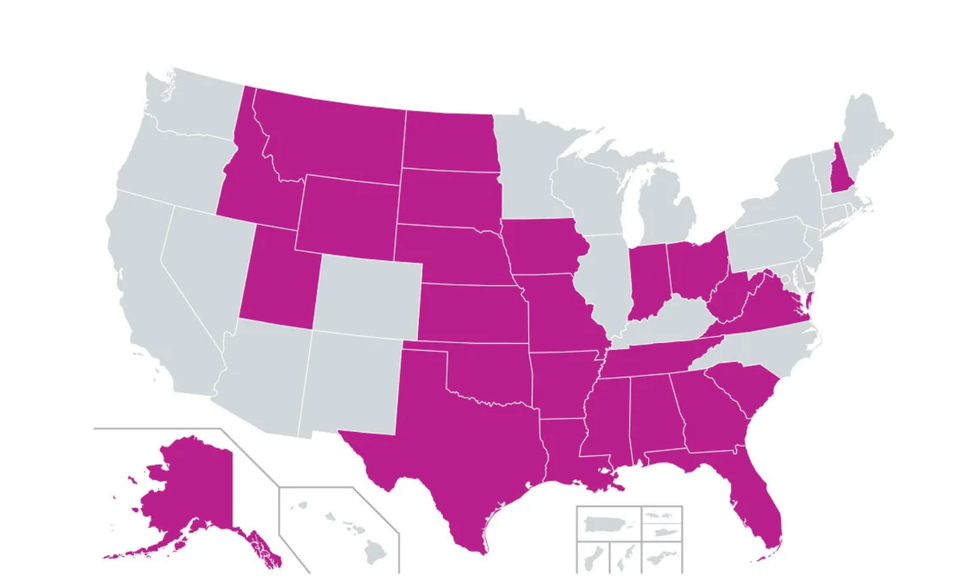 States shaded in red will be affected by a federal judge's temporary injunction against the Waters of the United States (WOTUS) rule. (Image: Earthjustice)
In 2020, the Trump administration rolled back WOTUS, which originated during the tenure of former President Barack Obama. The Biden administration revived the rule and last December it was finalized by the EPA.
Earlier this month, President Joe Biden vetoed legislation passed by Republicans and corporate Democrats in Congress that would have eviscerated the administration's ability to enforce WOTUS.
Hovland stopped short of issuing the nationwide injunction against WOTUS sought by the American Farm Bureau Federation and other agriculture industry interest groups. Still, Big Ag and Republican politicians in affected states overwhelmingly welcomed the injunction against what they say is a major act of government overreach.
Indigenous leaders, however, slammed Wednesday's ruling.
"Clean water is essential to tribal citizens' spiritual, physical, mental well-being, and survival."
"Clean water is essential to tribal citizens' spiritual, physical, mental well-being, and survival" Gary Harrison, traditional chief of the Chickaloon Native Village in Alaska, said in a statement. "Removing vital clean water safeguards will harm wetlands and streams that sustain tribal citizens, including myself."
G. Anne Richardson, chief of the Rappahannock tribe in Virginia, said that "the court's order threatens to strip vital protections from the network of waters that have been the lifeblood of the Rappahannock Tribe since time immemorial."
"Without the Clean Water Act," she added, "projects that would destroy important wetlands and streams could get rammed through without any opportunity for the tribe to object."