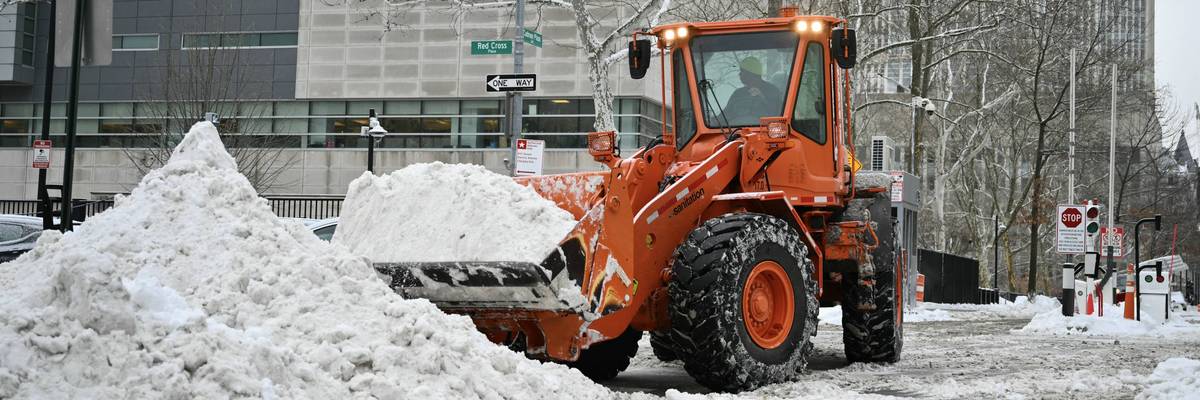
A snowplow removes snow from a street in the Brooklyn borough of New York City on January 26, 2026.
NYC's Speedy Snow Removal Under Mamdani Evokes Memories of 'Sewer Socialism'
The mayor’s response to the snowstorm has been described as an early test for his version of “common good” governance.
"God Bless sewer socialism." That's what historian David Austin Walsh had to say about New York City's swift response to the largest snowstorm it's seen in five years, which dumped over a foot of snow on the five boroughs this weekend.
Winter Storm Fern, which has ravaged the Northeastern United States, presented an early test for the city's left-wing mayor, Zohran Mamdani, who centered his insurgent campaign last year not simply on providing new free municipal services, but on making the ones New Yorkers already relied upon, like sanitation, more robust and accessible.
It was an agenda that led him to be compared to a breed of socialist mayor who focused less on lofty ideas and revolutionary rhetoric and more on using the power of government to remedy the everyday concerns of the public.
In October, just weeks before Mamdani's triumph in the general election, columnist E. J. Dionne Jr. wrote in the New York Times:
For history buffs, Mr. Mamdani has done the service of rekindling an interest in a largely forgotten American tradition, the “sewer socialists” who ran a significant list of cities in the last century. The most durable among them was Daniel Hoan, the socialist mayor of Milwaukee from 1916 to 1940. You don’t get reelected that often by being a failure.
Many socialist mayors did not mind being associated with repairing the grubbiest of urban amenities because doing so underscored their aim of running corruption-free governments that did whatever they could to improve the lives of working-class people in their jurisdictions. When lousy (or nonexistent) sewer systems led to illness and death in low-income and immigrant neighborhoods, said Michael Kazin, a historian at Georgetown University, building and fixing sewers became a powerful example of what “common good” governance could accomplish.
Mr. Mamdani knows sewer socialism’s history and has no qualms about identifying with it.
This weekend was the first opportunity for New York's youngest mayor in over a century to put this philosophy into action in a test of competence that past mayors have infamously failed—from Bill de Blasio, who was lambasted over the underplowing of certain neighborhoods, to Michael Bloomberg, who took heat for ditching the blizzard conditions for Bermuda, to John Lindsay, whose disastrous lack of preparation for a 1969 storm resulted in the deaths of at least 42 people.
As Walsh wrote on Friday, with the storm prepared to bear down, "Mamdani has a unique opportunity to prove that sewer socialism works, but the crucial first test is going to be not fucking up the snowstorm this weekend."
By then, Mamdani's preparations had long since begun, with the city fitting thousands of sanitation department trucks with snowplows, brining every highway and street in the city to make cleanup easier, and ensuring that enough shelter beds were available to protect those without homes from the elements.
The mayor also undertook a robust yet simple effort to communicate with New Yorkers about practical guidelines to stay safe through a series of upbeat PSAs and appearances on local news.
"Make no mistake, New Yorkers, the full power of this city's enormous resources is prepared, poised, and ready to be deployed," Mamdani said during a press conference on Saturday. "Every agency is working in lockstep with the other."
Though death tolls were considerably lower than in other storms of its magnitude, the storm did not pass without tragedy. At least one homeless man reportedly froze to death, while another six people have been found dead outside, though it's unclear if these deaths were weather-related.
But in all, the Times said "the city largely appeared to be prepared for the weather."
Crews headed out to begin clearing roads at 8:30 am, when precipitation had reached the requisite two inches; shortly after 7 pm, [Department of Sanitation spokesperson Joshua Goodman] said every single street under city control had been plowed at least twice; tens of millions of pounds of salt had been spread across the five boroughs; and 2,500 sanitation workers were rotating on 12-hour shifts to continue the cleanup.
Mamdani, meanwhile, was praised for his active role in the cleanup effort and for maintaining high visibility, where past mayors were accused of shirking into the background.
One widely shared video shows the mayor personally shoveling snow to free a stranded driver in the Williamsburg neighborhood of Brooklyn, home to a large Hasidic Jewish community.
Rabbi Moishe Indig, the executive vice president of the Jewish Community Council of Williamsburg, called it "hands-on leadership."
Even one of Mamdani's fiercest critics, Benny Polatseck, an aide to former Mayor Eric Adams, was complimentary to his response.
“Credit where due," he wrote Sunday afternoon on social media. "Looks like [Mamdani] is handling this storm very well so far."
We are at a crossroads
This country and this world are at a monumental crossroads. In a few short weeks, US voters will have an opportunity to beat back the forces of fascism and confront the billionaires who are rigging the economy, our media system, and our democracy, making it increasingly impossible for ordinary people to get by. We’re not just talking about the election. We’re talking about what must be done once these fascist elements are vanquished from power. We need a bolder set of solutions than what either major party has so far been willing to offer and a working-class movement ready to fight like hell for it. Trump didn't emerge from nowhere. The conditions that fueled MAGA authoritarianism were created by decades of radical neoliberal economic policies and a corrupt political system dominated by corporate interests. They slashed taxes on the super-rich, promising that the benefits would trickle down. They said giveaways to the corporate titans would make life more affordable for the rest of us. It was all bullshit. And when a bitter, betrayed populace searches for someone to blame, right-wing demagogues have little trouble finding scapegoats. People know when they're being lied to, but you won't hear any of this from the corporate media. Only independent journalism—powered and funded by people who believe in building a better world—can deliver truly trustworthy daily news. Our Fall Campaign is underway, and we need your help. To power our newsroom through the rest of the year, we need to raise $125,000 by midnight on October 31. So if you share our vision, please contribute whatever you can to sustain our work. |
"God Bless sewer socialism." That's what historian David Austin Walsh had to say about New York City's swift response to the largest snowstorm it's seen in five years, which dumped over a foot of snow on the five boroughs this weekend.
Winter Storm Fern, which has ravaged the Northeastern United States, presented an early test for the city's left-wing mayor, Zohran Mamdani, who centered his insurgent campaign last year not simply on providing new free municipal services, but on making the ones New Yorkers already relied upon, like sanitation, more robust and accessible.
It was an agenda that led him to be compared to a breed of socialist mayor who focused less on lofty ideas and revolutionary rhetoric and more on using the power of government to remedy the everyday concerns of the public.
In October, just weeks before Mamdani's triumph in the general election, columnist E. J. Dionne Jr. wrote in the New York Times:
For history buffs, Mr. Mamdani has done the service of rekindling an interest in a largely forgotten American tradition, the “sewer socialists” who ran a significant list of cities in the last century. The most durable among them was Daniel Hoan, the socialist mayor of Milwaukee from 1916 to 1940. You don’t get reelected that often by being a failure.
Many socialist mayors did not mind being associated with repairing the grubbiest of urban amenities because doing so underscored their aim of running corruption-free governments that did whatever they could to improve the lives of working-class people in their jurisdictions. When lousy (or nonexistent) sewer systems led to illness and death in low-income and immigrant neighborhoods, said Michael Kazin, a historian at Georgetown University, building and fixing sewers became a powerful example of what “common good” governance could accomplish.
Mr. Mamdani knows sewer socialism’s history and has no qualms about identifying with it.
This weekend was the first opportunity for New York's youngest mayor in over a century to put this philosophy into action in a test of competence that past mayors have infamously failed—from Bill de Blasio, who was lambasted over the underplowing of certain neighborhoods, to Michael Bloomberg, who took heat for ditching the blizzard conditions for Bermuda, to John Lindsay, whose disastrous lack of preparation for a 1969 storm resulted in the deaths of at least 42 people.
As Walsh wrote on Friday, with the storm prepared to bear down, "Mamdani has a unique opportunity to prove that sewer socialism works, but the crucial first test is going to be not fucking up the snowstorm this weekend."
By then, Mamdani's preparations had long since begun, with the city fitting thousands of sanitation department trucks with snowplows, brining every highway and street in the city to make cleanup easier, and ensuring that enough shelter beds were available to protect those without homes from the elements.
The mayor also undertook a robust yet simple effort to communicate with New Yorkers about practical guidelines to stay safe through a series of upbeat PSAs and appearances on local news.
"Make no mistake, New Yorkers, the full power of this city's enormous resources is prepared, poised, and ready to be deployed," Mamdani said during a press conference on Saturday. "Every agency is working in lockstep with the other."
Though death tolls were considerably lower than in other storms of its magnitude, the storm did not pass without tragedy. At least one homeless man reportedly froze to death, while another six people have been found dead outside, though it's unclear if these deaths were weather-related.
But in all, the Times said "the city largely appeared to be prepared for the weather."
Crews headed out to begin clearing roads at 8:30 am, when precipitation had reached the requisite two inches; shortly after 7 pm, [Department of Sanitation spokesperson Joshua Goodman] said every single street under city control had been plowed at least twice; tens of millions of pounds of salt had been spread across the five boroughs; and 2,500 sanitation workers were rotating on 12-hour shifts to continue the cleanup.
Mamdani, meanwhile, was praised for his active role in the cleanup effort and for maintaining high visibility, where past mayors were accused of shirking into the background.
One widely shared video shows the mayor personally shoveling snow to free a stranded driver in the Williamsburg neighborhood of Brooklyn, home to a large Hasidic Jewish community.
Rabbi Moishe Indig, the executive vice president of the Jewish Community Council of Williamsburg, called it "hands-on leadership."
Even one of Mamdani's fiercest critics, Benny Polatseck, an aide to former Mayor Eric Adams, was complimentary to his response.
“Credit where due," he wrote Sunday afternoon on social media. "Looks like [Mamdani] is handling this storm very well so far."
"God Bless sewer socialism." That's what historian David Austin Walsh had to say about New York City's swift response to the largest snowstorm it's seen in five years, which dumped over a foot of snow on the five boroughs this weekend.
Winter Storm Fern, which has ravaged the Northeastern United States, presented an early test for the city's left-wing mayor, Zohran Mamdani, who centered his insurgent campaign last year not simply on providing new free municipal services, but on making the ones New Yorkers already relied upon, like sanitation, more robust and accessible.
It was an agenda that led him to be compared to a breed of socialist mayor who focused less on lofty ideas and revolutionary rhetoric and more on using the power of government to remedy the everyday concerns of the public.
In October, just weeks before Mamdani's triumph in the general election, columnist E. J. Dionne Jr. wrote in the New York Times:
For history buffs, Mr. Mamdani has done the service of rekindling an interest in a largely forgotten American tradition, the “sewer socialists” who ran a significant list of cities in the last century. The most durable among them was Daniel Hoan, the socialist mayor of Milwaukee from 1916 to 1940. You don’t get reelected that often by being a failure.
Many socialist mayors did not mind being associated with repairing the grubbiest of urban amenities because doing so underscored their aim of running corruption-free governments that did whatever they could to improve the lives of working-class people in their jurisdictions. When lousy (or nonexistent) sewer systems led to illness and death in low-income and immigrant neighborhoods, said Michael Kazin, a historian at Georgetown University, building and fixing sewers became a powerful example of what “common good” governance could accomplish.
Mr. Mamdani knows sewer socialism’s history and has no qualms about identifying with it.
This weekend was the first opportunity for New York's youngest mayor in over a century to put this philosophy into action in a test of competence that past mayors have infamously failed—from Bill de Blasio, who was lambasted over the underplowing of certain neighborhoods, to Michael Bloomberg, who took heat for ditching the blizzard conditions for Bermuda, to John Lindsay, whose disastrous lack of preparation for a 1969 storm resulted in the deaths of at least 42 people.
As Walsh wrote on Friday, with the storm prepared to bear down, "Mamdani has a unique opportunity to prove that sewer socialism works, but the crucial first test is going to be not fucking up the snowstorm this weekend."
By then, Mamdani's preparations had long since begun, with the city fitting thousands of sanitation department trucks with snowplows, brining every highway and street in the city to make cleanup easier, and ensuring that enough shelter beds were available to protect those without homes from the elements.
The mayor also undertook a robust yet simple effort to communicate with New Yorkers about practical guidelines to stay safe through a series of upbeat PSAs and appearances on local news.
"Make no mistake, New Yorkers, the full power of this city's enormous resources is prepared, poised, and ready to be deployed," Mamdani said during a press conference on Saturday. "Every agency is working in lockstep with the other."
Though death tolls were considerably lower than in other storms of its magnitude, the storm did not pass without tragedy. At least one homeless man reportedly froze to death, while another six people have been found dead outside, though it's unclear if these deaths were weather-related.
But in all, the Times said "the city largely appeared to be prepared for the weather."
Crews headed out to begin clearing roads at 8:30 am, when precipitation had reached the requisite two inches; shortly after 7 pm, [Department of Sanitation spokesperson Joshua Goodman] said every single street under city control had been plowed at least twice; tens of millions of pounds of salt had been spread across the five boroughs; and 2,500 sanitation workers were rotating on 12-hour shifts to continue the cleanup.
Mamdani, meanwhile, was praised for his active role in the cleanup effort and for maintaining high visibility, where past mayors were accused of shirking into the background.
One widely shared video shows the mayor personally shoveling snow to free a stranded driver in the Williamsburg neighborhood of Brooklyn, home to a large Hasidic Jewish community.
Rabbi Moishe Indig, the executive vice president of the Jewish Community Council of Williamsburg, called it "hands-on leadership."
Even one of Mamdani's fiercest critics, Benny Polatseck, an aide to former Mayor Eric Adams, was complimentary to his response.
“Credit where due," he wrote Sunday afternoon on social media. "Looks like [Mamdani] is handling this storm very well so far."