
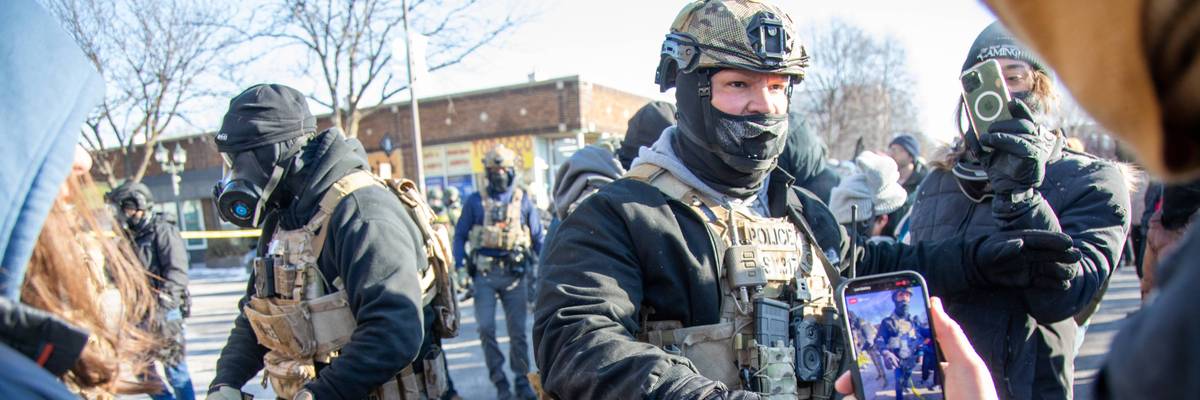
A MInneapolis resident films a federal agent in the city on January 24, 2026.
Indication That Alex Pretti Was Known to Federal Agents Raises New Questions Over Protester 'Database'
The Department of Homeland Security has denied it has a database of protesters or legal observers, but the agency sent a memo to agents asking them to collect data on dissenters in Minneapolis.
About a week before Alex Pretti was fatally shot by US Border Patrol agents in Minneapolis, he had another encounter with federal officers who objected to him observing an immigration raid, and his name was known to them—raising new questions about the "database" that Trump administration officials and agents on the ground have threatened dissenters with recently.
CNN reported Tuesday that Pretti, the Minneapolis nurse who was fatally shot by Border Patrol agents while acting as a legal observer and trying to help a woman who had been pepper-sprayed by one officer, was known to federal officers before his killing last weekend. About a week earlier, he had been tackled by a group of agents who broke his rib when he was protesting the detention of a community member.
The outlet reported that earlier this month, the US Department of Homeland Security sent a memo to Immigration and Customs Enforcement (ICE) agents deployed in the Minneapolis area that provided a form called "intel collection non-arrests," urging them to fill in personal data about protesters and people the department labeled as "agitators."
"Capture all images, license plates, identifications, and general information on hotels, agitators, protestors, etc., so we can capture it all in one consolidated form,” the DHS guidance read.
It was not clear whether Pretti's information was gathered on one of the forms or if the Border Patrol agents last Saturday knew who he was when they fatally shot him after throwing him to the ground on a Minneapolis street.
But the news that he had had a previous encounter and that officers in Minneapolis knew his name came amid numerous reports of federal agents behaving aggressively toward nonviolent protesters, and as top officials in the Trump administration as well as officers on the ground have issued threats to demonstrators and legal observers that DHS would be collecting information about them.
After a video taken by a Maine resident went viral last week, showing a federal immigration agent telling her that she would be considered a "domestic terrorist" by the Trump administration and included in a "nice little database" for filming him, Assistant Homeland Security Secretary Tricia McLaughlin denied that such a database exists.
“There is NO database of ‘domestic terrorists’ run by DHS," McLaughlin told CNN when asked about the video taken in Maine. "We do of course monitor and investigate and refer all threats, assaults, and obstruction of our officers to the appropriate law enforcement. Obstructing and assaulting law enforcement is a felony and a federal crime.”
Her response didn't explain why the agent in the video threatened a woman who was merely filming him, an activity that is broadly protected by the First Amendment.
Despite McLaughlin's denial, President Donald Trump's own border czar, Tom Homan, told Fox News earlier this month that he aimed to "create a database where those people that are arrested for interference, impeding, and assault, we’re going to make them famous."
🚨 BREAKING:
Tom Homan says the Trump admin is building a database of people attacking ICE and plans to broadcast their names and faces publicly.
Then he says they’ll contact employers, schools, and neighborhoods to expose them.
“We’re gonna MAKE ‘EM FAMOUS!”
That’s not law… pic.twitter.com/nrhtABt687
— Brian Allen (@allenanalysis) January 16, 2026
The White House has frequently claimed that there's been a "more than 1,000% rise" in assaults against federal immigration agents, but an analysis of federal court records by Colorado Public Radio showed in September that the reports of attacks on officers appeared exaggerated, with the increase closer to 25% from the previous year.
In Pretti's first encounter with federal agents, he told the source who spoke to CNN that he had stopped his car and began blowing a whistle and shouting when he saw ICE officers chasing a family on foot.
The agents then tackled him and leaned on his back, breaking his rib.
"That day, he thought he was going to die,” said the source, who spoke anonymously with CNN out of fear of retribution.
DHS told CNN it had "no record" of the initial encounter with Pretti.
Journalist Jasper Nathaniel said the revelation about Pretti's earlier encounter showed that it is "completely urgent to identify his killers and investigate whether they had access to the database" that officials have alluded to.
Questions about how the alleged database has been used in Minneapolis and elsewhere were raised as another viral clip taken by a legal observer in the city showed an ICE agent telling him, "You raise your voice, I will erase your voice.”
WOW! An ICE agent in Minneapolis tells an American citizen "If you raise your voice, I will erase your voice."
Stop telling me that the Trump administration isn't Fascist. They are threatening people for "raising their voice," and how exactly will ICE "erase our voice?"
Kill… pic.twitter.com/h0pRcWrsc1
— Ed Krassenstein (@EdKrassen) January 27, 2026
In Maine, legal observers have reported that ICE agents have shown up at their homes to confront them about filming and monitoring immigration enforcement.
One observer, Liz Eisele McLellan, told the Portland Press Herald that one agent said to her: “This is a warning. We know you live right here.”
We are at a crossroads
This country and this world are at a monumental crossroads. In a few short weeks, US voters will have an opportunity to beat back the forces of fascism and confront the billionaires who are rigging the economy, our media system, and our democracy, making it increasingly impossible for ordinary people to get by. We’re not just talking about the election. We’re talking about what must be done once these fascist elements are vanquished from power. We need a bolder set of solutions than what either major party has so far been willing to offer and a working-class movement ready to fight like hell for it. Trump didn't emerge from nowhere. The conditions that fueled MAGA authoritarianism were created by decades of radical neoliberal economic policies and a corrupt political system dominated by corporate interests. They slashed taxes on the super-rich, promising that the benefits would trickle down. They said giveaways to the corporate titans would make life more affordable for the rest of us. It was all bullshit. And when a bitter, betrayed populace searches for someone to blame, right-wing demagogues have little trouble finding scapegoats. People know when they're being lied to, but you won't hear any of this from the corporate media. Only independent journalism—powered and funded by people who believe in building a better world—can deliver truly trustworthy daily news. Our Fall Campaign is underway, and we need your help. To power our newsroom through the rest of the year, we need to raise $125,000 by midnight on October 31. So if you share our vision, please contribute whatever you can to sustain our work. |
About a week before Alex Pretti was fatally shot by US Border Patrol agents in Minneapolis, he had another encounter with federal officers who objected to him observing an immigration raid, and his name was known to them—raising new questions about the "database" that Trump administration officials and agents on the ground have threatened dissenters with recently.
CNN reported Tuesday that Pretti, the Minneapolis nurse who was fatally shot by Border Patrol agents while acting as a legal observer and trying to help a woman who had been pepper-sprayed by one officer, was known to federal officers before his killing last weekend. About a week earlier, he had been tackled by a group of agents who broke his rib when he was protesting the detention of a community member.
The outlet reported that earlier this month, the US Department of Homeland Security sent a memo to Immigration and Customs Enforcement (ICE) agents deployed in the Minneapolis area that provided a form called "intel collection non-arrests," urging them to fill in personal data about protesters and people the department labeled as "agitators."
"Capture all images, license plates, identifications, and general information on hotels, agitators, protestors, etc., so we can capture it all in one consolidated form,” the DHS guidance read.
It was not clear whether Pretti's information was gathered on one of the forms or if the Border Patrol agents last Saturday knew who he was when they fatally shot him after throwing him to the ground on a Minneapolis street.
But the news that he had had a previous encounter and that officers in Minneapolis knew his name came amid numerous reports of federal agents behaving aggressively toward nonviolent protesters, and as top officials in the Trump administration as well as officers on the ground have issued threats to demonstrators and legal observers that DHS would be collecting information about them.
After a video taken by a Maine resident went viral last week, showing a federal immigration agent telling her that she would be considered a "domestic terrorist" by the Trump administration and included in a "nice little database" for filming him, Assistant Homeland Security Secretary Tricia McLaughlin denied that such a database exists.
“There is NO database of ‘domestic terrorists’ run by DHS," McLaughlin told CNN when asked about the video taken in Maine. "We do of course monitor and investigate and refer all threats, assaults, and obstruction of our officers to the appropriate law enforcement. Obstructing and assaulting law enforcement is a felony and a federal crime.”
Her response didn't explain why the agent in the video threatened a woman who was merely filming him, an activity that is broadly protected by the First Amendment.
Despite McLaughlin's denial, President Donald Trump's own border czar, Tom Homan, told Fox News earlier this month that he aimed to "create a database where those people that are arrested for interference, impeding, and assault, we’re going to make them famous."
🚨 BREAKING:
Tom Homan says the Trump admin is building a database of people attacking ICE and plans to broadcast their names and faces publicly.
Then he says they’ll contact employers, schools, and neighborhoods to expose them.
“We’re gonna MAKE ‘EM FAMOUS!”
That’s not law… pic.twitter.com/nrhtABt687
— Brian Allen (@allenanalysis) January 16, 2026
The White House has frequently claimed that there's been a "more than 1,000% rise" in assaults against federal immigration agents, but an analysis of federal court records by Colorado Public Radio showed in September that the reports of attacks on officers appeared exaggerated, with the increase closer to 25% from the previous year.
In Pretti's first encounter with federal agents, he told the source who spoke to CNN that he had stopped his car and began blowing a whistle and shouting when he saw ICE officers chasing a family on foot.
The agents then tackled him and leaned on his back, breaking his rib.
"That day, he thought he was going to die,” said the source, who spoke anonymously with CNN out of fear of retribution.
DHS told CNN it had "no record" of the initial encounter with Pretti.
Journalist Jasper Nathaniel said the revelation about Pretti's earlier encounter showed that it is "completely urgent to identify his killers and investigate whether they had access to the database" that officials have alluded to.
Questions about how the alleged database has been used in Minneapolis and elsewhere were raised as another viral clip taken by a legal observer in the city showed an ICE agent telling him, "You raise your voice, I will erase your voice.”
WOW! An ICE agent in Minneapolis tells an American citizen "If you raise your voice, I will erase your voice."
Stop telling me that the Trump administration isn't Fascist. They are threatening people for "raising their voice," and how exactly will ICE "erase our voice?"
Kill… pic.twitter.com/h0pRcWrsc1
— Ed Krassenstein (@EdKrassen) January 27, 2026
In Maine, legal observers have reported that ICE agents have shown up at their homes to confront them about filming and monitoring immigration enforcement.
One observer, Liz Eisele McLellan, told the Portland Press Herald that one agent said to her: “This is a warning. We know you live right here.”
- Dems Press Palantir on Trump-Era Contracts for 'Mega-Database' of Americans' Info ›
- As AI Data Centers Disrupt US Cities, Wisconsin Woman Violently Arrested After Speaking Out ›
- 'No Kings' Rallies Against Trump Authoritarianism Could Be 'Largest Protest in US History' ›
- US News Outlet Sues Trump Admin Over Refusal to Release 'Secret List of Activities' | Common Dreams ›
About a week before Alex Pretti was fatally shot by US Border Patrol agents in Minneapolis, he had another encounter with federal officers who objected to him observing an immigration raid, and his name was known to them—raising new questions about the "database" that Trump administration officials and agents on the ground have threatened dissenters with recently.
CNN reported Tuesday that Pretti, the Minneapolis nurse who was fatally shot by Border Patrol agents while acting as a legal observer and trying to help a woman who had been pepper-sprayed by one officer, was known to federal officers before his killing last weekend. About a week earlier, he had been tackled by a group of agents who broke his rib when he was protesting the detention of a community member.
The outlet reported that earlier this month, the US Department of Homeland Security sent a memo to Immigration and Customs Enforcement (ICE) agents deployed in the Minneapolis area that provided a form called "intel collection non-arrests," urging them to fill in personal data about protesters and people the department labeled as "agitators."
"Capture all images, license plates, identifications, and general information on hotels, agitators, protestors, etc., so we can capture it all in one consolidated form,” the DHS guidance read.
It was not clear whether Pretti's information was gathered on one of the forms or if the Border Patrol agents last Saturday knew who he was when they fatally shot him after throwing him to the ground on a Minneapolis street.
But the news that he had had a previous encounter and that officers in Minneapolis knew his name came amid numerous reports of federal agents behaving aggressively toward nonviolent protesters, and as top officials in the Trump administration as well as officers on the ground have issued threats to demonstrators and legal observers that DHS would be collecting information about them.
After a video taken by a Maine resident went viral last week, showing a federal immigration agent telling her that she would be considered a "domestic terrorist" by the Trump administration and included in a "nice little database" for filming him, Assistant Homeland Security Secretary Tricia McLaughlin denied that such a database exists.
“There is NO database of ‘domestic terrorists’ run by DHS," McLaughlin told CNN when asked about the video taken in Maine. "We do of course monitor and investigate and refer all threats, assaults, and obstruction of our officers to the appropriate law enforcement. Obstructing and assaulting law enforcement is a felony and a federal crime.”
Her response didn't explain why the agent in the video threatened a woman who was merely filming him, an activity that is broadly protected by the First Amendment.
Despite McLaughlin's denial, President Donald Trump's own border czar, Tom Homan, told Fox News earlier this month that he aimed to "create a database where those people that are arrested for interference, impeding, and assault, we’re going to make them famous."
🚨 BREAKING:
Tom Homan says the Trump admin is building a database of people attacking ICE and plans to broadcast their names and faces publicly.
Then he says they’ll contact employers, schools, and neighborhoods to expose them.
“We’re gonna MAKE ‘EM FAMOUS!”
That’s not law… pic.twitter.com/nrhtABt687
— Brian Allen (@allenanalysis) January 16, 2026
The White House has frequently claimed that there's been a "more than 1,000% rise" in assaults against federal immigration agents, but an analysis of federal court records by Colorado Public Radio showed in September that the reports of attacks on officers appeared exaggerated, with the increase closer to 25% from the previous year.
In Pretti's first encounter with federal agents, he told the source who spoke to CNN that he had stopped his car and began blowing a whistle and shouting when he saw ICE officers chasing a family on foot.
The agents then tackled him and leaned on his back, breaking his rib.
"That day, he thought he was going to die,” said the source, who spoke anonymously with CNN out of fear of retribution.
DHS told CNN it had "no record" of the initial encounter with Pretti.
Journalist Jasper Nathaniel said the revelation about Pretti's earlier encounter showed that it is "completely urgent to identify his killers and investigate whether they had access to the database" that officials have alluded to.
Questions about how the alleged database has been used in Minneapolis and elsewhere were raised as another viral clip taken by a legal observer in the city showed an ICE agent telling him, "You raise your voice, I will erase your voice.”
WOW! An ICE agent in Minneapolis tells an American citizen "If you raise your voice, I will erase your voice."
Stop telling me that the Trump administration isn't Fascist. They are threatening people for "raising their voice," and how exactly will ICE "erase our voice?"
Kill… pic.twitter.com/h0pRcWrsc1
— Ed Krassenstein (@EdKrassen) January 27, 2026
In Maine, legal observers have reported that ICE agents have shown up at their homes to confront them about filming and monitoring immigration enforcement.
One observer, Liz Eisele McLellan, told the Portland Press Herald that one agent said to her: “This is a warning. We know you live right here.”
- Dems Press Palantir on Trump-Era Contracts for 'Mega-Database' of Americans' Info ›
- As AI Data Centers Disrupt US Cities, Wisconsin Woman Violently Arrested After Speaking Out ›
- 'No Kings' Rallies Against Trump Authoritarianism Could Be 'Largest Protest in US History' ›
- US News Outlet Sues Trump Admin Over Refusal to Release 'Secret List of Activities' | Common Dreams ›