

SUBSCRIBE TO OUR FREE NEWSLETTER
Daily news & progressive opinion—funded by the people, not the corporations—delivered straight to your inbox.
5
#000000
#FFFFFF
To donate by check, phone, or other method, see our More Ways to Give page.
Daily news & progressive opinion—funded by the people, not the corporations—delivered straight to your inbox.
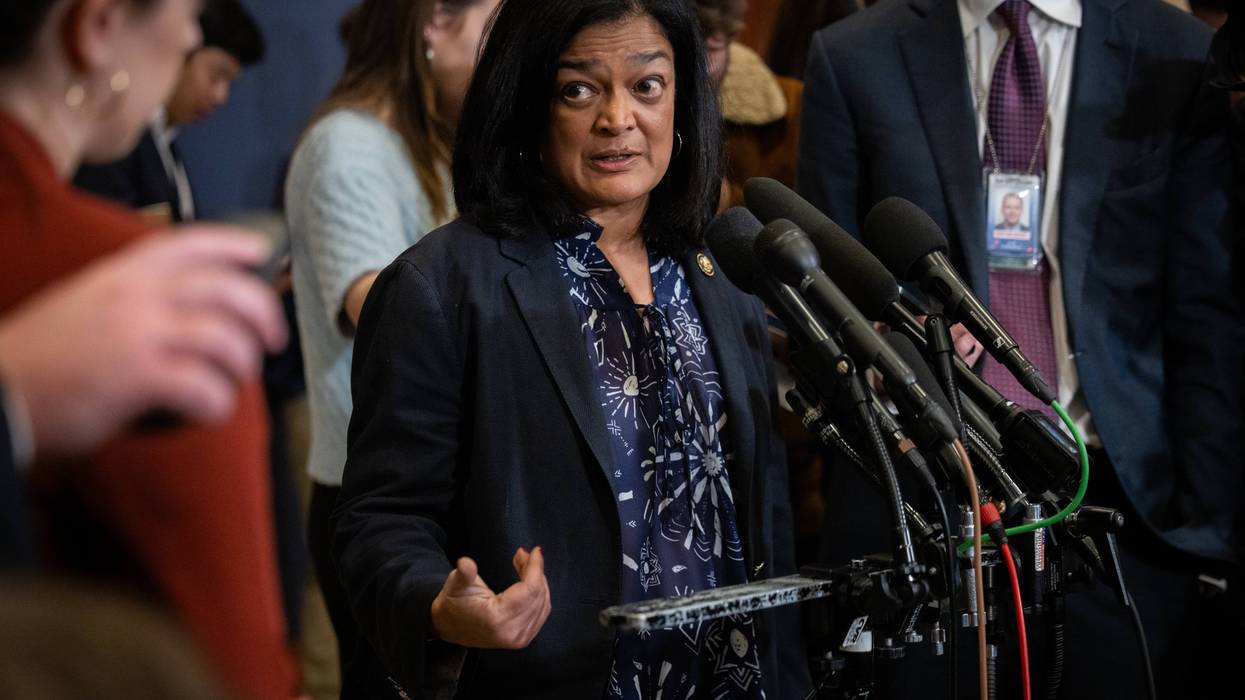
"For too long, we’ve allowed a few Big Tech companies to dominate the market."
Rep. Pramila Jayapal on Thursday unveiled a bill aimed at reining in the artificial intelligence industry that would force every AI company operating in the US to obtain a public charter.
According to Jayapal (D-Wash.), the charter system will be similar to the one long used in the US to regulate banks, which must submit to certain regulatory obligations before being allowed to operate.
"The crux of this bill is simple," said Jayapal. "If you want to be an AI company in this country, you have to obtain a public charter that has a broad set of terms and conditions to operate and ensure public benefit without the harms."
The Washington Democrat said the charter approach was needed given the broad reach large technology companies already have over every aspect of life in the US, and she argued it would be a more proactive alternative to the piecemeal approach US lawmakers have taken to regulating Big Tech.
"For too long, we’ve allowed a few Big Tech companies to dominate the market," she said. "They have used mass surveillance to steal private information, labor, and creative work, building trillion-dollar empires on our tracked personal lives. AI corporations and Big Tech are now following that same playbook."
Under the charter system, tech companies would be banned from practices such as surveillance pricing to charge individual consumers different prices based on their personal data and financial histories.
The system would also establish stronger liabilities for AI companies that commit harmful acts, and particularly egregious actions could be punished by removal of firms' charters, which would essentially be a corporate death penalty.
Jayapal's proposal would also put the government in charge of every step of the AI safety review process and would include "round-the-clock federal oversight, testing in government facilities and approval to release, adversarial stress tests, and a government-controlled kill switch," according to her office.
The proposed framework earned praise from former Federal Trade Commission Chair Lina Khan, who argued that American voters have already "paid an extraordinary price for Big Tech's self-regulation."
"For generations we have required banks, drug makers, and nuclear operators to meet public terms before they do business," Khan added, "and AI companies should be no different."
Sacha Haworth, executive director of the Tech Oversight Project, also gave the Jayapal plan kudos, saying it would "establish desperately needed rules of the road, punish AI companies that release dangerous products, and create the clear public benefit that the American people are calling for."
"Companies have continually pulled the rug out from under families, workers, and small businesses to build powerful and unaccountable Big Tech monopolies that dictate to us how we should live our own lives," Haworth emphasized. "Enough is enough."
Although President Donald Trump and House Speaker Mike Johnson (R-La.) have publicly opposed legislative restrictions on the AI industry, the bill comes as Democrats are aiming to win congressional majorities in the November midterm elections.