

SUBSCRIBE TO OUR FREE NEWSLETTER
Daily news & progressive opinion—funded by the people, not the corporations—delivered straight to your inbox.
5
#000000
#FFFFFF
To donate by check, phone, or other method, see our More Ways to Give page.
Daily news & progressive opinion—funded by the people, not the corporations—delivered straight to your inbox.
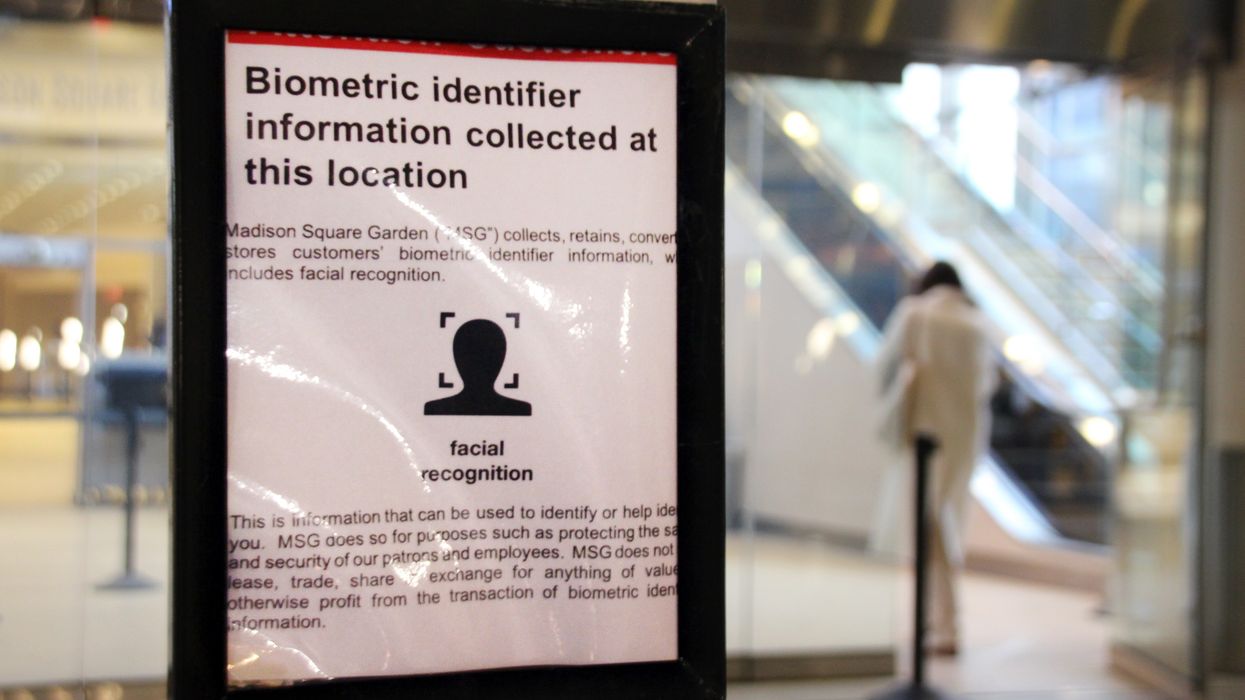
"AI tools have the potential to expand the NSA's surveillance dragnet more than ever before," the civil liberties group warned.
The ACLU on Thursday sued the National Security Agency in an effort to uncover how the federal body is integrating rapidly advancing artificial intelligence technology into its mass spying operations—information that the agency has kept under wraps despite the dire implications for civil liberties.
Filed in a federal court in New York, the lawsuit comes over a month after the ACLU submitted a Freedom of Information Act (FOIA) request seeking details on the kinds of AI tools the NSA is using and whether it is taking any steps to prevent large-scale privacy abuses of the kind the agency is notorious for.
The ACLU said in its new complaint that the NSA and other federal agencies have yet to release "any responsive records, notwithstanding the FOIA's requirement that agencies respond to requests within twenty working days."
"Timely disclosure of the requested records [is] vitally necessary to an informed debate about the NSA's rapid deployment of novel AI systems in its surveillance activities and the safeguards for privacy, civil rights, and civil liberties that should apply," the complaint states, asking the court for an injunction requiring the NSA to immediately process the ACLU's FOIA request.
In a blog post on Thursday, the ACLU's Shaiba Rather and Patrick Toomey noted that AI "has transformed many of the NSA's daily operations" in recent years, with the agency utilizing AI tools to "help gather information on foreign governments, augment human language processing, comb through networks for cybersecurity threats, and even monitor its own analysts as they do their jobs."
"Unfortunately, that's about all we know," the pair wrote. "As the NSA integrates AI into some of its most profound decisions, it's left us in the dark about how it uses AI and what safeguards, if any, are in place to protect everyday Americans and others around the globe whose privacy hangs in the balance."
"That's why we're suing to find out what the NSA is hiding," they added.
BREAKING: We just filed a FOIA lawsuit to find out how the NSA — one of America's biggest spy agencies — is using artificial intelligence.
These are dangerous, powerful tools and the public deserves to know how the government is using them.
— ACLU (@ACLU) April 25, 2024
The ACLU filed its lawsuit less than a week after Congress approved a massive expansion of Section 702 of the Foreign Intelligence Surveillance Act (FISA), warrantless spying authority that the NSA has heavily abused to sweep up the communications of American journalists, activists, and lawmakers.
With their newly broadened authority, the NSA and other intelligence agencies will have the power to enlist a wide range of businesses and individuals to participate in their warrantless spying operations—a potential catastrophe for privacy rights.
Rather and Toomey warned Thursday that the growing, secretive use of artificial intelligence tools has "the potential to expand the NSA's surveillance dragnet more than ever before, expose private facts about our lives through vast data-mining activities, and automate decisions that once relied on human expertise and judgment."
"The government's lack of transparency is especially concerning given the dangers that AI systems pose for people's civil rights and civil liberties," Rather and Toomey wrote. "As we've already seen in areas like law enforcement and employment, using algorithmic systems to gather and analyze intelligence can compound privacy intrusions and perpetuate discrimination."
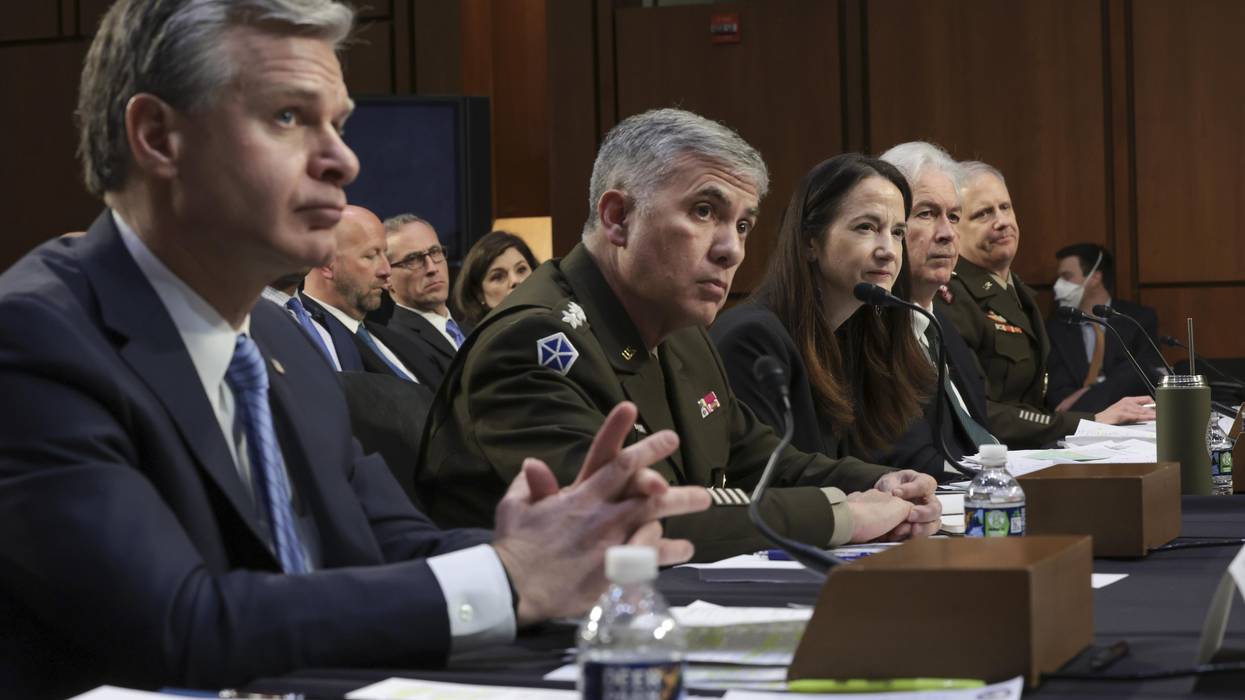
Lawmakers should not renew Section 702 without fundamental reforms to protect Americans' privacy.
One of the most sweeping surveillance statutes ever enacted by Congress is set to expire at the end of this year—creating an important opportunity to rein in America's sprawling surveillance state.
Section 702 of the Foreign Intelligence Surveillance Act permits the U.S. government to engage in mass, warrantless surveillance of Americans' international communications, including phone calls, texts, emails, social media messages, and web browsing. The government claims to be pursuing vaguely defined foreign intelligence "targets," but its targets need not be spies, terrorists, or criminals. They can be virtually any foreigner abroad: journalists, academic researchers, scientists, or businesspeople. And in the course of this surveillance, the government casts a wide net that ensnares the communications of ordinary Americans on a massive scale—in violation of our constitutional rights.
As Congress debates the reauthorization of Section 702, it's vital that we tell our representatives in Congress that we want an end to warrantless mass surveillance. Here's what you need to know to follow the debate and speak up for your right to privacy.
1. The NSA uses Section 702 to conduct at least two large-scale surveillance programs.
The government conducts at least two kinds of surveillance under Section 702:
PRISM: The NSA obtains communications—such as international messages, emails, and internet calls—directly from U.S. tech and social media companies like Facebook, Google, Apple, and Microsoft. The government identifies non-U.S. person accounts it wishes to monitor, and then orders the company to disclose all communications and data to and from those accounts, including communications with U.S. persons.
Upstream: Working with companies like AT&T and Verizon, the NSA intercepts and copies Americans' international internet communications in bulk as they flow into and out of the United States. The NSA then searches for key terms, such as email addresses or phone numbers, that are associated with its hundreds of thousands of foreign targets. Communications determined to be to and from those targets—as well as those that happen to be bundled with them in transit—are retained in NSA databases for further use and analysis.
Critically, while Section 702 does not allow the NSA to target Americans at the outset, vast quantities of our communications are still searched and amassed in government databases simply because we are in touch with people abroad. And this is the bait-and-switch: Although the law allows surveillance of foreigners abroad for "foreign intelligence" purposes, the FBI routinely exploit this rich source of our information by searching those databases to find and examine the communications of individual Americans for use in domestic investigations.
2. Section 702 surveillance is expanding.
The scale of Section 702 has been growing significantly over time, meaning more and more Americans are caught in this net.
When the government first began releasing statistics, after the Snowden revelations in 2013, it reported having 89,138 targets. By 2021, the government was targeting the communications of a staggering 232,432 individuals, groups, and organizations. Although the government often seeks to portray the surveillance as "targeted" and narrow, the reality is that it takes place on a massive scale.
Indeed, the government reported that in 2011, Section 702 surveillance resulted in the retention of more than 250 million internet communications (a number that does not reflect the far larger quantity of communications whose contents the NSA searched before discarding them). Given the rate at which the number of Section 702 targets is growing, it's likely that the government today collects over a billion communications under Section 702 each year. But these statistics tell only part of the story. The government has never provided data on the number of Americans who are surveilled under PRISM and Upstream, a number that is surely also increasing. That is a glaring gap in its transparency reports.
3. Section 702 has morphed into a domestic surveillance tool.
Although Congress intended Section 702 to be used for counterterrorism purposes, it's frequently used today to pursue domestic investigations of all kinds. Both the FBI and CIA have access to some of the raw data produced by this surveillance, and they increasingly use that access to examine the private communications of Americans they are investigating—all without a warrant.
FBI agents routinely run searches looking for information about Americans as part of criminal investigations, including those that have nothing to do with national security. Based on the most recent reporting, agents conduct millions of these U.S. person queries—also known as "backdoor searches"—each year. The only limitation on backdoor searches is that they must be "reasonably likely" to retrieve foreign intelligence or evidence of a crime.
The standard for conducting backdoor searches is so low that, without any showing of suspicion, an FBI agent can type in an American's name, email address, or phone number, and pull up whatever communications the FBI's Section 702 collection has vacuumed into its databases over the past five years. These searches are a free pass for accessing constitutionally protected communications that would otherwise be off-limits to the FBI, unless it got a warrant.
Evidence that agents have refused to comply with this low bar for conducting searches has piled up. Agents have violated the FBI's own rules over and over, accessing Americans' private communications without any legitimate purpose. They have dipped into Section 702 data for information about relatives, potential witnesses and informants, journalists, political commentators, and government officials, including a member of Congress.
4. Section 702 violates our constitutional rights, but the courts have failed to intervene.
The Fourth Amendment guarantees the right to be free from unreasonable searches and seizures. Government agents are required to obtain a warrant to access our emails, online messages, and chats. Large-scale, warrantless surveillance of Americans' private communications is at odds with this basic constitutional principle.
Section 702 also violates the Constitution by inhibiting freedom of speech and association. The reasonable fear that the U.S. government is spying on communications may deter journalists, lawyers, activists, and others from communicating freely on the Internet. We all have a right to exchange messages with our friends, family, colleagues, and clients abroad without worrying that the government is reading over our shoulder.
Because Section 702 is unconstitutional, the ACLU and others have attempted to challenge it in court. But the courts have failed to protect our constitutional rights. Instead, courts have repeatedly dismissed civil cases challenging Section 702—citing government claims of secrecy—and have declined to rule on claims in criminal cases that the government's backdoor searches violate the Fourth Amendment. This year, we brought one of these cases to the Supreme Court, but it refused to consider it.
5. Congress has the power to stop Section 702 surveillance.
Given the courts' inaction, it is up to Congress to stand up for our rights. Fifteen years ago, Congress enacted Section 702. Members of Congress should not vote to renew this law without fundamental reforms to protect Americans' privacy.
These reforms should include:
Beyond reforming Section 702 itself, Congress should also adopt broader safeguards that protect Americans in the face of bulk surveillance and strengthen court oversight when the government engages in spying for intelligence purposes.
Over the next year, the ACLU will be seizing on this moment to press Congress to reclaim our privacy rights. We invite you to join us by sending a message to your representatives now.

"If the courts are unwilling to hear Wikimedia's challenge, then Congress must step in to protect Americans' privacy," said the Knight First Amendment Institute's litigation director.
Privacy advocates on Tuesday blasted the U.S. Supreme Court's refusal to hear the Wikimedia Foundation's case against a federal program for spying on Americans' online communications with people abroad.
The nonprofit foundation, which operates Wikipedia, took aim at the National Security Agency (NSA) program "Upstream" that—under Section 702 of the Foreign Intelligence Surveillance Act—searches emails, internet messages, and other web communications leaving and entering the United States.
"In the course of this surveillance, both U.S. residents and individuals located outside the U.S. are impacted," the foundation explained in a statement. "The NSA copies and combs through vast amounts of internet traffic, including private data showing what millions of people around the world are browsing online, from communications with friends and family to reading and editing knowledge on Wikipedia and other Wikimedia projects."
"This government surveillance has had a measurable chilling effect on Wikipedia users, with research documenting a drop in traffic to Wikipedia articles on sensitive topics, following public revelations about the NSA's mass surveillance in 2013," the group added.
Last August, Wikimedia—represented by the ACLU, Knight First Amendment Institute at Columbia University, and the law firm Cooley LLP—petitioned the high court to take up the case after a divided panel of the U.S. Court of Appeals for the 4th Circuit dismissed it based on the "state secrets privilege."
"The Supreme Court's refusal to grant our petition strikes a blow against an individual's right to privacy and freedom of expression—two cornerstones of our society and the building blocks of Wikipedia," said Wikimedia legal director James Buatti. "We will continue to champion everyone's right to free knowledge, and urge Congress to take on the issue of mass surveillance as it evaluates whether to reauthorize Section 702 later this year."
As Common Dreams reported earlier this month, in a separate case, the ACLU sued the NSA along with the Central Intelligence Agency, Department of Justice, and Office of the Director of National Intelligence for failing to respond to public records requests for information about Section 702, which will expire if it is not reauthorized.
"Before Congress votes on reauthorizing this law, Americans should know how the government wants to use these sweeping spying powers," Patrick Toomey, deputy project director for the ACLU's National Security Project, said at the time.
Responding to the development in the Wikimedia case on Tuesday, Toomey declared that "the Supreme Court let secrecy prevail today, at immense cost to Americans' privacy."
"We depend on the courts to hold the government to account, especially when it wields powerful new technologies to peer into our lives like never before. But the Supreme Court has again allowed the executive branch to hide abuses behind unjustifiable claims of secrecy," he continued. "It is now up to Congress to insist on landmark reforms that will safeguard Americans in the face of the NSA's mass spying programs."
In a series of tweets about the case, the ACLU asserted that "we all deserve to use the internet without fear of being monitored by the government" and by declining to hear the case, "the court has slammed shut one of the only doors left to hold the NSA accountable for surveillance abuses revealed in 2013" by whistleblower Edward Snowden.
That thread concluded with a call for Congress to kill Section 702—which Snowden himself echoed on the platform:
Alex Abdo, litigation director of the Knight First Amendment Institute, joined them in urging action from U.S. lawmakers.
"This decision is a blow to the rule of law," Abdo said of the high court. "The government has now succeeded in insulating from public judicial review one of the most sweeping surveillance programs ever enacted. If the courts are unwilling to hear Wikimedia's challenge, then Congress must step in to protect Americans' privacy by reining in the NSA's mass surveillance of the internet."

The legal group argues that information about the surveillance program "is key as Congress considers reauthorizing Section 702—the law used to defend this unconstitutional spying."
The ACLU on Friday filed a federal lawsuit against top U.S. intelligence agencies that have failed to respond to public records requests for information about a "sweeping law that authorizes the warrantless surveillance of international communications," including those of Americans.
The suit, filed in the U.S. District Court for the Southern District of New York, targets the Central Intelligence Agency (CIA), Department of Justice (DOJ), National Security Agency (NSA), and Office of the Director of National Intelligence (DNI).
"Section 702 has morphed into a domestic surveillance tool for the FBI."
In December, the ACLU requested "recent Foreign Intelligence Surveillance Court (FISC) opinions concerning the government's surveillance activities, including those conducted pursuant to Section 702 of the Foreign Intelligence Surveillance Act (FISA)."
According to the ACLU's complaint, which was first reported on by Axios, "to date, none of these defendant agencies has released any responsive records," despite their legal obligation to respond to such requests within 20 working days.
"Though Section 702 is justified as a counterterrorism tool, in reality it permits surveillance far beyond what is needed to protect national security," the ACLU explains on its website. It continues:
It allows the government to target foreigners abroad if it believes they possess "foreign intelligence information"—a term so broadly defined that it can include ordinary information about foreign affairs that has nothing to do with national security. This means that targets of surveillance could include human rights defenders, journalists, whistleblowers, or business owners. The government collects the personal information of these individuals—including any communications they may have with people in the U.S.—and stores it in databases for years, and in some cases, indefinitely.
With Section 702 set to expire at the end of the year, the complaint explains, Congress in the coming months "will consider whether to reauthorize these surveillance powers and will newly examine the breadth and intrusiveness of the digital searches the government conducts under this authority."
"In 2021, the FISC took the unusual step of extending its review of the government's annual Section 702 application, in order to consider novel or significant issues raised by the proposed surveillance," the document notes. "But the government has not released the court opinions that resulted from that review, even though they bear directly on the public's understanding of the surveillance powers the government seeks to wield under Section 702."
"Timely disclosure of these FISC opinions is vitally necessary to an informed debate about whether these surveillance powers should be reauthorized or reformed," the filing argues.
Echoing that argument, Patrick Toomey, deputy project director for the ACLU's National Security Project, told Axios that "these opinions are essential to an informed public debate, and the government should release them immediately."
Toomey took aim at the Federal Bureau of Investigation, which falls under the DOJ. He said that "Section 702 has morphed into a domestic surveillance tool for the FBI."
Axios pointed out that the ODNI "disclosed in an annual report in April that the FBI conducted as many as 3.4 million searches of Americans' data in 2021 that was previously collected through 702."
Toomey asserted that "before Congress votes on reauthorizing this law, Americans should know how the government wants to use these sweeping spying powers."
The first trailer for Snowden, Oliver Stone's biopic of whistleblower Edward Snowden was released on Wednesday, offering a glimpse of the forthcoming film that depicts Snowden's entry into the National Security Agency (NSA), his 2013 release of mass surveillance documents, and his subsequent escape to Hong Kong.
Watch:
The film covers similar ground as Citizenfour, the 2014 documentary chronicling the fallout of Snowden's revelations, which was directed by Laura Poitras, one of the journalists who helped report on the documents, along with Glenn Greenwald. Citizenfour received the Academy Award for Best Documentary in 2015.
The film depicts all three. It stars Joseph Gordon-Levitt as Snowden, Melissa Leo as Poitras, and Zachary Quinto as Greenwald. The film also stars Tom Wilkinson as Ewen MacAskill, the Guardian journalist who traveled to Hong Kong to meet with Snowden and report on the leaks.
In the trailer, Snowden is shown being discharged from the army due to an injury and subsequently joining the NSA to "help my country make a difference in the world."
He is also shown taking an SD card loaded with government secrets out of the NSA building by hiding it under the tile of a Rubik's cube, perhaps a reference to a message he sent to Poitras ahead of their real-life rendezvous in Hong Kong: "We will meet in the hallway outside of the restaurant in the Mira Hotel. I will be working on a Rubik's cube so that you can identify me."
(He simply put the files on a USB thumb drive and walked out of the building.)
Snowden watched the trailer, too.
"Run, hide, live to tell the truth," the trailer states.
Snowden is set for release on September 16.
Civil liberties advocates slammed reports on Friday that the Obama administration is poised to authorize the National Security Agency (NSA) to share more of its private intercepted communications with other U.S. intelligence agencies without expanding privacy protections.
"Before we allow them to spread that information further in the government, we need to have a serious conversation about how to protect Americans' information," Alex Abdo, a staff attorney with the ACLU's Speech, Privacy and Technology Project, told the New York Times.
The Times reported, citing "officials familiar with the deliberations," that the change would loosen restrictions on access to communications collected in mass data sweeps, including emails and phone calls.
As Times reporter Charlie Savage explains, the new rules would give intelligence agencies access to phone calls and emails and "bulk collection of satellite transmissions, communications between foreigners as they cross network switches in the United States, and messages acquired overseas or provided by allies."
"That also means more officials will be looking at private messages--not only foreigners' phone calls and emails that have not yet had irrelevant personal information screened out, but also communications to, from, or about Americans that the N.S.A.'s foreign intelligence programs swept in incidentally," he writes.
The draft rules have yet to be released to the public. Brian P. Hale, a spokesperson for the Office of the Director of National Intelligence, which oversees the government's intelligence community, told the Times, "Once these procedures are final and approved, they will be made public to the extent consistent with national security."
Supporters rally around Apple in a watershed privacy rights case against the FBI. Activists, whistleblowers, and others are lining up to express their support for the tech company's refusal to hand over encrypted information to the intelligence agency.
National Security Agency (NSA) whistleblower Edward Snowden said Wednesday in a series of tweets, "This is the most important tech case in a decade...The FBI is creating a world where citizens rely on Apple to defend their rights, rather than the other way around."
Hours later, the Information Technology Industry Council, a trade group representing some of Silicon Valley's most influential companies--including Google, Facebook, Microsoft, IBM, Hewlett-Packard, and others--released a statement that read, "Our shared fight against terrorism must be grounded in principle. We worry about the broader implications both here and abroad of requiring technology companies to cooperate with governments to disable security features or introduce security vulnerabilities into technologies."
"Our fight against terrorism is actually strengthened by the security tools and technologies created by the technology sector, so we must tread carefully given our shared goals of improving security instead of creating insecurity," the Council continued.
Dozens of people rallied at Apple's flagship store in San Francisco on Wednesday evening in a rapid-response event organized by the digital rights group Fight for the Future, planning additional actions next Tuesday.
The FBI, with the help of a federal judge, is demanding that Apple unlock an iPhone belonging to one of the suspected San Bernardino shooters, which the tech company says is essentially a demand to build a backdoor to encryption, threatening all of its users' privacy rights and enabling a dangerous expansion of the government's authority.
"Governments have been frothing at the mouth hoping for an opportunity to pressure companies like Apple into building backdoors into their products to enable more sweeping surveillance," said Evan Greer, campaign director at Fight for the Future. "It's shameful that they're exploiting the tragedy in San Bernardino to push that agenda."
Other whistleblowers also expressed their support for Apple's stance. Mark Klein, an AT&T technician who exposed the telecom company's cooperation with the NSA in 2006, said Wednesday, "It's nice occasionally to have a company that has the balls to stand up to the government. The government--especially people like [CIA Director John] Brennan--is trying to browbeat everybody using the threat of terrorism. This allows the government to expand its powers continually."
And the San Francisco-based digital rights group Electronic Frontier Foundation (EFF), which is planning to file an amicus brief in support of Apple, released this statement: "We are supporting Apple here because the government is doing more than simply asking for Apple's assistance. For the first time, the government is requesting Apple write brand new code that eliminates key features of iPhone security--security features that protect us all. Essentially, the government is asking Apple to create a master key to open a single phone.
"And once that master key is created," EFF wrote, "we're certain that our government will ask for it again and again, for other phones, and turn this power against any software or device that has the audacity to offer strong security."
In an effort to discern how many Americans are being swept up in NSA surveillance under a law that authorizes the agency to target foreigners overseas, a coalition of more than 30 privacy and civil liberties groups on Thursday demanded that U.S. spy chief James Clapper determine and publicly disclose such information.
In a letter (pdf) addressed to Director of National Intelligence (DNI) Clapper, groups including the ACLU, the Brennan Center for Justice, and the Sunlight Foundation request "certain basic information about how Section 702 of the Foreign Intelligence Surveillance Act (FISA) affects Americans and other U.S. residents."
The law known as Section 702—which will expire in 2017 unless it is reauthorized—allows the NSA to collect the phone calls and e-mails of anyone reasonably believed to be a foreigner overseas as long as acquiring "foreign intelligence" is a significant purpose of the surveillance.
Yet, as the Brennan Center explained in a press statement:
Because the law doesn't require the target to be suspected of any crime, and because international communication is common, Section 702 surveillance is virtually guaranteed to acquire millions of communications between innocent Americans and foreigners. Moreover, the FBI routinely searches Section 702 data for Americans' communications, according to the Privacy and Civil Liberties Oversight Board, thus evading the Fourth Amendment's warrant requirement for domestic investigations.
Despite all this, the NSA "refuses to provide even an estimate of how many Americans' communications are picked up and handed over to the FBI," said Elizabeth Goitein, co-director of the Brennan Center's Liberty and National Security Program. "And the FBI won't reveal how many times it searches this data, without a warrant or any judicial oversight, for information about American citizens."
The letter declares that this information is critical to an informed public debate over pending reauthorization.
"Americans deserve to know the truth about so-called 'foreign intelligence' surveillance," Goitein added. "The fact that the NSA has made no effort to determine how much of its intake consists of Americans' communications is actually quite alarming."
The letter notes that U.S. Sen. Ron Wyden (D-Ore.) and former U.S. Sen. Mark Udall (D-Colo.) made repeated requests for such an estimate. While the NSA has said that doing so would violate Americans' privacy because it would require the NSA to examine the content of communications, the privacy organizations begged to differ.
"It does not serve Americans' privacy to keep them in the dark about how often the NSA scoops up their phone calls and e-mails," said Goitein. "The law requires the NSA to minimize collection of Americans information, and the NSA's mission statement includes protection of privacy and civil liberties. How can the NSA claim to be protecting Americans' privacy if it has no idea how much data about Americans it's collecting?"
For reasons that remain unclear, the Internal Revenue Service (IRS) has been in possession of the controversial cell phone spying devices known as Stingrays, the Guardian exclusively reported on Monday.
Invoices obtained following a request under the Freedom of Information Act show purchases made in 2009 and 2012 by the federal tax agency with Harris Corporation, one of a number of companies that manufacture the devices.
The ACLU, which has called for stricter oversight of the technology, describes Stingrays--also known as "cell site simulators" or "IMSI catchers"--as "invasive cell phone surveillance devices that mimic cell phone towers and send out signals to trick cell phones in the area into transmitting their locations and identifying information. When used to track a suspect's cell phone, they also gather information about the phones of countless bystanders who happen to be nearby."
Stingrays require only a low-level court order called a PEN register to grant permission for their use.
"Immense secrecy has so far surrounded these devices, but a picture is slowly emerging which shows widespread use," write Guardian reporters Nicky Woolf and William Green. "Various revelations by the American Civil Liberties Union and news outlets, including the Guardian, had shown that at least 12 federal agencies are already known to have these devices, including the National Security Agency and the Federal Bureau of Investigation. The IRS makes 13."
The Guardian adds that the devices are also used by local and, in some cases, state police departments across at least 20 states. The ACLU provides a map here.
Just last week, Homeland Security Assistant Secretary Seth M. Stodder explained to a U.S. House subcommittee that the Secret Service, too, can employ Stingrays without a warrant if there's believed to be a nonspecific threat to the president or another protected person.
While no one from the agency responded to a request for comment, a former IRS employee suggested to the Guardian that such widespread adoption across law enforcement agencies may explain why the IRS would find itself utilizing such technology:
[Mark Matthews, a former deputy commissioner for services and enforcement at the agency who now works for the law firm Caplin and Drysdale] said the IRS on its own usually uses gentler investigation tactics. But increasingly, investigating agents from the agency are brought on board for joint operations with the FBI and other agencies when the latter need financial expertise to look at, for example, money laundering from drug organizations.
From these joint operations, he said, "the IRS had moved to drug work and had learned a lot of aggressive techniques in the money laundering and drug world, and these bad habits were leaking over into the tax world, which was supposed to be their real mission."
Nate Wessler, a staff attorney with the speech, privacy, and technology project at the ACLU, told the Guardian: "The info showing that they are using Stingrays is generally consistent with the kinds of investigative tactics that they are engaging in, and it shows the wide proliferation of this very invasive surveillance technology."
"It's used by dozens, perhaps hundreds, of local law enforcement, used by the usual suspects at the federal level," Wessler added, "and if the IRS is using it, it shows just how far these devices have spread."
Following several dedicated grassroots campaigns by consumer rights advocates, technology companies are opposing the Cybersecurity Information Sharing Act (CISA) as the controversial surveillance bill approaches a vote in the U.S. Senate.
Some industry titans now publicly opposing CISA are Google, Apple, and Twitter, among other well-known companies, while those who support the bill include Verizon, AT&T, and Cisco.
CISA would allow tech companies to share user data with the National Security Agency (NSA) and other intelligence offices in cases of "cybersecurity threats." Critics say the bill only expands government surveillance powers and guts consumer protections.
Apple publicly came out against CISA on Tuesday as the Senate began gearing up for the vote, citing concerns over privacy and users' rights.
"We don't support the current CISA proposal," Apple said. "The trust of our customers means everything to us, and we don't believe security should come at the expense of their privacy."
Apple's strong stance on the issue earned it a top spot on digital rights group Fight for the Future's "Digital Scorecard," which tracks where tech firms stand in the battle for privacy. Companies that have publicly supported reform for the Electronic Communications Privacy Act (ECPA) and opposed CISA and other legislation that would give governments a backdoor into encrypted devices were named "Team Internet."
Those who did any less were dubbed "Team NSA."
"People trust these companies with a staggering amount of personal information, and we need ways to hold them accountable to ensure they keep our data safe from both attackers and the government," said Fight for the Future's campaign director Evan Greer. "It's not enough for companies to employ basic security practices; they must actively fight for their users' basic rights when key policy questions arise. Politicians constantly claim the tech industry's support when attempting to undermine our privacy, so these companies have a responsibility to fight back."
As Freedom of the Press Foundation co-founder Trevor Timm wrote in an op-ed for the Guardian on Tuesday, CISA is nothing more than "a surveillance bill in disguise." That opposition is coming from the likes of Google and Amazon--no strangers to privacy scandals--shows how bad the bill really is, Timm wrote.
Also in the internet's corner is Dropbox, marking a significant shift for a company that recently added surveillance advocate Condoleezza Rice to its board of directors and which NSA whistleblower Edward Snowden once called "a wannabe PRISM partner" for its anti-privacy policies.
"While the public and private sector needs to share relevant data about emerging threats, that type of collaboration should not come at the expense of users' privacy," Amber Cottle, head of Dropbox global public policy and government affairs, said on Tuesday.
Some of the other firms that also got high marks on the Digital Scorecard, including Apple and Microsoft, reversed course after initially giving their support to CISA--which resulted in a massive email campaign, also organized by Fight for the Future, threatening to quit using their products, services, and platforms if the bill went through.
The digital rights group said the pressure is on Congress and offered a similar warning to lawmakers.
"It's outrageous that Congress is even considering passing a law that would further erode Internet users' privacy and security at a time when both are already so fragile," Greer said. "CISA's supporters have repeatedly claimed that the tech industry needs this legislation, but now nearly every major tech company has come out opposing it, not only because they know it won't stop cyber attacks, but also because it's supremely unpopular with their users."
"Congress should remember that those users are also voters," Greer said.