

SUBSCRIBE TO OUR FREE NEWSLETTER
Daily news & progressive opinion—funded by the people, not the corporations—delivered straight to your inbox.
5
#000000
#FFFFFF
To donate by check, phone, or other method, see our More Ways to Give page.
Daily news & progressive opinion—funded by the people, not the corporations—delivered straight to your inbox.

“What I saw today made me feel ashamed to be Jewish," said Tamir Pardo after touring Occupied West Bank.
Tamir Pardo, the former chief of Israel's powerful Mossad intelligence agency, drew international attention on Monday by saying that what he witnessed during a tour of the Occupied West Bank reminded him of the treatment of the Jewish people during the Holocaust by Nazi Germany in the 1930s ad 40s.
Pardo, who served as Mossad director from 2011 to 2016, expressed sorrow and shame over what he saw, invoking his Jewish family's history.
“My mother was a Holocaust survivor, and what I saw reminded me of the events that happened against Jews in the last century,” Pardo told Channel 13 news. “What I saw today made me feel ashamed to be Jewish.”
Tamir Pardo, former Mossad head, on a tour documenting Jewish settler terror in the West Bank: “My mother is a Holocaust survivor, and what I saw here reminded me of the events of the previous century against the Jews.“ pic.twitter.com/o1eJ9vkhDi
— Etan Nechin (@Etanetan23) April 28, 2026
Observers noted that Pardo's statements—which echo, at least in certain key ways, those of experts and humanitarian advocates who have documented the abuses in the Occupied Palestinian Territories (OPT)—would come under harsh rebuke by the Anti-Defamation League (ADL) or other pro-Israel hardliners in the United States if spoken by others.
"The former head of the Mossad is comparing the actions of Israeli settlers in the occupied West Bank to Nazis in the Holocaust," said journalist Mehdi Hasan. "If someone said that in the West they'd be accused of antisemitism under the IHRA definition."
The IHRA definition refers to how the International Holocaust Remembrance Alliance articulates antisemitism, a more sweeping definition—one adopted by the ADL and many Zionist political forces in the United States—that equates criticism of the state of Israel or its policies with animus toward or discrimination of the Jewish people. Critics of the IHRA definition, including Jewish scholars and holocaust experts, have said its deployment undermines efforts to confront the real scourge of antisemitism while also insulating Israel from honest and necessary criticism.
“My mother is a Holocaust survivor. What I saw here today recalled the events that happened in the last century”
Former Mossad chief Tamir Pardo, during a tour tracing illegal settler violence in the occupied West Bank, compared the scenes he witnessed to the Holocaust.
Pardo… pic.twitter.com/rrsQx2CvpW
— TRT World (@trtworld) April 28, 2026
Pardo has spoken out previously about what he regards is an apartheid system in the OPT, including in 2023 prior to the October 7 attacks, but his warnings to curb the mistreatment of the Palestinian population were dismissed by the ruling coalition. In the time since, the situation in the West Bank for Palestinians has deteriorated significantly.
Touring the region with other former members of the Israeli Defense Forces (IDF), Pardo warned that the conditions on the ground, where Palestinians live under armed occupation and the near constant threat of settler violence, is setting the stage for a violent reaction similar to what occurred on October 7, 2023 when Gaza militant factions staged a violent assault on Israel.
“To my great regret, what we are seeing today,” said Pardo, “is the next October 7. It will be in a different format, much more painful, because the region is much more complicated."
While he said that Israeli authorities know full well the extent of the settler violence, they choose to ignore it. "The state has chosen to sow the seeds for the next October 7," he said.
Pardo said that what he witnessed in the OPT on Monday "is the existential threat to the State of Israel,” but warned that confronting settler violence, given the amount of backing the far-right settlers have in the current government of Prime Minister Benjamin Netanyahu, could tear the country apart.
As the Times of Israel reports on his comments:
“If we want, we can correct this, but the price will be very high,” Pardo said. “It can drag the entire country to a place” like the situation in Lebanon, an apparent reference to the civil and political strife in that country, where the Hezbollah terror group uses its military means to assert authority on the country.
“It is very much worth our while not to get there,” he said.
Pardo recalled the late Israeli philosopher Yeshayahu Leibowitz, who controversially warned that control over millions of Palestinians in the territories would ultimately corrupt Israeli society.
The former spy chief said he used to think that Leibowitz was misguided in his comments, but after witnessing the actions of settler extremists in recent months, he now believes “there was a lot of truth” to what the Israeli philosopher said.
Human rights group have said the intensified assault on Palestinians by settlers and IDF soldiers in the Occupied West Bank since October of 2023 have unleashed a widespread humanitarian crisis and called on the international community to intervene to halt Israel's continued settlement expansion and the abuses on the ground.

On top of the grotesque and horrifying photos and emails that appear to offer more evidence of systemic and widespread child abuse, the Epstein files revealed further allegations of his ties to Israel and its intelligence agency Mossad.
Late last month, the US Department of Justice published 3.5 million pages about convicted sex offender and financier Jeffrey Epstein.
On top of the grotesque and horrifying photos and emails that appear to offer more evidence of systemic and widespread child abuse, the Epstein files revealed further allegations of his ties to Israel and its intelligence agency Mossad.
The Epstein-Israel revelations have been covered at length by independent and overseas media outlets:
It is important to note that the Epstein emails contain allegations and intimations, and don’t prove that Epstein was an Israeli agent, formally or informally. However, they do add to the existing evidence that Epstein used his considerable connections and wealth to assist the Israeli state.
The Epstein-Israel ties were reported before the latest DOJ release by various independent media outlets, particularly Drop Site News. Drop Site’s reporting received scant coverage by US corporate media, as I documented at the time (FAIR.org. 11/14/25).
Drop Site based its reporting on a hack purportedly emanating from Iran’s government. The hack’s source seemed to have explained—at least in part—the lack of US corporate media coverage. The latest Epstein-Mossad ties, on the other hand, were uncovered in a release by the DOJ—a more acceptable source by US corporate media standards. (The Justice release confirmed some of the details in Drop Site‘s reporting based on the Iranian hack, such as Epstein’s close ties to the Israeli spy Yoni Koren—Drop Site, 11/11/25; Al Jazeera, 2/9/26.)
And yet only a few US corporate media outlets—most notably Axios, New York magazine, the New York Times, Wall Street Journal and Atlantic—have referenced the latest Epstein-Israel revelations.
Even then, these outlets cast doubt on the legitimacy of the connections by framing them as conspiracy theories, or conspiracy-adjacent—hardly a surprise, given previous US corporate media coverage.
Axios (2/3/26) wrote:
FBI source reports and internal emails contain unverified claims and secondhand suspicions about Epstein’s possible ties to Mossad and other intelligence services—material that stops well short of proof, but offers ample fodder for speculation.
A week later, Axios (2/10/26) acknowledged that Barak and his wife “stayed at Epstein’s apartment multiple times from 2015 to 2019,” citing Israeli media reports. Axios‘ Rebecca Falconer wrote that Barak “has said he ‘deeply regrets’ his past relationship with Epstein, and that he never saw nor participated in any inappropriate behavior during their meetings.” Falconer added:
Israeli Prime Minister Benjamin Netanyahu rejected conspiracy theories peddled online that his longtime political rival Barak’s “unusual close relationship” indicated that Epstein was an Israeli spy.
Although New York features writer Simon van Zuylen-Wood (2/6/26) mentioned “former Israeli prime minister Ehud Barak” as one of the “seemingly endless list of VIPs” corresponding with Epstein, it warned against looking too hard at Epstein’s ties to the Israeli state by linking an interest in the issue to antisemitism:
The horseshoe nature of the scandal makes it hard to untangle speculation about, say, Epstein’s intelligence ties from the antisemitism that is pervasive in Epstein discourse. “Yes, we are ruled by Satanic pedophiles who work for Israel,” announced the YouTuber Candace Owens, who may have been reading the same emails that prompted the left-wing commentator Cenk Uygur to post, “To my knowledge no one in legacy media has ever even discussed the possibility that Epstein was Mossad when it is all over the files.”
Right-wing conspiracy theories based in antisemitism (like Owens’) are a toxic form of discourse. But the latest batch of files—and Drop Site’s previous coverage, which Uygur has previously covered—is not hard to distinguish from antisemitism, and does more than just offer “ample fodder for speculation.”
Still, pundits like the Wall Street Journal‘s Barton Swaim (2/11/26) treated questions of Epstein and Israel as necessarily conspiratorial, heaping scorn on “influencers and politicos determined to attribute all bad things to the dark workings of cabals,” and citing how “Tucker Carlson conjectured that Epstein worked with the Mossad to blackmail its enemies.”
And the Atlantic (2/7/26) wrote that, “in death, Epstein has taken on far more significance than he did in life”:
Some Americans were already primed to believe in international pedophilia rings. Bonus points if they were run by wealthy Jews—Jews who were perhaps on the Mossad payroll, as many conspiracists have insisted Epstein was.
Jacob Shamsian of Business Insider (2/14/26) asked whether “there were any truth to the rumored connections to the CIA or the Mossad,” only to hand wave away those connections by citing anonymous sources. Shamsian pointed to “four people who had access to the Justice Department’s files,” who “said there was no trace of intelligence material, which would have been the case if Epstein or Maxwell’s crimes were tied to the CIA or Mossad.”
To Compact editor Matthew Schmitz (Washington Post, 2/12/26), the “scourge of rising antisemitism in recent years has found its latest manifestation in the government’s release of millions of files about sex offender Jeffrey Epstein.” Schmitz referenced “antiestablishment voices” that “have advanced the claim that Jewish networks and interests are corrupting American society.” He lumped together “antisemites on the left and right,” linking Owens and Tucker Carlson with “progressive influencers” Ana Kasparian and Briahna Joy Gray. But Schmitz omitted any mention of Epstein and Barak’s very real relationship.
The New York Times, for its part, largely downplayed the relationship between Epstein and Barak, and omitted key context. A Times article (2/5/26) on Epstein’s ties with tech start-ups briefly mentioned that Epstein “suggested to Ehud Barak, the former Israeli prime minister, that he speak with Mr. Thiel about an advisory role” at Palantir.
The Times quoted a Palantir spokesperson as denying “Epstein ever investing in or being a shareholder in Palantir,” and asserting that Palantir “has never had a business relationship with Ehud Barak.” They failed to mention that Palantir signed its first contract with the Israeli government a year after the Epstein-Barak conversation.
Less than a week later, the Times (2/11/26) wrote that “political score-settling has played a part in the reaction in other countries,” including in Israel, where Prime Minister Benjamin Netanyahu has “played up disclosures of emails” between Epstein and Barak.
The Times noted in that piece that “India’s foreign ministry dismissed an email from Mr. Epstein, in which he appeared to take credit for the ingratiating approach of Prime Minister Narendra Modi during a landmark state visit to Israel in 2017.”
The paper omitted the detail that Epstein had connected Barak to Anil Ambani, an Indian billionaire close to Modi, ahead of the trip. Drop Site (1/31/26) reported that the introduction “helped accelerate the burgeoning relationship” between Israel, India, and the US.
The sparse US corporate media coverage of the Epstein-Israel angle sharply contrasts with the extensive reporting of Epstein’s alleged ties to Russia.
Epstein visited Russia at least three times during the 2000s. He maintained a network of recruiters in Eastern Europe, including Russia and Ukraine, whom he tasked with finding “girls”—often using modeling agencies as a front to traffic them to the US or Europe. He maintained Russian bank accounts and sought investments in Russia.
Although Russia was referenced somewhat more often than Israel in the files—about 5,400 to 4,800 times—Epstein’s connections to Barak were far more tangible than his ties to Russian government figures.
Epstein tried to meet with Putin multiple times, but there is no evidence that he ever succeeded (Washington Post, 2/7/26). Epstein maintained relationships with Russian oligarchs, tech investors, and former Russian government officials, but there isn’t a Russian equivalent to Barak, with whom Epstein shared over 4,000 email messages.
Indeed, Epstein and Barak arranged to meet face-to-face more than 60 times between September 2010 to March 2019. At least seven of these meetings took place while Barak was serving as minister of Defense for Israel (Jacobin, 2/6/26).
At least one email thread even connected Epstein to an anti-Putin dissident. Politician Ilya Ponomarev sent an email in 2011 to Bill Gates’ adviser Boris Nikolic, asking how he could gain access to the World Economic Forum in Davos “to communicate what is going on, so that not only official Putin’s voice is heard.” His email came as Ponomarev was participating in mass protests against Putin and his reelection during the 2011 Russian presidential election.
Nikolic forwarded Ponomarev’s email to Epstein, writing: “We should go soon to Russia and you should meet my friend Ilya Ponomarev,” who he described as the “main organizer of the uprising against Putin.” He “might replace Putin and become a president by himself” if “he does not get killed before,” Nikolic said. He asked how Epstein could help, “not with Davos but with the other stuff in general.”
Epstein replied: “I can do end of March.”
It’s not clear from the files whether Epstein ever met with Ponomarev, but the email thread was noteworthy, showing Epstein’s willingness to meet with an anti-Putin dissident.
Yet it received only one mention in the US corporate media—from Yahoo (2/5/26), which republished an article from the Kyiv Independent (2/5/26), a Ukraine-based news outlet that receives funding from the CIA-linked National Endowment for Democracy.
Beyond including the email in the article, the Kyiv Independent didn’t bother expanding on its significance. Instead, the outlet wrote:
The documents do not prove that Epstein worked for Russian intelligence.
They do, however, reveal sustained, multi-year efforts by Epstein to embed himself in Russia’s political, financial, and diplomatic circles—efforts marked by persistence, access-seeking, and repeated attempts to present himself as useful to the Kremlin.
Among the US corporate media outlets to cover the Epstein-Russia connection in-depth are the New York Post, Washington Post, and New York Times.
A headline in the New York Post (2/2/26) read: “Emails Reveal New Theory About Whom Jeffrey Epstein Was Really Working For.”
The right-wing outlet relied on two anonymous sources—”people close to the Russian tyrant” and “US security officials”—and an article by the British tabloid Daily Mail (1/31/26), which based its reporting on “intelligence sources.”
In the final four paragraphs of the article, the New York Post acknowledged Epstein’s well-established connections to Israel—noting that his co-conspirator Ghislaine Maxwell was the daughter of British media tycoon Robert Maxwell, widely reported to be a Mossad agent—but excluded any mention of the recent revelations.
Two days later, the New York Post ran an article (2/4/26) that detailed how Poland was launching a probe into whether Epstein was working as a Russian spy.
The right-wing outlet also published an article (2/7/26) about Epstein’s ties to “key Russian government figures.” These figures included Sergey Belyakov, who the Post described as “Russia’s deputy economic minister at the time, and a Kremlin secret service-trained spy who Epstein often appeared to use as his personal fixer in Moscow,” as well as Vitaly Churkin, “Russia’s ambassador to the United Nations, between 2015 and his 2017 death.” The New York Post did not mention that Epstein introduced Belyakov to Barak in April 2015 (Reason, 8/27/25; Drop Site, 10/30/25; Washington Post, 2/7/26).
The Washington Post (2/7/26) similarly hyped up a Russia connection under the headline “Epstein Built Ties to Russians and Sought to Meet Putin, Files Show.”
Jeff Bezos’ Post—which recently largely gutted its foreign reporting desk—wrote that the files “show repeated attempts in the 2010s to arrange a meeting” with Putin, but added that there was “no evidence in the Justice Department files that such a meeting ever took place.”
The Post (2/6/26) ran another article about the Russia ties, this time about “Russian expatriate tech investors who have drawn scrutiny from US intelligence agencies over their past ties with the Kremlin.”
The Post speculated:
The newly revealed extent of Epstein’s Russian connections, which also include senior Russian government officials, has added momentum to previous suspicions that he worked with or was targeted by intelligence agencies because of his personal connections to international elites.
In its own long-form article on the Epstein-Russia connection, the New York Times (2/10/26) similarly wrote that the latest batch of files have “raised new questions among Russia’s critics about whether the relationships opened the door to Russian intelligence activity.”
It is possible that Epstein was a Russian intelligence asset. However, there is no good reason for the US corporate media to frame these allegations as a real possibility, while ignoring the Epstein-Israel ties, or continuing to paint them as a far-fetched conspiracy theory.
The latest batch of files deepens the evidence, documented by Drop Site and others, that Epstein was engaged in assisting the Israeli state, serving as a go-between on commercial, diplomatic, and intelligence matters. Although Epstein maintained relationships with Russian oligarchs, tech investors, and former Russian government officials, no evidence has yet surfaced that he advocated on behalf of Russian interests. The only reasons to think that the former is more newsworthy than the latter are purely political.
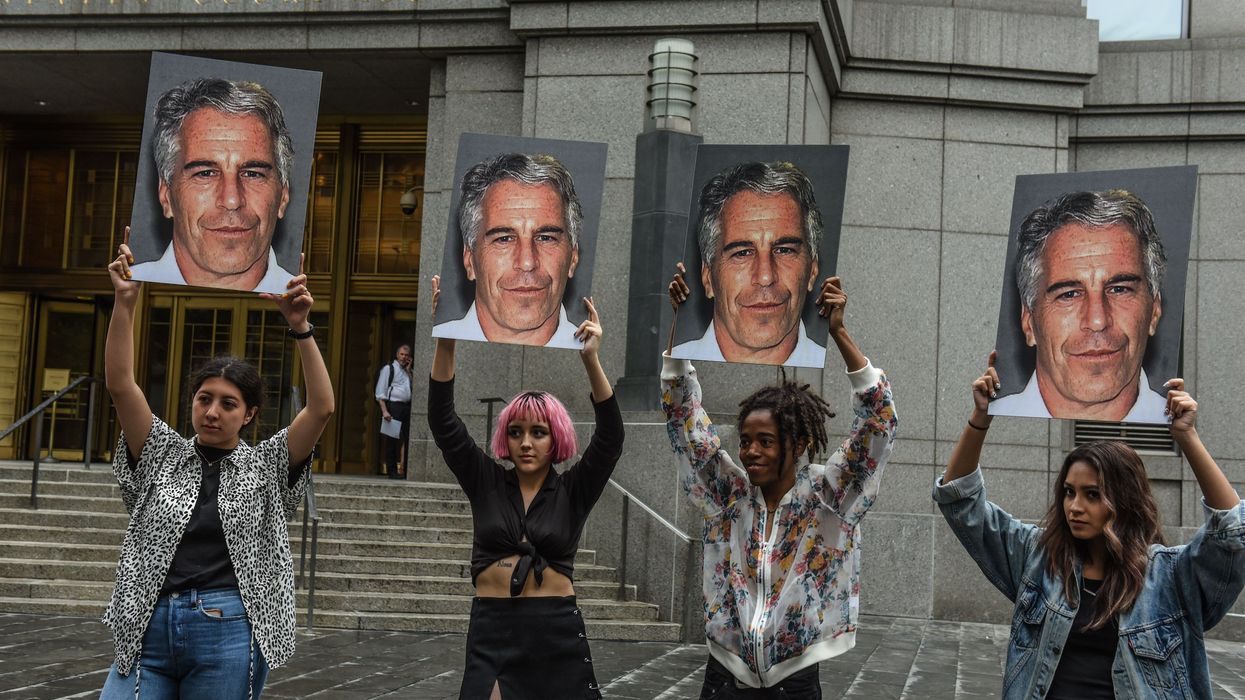
There has been wall-to-wall US corporate media coverage of the Department of Justice’s Epstein files and the battle over its release. So why has new reporting about hacked materials largely been ignored by US corporate media?
For years, there have been whispers that convicted sex offender Jeffrey Epstein, who had ties to key officials in the US and foreign governments, was involved with Israel’s intelligence agency, Mossad.
However, the Epstein/Mossad ties were often labeled by US corporate media as “unfounded” (New York Times, 8/24/25), dismissed as a “conspiracy theory” (New York Times, 7/16/25), or said to have been “largely manufactured by paranoiacs and attention seekers and credulous believers” (New York Times, 9/9/25). Former Israeli Prime Minister Naftali Bennett has claimed that “Epstein’s conduct, both the criminal and the merely despicable, had nothing whatsoever to do with the Mossad or the State of Israel.”
It’s true that far-right antisemites like Candace Owens and Tucker Carlson have promoted a conspiratorial version of the Epstein/Israel connection as part of their bigoted, attention-seeking narratives. But recent investigations by Drop Site News—the nonprofit investigative outlet founded in July 2024—into a major hack targeting Israel revealed that Epstein did play a significant role in brokering multiple deals for Israeli intelligence. Despite the hack’s significant revelations, US corporate media coverage remains scant.
Since 2024, a hacking group called “Handala” with reported ties to the Iranian government (Committee to Protect Journalists, 7/9/25) has carried out a series of cyberattacks targeting Israeli government officials and facilities (Press TV, 12/1/24; CyberDaily, 6/16/25).Aspects of the Handala hack were published on the website of nonprofit whistleblower Distributed Denial of Secrets (DDoS), including hundreds of thousands of emails from former Israeli Prime Minister Ehud Barak, one of Epstein’s closest connections.
Since the hacked information was released, numerous independent media outlets—including Reason (8/27/25), All-Source Intelligence (9/17/25, 9/29/25, 10/13/25), Grayzone (10/6/25, 10/9/25, 10/13/25), the (b)(7)(D) (10/16/25, 10/21/25) and DeClassified UK (9/1/25, 11/3/25)—have published investigations on its contents. Among the independent media outlets, Drop Site’s coverage stands out for its in-depth research and broad scope.
Drop Site’s investigations into the Handala hack have included six major stories since late September, four of which have centered around “Epstein’s work on behalf of Israeli military interests, particularly as it relates to his role in the development of Israel’s cyber warfare industry.”
Drop Site reporters Murtaza Hussain and Ryan Grim (9/28/25) detailed how Epstein wielded his influence to expand Israel’s cyber warfare industry into Mongolia. Drop Site wrote:
Jeffrey Epstein…exploited his network of political and financial elites to help Barak, and ultimately the Israeli government itself, to increase the penetration of Israel’s spy-tech firms into foreign countries.
In their next piece, Drop Site revealed (10/30/25) that Epstein created an Israel/Russia backchannel to attempt to oust Syrian President Bashar al-Assad. Hussain and Grim reported that Epstein also worked with Barak and Russian elites to pressure the Obama administration into approving strikes on Iran, demonstrating his “knack for steering the superpowers toward Israel’s interests by leveraging a social network that intersected the Israeli, American and Russian intelligence communities.”
In the same piece, Hussain and Grim quoted Epstein asking Barak to “wait until they could speak privately before Barak notified intelligence leaders of a deal” with Russian-Israeli oligarch Viktor Vekselberg, and to “not go to number 1 too quickly.” Number 1 has long been a nickname for the head of the Mossad, DropSite noted.
Another article (11/7/25) recounted that Epstein sold surveillance technology to Côte d’Ivoire: “Epstein helped Barak deliver a proposal for mass surveillance of Ivorian phone and internet communications, crafted by former Israeli intelligence officials.”
Most recently, Grim and Hussain (11/11/25) reported that an Israeli spy regularly stayed at Epstein’s Manhattan apartment. The spy, Yoni Koren, “made his intelligence career working in covert operations alongside the Mossad.”
Hacked information must be handled ethically by journalists—including by verifying the files, considering public interest, concealing identities when necessary, and noting its origins. This is what Drop Site has done. And its reporting has significant public interest, revealing the ways in which Epstein served Israel’s interests.
Yet in a search of ProQuest’s US Newsstream collection for “Handala,” as well as a supplementary Google search, the only US corporate media outlet found to have covered the Handala hack is the New York Post (8/31/25). Its single 700-word story, drawing from Reason (8/27/25) and the Times of London (8/30/25), focused on how Prince Andrew stayed in contact with Epstein for five years longer than previously stated—sidestepping the revelations from Drop Site about Epstein’s ties to Mossad.
Hussain, who had not seen the New York Post story, said US corporate media is “deliberately ignoring” the story:
It’s such a goldmine of stories. They’re not going through it, they don’t want to talk about it. I think it’s very difficult for them to conceive what these emails refer to because they’ve spent so much time talking about it as a conspiracy theory. And now contravening evidence is emerging, or well-substantiated evidence, showing that it’s really not a conspiracy theory.
Indeed, recent mentions of Epstein’s ties to Israeli government officials have continued to dismiss them as conspiracy theories, ignoring the hack and Drop Site‘s work. For instance, an LA Times op-ed (10/10/25) on antisemitism in the GOP listed Tucker Carlson’s suggestion that “Epstein was a Mossad agent” (and accusing Israel of “genocide” in Gaza) as evidence of “appalling behavior,” alongside things like “entertaining Hitler/Nazi apologia” and suggesting that “Jews had something to do with [Charlie] Kirk’s death.”
The New Yorker’s Jay Caspian Kang (10/10/25) asserted in his weekly column:
On Planet Epstein, everything that happens—the assassination of Charlie Kirk, the war in Gaza, the suppression of speech by the Trump Administration—proves the country is run by blackmail, pedophilia and fealty to Israel.
While it is of course absurd to blame “everything” on Epstein or Israel—and right-wing conspiracy theories that incorporate antisemitism are very real and dangerous—is it really unreasonable to blame “the war in Gaza” on too much “fealty to Israel”? After all, from October 7, 2023 to September 2025, the US sent $21.7 billion in military aid to Israel, according to Brown University’s Costs of War project—more than a quarter of Israel’s total post–October 7 military expenditures. Epstein’s evident connections to Mossad do raise the question of whether there is more to that “fealty” than the $100 million the pro-Israel lobbying group AIPAC spent on both parties during the 2024 election cycle (Common Dreams, 8/28/24).
By using the “conspiracy theory” frame, Kang not only overlooked the recently revealed files from Drop Site, but also failed to convey the full scope of Epstein’s influence, leaving the actions of associates and key government officials unscrutinized.
Other aspects of the Handala hack have also been well-covered by independent media, including reports of billionaires funding an Israeli cyber campaign against anti-apartheid activists (All-Source Intelligence, 9/17/25). Other stories describe Iran striking a secret Israeli military site near a Tel Aviv tower (All-Source Intelligence, 10/13/25; Grayzone, 10/13/25), and Larry Ellison’s son, David Ellison, meeting with a top Israeli general to plan spying on Americans (Grayzone, 10/6/25). The Grayzone (10/9/25) also reported that a former US ambassador secretly worked with a top Israeli diplomat to help Israel access several prestigious UN committees.
In Israeli media, Haaretz (3/9/25) reported that thousands of Israeli gun owners were exposed in an Iranian hack-and-leak operation. The paper (7/9/25) also revealed the leak of a database containing thousands of résumés belonging to Israelis who served in classified and sensitive positions within the Israel Defense Forces and other military and security agencies.
These details, like those about Epstein, have also been met with silence in US corporate media.
There has been wall-to-wall US corporate media coverage of the Department of Justice’s Epstein files and the battle over its release. So why has the hack largely been ignored by US corporate media? One possible reason is the hack’s likely origin. It has been reportedly attributed to Banished Kitten, a cyber unit within Iran’s Ministry of Intelligence (Committee to Protect Journalists, 7/9/25). Hacks purportedly emanating from Iran are rarely covered in US corporate media—and when they are, the origin of the hack, not its content, becomes the focus.
Look no further than media coverage of the 271-page official dossier of then–Republican vice presidential candidate JD Vance, which revealed that the Trump campaign believed Vance “embraced noninterventionism,” among other purported vulnerabilities (Ken Klippenstein, 9/26/24). The US government alleged the Vance dossier was leaked through Iranian hacking (FAIR.org, 9/30/24). While the New York Times, Washington Post and Politico possessed the Vance dossier for weeks, they declined to publish it (Popular Information, 9/9/24).
The contents of the Vance dossier were eventually revealed by independent reporter Ken Klippenstein, as well-documented by FAIR contributor Ari Paul (9/30/24). Paul noted that while Klippenstein’s reporting pushed the story into the legacy media, “most of the reporting about this dossier has been on the intrigue revolving around Iranian hacking rather than the content itself” (Daily Beast, 8/10/24; Politico, 8/10/24; Forbes, 8/11/24).
Today, despite Drop Site‘s thorough and revealing reporting, the Handala hack has been almost completely ignored by US corporate media. Said Drop Site‘s Hussain:
A lot of these [media] organizations, it’s kind of not a secret, they have sympathies or ties to Israel, so it’s not a story which is appealing to them, it’s not politically convenient for these organizations, for the most part.
I think when something’s in the public interest, you report on it, and you’re transparent about where it came from. But in this case, [US corporate] media chose not to.

"It looked like Mossad was working for Epstein instead of Epstein working for Mossad,” said Drop Site News reporter Murtaza Hussain.
As the US House of Representatives appears poised to vote for a resolution demanding the release of files relating to the late sex criminal and financier Jeffrey Epstein, a new series of investigations is digging into an area of the disgraced financier's life that has largely evaded scrutiny: his extensive ties with Israeli intelligence.
Epstein's relationship with the Israeli government has long been the subject of speculation and conspiracy theorizing. But the extent of the connections has long been difficult to prove. That is, until October 2024, when the Palestinian group Handala released a tranche of more than 100,000 hacked emails from former Israeli Prime Minister Ehud Barak, who led the country from 1999 to 2001.
The emails span the years 2013-16, beginning just before Barak concluded his nearly six-year tenure as Israel's minister of defense. Barak is known to have been one of Epstein's closest associates, with the Wall Street Journal reporting that he visited the financier's estates in Florida and New York more than 30 times between 2013 and 2017, years after Epstein had been convicted for soliciting a minor for prostitution.
Virginia Giuffre, one of Epstein's most prominent victims, who died earlier this year, alleged in her posthumous memoir that a figure, described only as "the Prime Minister," but widely believed to be Barak, violently raped her on Epstein's private Caribbean island when she was 18. In past court filings, Giuffre accused Barak of sexually assaulting her. Barak has categorically denied those allegations and said he was unaware of Epstein's activities with minors during the time of their friendship.
Emails between Barak and Epstein have served as the basis for the ongoing investigative series published since late September by the independent outlet Drop Site News, which used them to unearth Epstein's extensive role in brokering intelligence deals between Israel and other nations.
The emails reveal that between 2013 and 2016, the pair had "intimate, oftentimes daily correspondence," during which they discussed "political and business strategy as Epstein coordinated meetings for Barak with other members of his elite circles."
The investigation comes as President Donald Trump's extensive ties to Epstein face renewed scrutiny in Congress. On Wednesday, just a day after Drop Site published the fourth part of its series, Democrats on the House Oversight Committee released a new trove of documents from Epstein's private estate.
Among them were emails sent in 2011 from Epstein to his partner and co-conspirator Ghislane Maxwell, in which he said the then private-citizen Trump “spent hours at my house” with one of his sex trafficking victims, referring to Trump as a “dog that hasn’t barked.”
Murtaza Hussain, one of the Drop Site reporters who has dug into Epstein's Israel connections, told Democracy Now! on Wednesday that the focus on Trump, while important, has diverted attention from other key tendrils of Epstein's influence.
"There's been a lot of justifiable focus on Epstein's very grave crimes and facilitation of the crimes of others related to sex trafficking and sex abuse," Hussain said. "But one critical aspect of the story that has not been covered is Epstein's own relations to foreign governments, the US government, and particularly foreign intelligence agencies."
The first report shows that Epstein was instrumental in helping Barak develop a formal security agreement between Israel and Mongolia, recruiting powerful friends like Larry Summers, who served as an economist to former Presidents Bill Clinton and Barack Obama, to serve on a Presidential Advisory Board for the Central Asian nation's economy.
Epstein helped to facilitate an agreement for Mongolia to purchase Israeli military equipment and surveillance technology from companies with which the men had financial ties.
Another report shows how Epstein helped Israel to establish a covert backchannel with the Russian government at the height of the Syrian Civil War, during which they attempted to persuade the Kremlin to oust Syrian President Bashar al-Assad, a major national security priority for Israel, which had become substantially involved in the conflict.
This process was coordinated with Israeli intelligence and resulted in Barak securing a meeting with Russian President Vladimir Putin. In one message, Barak explicitly thanked Epstein for "setting the whole thing together."
Epstein also worked alongside Barak to sell Israeli surveillance tech, which had previously been used extensively in occupied Palestine, to the West African nation of Côte d’Ivoire.
In 2014, the pair architected a deal by which the nation's government, led by President Alassane Ouattara, purchased technology used to listen in on phone calls and radio transmissions and monitor points of interest like cybercafes.
In the decade since, the report says, "Ouattara has tightened his grip on power, banning public demonstrations and arresting peaceful protestors," while "his Israeli-backed police state has squashed civic organizations and silenced critics."
On Tuesday, just before the House Oversight Committee dropped its latest batch of documents, the series' latest report revealed that an Israeli spy, Yoni Koren, stayed at Epstein's New York apartment for weeks at a time on three separate occasions between 2013 and 2015. Koren served as an intermediary between the American and Israeli governments, helping Barak organize meetings with top intelligence officials, including former CIA Director Leon Panetta.
Drop Site's reporting has fueled speculation of the longstanding theory that Epstein may have worked as an agent of Mossad, Israel's central intelligence agency. Hussain said that the evidence points to the idea that Epstein was not a formal Mossad agent, but was working as an asset to advance its most hawkish foreign policy goals.
He marveled at the fact that throughout each of these stories, “it’s not Epstein chasing Barak—it’s Barak chasing Epstein," and that at times, "it looked like Mossad was working for Epstein instead of Epstein working for Mossad.”
In a foreword to their latest report, Hussain and co-author Ryan Grim expressed bewilderment at the lack of media attention paid to the publicly available files revealing Epstein's role as a semi-official node in Israel's intelligence apparatus.
While Epstein's relationship with Trump has routinely been front-page news for many outlets, the New York Times, the Washington Post, and the Wall Street Journal have not published a story focused on Epstein's role in Israeli intelligence.
"We’re left wondering why the rest of the media, which has demonstrated no lack of excitement when it comes to the saga of Jeffrey Epstein, has all of a sudden lost its reporting capacity, in the face of reams of publicly available newsworthy documents," the reporters asked. "A question for editors reading this newsletter: What are you doing?"
In the interview, Hussain said he and Grim "are going to continue drilling down on this and not shying away from the political implications of his activities."
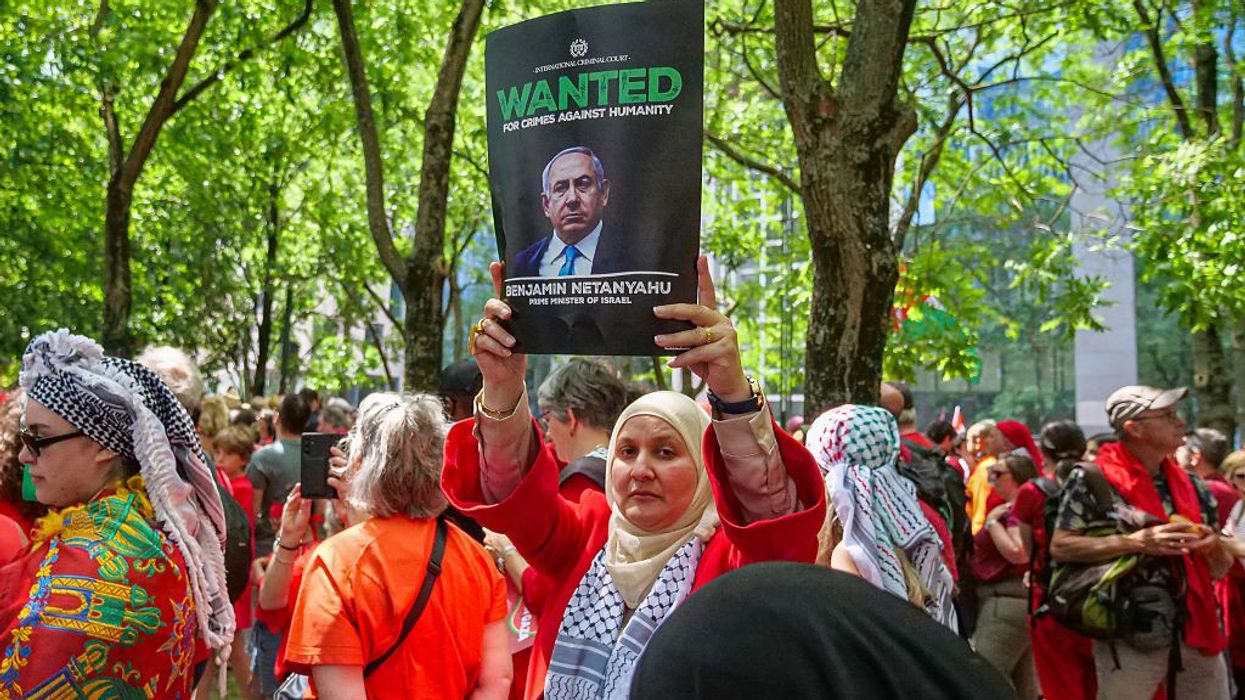
We could soon see several nuclear powers pitted against each other and dragging the world closer to nuclear annihilation.
For nearly 30 years, Israel’s Prime Minister Benjamin Netanyahu has driven the Middle East into war and destruction. The man is a powder keg of violence. Throughout all the wars that he has championed, Netanyahu has always dreamed of the big one: to defeat and overthrow the Iranian Government. His long-sought war, just launched, might just get us all killed in a nuclear Armageddon, unless Netanyahu is stopped.
Netanyahu’s fixation on war goes back to his extremist mentors, Ze’ev Jabotinsky, Yitzhak Shamir, and Menachem Begin. The older generation believed that Zionists should use whatever violence–wars, assassinations, terror–is needed to achieve their aims of eliminating any Palestinian claim to a homeland.
The founders of Netanyahu’s political movement, the Likud, called for exclusive Zionist control over all of what had been British Mandatory Palestine. At the start of the British Mandate in the early 1920s, the Muslim and Christian Arabs constituted roughly 87% of the population and owned ten times more land than the Jewish population. As of 1948, the Arabs still outnumbered the Jews roughly two to one. Nonetheless, the founding charter of Likud (1977) declared that “between the Sea and the Jordan there will only be Israeli sovereignty.” The now infamous chant, “from the River to the Sea,” which is characterized as anti-Semitic, turns out to be the anti-Palestinian rallying call of the Likud.
Israel’s war on Iran is the final move in a decades-old strategy. We are witnessing the culmination of decades of extremist Zionist manipulation of US foreign policy.
The challenge for Likud was how to pursue its maximalist aims despite their blatant illegality under international law and morality, both of which call for a two-state solution.
In 1996, Netanyahu and his American advisors devised a “Clean Break” strategy. They advocated that Israel would not withdraw from the Palestinian lands captured in the 1967 war in exchange for regional peace. Instead, Israel would reshape the Middle East to its liking. Crucially, the strategy envisioned the US as the main force to achieve these aims—waging wars in the region to dismantle governments opposed to Israel’s dominance over Palestine. The US was called upon to fight wars on Israel’s behalf.
The Clean Break strategy was effectively carried out by the US and Israel after 9/11. As NATO Supreme Commander General Wesley Clark revealed, soon after 9/11, the US planned to “attack and destroy the governments in seven countries in five years—starting with Iraq, then Syria, Lebanon, Libya, Somalia, Sudan, and Iran.”
The first of the wars, in early 2003, was to topple the Iraqi government. Plans for further wars were delayed as the US became mired in Iraq. Still, the US supported Sudan’s split in 2005, Israel’s invasion of Lebanon in 2006, and Ethiopia’s incursion into Somalia that same year. In 2011, the Obama administration launched CIA operation Timber Sycamore against Syria and, with the UK and France, overthrew Libya’s government through a 2011 bombing campaign. Today, these countries lie in ruins, and many are now embroiled in civil wars.
Netanyahu was a cheerleader of these wars of choice–either in public or behind the scenes–together with his neocon allies in the U.S. Government including Paul Wolfowitz, Douglas Feith, Victoria Nuland, Hillary Clinton, Joe Biden, Richard Perle, Elliott Abrams, and others.
Testifying in the U.S. Congress in 2002, Netanyahu pitched for the disastrous war in Iraq, declaring “If you take out Saddam, Saddam’s regime, I guarantee you that it will have enormous positive reverberations on the region.” He continued, “And I think that people sitting right next door in Iran, young people, and many others, will say the time of such regimes, of such despots is gone.” He also falsely told Congress, “There is no question whatsoever that Saddam is seeking, is working, is advancing towards to the development of nuclear weapons.”
The slogan to remake a “New Middle East” provides the slogan for these wars. Initially stated in 1996 through “Clean Break,” it was popularized by Secretary Condoleezza Rice in 2006. As Israel was brutally bombarding Lebanon, Rice stated:
“What we're seeing here, in a sense, is the growing -- the birth pangs of a new Middle East and whatever we do we have to be certain that we're pushing forward to the new Middle East not going back to the old one.”
In September 2023, Netanyahu presented at UN General Assembly a map of the “New Middle East” completely erasing a Palestinian state. In September 2024, he elaborated on this plan by showing two maps: one part of the Middle East a “blessing,” and the other–including Lebanon, Syria, Iraq, and Iran–a curse, as he advocated regime change in the latter countries.
Israel’s war on Iran is the final move in a decades-old strategy. We are witnessing the culmination of decades of extremist Zionist manipulation of US foreign policy.
The premise of Israel’s attack on Iran is the claim that Iran is on the verge of acquiring nuclear weapons. Such a claim is fatuous since Iran has repeatedly called for negotiations precisely to remove the nuclear option in return for an end to the decades of US sanctions.
Since 1992, Netanyahu and his supporters have claimed that Iran will become a nuclear power “in a few years." In 1995, Israeli officials and their US backers declared a 5-year timeline. In 2003, Israel’s Director of Military Intelligence said that Iran will be a nuclear power “by the summer of 2004.” In 2005, the head of Mossad said that Iran could build the bomb in less than 3 years. In 2012, Netanyahu claimed at the United Nations that “it’s only a few months, possibly a few weeks before they get enough enriched uranium for the first bomb.” And on and on.
This 30-year-plus pattern of shifting deadlines has marked a deliberate strategy, not a failure in prophecy. The claims are propaganda; there is always an “existential threat.” More importantly, there is Netanyahu’s phony claim that negotiations with Iran are useless.
Iran has repeatedly said that it does not want a nuclear weapon and that it has long been prepared to negotiate. In October 2003, Supreme Leader Ayatollah Ali Khamenei issued a fatwa forbidding the production and use of nuclear arms—a ruling later officially cited by Iran at an IAEA meeting in Vienna in August 2005 and referenced since as a religious and legal barrier to pursuing nuclear weapons.
Even for those skeptical of Iran’s intentions, Iran has consistently advocated for a negotiated agreement supported by independent international verification. In contrast, the Zionist lobby has opposed any such settlements, urging the US to maintain sanctions and reject deals that would allow strict IAEA monitoring in exchange for lifting sanctions.
In 2016, the Obama Administration, together with the UK, France, Germany, China, and Russia, reached the Joint Comprehensive Plan of Action (JCPOA) with Iran—a landmark agreement to strictly monitor Iran’s nuclear program in exchange for sanctions relief. Yet, under relentless pressure from Netanyahu and the Zionist lobby, President Trump withdrew from the deal in 2018. Predictably, when Iran responded by expanding its uranium enrichment, it was blamed for violating an agreement that the US itself had abandoned. The double-standard and propaganda is hard to miss.
On April 11, 2021, Israel’s Mossad attacked Iran’s nuclear facilities in Natanz. Following the attack, on April 16, Iran announced that it would increase its uranium enrichment further, as bargaining leverage, while repeatedly appealing for renewed negotiations on a deal like the JCPOA. The Biden Administration rejected all such negotiations.
At the start of his second term, Trump agreed to open a new negotiation with Iran. Iran pledged to renounce nuclear arms and to be subject to IAEA inspections but reserved the right to enrich uranium for civilian purposes. The Trump Administration appeared to agree to this point but then reversed itself. Since then, there have been five rounds of negotiations, with both sides reporting progress on each occasion.
The sixth round was ostensibly to take place on Sunday, June 15. Instead, Israel launched a preemptive war on Iran on June 12. Trump confirmed that the US knew of the attack in advance, even as the administration was speaking publicly of the upcoming negotiations.
Israel’s attack was made not only in the midst of negotiations that were making progress, but days before a scheduled UN Conference on Palestine that would have advanced the cause of the two-state solution. That conference has now been postponed.
Israel’s attack on Iran now threatens to escalate to a full-fledged war that draws in the US and Europe on the side of Israel and Russia and perhaps Pakistan on the side of Iran. We could soon see several nuclear powers pitted against each other and dragging the world closer to nuclear annihilation. The Doomsday Clock is at 89 seconds to midnight, the closest to nuclear Armageddon since the clock was launched in 1947.
Over the past 30 years, Netanyahu and his US backers have destroyed or destabilized a 4,000-km swath of countries stretching across North Africa, the Horn of Africa, the Eastern Mediterranean, and Western Asia. Their aim has been to block a Palestinian State by overthrowing governments supporting the Palestinian cause. The world deserves better than this extremism. More than 170 countries in the UN have called for the two-state solution and regional stability. That makes more sense than Israel bringing the world to the brink of nuclear Armageddon in pursuit of its illegal and extremist aims.
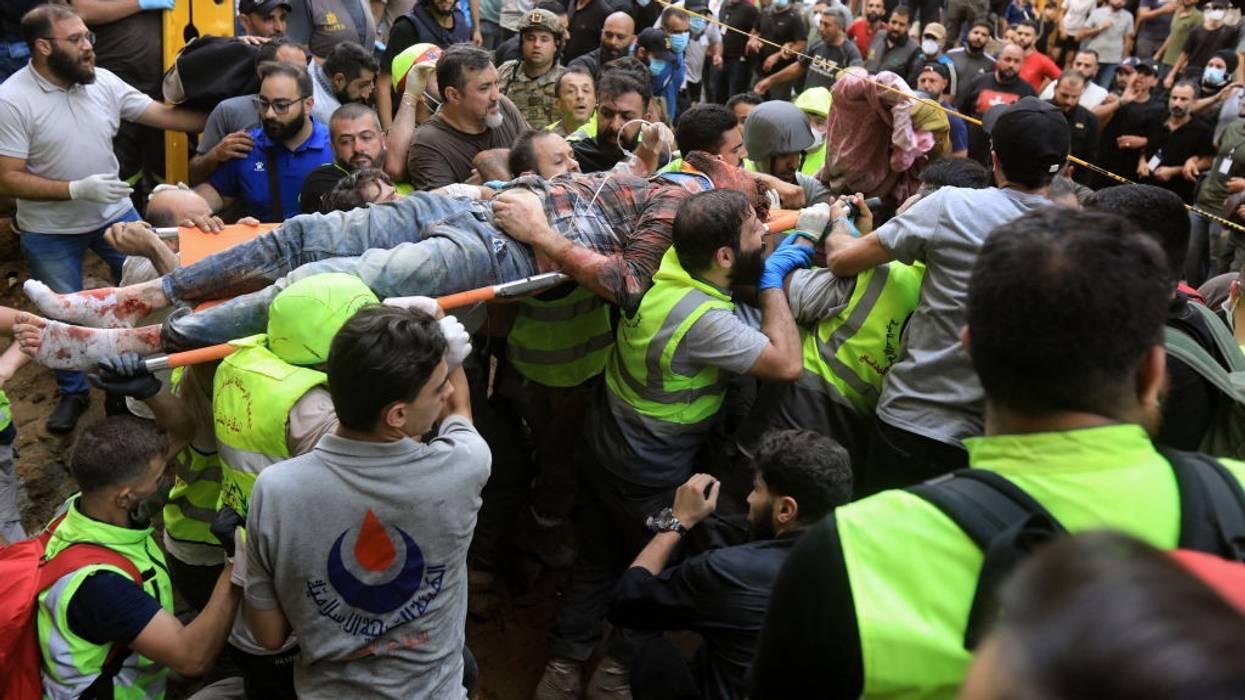
The only solution to the Arab-Israeli conflict is the end of the occupation and apartheid and the establishment of a truly democratic state for both the Palestinians and Jews.
Israel’s massive cyber-attack on Lebanon on 17 and 18 September, with the near-simultaneous explosion of 3,000-4,000 pagers and walkie-talkies, has killed a few dozen Hezbollah members and many civilians, including some children and health workers, has blinded and maimed hundreds of people and wounded many thousands. Hezbollah’s leader Sayyed Hassan Nasrallah, in a long speech on 19 September, frankly admitted that the attacks had delivered a severe and unprecedented blow to the radical movement, but he said that the movement would recover from it.
From an intelligence and technical point of view, the booby-trapping of the pagers was a sophisticated espionage operation carried out by the Israeli Mossad. There is an international trail in this complex operation and, so far, even the company that produced those pagers and those who manipulated them have not been identified. In view of the impact of this extensive form of cyber terrorism on the current Israeli war and its repercussions in the region and beyond and what it means for cyber security in the future, this incident must be properly investigated to see which firms and which countries were involved in this heinous act.
Many international legal experts and academics have stressed the illegal nature of such indiscriminate action and have described it as another Israeli war crime. Luigi Daniele, a senior lecturer at Nottingham Trent University and an expert in international humanitarian law, says that these acts constitute at least two war crimes. “The first is intentionally directing attacks against individual civilians not taking a direct part in the hostilities, for all the unlawful targets, so basically, diplomats or merely political affiliates of Hezbollah with no combat function.” The second is “intentionally launching an attack in the knowledge that such attack will cause incidental loss of life or injury to civilians or damage to civilian objects or widespread, long-term and severe damage to the natural environment which would be clearly excessive in relation to the concrete and direct overall military advantage anticipated.”
Yet, some pro-Israeli commentators have bizarrely praised it as an example of Israel’s technical expertise and its intelligence dominance of the region. Writing in Haaretz, Yossi Melman called it a “genius move” and praised it as “a brilliant and innovative operation, showing that for imaginative spy craft planners the sky is really the limit.” However, he criticises its “early implementation”, rather than waiting for the start of a war on Hezbollah. Axios cited a former Israeli official who said Israeli intelligence services had originally planned to use the modified pagers as a “surprise opening blow in an all-out war to try to cripple Hezbollah”, but three U.S. officials told Axios that they used them prematurely because they believed that their secret might have been discovered by the group.
Although so far, the United States has supported Israel at great cost to its reputation and its relations with Middle Eastern and Muslim countries as a whole, there are indications that most Americans, including young Jewish Americans have turned against Israel’s far-right government.
Clearly, the massive pager attack on Lebanon was meant to coincide with the start of a major Israeli invasion of Lebanon and it might still lead to a regional war. Israeli aircraft have already started bombing parts of Lebanon. Even from before the 7th October attack, Netanyahu spoke about a new Middle East. In a speech at the UN General Assembly in New York, Netanyahu showed a map of Israel which had incorporated both Gaza and the West Bank.
Speaking two days after the Hamas attack on Israel, Netanyahu vowed to change the Middle East: “What Hamas will experience will be difficult and terrible … we are going to change the Middle East.” The day after the Hamas attack, Israeli forces shelled Lebanon, killing three Hezbollah members, to which Hezbollah responded by firing a salvo of rockets into northern Israel, marking a significant expansion of the conflict. These border attacks have continued ever since, displacing some 60,000 Israelis from their homes in Northern Israel and a larger number of Lebanese from southern Lebanon.
Israel’s technical prowess and the expansion of the war to Lebanon may be a sign of Israel’s military superiority, but in the long-run they may prove to be counter-productive and even foolish. Praising them is similar to praising Hitler’s aggressive wars as signs of German military strength. The German invasion of Poland on 1 September 1939 marked the beginning of World War II with dire consequences for Europe, for the world, and especially for Germany. Yet, from a military point of view, it was a great achievement. It started with the Gleiwitz incident, which was a false flag attack on a radio station in Gleiwitz (then Germany and now Gliwice, Poland) staged by Nazi Germany as a casus belli for the invasion of Poland.
One of the aims of the invasion was to divide Polish territory at the end of the operation and seize large parts of it, something that the Israelis have done before in the case of Lebanon. The 1978 South Lebanon conflict (codenamed Operation Litani) began when Israeli forces invaded southern Lebanon up to the Litani River in March 1978. The conflict resulted in the deaths of as many as 2,000 Lebanese and Palestinians, and 20 Israelis, and the internal displacement of nearly 250,000 people in Lebanon. In response to the Israeli invasion, the United Nations Security Council adopted Resolutions 425 and 426, calling on Israel to withdraw its forces from Lebanon, which eventually she was forced to do.
Again, on 6 June 1982, Israeli forces under the command of Ariel Sharon invaded Lebanon on the false excuse of the attempted assassination of an Israeli diplomat in London by the PLO, despite the fact that the perpetrators belonged to Abu Nidal Organisation, which was an enemy of the PLO. Israel’s objectives were to expel the PLO members who had fled to Lebanon following the Nakba, and install a pro-Israeli Christian government led by President Bachir Gemayel.
Israeli forces carried out massive bombardment of Beirut and Sidon, killing between 20,000 and 30,000 people and displacing hundreds of thousands of the Lebanese. Those savage attacks ended with the Sabra and Shatila Massacre when between 16–18 September 1982 several thousand unarmed Palestinians were massacred by Israeli-backed right-wing Lebanese militias, while Israeli forces provided lighting for the massacre. In February 1983, an independent commission chaired by Irish diplomat Sean MacBride, assistant to the Secretary-General of the United Nations, concluded that the IDF, as the then occupying power over Sabra and Shatila, bore the main responsibility for the militia’s massacre.
The Shi’is who formed the majority in the south bore the brunt of Israeli occupation of southern Lebanon. This is how Hezbollah was born to force the Israeli forces to leave Lebanon, which they eventually achieved in the year 2000. The Israelis have a habit of describing all those who rise against their occupation as terrorists, whether the PLO and later the Hezbollah in Lebanon or Hamas which came to power in Gaza as the result of a democratic election, encouraged by President Bush mainly in order to weaken the PLO.
If Israeli forces are foolish enough to invade Lebanon again and try to occupy a part of it near their border they will face the same outcome. Despite massive and unquestioning US support, the Israelis constitute a tiny minority in the Middle East. The genocide in Gaza has alienated and infuriated many people, even many of Israel’s former friends. Far from achieving an Israeli-Arab front against Iran, many Arab countries that Netanyahu counted on, including Saudi Arabia, the United Arab Emirates and Bahrain have established relations with Iran. Egyptian and Iranian leaders have spoken of the possibility of renewing diplomatic relations. Turkey which has friendly relations with Iran has turned against Israel and has called Netanyahu’s government a terrorist regime.
Although so far, the United States has supported Israel at great cost to its reputation and its relations with Middle Eastern and Muslim countries as a whole, there are indications that most Americans, including young Jewish Americans have turned against Israel’s far-right government.
Netanyahu has not concealed his ultimate desire to expand the scope of the war and get the United States involved in a war against Iran. Such a war will not be in the interest of the region and the United States. Even if Israel manages to crush Hezbollah and weaken Iran, he will not be able to get rid of some seven million Palestinians in Gaza, the West Bank and in Israel. In this day and age, the world will not allow another massive genocide and ethnic cleansing similar to the one Israel carried out in 1948. The only solution to the Arab-Israeli conflict is the end of the occupation and apartheid and the establishment of a truly democratic state for both the Palestinians and Jews.
The world’s highest judicial authority, the International Court of Justice, has described Israel’s massacres in Gaza as “plausible genocide”, and had ordered Israel to stop the war. It has also clearly declared the occupation of Gaza, the West Bank, East Jerusalem and the Golan Heights as illegal and had ordered Israel to end the occupation as soon as possible. On 18th September, the United Nations General Assembly adopted a resolution demanding that Israel “brings to an end without delay its unlawful presence” in the Occupied Palestinian Territory. The voting result was as follows: In favour: 124, Against: 14, Abstain: 43. This shows that the international community as a whole regards Israel’s occupation of Palestinian territories as illegal and views its system as an apartheid regime. Israel should stop digging and should abide by international law.
As was done in the case of the apartheid South Africa, the international community must form a truth and reconciliation commission, to punish those who have been directly involved in the genocide and to form a unity government under United Nations supervision, until the two communities learn to live in peace together. Any other alternative will be a mirage and will lead to greater tragedies in the future.

"Bullying won't hide genocide and war crimes," said one anti-war group.
Just over a week after the International Criminal Court announced it had officially applied for an arrest warrant for two top Israeli officials over the Israel Defense Forces' assault on Gaza, an investigative report revealed Tuesday that the Israeli intelligence chief spent close to a decade attempting to intimidate the ICC's prosecutor into halting a war crimes probe.
Former ICC Prosecutor Fatou Bensouda opened a preliminary investigation into Israel's actions in Palestine in 2015, a year after Israel launched an offensive in Gaza that killed 2,251 Palestinians in less than two months. Bensouda aimed to make an initial assessment of allegations of possible war crimes in Gaza, the West Bank, and East Jerusalem.
According to Israeli publications +972 Magazine and Local Call and U.K. newspaper The Guardian, Bensouda and her prosecution team soon began to receive warnings that Mossad, the Israeli national intelligence agency, "was taking a close interest in their work."
After briefly meeting Bensouda at the Munich Security Conference in 2017, Mossad Director Yossi Cohen "ambushed" the prosecutor at a hotel in New York in 2018, when Bensouda was meeting Democratic Republic of Congo President Joseph Kabila.
"The pair had met several times before in relation to the ICC's ongoing investigation into alleged crimes committed in his country," reported The Guardian. "The meeting, however, appears to have been a setup. At a certain point, after Bensouda's staff were asked to leave the room, Cohen entered, according to three sources familiar with the meeting. The surprise appearance, they said, caused alarm to Bensouda and a group of ICC officials traveling with her. Why Kabila helped Cohen is unclear, but ties between the two men were revealed in 2022 by the Israeli publication TheMarker."
The investigation found that Cohen—who retired in 2021—repeatedly called Bensouda and sought meetings with her after the "ambush," eventually prompting Bensouda to alert senior ICC officials about the Mossad chief's conduct after his tactics shifted to "threats and manipulation." One ICC official compared Cohen's behavior to "stalking."
Cohen initiated at least three meetings with Bensouda between 2019-21, including one where he allegedly told the prosecutor: "You should help us and let us take care of you. You don't want to be getting into things that could compromise your security or that of your family."
He also allegedly suggested to Bensouda that a full investigation into war crimes by Israel would harm her career, and showed her copies photos that had covertly been taken of her husband.
The Guardian reported that Cohen did not respond to a request for comment, and Bensouda declined to comment on the reporting. A spokesperson for the Israeli government told the newspaper that the report was "replete with many false and unfounded allegations meant to hurt the state of Israel."
Threats against an ICC prosecutor could amount to offenses against the administration of justice, a violation of Article 70 under the Rome Statute, which established the court in 1998. Israel is not a signatory to the Rome Statute and does not recognize the authority of the ICC, but Israeli officials including Cohen can still be prosecuted for an offense against the administration of justice.
After Cohen's alleged threats against Bensouda's family and career, the ICC in 2021 opened its formal war crimes investigation into alleged war crimes going back to 2014. Last week, current ICC Prosecutor Karim Khan announced he was seeking warrants to arrest Prime Minister Benjamin Netanyahu, Defense Minister Yoav Gallant, and three Hamas leaders for actions since October 7, 2023.
Jacobin journalist Branko Marcetic said the revelations about Cohen's targeting of Bensouda in the midst of her preliminary investigation proves the Israeli government "is completely out of control"—partially because continued political and material support from the United States, its largest international military funder, allows it to act with impunity.
Threats against an ICC prosecutor, said Canadian New Democratic Party lawmaker Charlie Angus, "are the actions of a criminal state."
Another of what one journalist called "truly jaw-dropping allegations" was that Mossad obtained transcripts and other materials that were part of a "smear campaign" against Bensouda.
"The diplomatic efforts were part of a coordinated effort by the governments of Netanyahu and [then-President] Donald Trump in the U.S. to place public and private pressure on the prosecutor and her staff," reported The Guardian.
The Trump administration imposed sanctions including visa restrictions against Bensouda between 2019-20, allegedly in retaliation for a separate war crimes probe regarding Afghanistan. Then-Secretary of State Mike Pompeo suggested the sanctions were imposed because the ICC was "putting Israel in [its] crosshairs."
Tuesday's reporting indicated that Israel "is fast becoming a pariah," said Trita Parsi, executive vice president of the Quincy Institute for Responsible Statecraft.
"Not only is it committing war crimes and likely genocide," said Parsi, "now we find out that they use their spy chief to threaten to hurt family members of ICC prosecutors."

Although this week's deadly bombing in Kerman turns out not to implicate Israel, it certainly has a context in Tel Aviv’s reduction of Gaza to rubble and its murder of over 20,000 civilian noncombatants.
The responsibility for the bombing in Kerman, Iran, on Wednesday that killed at least 84 people and wounded another 284, has been claimed by the ISIL (Daesh, ISIS) terrorist group. The worst terrorist bombing in Iran since the Mojahedin-e Khalq (MEK) blew up the Iranian leadership in 1981 struck at a commemoration of the assassination by Donald Trump of Iranian Revolutionary Guards Corps General Qasem Soleimani.
Initially, figures on the Iranian government blamed Israel, and threatened retaliation. Iran opposes the Israeli total war on the civilians of Gaza, and leads a loosely organized Alliance of Resistance (against Israeli militarism) comprising Lebanon’s Hezbollah, Iraqi Shiite militias, and Yemen’s Houthis. The modus operandi of the Kerman bombing, however, with its targeting of civilian crowds in the service of inflaming conflict, better suits ISIL. The ISIL leadership had taken over northern Iraq and eastern Syria 2014-2018 by fomenting Sunni-Shiite civil war.
The Gaza conflict is having the effect of strengthening Iran’s Alliance of Resistance on the one hand, and of raising jealousies among and galvanizing Sunni radicals on the other.
Although the bombing turns out not to implicate Israel, it certainly has a context in Tel Aviv’s reduction of Gaza to rubble and its murder of over 20,000 civilian noncombatants.
Osama Bin Laden gave three reasons for undertaking the 2001 terrorist attacks on New York and Washington, D.C. — the US military presence in the Muslim holy land of Saudi Arabia, the excess civilian deaths caused by the US sanctions on Iraq in the 1990s, and the Israel occupation of Jerusalem and the threat it posed to the al-Aqsa Mosque complex (Islam’s third holiest shrine).
The Palestine piece is crucial. I wrote in 2010, “Last winter during the Gaza War, an audio tape attributed to Bin Laden did not neglect to mention the need to recover al-Aqsa Mosque (the Muslim holy site in Jerusalem) for Islam. Before 9/11, in early 2001, Bin Laden was penning odes to the liberation of Jerusalem and reading them at his son’s wedding.”
The US and European press never gave the Palestine issue its due in explaining Muslim radicalism twenty years ago, because facing the truth was too painful.
The longer the Biden administration allows this savage carnage on the part of Israel to continue before the eyes of the world, the more likely it is that the whole Middle East and perhaps the Muslim world more widely will be destabilized.
If ISIL did strike Iran, it may well have done so to take the shine off Iran’s current street cred in the Muslim world over Gaza. As the major Sunni Muslim countries have fallen silent or secretly cooperated with the Israeli onslaught, Iran has vigorously denounced the Israeli campaign against the Palestinians of Gaza. Its proxy militias in Iraq and Syria have repeatedly attacked US military personnel at Tanf in Syria and at Ain al-Asad base in Iraq. The Houthis have closed the Red Sea to traffic by international container ship companies.
ISIL hates Shiites and sees them as wretched heretics, and has made attempts to establish itself among Palestinians. It would want credit for resistance to the Israeli campaign to go to Sunni radicals. This strike at Kerman was revenge for the Iranian role in defeating ISIL in Syria, an effort directed by Soleimani.
Indirectly, then, the Gaza conflict is having the effect of strengthening Iran’s Alliance of Resistance on the one hand, and of raising jealousies among and galvanizing Sunni radicals on the other.
The longer the Biden administration allows this savage carnage on the part of Israel to continue before the eyes of the world, the more likely it is that the whole Middle East and perhaps the Muslim world more widely will be destabilized. The US and its allies will not be left untouched by such a development, as the Red Sea debacle already demonstrates. But that interruption of container ship traffic could be a minor consequence of the Israeli genocide against Gaza compared to what is coming.

No leftist or bleeding-heart liberal, Tamir Pardo is an exemplar of the tough, pragmatic, and somewhat ruthless Israeli tradition of security officials.
Tia Goldenberg at the Associated Press got the scoop. She landed an interview with the former head of Israeli intelligence, the Mossad, in which he unloaded on the Israeli system of Apartheid.
She quotes him as saying, “There is an apartheid state here. In a territory where two people are judged under two legal systems, that is an apartheid state.”
Tamir Pardo, roughly 69, served as the head of Mossad from 2011 to 2016. He is no leftist or bleeding-heart liberal, but an exemplar of the tough, pragmatic and somewhat ruthless Israeli tradition of security officials. He once observed that Mossad is a criminal organization with a license and that is what makes it fun. I suspect the same thing can be said about most external intelligence organizations, including MI6 and the CIA.
Goldenberg added, “Pardo said that as Mossad chief, he repeatedly warned Netanyahu that he needed to decide what Israel’s borders were, or risk the destruction of a state for the Jews . . . Pardo warned that if Israel doesn’t set borders between it and the Palestinians, Israel’s existence as a Jewish state will be in danger.”
What he means is that if the extremists in the current government of Prime Minister Binyamin Netanyahu succeed in their goal of annexing the occupied Palestinian territories, they will willy-nilly make 5 million Palestinians Israeli citizens. Taking the land without the people and keeping the indigenous Palestinians stateless is the very definition of Apartheid. The only way to regularize and make legitimate such an annexation would be to give Palestinians citizenship. But if they were added to the nearly 2 million Israelis of Palestinian heritage, that would make about 7 million Palestinian-Israelis versus 7 million Jewish Israelis. Pardo’s point is that Israel would no longer be a Jewish state under those circumstances but a multi-ethnic one, like Belgium or Lebanon.
The Jewish Power and Religious Zionism extremists in the government, I think, hope to chase the Palestinians away to Jordan, creating a large new wave of refugees. I’m not sure, though, that such a thing is possible now, as it had been in 1948 and 1967. Jordan’s army would try to stop it. If such expulsion or “transfer” succeeded, it would likely make Jordan unstable, with highly negative security implications for Israel. And of course, such an expulsion of the Palestinians would be a major war crime that might well lead to sanctions on Israel.
Pardo supports the massive protests that have roiled Israel since January, and which aim to pressure PM Netanyahu to back off his plan to neuter the country’s High Court. Pardo also, like many Israelis, despises the Jewish Power and Religious Zionism zealots who now control key cabinet posts. He said in a radio interview in late July, “Someone took the Ku Klux Klan and brought it into the government.” The someone was of course Netanyahu, as Pardo acknowledged.
He even went so far as implicitly to compare Bezalel Smotrich’s call for the Palestinian village of Huwara to be wiped out to the mass parties of the 1930s, including, presumably, the Nazis.
Pardo seems to think he is asking for a return to pre-1967 normalcy, but what he is really asking for is for Israel to settle down and become an ordinary country instead of behaving like a messianic cause
He said the government’s rules allowing Jewish communities to exclude Palestinian-Israelis were “antisemitic:” “Tomorrow morning, they can’t enter a club, or a locality, or can’t buy a house in a certain area, or have less rights, that is antisemitism for its own sake.” I think his point was that Arabs are also Semites, and were being discriminated against on racial grounds.
Jonathan Shamir at Haaretz wrote, of Pardo’s revelations in his radio interview with Kan, “When Pardo confronted Netanyahu with the fact that Israel ‘rules from the [Mediterranean] sea to the [river] Jordan, and in practice, holds Gaza as the largest open-air prison in the world,’ he said he was never met with any substantive response. ‘His vision [on this issue] is the vision of Smotrich,’ Pardo charged.”
Pardo worried about an exodus of physicians, the hi-tech sector, and academics from Israel, without which, he said, “we won’t have a country anymore” or it will become a third-world state. He also worries about the military and Mossad being weakened by the increasing number of Israeli refuseniks who decline to serve.
Pardo not only had a long career in the Mossad, starting in 1980, but also was detailed to the Israeli Defense Forces for a while, and worked briefly in the tech sector himself. In 2011-2016 while heading Mossad, he came into conflict with Netanyahu over the prime minister’s plans to launch a unilateral attack on Iran without parliamentary approval. On the other hand, Pardo has lobbied the international community hard to stop Iran’s nuclear enrichment program.
So he isn’t saying that Israel is an Apartheid state, or that it keeps Gaza as an open air prison, or that the Israeli extremist parties are the KKK because he is a Marxist or has studied intersectionality. He is saying these things because as a former security official, he sees them as dire security threats to Israel.
The problem he points to, however, of not having settled borders and not really wanting them goes back to David Ben-Gurion. As Israel was coming into being in May 1948, Ben-Gurion wrote in his diary that the new state, like the US, had no recognized borders. He was implying that it could still grow, just as the US extended west through the nineteenth century under the doctrine of manifest destiny. It is one reason that the claim by Israel apologists that Israel recognized the 1947 UN General Assembly partition plan whereas the Arabs did not fall flat. The Israelis did not really recognize it. They took lots of territory that the UNGA did not award them, and in later years they tried to annex Egypt’s Sinai Peninsula, one-tenth of Lebanon, and both the Palestinian West Bank and Gaza. They only managed to keep the latter two, but they were clearly attempting to grab as much of their neighbors’ territory as they could get away with. (The UNGA plan, by the way, did not have the force of law, since it was never ratified by the UN Security Council).
That is, Pardo seems to think he is asking for a return to pre-1967 normalcy, but what he is really asking for is for Israel to settle down and become an ordinary country instead of behaving like a messianic cause with an expansionist remit, as it generally has done since its founding.