SUBSCRIBE TO OUR FREE NEWSLETTER
Daily news & progressive opinion—funded by the people, not the corporations—delivered straight to your inbox.
5
#000000
#FFFFFF
To donate by check, phone, or other method, see our More Ways to Give page.
Daily news & progressive opinion—funded by the people, not the corporations—delivered straight to your inbox.
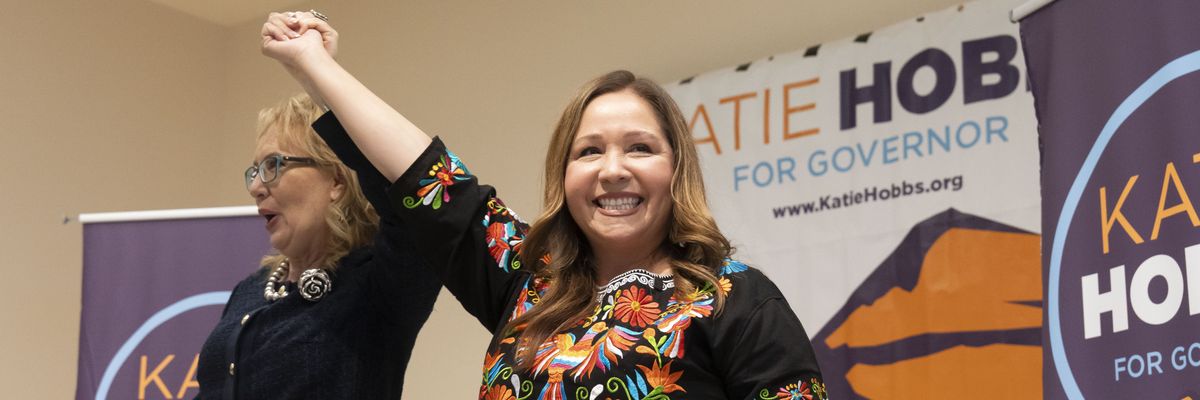
US Rep.-elect Adelita Grijalva holds hands with former U.S. Rep. Gabby Giffords during Arizona Gov. Katie Hobbs' "Arizona First" rally at El Rio Center on November 1, 2025, in Tucson, Arizona.
Speaker Mike Johnson has been accused of blocking Grijalva from her seat because she'd be the 218th vote to release the files on the late sex criminal Jeffrey Epstein.
After being kept out of Congress for more than seven weeks by Republican House Speaker Mike Johnson, the Arizona Democrat Adelita Grijalva will finally be sworn in as a member of the US House of Representatives this week.
Johnson told CNN on Monday night that Grijalva will be sworn in after Congress returns from a lengthy absence this week, when it is expected to vote to end the longest government shutdown in US history.
The blockade on Grijalva, who was elected to fill her late father's House seat on September 23, is also the longest that an elected member of Congress has been kept out of the chamber after winning a special election.
While Johnson has insisted he could not swear in members of Congress during a recess, he notably did so this April for two Florida Republicans—Reps. Randy Fine and Jimmy Patronis—just one day after their elections.
Though he's denied the accusation, many have assumed that Johnson has dragged his feet on seating Grijalva because she is expected to be the final vote needed for the House to vote on a measure requiring the US Department of Justice to release its files on deceased sex offender Jeffrey Epstein.
In late October, 20 victims of Epstein and his partner Ghislane Maxwell signed an open letter calling on Johnson to swear Grijalva into office.
"This delay appears to be a deliberate attempt to block her participation in the discharge petition that would force a vote to unseal the Epstein/Maxwell files," the survivors said. "The American public has a right to transparency and accountability, and we, as survivors, deserve justice."
In a news appearance last Monday, Grijalva said that someone told her on election night that Johnson is "not going swear you in because of those files."
"I thought, no, that can't be it," she said. "And here we are..."
The financier's ties to President Donald Trump have led to mounting suspicion, including from fellow Republicans like Reps. Thomas Massie (Ky.) and Marjorie Taylor Greene (Ga.), who have said they plan to join Democrats in voting for the files' release.
Johnson has managed to delay a vote on the Epstein files for months. In July, as a bipartisan resolution pushed by Massie and Rep. Ro Khanna (D-Calif.) was gaining steam, Johnson sent Congress home early for its August recess, which delayed business until September.
In the final weeks before the shutdown, after a bill to fund the government stalled in the Senate, Johnson sent members home again on September 19, just days before Grijalva's election would have made her the 218th vote to force an Epstein resolution to the floor.
While Grijalva expressed excitement at finally being sworn in, she said, "this delay never should have happened in the first place."
"For seven weeks, 813,000 Arizonans have been denied a voice and access to basic constituent services," she said in a statement published Monday. "This is an abuse of power that no speaker should have."
The House is expected to vote on a continuing resolution to reopen the government after eight Senate Democrats caved to Republican pressure on Sunday after weeks of holding the line in hopes of securing the extension of Affordable Care Act subsidies that, if allowed to expire at the end of the year, will result in health insurance premiums more than doubling for over 20 million Americans.
"While I am eager to get to work," Grijalva said, "I am disappointed that one of my first votes will be on a bill that does nothing to protect working people from skyrocketing premiums, loss of health coverage, or do anything significant to rein in Trump's abuse of power."
This country and this world are at a monumental crossroads. US voters have an opportunity to beat back the forces of fascism and confront the billionaires who are rigging the economy, our media system, and our democracy, making it increasingly impossible for ordinary people to get by. We’re not just talking about the election. We’re talking about what must be done once these fascist elements are vanquished from power. We need a bolder set of solutions than what either major party has so far been willing to offer and a working-class movement ready to fight like hell for it. Trump didn't emerge from nowhere. The conditions that fueled MAGA authoritarianism were created by decades of radical neoliberal economic policies and a corrupt political system dominated by corporate interests. They slashed taxes on the super-rich, promising that the benefits would trickle down. They said giveaways to the corporate titans would make life more affordable for the rest of us. It was all bullshit. And when a bitter, betrayed populace searches for someone to blame, right-wing demagogues have little trouble finding scapegoats. People know when they're being lied to, but you won't hear any of this from the corporate media. Only independent journalism—powered and funded by people who believe in building a better world—can deliver truly trustworthy daily news. If you share our vision, please contribute whatever you can to sustain our work. |
After being kept out of Congress for more than seven weeks by Republican House Speaker Mike Johnson, the Arizona Democrat Adelita Grijalva will finally be sworn in as a member of the US House of Representatives this week.
Johnson told CNN on Monday night that Grijalva will be sworn in after Congress returns from a lengthy absence this week, when it is expected to vote to end the longest government shutdown in US history.
The blockade on Grijalva, who was elected to fill her late father's House seat on September 23, is also the longest that an elected member of Congress has been kept out of the chamber after winning a special election.
While Johnson has insisted he could not swear in members of Congress during a recess, he notably did so this April for two Florida Republicans—Reps. Randy Fine and Jimmy Patronis—just one day after their elections.
Though he's denied the accusation, many have assumed that Johnson has dragged his feet on seating Grijalva because she is expected to be the final vote needed for the House to vote on a measure requiring the US Department of Justice to release its files on deceased sex offender Jeffrey Epstein.
In late October, 20 victims of Epstein and his partner Ghislane Maxwell signed an open letter calling on Johnson to swear Grijalva into office.
"This delay appears to be a deliberate attempt to block her participation in the discharge petition that would force a vote to unseal the Epstein/Maxwell files," the survivors said. "The American public has a right to transparency and accountability, and we, as survivors, deserve justice."
In a news appearance last Monday, Grijalva said that someone told her on election night that Johnson is "not going swear you in because of those files."
"I thought, no, that can't be it," she said. "And here we are..."
The financier's ties to President Donald Trump have led to mounting suspicion, including from fellow Republicans like Reps. Thomas Massie (Ky.) and Marjorie Taylor Greene (Ga.), who have said they plan to join Democrats in voting for the files' release.
Johnson has managed to delay a vote on the Epstein files for months. In July, as a bipartisan resolution pushed by Massie and Rep. Ro Khanna (D-Calif.) was gaining steam, Johnson sent Congress home early for its August recess, which delayed business until September.
In the final weeks before the shutdown, after a bill to fund the government stalled in the Senate, Johnson sent members home again on September 19, just days before Grijalva's election would have made her the 218th vote to force an Epstein resolution to the floor.
While Grijalva expressed excitement at finally being sworn in, she said, "this delay never should have happened in the first place."
"For seven weeks, 813,000 Arizonans have been denied a voice and access to basic constituent services," she said in a statement published Monday. "This is an abuse of power that no speaker should have."
The House is expected to vote on a continuing resolution to reopen the government after eight Senate Democrats caved to Republican pressure on Sunday after weeks of holding the line in hopes of securing the extension of Affordable Care Act subsidies that, if allowed to expire at the end of the year, will result in health insurance premiums more than doubling for over 20 million Americans.
"While I am eager to get to work," Grijalva said, "I am disappointed that one of my first votes will be on a bill that does nothing to protect working people from skyrocketing premiums, loss of health coverage, or do anything significant to rein in Trump's abuse of power."