SUBSCRIBE TO OUR FREE NEWSLETTER
Daily news & progressive opinion—funded by the people, not the corporations—delivered straight to your inbox.
5
#000000
#FFFFFF
To donate by check, phone, or other method, see our More Ways to Give page.

Daily news & progressive opinion—funded by the people, not the corporations—delivered straight to your inbox.
"Make no mistake," said one expert, "the day will come when there is a president in the White House who will not hesitate to make full use of the Orwellian power this bill provides."
With the U.S. Senate poised to vote later this week on legislation to reauthorize a heavily abused warrantless surveillance authority, privacy advocates are ramping up pressure on lawmakers to remove a provision that would force a wide range of businesses and individuals to take part in government spying operations.
Dubbed the "Make Everyone a Spy" provision by one advocacy group, the language was tucked into a House-passed bill that would extend Section 702 of the Foreign Intelligence Surveillance Act (FISA), which allows U.S. agencies to spy on non-citizens located outside of the country without a warrant. Americans' communications have frequently been collected under the spying authority.
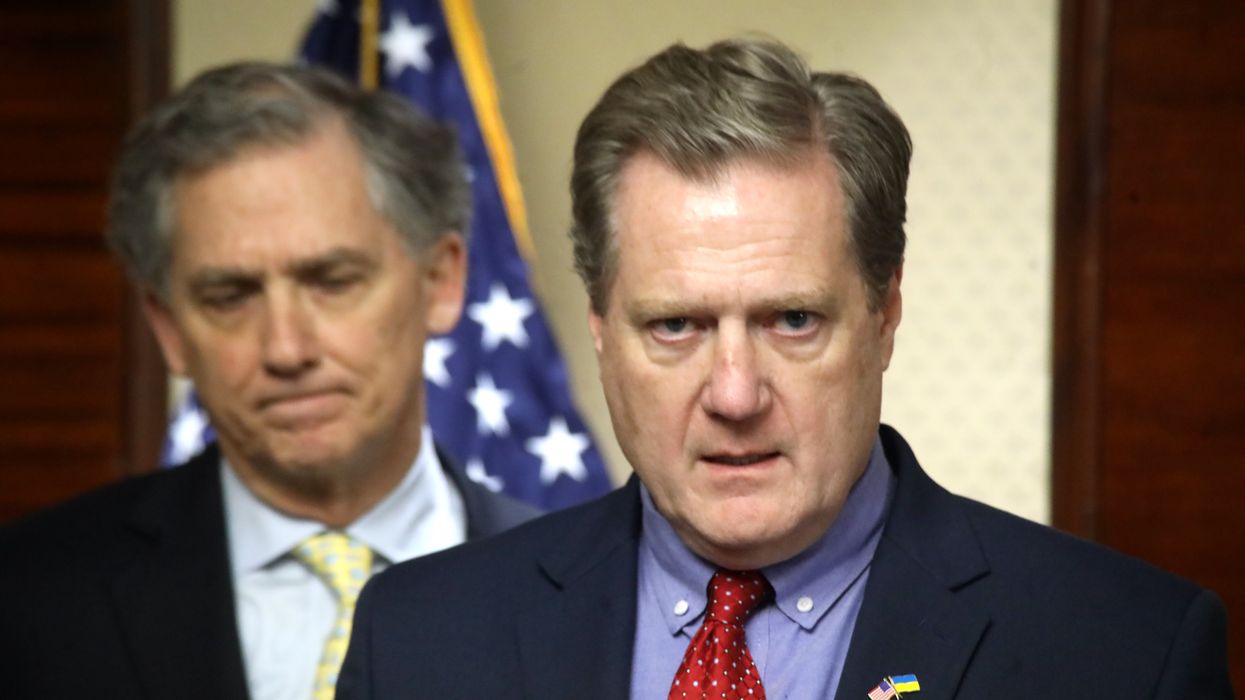
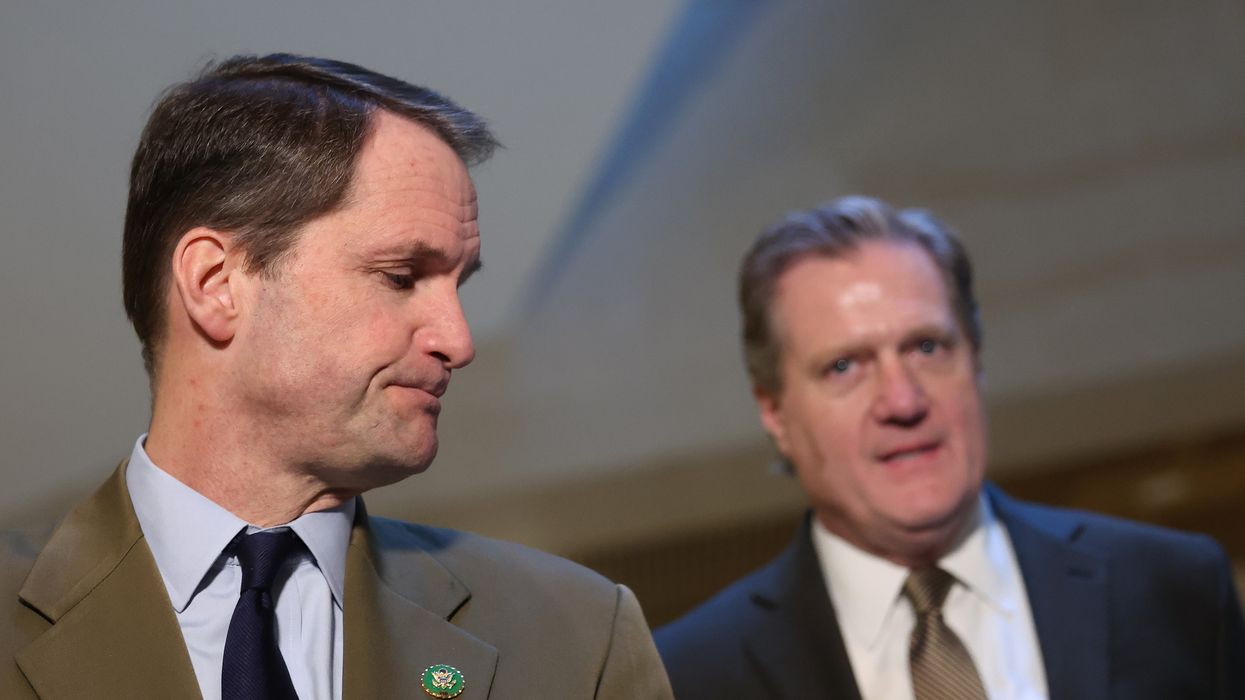
The provision that has sparked grave warnings from privacy advocates was spearheaded by the chair of the House Permanent Select Committee on Intelligence, Rep. Mike Turner (R-Ohio), and the panel's ranking member, Rep. Jim Himes (D-Conn.).
While supporters of the provision, including the Biden White House, claim the proposed change to existing law is narrow, civil liberties defenders say it's anything but.
Currently, U.S. agencies can use Section 702 authority to collect the data of non-citizens abroad from electronic communications service providers such as Google, Verizon, and AT&T without a warrant.
The Turner-Himes amendment would significantly expand who could be ordered to cooperate with government surveillance efforts, broadening Section 702 language to encompass "any other service provider who has access to equipment that is being or may be used" to transmit or store electronic communications.
That change, privacy advocates say, would mean grocery stores, laundromats, gyms, barber shops, and other businesses would potentially be conscripted to serve as government spies.
"The Make Everyone a Spy provision is recklessly broad and a threat to democracy itself," Sean Vitka, policy director of Demand Progress, said in a statement Tuesday. "It is simply stunning that the administration and House Intelligence Committee do not have a single answer for how frighteningly broad this provision is."
"You can't create a surveillance state and just hope the government won't take advantage."
The New York Times explained Tuesday that after the FISA Court "approves the government's annual requests seeking to renew the program and setting rules for it, the administration sends directives to 'electronic communications service providers' that require them to participate."
In 2022, the Times noted, the FISA Court "sided with an unidentified company that had objected to being compelled to participate in the program because it believed one of its services did not fit the necessary criteria." Unnamed people familiar with the matter told the newspaper that "the judges found that a data center service does not fit the legal definition of an 'electronic communications service provider'"—prompting the bipartisan effort to expand the reach of Section 702.
"While the Department of Justice wants us to believe that this is simply about addressing data centers, that is no justification for exposing cleaning crews, security guards, and untold scores of other Americans to secret Section 702 directives, which are issued without any court review," Vitka said Tuesday. "Receiving one can be a life-changing event, and Jim Himes appears not to have any sense of that. The Senate must stop this provision from advancing."
Elizabeth Goitein, co-director of the Liberty and National Security Program at the Brennan Center for Justice, wrote on social media Tuesday that "it's critical to stop this bill."
"The administration claims it has no intent to use this provision so broadly—and who knows, maybe it doesn't. But the plain language of the bill allows involuntary conscription of much of the private sector for [National Security Agency] surveillance purposes," Goitein wrote. "Make no mistake, the day will come when there is a president in the White House who will not hesitate to make full use of the Orwellian power this bill provides. You can't create a surveillance state and just hope the government won't take advantage."
URGENT: Please read thread below. We have just days to convince the Senate NOT to pass a “terrifying” law (@RonWyden) that will force U.S. businesses to serve as NSA spies. CALL YOUR SENATOR NOW using this call tool (click below or call 202-899-8938). 1/25 https://t.co/HAOHURZoJQ
— Elizabeth Goitein (@LizaGoitein) April 15, 2024
With Section 702 set to expire Friday, Senate Majority Leader Chuck Schumer (D-N.Y.) said in a floor speech Tuesday that he has placed the House-passed FISA legislation on the chamber's calendar and will soon "file cloture on the motion to proceed" to the bill, which is titled the Reforming Intelligence and Securing America Act (RISAA).
"We don't have much time to act," said Schumer. "Democrats and Republicans are going to have to work together to meet the April 19th deadline. If we don't cooperate, FISA will expire, so we must be ready to cooperate."
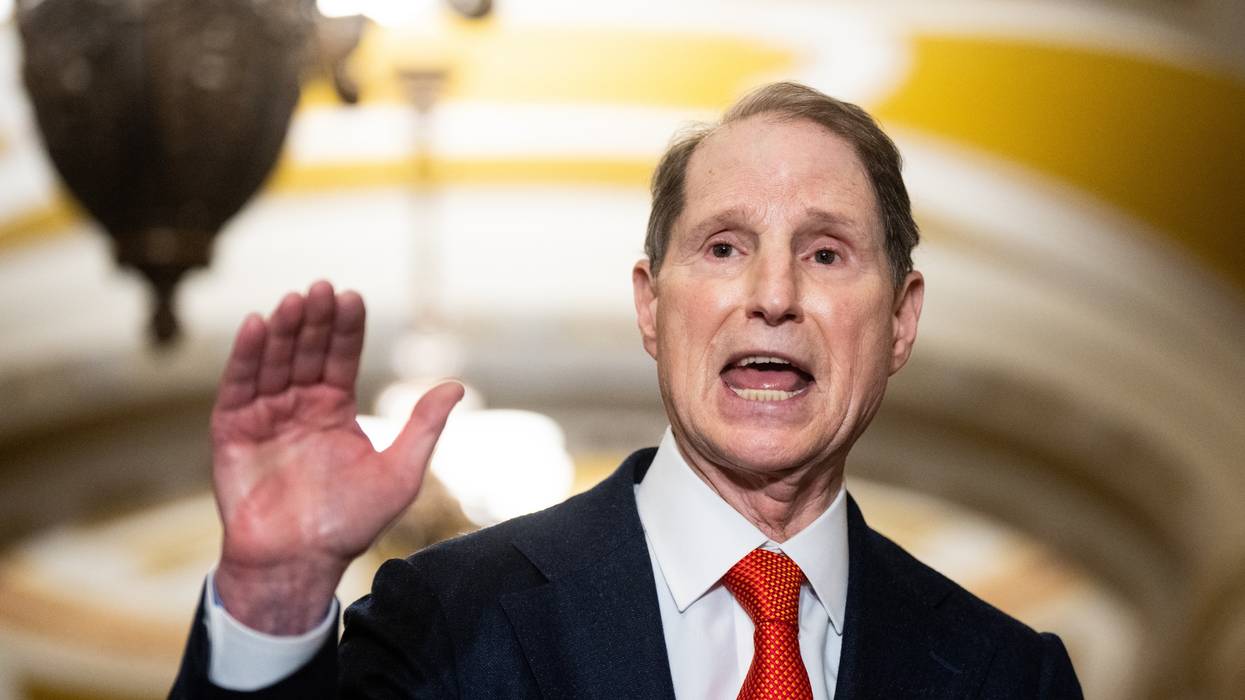
Sen. Ron Wyden (D-Ore.), a member of the Senate Select Committee on Intelligence and outspoken privacy advocate, has called RISAA's proposed expansion of government surveillance "terrifying" and warned it would "force any American who installs, maintains, or repairs anything that transmits or stores communications to spy on the government's behalf."
According to the Times, Wyden's office has in recent days been circulating "a warning that the provision could be used to conscript someone with access to a journalist's laptop to extract communications between that journalist and a hypothetical foreign source who was targeted for intelligence."
In a social media post on Tuesday, Wyden echoed campaigners in urging people to contact their senators.
"Congress wants to make it easier for the government to spy on you without a warrant," Wyden wrote. "Scared? Me too. Call your senator at (202) 224-3121 before April 19 and tell them to vote NO on expanding warrantless government surveillance under FISA."
"In my opinion no country that has something like this to enter into force can still be considered to be free," said Edward Snowden.
NSA whistleblower Edward Snowden is among the privacy advocates sounding the alarm over a major expansion of mass surveillance that the U.S. House approved in a bipartisan vote last week, a step toward handing the federal government—and a potential second Trump administration—even more power to spy on Americans' communications without a warrant.
Sean Vitka, policy director of Demand Progress, used social media to press the top Democrat on the House Permanent Select Committee on Intelligence (HPSCI) on the implications of an amendment that the lower chamber approved as part of a bill to reauthorize Section 702 of the Foreign Intelligence Surveillance Act (FISA).
"Did you know your FISA [electronic communications service provider] amendment facilitates Stasi-like powers, very plausibly for [former President Donald] Trump? I asked your staff if you were lied to about it or if you knew. Can you confirm?" Vitka asked Rep. Jim Himes (D-Conn.) on X, the platform formerly known as Twitter. (Trump, the presumptive 2024 GOP nominee, has postured as a FISA opponent, but as president he signed an extension of Section 702 authority.)
Vitka noted Sunday that Himes repeatedly characterized the amendment—which was led by HPSCI Chair Rep. Mike Turner (R-Ohio)—as narrow, even though it would dramatically expand the kinds of businesses that can be forced to help the government conduct surveillance operations under Section 702, possibly handing a would-be authoritarian chilling surveillance powers.
As the Brennan Center for Justice explained, "Although the amendment exempts hotels, libraries, restaurants, and a handful of other types of establishments, an enormous range of businesses could still be conscripted into service, including grocery stores, department stores, hardware stores, laundromats, barber shops, fitness centers, and countless other locations Americans frequent—even the offices in which they work."
"Moreover, although the targets would still have to be non-U.S. persons overseas, many of these businesses would lack the technical ability to turn over specific communications, so they would be forced to give the NSA access to entire communications streams—trusting the government to retain only the communications of approved targets," the group added.
Section 702 permits U.S. agencies to spy on non-citizens located outside of the country, but the communications of Americans—including activists, journalists, and lawmakers—have
frequently been swept up under the surveillance authority, sparking a bipartisan reform push.
Himes, an
opponent of reform efforts, responded dismissively to Vitka's question on Sunday, writing that "life is really too short to engage with people who need to use bombastic absurdities like 'Stasi-like.'"
"Yes I know exactly what is in there," Himes added, referring to the Turner-led amendment. "Some of it is classified. And none of it is remotely 'Stasi-like.' Sell your nonsense elsewhere."
Snowden, who in 2013 exposed the NSA's
illegal mass surveillance program, said in response that "the 'it's classified' dodge" by Himes "is a bright red flag."
"This amendment radically—and I repeat radically—expands the range of who the gov't can force to spy on their behalf. It may be law in DAYS!" Snowden wrote on social media.
Snowden went on to argue that Vitka's "invocation of 'Stasi-like' is not only a fair characterization" of the amendment, "it's probably generous."
"Frankly, it's hard to imagine any modern communication beyond the reach of this thing—which is, of course, the true reason they're trying to sneak it into law so quietly," he added. "It is unbelievably overbroad, and in my opinion no country that has something like this to enter into force can still be considered to be free."
"The House bill represents one of the most dramatic and terrifying expansions of government surveillance authority in history."
Elizabeth Goitein, co-director of the Brennan Center's Liberty and National Security Program,
said the "disregard for Americans' civil liberties" in Himes' reply to Vitka "is staggering."
"This provision allows the NSA to force a huge range of ordinary U.S. businesses to assist the NSA in Section 702 surveillance," Goitein added. "That's not 'nonsense,' that's a fact. And this is your response?"
URGENT: Please read thread below. We have just days to convince the Senate NOT to pass a “terrifying” law (@RonWyden) that will force U.S. businesses to serve as NSA spies. CALL YOUR SENATOR NOW using this call tool (click below or call 202-899-8938). 1/25 https://t.co/HAOHURZoJQ
— Elizabeth Goitein (@LizaGoitein) April 15, 2024
The Reforming Intelligence and Securing America Act (RISAA), described by some as "Patriot Act 2.0," passed the House in an overwhelming bipartisan vote last week after mass spying supporters—including the Biden White House—defeated an effort to add a search warrant requirement to the bill.
But the legislation still has to clear a procedural hurdle to reach the Senate. Later Monday, the House is expected to vote on whether to table a motion to reconsider RISAA's passage.
If the bill does reach the closely divided Senate, privacy advocates are expected to continue their fight for meaningful reforms.
"The House bill represents one of the most dramatic and terrifying expansions of government surveillance authority in history," Sen. Ron Wyden (D-Ore.) said in a statement following Friday's House vote. "It allows the government to force any American who installs, maintains, or repairs anything that transmits or stores communications to spy on the government's behalf. That means anyone with access to a server, a wire, a cable box, a Wi-Fi router, or a phone."
"It would be secret: The Americans receiving the government directives would be bound to silence, and there would be no court oversight," he added. "I will do everything in my power to stop this bill."
"If any lawmakers were still on the fence and waiting for a smoking gun, THIS IS IT," said one advocate of reforming Section 702.
Privacy advocates issued fresh calls for changes to a historically abused U.S. spying program on Tuesday after Wired reported that a top Republican congressman privately tried using peaceful protests as proof of the need to block long-demanded reforms.
"If you care about the First Amendment, please stop everything and read this Wired article," Elizabeth Goitein, senior director of the Brennan Center for Justice's Liberty & National Security Program, said on social media, sharing the piece.
Wired's Dell Cameron obtained a pair of presentation slides and spoke with multiple GOP staffers who attended a December 11 meeting with Rep. Mike Turner, the Ohio Republican who chairs the House Permanent Select Committee on Intelligence (HPSCI).
"This is ice in the heart of our democracy."
The meeting was about competing legislation to reauthorize Section 702 of the Foreign Intelligence Surveillance Act (FISA), which allows warrantless surveillance targeting noncitizens located outside the United States to acquire foreign intelligence information, but also sweeps up Americans' data—and has been misused, particularly by the Federal Bureau of Investigation. One of the bills would require the FBI to get a warrant before accessing U.S. citizens' communications.
Turner—who opposes the bill with that and other reforms—reportedly displayed the slides about 15 minutes into the meeting, which latest over an hour. The first shows a photo of opponents of Israel's genocidal U.S.-backed war on the Gaza Strip protesting outside the Brooklyn residence of Senate Majority Leader Chuck Schumer (D-N.Y.). It does not note that the October 13 action was organized by Jewish Voice for Peace.
The second slide features a social media post from Washington Free Beacon staff writer Matthew Foldi that contains misinformation suggesting Hamas—which governs Gaza and is designated as a terrorist group by the U.S. government—was tied to a November demonstration at the Democratic leader's residence. The slides do not make clear that they were different events.
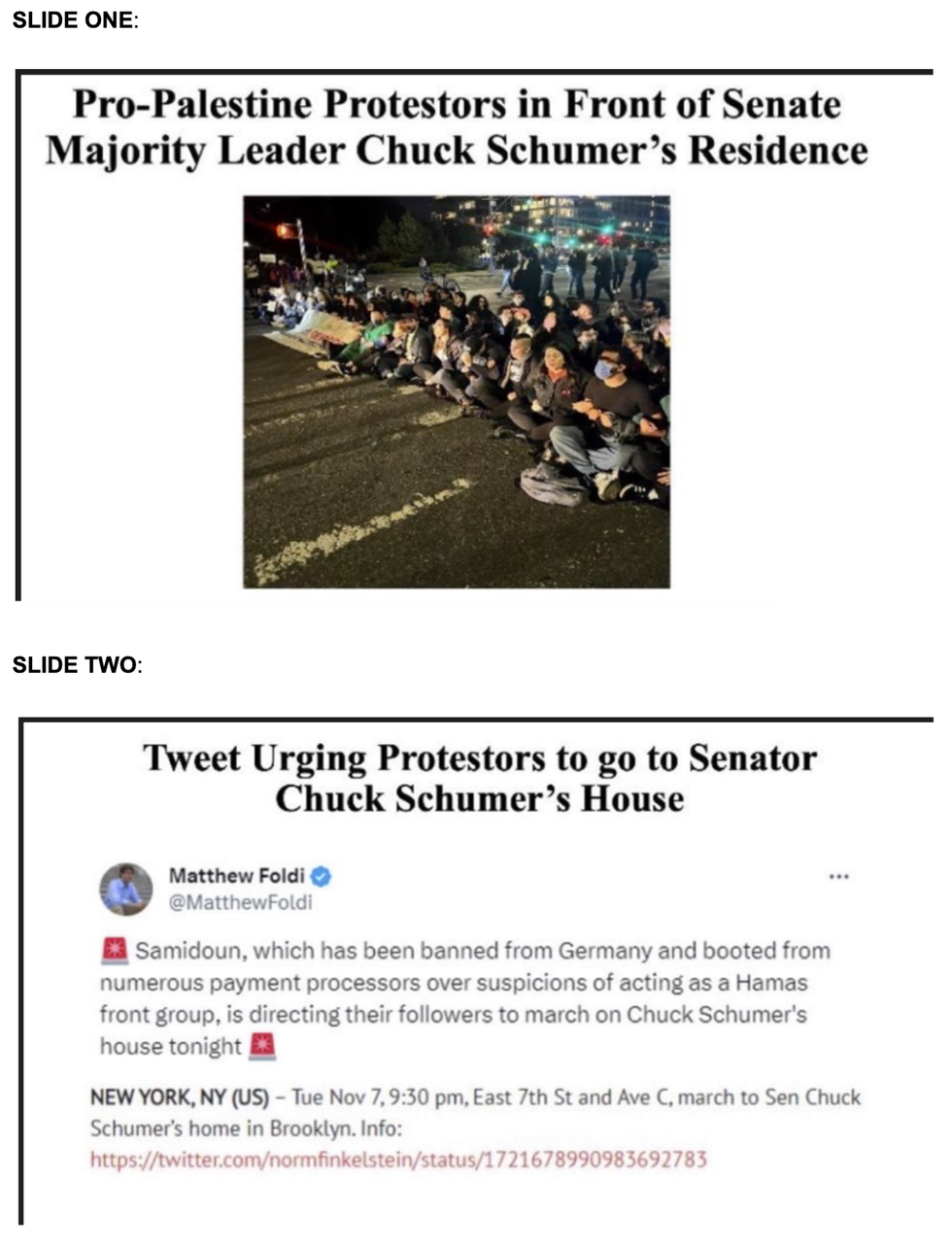
"At the outset of the presentation, he's running through slides, making his case for why 702 reauthorization is needed," one senior Republican aide told Wired about Turner's presentation. "Then he throws up that photo. The framing was: 'Here are protesters outside of Chuck Schumer's house. We need to be able to use 702 to query these people.'"
As Cameron detailed:
Jeff Naft, the HPSCI spokesperson, says the purpose of the slides was to illustrate that, even if the protesters did have ties to Hamas, they would "not be subject to surveillance" under the 702 program. "702 is not used to target protestors," he says. "702 is used on foreign terrorist organizations, like Hamas. Chairman Turner's presentation was a distinction exercise to explain the difference between a U.S. person and Hamas."
Wired's sources, who are not authorized to discuss closed-door briefings and requested anonymity to do so, describe this as a conflation of two separate issues—a tactic, they say, that has become commonplace in the debate over the program's future. "Yes, it's true, you cannot 'target' protesters under 702," one aide, a legislative director for a Republican lawmaker, says. "But that doesn't mean the FBI doesn't still have the power to access those emails or listen to their calls if it wants."
In response to Wired's reporting, Goitein—who was quoted in the piece—said on social media that "if any lawmakers were still on the fence and waiting for a smoking gun, THIS IS IT. Turner has made the stakes crystal clear. A vote to reauthorize Section 702 without a warrant requirement is a vote to allow the FBI to keep tabs on protesters exercising [First Amendment] rights."
"HPSCI leaders are reportedly trying to persuade congressional leaders to slip a Section 702 reauthorization into one of the upcoming funding bills," she pointed out. "Lawmakers must be given the opportunity to vote on Section 702 reforms, including a warrant requirement and other critical protections for Americans' civil liberties. Our First Amendment rights depend on it."
House Speaker Mike Johnson (R-La.) abruptly delayed action on Section 702 last month after Turner announced that the HPSCI had provided members of Congress with "information concerning a serious national security threat," which news outlets reported was that Russia has made alarming progress on a space-based nuclear weapon designed to target U.S. satellites. Critics called it a ploy by the chair to force through the spying program and demanded his immediate resignation.
Among the groups that pressured Turner to step down last month was Demand Progress, a longtime supporter of Section 702 reforms whose policy director, Sean Vitka, was also quoted in Wired's piece and issued a statement about the "disturbing" revelations.
"This is ice in the heart of our democracy," Vitka said. "Americans' right to protest is sacred, and all the more critical given the political volatility 2024 is certain to produce. As intelligence agencies and congressional intelligence committees mislead the public about what's at stake in this fight for privacy, Chairman Turner has been secretly selling his colleagues on backdoor searches of Americans as a way to help the FBI spy on protesters without so much as a court order."
Calling for "a forceful response" from Schumer, Johnson, and House Minority Leader Hakeem Jeffries (D-N.Y.), he argued that "Congress must stop letting the House Intelligence Committee dictate its agenda by secretly vetoing any meaningful reform. In the coming weeks, Congress has the opportunity to enact meaningful privacy protections that would protect protesters and all people in the United States from warrantless surveillance, specifically by closing the backdoor search and data broker loopholes."
"This discussion is one more example of why Congress must pass a warrant requirement to ensure that these searches are not subject to abuse."
Jeramie Scott, senior counsel and director of the Electronic Privacy Information Center, also weighed in on the reporting.
"Americans exercising their constitutional right to protest have a right to be free from warrantless surveillance. There should be no suggestion that foreign intelligence authorities can be used to target protestors; that would be counter to our core American values," Scott said. "This discussion is one more example of why Congress must pass a warrant requirement to ensure that these searches are not subject to abuse."
Kia Hamadanchy, senior policy counsel at ACLU, similarly demanded action, saying that "in the United States, a political leader's disagreement with the views of a protest movement does not give the government license to investigate those protesters, and Chairman Turner knows that."
"It is clear our leaders view the ability to conduct warrantless searches based on vague and unfounded claims of foreign influence as a feature of the program—not a bug," he added. "That's precisely why Congress must not reauthorize Section 702 without the fundamental reforms needed to prevent these egregious abuses."
This post has been updated with comment from the ACLU.
"The administration has decided to short-circuit the legislative process and ask the FISA Court for an extra year of surveillance without any reforms at all," said Sen. Ron Wyden.
Privacy advocates responded with outrage Thursday to news that the Biden administration has decided to pursue a year-long extension of warrantless spying authority in court rather than working with Congress to enact reforms that are popular across party lines.
The decision, first reported by The New York Times, came after the House Republican leadership last month abruptly canceled planned votes on proposed changes to Section 702 of the Foreign Intelligence Surveillance Act (FISA).
While Section 702 is supposed to only allow U.S. agencies to spy on non-citizens located outside the country, the communications of American journalists, activists, and others are regularly collected under the surveillance authority, sparking widespread support for an overhaul.
Sen. Ron Wyden (D-Ore.), a leading advocate of Section 702 reform, said in a statement Thursday that "it is utterly ridiculous that the Biden administration and the Justice Department would rather risk the long-term future of an important surveillance authority than support a single meaningful reform to protect Americans' rights."
"A broad bipartisan, bicameral coalition agrees that FISA Section 702 should be reauthorized with reforms to protect the rights of Americans," said Wyden. "Yet rather than seriously engage with congressional reformers, the administration has decided to short-circuit the legislative process and ask the FISA Court for an extra year of surveillance without any reforms at all."
Rep. Zoe Lofgren (D-Calif.) also expressed alarm over the Biden administration's decision, saying it is "extraordinary that, despite broad support for substantial reform, the Department of Justice is discreetly attempting to bypass the legislative process to secure another surveillance reauthorization."
"This is unacceptable," Lofgren added, "and completely undermines the authority of the Congress."
Section 702 authority is set to expire in April. The Biden administration has claimed that allowing Section 702 to lapse would create a "dangerous gap" in data collection.
"The government isn't trying to prevent a gap; it's trying to sneak through an additional year of surveillance without congressional approval."
Last month, the House was supposed to vote on amendments to a compromise Section 702 bill—and reform advocates believed they could secure passage of meaningful reforms to the spying authority.
But House Speaker Mike Johnson (R-La.) called off the votes shortly after Rep. Mike Turner (R-Ohio), chair of the House Permanent Select Committee on Intelligence (HPSCI), issued a statement warning of a "serious national security threat"—an obvious ploy to derail momentum for Section 702 reform.
It later became clear that Turner's statement pertained to U.S. intelligence indicating that Russia has made progress on a space-based nuclear weapon—something members of Congress have known about for years. The intelligence was reportedly gathered using Section 702 authority.
Turner's gambit prompted calls for his resignation from the HPSCI chairmanship, with advocacy groups accusing the Ohio Republican of exploiting his privileged access to intelligence to "scare" his fellow lawmakers "in an effort to undermine reform of warrantless surveillance laws."
The Times reported earlier this week that the U.S. Justice Department has informed congressional leaders of its decision to seek a one-year extension of Section 702 powers.
Reform advocates want, at the very least, to require U.S. agencies to obtain a warrant before collecting the communications data of an American—a change the Biden administration opposes. Reformers are also working to close the so-called "data broker loophole," which allows government agencies to purchase Americans' information from commercial data brokers.
Elizabeth Goitein, co-director of the Liberty and National Security program at the Brennan Center for Justice, told the Times that the Biden administration's effort to extend the spying powers through the FISA Court "shows the government's utter contempt for the role of Congress and the democratic process when it comes to FISA and Section 702."
"The government isn't trying to prevent a gap; it's trying to sneak through an additional year of surveillance without congressional approval," said Goitein.
In addition to opposing a Section 702 extension through the FISA Court, civil liberties advocates are warning against any attempt to include an extension in must-pass government funding legislation.
"Bypassing this process by slipping an extension of the law into a must-pass funding bill would demonstrate a blatant disregard for the civil liberties and civil rights of the American people," a coalition of civil society organizations wrote in a letter to congressional leaders on Wednesday.
"In a time where trust in government is at a historic low, Chairman Turner should resign so that maybe, just maybe, some of that trust can begin to be restored."
Advocacy groups who support changes to a U.S. government spying program that targets foreigners but sweeps up Americans' data on Friday joined calls for Congressman Mike Turner to step down from his leadership role in the House of Representatives after the Ohio Republican made moves suspected as an attempt to kill bipartisan surveillance reform efforts.
In a letter to Turner first reported by Politico, Demand Progress, Due Process Institute, FreedomWorks, and Restore the Fourth called for his resignation as chair of the House Permanent Select Committee on Intelligence (HPSCI), writing that "it appears you exploited your privileged access to intelligence to scare your colleagues in an effort to undermine reform of warrantless surveillance laws—and in so doing have undermined your credibility, your committee, and national security."
"It is unconscionable that he would exploit his privileged access to classified information to undermine House consideration of FISA reform."
House Speaker Mike Johnson (R-La.), who was sent a copy of the letter, delayed action on Section 702 of the Foreign Intelligence Surveillance Act (FISA) after Turner announced Wednesday that the HPSCI had provided all members of Congress with "information concerning a serious national security threat," which multiple news outlets—citing unnamed intelligence sources—reported was that Russia has made concerning progress on a space-based nuclear weapon designed to target U.S. satellites.
The timing of Turner's statement and the leaks led lawmakers from both sides of the aisle to urge an investigation into him or call for his resignation as the HPSCI leader. Rep. Jim Himes (D-Conn.), the committee's ranking member, has also come under fire for his role in what Wired called "a sabotage campaign," reporting Friday that Capitol Hill senior aides accuse the pair of trying "to instill paranoia in members that would inevitably raise doubts as to whether popular private reforms were simply too great a risk."
Sources said that HPSCI leaders "abandoned a deal that had been agreed to in private after weeks of negotiation," according to Wired. The chair "personally exploded the deal while refusing to appear for a hearing on Wednesday in which lawmakers were meant to decide the rules surrounding the vote. A congressional website shows that HPSCI staff had not filed one of the amendments meant to be discussed before the Rules Committee, suggesting that at no point in the day did Turner plan to attend."
The advocacy groups wrote to Turner: "The damage you have done to the United States' methods of intelligence collection may have caused serious harm. Moreover, the near-panic you caused by exploiting this potential future threat for immediate political gain is beneath a member of Congress, and in particular the committee you currently lead, which was formed to rein in—not be a mouthpiece for—warrantless domestic spying. This week is the culmination of months of bad-faith tactics that collectively demonstrate you should not continue as chairman."
The organizations also reiterated their demands for specific reforms:
As you are aware, we support legislation that reauthorizes and reforms FISA's controversial Section 702, namely the Protect Liberty and End Warrantless Surveillance Act, H.R. 6570, as well as amendments to the base text of the Reforming Intelligence and Securing America Act, H.R. 7320. The proposals we support would end warrantless surveillance of Americans, prohibit federal agencies from circumventing the Supreme Court's decision in Carpenter v. United States (2018) by purchasing Americans' data from third-party brokers, and strengthen the amici curiae of the Foreign Intelligence Surveillance Court. You have, also falsely, said that these amount to an evisceration of the surveillance authorities they—in fact —reauthorize.
We are aware that you are in the midst of an effort to force House leadership to include FISA in a must-pass bill, which would deprive your colleagues of the chance to vote for critical and overwhelmingly popular privacy protections. We will work with our allies in Congress to prevent that from happening. We demand votes on these reforms to warrantless surveillance—a long-overdue debate you have wrongfully wielded your chairmanship to deny your colleagues and the American people.
Taking aim at Turner in a statement Friday, Demand Progress policy director Sean Vitka said that "it is unconscionable that he would exploit his privileged access to classified information to undermine House consideration of FISA reform."
"If Mike Turner actually cares about America's security, he should allow for his colleagues to vote on the overwhelmingly popular reforms to FISA instead of bringing down Rules Committee hearings, which would have allowed his colleagues to vote on both reform and reauthorization," he added. "This further suggests the Intelligence Committee is trying to force House leadership to jam reauthorization into upcoming must-pass legislation, which would be a betrayal of the American people."
FreedomWorks policy adviser Eric Harrison asserted that "in a time where trust in government is at a historic low, Chairman Turner should resign so that maybe, just maybe, some of that trust can begin to be restored."
"This threat is emerging the day before a vote on reauthorizing vast domestic spying capabilities?" wrote one journalist. "What are the chances!"
The House Republican leadership on Wednesday abruptly canceled planned floor votes on mass surveillance reforms shortly after unnamed U.S. intelligence officials told multiple news outlets that Russia has made alarming progress on a space-based nuclear weapon purportedly designed to target American satellites.
The timing of the intelligence leak raised suspicions among journalists and lawmakers who support reforms to Section 702 of the Foreign Intelligence Surveillance Act (FISA), authority that allows U.S. agencies to spy on non-citizens located outside of the country.
The Federal Bureau of Investigation and National Security Agency have regularly abused Section 702 to collect the data of American journalists, activists, and even members of Congress without a warrant—abuses that have spurred the latest push for reforms.
"Very interested to learn about this threat," said Sen. Mike Lee (R-Utah), who is part of the ideologically diverse coalition that wants substantive FISA changes. "Also very interested to know why the spy guys are raising mysterious alarms right before we're about to reform illegal domestic surveillance under FISA."
Lee's comment came in response to a vaguely menacing statement from Rep. Mike Turner (R-Ohio), chair of the House Permanent Select Committee on Intelligence.
Turner said Wednesday morning that the committee provided all members of Congress with "information concerning a serious national security threat," without providing any specific details.
"I am requesting that President [Joe] Biden declassify all information related to this threat so that Congress, the administration, and our allies can openly discuss the actions necessary to respond to this threat," added Turner, an outspoken supporter of upholding federal agencies' mass spying authority under Section 702.
The Intercept's Ken Klippenstein noted that Turner "has tweeted out support for 702 at least a dozen times in the past year alone."
"I wonder if that has anything to do with his decision to apprise us of this ominous threat!" Klippenstein wrote in his newsletter.
Klippenstein's colleague at The Intercept, Daniel Boguslaw, had a similar reaction to Turner's statement.
Wow. This threat is emerging the day before a vote on reauthorizing vast domestic spying capabilities? And the head of the house intel wants to declassify it? What are the chances! https://t.co/2sKCn3P3nY
— Daniel Boguslaw (@DRBoguslaw) February 14, 2024
Reporting by The New York Times, ABC News, and other prominent outlets soon made clear that the secret information Turner referenced was related to Russian anti-satellite weaponry, which Moscow has been working on for years.
But officials and lawmakers privy to the intelligence, which was reportedly obtained under Section 702 authority, were quick to stress that the "serious national security threat" that Turner invoked was in no way imminent.
"It is a serious national security issue in the medium-to-long term that the Congress and the administration need to focus on," said Rep. Jim Himes (D-Conn.), the top Democrat on the House Intelligence Committee. "But no need to buy gold."
Which begs the question: If the supposed threat to U.S. national security isn't urgent, why did Turner choose to raise the issue a day before the House was set to vote on whether to reform and reauthorize Section 702?
Citing one unnamed U.S. official, The Washington Post reported that Turner "appears to want to use the information about the adversary capability to convince skeptical colleagues that 702 is an indispensable intelligence tool."
"Lawmakers in the House and Senate have been in possession of the raw intelligence concerning the foreign capability for several weeks and were preparing to learn how the administration might respond," the Post added. "Turner's disclosure could make that response more difficult if it revealed information about how the intelligence was obtained in the first place."
In the wake of the flurry of news stories on the U.S. intelligence, Raj Shah, a spokesperson for House Speaker Mike Johnson (R-La.), announced on social media that the GOP leadership has decided to postpone a vote on Section 702 reform and reauthorization indefinitely "to allow Congress more time to reach consensus."
Without congressional action, Section 702 will expire on April 19.
"The FBI's boosters on the Intelligence Committee are afraid to vote on key reforms—but these votes are long overdue and something the American people deserve."
Elizabeth Goitein, co-director of the Liberty and National Security program at the Brennan Center for Justice, called Johnson's decision to cancel Thursday's votes "jaw-dropping" and accused members of the House Intelligence Committee of "waging a propaganda campaign" to tank popular, bipartisan reform efforts.
Last month, the House Judiciary Committee overwhelmingly passed legislation that would require "all intelligence agencies and the FBI to obtain a warrant from the Foreign Intelligence Surveillance Court (FISC) before conducting any query of a U.S. person," along with other reforms.
The House Permanent Select Committee on Intelligence passed its own bill that Goitein argued is "designed to look like reform while doing nothing at all," allowing the FBI to "continue abusing Section 702."
Because the House judiciary panel has jurisdiction over surveillance matters, Johnson should have run with its bipartisan bill, Goitein wrote.
"Instead, Johnson orchestrated a new bill, framed as a 'compromise' but in fact closely tracking HPSCI's bill," Goitein wrote, alluding to the Reforming Intelligence and Securing America Act.
Let’s review. The Chair of HPSCI made a public statement that frightened the American people, may have compromised intelligence sources, and was wholly unnecessary given the absence of any urgent threat, in order to gin up a new (bogus) argument against Section 702 reform. 12/13
— Elizabeth Goitein (@LizaGoitein) February 15, 2024
Sensing broad support for reform, Section 702 supporters on Wednesday gummed up the works during a House Rules Committee hearing on the new legislation. Johnson then yanked the bill, which reform advocates were trying to amend to include greater privacy protections.
Jake Laperruque, deputy director on surveillance at the Center for Democracy and Technology, said in a statement that "privacy advocates and Judiciary Committee leadership made clear this week that we are ready and eager to vote on FISA, and the surveillance loopholes that are misused to evade warrant rules."
"The FBI's boosters on the Intelligence Committee are afraid to vote on key reforms—but these votes are long overdue and something the American people deserve," Laperruque added. "It's time to stop punting and bring the debate over warrantless FISA surveillance to the House floor."