SUBSCRIBE TO OUR FREE NEWSLETTER
Daily news & progressive opinion—funded by the people, not the corporations—delivered straight to your inbox.
5
#000000
#FFFFFF
To donate by check, phone, or other method, see our More Ways to Give page.
Daily news & progressive opinion—funded by the people, not the corporations—delivered straight to your inbox.

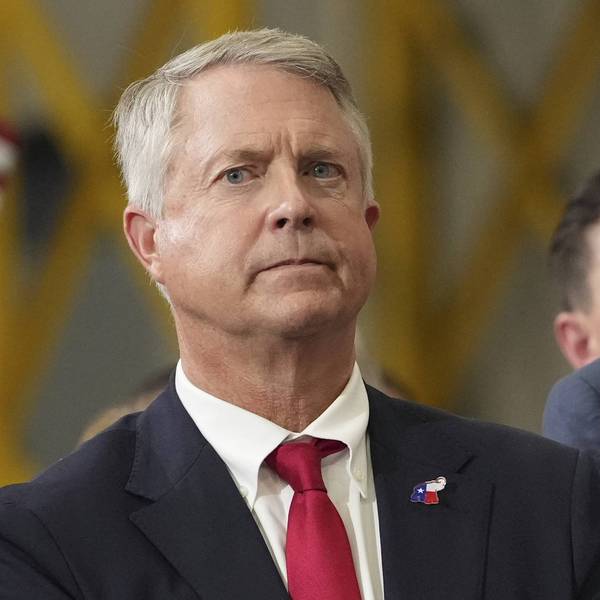
Sen. Ron Wyden (D-Ore.) speaks during a news conference in the U.S. Capitol on May 2, 2023.
"Make no mistake," said one expert, "the day will come when there is a president in the White House who will not hesitate to make full use of the Orwellian power this bill provides."
With the U.S. Senate poised to vote later this week on legislation to reauthorize a heavily abused warrantless surveillance authority, privacy advocates are ramping up pressure on lawmakers to remove a provision that would force a wide range of businesses and individuals to take part in government spying operations.
Dubbed the "Make Everyone a Spy" provision by one advocacy group, the language was tucked into a House-passed bill that would extend Section 702 of the Foreign Intelligence Surveillance Act (FISA), which allows U.S. agencies to spy on non-citizens located outside of the country without a warrant. Americans' communications have frequently been collected under the spying authority.
The provision that has sparked grave warnings from privacy advocates was spearheaded by the chair of the House Permanent Select Committee on Intelligence, Rep. Mike Turner (R-Ohio), and the panel's ranking member, Rep. Jim Himes (D-Conn.).
While supporters of the provision, including the Biden White House, claim the proposed change to existing law is narrow, civil liberties defenders say it's anything but.
Currently, U.S. agencies can use Section 702 authority to collect the data of non-citizens abroad from electronic communications service providers such as Google, Verizon, and AT&T without a warrant.
The Turner-Himes amendment would significantly expand who could be ordered to cooperate with government surveillance efforts, broadening Section 702 language to encompass "any other service provider who has access to equipment that is being or may be used" to transmit or store electronic communications.
That change, privacy advocates say, would mean grocery stores, laundromats, gyms, barber shops, and other businesses would potentially be conscripted to serve as government spies.
"The Make Everyone a Spy provision is recklessly broad and a threat to democracy itself," Sean Vitka, policy director of Demand Progress, said in a statement Tuesday. "It is simply stunning that the administration and House Intelligence Committee do not have a single answer for how frighteningly broad this provision is."
"You can't create a surveillance state and just hope the government won't take advantage."
The New York Times explained Tuesday that after the FISA Court "approves the government's annual requests seeking to renew the program and setting rules for it, the administration sends directives to 'electronic communications service providers' that require them to participate."
In 2022, the Times noted, the FISA Court "sided with an unidentified company that had objected to being compelled to participate in the program because it believed one of its services did not fit the necessary criteria." Unnamed people familiar with the matter told the newspaper that "the judges found that a data center service does not fit the legal definition of an 'electronic communications service provider'"—prompting the bipartisan effort to expand the reach of Section 702.
"While the Department of Justice wants us to believe that this is simply about addressing data centers, that is no justification for exposing cleaning crews, security guards, and untold scores of other Americans to secret Section 702 directives, which are issued without any court review," Vitka said Tuesday. "Receiving one can be a life-changing event, and Jim Himes appears not to have any sense of that. The Senate must stop this provision from advancing."
Elizabeth Goitein, co-director of the Liberty and National Security Program at the Brennan Center for Justice, wrote on social media Tuesday that "it's critical to stop this bill."
"The administration claims it has no intent to use this provision so broadly—and who knows, maybe it doesn't. But the plain language of the bill allows involuntary conscription of much of the private sector for [National Security Agency] surveillance purposes," Goitein wrote. "Make no mistake, the day will come when there is a president in the White House who will not hesitate to make full use of the Orwellian power this bill provides. You can't create a surveillance state and just hope the government won't take advantage."
URGENT: Please read thread below. We have just days to convince the Senate NOT to pass a “terrifying” law (@RonWyden) that will force U.S. businesses to serve as NSA spies. CALL YOUR SENATOR NOW using this call tool (click below or call 202-899-8938). 1/25 https://t.co/HAOHURZoJQ
— Elizabeth Goitein (@LizaGoitein) April 15, 2024
With Section 702 set to expire Friday, Senate Majority Leader Chuck Schumer (D-N.Y.) said in a floor speech Tuesday that he has placed the House-passed FISA legislation on the chamber's calendar and will soon "file cloture on the motion to proceed" to the bill, which is titled the Reforming Intelligence and Securing America Act (RISAA).
"We don't have much time to act," said Schumer. "Democrats and Republicans are going to have to work together to meet the April 19th deadline. If we don't cooperate, FISA will expire, so we must be ready to cooperate."
Sen. Ron Wyden (D-Ore.), a member of the Senate Select Committee on Intelligence and outspoken privacy advocate, has called RISAA's proposed expansion of government surveillance "terrifying" and warned it would "force any American who installs, maintains, or repairs anything that transmits or stores communications to spy on the government's behalf."
According to the Times, Wyden's office has in recent days been circulating "a warning that the provision could be used to conscript someone with access to a journalist's laptop to extract communications between that journalist and a hypothetical foreign source who was targeted for intelligence."
In a social media post on Tuesday, Wyden echoed campaigners in urging people to contact their senators.
"Congress wants to make it easier for the government to spy on you without a warrant," Wyden wrote. "Scared? Me too. Call your senator at (202) 224-3121 before April 19 and tell them to vote NO on expanding warrantless government surveillance under FISA."
Dear Common Dreams reader, It’s been nearly 30 years since I co-founded Common Dreams with my late wife, Lina Newhouser. We had the radical notion that journalism should serve the public good, not corporate profits. It was clear to us from the outset what it would take to build such a project. No paid advertisements. No corporate sponsors. No millionaire publisher telling us what to think or do. Many people said we wouldn't last a year, but we proved those doubters wrong. Together with a tremendous team of journalists and dedicated staff, we built an independent media outlet free from the constraints of profits and corporate control. Our mission has always been simple: To inform. To inspire. To ignite change for the common good. Building Common Dreams was not easy. Our survival was never guaranteed. When you take on the most powerful forces—Wall Street greed, fossil fuel industry destruction, Big Tech lobbyists, and uber-rich oligarchs who have spent billions upon billions rigging the economy and democracy in their favor—the only bulwark you have is supporters who believe in your work. But here’s the urgent message from me today. It's never been this bad out there. And it's never been this hard to keep us going. At the very moment Common Dreams is most needed, the threats we face are intensifying. We need your support now more than ever. We don't accept corporate advertising and never will. We don't have a paywall because we don't think people should be blocked from critical news based on their ability to pay. Everything we do is funded by the donations of readers like you. When everyone does the little they can afford, we are strong. But if that support retreats or dries up, so do we. Will you donate now to make sure Common Dreams not only survives but thrives? —Craig Brown, Co-founder |
With the U.S. Senate poised to vote later this week on legislation to reauthorize a heavily abused warrantless surveillance authority, privacy advocates are ramping up pressure on lawmakers to remove a provision that would force a wide range of businesses and individuals to take part in government spying operations.
Dubbed the "Make Everyone a Spy" provision by one advocacy group, the language was tucked into a House-passed bill that would extend Section 702 of the Foreign Intelligence Surveillance Act (FISA), which allows U.S. agencies to spy on non-citizens located outside of the country without a warrant. Americans' communications have frequently been collected under the spying authority.
The provision that has sparked grave warnings from privacy advocates was spearheaded by the chair of the House Permanent Select Committee on Intelligence, Rep. Mike Turner (R-Ohio), and the panel's ranking member, Rep. Jim Himes (D-Conn.).
While supporters of the provision, including the Biden White House, claim the proposed change to existing law is narrow, civil liberties defenders say it's anything but.
Currently, U.S. agencies can use Section 702 authority to collect the data of non-citizens abroad from electronic communications service providers such as Google, Verizon, and AT&T without a warrant.
The Turner-Himes amendment would significantly expand who could be ordered to cooperate with government surveillance efforts, broadening Section 702 language to encompass "any other service provider who has access to equipment that is being or may be used" to transmit or store electronic communications.
That change, privacy advocates say, would mean grocery stores, laundromats, gyms, barber shops, and other businesses would potentially be conscripted to serve as government spies.
"The Make Everyone a Spy provision is recklessly broad and a threat to democracy itself," Sean Vitka, policy director of Demand Progress, said in a statement Tuesday. "It is simply stunning that the administration and House Intelligence Committee do not have a single answer for how frighteningly broad this provision is."
"You can't create a surveillance state and just hope the government won't take advantage."
The New York Times explained Tuesday that after the FISA Court "approves the government's annual requests seeking to renew the program and setting rules for it, the administration sends directives to 'electronic communications service providers' that require them to participate."
In 2022, the Times noted, the FISA Court "sided with an unidentified company that had objected to being compelled to participate in the program because it believed one of its services did not fit the necessary criteria." Unnamed people familiar with the matter told the newspaper that "the judges found that a data center service does not fit the legal definition of an 'electronic communications service provider'"—prompting the bipartisan effort to expand the reach of Section 702.
"While the Department of Justice wants us to believe that this is simply about addressing data centers, that is no justification for exposing cleaning crews, security guards, and untold scores of other Americans to secret Section 702 directives, which are issued without any court review," Vitka said Tuesday. "Receiving one can be a life-changing event, and Jim Himes appears not to have any sense of that. The Senate must stop this provision from advancing."
Elizabeth Goitein, co-director of the Liberty and National Security Program at the Brennan Center for Justice, wrote on social media Tuesday that "it's critical to stop this bill."
"The administration claims it has no intent to use this provision so broadly—and who knows, maybe it doesn't. But the plain language of the bill allows involuntary conscription of much of the private sector for [National Security Agency] surveillance purposes," Goitein wrote. "Make no mistake, the day will come when there is a president in the White House who will not hesitate to make full use of the Orwellian power this bill provides. You can't create a surveillance state and just hope the government won't take advantage."
URGENT: Please read thread below. We have just days to convince the Senate NOT to pass a “terrifying” law (@RonWyden) that will force U.S. businesses to serve as NSA spies. CALL YOUR SENATOR NOW using this call tool (click below or call 202-899-8938). 1/25 https://t.co/HAOHURZoJQ
— Elizabeth Goitein (@LizaGoitein) April 15, 2024
With Section 702 set to expire Friday, Senate Majority Leader Chuck Schumer (D-N.Y.) said in a floor speech Tuesday that he has placed the House-passed FISA legislation on the chamber's calendar and will soon "file cloture on the motion to proceed" to the bill, which is titled the Reforming Intelligence and Securing America Act (RISAA).
"We don't have much time to act," said Schumer. "Democrats and Republicans are going to have to work together to meet the April 19th deadline. If we don't cooperate, FISA will expire, so we must be ready to cooperate."
Sen. Ron Wyden (D-Ore.), a member of the Senate Select Committee on Intelligence and outspoken privacy advocate, has called RISAA's proposed expansion of government surveillance "terrifying" and warned it would "force any American who installs, maintains, or repairs anything that transmits or stores communications to spy on the government's behalf."
According to the Times, Wyden's office has in recent days been circulating "a warning that the provision could be used to conscript someone with access to a journalist's laptop to extract communications between that journalist and a hypothetical foreign source who was targeted for intelligence."
In a social media post on Tuesday, Wyden echoed campaigners in urging people to contact their senators.
"Congress wants to make it easier for the government to spy on you without a warrant," Wyden wrote. "Scared? Me too. Call your senator at (202) 224-3121 before April 19 and tell them to vote NO on expanding warrantless government surveillance under FISA."
With the U.S. Senate poised to vote later this week on legislation to reauthorize a heavily abused warrantless surveillance authority, privacy advocates are ramping up pressure on lawmakers to remove a provision that would force a wide range of businesses and individuals to take part in government spying operations.
Dubbed the "Make Everyone a Spy" provision by one advocacy group, the language was tucked into a House-passed bill that would extend Section 702 of the Foreign Intelligence Surveillance Act (FISA), which allows U.S. agencies to spy on non-citizens located outside of the country without a warrant. Americans' communications have frequently been collected under the spying authority.
The provision that has sparked grave warnings from privacy advocates was spearheaded by the chair of the House Permanent Select Committee on Intelligence, Rep. Mike Turner (R-Ohio), and the panel's ranking member, Rep. Jim Himes (D-Conn.).
While supporters of the provision, including the Biden White House, claim the proposed change to existing law is narrow, civil liberties defenders say it's anything but.
Currently, U.S. agencies can use Section 702 authority to collect the data of non-citizens abroad from electronic communications service providers such as Google, Verizon, and AT&T without a warrant.
The Turner-Himes amendment would significantly expand who could be ordered to cooperate with government surveillance efforts, broadening Section 702 language to encompass "any other service provider who has access to equipment that is being or may be used" to transmit or store electronic communications.
That change, privacy advocates say, would mean grocery stores, laundromats, gyms, barber shops, and other businesses would potentially be conscripted to serve as government spies.
"The Make Everyone a Spy provision is recklessly broad and a threat to democracy itself," Sean Vitka, policy director of Demand Progress, said in a statement Tuesday. "It is simply stunning that the administration and House Intelligence Committee do not have a single answer for how frighteningly broad this provision is."
"You can't create a surveillance state and just hope the government won't take advantage."
The New York Times explained Tuesday that after the FISA Court "approves the government's annual requests seeking to renew the program and setting rules for it, the administration sends directives to 'electronic communications service providers' that require them to participate."
In 2022, the Times noted, the FISA Court "sided with an unidentified company that had objected to being compelled to participate in the program because it believed one of its services did not fit the necessary criteria." Unnamed people familiar with the matter told the newspaper that "the judges found that a data center service does not fit the legal definition of an 'electronic communications service provider'"—prompting the bipartisan effort to expand the reach of Section 702.
"While the Department of Justice wants us to believe that this is simply about addressing data centers, that is no justification for exposing cleaning crews, security guards, and untold scores of other Americans to secret Section 702 directives, which are issued without any court review," Vitka said Tuesday. "Receiving one can be a life-changing event, and Jim Himes appears not to have any sense of that. The Senate must stop this provision from advancing."
Elizabeth Goitein, co-director of the Liberty and National Security Program at the Brennan Center for Justice, wrote on social media Tuesday that "it's critical to stop this bill."
"The administration claims it has no intent to use this provision so broadly—and who knows, maybe it doesn't. But the plain language of the bill allows involuntary conscription of much of the private sector for [National Security Agency] surveillance purposes," Goitein wrote. "Make no mistake, the day will come when there is a president in the White House who will not hesitate to make full use of the Orwellian power this bill provides. You can't create a surveillance state and just hope the government won't take advantage."
URGENT: Please read thread below. We have just days to convince the Senate NOT to pass a “terrifying” law (@RonWyden) that will force U.S. businesses to serve as NSA spies. CALL YOUR SENATOR NOW using this call tool (click below or call 202-899-8938). 1/25 https://t.co/HAOHURZoJQ
— Elizabeth Goitein (@LizaGoitein) April 15, 2024
With Section 702 set to expire Friday, Senate Majority Leader Chuck Schumer (D-N.Y.) said in a floor speech Tuesday that he has placed the House-passed FISA legislation on the chamber's calendar and will soon "file cloture on the motion to proceed" to the bill, which is titled the Reforming Intelligence and Securing America Act (RISAA).
"We don't have much time to act," said Schumer. "Democrats and Republicans are going to have to work together to meet the April 19th deadline. If we don't cooperate, FISA will expire, so we must be ready to cooperate."
Sen. Ron Wyden (D-Ore.), a member of the Senate Select Committee on Intelligence and outspoken privacy advocate, has called RISAA's proposed expansion of government surveillance "terrifying" and warned it would "force any American who installs, maintains, or repairs anything that transmits or stores communications to spy on the government's behalf."
According to the Times, Wyden's office has in recent days been circulating "a warning that the provision could be used to conscript someone with access to a journalist's laptop to extract communications between that journalist and a hypothetical foreign source who was targeted for intelligence."
In a social media post on Tuesday, Wyden echoed campaigners in urging people to contact their senators.
"Congress wants to make it easier for the government to spy on you without a warrant," Wyden wrote. "Scared? Me too. Call your senator at (202) 224-3121 before April 19 and tell them to vote NO on expanding warrantless government surveillance under FISA."