

SUBSCRIBE TO OUR FREE NEWSLETTER
Daily news & progressive opinion—funded by the people, not the corporations—delivered straight to your inbox.
5
#000000
#FFFFFF
To donate by check, phone, or other method, see our More Ways to Give page.
Daily news & progressive opinion—funded by the people, not the corporations—delivered straight to your inbox.
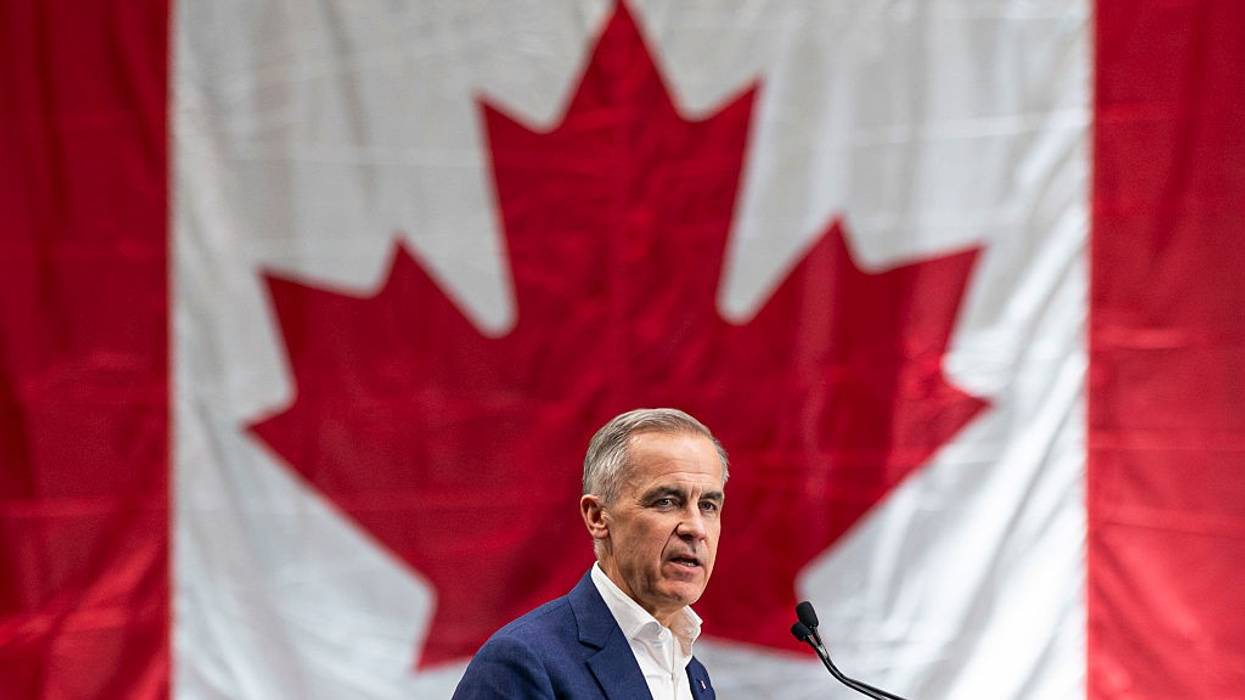
Ottawa wants Canadians to believe that a new era of strategic independence is underway, but the trade measures increasingly look performative, while the surge in military spending risks doing little to reduce Canada’s underlying dependence on the United States.
There is something almost admirable about the Canadian government’s ability to respond to an American provocation with precisely the right number of carefully selected adjectives. Washington imposes tariffs. Ottawa expresses deep disappointment. Washington threatens Canadian sovereignty. Ottawa says the relationship is changing. Washington escalates again. Ottawa announces that Canada is entering a new era. Then everyone goes home.
The problem is no longer simply that Canada’s foreign policy is too cautious. It increasingly appears to have no direction at all. Ottawa responds to American provocations with carefully worded statements, measured diplomatic language and assurances. But underneath the polished rhetoric there is no clear moral compass, little strategic spine and, most importantly, remarkably little follow-through. Canada continues to drift like seaweed, bending with every current while insisting that it is still steering the boat.
The recent tariffs should have been a wake-up call. They exposed the extraordinary vulnerability of a country whose economic fortunes are so deeply tied to a neighbor that increasingly treats trade as an instrument of coercion. The threats to Canadian sovereignty should have made the lesson even clearer: Economic integration is no guarantee of political goodwill, and decades of unquestioned alignment do not necessarily buy Canada respect or security. Canadian Prime Minister Mark Carney himself recognized the changing environment when he spoke of a world in which economic integration could be weaponized. Yet, Canada’s answer has been to dress up token diversification as strategic independence while continuing to bend to Washington on matters far beyond trade.
Cheerleading American military interventions and then dressing up Trump's annihilation rhetoric as merely the language of war is not buying Canada any goodwill in Washington.
Tariff by tariff, Ottawa has responded with declarations of retaliation and resilience. Canada announced trade missions, new partnerships, investment initiatives, and efforts to expand access to markets beyond the United States. These are bombarded as evidence that the country is moving toward a more diversified and resilient economy.
There is some truth to that, yes. The US share of Canadian merchandise exports did fall from 75.9% in 2024 to 71.7% in 2025, and while exports to countries outside the United States rose 17.2%, that headline figure conceals the limits of the transformation. Global Affairs Canada reports that the growth in non-US exports was driven largely by an exceptional increase in gold exports, with gold exports rising by $14.1 billion in 2025. The increase was driven by a 45.2% rise in gold prices, while gold export volumes actually fell 6.3%. In other words, what Ottawa can present as evidence of diversification was substantially boosted by a gold-price windfall, not simply by Canadian businesses dramatically expanding into new international markets. And among Canadian exporters whose US sales declined, most did not significantly expand sales into non-US markets.
That is not exactly the economic equivalent of escaping Washington’s orbit. It is more like rearranging the deck chairs and announcing that the ship has changed direction. Canada can announce trade missions, negotiations, and investment funds. But such announcements are not diversified supply chains. They are not new markets. They are not industrial capacity. After the magnitude of America’s pressure on Canada, the question should not be whether diversification has started. It should be whether Canada has diversified enough to reduce the vulnerability that Ottawa itself says exists. It hasn’t.
The contradiction becomes even harder to ignore when we look at defense. Canada is dramatically increasing military spending while remaining deeply embedded in a security architecture dominated by the United States. Canada plans to acquire 88 F-35 fighter aircraft at an acquisition cost of approximately $27.7 billion, with the initial Canadian aircraft scheduled to be based at Luke Air Force Base in Arizona for training. This is not at all an isolated procurement decision but part of a deeply integrated military relationship. Already, NORAD links the two countries’ air defense systems, making their military architecture deeply intertwined. Canada is consistently embedding its defense posture in a security architecture overwhelmingly shaped by the United States.
So to sum up, Canada has not escaped its dependence, either economically or militarily. It has barely moved the needle. And more importantly, it does not appear intent on doing so. Ottawa wants Canadians to believe that a new era of strategic independence is underway, but the trade measures increasingly look performative, while the surge in military spending risks doing little to reduce Canada’s underlying dependence on the United States. And if the recent United Nations General Assembly is any indication, the Carney-Anand duo has not merely failed to distance itself from Washington's military adventures. It has doubled down on its political and diplomatic alignment with them.
In his latest speech at the UN, Carney called Iran “one of the greatest threats in the current world” and described it as an “existential threat to Israel and its allies.” When asked about US President Donald Trump’s threats to annihilate or destroy Iran, he simply responded with “Well, there is a war underway, and he’s speaking the language of war.” He might as well have said, “Boys will be boys.” This time, Ottawa did not even seem interested in trying to sound politically correct. Foreign Minister Anita Anand was even more categorical. At the United Nations General Assembly, she declared: “Iran is the principal threat to peace and security in its region… Its threats to navigation rights in the Strait of Hormuz are a direct affront to international law.”
Ever since the United States and Israel launched their illegitimate war on Iran on February 28, which has already killed around 3,500 people and displaced over 3.2 million people and counting, Carney’s government continued to express support. Canada has spent months issuing statements condemning Iran, sanctioning hundreds of individuals and entities, and diplomatically isolating Tehran. Last week, Anita Anand announced sanctions against another five individuals and five entities under Canada’s Special Economic Measures (Iran) Regulations. This is where Canada’s claim to an independent foreign policy begins to look increasingly hollow. You do not need to go to Georgetown to understand what appeasement looks like. You simply need to watch Ottawa's foreign policy unfold across Gaza, the West Bank, Lebanon, Cuba, Venezuela, and now Iran. The pattern is remarkably consistent. Every single time the United States goes about their military adventurism, Canada unflinchingly finds diplomatic language to accommodate it. And the performative language of rules-based international order just whimpers out of the vocabulary.
But this time, at the UN General Assembly, Carney and his foreign minister were effectively going above and beyond, doing the public-relations work of explaining away Trump's language better than any McKinsey consultant could have managed. Canada does not merely follow Washington. Increasingly, it appears to anticipate what Washington wants and adjust its own language accordingly. The result is a foreign policy that is forceful toward countries Washington opposes while remarkably accommodating toward the power whose military, economic, and political leverage constrains Canada's choices.
And this is where the absurdity of the strategy becomes difficult to ignore. Canada has been hit with tariff after tariff, threatened over its sovereignty, and repeatedly reminded that Washington is willing to weaponize the very economic relationship on which Canada depends. Yet Ottawa continues to cower before Washington while backing its military adventures and accommodating its rhetoric. Stupidity, as the old saying goes, is doing the same thing repeatedly and expecting a different outcome. If decades of deference were supposed to buy Canada security, goodwill, or protection from American coercion, the tariffs should have demonstrated by now that the strategy has failed. Instead, Ottawa appears determined to double down.
Perhaps in a parallel universe, Canada has the courage to stand up to the United States and develop a genuinely independent foreign policy. But this is not that universe. This is Canada in which Mark Carney is prime minister and Anita Anand is foreign minister. Canada was given a wake-up call. The tariffs exposed the danger of economic dependence. The threats to Canadian sovereignty exposed the limits of political complacency. The wars and conflicts surrounding Canada's foreign policy exposed the limits of strategic independence. Ottawa's answer has been to diversify a little, spend billions on American-linked defense systems, issue carefully calibrated statements, and continue moving in Washington's direction.
Perhaps expecting this government to have the conscience to call a genocide a genocide; call for a ceasefire in Iran, Gaza, or Lebanon; or demand an end to the US blockade of Cuba is wishful thinking. But repeated tariffs and threats to Canadian sovereignty should at least force Ottawa to wake up to the obvious: Cheerleading American military interventions and then dressing up Trump's annihilation rhetoric as merely the language of war is not buying Canada any goodwill in Washington.
Nor is it reflecting the views of the Canadians this government claims to represent and hopes to win over at the next election. A clear majority of Canadians have opposed the US military action against Iran and, with every passing day, Canadians have also become increasingly critical of Israel's conduct in Gaza, with polls showing substantial support for describing Israel’s actions as genocide. Perhaps, then, after tariff after tariff, Ottawa might finally realize that subservience is not a foreign-policy strategy. So if there is any silver lining to this prolonged humiliation, it may be that Carney might be finally forced to rethink Canada's relationship with the United States and begin divesting from that dependence. Maybe it is time to stop guessing what Washington wants, stop parroting its justifications, and start listening to the Canadians this government claims to represent.

"The fact that Trump immediately resorts to new threats is further proof that stronger EU-Canada cooperation is both wise and necessary," said a Belgian member of the European Parliament.
In the wake of President Donald Trump's threats of annexation and economic warfare, Canada is distancing itself from the United States and moving toward a first-of-its-kind "associate membership" with the European Union. Trump suggested on Wednesday that this could be a "hostile act."
European Commission President Ursula von der Leyen first introduced the idea earlier that day of Canada deepening its ties with the EU economic bloc during a meeting of the European Parliament in Strasbourg, France.
"Democracies have the freedom to choose with whom to work," Von der Leyen said, suggesting that an "Alliance for the Future" between the EU and Canada would expand cooperation on technology, economic security, and military industry, among other critical areas.
She described such cooperation as a necessity in an "openly hostile world."
This was, in part, a not-so-subtle dig at Trump, who has antagonized Canada during his second term by slapping 50% tariffs on roughly $20 billion of Canadian imports and repeatedly floating the idea of making it the "51st state."
Europe, too, has been targeted by Trump's trade war, while the president has repeatedly threatened the sovereignty of Greenland, an autonomous territory of Denmark, by suggesting the United States could take control of it—including by military force.
An "associate membership" in the EU for a non-European nation has no formal basis in EU statute. One EU diplomat told Reuters that "nobody really knows what it means."
However, Trump described it as an unmistakable slight and issued more threats.
"I think it’s laughable, the whole thing with Canada," he told reporters on Wednesday. "Canada’s been a terrible trade partner."
If the two reached an agreement, Trump said he may retaliate further, heightening the tariffs that have led to sharp declines in European exports to the US and driven up costs for American consumers, especially low-income households.
"If they do that, if I think it’s at all a hostile act, I will put very serious tariffs or stop trading with Europe on many things," Trump said. "So if they do that, if Europe does that with a bad intention, if it’s a good intention, that’s fine.”
"If it’s a bad intention, we’ll put very heavy tariffs on Europe," he reiterated.
Speaking at the European Parliament on Thursday, Canadian Prime Minister Mark Carney—whose compatriots are now more inclined to view the US as an "enemy" than an "ally," according to a recent poll—said of Von der Leyen's proposal, "We welcome this ambition."
While he did not discuss the specifics of becoming an associate member, he agreed that Canada's relationship with the EU should move beyond the current Canada-European Union Comprehensive Economic and Trade Agreement (CETA).
"Canada and Europe should secure our strategic autonomy through deep cooperation in the full range of strategic capabilities, including critical minerals, defense industrial capacity, AI and compute, energy security, space, and payments," he said.
Carney stressed that the act was not one of hostility toward the United States and that he did not seek to form "a third bloc in order to become a great-power rival." But he also seemed to draw a contrast with Trump's bellicosity.
"We do not seek power to dominate others," he said. "On the contrary, we are pursuing resilience so that no one can control our open markets, impair our sovereignty, threaten our territorial integrity, or undermine our freedoms, our democracies, our rule of law."
Trump has not yet specified what tariff rate he'd seek to impose against Europe or what would signify that the alliance with Canada had a "bad intention."
But Kathleen Van Brempt, a Belgian social-democratic politician and member of the European Parliament, said that "the fact that Trump immediately resorts to new threats is further proof that stronger EU-Canada cooperation is both wise and necessary."
"He does not find the idea ridiculous; he fears it because it would weaken his divide-and-conquer tactics and his ability to wield illegal tariffs as political and economic weapons," she wrote on social media.
"He might not react when you lift a finger," she added. "But he will understand when you raise a fist."
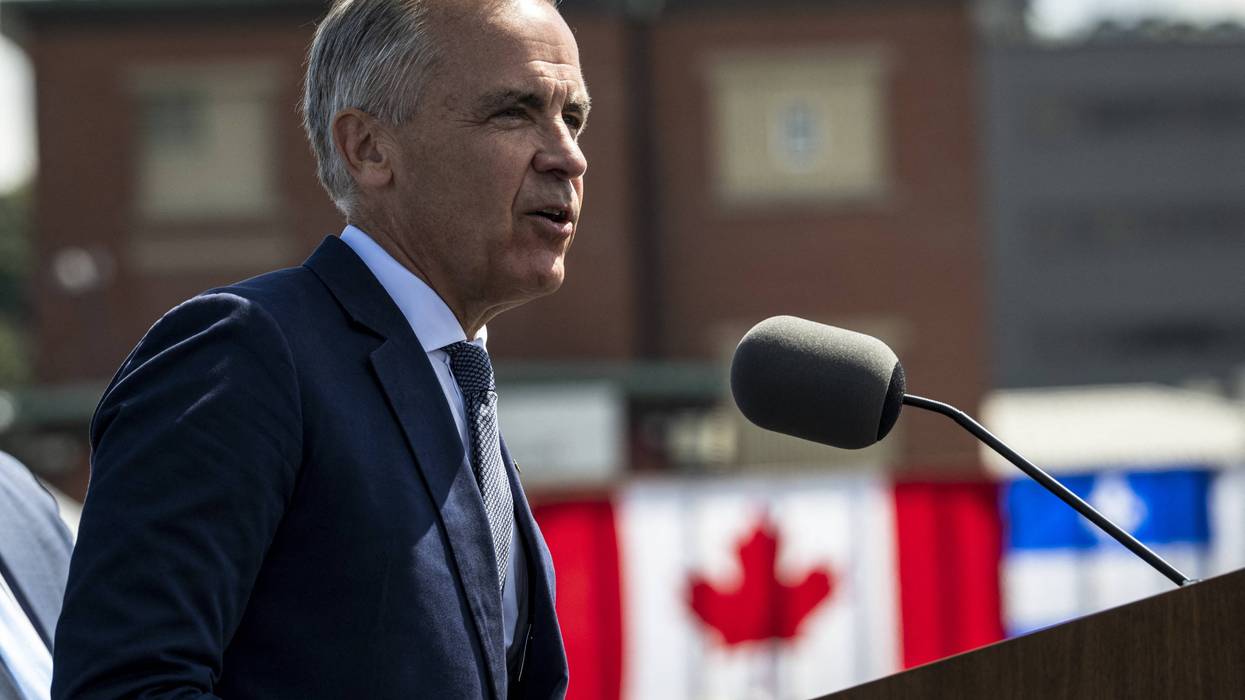
Canadian Prime Minister Mark Carney said his nation is not "going to accept" an "attitude at the negotiation table that Canada is a subsidiary of the United States."
Canada announced Tuesday that it will impose roughly $20 billion in retaliatory tariffs on American imports in response to President Donald Trump's 50% tariff on many of its goods after bilateral negotiations collapsed amid what Ottawa said were last-minute concessions that damaged the Canadian economy and intruded on its sovereignty.
The government of center-left Canadian Prime Minister Mark Carney said its countermeasures will cover roughly C$27.6 billion ($20 billion) worth of American products, with tariffs ranging from 15% to 50% on hundreds of categories including steel, aluminum, appliances, clothing, seafood, electronics, furniture, and dairy. The measures are scheduled to take effect September 8. Ottawa also unveiled billions of dollars in assistance for workers and businesses expected to be hurt by the conflict.
"Canada must respond, and today we are, in a proportionate, targeted, and strategic way," Canadian Finance Minister François-Philippe Champagne said during a press conference in Ottawa. "Today I'm announcing that Canada will match the United States tariffs dollar for dollar, rate for rate."
"Canada's counter-tariffs are designed primarily to provide protection for Canadian industry impacted by US tariffs and allow them to compete against US products in the Canadian market," he added. "It's all about fairness, it's all about a level playing field, it's all about supporting Canadian workers and Canadian businesses."
It's also apparently about political calculation ahead of November's midterm elections, in which the congressional balance of power—and therefore Trump's ability to pursue his agenda—is at stake.
The administration's trade war with Canada is hitting industries concentrated in states where Republicans are fighting to defend vulnerable US Senate seats, including Maine's lobster industry and Michigan's auto sector, while Ohio and other Midwestern states face exposure via cross-border manufacturing and supply chains.
Whatever you call it, you just made all the goods we buy that come across our border more expensive. Michigan, he’s asking us to pay for his vanity trade war with our money.
[image or embed]
— Abdul El-Sayed (@abdulelsayed.bsky.social) August 25, 2026 at 7:12 AM
On Monday, Trump told Canadian leaders to "fall in line" or face "far WORSE" consequences than the new tariffs.
Carney retorted that Canadians are not "going to accept" an "attitude at the negotiation table that Canada is a subsidiary of the United States."
Canadian anger toward Trump has surged as the US president has repeatedly threatened Canada's sovereignty, including his frequent talk of making Canada the "51st state." Canadian political leaders and labor organizations have largely rallied behind a tougher response, while a growing grassroots boycott of US products has become a symbol of national resistance.
"Canadians understand that maintaining our sovereignty and independence will entail consequences and sacrifices," Calgary-based commentator Jen Gerson wrote Tuesday in The Guardian. "We did not bring this trade war on ourselves; we have merely refused to comply in advance to the unreasonable demands of a bad-faith actor. We will be punished for it. We have accepted this."
"If nothing else, let the [United States'] retaliation be a warning to the rest of the Western alliance," Gerson added. "Run, run. Protect yourselves. Move faster."
Trump—the self-proclaimed “peace president" who has attacked more countries than any other US leader in modern history—has menaced a string of allies. He's threatened to retake the Panama Canal, launch armed attacks on Colombia and Mexico, "bomb the shit" out of Oman, and take over Greenland.
Longtime US allies have taken notice—and action. Just as Russia's invasion of Ukraine spooked Sweden and Finland into the North Atlantic Treaty Organization, Trump's erratic aggression has pushed other countries in directions once thought highly unlikely. European Union membership for Iceland, long a politically moribund proposition, is now politically plausible amid developments including Trump's Arctic saber-rattling. US tariff pressure on India is even incentivizing India to seek closer economic ties with China, a traditional adversary.
Trump's increasingly aggressive and condescending rhetoric has left many Canadians feeling like their relationship with their southern neighbor has irreparably changed.
"America has changed, and... we will not return to our old relationship," Carney said after Trump announced the 50% tariffs over the weekend.
"You’re at war when you get attacked," the prime minister also said. "We got attacked."
Such rhetoric was once the realm of comedy, like the 1995 satirical film Canadian Bacon, directed by Michael Moore and starring John Candy and Dan Aykroyd, about a struggling US president who manufactures a shooting war with Canada, invasion and all, in hopes of rallying Americans around a foreign enemy.
The premise was absurd because the notion of Washington deliberately provoking its peaceful northern neighbor into war seemed preposterous. Many critics have noted that under Trump, absurdity has become the new normal.
On Tuesday, Trump said he's considering changing the name of Lake Ontario to "Lake America," because, as one Bluesky account noted, "Trump likes to slap the name of America on everything."
President Trump likes to slap the name of America on everything. Gulf of Mexico? Gulf of America. Strait of Hormuz? Strait of of America. Lake Ontario? Lake America. Epstein Island? America Island.
[image or embed]
— Missing The Point (@missingthept.bsky.social) August 25, 2026 at 7:27 AM
"Gulf of Mexico? Gulf of America. Strait of Hormuz? Strait of America. Lake Ontario? Lake America," the account quipped, adding one more suggestion: "Epstein Island? America Island."
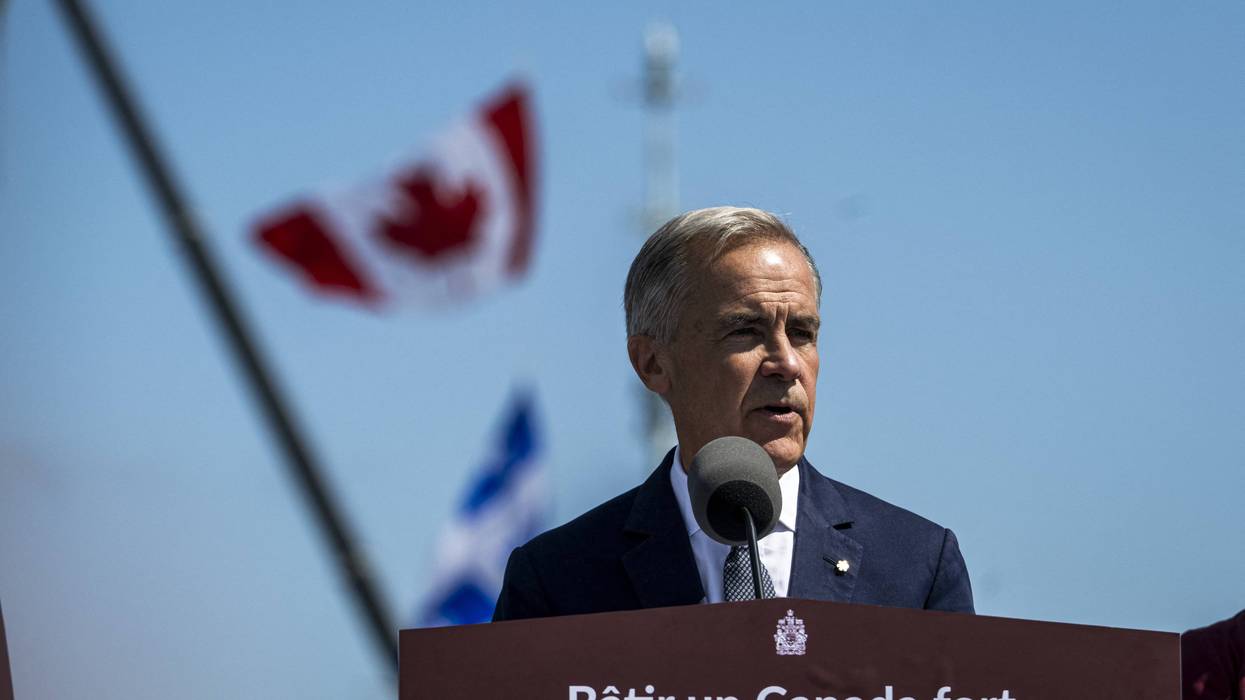
"We can put massive pain on the US," said Ontario Premier Doug Ford.
Politicians from Canada's two biggest political parties vowed on Monday to hit back hard against US President Donald Trump's trade war against their country.
Trade negotiations between the two countries collapsed last week after Trump reportedly sought to restrict Canada from striking trade deals with other nations, while also pressuring the country to scrap requirements aimed at preserving the use of the French language.
Speaking to reporters on Monday, Canadian Prime Minister Mark Carney warned that Trump's aggression would come back to hurt US workers.
"It's not a surprise that the US would take some form of reprisal to our response to their unjustified tariffs," said Carney, a member of the center-left Liberal Party. "But what message does that send to the workers in Michigan and Ohio and Kentucky and Alabama who rely on Canadian demand? We're their largest customer for automobiles, more than the European Union, Japan, Korea."
Mark Carney: "It's not a surprise that the US would take some form of reprisal to our response to their unjustified tariffs, which was on top of other unjustified tariffs. But what message does that send to the workers in Michigan and Ohio and Kentucky and Alabama who rely on… pic.twitter.com/2o5rbEmQAo
— Aaron Rupar (@atrupar) August 24, 2026
Carney also said there was an "attitude at the negotiating table" from US officials that "Canada is a subsidiary of the United States," which is "not something we're going to accept."
Ontario Premier Doug Ford, a member of the rival center-right Progressive Conservative Party, delivered a more strident rebuke to Trump, vowing that Canada's response would deliver a hit to the president's voters.
"The red states, we're going to hit hard," said Ford.
The Ontario premier then outlined all the ways his country can make life more painful for US consumers so long as Trump keeps trying to undermine Canadian sovereignty.
"If it gets really, really bad, I say everything's on the table," Ford said. "We need everyone to be on Team Canada and throw everything and the kitchen sink at them, no matter if it's electricity, if it's fuel, again, if it's potash, if it's uranium. We need to have everything on the table... we can put massive pain on the US. President Trump underestimates us. And that's the biggest mistake."
Ontario Premier Doug Ford: "We need to throw everything and the kitchen sink that them -- electricity, fuel, potash, uranium ... we can put massive pain on the US. President Trump underestimates us. And that's a mistake." pic.twitter.com/IRIidj0iYS
— Aaron Rupar (@atrupar) August 24, 2026
Trump lashed out at both Carney and Ford in a Monday morning Truth Social post.
"The USA will always be far bigger, richer, and stronger than Canada," Trump wrote. "Without the United States, Canada couldn’t survive—it’s where they get all of their money and, because of their current bad leadership, primarily Governor Carney, and his Flunky, Ford, they will not be allowed to keep taking advantage of the United States—their key to survival."
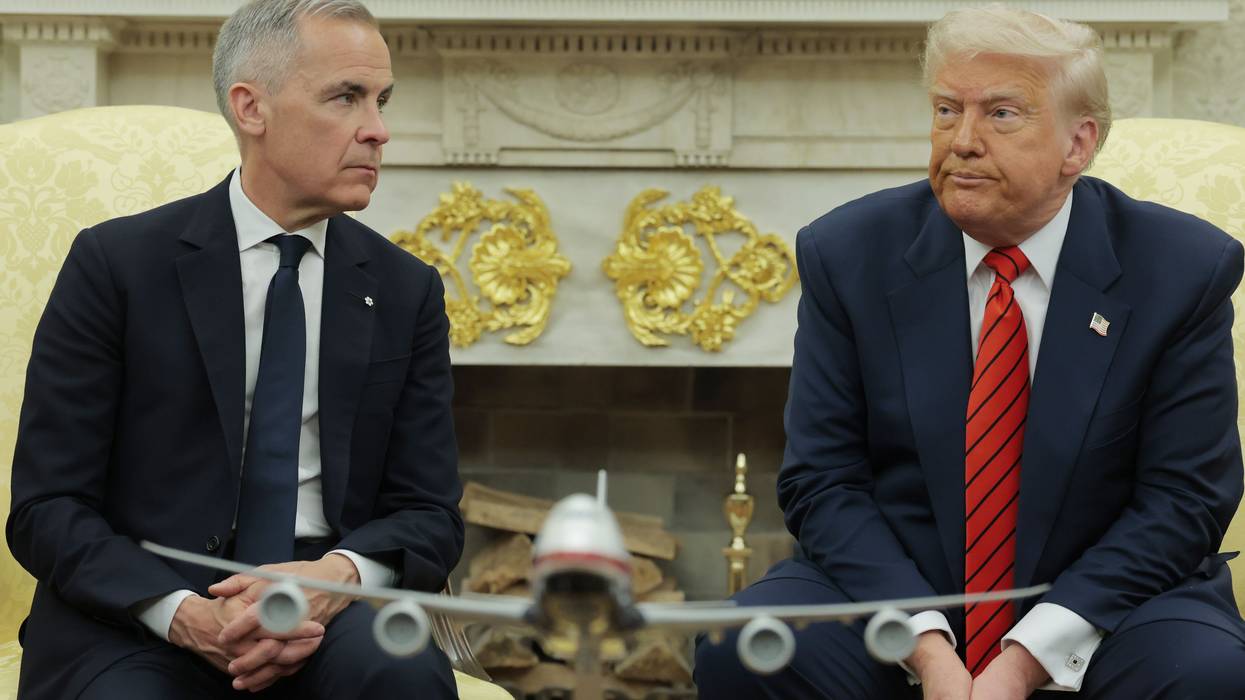
The question I ask myself is how much worse will his behavior have to get before Republicans do a damn thing to put an end to this?
Not exactly a war, but a trade war — which will impose huge costs on both American consumers and on Canada.
As I said, Trump is now completely and utterly out of his mind.
The very idea of a trade war with Canada — our neighbor, our ally, our closest friend, a nation that’s peaceful and whose people have a reputation for kindness — is absurd.
But Trump is doing it anyway. He’s imposing a 50 percent tariff on goods coming from Canada — which, remember, is an import tax paid by you and me. The tariffs account for $20 billion of the $382 billion worth of products Americans bought from Canada last year and cover a wide array of goods (the full list of more than 500 products can be found here, here, and here).
Trump has singled out several Canadian industries — especially forestry, including building products like plywood.
The obvious effect will be to make it more expensive to build houses in the United States. Couple this with the rise in long-term interest rates — i.e. mortgage interest rates — courtesy of Trump’s war spending, his tax cuts mainly for the rich and big corporations, and the giant corporate AI debt (encouraged by Trump) — and the result will be to make housing even less affordable than it already is.
This is another example of Trump’s perverse rage. I say “perverse” because I’ve come to believe that his insanity is expressing itself in ways deliberately contrary to what’s expected of a president of the United States — ways considered wrong if not stupid by most serious observers — which makes him want to do it all the more.
He’s lost his war in Iran, most Americans are struggling financially, his mass deportations are unpopular — so what does he do? He flips the finger at Canada because Canada is exactly the kind of nation that an American bully targets. Bullies always go after targets that won’t or can’t fight back.
Trump has been bullying Canada since the start of his second term. Six months ago Trump suggested the border between Canada and the U.S. was an “arbitrary” line. He’s repeatedly proposed that Canada be annexed as the 51st state. He said he’s willing to inflict “economic pain” on Canada to get what he wants. On July 1, Canada’s national holiday, Trump declined to renew the United States-Mexico-Canada Agreement on trade, which means the agreement will now undergo annual reviews.
Mostly, though, Trump is enraged that Canadian prime minister Mark Carney asserted in January at the World Economic Forum in Davos, Switzerland, that the U.S. is no longer a guarantor of stability in the world and that middle powers like Canada must unite in order to survive. It was a forceful speech — and the first time that a U.S. ally has stood up to Trump.
The day after Carney gave his speech, Trump told the same World Economic Forum:
“Canada gets a lot of freebies from us. By the way, they should be grateful also, but they’re not. I watched your prime minister yesterday. He wasn’t so grateful — they should be grateful to us, Canada. Canada lives because of the United States. Remember that, Mark, the next time you make your statements.”
Trump is a peevish, angry, perverse child.
The question I ask myself is how much worse will his behavior have to get before Republicans and suck-ups around him take some action to stop him?
"Trump is going to be hitting American consumers with a new round of tax hikes just over two months before the election," said one economist.
"It's war."
That's how one Canadian journalist described overnight developments between the governments of the US and Canada after trade talks were suspended Friday night without a deal to avoid the 50% tariffs President Donald Trump threatened on a wide swath of Canadian goods.
Both nations accused the other of scuttling the deal, with Canadian Prime Minister Mark Carney citing "last-minute changes" by the Trump administration and US Trade Representative Jamieson Greer pointing to "new demands and walkbacks" by the Canadians.
Asked earlier on Friday if a deal was within reach, Trump responded, "I think so, yeah, we'll see." But by late Friday night, it was clear the talks had collapsed entirely as Carney summoned Canada's representatives back to Ottawa.
In his statement on Friday night, Carney said, "We have recognized from the beginning that America has changed, and that we will not return to our old relationship. Our government understood, before many, that America is altering all its trade relationships. Putting tariffs on its closest allies and charging for access to its vast market."
CBC News reports:
The fresh American tariffs and the promise of Canadian counter-tariffs are a significant escalation in the dispute between Canada and the US, two countries once seen as being as close as can be on trade.
Canadian Trade Minister Dominic LeBlanc met with Greer, his American counterpart, throughout the week in Washington, DC, to try to secure a deal before the administration's Friday night deadline.
The terms of the tentative deal were not made public, but separate sources have said the agreement would have lowered sectoral tariffs that have been crushing the Canadian aluminum, steel and automobile sectors for months. In return, Carney asked Canadian premiers to consider ending provincial bans on American alcohol.
While Carney said the Canadian government operated to strike "a fair deal that would provide the best access to the US market and greater certainty to Canadian businesses and workers," ultimately the "progress has not been enough," leading to the suspension of talks.
Carney noted that the US government under Trump would impose, starting at midnight on Friday, a 50% tariff on roughly $28 billion worth of goods, and he vowed that Canada would "match those tariffs dollar for dollar to protect our workers and businesses."
With such pain being inflicted on both sides of the border, economist Dean Baker, co-founder of the Center for Economic and Policy Research (CEPR) in Washington, DC, said Americans will not avoid the sting of higher prices on a variety of consumer goods, which he argues should be recognized as a tax imposed by President Trump's chaotic trade policy.
"Trump is going to be hitting American consumers with a new round of tax hikes just over two months before the election," warned Baker.
Peter Armstrong, senior economics reporter for CBC News, said not only would the new tariffs will "very hard" in the sectors targeted and "be catastrophic for some businesses," the additional concern that people must understand is that "the collapse in talks" between the US and Canada "might be even worse" due to the breakdown in trust and the new "injection of uncertainty" between two nations that once stood as solid and reliable trading partners.
With no clear sign about when, how, or if talks would resume, Armstrong warned the risk of tit-for-tat retaliation—a spiraling trade war, in other words—remains high. Armstrong said he texted one business leader in Canada to ask "just how bad" things are and the one-word reply was: "Very."
Peter Armstrong on the collapse of Canada-US trade talks: "There will be books written about what happened tonight." pic.twitter.com/Hcw9nJK4Yl
— Scott Robertson (@sarobertson_) August 22, 2026
"The US-Canada trade war is threatening to spiral," commented Bloomberg's Josh Wingrove. "Carney is threatening to match tonight's tariffs dollar-for-dollar; if he does that, a US official is saying Trump will be given options to retaliate again."
Labor union leaders in Canada expressed support for Carney's position, but also lamented the looming negative impact the tariffs would have on Canadian industry and workers. As the Toronto Star reports:
Automotive Parts Manufacturers Association president Flavio Volpe, who sits on Ottawa’s Canada-U.S. advisory council, said that while he did not know any details of what happened, “the prime minister promised Canadians that he would walk away from a bad deal and he kept his word. Canadians will appreciate that.”
Unifor president Lana Payne, another member of the group, said negotiators made the right decision to walk away.
“We can’t trade good jobs for a bad deal, and it was clear the U.S. was continuing to push for untenable concessions,” she said.
However, the Global Automakers of Canada said in a statement it was disappointed the two sides could not come to a deal, claiming the “current trade and tariff environment has already cost the sector over $100 billion.”
Phillips P. O'Brien, a professor of strategic studies at the University of St. Andrews, looked at the situation with Canada and castigated the Trump administration's handling of multiple issues on the geopolitical stage.
"The US decision to launch a trade war against Canada while it is in the midst of a foolish war with Iran, while China is laughing at its weakness, while the deficit is exploding and bond markets are calling BS... shows that the US government is not acting in the US national interest."
According to O'Brien, "The great debate in foreign relations today is whether the US is more untrustworthy or more self-destructive in how it is interacting with its former allies." Citing his own confusion on the question, he said, "I can’t make my mind up between them."
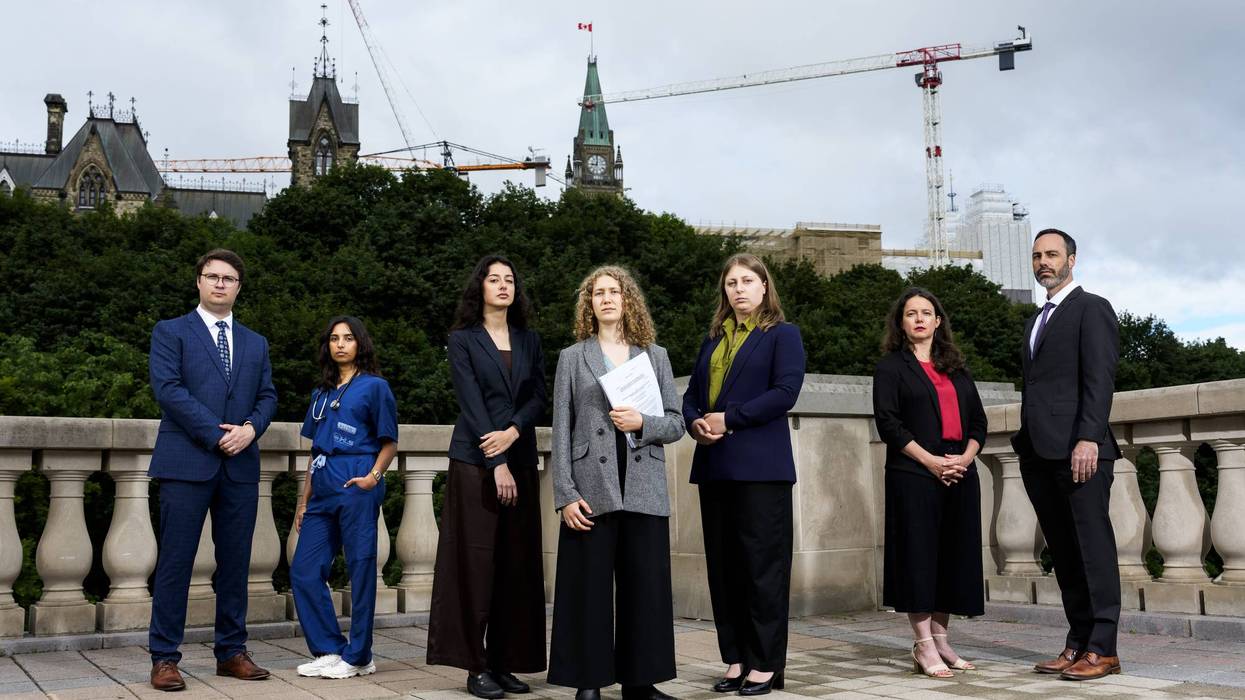
"Everyone in Canada deserves to be safe and healthy," said one organization leader. "Instead, our government is putting people at risk by dismantling key climate policies without a credible plan to reduce emissions."
"You cannot abandon the map and still expect to reach your destination. Yet that's exactly what the federal government has done with its 2030 climate plan."
That's according to Charlie Hatt, climate director at Ecojustice, Canada's largest environmental law charity and one of the groups that partnered with a trio of young citizens this week to challenge Prime Minister Mark Carney's "failure" to bring the country's 2030 emissions reduction plan into compliance with a key federal law.
"Right now, its only climate plan is a plan to fail—and that's not just irresponsible, it's unlawful under the Canadian Net-Zero Emissions Accountability Act," said Hatt. "Neither the climate nor the law can tolerate rollbacks today in exchange for promises of action many years from now."
The act requires the federal government to set science-based climate goals, create a plan to achieve them, and report on its progress. However, Carney has recently pursued various rollbacks and boosted fossil fuel development, putting his nation's 2030 emissions reduction target out of reach—which the groups and young people argued violates the law.
"Everyone in Canada deserves to be safe and healthy," said Dr. Samantha Green, president of the Canadian Association of Physicians for the Environment. "Instead, our government is putting people at risk by dismantling key climate policies without a credible plan to reduce emissions. Climate change is not an abstract future threat: It is a public health emergency that is already harming patients and communities across Canada. That's why CAPE is joining this lawsuit."
The fossil fuel-driven climate emergency isn't just a danger to public health. As Environmental Defence's Julia Levin noted, Canadians "are paying the price through wildfires, heat domes, rising food insecurity, and high costs of living."
"PM Carney is betraying Canadians by taking a wrecking ball to our hard-fought climate progress," Levin declared, accusing the Liberal Party leader of following in the footsteps of Big Oil-backed Republican US President Donald Trump.
"The rest of the world is rapidly adopting clean energy systems that are already more reliable, affordable, and secure than fossil fuels," she said. "Meanwhile, our prime minister is copying President Trump's playbook, ensuring that Canada will be left behind."
Carney's climate policies as prime minister—especially compared with how he talked about the crisis before rising to his current position last year—have frustrated many citizens and left "climate-anxious voters... feeling a major case of buyer's remorse, disoriented by the dissonance between who they thought they were supporting and a climate plan that is now a complete shambles," as Canadian climate writer and activist Seth Klein wrote for The Guardian last month.
Youth applicants in the new legal fight made that frustration clear on Tuesday. Montréal, Quebec-based climate organizer Shirley Barnea said that "the Carney government's gutting of climate policy is a massive insult. After presenting himself as a climate leader, our prime minister is now abdicating responsibility—to Canadians, to future generations, to the law. As long as governments continue ignoring climate science and rolling back protections for our futures, young people will continue taking them to court."
Marie Maltais, who is from Sainte-Catherine-de-la-Jacques-Cartier, Québec, and has advocated for the climate since her early teens, said that "my generation has grown up surrounded by climate disasters and broken political promises to address them. We're told to trust the government's climate commitments—but commitments mean nothing without a real plan behind them."
Sudbury, Ontario-based Sophia Mathur, an early participant in Greta Thunberg's Fridays for Future movement who recently met with Carney and urged him to keep his climate promises, added that "young people are being handed the consequences of decisions we didn't make. We are going to live with the impacts of unchecked climate change for the rest of our lives—so we're standing up for our futures, now."
The young citizens and advocacy groups are seeking a court order that would compel Carney to comply with the Canadian Net-Zero Emissions Accountability Act, stressing that "climate change is an existential threat to all Canadians."
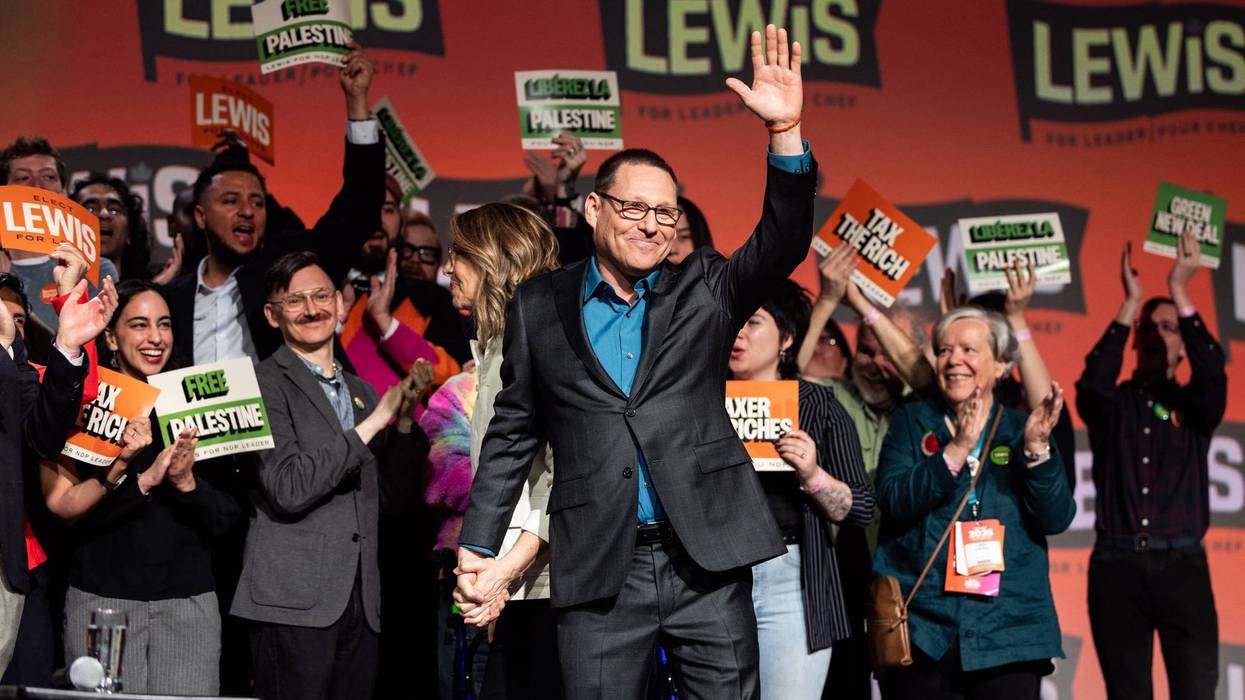
"The NDP will start winning again because we will become that beacon to the 99%," Lewis said.
Progressive activist Avi Lewis is pledging to bring Canada's New Democratic Party "out of the wilderness" after being decisively elected as its new leader on Sunday on the back of an ambitious, affordability-focused agenda aimed at winning back working-class voters.
Lewis, the grandson of one of the NDP's cofounders, cruised to a resounding victory, earning 56% of the vote to take over leadership of the long-ailing left-wing party, which has bled members in recent years to both Prime Minister Mark Carney's Liberals and Pierre Poilievre's Conservatives.
He was introduced at Sunday's Winnipeg convention by his wife, the acclaimed author and activist Naomi Klein, who said her husband's victory was an invitation for Canadians to “dream big once again" and renew the fight against corporate greed at a time when more than half of the population says they struggle to afford basic necessities.
Lewis has proposed a sweeping agenda of “public options” aimed at combating Canada’s affordability crisis, including publicly owned grocery stores and banks to compete with price-gouging corporate monopolies.
A scion of the party that helped to build Canada’s universal healthcare system—which covers hospital and physician care—he’s called for it to be expanded into a “head-to-toe” care system that guarantees dental, drugs, vision, hearing, and mental health services for all Canadians.
In order to pay for these programs and others—including public housing, green energy investment, and subsidized phone and internet plans—Lewis has campaigned to pass a wealth tax on the richest 1% of Canadians, who own nearly $1.25 trillion, almost as much as the bottom 80% of Canadians, according to a recent report by Oxfam Canada.
"This country is awash in wealth. We can have nice things," Lewis asserted to a raucous crowd during his acceptance speech. "Banks made $70 billion in profits last year alone. Oil companies are expecting a new windfall in the tens of billions. Grocery baron Galen Weston alone is worth $20 billion."
During his campaign, Lewis railed against tax cuts for wealthy Canadians passed by the Liberal government, which are projected to cost the government nearly $76 billion over five years and slash an estimated 57,000 public-sector jobs by 2028.
"It is time, far past time, to properly tax the billionaires and corporations that have been riding a tidal wave of profit," Lewis said.
While he acknowledged that Carney is still largely popular in Canada, in large part due to his fiery denunciations of US President Donald Trump's tariff war and threats to annex Canada, Lewis argued that the prime minister's revulsion toward Trumpism is only skin-deep.
"I think when you connect the dots, his moves do not add up to the vision that Canadians truly want and deserve in this perilous moment," he said. "Half a trillion dollars in a decade for weapons to make Canada a major arms exporter in a war-torn world. Slashing our cherished public services, sweeping aside indigenous rights... No regulations on AI and pipelines."
"In the last federal election, Canadians voted to say no to Trump and Trumpism," Lewis said. "What they're getting instead is our government following the US into a future of wars, fossil fuels, austerity, and job-killing generative AI."
Lewis will face a difficult task ahead in rebuilding the NDP from a disastrous loss of support under its previous leader, Jagmeet Singh, who stepped down from his post after the party suffered the worst defeat in its history during last April’s elections, dropping to just seven seats in Parliament—not even enough to be considered a “recognized” party.
The role of NDP leader is the highest office Lewis has held in his life, having run two failed campaigns for parliament in his native Vancouver in 2021 and 2025.
Though NDP currently sits at a distant third, with only about 7% support according to an Abacus poll from March, other polls show that their positions, including a wealth tax and expanding federal health coverage, are popular with the vast majority of voters across party lines.
Other polls show that Canadians, especially those with low incomes, increasingly view affordability and inequality as pressing issues, especially as Trump's war against Iran has caused global energy shortages and price hikes.
"The NDP is coming back because we know that a thriving world is possible, and we know who is standing in our way, and there are way more of us than there are of them," Lewis said. "The NDP will start winning again because we will become that beacon to the 99%."
Ottawa has expressed concern, called for deescalation, and urged all parties to respect international law, but it has avoided naming responsibility and evaded confronting its closest ally.
The world is witnessing yet another manufactured humanitarian catastrophe unfolding in plain sight in Cuba. This crisis is not the result of any internal collapse or mismanagement. It is the deliberate outcome of United States policy, a policy of collective punishment designed to impose economic suffocation on an entire population to extract political change. President Donald Trump has openly declared his intention to overthrow the Cuban government by year’s end, meaning Washington is transforming its decades-old blockade into a full-scale siege. The Trump administration has absurdly designated the small, peaceful Caribbean nation as “an unusual and extraordinary threat” to the United States, weaponizing tariffs and economic coercion against any country that dares to sell oil to Cuba.
The consequences are immediate and impossible to ignore. Cuban authorities have announced that jet fuel will be unavailable at airports across the country starting this week, disrupting airport operations and grounding both domestic and international carriers. Canadian airlines have already announced contingency plans for flights to and from Cuba, assessing reroutes, suspensions, and assistance for stranded travelers. But aviation is only the most visible edge of a far deeper collapse. If Cuba’s energy infrastructure fails, people will die. This is not a metaphor. It is inevitable. Without electricity, food cannot be grown, preserved, or transported. Medicines cannot be produced, refrigerated, or administered. Hospitals cannot operate. Ambulances, incubators, and ventilators will stop.
This deprivation is not at all incidental. It is intentional. Administration officials and the extreme right Cuban American political establishment have been explicit: The goal is to inflict suffering, to manufacture hunger, medicine shortages, and nationwide blackouts as instruments of regime change. Washington’s intentions could not be clearer. The United States is attempting to strangle an entire nation into submission.
While the US pursues this deliberate campaign of suffering, Ottawa has once again chosen the path of procedural dithering, offering words instead of action. Canada’s response, to no one’s surprise, has been another Kafkaesque exercise in bureaucratic evasion. When Senator Yuen Pau Woo asked officials from the Senate Committee on Foreign Affairs and International Trade what Canada is doing to prevent this potentially catastrophic humanitarian disaster in Cuba, the exchange exposed more absence than action. Pressed for specifics, the response was: “There are no specifics.” The officials further conceded that “there is no humanitarian response plan for Cuba that I’m aware of,” explaining that Canada’s engagement has been framed as “more looking at the development context and not the humanitarian context.”
Canada is not responsible for US actions. But it is responsible for its response to them.
In practice, this distinction functions as a delay mechanism. The government is “looking into the matter,” as it so often does, deferring urgency behind the process while conditions deteriorate. The latency appears less accidental than structural. And, as usual, no timeline has been offered, no indication of when this period of observation will end, or when statements will give way to action.
This pattern is not all new, nor is it confined to Cuba. It is, in fact, a continuation of a long record of calibrated restraint and strategic silence. Canada’s response over the past few years has been consistent, predictable, and deeply inadequate. By now, Canada has perfected the art of tactful bystanding, present in language, absent in consequence. Ottawa has expressed concern, called for deescalation, and urged all parties to respect international law, but it has avoided naming responsibility and evaded confronting its closest ally. Canada criticizes outcomes while refusing to challenge the very system that produces them. This is simply appeasement dressed up as diplomacy. While statements are issued, the systems that produce these horrors remain untouched, leaving ordinary people, Palestinians, Venezuelans, Iranians, and now Cubans, to bear the consequences.
For the past two years, the United States has funded and enabled genocide in Gaza, where tens of thousands of civilians have been killed with US weapons, under US protection, with full knowledge that no meaningful consequences will follow. A recent Al Jazeera investigation revealed that US-supplied thermal and thermobaric munitions, burning at 3,500°CC, effectively evaporated nearly 3,000 Palestinians, leaving no trace of their bodies, a stark illustration of unchecked barbarism. And as we speak, Israeli authorities are reportedly preparing to execute Palestinian prisoners under mandatory death penalties in military courts for vaguely defined “terrorism” offenses, laws applied only to Palestinians. And yet Canada, despite claiming to have imposed an arms embargo, continues to supply ammunition and weapons parts that fuel this violence. Canadian factories produce fighter jet components, explosives, and munitions that flow through US channels directly into the assault, sustaining the machinery of death while Ottawa issues carefully worded statements of concern.
This silence is not confined to Gaza. After the United States launched strikes on Iranian nuclear sites, Ottawa responded with bland calls for calm and diplomacy. Still, it deliberately refrained from directly condemning Washington’s military action, instead echoing cautious G7 language about negotiation without even naming the US role in the escalation.
And when the US carried out large‑scale strikes in Venezuela and captured its president, Canada’s official statement did not even bother to mention the United States. And, instead offered abstract calls for all parties to “uphold international law” while leaving Washington’s unilateral intervention unchallenged.
In each case, Ottawa paid lip service to restraint while leaving raw power untouched, exposing how Ottawa’s posture has consistently privileged diplomatic caution over moral accountability.
Although recently, it did seem that Canada’s posture might be shifting, tellingly, not because of mass civilian deaths abroad. The change came only when US military adventurism edged closer to home. Prime Minister Mark Carney’s warnings about a collapsing rules-based international order only came after the US threatened Greenland, a territory tied to NATO allies and Arctic stability. Only then did Canada speak clearly about sovereignty, coercion, and the dangers of unchecked power. The timing is telling. It suggests Canada perceives the risks of impunity only when they threaten Western interests or its own proximity, while the devastation inflicted on others remains effectively invisible.
Even then, the response has remained largely rhetorical.
When Canada’s response to ICE’s documented brutalities of its own citizens is so plainly inadequate, it comes as no surprise that its response to US aggression abroad is equally hollow and insufficient.
And now, as the humanitarian catastrophe looms in Cuba, Canada appears to be relying on verbal gymnastics to maintain political correctness while avoiding meaningful action. Even though, on paper, Ottawa opposes US sanctions and the blockade, in practice, it offers no condemnation, no advocacy, and no protection for ordinary Cubans facing hunger, blackouts, and collapsing hospitals. Suffice it to say, Canada has by now perfected the role of silent bystander to nearly an art form.
Today, the mechanisms that enable atrocity, impunity, exceptionalism, and allied silence are on full display and fully operational, and Cuba is simply the latest victim. To call the United States’ behavior “outside the spirit of international law” would be a grotesque understatement. Washington treats international law as optional, shielding mass civilian slaughter through diplomatic vetoes, launching unilateral strikes with impunity, and sustaining devastation through overwhelming military support.
Canada is not responsible for US actions. But it is responsible for its response to them. Ottawa has deliberately hidden behind bureaucratic loopholes while allowing Canadian-made weapons components and ammunition to move through US supply chains and into Israel, insulating itself from accountability while profiting from the machinery of war. Carney’s government has offered no clear or urgent plan on Bill C-233, legislation intended to curb Canadian arms exports where there is a risk of war crimes. The bill continues to hang in limbo, while Canada remains embedded in US military supply chains. Canadian-made F-35 components and ammunition continue to flow to the United States, where end-use accountability effectively disappears. Simultaneously, Canada continues to export armoured vehicles and security equipment to US agencies, including Immigration and Customs Enforcement (ICE), an institution that has detained Canadian citizens without explanation, due process, or urgency.
When Canada’s response to ICE’s documented brutalities of its own citizens is so plainly inadequate, it comes as no surprise that its response to US aggression abroad is equally hollow and insufficient. None of the people affected by the US aggression—Palestinians, Iranians, Venezuelans, Cubans, or others subjected to unilateral force—believe that Canada is in their corner in any meaningful way. None. Canada’s response serves no protective function at all. It is a calculated performance of concern, engineered to evade moral obligation without disrupting US power.
If Canada genuinely wants to make a difference, it can start with something simple and immediate: Sell essential goods to Cuba, food, fuel, and medicine. Not statements. Not carefully worded press releases. Tangible relief that keeps lights on, shelves stocked, and patients alive. Yet, as so often before, Ottawa may retreat behind another polished, empty statement while taking no meaningful action.
Ottawa’s approach is built on a reckless assumption that Trump’s chaos is governed by strategy, that US volatility is calculable, and that Canada will somehow remain exempt. That illusion has already collapsed. The same contempt for international law has now extended to Greenland, with explicit annexation threats aimed at allies. If Canada continues to hedge, appease, and delay rather than act on principle, it should not expect any support when its own sovereignty is challenged. Silence does not buy safety. It only invites escalation. If Canada does not adjust its course, it may find that when threats strike closer to home, there will be no one left willing to stand alongside it.
For those in Washington who assume the old alliances will endure regardless of how allies are treated, Canada's actions show the old order really is not coming back.
Canadian Prime Minister Mark Carney’s speech at the World Economic Forum on January 20 was not an exercise in pique. It was the clearest articulation yet of a strategic shift that has profound implications—not just for US-Canada relations, but for the entire structure of American alliances worldwide.
Carney told the Davos audience that “the old order is not coming back” and that the rules-based international system was always “partially false.” The strongest exempted themselves when convenient, trade rules were enforced asymmetrically, and Canada “placed the sign in the window” while avoiding the gaps between rhetoric and reality. That bargain, he declared, no longer works. Canada is now building what Carney called “strategic autonomy”—the capacity to feed itself, fuel itself, and defend itself without depending on the United States.
The speech codified what six months of frenetic diplomacy had already demonstrated. Since taking office, Carney has signed 12 trade and security agreements across four continents. Canada has joined the European Union’s €150 billion Security Action for Europe (SAFE) defense procurement program; the first non-European nation admitted. Recently, Carney announced a strategic partnership with Xi Jinping and opened Canadian markets to Chinese electric vehicles. Ottawa has committed to the largest military spending increase since World War II, deliberately structured to reduce reliance on American defense contractors.
This matters beyond North America because Canada was, until recently, the test case for deep integration with the United States. More than 75% of Canadian exports went south. Supply chains, especially in automotive and energy, were seamlessly continental. Defense was jointly managed through NORAD. If any country had conclusively answered the question of whether binding one’s self to American hegemony was safe, it was Canada.
When allies begin describing authoritarian rivals as more reliable than the United States, something fundamental has broken.
The answer, Ottawa has now concluded, is no. And that conclusion is being watched carefully in Brussels, Tokyo, Canberra, and Seoul.
The proximate cause is the Trump administration’s tariffs, threats to abandon the US-Mexico-Canada Agreement, and repeated suggestions that Canada should become the 51st US state. But Carney’s Davos speech made clear that the problem runs deeper than one administration. The issue is structural: American policy now swings so dramatically between presidencies that commitments made by one administration cannot be trusted to survive the next. For allies making decade-long investments in defense procurement, energy infrastructure, or trade relationships, this volatility is intolerable.
Carney borrowed a framework from Finnish President Alexander Stubb: “values-based realism.” Canada will remain committed to sovereignty, human rights, and international law in principle. However, Canada will be pragmatic about working with partners who do not share those values. This explains the China pivot. Beijing is not a trustworthy partner, and Canadians know this better than most after the arbitrary detention of the two Michaels—Michael Spavor and Michael Kovrig—in 2018 (and released in 2021). But China is predictable in ways that Washington no longer is. As Carney noted in Beijing, the relationship with China is now “more predictable” than the one with the United States.
That statement should alarm policymakers in Washington far more than any tariff retaliation. When allies begin describing authoritarian rivals as more reliable than the United States, something fundamental has broken.
The Canadian pivot also reveals the limits of geographical determinism. American analysts have long assumed that Canada has no real alternatives; that proximity and integration lock Ottawa into the US orbit regardless of policy. Carney is testing that assumption. The Trans Mountain pipeline now ships Canadian oil to Asia. Liquefied natural gas terminals are under construction for Pacific exports. The EU defense partnership opens European procurement to Canadian manufacturers.
Canada cannot replace American trade overnight, but it can build sufficient alternatives to survive without it. That is precisely what Carney has pledged: doubling non-US exports within 10 years.
For other US allies, the lesson is clear. If Canada, the most integrated, most proximate, most culturally similar American ally, has concluded that dependence on Washington is too risky, then no alliance is safe from reassessment. The Europeans are already drawing similar conclusions. The EU’s Mercosur deal and accelerated talks with Japan and South Korea reflect the same diversification logic. Even Australia, historically the most reliable US partner in the Indo-Pacific, is quietly exploring options.
None of this necessarily serves those allies’ long-term interests. China is not a benign alternative to American hegemony. The middle-power coalitions Carney envisions may lack the capacity to provide genuine security. And the economic costs of unwinding continental integration will be substantial. Canada’s gamble may yet prove to be a mistake.
But that is not the point. America’s closest ally has made a rational decision, based on observed evidence, that the United States can no longer be trusted, and is acting accordingly. Other allies are making similar calculations. The network of relationships that has amplified American power since 1945 is fraying, and American policy is what’s fraying it.
Carney closed his Davos speech with a line that deserves attention beyond Ottawa: “Nostalgia is not a strategy.” For those in Washington who assume the old alliances will endure regardless of how allies are treated, the warning applies with equal force. The old order really is not coming back. The question is what replaces it, and whether the United States will have any role in building it.