SUBSCRIBE TO OUR FREE NEWSLETTER
Daily news & progressive opinion—funded by the people, not the corporations—delivered straight to your inbox.
5
#000000
#FFFFFF
To donate by check, phone, or other method, see our More Ways to Give page.
Daily news & progressive opinion—funded by the people, not the corporations—delivered straight to your inbox.
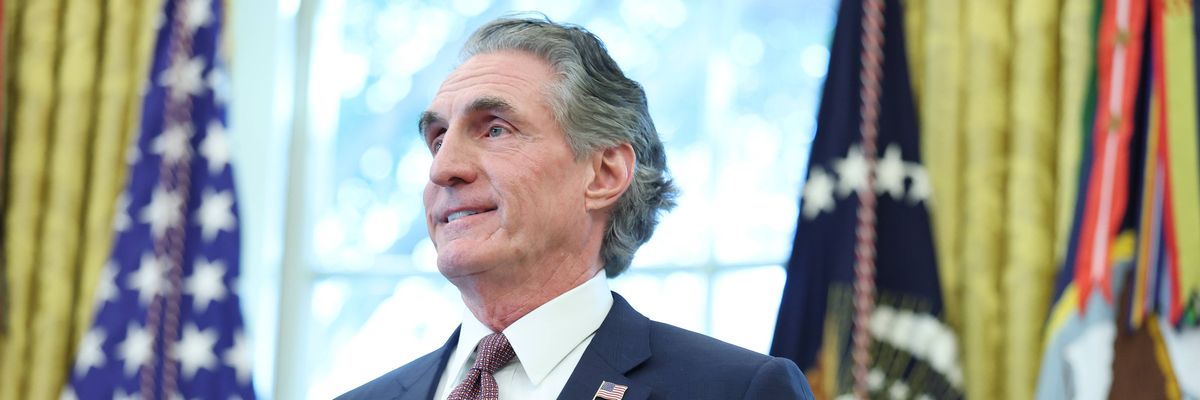
US Interior Secretary Doug Burgum speaks during an event with President Donald Trump in the Oval Office at the White House on October 6, 2025 in Washington, DC.
“Burgum’s actions on offshore wind appear to be motivated by the personal financial interests of those in the administration, not our collective national interests."
A week after the US Department of the Interior said it was immediately halting five offshore wind projects in the interest of "national security," a watchdog group told congressional committees Monday that the move is "not legally defensible" and raises "significant" questions about conflicts of interest concerning a top DOI official's investments in fossil gas.
Timothy Whitehouse, executive director of Public Employees for Environmental Responsibility (PEER), wrote to the top members of the Senate Energy and Natural Resources Committee and the House Committee on Natural Resources regarding the pause on projects off the coasts of Virginia, New York, Rhode Island, Connecticut, and Massachusetts—projects that account for billions of dollars in investment, employ thousands of people, and generate sustainable energy for roughly 2.5 million homes and businesses.
The announcement made by Interior Secretary Doug Burgum last week pertained to "five vague, perfunctory, cookie-cutter orders" halting the projects, wrote Whitehouse, but PEER is concerned that the orders were issued to evade the Congressional Review Act (CRA), under which the action to halt the projects likely constitutes a "major rule."
Whitehouse explained:
Under the CRA, a rule that meets any one of three criteria (an annual effect on the economy of $100,000,000 or more; a major increase in costs or prices for consumers, individual industries, federal, state, or local government agencies, or geographic regions; or in pertinent part significant adverse effects on competition, employment, investment, productivity, or innovation) is a major rule. Interior’s pause likely meets all three.
As a major rule under the CRA, the pause cannot take effect until at least 60 days after BOEM provides Congress the requisite notification and report under the CRA, which, according to GAO’s database, has not yet occurred. Congress must use its oversight authority to unveil the truth and, as appropriate, and to enforce the rule of law.
He said in a statement that “Burgum’s move is designed to bypass all congressional and public input."
The CRA states that a rule is "the whole or a part of an agency statement of general or particular applicability and future effect designed to implement, interpret, or prescribe law or policy or describing the organization, procedure, or practice requirements of an agency.”
Press statements by the DOI and by Burgum last week were "statements of general applicability and imminent future effect, designed to implement policy," wrote Whitehouse, who also said the interior secretary embarked on "a coordinated rollout with Fox News entities."
On December 22, Fox anchor Maria Bartiromo asked Burgum at 8:00 am Eastern, “What next action did you want to tell us about this morning?” Five minutes later, FoxNews.com published its first story on Burgum's orders, citing a press release that had not yet been made public and including a quote from the secretary about the "emerging national security risk" posed by the offshore wind projects.
"If last week’s actions are allowed to stand, future presidents will have unchecked authority under the guise of national security to target federal leases related to entire disfavored energy industries for political purposes."
Burgum's announcement to Fox came at least one to two hours before Bureau of Ocean Energy Management (BOEM) acting Director Matthew Giacona provided the orders to the lessees running the five wind projects.
Further, wrote Whitehouse, "Burgum’s voluminous public comments in the hours and days since the pause further show the true purpose of Interior’s singular action."
"The national security pretext quickly gives way to broad and spurious talking points about the 'Green New Scam,' how 'wind doesn’t blow 24-7' (evincing Burgum’s seeming unfamiliarity with energy storage technologies), and unyielding promotion of liquified natural gas projects," wrote Whitehouse.
Aside from the alleged illegality of Burgum's order, PEER pointed to Giacona's potential conflicts of interest with BOEM operations and specifically with halting wind projects. Giacona is a "diligent filer" of financial disclosure forms required by the Ethics in Government Act, noted Whitehouse—but those forms point to potential benefits he may reap from shutting down offshore wind infrastructure.
Giacona reported his purchase of interests in the United States Natural Gas Fund (UNG) on September 16. The fund tracks daily price movements of "natural" gas delivered at the Henry Hub in Louisiana and is subject to regulation by the Commodity Futures Trading Commission.
"Accordingly, a government employee who has an interest in UNG also has a potential conflict of interest with the underlying holdings of UNG (currently primarily natural gas futures contracts at the Henry Hub)," wrote Whitehouse.
PEER does not know whether Giacona continues to hold a financial interest in UNG or whether the offshore wind pause will have a "direct and predictable effect on a financial interest in UNG," but Whitehouse noted that Burgum and DIO have entwined the pause with the promotion of liquefied natural gas.
"It is disconcerting that Mr. Giacona temporarily had even a de minimis financial interest in natural gas futures while also leading the agency that manages the development of natural gas resources on the outer continental shelf," wrote Whitehouse, adding that Giacona also sold interests in the United States Oil Fund on September 3, while overseeing BOEM.
Based on Giacona's investments, said Whitehouse, “Burgum’s actions on offshore wind appear to be motivated by the personal financial interests of those in the administration, not our collective national interests. This is another misguided step in transforming the federal government into a franchise of the fossil fuel industry.”
“On public lands across the United States, the Department of the Interior has tens of thousands of additional active leases related to oil, gas, wind, solar, and geothermal production and mining for energy-related minerals," he added. "If last week’s actions are allowed to stand, future presidents will have unchecked authority under the guise of national security to target federal leases related to entire disfavored energy industries for political purposes."
Dear Common Dreams reader, It’s been nearly 30 years since I co-founded Common Dreams with my late wife, Lina Newhouser. We had the radical notion that journalism should serve the public good, not corporate profits. It was clear to us from the outset what it would take to build such a project. No paid advertisements. No corporate sponsors. No millionaire publisher telling us what to think or do. Many people said we wouldn't last a year, but we proved those doubters wrong. Together with a tremendous team of journalists and dedicated staff, we built an independent media outlet free from the constraints of profits and corporate control. Our mission has always been simple: To inform. To inspire. To ignite change for the common good. Building Common Dreams was not easy. Our survival was never guaranteed. When you take on the most powerful forces—Wall Street greed, fossil fuel industry destruction, Big Tech lobbyists, and uber-rich oligarchs who have spent billions upon billions rigging the economy and democracy in their favor—the only bulwark you have is supporters who believe in your work. But here’s the urgent message from me today. It's never been this bad out there. And it's never been this hard to keep us going. At the very moment Common Dreams is most needed, the threats we face are intensifying. We need your support now more than ever. We don't accept corporate advertising and never will. We don't have a paywall because we don't think people should be blocked from critical news based on their ability to pay. Everything we do is funded by the donations of readers like you. When everyone does the little they can afford, we are strong. But if that support retreats or dries up, so do we. Will you donate now to make sure Common Dreams not only survives but thrives? —Craig Brown, Co-founder |
A week after the US Department of the Interior said it was immediately halting five offshore wind projects in the interest of "national security," a watchdog group told congressional committees Monday that the move is "not legally defensible" and raises "significant" questions about conflicts of interest concerning a top DOI official's investments in fossil gas.
Timothy Whitehouse, executive director of Public Employees for Environmental Responsibility (PEER), wrote to the top members of the Senate Energy and Natural Resources Committee and the House Committee on Natural Resources regarding the pause on projects off the coasts of Virginia, New York, Rhode Island, Connecticut, and Massachusetts—projects that account for billions of dollars in investment, employ thousands of people, and generate sustainable energy for roughly 2.5 million homes and businesses.
The announcement made by Interior Secretary Doug Burgum last week pertained to "five vague, perfunctory, cookie-cutter orders" halting the projects, wrote Whitehouse, but PEER is concerned that the orders were issued to evade the Congressional Review Act (CRA), under which the action to halt the projects likely constitutes a "major rule."
Whitehouse explained:
Under the CRA, a rule that meets any one of three criteria (an annual effect on the economy of $100,000,000 or more; a major increase in costs or prices for consumers, individual industries, federal, state, or local government agencies, or geographic regions; or in pertinent part significant adverse effects on competition, employment, investment, productivity, or innovation) is a major rule. Interior’s pause likely meets all three.
As a major rule under the CRA, the pause cannot take effect until at least 60 days after BOEM provides Congress the requisite notification and report under the CRA, which, according to GAO’s database, has not yet occurred. Congress must use its oversight authority to unveil the truth and, as appropriate, and to enforce the rule of law.
He said in a statement that “Burgum’s move is designed to bypass all congressional and public input."
The CRA states that a rule is "the whole or a part of an agency statement of general or particular applicability and future effect designed to implement, interpret, or prescribe law or policy or describing the organization, procedure, or practice requirements of an agency.”
Press statements by the DOI and by Burgum last week were "statements of general applicability and imminent future effect, designed to implement policy," wrote Whitehouse, who also said the interior secretary embarked on "a coordinated rollout with Fox News entities."
On December 22, Fox anchor Maria Bartiromo asked Burgum at 8:00 am Eastern, “What next action did you want to tell us about this morning?” Five minutes later, FoxNews.com published its first story on Burgum's orders, citing a press release that had not yet been made public and including a quote from the secretary about the "emerging national security risk" posed by the offshore wind projects.
"If last week’s actions are allowed to stand, future presidents will have unchecked authority under the guise of national security to target federal leases related to entire disfavored energy industries for political purposes."
Burgum's announcement to Fox came at least one to two hours before Bureau of Ocean Energy Management (BOEM) acting Director Matthew Giacona provided the orders to the lessees running the five wind projects.
Further, wrote Whitehouse, "Burgum’s voluminous public comments in the hours and days since the pause further show the true purpose of Interior’s singular action."
"The national security pretext quickly gives way to broad and spurious talking points about the 'Green New Scam,' how 'wind doesn’t blow 24-7' (evincing Burgum’s seeming unfamiliarity with energy storage technologies), and unyielding promotion of liquified natural gas projects," wrote Whitehouse.
Aside from the alleged illegality of Burgum's order, PEER pointed to Giacona's potential conflicts of interest with BOEM operations and specifically with halting wind projects. Giacona is a "diligent filer" of financial disclosure forms required by the Ethics in Government Act, noted Whitehouse—but those forms point to potential benefits he may reap from shutting down offshore wind infrastructure.
Giacona reported his purchase of interests in the United States Natural Gas Fund (UNG) on September 16. The fund tracks daily price movements of "natural" gas delivered at the Henry Hub in Louisiana and is subject to regulation by the Commodity Futures Trading Commission.
"Accordingly, a government employee who has an interest in UNG also has a potential conflict of interest with the underlying holdings of UNG (currently primarily natural gas futures contracts at the Henry Hub)," wrote Whitehouse.
PEER does not know whether Giacona continues to hold a financial interest in UNG or whether the offshore wind pause will have a "direct and predictable effect on a financial interest in UNG," but Whitehouse noted that Burgum and DIO have entwined the pause with the promotion of liquefied natural gas.
"It is disconcerting that Mr. Giacona temporarily had even a de minimis financial interest in natural gas futures while also leading the agency that manages the development of natural gas resources on the outer continental shelf," wrote Whitehouse, adding that Giacona also sold interests in the United States Oil Fund on September 3, while overseeing BOEM.
Based on Giacona's investments, said Whitehouse, “Burgum’s actions on offshore wind appear to be motivated by the personal financial interests of those in the administration, not our collective national interests. This is another misguided step in transforming the federal government into a franchise of the fossil fuel industry.”
“On public lands across the United States, the Department of the Interior has tens of thousands of additional active leases related to oil, gas, wind, solar, and geothermal production and mining for energy-related minerals," he added. "If last week’s actions are allowed to stand, future presidents will have unchecked authority under the guise of national security to target federal leases related to entire disfavored energy industries for political purposes."
A week after the US Department of the Interior said it was immediately halting five offshore wind projects in the interest of "national security," a watchdog group told congressional committees Monday that the move is "not legally defensible" and raises "significant" questions about conflicts of interest concerning a top DOI official's investments in fossil gas.
Timothy Whitehouse, executive director of Public Employees for Environmental Responsibility (PEER), wrote to the top members of the Senate Energy and Natural Resources Committee and the House Committee on Natural Resources regarding the pause on projects off the coasts of Virginia, New York, Rhode Island, Connecticut, and Massachusetts—projects that account for billions of dollars in investment, employ thousands of people, and generate sustainable energy for roughly 2.5 million homes and businesses.
The announcement made by Interior Secretary Doug Burgum last week pertained to "five vague, perfunctory, cookie-cutter orders" halting the projects, wrote Whitehouse, but PEER is concerned that the orders were issued to evade the Congressional Review Act (CRA), under which the action to halt the projects likely constitutes a "major rule."
Whitehouse explained:
Under the CRA, a rule that meets any one of three criteria (an annual effect on the economy of $100,000,000 or more; a major increase in costs or prices for consumers, individual industries, federal, state, or local government agencies, or geographic regions; or in pertinent part significant adverse effects on competition, employment, investment, productivity, or innovation) is a major rule. Interior’s pause likely meets all three.
As a major rule under the CRA, the pause cannot take effect until at least 60 days after BOEM provides Congress the requisite notification and report under the CRA, which, according to GAO’s database, has not yet occurred. Congress must use its oversight authority to unveil the truth and, as appropriate, and to enforce the rule of law.
He said in a statement that “Burgum’s move is designed to bypass all congressional and public input."
The CRA states that a rule is "the whole or a part of an agency statement of general or particular applicability and future effect designed to implement, interpret, or prescribe law or policy or describing the organization, procedure, or practice requirements of an agency.”
Press statements by the DOI and by Burgum last week were "statements of general applicability and imminent future effect, designed to implement policy," wrote Whitehouse, who also said the interior secretary embarked on "a coordinated rollout with Fox News entities."
On December 22, Fox anchor Maria Bartiromo asked Burgum at 8:00 am Eastern, “What next action did you want to tell us about this morning?” Five minutes later, FoxNews.com published its first story on Burgum's orders, citing a press release that had not yet been made public and including a quote from the secretary about the "emerging national security risk" posed by the offshore wind projects.
"If last week’s actions are allowed to stand, future presidents will have unchecked authority under the guise of national security to target federal leases related to entire disfavored energy industries for political purposes."
Burgum's announcement to Fox came at least one to two hours before Bureau of Ocean Energy Management (BOEM) acting Director Matthew Giacona provided the orders to the lessees running the five wind projects.
Further, wrote Whitehouse, "Burgum’s voluminous public comments in the hours and days since the pause further show the true purpose of Interior’s singular action."
"The national security pretext quickly gives way to broad and spurious talking points about the 'Green New Scam,' how 'wind doesn’t blow 24-7' (evincing Burgum’s seeming unfamiliarity with energy storage technologies), and unyielding promotion of liquified natural gas projects," wrote Whitehouse.
Aside from the alleged illegality of Burgum's order, PEER pointed to Giacona's potential conflicts of interest with BOEM operations and specifically with halting wind projects. Giacona is a "diligent filer" of financial disclosure forms required by the Ethics in Government Act, noted Whitehouse—but those forms point to potential benefits he may reap from shutting down offshore wind infrastructure.
Giacona reported his purchase of interests in the United States Natural Gas Fund (UNG) on September 16. The fund tracks daily price movements of "natural" gas delivered at the Henry Hub in Louisiana and is subject to regulation by the Commodity Futures Trading Commission.
"Accordingly, a government employee who has an interest in UNG also has a potential conflict of interest with the underlying holdings of UNG (currently primarily natural gas futures contracts at the Henry Hub)," wrote Whitehouse.
PEER does not know whether Giacona continues to hold a financial interest in UNG or whether the offshore wind pause will have a "direct and predictable effect on a financial interest in UNG," but Whitehouse noted that Burgum and DIO have entwined the pause with the promotion of liquefied natural gas.
"It is disconcerting that Mr. Giacona temporarily had even a de minimis financial interest in natural gas futures while also leading the agency that manages the development of natural gas resources on the outer continental shelf," wrote Whitehouse, adding that Giacona also sold interests in the United States Oil Fund on September 3, while overseeing BOEM.
Based on Giacona's investments, said Whitehouse, “Burgum’s actions on offshore wind appear to be motivated by the personal financial interests of those in the administration, not our collective national interests. This is another misguided step in transforming the federal government into a franchise of the fossil fuel industry.”
“On public lands across the United States, the Department of the Interior has tens of thousands of additional active leases related to oil, gas, wind, solar, and geothermal production and mining for energy-related minerals," he added. "If last week’s actions are allowed to stand, future presidents will have unchecked authority under the guise of national security to target federal leases related to entire disfavored energy industries for political purposes."