

SUBSCRIBE TO OUR FREE NEWSLETTER
Daily news & progressive opinion—funded by the people, not the corporations—delivered straight to your inbox.
5
#000000
#FFFFFF
To donate by check, phone, or other method, see our More Ways to Give page.
Daily news & progressive opinion—funded by the people, not the corporations—delivered straight to your inbox.
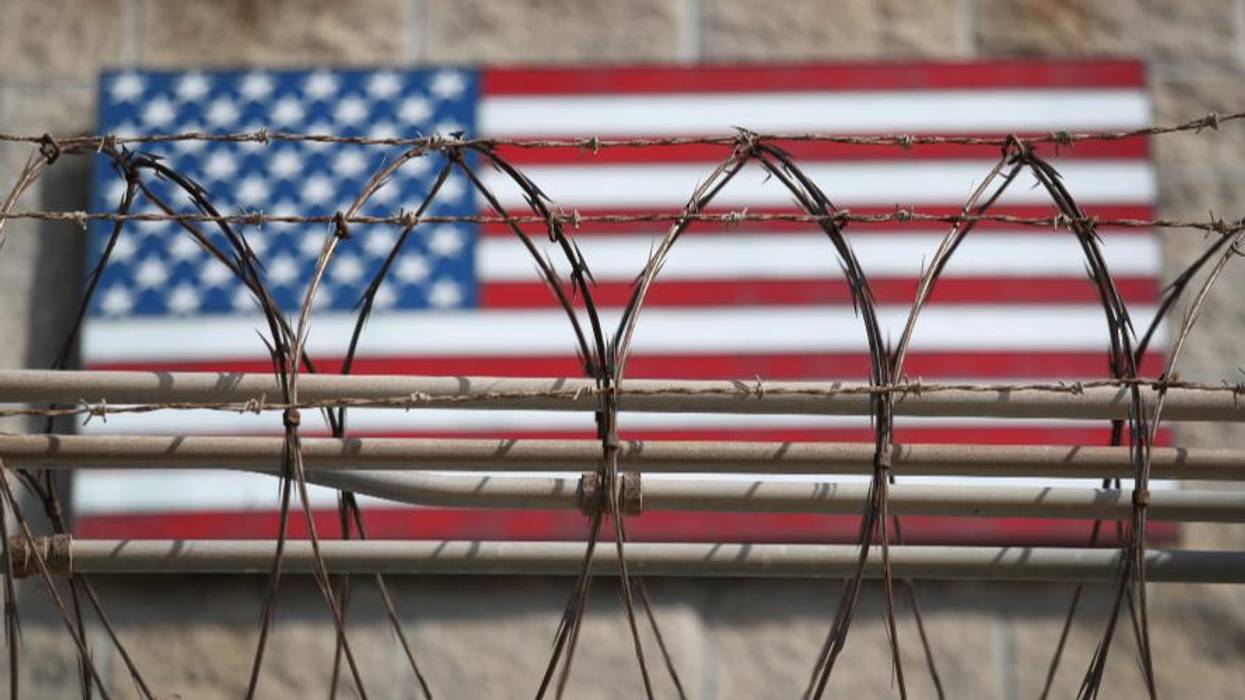
Many former detainees who have been repatriated to their home country or resettled in a third country have found themselves in either another prison or in what we call Guantánamo 2.0.
Shortly after the U.S. repatriated the cleared prisoner and Saudi engineer Ghassan Abdullah al-Sharbi to his home country, he disappeared, adding to the growing list of men who, once released from Guantánamo, walk into conditions much worse, including execution. Attempts to find these men are met with silence from the U.S. and the implicated countries. Why?
When given the opportunity to be transferred out of Guantánamo, it’s hard to think of any reason why any incarcerated person would want to stay. That is, unless they were going to be sent somewhere that likely could be or would be worse than the U.S.’ infamous offshore prison. This past March, Ghassan al-Sharbi, a Saudi engineer who was detained at Guantánamo for over two decades without trial, was transferred to his home country. Instead of being cause for celebration however, al-Sharbi feared for his life and shared his fears with a fellow prisoner with whom he was departing to Saudi Arabia.
Despite the fact that al-Sharbi cited threats from the Saudi delegation that had met with him in Guantánamo, and previously informed the International Committee of the Red Cross (ICRC) and the State Department that he did not want to return to his home country for safety reasons, his transfer back to Saudi Arabia was nevertheless authorized by Defense Secretary Lloyd J. Austin in September, following extensive diplomatic efforts by the Biden administration.
Those of us who remained in Guantánamo while our brothers were released heard shocking stories about their predicaments.
The Pentagon’s statement announcing al-Sharbi’s transfer home expressed gratitude to Saudi Arabia and other nations for their assistance in reducing the detainee population at Guantánamo Bay. The statement also said in part that “...in consultation with our partners in the Kingdom of Saudi Arabia, we completed the requirements for responsible transfer.” Of course, “responsible,” was left undefined and notably absent from the statement, as well as any mention of how al-Sharbi’s safety and rights as an ex-prisoner innocent of all charges would be assured or the exact circumstances surrounding his repatriation.
Upon being transferred, al-Sharbi was reportedly sick and on a hunger strike in protest of forced repatriation. According to a Guantánamo source, al-Sharbi allegedly cut his veins, resulting in significant bleeding that necessitated hospitalization. The act was purportedly driven by his apprehension of facing torture and execution in Saudi Arabia.
Unfortunately, as it turned out, al-Sharbi’s apprehensions about his safety in Saudi Arabia were not unfounded. In fact, since he was transferred to Saudi Arabia, he has effectively disappeared and no one including his family or his lawyer Sabrina Shroff—who expressed deep concerns prior to his repatriation—have been able to contact him, let alone receive any information about his well-being.
In correspondence with Shroff, the State Department exhibited a total disregard for al-Sharbi’s condition or whereabouts; Shroff stated that they “had been most unhelpful. Their response consists of a bunch of words—like the ones you read in a Hallmark card. Bunch of platitudes with zero information. No information as to his whereabouts in Saudi.” Given the almost complete and total disregard for the men’s fate, the State Department’s response is not surprising. However, it doesn’t make them any less accountable for being bystanders to Saudi violence.
The story of al-Sharbi’s ordeal began in the early 2000s when he was accused of being part of a group captured in Pakistan that was allegedly manufacturing explosive devices intended for use against U.S. soldiers in Afghanistan.
He was charged with “providing material support for terrorism.” Higher courts ruled that this charge was not recognized as an international war crime at the time of his alleged actions, which led to the case being dropped. Nevertheless, he was subjected to years of indefinite detention and suffered egregious human rights abuses including torture, including extreme sleep deprivation, isolation, and sexual abuse. He spent over a decade on hunger strikes protesting his imprisonment, and because of this he was subjected to force feeding, with serious physical health and psychological problems.
Instead of al-Sharbi receiving any adequate care or treatment for the abuse he has suffered, like other Guantánamo survivors transferred to Saudi Arabia, he will likely be sent to a transitional rehabilitation center. There is little that is transparent about the rehabilitation center and how it operates; however, the center’s precondition for release is an admission of guilt. This injustice raises the potential for coerced confessions.
While the repatriation of Ghassan Abdullah al-Sharbi is a stark reminder of the long-lasting consequences of the United States’ abysmal record at Guantánamo Bay, it raises urgent questions about the treatment of former prisoners upon release; the lack of accountability for human rights abuses not only at Guantánamo, but also afterwards; and the need for transparency in the repatriation process.
In addition to the disappearance of Ghassan Abdullah al-Sharbi, three other former Guantánamo prisoners were transferred to Saudi Arabia only to be detained once arriving. For example Mohammed al Qahtani was repatriated to Saudi Arabia almost exactly a year before al-Sharbi, on March 6, 2022, only to be disappeared upon his return home. In addition, Zayed al-Hussain (also known as Zaid al-Ghamdy), who was repatriated in 2007, and Mohammad al-Shumrani, who was repatriated in 2015, have both disappeared.
Al-Hussain was sentenced to 23 years in prison for refusing to shake hands with former Crown Prince Mohammed bin Nayef, and under the present Crown Prince Mohammed bin Salman, he has been sentenced to death by execution.
Al-Shumrani was sentenced shortly after his release to Saudi Arabia to eight years in detention for criticizing a judge at the court and for challenging the Saudi monarchy to a public debate. The Saudi prosecutor in charge of his case is seeking the death penalty, and a confidential source indicated that it is highly likely that al-Shumrani will in fact be executed.
According to an in-depth report on over 1,000 executions carried out in the kingdom since Crown Prince Mohammed bin Salman assumed power in 2015, the death penalty in Saudi Arabia has almost doubled. This year alone, Saudi Arabia has executed over 100 people. These numbers make the fate of the men even more worrisome—not to mention that the Saudi Embassy in Washington and the Saudi Ministry of Foreign Affairs have not responded to any questions about these men.
Despite the fact that the transfer out of Guantánamo was supposed to offer survivors some reprieve from the abuse at the prison, many of those who have been repatriated to their home country or resettled in a third country have found themselves in either another prison or in what we call Guantánamo 2.0. Those of us who remained in Guantánamo while our brothers were released heard shocking stories about their predicaments. This includes Uyghur prisoners being released to a refugee camp in Albania and having their beards forcibly shaved by the Albanian police; a prisoner who was resettled in Slovakia and beaten by police so severely he had to be hospitalized; and many former prisoners who have simply disappeared in prisons where they were abused, tortured, and killed..
One of the most shocking cases was the death of a man I knew and lived with for years in Guantánamo—the Arabic poet Asim al-Khalaqi, who was released to Kazakhstan in 2014. The Kazakh government has a long history of mistreating men released from Guantánamo, and survivors have no legal rights and are effectively under house arrest.
Al-Khalaqi had dreams to raise his family and publish his book of poetry, which he wrote in Guantánamo. But we heard he had suddenly died a few months after his release. The Kazakh government denied mistreating al-Khalaqi then and subsequently denied him medical care. When he fell ill, his family was not allowed to visit him. Moreover, aside from being denied visitations, his family was prevented from attending his funeral and receiving his body. With the utmost cruelty, the Kazakh secret service buried al-Khalaqi in a location that is unknown to this day.
Life after Guantánamo is filled with even more harrowing cases, including the stories of several men who were released to the UAE (in 2015, 16, and 17) as part of a resettlement agreement. These men—four Afghans, 18 Yemenis, and one Russian—found themselves in conditions they described as worse than Guantánamo because they were suffering brutal abuse at the hand of the UAE’s prison guards. While the Afghanis and Yemenis were eventually transferred back to their home countries, with some facing imprisonment again, Russian survivor Ravil Mingazov remains in solitary confinement.
“He is under constant harassment and abuse by the UAE prison guards,” a released prisoner stated in a text message when I asked about Mingazov. Last month Cage launched a campaign to highlight his ordeal and to push for his release. My attempts to reach the Embassy of the UAE in Washington and the UAE Ministry of Foreign Affairs for comment have been met with silence.
Rather than exhibiting any care or taking precautions for the well-being, safety, and security of survivors of Guantánamo, the U.S. State Department has continued to repatriate and send former prisoners to their home countries and third-party countries where they are denied basic rights as citizens and human beings.
The most recently released prisoner from Guantánamo, Saeed Bakhouch, was repatriated to Algeria in late April after 21 years of detention without charge. I have been tracking and working for his release since his repatriation. While his lawyer was assured by the State Department that he would be treated humanely, Bakhouch was subjected to intense interrogation by the Algerian secret service. He was denied legal representation and was deprived of his medicine as a way of pressuring him to confess to a false accusation of being linked to al Qaeda in order to prosecute him. Absurdly, he was charged with “swearing allegiance to Osama bin Laden,” a man he had never met, and he had never set foot in Afghanistan.
All our attempts to reach out to the State Department, the Algerian Embassy in Washington, and the Algerian Ministry of Foreign Affairs about Bakhouch’s case have been ignored.
Bakhouch was eventually released last October on parole awaiting a trial; his release came after the intervention of the U.N. rapporteur to Guantánamo Fionnuala Ní Aoláin
In the midst of this official silence, a few of us working to trace and try to assist released prisoners from Guantánamo to secure their rights are left to return to the U.S. State Department, who authorized these repatriations in the first place.
Rather than exhibiting any care or taking precautions for the well-being, safety, and security of survivors of Guantánamo, the U.S. State Department has continued to repatriate and send former prisoners to their home countries and third-party countries where they are denied basic rights as citizens and human beings. Moreover, the State Department has done nothing to track these cases. While lawyers, NGOs, and activists attempt to contact the State Department, they are often told that the U.S. government can’t intervene in how other countries treat former prisoners. However, in most cases the department does not even respond.
That’s why we will keep appealing to the U.S. government to:
This is the least the U.S. can do to attempt to repair the insidious legacy of Guantánamo.
Guantánamo is approaching its 22nd anniversary, and despite the passage of time, 30 individuals remain imprisoned in the military prison in the U.S. naval base in Guantánamo. Among them, 16 have been granted clearance for release but are still in a state of uncertainty.
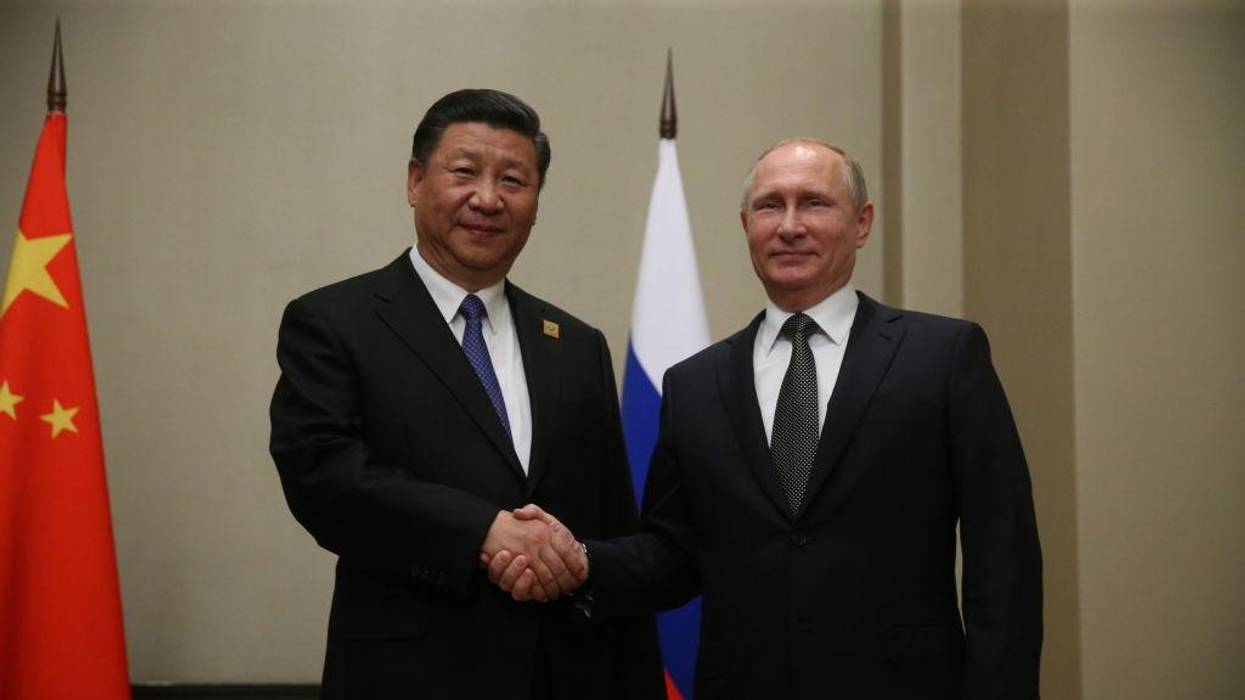
After publishing the first two editions of the Confessions of an Economic Hit Man trilogy, I was invited to speak at global summits. I met with heads of state and their top advisors from many countries. Two particularly significant venues were conferences in the summer of 2017 in Russia and Kazakhstan, where I joined an array of speakers that included major corporate CEOs, government and NGO heads such as UN Secretary-General António Guterres, Indian Prime Minister Narendra Modi, and (before he invaded Ukraine) Russian President Vladimir Putin. I was asked to speak on the need to end an unsustainable economic system that’s consuming and polluting itself into extinction — a Death Economy — and replace it with a regenerative one that was beginning to evolve — a Life Economy.
When I left for that trip, I felt encouraged. But something else happened.
In talking with leaders who had been involved in the development of China’s New Silk Road (officially, the Belt and Road Initiative, or BRI), I learned that an innovative, potent, and dangerous strategy was being implemented by China’s economic hit men (EHMs). It began to seem impossible to stop a country that in a few decades had pulled itself from the ashes of Mao’s Cultural Revolution to become a dominant world power and a major contributor to the Death Economy.
During my time as an economic hit man in the 1970s, I learned that two of the most important tools of the US EHM strategy are:
US EHMs maintain that the world is divided into the good guys (America and its allies) and the bad guys (the Soviet Union/Russia, China, and other Communist nations), and we try to convince people around the world that if they don’t accept neoliberal economics they’ll be doomed to remain “undeveloped” and impoverished forever.
Neoliberal policies include austerity programs that cut taxes for the rich and wages and social services for everyone else, reduce government regulations, and privatize public-sector businesses and sell them to foreign (US) investors — all of which support “free” markets that favor transnational corporations. Neoliberal advocates promote the perception that money will “trickle down” from the corporations and elites to the rest of the population. However, in truth, these policies almost always cause greater inequality.
Although the US EHM strategy has been successful in the short term at helping corporations control resources and markets in many countries, its failures have become increasingly obvious. America’s wars in the Middle East (while neglecting much of the rest of the world), the tendency of one Washington administration to break agreements made by previous ones, the inability of Republicans and Democrats to compromise, the wanton destruction of environments, and the exploitation of resources create doubts and often cause resentment.
China has been quick to take advantage.
Xi Jinping became president of China in 2013 and immediately began campaigning in Africa and Latin America. He and his EHMs emphasized that by rejecting neoliberalism and developing its own model, China had accomplished the seemingly impossible. It had experienced an average annual economic growth rate of nearly 10 percent for three decades and elevated more than 700 million people out of extreme poverty. No other country had ever done anything even remotely approaching this. China presented itself as a model for rapid economic success at home and it made major modifications to the EHM strategy abroad.
In addition to rejecting neoliberalism, China promoted the perception that it was ending the divide-and-conquer tactic. The New Silk Road was cast as a vehicle for uniting the world in a trading network that, it claimed, would end global poverty. Latin American and African countries were told that, through Chinese-built ports, highways, and railroads, they would be connected to countries on every continent. This was a significant departure from the bilateralism of colonial powers and the US EHM strategy.
Whatever one thinks of China, whatever its real intent, and despite recent setbacks, it’s impossible not to recognize that China’s domestic successes and its modifications to the EHM strategy impress much of the world.
However, there’s a downside. The New Silk Road may be uniting countries that were once divided, but it’s doing so under China’s autocratic government — one that suppresses self-evaluation and criticism. Recent events have reminded the world about the dangers of such a government.
Russia’s invasion of Ukraine offers an example of how a tyrannical administration can suddenly alter the course of history.
It’s important to keep in mind that rhetoric around China’s modifications to the EHM strategy disguises the fact that China is using the same basic tactics as those employed by the US. Regardless of who implements this strategy, it’s exploiting resources, expanding inequality, burying countries in debt, harming all but a few elites, causing climate change, and worsening other crises that threaten our planet. In other words, it’s promoting a Death Economy that’s killing us.
The EHM strategy, whether implemented by the US or China, must end. It’s time to replace the Death Economy based on short-term profits for the few with a Life Economy that’s based on long-term benefits for all people and nature.
Taking action to usher in a Life Economy requires:

A Mexican transgender activist and pageant winner denied a U.S. visa to participate in San Francisco's Pride parade during former President Donald Trump's transphobic tenure is hopeful that policy changes implemented by the Biden administration will allow her to return to the United States, a country she once called home.
"Many Latino trans people live in the U.S. I want to show them my life, to give them an example of what they can do in their lives if they want it."
After four years of overt hostility toward the queer community--and especially transgender people--during the Trump era, and amid mounting attacks on trans rights in Republican-controlled states, the Biden administration quickly moved to restore and expand LGBTQ+ rights.
In language unimaginable until recently, President Joe Biden celebrated this year's Transgender Day of Visibility by hailing the "achievements and resiliency" of the trans community, praising its "generations of struggle, activism, and courage" and vowing a commitment to "fulfilling the promise of America for all Americans by stamping out discrimination and delivering freedom and equality for all."
Trans activists around the world have taken notice of the White House's new tone.
"I feel like the times are changing," Lorena Amor Barajas, a pioneering LGBTQ+ rights advocate and reigning Miss Trans Global Mexico, told Common Dreams in a weekend phone interview. "I really hope it's true."
In the spring of 2019, Barajas, then recently crowned Miss Trans Jalisco, was invited to participate in San Francisco Pride, marching in the parade and mentoring transgender Latinx youth.
"I was only going to stay three days in San Francisco," she explained, sharing a glowing letter of recommendation from Jalisco's state tourism director that cited her activism and the achievement of being the first transgender member of Mexico's National Chamber of Commerce.
With her home city of Puerto Vallarta and San Francisco--both known for their dynamic queer populations--being newly twinned sister cities, Barajas, who has nearly a million social media followers and hosts a popular late-night LGBTQ+ television talk show, was selected as an emissary to represent both her hometown and its LGBTQ+ community at SF Pride 2019. The Jalisco tourism bureau paid her airfare, accommodation, and other expenses and sent her on her way to Guadalajara for what she thought would be an easy visa approval.
There was very little risk of Barajas remaining in the United States. In addition to her activism and her burgeoning modeling career, she is also a renowned hairstylist who owns a successful salon in tony Marina Vallarta. She was sure she would get her visa.
But after Barajas placed her finger on a biometric scanner at the U.S. consulate, the young officer questioned why the name on his computer screen did not match the one on her identification documents. She explained that she successfully fought to become one of the first trans people in Mexico to legally amend their identification to match their gender identity.
"He said, 'You're a man, not a woman.' He called me Antonio, my old name. He said I was not fit to travel to the United States."
"He didn't believe me," she said. "He said, 'You're a man, not a woman.' He called me Antonio, my old name. He said I was not fit to travel to the United States."
"I was so excited for an amazing experience in my life, but they cut my wings," lamented Barajas. "I lost so many opportunities, not only for my career, but for the young trans people I want to help, for all the amazing activists in the LGBT community."
Barajas' denial came as the Trump administration waged what the Human Rights Campaign called "a reign of hate" against LGBTQ+ people.
From banning trans people from serving in the military to stripping trans workers, students, patients, unhoused people, prisoners, and others of their civil rights, Trump's war on gender-nonconforming people culminated in a bid to literally define transgender people out of existence by narrowly defining gender as a fixed biological condition determined by a person's genitals at birth. The administration even tried to export its bigotry abroad by removing the word "gender" from United Nations human rights documents.
After being denied a U.S. visa, Barajas focused on her activism and growing her business and modeling career. Last year, she was selected from a pool of 50 nationwide contestants to represent Mexico in the Miss Trans Global pageant in the United Kingdom.
"I had no trouble getting into the country," she said.
Robyn McCutcheon, who was the first openly transgender career U.S. foreign service officer, told Common Dreams that discriminatory visa denials happened "fairly often" during the Trump era.
"It does not surprise me at all, but it saddens me greatly," McCutcheon--who transitioned while serving in Romania during the supportive Obama administration--said of Barajas' experience trying to enter the United States.
McCutcheon explained that non-immigrant visa applicants are usually only afforded a few minutes to present their papers--and their cases--at an officer's window.
Some consular officers, she said, "are making decisions willy-nilly based on notions they brought with them from home."
"Younger people looking to make a career in the foreign service are much more attuned to what's going to please the consular chief."
"Mostly entry-level foreign service officers work at consular visa windows," McCutcheon continued. "Younger people looking to make a career in the foreign service are much more attuned to what's going to please the consular chief, or which way the political winds are currently blowing in Washington."
"In order to move their own careers forward," she added, "there might be some who, either subconsciously or due to their preconceived notions," engage in discriminatory behavior.
McCutcheon saw it herself while serving as an officer at the U.S. Embassy in Astana, Kazakhstan during the Obama and Trump administrations. In August 2017 she filed a dissent cable decrying what she alleged was a "lack of understanding of LGBTQI issues" among in-country U.S. consular officials after two well-qualified transgender visa applicants were denied visas.
One of these was a young woman named Sultana Kali who, after being expelled from her school in 2015 due to her gender identity, was set to attend Lane Community College in Eugene, Oregon. Of the 15 Kazakh applicants accepted into Lane since 2010, only Kali--who appeared in the U.S. Embassy's 2016 Human Rights Day video--was denied a visa. "This fact," McCutcheon wrote in her dissent, "raises the question" of whether consular officers are "expressing latent transphobia."
Speaking now, McCutcheon dispenses with diplomatic delicacy: Kali "was denied simply because she was trans," she said.
Discriminatory denials happened even during the Obama administration. Central American trans rights activists Mixair Nolasco, Stacy Vasquez Velasquez, and Ambar Alvarado Alfaro were invited to attend the 2015 Organization of American States General Assembly in Washington, D.C. Despite having all their documentation in order, the women were denied visas.
So, has the Biden administration lived up to its lofty pro-trans rhetoric when it comes to transgender people outside the United States--especially from the Global South--trying to enter the country?
For trans people without permission to enter the U.S., the answer largely remains no. Undocumented asylum-seeking trans immigrants still report physical, psychological, and sexual abuse while in U.S. immigration lockups.
But for others, especially those with the means and privilege to travel abroad, there have been noticeable improvements. When asked if things have changed for the better internally at the State Department, McCutcheon--who retired in 2019--replied affirmatively.
"There are now more trans foreign service officers. Still less than 10, but an order-of-magnitude improvement."
For one thing, "there are now more trans foreign service officers," she said. "Still less than 10, but an order-of-magnitude improvement."
McCutcheon relates that Kali gave up on trying to come to the U.S. and is now living in Europe.
"I don't know if she'll ever want to visit the United States after her experience," she added.
Barajas would like to return to the U.S. to finish what she was unable to start.
"We are all together in the same world" she said. "We are all only human and we all deserve to have the same opportunities in life."
"I still want to go to Pride in San Francisco. I want to work with Latino LGBT and trans activists there," she added. "Many Latino trans people live in the U.S. I want to show them my life, to give them an example of what they can do in their lives if they want it. I want my wings back."
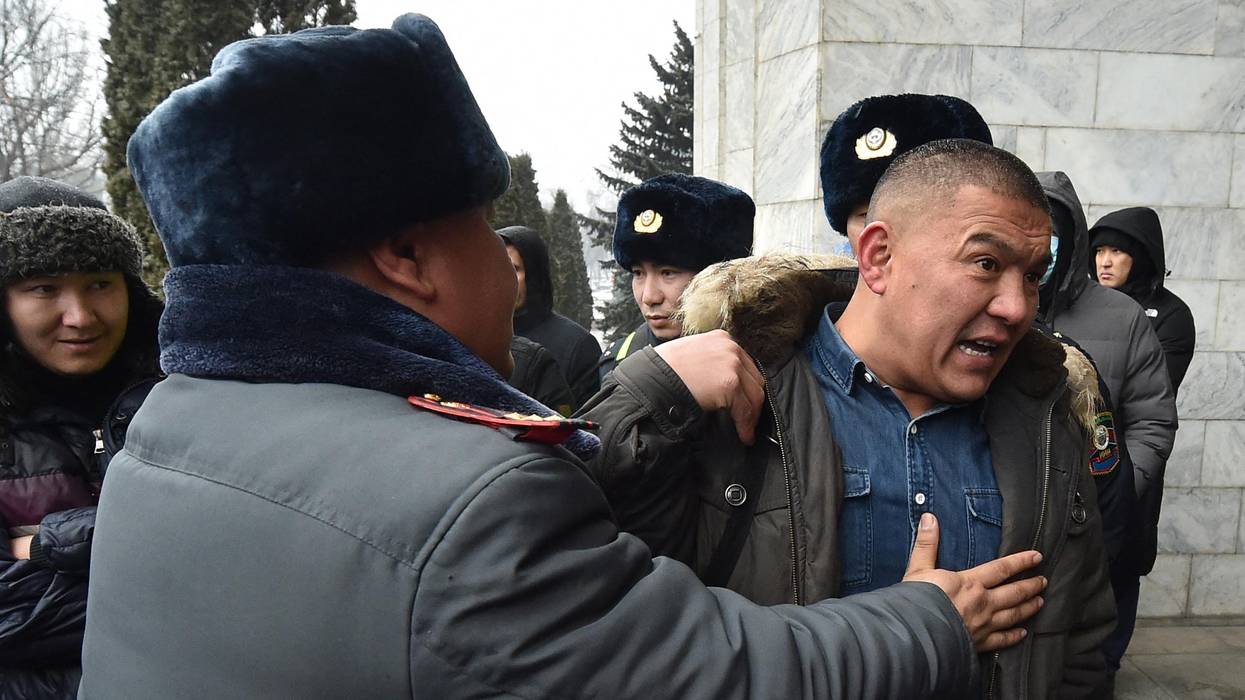
Human rights advocates expressed alarm Friday after Kazakhstan's president ordered security forces to "shoot to kill without warning" protesters engaged in ongoing demonstrations over high fuel prices, economic inequality, and corruption.
President Kassym-Jomart Tokayev announced he had given the order in a speech as he also accused media outlets of encouraging unrest and claimed without evidence that demonstrators have taken orders from a "single command post" and have "a clear plan of attacks on military, administrative, and social facilities in all areas."
"They need to be destroyed and this will be done," said Tokayev of the demonstrators, adding that suggestions of negotiating peacefully with the public were "just nonsense."
Noting that authorities "have a duty to maintain order," Amnesty International said on social media that "giving blanket approval for police officers and troops to fire without warning is unlawful and a recipe for disaster."
The popular uprising began Sunday in the western city of Zhanaozen after the government lifted a cap on the price of liquefied petroleum gas (LPG), which is used widely by Kazakh drivers. After the cap was lifted, gas station prices quickly doubled from the equivalent of $0.14 to $0.28 per liter.
The price hike exacerbated simmering anger over economic inequality in the oil-rich Central Asian country, where the average worker earns less than $600 per month and wealth is concentrated among the very rich.
"The only thing flourishing in Kazakhstan is corruption," a protester identified as Saule told Euronews Friday.
As the demonstrations grew, protesters expressed anger over a system in which the president appoints regional leaders rather than holding elections. On Friday, attendees at a rally in Zhanaozen called for a return to the constitution that was in place after Kazakhstan became an independent country in 1991, which had "a more democratic tone and a clearer division of power than the current one," according to the Washington Post.
"The protests unfolding in Kazakhstan, which have turned violent, are a direct consequence of the authorities' widespread repression of basic human rights."
The government has agreed to some concessions since the unrest began, announcing a new cap on LPG prices and utility bills on Thursday, dismissing Tokayev's cabinet, and suggesting that Parliament could be dissolved and new elections could be held.
But Tokayev has blamed tens of thousands of demonstrators for the escalation of unrest, including a fire that was set at City Hall in Almaty, the nation's largest city, on Wednesday. He also called on Russian President Vladimir Putin to send troops into the country, a move Tokayev said Friday had helped his government regain power.
Security forces have reportedly killed at least 26 people since the protests began, with the Interior Ministry saying the "armed criminals" had been "liquidated." Authorities also said Friday that nearly 4,000 "riot participants" had been detained and blamed demonstrators for the deaths of 13 police officers.
Authorities said they were carrying out an "anti-terrorist operation" in Almaty, leading protesters to gather with signs reading, "We are residents of Almaty, not terrorists."
"The protests unfolding in Kazakhstan, which have turned violent, are a direct consequence of the authorities' widespread repression of basic human rights," said Marie Struthers, Amnesty International's director for Eastern Europe and Central Asia, on Wednesday. "For years, the government has relentlessly persecuted peaceful dissent, leaving the Kazakhstani people in a state of agitation and despair."
"Instead of threatening to crack down on protesters, the Kazakhstani authorities must resolve the situation peacefully by immediately and unconditionally releasing all those who have been arbitrarily detained and addressing past abuses committed by the state," Struthers added. "Protesters accused of internationally recognized crimes for violent actions should be provided with fair trials in accordance with international human rights law."
Free press advocates also condemned reports that at least eight journalists have been detained for reporting on the uprising while at least two news sites have been blocked for covering the events of the past week.
The Ministry of Information said as the protests grew that outlets which "knowingly [spread] false information" would face an increased maximum penalty of up to seven years in prison.
"We call on the Kazakh government to cease detaining members of the media, ensure the free flow of information, and take all possible measures to ensure the safety of journalists on the ground," said Gulnoza Said, Europe and Central Asia program coordinator for the Committee to Protect Journalists.

Right here in Washington DC an unprecedented showdown is unfolding. Venezuelan supporters of self-declared interim president Juan Guaido have been trying to take over the Venezuelan Embassy. This goes against international law, the wishes of the government in control in Venezuela, and the dogged determination of a group of US citizens called the Embassy Protection Collective, who have been living in the Embassy since April 15.
A takeover of the embassy of a sovereign nation whose government holds power and is recognized by the United Nations would be illegal according to the 1961 Vienna Conventions on Diplomatic Relations, which says that diplomatic premises are inviolable and the receiving State must protect the premises against any "intrusion, disturbance of the peace or impairment of its dignity."
This has nothing to do with whether one likes Nicolas Maduro or considers the Venezuelan elections fair. My Saudi friends in Washington DC hate Mohammad Bin Salman--a man who has NEVER been elected by anyone--but the US government would never let them take over the Saudi Embassy. Chinese dissidents say that "winners" of Chinese rigged elections--with only the Communist Party allowed to exist--should not be recognized by the rest of world, but they would never get access to the Chinese Embassies. Likewise for dissidents from Egypt, Honduras, Syria, Zambia, Congo, Romania, Kazakhstan, Uzbekistan, etc.--all countries with highly questionable elections, to put it mildly.
The inflammatory act of handing over the Venezuelan Embassy to Guiado supporters would also have the potential to dramatically escalate the conflict between the United States and Venezuela.
The inflammatory act of handing over the Venezuelan Embassy to Guiado supporters would also have the potential to dramatically escalate the conflict between the United States and Venezuela. If the Trump administration were to allow this, the Maduro government would likely reciprocate by taking over the US Embassy. This could be just what warhawks John Bolton and Elliot Abrams are looking for as a justification for a US military intervention.
Determined to avoid another war, a group of US peace activists sought and received permission from the legitimate Venezuelan government to form an Embassy Protection Collective. Since April 15, a group has been living in the Embassy, sleeping on couches and floors, while outside supporters have been providing supplies and joining them for meals and educational events.
At first the Venezuelan diplomats were still working in the building, but the State Department ordered them to leave the country by April 25. Since then, we have been alone, holding the embassy so that a diplomatic solution can be worked out similar to the situation with Iran, where U.S. Interests Section in Tehran has been operating under the Swiss Embassy and the Iranian Interests Section in Washington DC is operating under the Pakistani Embassy.
On May 1, however, our peaceful presence was violently besieged by angry Guaido supporters. Designed to coincide with Guaido's call for a May 1 uprising, his US representative Carlos Vecchio showed up for a press conference and quickly left, leaving behind an unruly, violent mob. This group has been surrounding the embassy since then, creating mayhem and not allowing food, medicines or supplies to the people inside.
Even more shocking, Secret Service, which is tasked with guarding embassies, has allowed this to happen. They have had a constant presence at the Embassy since May 1 but have stood by as this group damages the building and threatens the peace activists inside and outside. They have allowed the opposition to bang on the doors with sledgehammers to try to break in, post signs all over the property against the wishes of the legal owners, physically attack people trying to get food inside, and destroy and steal the property of the Embassy Protection Collective (food, placards, signs, canopy). In violation of the city's noise ordinance, the mob has been blasting sirens all day long as decibels so high that even the Secret Service police have been wearing ear plugs. They block the sidewalks and all public passages. They have set up 10 canopies and 3 tents to surround the entire building. When we tried to set up a canopy, we were attacked by Guaido supporters, but it was our member, Tighe Barry, who was arrested and accused of pushing a Secret Service officer.
The Secret Service has a public statement saying that no individuals, medicine or food have been prevented from entering the building. We ask anyone who believes this to go to the Embassy and try to deliver a package to the people inside. Even packages sent by the US Postal Service are not allowed in. Every entrance is blocked by opponents and the Secret Service does nothing to stop them. On the contrary, supporters who have tried to bring food have been arrested. This was the case of CODEPINK organizer Ariel Gold. When she found all entrances blocked, she threw bread into an empty ramp outside a door and was arrested for "throwing missiles." When we tied a package to a rope to send food up through a window, three of us were physically assaulted and despite clear video evidence, the police refused to arrest our attacker.
Our people inside are without sufficient food and other critical supplies. They are not allowed to freely exit and enter the building. They sleep at night with a terrible sense of insecurity, worried that the angry mob will break in and attack. But we remain resolute, those of us on the inside and those of us supporting them on the outside, and we demand that our government respect US and international law. The Secret Service must protect the Embassy and the people who are lawfully on embassy property until the two governments come to an agreement about their premises. At that time, the Embassy Protection Collective will happily dissolve and leave the embassy, happy because we can go back to our lives but happy, most of all, because we will have helped to give John Bolton and Elliot Abrams one less reason to drag our nation into another war.
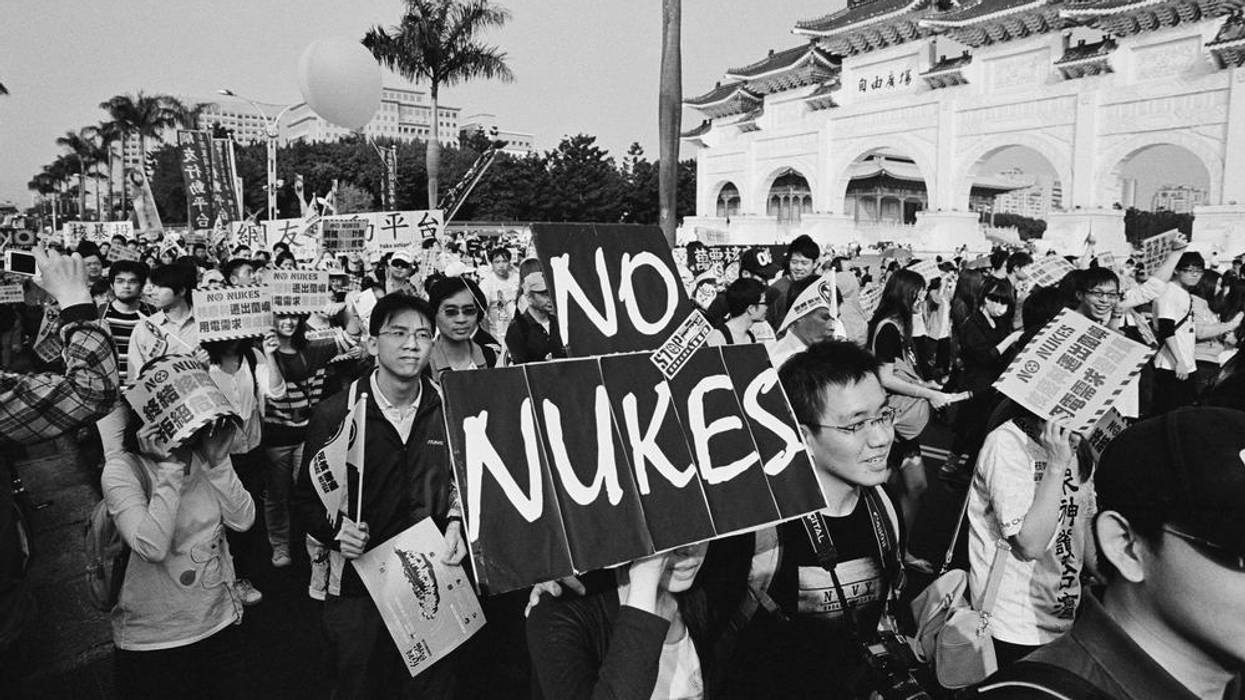
My first trip to Washington, DC to do something other than protest on the streets was to interview for a Herbert Scoville Jr. Peace Fellowship, which brings young people to the nation's capital to work on arms control and disarmament.
It was 1987, around the time that Ronald Reagan and Mikhail Gorbachev signed the Intermediate-Range Nuclear Forces (INF) Agreement. The INF treaty committed the United States and the Soviet Union to eliminate nuclear weapons for the first time on a large scale (over 2,500 of them by 1991). It was a high point for the arms control movement.
To get to the interview stage, however, I wrote an application essay about the flaws of arms control agreements--that they provided a false sense of accomplishment, that they capped the number of nuclear weapons but rarely reduced them, that they accepted the "logic" of mutually assured destruction, that they reinforced the privileges of the nuclear club, and so on.
Arms control was conventionally thought of as the path toward disarmament. I made the case instead that arms control was a detour around disarmament.
When I walked into the room for my interview, I found myself facing a dozen of the leading arms control advocates in the country. I'd anticipated a one-on-one discussion, not a full court of inquisition. They understandably grilled me about my arguments and looked universally dissatisfied with my answers. Yet, in the end, they gave me a fellowship, perhaps for the same reason that Antonin Scalia liked to employ one liberal Supreme Court clerk -- to have a dissenter close at hand to sharpen arguments. I did my fellowship at Nuclear Times magazine, a periodical devoted to scrapping nuclear weapons rather than merely controlling their production.
Nuclear Times folded long ago. Now the INF agreement, after both the United States and Russia suspended their compliance this February, is effectively dead too. Led by National Security Advisor John Bolton, an inveterate opponent of arms control, the Trump administration has taken aim at a wide range of efforts to control the production and proliferation of weapons, from the Iran nuclear deal to the Arms Trade Treaty that the president just savaged in front of a group of cheering National Rifle Association members.
And yet, Trump has also said, just this week, that he wants to get rid of all nuclear weapons. So, is it time to write an epitaph for arms control and herald a new age of disarmament?
The Swerve
Since my time at Nuclear Times, two major events contributed to pushing some otherwise conservative policy makers away from arms control and towards actual disarmament.
The first development was the collapse of the Soviet Union. The number of nuclear weapons in the world peaked the year before my Washington interview at just over 70,000. The end of the Cold War spurred a reduction to under 14,000 today.
Also, in 1991, Democrat Sam Nunn and Republican Richard Lugar teamed up to create a groundbreaking piece of legislation, the Cooperative Threat Reduction (CTR) Program, later dubbed the Nunn-Lugar Act. It provided U.S. funds to decommission weapons of mass destruction in the former Soviet states. Among other results of the program, the new states of Ukraine, Kazakhstan, and Belarus became the first countries in history to abandon their nuclear weapons.
But attempts to negotiate a new set of arms control treaties with Russia have run up against a number of obstacles, from the intransigence of congressional hawks to Russia's seizure of Crimea and involvement in the civil war in Ukraine. Over the years, Congress has chipped away at the funding for CTR. And Richard Lugar died this weekend, the passing of one of the last moderate Republicans committed to a cooperative U.S. relationship with the world.
The other half of Nunn-Lugar, meanwhile, has been part of the second major development: the response to global terrorism.
In 2007, Sam Nunn joined Henry Kissinger, George Shultz, and William Perry to author a series of op-eds in The Wall Street Journal urging the foreign policy establishment to embrace not just arms control, but disarmament. They expressed concern about states like North Korea and Iran acquiring nuclear weapons and disrupting the tenuous balance of nuclear power. But they reserved most of their anxiety for scenarios in which non-state actors acquired nukes:
In today's war waged on world order by terrorists, nuclear weapons are the ultimate means of mass devastation. And non-state terrorist groups with nuclear weapons are conceptually outside the bounds of a deterrent strategy and present difficult new security challenges.
The United States built an arsenal of nuclear weapons to preserve and extend its global dominance. But now, in a perverse development, nukes threatened that dominance. So, the lions of U.S. foreign policy had decided that they must go. No longer convinced that nukes kept the peace, they pushed for a world free of these weapons of mass destruction.
Two years later, clearly influenced by these arguments, President Barack Obama gave a speech in Prague announcing for the first time that the United States was committed to nuclear disarmament. He outlined a number of steps toward that goal: a new Strategic Arms Reduction Treaty with Moscow, U.S. ratification of the Comprehensive Test Ban Treaty, a fissile material cut-off treaty, a strengthened Nuclear Non-Proliferation Treaty, and so on. It was an impressive to-do list, but alas this agenda remains unrealized.
The nuclear stand-off of the Cold War was predicated on predictability. The United States and Soviet Union wouldn't launch a first strike because of the near certainty that the other side would then engage in massive retaliation. But the end of the Cold War and the possibility that nuclear material would fall into the hands of unpredictable actors changed the nuclear calculus.
Then, to complicate matters further, along came the most unpredictable element of all: Donald Trump.
The Trump Paradox
As the self-professed king of negotiators, Donald Trump used to boast of his ability to solve the nuclear impasse if only the U.S. government would appoint him as special emissary to the Soviet Union. Within an hour of meeting Gorbachev, Trump told Nobel Peace Prize winner Bernard Lown, he could end the Cold War. In an article for The New York Times in 1984, journalist William Geist wrote:
The idea that he would ever be allowed to get into a room alone and negotiate for the United States, let alone be successful in disarming the world, seems the naive musing of an optimistic, deluded young man who has never lost at anything he has tried. But he believes that through years of making his views known and through supporting candidates who share his views, it could someday happen.
Young no more and now in a powerful political position, Trump still holds on to this illusion. But to achieve his ambition of personally disarming the world, Trump believes that first he has to get rid of all the poorly negotiated efforts of his predecessors. In this endeavor he is aided by Bolton, who has made it his personal mission to torpedo every arms control treaty that he can bring within his sights.
That's why the Trump administration seems to be all over the map on arms control. On the one hand, the president has withdrawn from the nuclear deal with Iran and pulled out of one of the last remaining arms control agreements with Russia, the aforementioned INF treaty.
Then, last week, he announced that he would unsign the Arms Trade Treaty, which the Obama administration supported and which imposes a number of important restrictions on the sale and transfer of armaments across borders. The Senate has yet to ratify the treaty. Over 100 nations have both signed and ratified the ATT, and it went into effect in 2014. Trump, by denigrating the ATT, has thrown the United States into the same camp of opposition as North Korea, Iran, China, and Russia.
On the other hand, Trump also declared last week:
Between Russia and China and us, we're all making hundreds of billions of dollars' worth of weapons, including nuclear, which is ridiculous. And I would say that China will come along, and I would say Russia will come along. It doesn't really make sense that we're doing this.
The president has thus instructed officials to prepare for big agreements on nuclear weapons with both Russia and China.
To get from here (dangerous) to there (disarmament), Trump has to follow some pretty obvious steps, points out David Wright, of the Union of Concerned Scientists. These include a new treaty on strategic nuclear weapons with Russia, reentry into the INF Treaty, scaling back on missile defense, and kicking Bolton out of his administration. So far, Trump has expressed zero interest in making any of these moves.
When it comes to any kind of large-scale arms control treaty with Russia and/or China, as Daryl Kimball writes in Arms Control Today, the administration has "no plan, strategy, or capacity to negotiate such a far-reaching deal. Even if it did, negotiations would likely take years." Kimball suspects that the administration has an entirely different goal in mind: to load the arms-control agenda with so many big asks that it makes future deals, like a new strategic treaty with Russia, untenable. Kimball continues:
If in the coming weeks, however, Team Trump suggests China must join New START or that Russia must agree to limits on tactical nuclear weapons as a condition for its extension, that should be recognized as a disingenuous poison pill designed to create a pretext for killing New START.
Trump will soon come to the same realization on arms control that he did on health care: "Nobody knew [it] could be so complicated."
Of course, everyone knew that health care--and arms control--could be so complicated. Only Trump believes that he alone, though force of will, can substitute for the patient and informed diplomacy of hundreds of experts. As with his efforts to negotiate with North Korea, once he bumps up against the complexity of the situation, Trump will hand over responsibility for the details to his aides--and that means that Bolton will have a free hand to block any progress in talks with Russia and China.
Since 1987, the logic of arms control has changed. Because of the end of the Cold War, arms control agreements have led to dramatic reductions in nuclear forces and the prevention of states like Iran from becoming nuclear powers. The threat of nuclear material falling into the hands of non-state actors, meanwhile, has shifted the consensus away from deterrence and toward disarmament. Arms control is now clearly part of the solution, not part of the problem.
So, I've changed my mind about arms control being a detour around disarmament. Arms control has become more important than ever before, given that a new nuclear arms race beckons.
The United States, China, Russia are all modernizing their arsenals. Key arms control treaties, like the INF, no longer serve as checks on weapon development and deployment. Important initiatives like the Comprehensive Test Ban treaty can't go forward without U.S. support. The nuclear club refuses to sign the new treaty on the prohibition of nuclear weapons. And John Bolton is on the loose, like a fox bent on killing off every inhabitant of the henhouse.
So, it isn't just Donald Trump who has a paradoxical attitude toward nuclear weapons. The world as a whole has never been closer to consensus on the need for disarmament. And yet it's also never been further away, in a practical sense, from following the necessary steps to achieving global zero.
Perhaps, however, this is only a temporary paradox. Let's hope that the Trump administration proves to be the detour on the path to finally bidding farewell to nuclear arms.
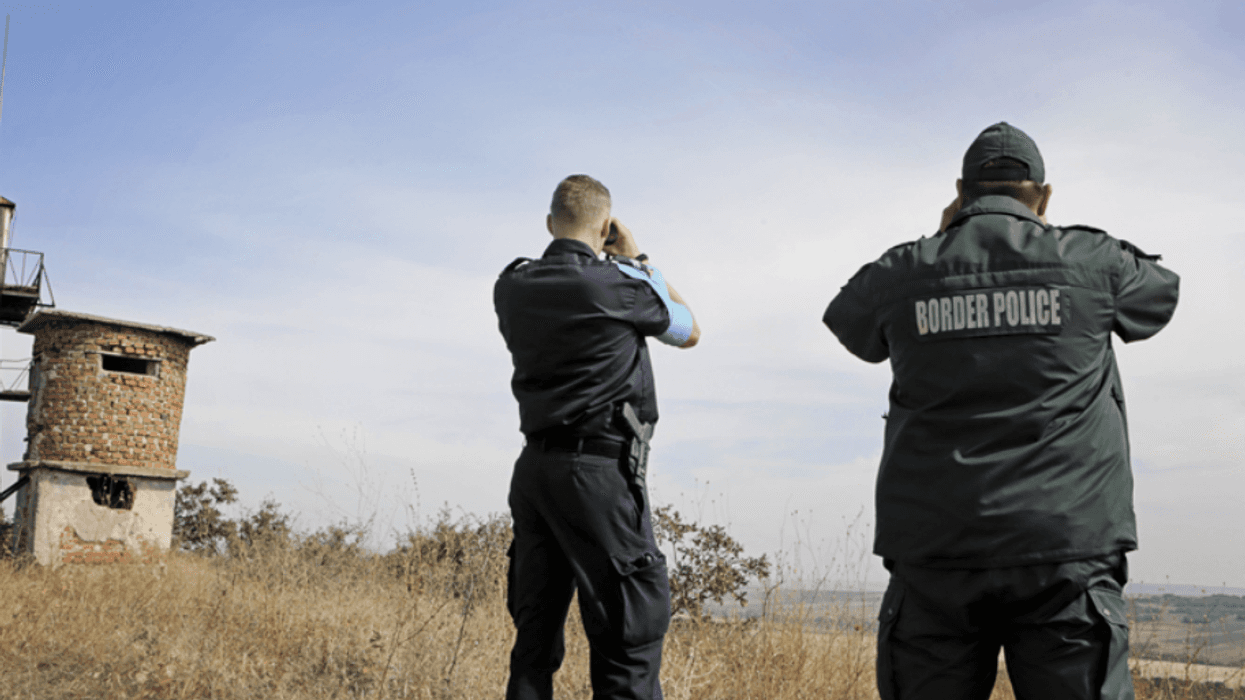
Nation-states: what a quaint notion.
As a means of organizing territory, they seem to be a brief transition period between large empires and an even larger, borderless world. Sure, nation-states might live on in the form of anthems and flags and independence days, but the idea of fixed borders just don't make sense in a world of cell phones, the Internet, and global assembly lines. Borders just seem like a twentieth-century contrivance that slows everything down, like those paper forms you still have to fill out at the doctor's office.
But just when you think you've progressed to the next level, along comes a reminder that the past is nipping at your heels, eager to bring you down.
This Sunday, Donald Trump temporarily closed the border crossing at San Ysidro in San Diego, across from Tijuana, Mexico. In response to a surge in migrants and asylum-seekers from Central America, the president has threatened to close the entire border permanently and even shut down the U.S. government if Congress doesn't fund his border wall.
Also this Sunday, the European Union approved British Prime Minister Theresa May's Brexit proposal. If the British parliament gives its okay, Britain will begin its formal withdrawal from the transnational pact at the end of March. Parliamentary approval, however, is far from certain, which leaves the border between the EU and its second most economically powerful member still very much up in the air.
Finally, in the Azov Sea this Sunday, Russian border patrol boats opened fire on three Ukrainian vessels and then took them into custody. Russia is currently holding 24 Ukrainian sailors. Both Russia and Ukraine border the Sea of Azov, as does the disputed territory of Crimea. It's only the latest in a long series of clashes over the border between the two most populous successor states of the Soviet Union.
The border disputes this Sunday were by no means the only ones. Tensions continue over who controls what islands and reefs in the South China Sea. Israel and Palestine continue to clash around the Gaza border and over the West Bank. Syria remains an internally divided country, as is Libya and, frankly, Iraq as well.
Borders are back in fashion. Whether they're trying to keep out immigrants, confront neighbors, or just reassert sovereignty in an increasingly intrusive world, the latest batch of nationalist and authoritarian leaders are challenging the notion that history is heading in an ever more frictionless direction.
Actually, these leaders are all about friction, especially at the borders, because that's precisely where worldviews rub up against each other and create dangerous sparks.
The Break
The decision by a narrow majority of Britons, in a 2016 referendum, to leave the EU was impulsive, uninformed, and splenetic. It was, ultimately, a crime of passion. And now, unless someone issues a last-minute reprieve, the authorities are going to execute the judgment.
I can't resist another metaphor. There is no good Brexit, just as there is no good broken kneecap. They are both ruptures that require careful surgery and a long period of rehabilitation. In this case, there's not just one fracture. Other border issues have included Gibraltar (resolved at the last minute), Northern Ireland (still unclear), and Scotland (it might vote for independence in order to negotiate its own EU membership).
The "soft" Brexit deal to which May and the EU have agreed would keep the UK in the trade area, for a transition period, but also force it to comply with many of the EU regulations that prompted the "leave" campaign to begin with. That's why a number of May's cabinet ministers, including Foreign Minister Boris Johnson, resigned in mid-November. They wanted a "hard" Brexit that represents a clean break with the EU regulatory system - a deal that the EU was not likely to approve.
If the British parliament rejects May's proposal, however, the prime minister might be forced to negotiate a divorce without any deal at all, the hardest of hard Brexits. At the moment, the parliament seems to be gearing up to do just that, though May will use the threat of impending chaos to force the wary to line up behind her.
There are other possibilities, such as an even softer "Norway-plus" arrangement. Also, the European Court of Justice is now considering whether an interpretation of Article 50 of the Lisbon Treaty - which covers withdrawal from the EU - could permit Britain to revoke its Brexit declaration unilaterally. If that's the case, then, the British could go ahead with a second referendum to see if the people, now apprised of the consequences of their actions, are willing to change their minds. It's a rewind button that those who commit crimes of passion and break their kneecaps are not given. Back in March, the people building a new anti-Brexit campaign, with the help of donors like George Soros, gave the prospects of a second referendum at 50/50. With the May government increasingly rickety, the EU standing firm, and virtually everyone predicting economic decline under any Brexit scenario, those odds have gone up.
Still, as Andrew Rawnsley points out in The Guardian, preaching to the Remainers may not be enough to secure a win the second time around.
It is one thing to hold Boris Johnson and his gang to account for the mendacities they peddled in 2016. It is another thing to say that the millions of voters who bought into the bogus Brexit prospectus were idiots and suckers. It is never a smart idea to tell voters that they have been fools. Even, perhaps especially, when they have been. The anti-Brexit campaign has to show respect for Leave voters and for the reasons that they voted Leave. They may be willing to change their minds but they won't hear the arguments for doing so unless they are convinced that they have been listened to as well.
Sound familiar? The Democrats will face the same choice in two years when it comes time to address the buyer's remorse of the American people for shelling out good money for a lemon president.
The Wall
It's no surprise that Donald Trump has declared his first war against a group of civilians, many of them women and children. In a Cabinet memo on November 20, the president authorized U.S. soldiers to use lethal force against asylum-seekers at the Mexican border. Pentagon chief Jim Mattis has tried to indicate that calmer heads will prevail at the border. But impatient protesters threw some rocks on Sunday at the San Ysidro border crossing, and Customs and Border Protection officers sprayed the crowd with tear gas. It was bad enough for the protesters. The visuals also reinforced the message that the Trump administration will do whatever it takes to break national and international law that requires processing the claims of asylum-seekers fairly and expeditiously.
Tear gas is only the latest indignity visited upon the people waiting in Mexico for safe passage out of the horror that had become their lives. In an episode from mid-September, This American Life recounted all the different ways that the Trump administration has made life even more difficult for asylum-seekers.
Over the last six months, Customs and Border Protection officers have been stopping asylum seekers from even walking up to federal facilities at the border. This has been filmed by crews from CBS, NBC, Fox, and many others. They stop people in the middle of bridges that cross from Mexico into the United States at El Paso and Brownsville, and turn them away before they can even get to the official ports of entry on the other side to apply for asylum.
These were people freely exercising their right - not folks jumping over walls or swimming across rivers. Before the latest caravan arrived, a thousand people were basically waiting in line in Mexico for the few opportunities to make their case for asylum. By November 10, the administration closed down that option as well with its asylum ban, which a federal judge blocked 10 days later (which set up the testy exchange between the president and Chief Justice Roberts about "Obama" judges).
Asylum-seekers: can you think of a more ragtag "enemy" to target? Trump has tried to beef up his purported adversary by claiming that gang members and Middle Eastern terrorists have infiltrated their ranks. No one except perhaps the lunatic Ann Coulter, who has urged an invasion of Mexico, believes that particular claim. But a few thousand civilians with no more than rocks for weapons, are just the straw man he needs. The president doesn't want to go up against an opponent that has any chance of winning. Ronald Reagan, when dealing with the legacy of the Vietnam War syndrome, went to war against the tiny island nation of Grenada. Trump, dealing with the Iraq War syndrome, has chosen an even weaker target.
But what motivates the president's attack on immigrants and the caravan more specifically is the opportunity to weaponize America's borders. Right-wing populists in Europe used the immigration issue for the same purpose. Viktor Orban built his own wall to keep the desperate out of Hungary. More importantly, Orban and Poland's Jaroslaw Kaczynski and the Czech Republic's Milos Zeman discovered that nothing defines a nation's sovereignty better than a full-scale effort to keep people out of the country. Moreover, in so doing, they can challenge a key principle of European integration, the free movement of people, in a way to reinforce their Euroskeptical agenda.
Trump doesn't have to deal with Brussels. But he is sandwiched between a liberal in Canada and a socialist in Mexico. He has insulted the former and twisted the arm of the latter to line up behind a new (sort of) regional trade deal. They are stand-ins for what Trump considers an invasive species: globalists. Trump has challenged international institutions, imposed tariffs on allies and adversaries alike, and ridiculed global principles like human rights. And like many so-called conservatives, he has benefited enormously from the system he lambastes (the immigrants he's hired, the global assembly line that has produced his namesake goods).
But again, Trump prefers wars that have favorable odds. He wants to win. Globalization's ardent supporters, like politicians and financiers, are powerful people. They cross borders with ease. Much easier to pick on the poorest and most disadvantaged people in the world.
The War
The conflict between Ukraine and Russia has largely disappeared from the headlines. The Crimean Peninsula remains in Russian hands, the status of eastern Ukraine is still up in the air, and Russia continues to manipulate matters behind the scenes to weaken Ukraine as a whole and battle Western influence in the region. People are still dying every day in the conflict. The separatist ranks in the Donbass have been thinned by assassination and exile. And corruption in eastern Ukraine is rampant. But Europe has too many other crises to manage in-house and not a lot of spare resources to focus on Ukraine.
It's hard not to see the latest naval clash in the Azov Sea as a convenient provocation by Kiev. Ukrainian President Petro Poroshenko has been trying to persuade his parliament to grant him state-of-emergency powers. They balked and balked. But on Monday, after Russia seized the Ukrainian vessels, Poroshenko got what he wanted, for the next month at least. Plus, the most recent crisis strengthens the case for an extension of sanctions against Moscow.
Ukraine says that the boats sought permission to enter the sea when the Russian crafts suddenly attacked. It also complains that Russia has been trying to turn the Azov Sea into a Russian lake. Moscow controls the narrow access of the Kerch strait, particularly after it built a low bridge connecting Crimea to the Russian mainland - which has slowed Ukraine's access to its Azov ports. A 2003 agreement gives both countries access to this body of water, but Russia no longer seems to adhere to it.
It all sounds like a plot line out of Occupied, the TV series about the Russian occupation of Norway. In that series, the Russians and Free Norway rebels both escalate situations in order to improve their strategic positions. It's often hard to know who has provoked whom.
Russian President Vladimir Putin, however, has a very clear agenda. He needs to keep his public opinion ratings high (they've been dropping). He'd like to widen the split between Washington and Brussels and perhaps was thinking that Trump would overlook a naval spat much as he has apparently let Saudi Crown Prince Mohammed bin Salman off the hook for planning the assassination of journalist Jamal Khashoggi. And he'd like to strengthen the wall that divides the EU from all areas to the east.
In a recent interview with Putin, a Russian journalist complains about the EU. "They are working on Belarus, Kazakhstan and now they are very active in Armenia. We can see how they drip poison into their ears. We should do something about it. Our allies are leaving us." Putin responds with a verbal threat that has all too much resonance in light of Russian conduct.
"The poisoners dripping poison into someone's ears will sooner or later swallow it and get poisoned," Putin says.
After this latest clash in the Sea of Azov, Russian allies and adversaries will think twice about sidling up to the bear. Putin would like to reinforce the border between Russia and the West in order to maintain greater influence over Russia's "near abroad." For that same reason, however, the Russian president prefers that the borders closer to home are more fluid, which enables him to meddle more easily in the affairs of his neighbors.
Against Fluidity
It might seem ironic that countries are getting so hung up over borders just when so many people around the world are challenging borders in their everyday lives. Gender fluidity asserts a spectrum of options rather than a rigid binary. Greater racial diversity pushes everyone to think beyond black and white. Workplaces have been revolutionized by telecommuting and automation and the sharing economy. Race, class, and gender are no longer such clearly delineated categories.
Trump is against many things: immigrants, Europeans, strong women, cosmopolitans, policy wonks, whiny democrats, anyone who crosses him. But in his references to an imagined past when America was great and prosperous and commanded global respect - claims that require just the kind of asterisks that Trump hates - the president is also channeling the anxiety of many people for a time of certainties: when men were men and never changed their minds about it, when men married women and never had second thoughts, when a job was a lifetime appointment, and when nation-states were like billiard balls that clashed or kissed but never interpenetrated one another.
Trump's message is so appealing to the older generation, evangelicals, and traditional conservatives that they're willing to overlook the fluidities in the president's own life (divorce, adultery, political perambulations). Trump's supporters cling to his false certainties because they're preferable to true uncertainties.
Such delusions can last only so long.
After all, countries will rise and fall. Regional pacts may crumble. Rates of migration will fluctuate according to national and international policy, the vicissitudes of war and peace, and the hazards of climate change.
But however much the Trumps and Putins and Euroskeptics of the world beef up the borders, fluidity is here to stay.
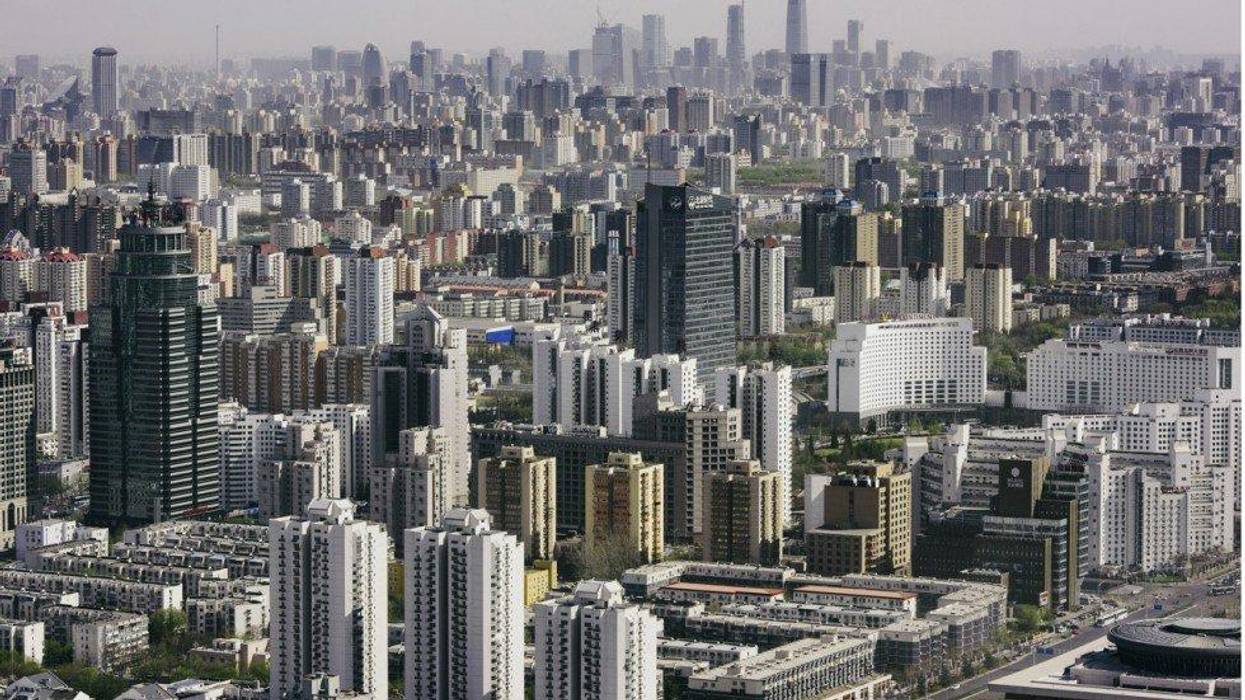
As the second year of Donald Trump's presidency and sixth of Xi Jinping's draws to a close, the world seems to be witnessing one of those epochal clashes that can change the contours of global power. Just as conflicts between American President Woodrow Wilson and British Prime Minister Lloyd George produced a failed peace after World War I, competition between Soviet dictator Joseph Stalin and American President Harry Truman sparked the Cold War, and the rivalry between Soviet leader Nikita Khrushchev and President John F. Kennedy brought the world to the brink of nuclear war, so the empowered presidents of the United States and China are now pursuing bold, intensely personal visions of new global orders that could potentially reshape the trajectory of the twenty-first century -- or bring it all down.
The countries, like their leaders, are a study in contrasts. China is an ascending superpower, riding a wave of rapid economic expansion with a burgeoning industrial and technological infrastructure, a growing share of world trade, and surging self-confidence. The United States is a declining hegemon, with a crumbling infrastructure, a failing educational system, a shrinking slice of the global economy, and a deeply polarized, divided citizenry. After a lifetime as the ultimate political insider, Xi Jinping became China's president in 2013, bringing with him a bold internationalist vision for the economic integration of Asia, Africa, and Europe through monumental investment in infrastructure that could ultimately expand and extend the current global economy. After a short political apprenticeship as a conspiracy advocate, Donald Trump took office in 2017 as an ardent America First nationalist determined to disrupt or even dismantle an American-built-and-dominated international order he disdained for supposedly constraining his country's strength.
Although they started this century on generally amicable terms, China and the U.S. have, in recent years, moved toward military competition and open economic conflict. When China was admitted to the World Trade Organization (WTO) in 2001, Washington was confident that Beijing would play by the established rules and become a compliant member of an American-led international community. There was almost no awareness of what might happen when a fifth of humanity joined the world system as an economic equal for the first time in five centuries.
By the time Xi Jinping became China's seventh president, a decade of rapid economic growth averaging 11% annually and currency reserves surging toward an unprecedented $4 trillion had created the economic potential for a rapid, radical shift in the global balance of power. After just a few months in office, Xi began tapping those vast reserves to launch a bold geopolitical gambit, a genuine challenge to U.S. dominion over Eurasia and the world beyond. Aglow in its status as the world's sole superpower after "winning" the Cold War, Washington had difficulty at first even grasping such newly developing global realities and was slow to react.
China's bid couldn't have been more fortuitous in its timing. After nearly 70 years as the globe's hegemon, Washington's dominance over the world economy had begun to wither and its once-superior work force to lose its competitive edge. By 2016, in fact, the dislocations brought on by the economic globalization that had gone with American dominion sparked a revolt of the dispossessed in democracies worldwide and in the American heartland, bringing the self-proclaimed "populist" Donald Trump to power. Determined to check his country's decline, he has adopted an aggressive and divisive foreign policy that has roiled long-established alliances in both Asia and Europe and is undoubtedly giving that decline new impetus.
Within months of Trump's entry into the Oval Office, the world was already witnessing a sharp rivalry between Xi's advocacy of a new form of global collaboration and Trump's version of economic nationalism. In the process, humanity seems to be entering a rare historical moment when national leadership and global circumstances have coincided to create an opening for a major shift in the nature of the world order.
Trump's Disruptive Foreign Policy
Despite their constant criticism of Donald Trump's leadership, few among Washington's corps of foreign policy experts have grasped his full impact on the historic foundations of American global power. The world order that Washington built after World War II rested upon what I've called a "delicate duality": an American imperium of raw military and economic power married to a community of sovereign nations, equal under the rule of law and governed through international institutions such as the United Nations and the World Trade Organization.
On the realpolitik side of that duality, Washington constructed a four-tier apparatus -- military, diplomatic, economic, and clandestine -- to advance a global dominion of unprecedented wealth and power. This apparatus rested on hundreds of military bases in Europe and Asia that made the U.S. the first power in history to dominate (if not control) the Eurasian continent.
Even after the Cold War ended, former national security adviser Zbigniew Brzezinski warned that Washington would remain the world's preeminent power only as long as it maintained its geopolitical dominion over Eurasia. In the decade before Trump's election, there were, however, already signs that America's hegemony was on a downward trajectory as its share of global economic power fell from 50% in 1950 to just 15% in 2017. Many financial forecasts now project that China will surpass the U.S. as the world's number one economy by 2030, if not before.
In this era of decline, there has emerged from President Trump's torrent of tweets and off-the-cuff remarks a surprisingly coherent and grim vision of America's place in the present world order. Instead of reigning confidently over international organizations, multilateral alliances, and a globalized economy, Trump evidently sees America standing alone and beleaguered in an increasingly troubled world -- exploited by self-aggrandizing allies, battered by unequal trade terms, threatened by tides of undocumented immigrants, and betrayed by self-serving elites too timid or compromised to defend the nation's interests.
Instead of multilateral trade pacts like NAFTA, the Trans-Pacific Partnership (TPP), or even the WTO, Trump favors bilateral deals rewritten to the (supposed) advantage of the United States. In place of the usual democratic allies like Canada and Germany, he is trying to weave a web of personal ties to avowedly nationalist and autocratic leaders of a sort he clearly admires: Vladimir Putin in Russia, Viktor Orban in Hungary, Narendra Modi in India, Adel Fatah el-Sisi in Egypt, and Crown Prince Mohammad bin Salman of Saudi Arabia.
Instead of old alliances like NATO, Trump favors loose coalitions of like-minded countries. As he sees it, a resurgent America will carry the world along, while crushing terrorists and dealing in uniquely personal ways with rogue states like Iran and North Korea.
His version of a foreign policy has found its fullest statement in his administration's December 2017 National Security Strategy. As he took office, the nation, it claimed, faced "an extraordinarily dangerous world, filled with a wide range of threats." But in less than a year of his leadership, it insisted, "We have renewed our friendships in the Middle East... to help drive out terrorists and extremists... America's allies are now contributing more to our common defense, strengthening even our strongest alliances." Humankind will benefit from the president's "beautiful vision" that "puts America First" and promotes "a balance of power that favors the United States." The whole world will, in short, be "lifted by America's renewal."
Despite such grandiose claims, each of President Trump's overseas trips has been a mission of destruction in terms of American global power. Each, seemingly by design, disrupted and possibly damaged alliances that have been the foundation for Washington's global power since the 1950s. During the president's first foreign trip in May 2017, he promptly voiced withering complaints about the supposed refusal of Washington's European allies to pay their "fair share" of NATO's military costs, leaving the U.S. stuck with the bill and, in a fashion unknown to American presidents, refused even to endorse the alliance's core principle of collective defense. It was a position so extreme in terms of the global politics of the previous half-century that he was later forced to formally back down. (By then, however, he had registered his contempt for those allies in an unforgettable fashion.)
During a second, no-less-divisive NATO visit in July, he charged that Germany was "a captive of Russia" and pressed the allies to immediately double their share of defense spending to a staggering 4% of gross domestic product (a level even Washington, with its monumental Pentagon budget, hasn't reached) -- a demand they all ignored. Just days later, he again questioned the very idea of a common defense, remarking that if "tiny" NATO ally Montenegro decided to "get aggressive," then "congratulations, you're in World War III."
Moving on to England, he promptly kneecapped close ally Theresa May, telling a British tabloid that the prime minister had bungled her country's Brexit withdrawal from the European Union and "killed off any chance of a vital U.S. trade deal." He then went on to Helsinki for a summit with Vladimir Putin, where he visibly abased himself before NATO's nominal nemesis, completely enough that there were even brief, angry protests from leaders of his own party.
During Trump's major Asia tour in November 2017, he addressed the Asian-Pacific Economic Council (APEC) in Vietnam, offering an extended "tirade" against multilateral trade agreements, particularly the WTO. To counter intolerable "trade abuses," such as "product dumping, subsidized goods, currency manipulation, and predatory industrial policies," he swore that he would always "put America first" and not let it "be taken advantage of anymore." Having denounced a litany of trade violations that he termed nothing less than "economic aggression" against America, he invited everyone there to share his "Indo-Pacific dream" of the world as a "beautiful constellation" of "strong, sovereign, and independent nations," each working like the United States to build "wealth and freedom.
Responding to such a display of narrow economic nationalism from the globe's leading power, Xi Jinping had a perfect opportunity to play the world statesman and he took it, calling upon APEC to support an economic order that is "more open, inclusive, and balanced." He spoke of China's future economic plans as an historic bid for "interconnected development to achieve common prosperity... on the Asian, European, and African continents."
As China has lifted 60 million of its own people out of poverty in just a few years and was committed to its complete eradication by 2020, so he urged a more equitable world order "to bring the benefits of development to countries across the globe." For its part, China, he assured his listeners, was ready to make "$2 trillion of outbound investment" -- much of it for the development of Eurasia and Africa (in ways, of course, that would link that vast region more closely to China). In other words, he sounded like a twenty-first century Chinese version of a twentieth-century American president, while Donald Trump acted more like Argentina's former presidente Juan Peron, minus the medals. As if to put another nail in the coffin of American global dominion, the remaining 11 Trans-Pacific trade pact partners, led by Japan and Canada, announced major progress in finalizing that agreement -- without the United States.
In addition to undermining NATO, America's Pacific alliances, long its historic fulcrum for the defense of North America and the dominance of Asia, are eroding, too. Even after 10 personal meetings and frequent phone calls between Japan's Prime Minister Shinzo Abe and Donald Trump during his first 18 months in office, the president's America First trade policy has placed a "major strain" on Washington's most crucial alliance in the region. First, he ignored Abe's pleas and cancelled the Trans-Pacific Partnership trade pact and then, as if his message hadn't been strong enough, he promptly imposed heavy tariffs on Japanese steel imports. Similarly, he's denounced the Canadian prime minister as "dishonest" and mimicked Indian Prime Minister Modi's accent, even as he made chummy with North Korean dictator Kim Jong-un and then claimed, inaccurately, that his country was "no longer a nuclear threat."
It all adds up to a formula for further decline at a faster pace.
Beijing's Grand Strategy
While Washington's influence in Asia recedes, Beijing's grows ever stronger. As China's currency reserves climbed rapidly from $200 billion in 2001 to a peak of $4 trillion in 2014, President Xi launched a new initiative of historic import. In September 2013, speaking in Kazakhstan, the heart of Asia's ancient Silk Road caravan route, he proclaimed a "one belt, one road initiative" aimed at economically integrating the enormous Eurasian land mass around Beijing's leadership. Through "unimpeded trade" and infrastructure investment, he suggested, it would be possible to connect "the Pacific and the Baltic Sea" in a proposed "economic belt along the Silk Road," a region "inhabited by close to 3 billion people." It could become, he predicted, "the biggest market in the world with unparalleled potential."
Within a year, Beijing had established a Chinese-dominated Asian Infrastructure and Investment Bank with 56 member nations and an impressive $100 billion in capital, while launching its own $40 billion Silk Road Fund for private equity projects. When China convened what it called a "belt and road summit" of 28 world leaders in Beijing in May 2017, Xi could, with good reason, hail his initiative as the "project of the century."
Although the U.S. media has often described the individual projects involved in his "one belt, one road" project as wasteful, sybaritic, exploitative, or even neo-colonial, its sheer scale and scope merits closer consideration. Beijing is expected to put a mind-boggling $1.3 trillion into the initiative by 2027, the largest investment in human history, more than 10 times the famed American Marshall Plan, the only comparable program, which spent a more modest $110 billion (when adjusted for inflation) to rebuild a ravaged Europe after World War II.
Beijing's low-cost infrastructure loans for 70 countries from the Baltic to the Pacific are already funding construction of the Mediterranean's busiest port at Piraeus, Greece, a major nuclear power plant in England, a $6 billion railroad through rugged Laos, and a $46 billion transport corridor across Pakistan. If successful, such infrastructure investments could help knit two dynamic continents, Europe and Asia -- home to a full 70% percent of the world's population and its resources -- into a unified market without peer on the planet.
Underlying this flurry of flying dirt and flowing concrete, the Chinese leadership seems to have a design for transcending the vast distances that have historically separated Asia from Europe. As a start, Beijing is building a comprehensive network of trans-continental gas and oil pipelines to import fuels from Siberia and Central Asia for its own population centers. When the system is complete, there will be an integrated inland energy grid (including Russia's extensive network of pipelines) that will extend 6,000 miles across Eurasia, from the North Atlantic to the South China Sea. Next, Beijing is working to link Europe's extensive rail network with its own expanded high-speed rail system via transcontinental lines through Central Asia, supplemented by spur lines running due south to Singapore and southwest through Pakistan.
Finally, to facilitate sea transport around the sprawling continent's southern rim, China has already bought into or is in the process of building more than 30 major port facilities, stretching from the Straits of Malacca across the Indian Ocean, around Africa, and along Europe's extended coastline. In January, to take advantage of Arctic waters opened by global warming, Beijing began planning for a "Polar Silk Road," a scheme that fits well with ambitious Russian and Scandinavian projects to establish a shorter shipping route around the continent's northern coast to Europe.
Though Eurasia is its prime focus, China is also pursuing economic expansion in Africa and Latin America to create what might be dubbed the strategy of the four continents. To tie Africa into its projected Eurasian network, Beijing already had doubled its annual trade there by 2015 to $222 billion, three times that of the United States, thanks to a massive infusion of capital expected to reach a trillion dollars by 2025. Much of it is financing the sort of commodities extraction that has already made the continent China's second largest source of crude oil. Similarly, Beijing has invested heavily in Latin America, acquiring, for instance, control over 90% of Ecuador's oil reserves. As a result, its commerce with that continent doubled in a decade, reaching $244 billion in 2017, topping U.S. trade with what once was known as its own "backyard."
A Conflict with Consequences
This contest between Xi's globalism and Trump's nationalism has not been safely confined to an innocuous marketplace of ideas. Over the past four years, the two powers have engaged in an escalating military rivalry and a cutthroat commercial competition. Apart from a shadowy struggle for dominance in space and cyberspace, there has also been a visible, potentially volatile naval arms race to control the sea lanes surrounding Asia, specifically in the Indian Ocean and South China Sea. In a 2015 white paper, Beijing stated that "it is necessary for China to develop a modern maritime military force structure commensurate with its national security." Backed by lethal land-based missiles, jet fighters, and a global satellite system, China has built just such a modernized fleet of 320 ships, including nuclear submarines and its first aircraft carriers.
Within two years, U.S. Chief of Naval Operations Admiral John Richardson reported that China's "growing and modernized fleet" was "shrinking" the traditional American advantage in the Pacific, and warned that "we must shake off any vestiges of comfort or complacency." Under Trump's latest $700-billion-plus defense budget, Washington has responded to this challenge with a crash program to build 46 new ships, which will raise its total to 326 by 2023. As China builds new naval bases bristling with armaments in the Arabian and South China seas, the U.S. Navy has begun conducting assertive "freedom-of-navigation" patrols near many of those same installations, heightening the potential for conflict.
It is in the commercial realm of trade and tariffs, however, where competition has segued into overt conflict. Acting on his belief that "trade wars are good and easy to win," President Trump slapped heavy tariffs, targeted above all at China, on steel imports in March and, just a few weeks later, punished that country's intellectual property theft by promising tariffs on $50 billion of Chinese imports. When those tariffs finally hit in July, China immediately retaliated against what it called "typical trade bullying" with similar tariffs on U.S. goods. The Financial Times warned that this "tit-for-tat" can escalate into a "full bore trade war... that will be very bad for the global economy." As Trump threatened to tax $500 billion more in Chinese imports and issued confusing, even contradictory demands that made it unlikely Beijing could ever comply, observers became concerned that a long-lasting trade war could destabilize what the New York Times called the "mountain of debt" that sustains much of China's economy. In Washington, the usually taciturn Federal Reserve chairman issued an uncommon warning that "trade tensions... could pose serious risks to the U.S. and global economy."
China as Global Hegemon?
Although a withering of Washington's global reach, abetted and possibly accelerated by the Trump presidency, is already underway, the shape of any future world order is still anything but clear. At present, China is the sole state with the obvious requisites for becoming the planet's new hegemon. Its phenomenal economic rise, coupled with its expanding military and growing technological prowess, provide that country with the obvious fundamentals for superpower status.
Yet neither China nor any other state seems to have the full imperial complement of attributes to replace the United States as the dominant world leader. Apart from its rising economic and military clout, China, like its sometime ally Russia, has a self-referential culture, non-democratic political structures, and a developing legal system that could deny it some of the key instruments for global leadership.
In addition to the fundamentals of military and economic power, "every successful empire," observes Cambridge University historian Joya Chatterji, "had to elaborate a universalist and inclusive discourse" to win support from the world's subordinate states and their leaders. Successful imperial transitions driven by the hard power of guns and money also require the soft-power salve of cultural suasion for sustained and successful global dominion. Spain espoused Catholicism and Hispanism, the Ottomans Islam, the Soviets communism, France a cultural francophonie, and Britain an Anglophone culture. Indeed, during its century of global dominion from 1850 to 1940, Britain was the exemplar par excellence of such soft power, evincing an enticing cultural ethos of fair play and free markets that it propagated through the Anglican church, the English language and its literature, and the virtual invention of modern athletics (cricket, soccer, tennis, rugby, and rowing). Similarly, at the dawn of its global dominion, the United States courted allies worldwide through soft-power programs promoting democracy and development. These were made all the more palatable by the appeal of such things as Hollywood films, civic organizations like Rotary International, and popular sports like basketball and baseball.
China has nothing comparable. Its writing system has some 7,000 characters, not 26 letters. Its communist ideology and popular culture are remarkably, even avowedly, particularistic. And you don't have to look far for another Asian power that attempted Pacific dominion without the salve of soft power. During Japan's occupation of Southeast Asia in World War II, its troops went from being hailed as liberators to facing open revolt across the region after they failed to propagate their similarly particularistic culture.
As command-economy states for much of the past century, neither China nor Russia developed an independent judiciary or the autonomous rules-based order that undergirds the modern international system. From the foundation of the Permanent Court of Arbitration at The Hague in 1899 through the formation of the International Court of Justice under the U.N.'s 1945 charter, the world's nations have aspired to the resolution of conflicts via arbitration or litigation rather than armed conflict. More broadly, the modern globalized economy is held together by a web of conventions, treaties, patents, and contracts grounded in law.
From its founding in 1949, the People's Republic of China gave primacy to the party and state, slowing the growth of an autonomous legal system and the rule of law. A test of its attitude toward this system of global governance came in 2016 when the Permanent Court of Arbitration at The Hague ruled unanimously that China's claims to sovereignty in the South China Sea "are contrary to the Convention [on the Law of the Sea] and without lawful effect." Beijing's Foreign Ministry simply dismissed the adverse decision as "invalid" and without "binding force." President Xi insisted China's "territorial sovereignty and maritime rights" were unchanged, while the state Xinhua news agency called the ruling "naturally null and void." Although China might be well placed to supplant Washington's economic and military power, its capacity to assume leadership via that other aspect of the delicate duality of global power, a network of international organizations grounded in the rule of law, is still open to question.
If Donald Trump's vision of world disorder is a sign of the American future and if Beijing's projected $2 trillion in infrastructure investments, history's largest by far, succeed in unifying the commerce and transport of Asia, Africa, and Europe, then perhaps the currents of financial power and global leadership will indeed transcend all barriers and flow inexorably toward Beijing, as if by natural law. But if that bold initiative ultimately fails, then for the first time in five centuries the world may face an imperial transition without a clear successor as global hegemon. Moreover, it will do so on a planet where the "new normal" of climate change -- the heating of the atmosphere and the oceans, the intensification of flood, drought, and fire, the rising seas that will devastate coastal cities, and the cascading damage to a densely populated world -- could mean that the very idea of a global hegemon is fast becoming a thing of the past.
Month by month, tweet by tweet, the events of the past two years have made it clearer than ever that Washington's once-formidable global might is indeed fading. As the American empire unravels with previously unimagined speed, there are many across this country's political spectrum who will not mourn its passing. Both peace activists and military veterans have grown tired of the country's endless wars. Trade unionists and business owners have come to rue the job losses that accompanied Washington's free-trade policies. Anti-globalization protesters and pro-Trump populists alike cheered the president's cancellation of the Trans-Pacific Partnership. The idea of focusing on America and rebuilding the country's tattered infrastructure has a growing bipartisan appeal.
But before we join this potential chorus of "good riddance" to U.S. global power, it might be worth pausing briefly to ask whether the acceleration of the American decline by President Trump's erratic foreign policy might not come with unanticipated and unpleasant costs. As Americans mobilize for the 2018 midterms and the 2020 presidential contest, they might look beyond Washington's mesmerizing celebrity scandals and consider instead the hidden consequences of the country's ongoing withdrawal from the global arena. Indeed, this fitful, uncontrolled retreat carries with it such serious risks that it might be time for ordinary voters and political activists alike to put foreign policy, in the broadest sense, at the top of their electoral watch list.
First, let's just admit the obvious. After 18 months in office, Trump's one-man style of diplomacy, though potentially capable of a few "wins," is clearly degrading American global stature. After surveying 134 countries, Gallup's pollsters recently reported that worldwide approval of U.S. leadership has plunged from 48% in 2016 to a record low of 30%, a notch below China's 31% and significantly under Germany's 41%.
As Trump has abrogated one international accord after another, observers worldwide have struggled to find some rationale for decisions that seem questionable on their merits and have frayed relations with long-standing allies. Given his inordinate obsession with the "legacy" of Barack Obama, epitomized in a report, whether true or not, of his ritual "defiling" of his predecessor's Moscow hotel bed via the "golden showers" of Russian prostitutes, there's a curious yet coherent logic to his foreign policy. You might even think of it as Golden Shower diplomacy. Whatever Obama did, Trump seems determined to undo with a visceral vehemence: the Trans-Pacific trade pact (torn up), the Paris climate accord (withdrawn), the Iran nuclear freeze (voided), close relations with NATO allies (damaged), diplomatic relations with Cuba (frozen), Middle Eastern military withdrawal (reversed), ending the Afghan war (cancelled), the diplomatic pivot to Asia (forgotten), and so on into what already seems like an eternity.
As bizarre as all this might be, Trump's four to eight years presiding over what still passes for U.S. foreign policy through such personal pique will have lasting consequences. The American presence on the global stage will be further reduced, potentially opening the way for the rise of those autocratic powers, Beijing and Moscow, hostile to the liberal international order that Washington promoted for the past 70 years, even as -- thanks to Trump's love of fossil fuels -- the further degradation of the planetary environment occurs.
The Delicate Duality of American Global Power
To fully understand what's at stake, you would need to reach back to the dawn of U.S. global dominion and try to grasp the elusive character of the power that went with it. In the closing months of World War II, whenthe United States stood astride a partially wrecked planet like a titan, Washington used its extraordinary clout to build a new world order grounded in a "delicate duality" that juxtaposed two contradictory attributes. It fostered an international community of sovereign nations governed by the rule of law, while also building its own superpower dominion through the raw Realpolitikof economic pressure, crushing military force, unrestrained covert action, and diplomatic leverage.
Keep in mind that America had emerged from the ashes of that world war as a behemoth of unprecedented power. With Europe, Japan, and Russia in ruins, the U.S. had the only intact industrial complex left and then accounted for about half of the world's entire economic output. At war's end, its military had swelled to more than 12 million troops, its Navy ruled the seas with more than 1,000 warships, and its air force commanded the skies with 41,000 combat aircraft. In the decade that followed, Washington would encircle Eurasia with hundreds of military bases, as well as bevies of strategic bombers and warships. In the process, it would also confine its Cold War enemies, China and Russia, behind that infamous Iron Curtain.
Throughout those early Cold War years, Washington's diplomats walked tall in the corridors of power, deftly negotiating defense pacts and trade deals that gave the country a distinct advantage on the world stage. Meanwhile, its clandestine operatives maneuvered relentlessly in the shadow lands of global power to topple neutral or hostile governments via coups and covert operations. Washington, of course, eventually won the Cold War, but its tactics produced almost unimaginably dreadful costs -- brutal military dictatorships across Asia and Latin America, millions of dead in Indochina, and devastated societies in Central Asia, Central America, and southern Africa.
Simultaneously, however, the U.S. victory in World War II also brought a surge of citizen idealism as millions of American veterans returned home, hopeful that their sacrifice had not only defeated fascism but also won a more peaceful world. To ensure that the ravaged planet would never again experience such global death and destruction, American diplomats also began working with their allies to build, step by step, nothing less than a novel architecture for global governance, grounded in the rule of international law.
At the Bretton Woods resort in New Hampshire in 1944, Washington convened 44 nations, large and small, to design a comprehensive economic regime for a prosperous post-war world. In the process, they formed the International Monetary Fund, or IMF (for financial stability); the World Bank (for postwar reconstruction); and, somewhat later, the General Agreement on Tariffs and Trade (for free trade), the predecessor of the World Trade Organization.
A year after that, in San Francisco, Washington led 850 delegates from 50 allied nations in drafting the charter for a new organization, the United Nations, that aspired to a world order marked by inviolable sovereignty, avoidance of armed conflict, human rights, and shared prosperity. In addition to providing crisis management through peacekeeping and refugee relief, the U.N. also helped order a globalizing world by creating, over the next quarter century, 17 specialized organizations responsible for everything from food security (the Food and Agriculture Organization, or FAO) to public health (the World Health Organization, or WHO).
Starting with the $13 billion Marshall Plan for the reconstruction of war-torn Europe, Washington also supplemented the U.N.'s work by providing billions of dollars in bilateral aid to fund reconstruction and economic development in nations old and new. President John F. Kennedy globalized that effort by establishing the U.S. Agency for International Development (USAID) that today has a budget of $27 billion and 4,000 employees who deliver humanitarian assistance worldwide by providing, for instance, $44 million in emergency relief for 700,000 Rohingya refugees in Bangladesh.
Washington was careful to weave this new world order into the web of international law it had been building assiduously since its debut on the world stage at the Second Hague Conference on peace in 1907. Under the U.N. charter of 1945, the General Assembly convened the International Court of Justice, which took its seat at the grandiose Peace Palace in The Hague built by steel baron Andrew Carnegie years before to promote the international rule of law.
Just months after its founding, the U.N. also formed its Human Rights Commission, chaired by former First Lady Eleanor Roosevelt, to draft the landmark Universal Declaration of Human Rights adopted in Paris on December 10, 1948. In addition, instead of firing squads for the defeated Axis leaders, the U.S. led the Allies in convening tribunals at Nuremburg and Tokyo in 1945-1946 that tried their war crimes under international law. Three years later, Washington joined the international community in adopting the four modern Geneva conventions that laid down the laws of war for future conflicts to protect both captives and civilians.
During the 70 years that Washington led many of these international institutions, half the world won national independence, economic prosperity spread, poverty declined, hunger receded, diseases were defeated, world war was indeed avoided, and human rights advanced. No other empire in world history had presided over so much progress and prosperity for such a significant share of humanity.
Citizen Diplomats
Some scholars of international relations remain confident that the international institutions America has long promoted can survive its demise as the globe's dominant power. But Trump's control over foreign policy and his erratic leadership make that prospect at best uncertain. While scholars place their hopes on the internal resilience of the liberal world order, an equally important source for its potential survival lies with the millions of U.S. citizen-diplomats who have served, for the past 70 years, as adjuncts in its promotion and remain, as activists and voters, potential advocates for its preservation -- and these even include one group that might normally be considered unlikely indeed: the very evangelicals who, in recent times, have backed Donald Trump in startling numbers.
Unlike the genteel elite exchanges and government programs that marked Europe's old empires, America has influenced billions of people worldwide pervasively through mass communications and directly through citizen initiatives. While in Britain's imperial heyday, elite circles communicated with each other via telegraph, newspaper, and radio, America has freed the flow of information for uncounted billions through television, the Internet, and cell phones -- making grassroots activism a global reality and citizen diplomacy a major force in a changing world.
Although much less visible than those cellular towers lining rural roads and the computer screens dotting desktops in every city, the global impact of U.S. citizen initiatives has been no less profound. Despite a foreign policy that frequently retreated into isolationism or hyper-nationalism or brutal wars, since the end of World War II a surprising number of Americans have immersed themselves in the wider world, arguably far more deeply than any other people on the planet. The old European colonial empires were state enterprises, but the U.S. imperium has been, in significant ways, a people's project (as well, of course, in Washington's coups and wars, as an anti-people's project).
If Europe's missionary efforts were generally state-sponsored, the spirit has moved millions of individual American evangelicals to "go on mission," often to the most remote, rugged parts of the planet. From the Civil War to World War II, mainline Protestant denominations sponsored small numbers of career missionaries who made the conversion of China the aspiration of the post-Civil War generation. But since the Boeing Corporation introduced cheap jet travel in the 1960s, countless millions of evangelicals have launched themselves on short-term missions. While religious conversion has certainly been their prime goal, providing medicine, food, and education to remote areas of Asia, Africa, and Latin America has also been a key part of that endeavor.
As a way to count these countless evangels, in my own small family circle a cousin, a Harvard-trained pediatrician, has made several medical missions to West Africa; the real-estate agent for my mother's house repeatedly slowed the sale by going on education missions to Cambodia; friends from my Anglican parish travel regularly to Haiti on a development mission to a sister church; and my father-in-law's old army buddy for years flew his private plane down to Central America on gospel missions.
Whenever global disasters strike, the Mormons, along with the 5,000 employees of Catholic Relief and 46,000 workers of the Protestant World Vision, mobilize what has become billions of dollars annually to send massive shipments of relief goods to the farthest corners of the Earth.
America's concern for the world beyond its borders also has a no-less-vital secular side. Paralleling the rise of Washington as a world power, the Chicago-based Rotary International, for instance, has grown into a global network of 33,000 clubs in 200 countries. Since 1985, its 1.2 million members have donated nearly two billion dollars to inoculate two billion children worldwide against polio. As someone who still limps from this childhood disease, I was delighted to learn a few years ago, when I spoke before my local Rotary Club in Madison, Wisconsin, that my speaker's fee had been automatically donated to the worldwide fight against polio.
When I spoke to the local Kiwanis chapter, I found that they were crisscrossing the state collecting antique foot-pedal Singer sewing machines for shipment to rural co-ops in Central America without electricity -- catalyzing this small city's Sewing Machine Project that has sent 2,500 machines worldwide since 2005. In a similar fashion, recent immigrants to the U.S. have often sponsored schools and medical care in their former homelands; military veterans have promoted humanitarian efforts in old battlegrounds like Vietnam; the 230,000 returned Peace Corps volunteers have been voices for a people-oriented foreign policy; and the list only goes on.
Whether passing the plate down the pews or logging onto the Internet, millions of Americans send billions of dollars overseas every year through their churches or activist groups like Doctors Without Borders, CARE USA, and Save the Children USA, whether for the Ethiopian famine, Indonesia's tsunami, or the Rohingya crisis.
This tradition of what might be thought of as citizen diplomacy and the ingrained internationalism that goes with it were manifest in the extraordinary eruption of mass protest that occurred when, in his first week in office, President Trump tried to ban travellers from seven Muslim-majority nations. Within a day, a small crowd of 30 people with placards at JFK international airport in New York swelled into impassioned protests by thousands attending demonstrations across the city. Over the next week, there would be parallel protests by tens of thousands in some 30 cities nationwide, including Los Angeles, San Francisco, Houston, Detroit, Philadelphia, and Portland, Maine. It is these ardent demonstrators and the millions more with their own international causes who seem mindful of what might be lost as America heads for the exits from the world stage.
China Rising
Yes, CIA coups, the Vietnam War, and untold other horrors of empire will long remain troubling memories of U.S. hegemony, not to speak of the twenty-first-century war on terror, those CIA black sites, drone strikes, and so on, so why should anyone, liberal or conservative, who harbors doubts about America's global power be concerned with its accelerating decline? At its core, the U.S. world order has rested, for the past 70 years, on that delicate duality -- an idealistic community of sovereign nations and sovereign citizens equal under the rule of international law joined tensely, even tenuously, to an American imperium grounded in the grimmest aspects of U.S. military and economic power.
Now, consider the likely alternatives if Donald Trump succeeds in withdrawing the U.S. from any form of idealistic internationalism. While the downside of Washington's harsh hegemony of the last almost three-quarters of a century was in some part balanced by its promotion of a liberal international order, both Beijing and Moscow seem inclined to the idea of hegemony without that international community and its rule of law. Beijing accepts the U.N. (where it has a seat on the Security Council) and the World Trade Organization (a convenient wedge into world markets), but it simply ignores inconvenient aspects of the international community like the Permanent Court of Arbitration, recently dismissing an adverse decision there over its claims to the South China Sea.
Beijing has quietly challenged what it views as pro-Western organizations by beginning to build its own parallel world order, which it naturally intends to dominate: the Shanghai Cooperation Organization instead of NATO, its Asian Infrastructure Investment Bank in lieu of the IMF, and the Regional Comprehensive Economic Partnership to supplant the Trans-Pacific Partnership trade pact. The trillions of dollars in trade and development agreements that Beijing has doled out across Asia, Africa, and Latin America in recent years are the epitome of commercial Realpolitik, devoid of any concern for the environment or for workers' rights. Putin's Russia is even more dismissive of the restraints of international law, expropriating sovereign territory, invading neighboring nations, assassinating domestic enemies abroad, and blatantly manipulating elections overseas (a subject in which, of course, the United States once showed a certain expertise).
Although overshadowed in recent years by its endless counterterror operations and its devastatingly destructive wars across the Greater Middle East and Africa, the United States has nonetheless had a profound and often positive impact upon the world, in terms both of its high politics and its mass culture. Long after the damaging excesses of Washington's hegemonic power -- the CIA coups, the torture, the drone killings, and those never-ending wars -- fade from memory, the world will still need the more benign dimension of its dominion, particularly the very idea of global governance through international organizations and the rule of law, especially as we face a planet similarly in decline. The loss of all of that would be a loss indeed.
If the world experiences a slow, relatively peaceful transition away from U.S. hegemony, then the subsequent global order just might maintain some of the liberal international institutions that still represent the best of American values. If, by contrast, the golden-shower diplomacy of Donald Trump continues, while the Chinese and Russian versions of hegemony only gain strength, then we will likely witness a harsher world order based on autocracy, Realpolitik, and commercial domination, with scant attention to human rights, women's rights, or the rule of law. At this critical turning point in world history, the choice is still, to a surprising degree, ours to make. But not for long.

For over a year, outlets from FAIR (8/24/16) to TruthDig (1/7/17) to The Nation (8/7/17) to The Intercept (2/12/18) have been warning about the pitfalls of nonstop Russia Is Everywhere and Out to Get Us coverage. The Russians are "stoking discord" and "sowing unrest" and infiltrating online and real-life spaces with memes and rallies and disinformation, corporate media tell us. Did you share Russian disinfo? Twitter and Facebook will let you know. Did you buy into Russian "fake news"? CNN wants to find out. Russia is everywhere, and it's important the media not only report this fact, but do so over and over and over again, until one is looking for the Russian menace in every interaction.
This narrative, fueled by center-left outlets like MSNBC, Center for American Progress and Mother Jones, has reached its inevitable, sleazy nadir: the smearing of a black activist by an NPR affiliate for the crime of going on a Russian government-funded radio station a handful of times.
Reporter Johnny Kauffman at WABE (4/18/18), an NPR affiliate in Atlanta, did a profile on black activists Anoa Changa and Eugene Puryear. But instead of using this opportunity to highlight the causes they're fighting for, or the injustices that brought them to become activists, WABE used its considerable resources and influence to talk about, you guessed, Russian influence:
The incriminating headline sets up the premise: Atlanta (black) activists are pawns in a cynical Russian "effort to create chaos":
By agreeing to appear on two Sputnik programs, Changa gained something hard to find: a bigger platform to broadcast her political views. But Changa's association with Sputnik may put her credibility at risk, while furthering Russia's effort to create chaos in the US.
One could be forgiven for thinking "may put her credibility at risk" sounds more like a threat than a neutral observation: Nice reputation you have here, African-Americans who may be thinking about using Russian-backed media. Be a shame if something happened to it.
How Changa or Puryear discussing racism and war furthers an effort to "create chaos" is never made clear, unless stating facts about the world that are unflattering to US centers of power is now per se destructive. Does Kauffman mention that Changa has also appeared on the British government-funded BBC and other "mainstream" outlets? No, this would muddy the narrative.
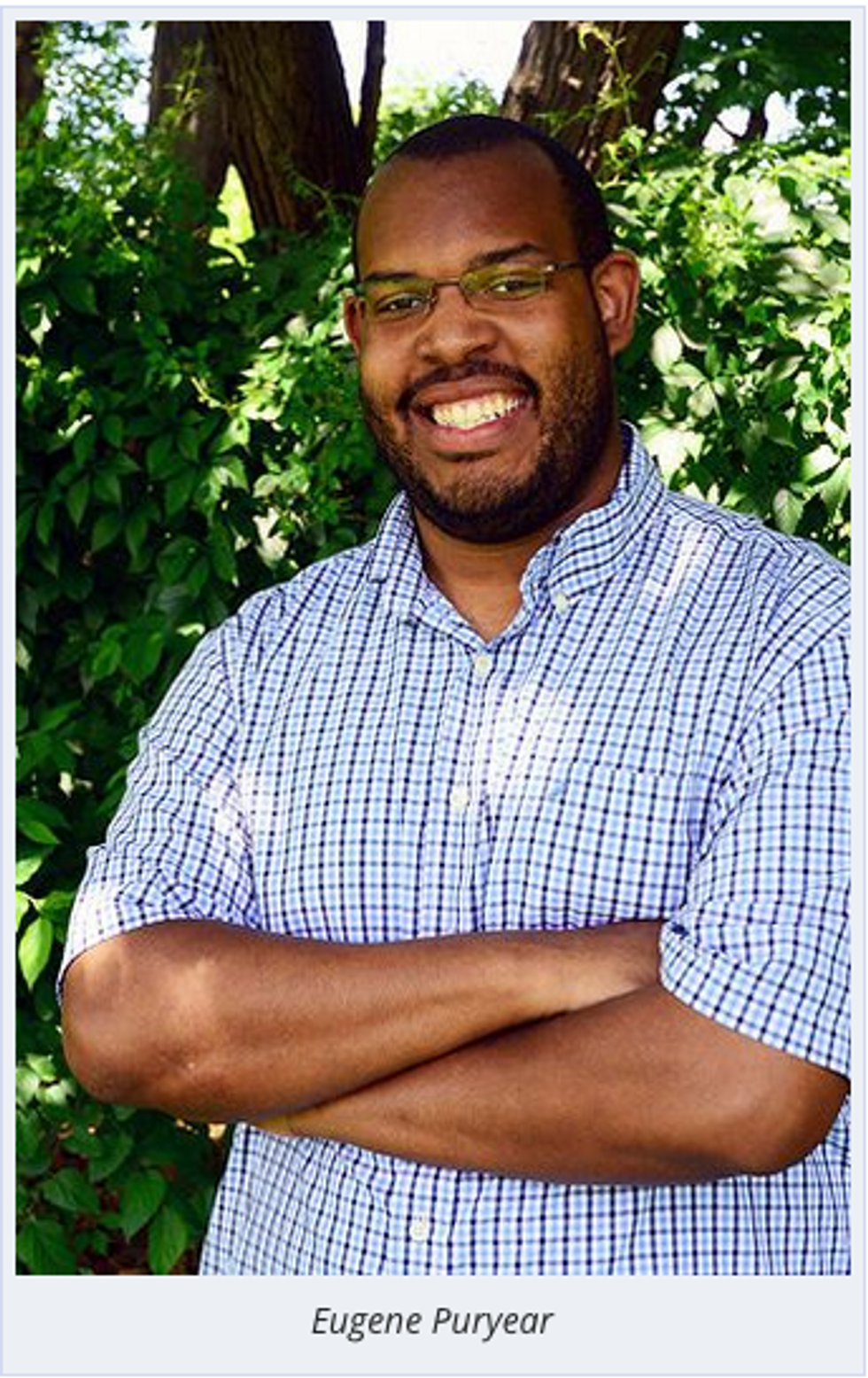
Changa's crime is simply appearing on Eugene Puryear's radio show, By Any Means Necessary. Puryear, in turn, is guilty of collecting a salary from a station funded by Russia--a distinction Kauffman makes in passing, but moral delineation isn't really the point; the point is to create the image of restless black leftists carrying out Moscow's agenda.
The piece then quotes international relations professor Robert Orttung for the obligatory scare lines about how sinister Russian propaganda is. "Those platforms are set up for the sole purpose of promoting the Kremlin line," Orttug tells WABE. "The idea is to create as much chaos as possible because the Russians see it as a zero-sum game, where anything that weakens us is going to strengthen them."
Who "us" is in this equation, or how "we" are weakened by black activists critiquing US imperialism and racism, is not explained. The white professor has told the white NPR reporter that this nebulous "us" is being undermined, and that's that.
Orttung is referred to an "associate research professor of international affairs at the George Washington University," but what Kauffman ignores, ironically, is that Orttung is himself an agent of government propaganda. Orttung is on the International Forum for Democratic Studies Council at the National Endowment for Democracy, an organization set up in 1983 by the US government--specifically Ronald Reagan--as a "soft power" tool in the Cold War. NED's budget is almost entirely provided by the US government ($170 million in 2016 alone) and those who work for the NED are, by Kauffman's own standard, agents of influence for a government entity. (Orttung's perch at GWU, the Institute for European, Russian and Eurasian Studies, is also funded in part by the US State Department--as well as by the government of Kazakhstan.)
Is this mentioned? Is this disclosed, so one can maybe put in broader context how talking heads like Orttung are "US-backed pundits" using US-backed public radio "to spread a message"? Of course not, because money distributed by the US government is, for reasons that are never fully explained, never corrupting or influencing. Only rubles turn media into "propaganda"; dollar bills are presumably laced with an anti-corruption chemical that prevents venality and careerist conformism.
Changa, for her part, says she was misled about the nature of the story, and has expressed her frustration over how she was portrayed in a Twitter thread that's worth reading:
Kauffman does quote Puryear taking issue with the narrative--otherwise embraced by the piece--that talking about racism is part of a plot to undermine the United States: "So raising Black Lives Matter issues is divisive in America?" he says. "I mean, I think what's divisive is racism and police brutality." But the public radio reporter trumps that argument by employing the known Soviet propaganda tactic of "whataboutism": by insisting its the Russians who are the real racists!
Many media reports describe links between white supremacist groups and Russian propaganda outlets like Sputnik.
NPR's national news desk did a similar sleight-of-hand in March, when it noted concerns from black users on Twitter about potentially racist coverage of the Austin bombings (which killed two African-Americans), and instead of doing any media analysis to see if there was, in fact, bias in the coverage because the victims were black, it focused instead on alleged "Russian bots" amplifying these concerns (FAIR.org, 4/5/18).
The piece ends with Kauffman narcing on Changa to one of her political allies, in an obvious attempt to create a chilling effect for others. WABE puts a microphone in front of congressional candidate Richard Winfield's face and asks him what he thinks about Changa being associated with the stain of "Russian influence":
Winfield said he didn't know Changa was a regular on Sputnik, but if he did, he wouldn't have agreed to appear on her personal podcast.
"It raises the possibility of people impugning not just me," said Winfield, "but the political positions I'm advancing and distracting from the power of these positions."
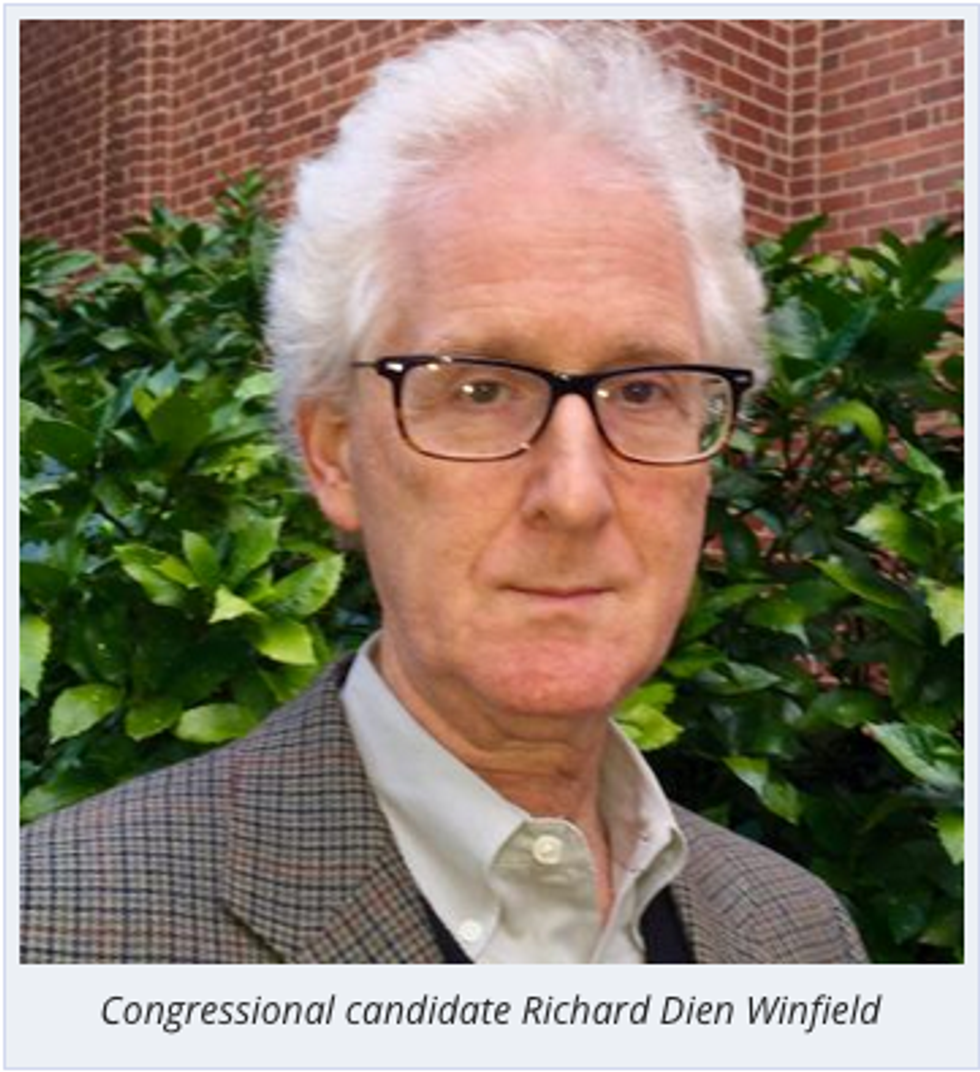
There is no other way to read this other than a veiled warning to those on the left thinking about exploiting Russian-backed media to advance their cause: Touch Sputnik or RT and your reputation will be harmed, if not by the natural course of events, then by Russia-obsessed media on the lookout for Kremlin stooges, no matter how obscure or powerless they may be.
At no point do NPR or WABE lay out which government funding is corrupting and which isn't. Yours truly collects checks from Al Jazeera for freelance work now and then, a network funded by a government that has ties to extremists in Syria and punishes homosexuality with imprisonment. NPR gets 14 percent of its budget from a government that incarcerates more people than any other nation, is currently bombing seven countries and is guilty of multiple human rights abuses over the past two decades. Is that OK? Does that make Adam Johnson and Johnny Kauffman stooges of Qatar and the US, respectively? If assumptions about "Country X-backed media" are used to smear those who take a check--or even come close to those who take a check--from Russia, there should be a consistent standard for everyone.
But no such standard will be forthcoming. Because no one is interested in a robust and honest conversation about foreign or government influence on the media. What US media are interested in doing, instead, is singling out Official Enemies and using them as a bludgeon to marginalize the already-marginalized, to sully those who make substantive critiques of US society and empire without apology. Instead of engaging with Changa and Puryear's years of activism, WABE would rather run racist middlebrow schlock, reducing black activists to Russian pawns for the white tote-bag set.
Messages to WABE may be sent here (or via Twitter: @WABEnews). Please remember that respectful communication is the most effective.