

SUBSCRIBE TO OUR FREE NEWSLETTER
Daily news & progressive opinion—funded by the people, not the corporations—delivered straight to your inbox.
5
#000000
#FFFFFF
To donate by check, phone, or other method, see our More Ways to Give page.
Daily news & progressive opinion—funded by the people, not the corporations—delivered straight to your inbox.
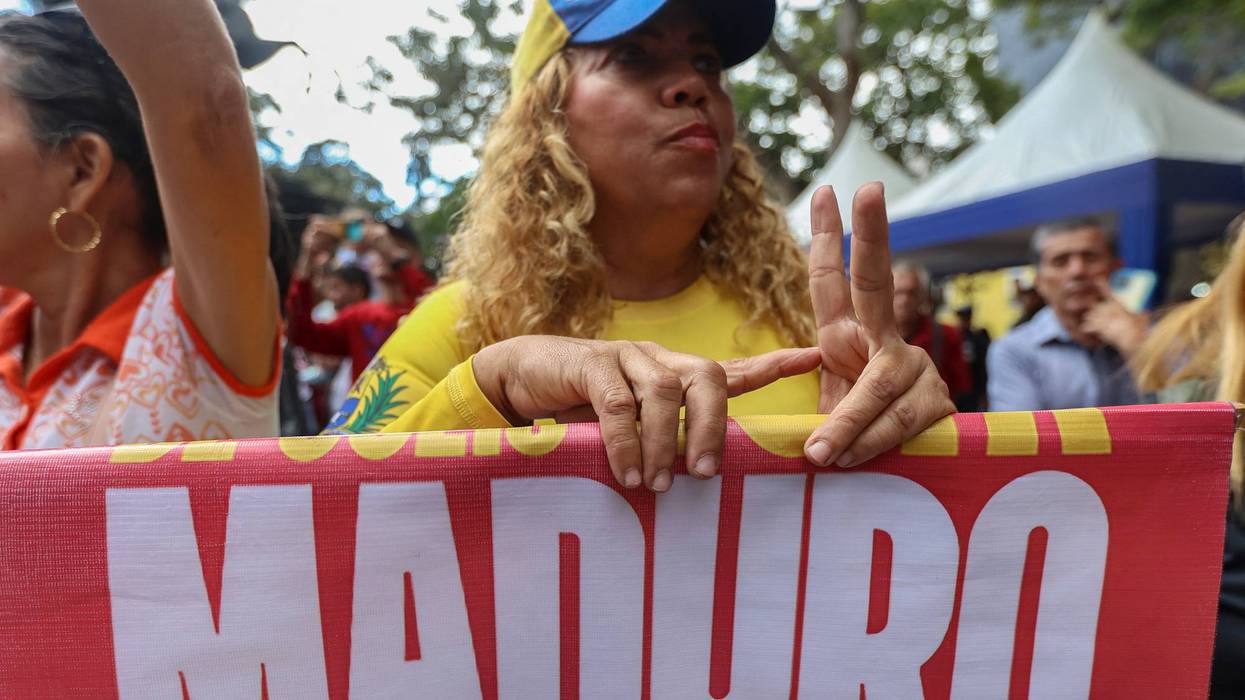
Washington’s kidnapping of Maduro was intended to demonstrate the empire’s dominance. But it also exposed its limits.
The kidnapping of a sitting head of state marks a grave escalation in US-Venezuela relations. By seizing Venezuela’s constitutional president, Washington signaled both its disregard for international law and its confidence that it would face little immediate consequence.
The response within the US political establishment to the attack on Venezuela has been striking. Without the slightest cognitive dissonance over President Nicolás Maduro’s violent abduction, Democrats call for “restoring democracy”—but not for returning Venezuela’s lawful president.
So why didn’t the imperialists simply assassinate him? From their perspective, it would have been cleaner and more cost-efficient. It would have been the DOGE thing to do: launch a drone in one of those celebrated “surgical” strikes.
Targeted killings are as much a part of US policy now as there were in the past. From former President Barack Obama’s drone strikes on US citizens in 2011 to President Donald Trump’s killing of Iranian General Qasem Soleimani, lethal force has been used when deemed expedient. And only last June, the second Trump administration and its Zionist partner in crime droned 11 Iranian nuclear scientists.
The present US-Venezuelan détente is making history. So far—in Hugo Chávez’s words, por ahora—it does not resemble the humanitarian catastrophes imposed by the empire on Haiti, Libya, Iraq, Syria, or Afghanistan.
The US posted a $50 million bounty on Maduro, yet they took him very much alive along with his wife, First Combatant (the Venezuelan equivalent of the First Lady) Cilia Flores.
The reason Maduro’s life was spared tells us volumes about the resilience of the Bolivarian Revolution, the strength of Maduro even in captivity, and the inability of the empire to subjugate Venezuela.
Killing Nicolás Maduro Moros appears to have been a step too far, even for Washington’s hawks. Perhaps he was also seen as more valuable to the empire as a hostage than as a martyr.
But the images of a handcuffed Maduro flashing a victory sign—and declaring in a New York courtroom, “I was captured… I am the president of my country”—were not those of a defeated leader.
Rather than collapsing, the Bolivarian Revolution survived the decapitation. With a seamless continuation of leadership under acting President Delcy Rodríguez, even some figures in the opposition have rallied around the national leadership, heeding the nationalist call of a populace mobilized in the streets in support of their president.
This has pushed the US to negotiate rather than outright conquer, notwithstanding that the playing field remains decisively tilted in Washington’s favor. Regardless, Venezuelan authorities have demanded and received the US’ respect. Indeed, after declaring Venezuela an illegitimate narco-state, Trump has flipped, recognized the Chavista government, and invited its acting executive to Washington.
NBC News gave Delcy Rodríguez a respectful interview. After affirming state ownership of Venezuela’s mineral resources and Maduro as the lawful president, she pointed out that the so-called political prisoners in Venezuelan prisons were there because they had committed acts of criminal violence.
Before a national US television audience she explained that free and fair elections require being “free of sanctions and… not undermined by international bullying and harassment by the international press” (emphasis added).
Notably, the interviewer cited US Energy Secretary Chris Wright’s admission made during his high-level visit to Venezuela. The US official said that elections there could be held, not in three months, but in three years, in accordance with the constitutionally mandated schedule.
As for opposition politician María Corina Machado, the darling of the US press corps, Rodríguez told the interviewer that Machado would have to answer for her various treasonous activities if she came back to Venezuela.
Contrary to the corporate press’s media myth, fostered at a reception in Manhattan, that Machado is insanely popular and poised to lead “A Trillion-Dollar Opportunity: The Global Upside of a Democratic Venezuela,” the US government apparently understood the reality on the ground. “She doesn’t have the support within, or the respect within, the country,” was the honest evaluation, not of some Chavista partisan, but of President Trump himself.
Yader Lanuza documents how the US provided millions to manufacture an effective astroturf opposition to the Chavistas. It is far from the first time that Washington has squandered money in this way—we only have to look back at its failed efforts to promote the “presidency” of Juan Guaidó. Its latest efforts have again had no decisive result, leaving Machado in limbo and pragmatic engagement with the Chavista leadership as the only practical option.
Any doubts that there is daylight between captured President Maduro and acting President Rodríguez can be dispelled by listening to the now incarcerated Maduro’s New Year’s Day interview with international leftist intellectual Ignacio Ramonet.
Maduro said it was time to “start talking seriously” with the US—especially regarding oil investment—marking a continuation of his prior conditional openness to diplomatic engagement. He reiterated that Venezuela was ready to discuss agreements on combating drug trafficking and to consider US oil investment, allowing companies like Chevron to operate.
That was just two days before the abduction. Subsequently, Delcy Rodríguez met with the US energy secretary and the head of the Southern Command to discuss oil investments and combating drug trafficking, respectively.
Venezuelan analysts have framed the current moment as one of constrained choice. “What is at stake is the survival of the state and the republic, which if lost, would render the discussion of any other topic banal,” according to Sergio Rodríguez Gelfenstein. The former government official, who was close to Hugo Chávez, supports Delcy Rodríguez’s discussions with Washington—acknowledging that she has “a missile to her head.”
“The search for a negotiation in the case of the January 3 kidnapping is not understood, therefore, as a surrender, but as an act of political maturity in a context of unprecedented blackmail,” according to Italian journalist and former Red Brigades militant Geraldina Colotti.
The Amnesty Law, a longstanding Chavista initiative, is being debated in the National Assembly to maintain social peace, according to the president of the assembly and brother of the acting president, Jorge Rodríguez, in an interview with the US-based NewsMax outlet.
As Jorge Rodríguez commented, foregoing oil revenues by keeping oil in the ground does not benefit the people’s well-being and development. In that context, the Hydrocarbon Law has been reformed to attract vital foreign investment.
The Venezuelan outlet Mision Verdad elaborates: “The 2026 reform ratifies and, in some aspects, deepens essential elements of the previous legislation… [I]t creates the legal basis for a complete strategic adaptation of the Venezuelan hydrocarbon industry, considering elements of the present context.”
As Karl Marx presciently observed about the present context, people “make their own history, but they do not make it as they please; they do not make it under self-selected circumstances.” The present US-Venezuelan détente is making history. So far—in Hugo Chávez’s words, por ahora—it does not resemble the humanitarian catastrophes imposed by the empire on Haiti, Libya, Iraq, Syria, or Afghanistan.
But make no mistake: The ultimate goal of the empire remains regime change. And there is no clearer insight into the empire’s core barbarity than Secretary of State Marco Rubio’s speech at the Munich conference with his praising of the capture of a “narcoterrorist dictator” and his invocation of Columbus as the inspiration “to build a new Western century.”
Washington’s kidnapping of Maduro was intended to demonstrate the empire’s dominance. But it also exposed its limits: the durability of the Bolivarian Revolution and the reality that even great powers must sometimes negotiate with governments they detest. The outcome remains uncertain.
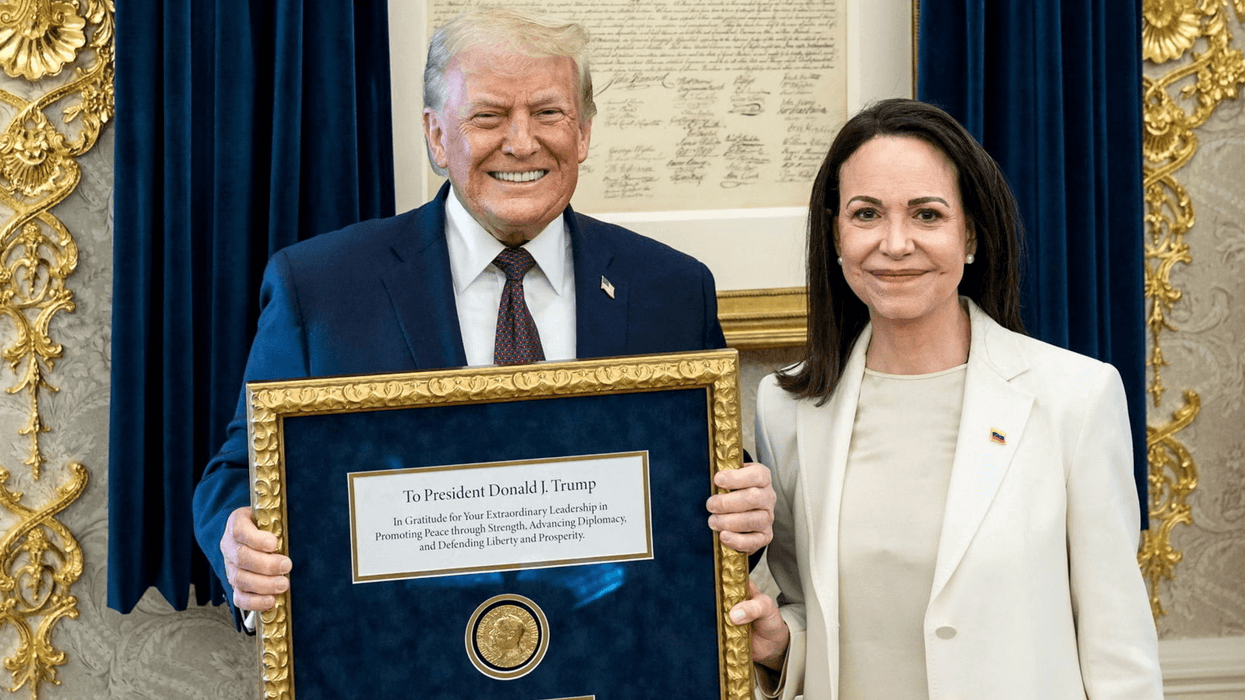
Machado’s decision to accept the prize, supposedly contrary to the wishes of the White House, before delivering it to him in person, signifies the depth of Machado’s commitment to enact the US will on Venezuela.
Maria Corina Machado said it was a “historic day for us Venezuelans” as she handed President Donald Trump her Nobel Peace Prize. For the pro-Israel, far-right opposition figure in Venezuela, being welcomed to the White House may have been a historic day. But for those of us interested in peace and justice, the only history the United States is making by keeping the sitting president of Venezuela locked up in New York is of colonialist bullying and imperialist violence.
After being snubbed of her dreamed-of-role as President of Venezuela, Machado left no hard feelings as she gave her recently awarded Nobel Peace Prize to Trump on January 15. One might think being told she didn’t have the “respect” nor “support” within Venezuela to be parachuted in as leader would sever Trump-Machado relations. But, US relations with Machado and her far-right party are deep. This remains the zenith of her life’s worth to sell back her country to capital. For those wondering if Trump now has the Nobel Prize–yes. Well, he did the second Machado got it, no matter his statements to counteract that. Machado’s decision to accept the prize, supposedly contrary to the wishes of the White House, before delivering it to him in person, signifies the depth of Machado’s commitment to enact the US will on Venezuela.
Maria Corina Machado was born in 1967 into one of the wealthiest families in Venezuela. This wealth came from their ownership and control of Venezuela’s largest private-sector steel company, Sivensa, and its largest private steel processor, Sidetur. Her family also benefited greatly from the 1997 privatization of Sidor, the largest steelmaker in Venezuela, as they held a controlling stake. Between 2008 and 2010, the Chávez government nationalized all three of these companies, which stripped the Machado family of their life of abhorrent luxury while most Venezuelans suffered. Like many of this era, these wealthy families never forgave the revolutionary government for providing for the Venezuelan people.
In her youth, with all of the riches of these companies, Machado was educated at an elite boarding school in the United States, which costs $78,000 a year in today’s money. She then studied engineering at the graduate and post-graduate levels. After completing her studies, she spent a brief stint in her family’s steel company before she moved into philanthropy. It is not hard to see where her virulent pro-US politics have come from. But US-Machado relations go back a long way, which is why her handing Trump the Nobel Peace Prize is not the first occasion when she has shown her true nature as a US-backed asset.
In 2002, Machado set up Súmate, an NGO aiming to topple the Bolivarian Revolution under the supposed task of “election monitoring” in Venezuela. It immediately received at least $53,400 from the United States via the National Endowment for Democracy, the infamous route through which the US funds its CIA campaigns globally. Súmate was the front through which US interests repeatedly attempted to undermine Chávez: They pushed the campaign for a 2004 recall of the presidential election, produced data for opposition attacks, and peddled anti-Chávez propaganda in the media, among other nefarious activities using the front of “democracy” to do so. In 2005, President George W. Bush invited Machado into the Oval Office to personally thank her for carrying out this work.
In 2012, Machado set up Vente Venezuela, a far-right political party that pushed for private property and free markets in Venezuela. Through this political party, she has attempted to unify strands of the opposition to push her challenge to the Bolivarian project and launch counterrevolutionary measures aimed at overthrowing the government. Machado has asserted that if she were in power, she would sell off Venezuela’s publicly owned oil company and privatize all oil and gas reserves that currently fund public services for Venezuelans. These instances reveal that “democracy” and “freedom” are guises for the ultimate aim of privatization in order for her, as well as her friends and family, to once more embezzle huge sums of money and cut off millions of people from needed public services.
Machado is a key asset for the US as a voice that ostensibly speaks on behalf of those grieved from within Venezuela that can be used to justify its regime change attempts from outside.
When the US imposed sanctions on Venezuela, formally in 2005, Machado was one of the loudest and most abrasive supporters. On many occasions, she has been boldly in support of these unilateral coercive measures that have killed over 100,000 people and caused absolute misery for Venezuelans.
Beyond her support for sanctions, Machado’s appetite for the murder of her own countrymen is seen through her support for the US naval armada as well as murderous US attacks on small boats in the Caribbean and Pacific, which have killed over 120 people since September 2025. As 70% of the US oppose war on Venezuela, as families mourn their loved ones, and as millions of dollars are used to fund warship deployments in the Caribbean, Machado said: “I totally support [Trump’s] strategy. I think it is the right thing to do. It’s courageous. It’s visionary.” Perhaps Machado’s American boarding school taught her such conceptions of courage and vision, but for those of us who have seen the videos of boats being bombed, heard testimonies of the civilian victims of airstrikes in La Gauira, and watched the rabid threats of war flow unabated, they are supportive of terror and murder.
Not only are people in Venezuela being sacrificed in Machado’s dream of a ravaged, neoliberal Venezuela, but as per her duty, she also justifies US action against Venezuelans living in the United States. Machado peddled lies about drug cartels and their links to the Venezuelan government, which justified Trump’s incarceration of 200 Venezuelans in the US to the CECOT torture facility in El Salvador. When she traveled to Oslo to receive the Nobel Peace Prize, Machado revealed her journey was made possible by US support. She also dedicated the prize to Trump before ultimately delivering the prize to him by hand this week. Machado is a key asset for the US as a voice that ostensibly speaks on behalf of those grieved from within Venezuela that can be used to justify its regime change attempts from outside.
A second prong to Machado’s role in the Venezuelan opposition is in instigating violence, both within Venezuela, through funding and provoking violent riots, and externally, encouraging foreign intervention. In 2002, Machado helped lead the US-backed coup to overthrow democratically elected President Hugo Chávez. She signed the Carmona Decree, which tried to dissolve the National Assembly, the Supreme Court, and other governmental bodies that brought about change in the interests of the Venezuelan people and away from the hoarding of foreign and domestic elites, like herself.
Machado was a key figure in organizing guarimbas, violent riots aimed at causing chaos and paralyzing the country in order to provoke political and economic collapse. In 2014, Machado was a key organizer and supporter of guarimbas that killed her political opponents, burnt down public infrastructure, and set ambulances and doctors on fire. Again in 2017, she helped to organize and fund the guarimbas, which killed 200 people and wounded more than 15,000, and caused significant damage to bus drivers, metro workers, and passengers, hospitals, roads, and other public buildings. These riots targeted people living their daily lives: Barricades were erected to stop people from going to work or school, bus drivers were attacked for transporting people, metal wires were hung to kill anyone who tried to bypass them, and the public infrastructure for life was destroyed. This onslaught on Venezuelans strove to make their lives unbearable to inflict the maximum social damage and force political change through terror and violence. After the presidential election in 2024, Machado’s party funded saboteurs to stage tire-burning protests and attack military bases in an attempt to spur more guarimbas and justify the US and opposition’s call that the election was a “fraud.”
As well as her support for US sanctions and attacks on Venezuela, Machado made a plea to genocide architect Benjamin Netanyahu in 2018 to intervene at the United Nations for military intervention in Venezuela. She asked for Netanyahu’s apparent “strength and influence to advance the dismantling of the criminal Venezuelan regime.” But this appeal represents the critical link between Machado’s desire for Venezuela and her Zionist fanaticism, necessary and unsurprising as Machado is a node within the global imperialist axis,
Machado is openly Zionist and receives strong support from Israel, perhaps unsurprisingly given her status as a US puppet. She’s repeatedly committed to alliances with the Zionist entity and spread its propaganda, particularly as she has become the key opposition leader of the current moment. Since 2009, when Chávez ended diplomatic relations with Israel, Venezuela has not engaged with the Zionist entity. This, too, is a rationale for persistent US efforts at overthrowing the anti-imperialist, anti-Zionist governments of Chávez and Nicolás Maduro, who have repeatedly stated: “Humanity’s most important battle is for the liberation of Palestine.”
In 2020, Machado’s party signed a cooperation agreement with Israel’s fascist “Likud” Party, a party advocating for the total extermination of Palestine. Every year, she posts on social media erasing and celebrating Nakba Day as Israel’s “founding,” a genocidal Zionist propaganda line. In 2025, she praised Netanyahu for the genocide in Gaza, saying “she greatly appreciates his decisions and resolute actions in the course of the war, and Israel's achievements." Her desire for power is also in the interest of Israel; she said if she were president, “Venezuela will be Israel’s closest ally in Latin America.” Machado has promised to move Venezuela’s embassy to Jerusalem in an attempt to legitimize Israel’s occupation. She has also vowed to restore relations with Israel.
Machado is ultimately one thread in the fabric of the US empire.
Previous failed US-backed opposition leaders have also been recognized by Israel immediately, including Juan Guaido, who announced himself president and quickly said, “The process of stabilizing relations with Israel is at its height.” Israel also recognized Machado’s predecessor, Edmundo Gonzalez’s claim that he was president of Venezuela in 2024, after he lost the election. When the US pushes these leaders, they are in the interests of its own empire, of which Israel is a critical component. Thus, we must recognize the role of Venezuela’s revolutionary government in supporting Palestine in sharp contrast to the far-right opposition’s desire to propel Venezuela into the US-Israel axis.
While Machado has played a pertinent and critical role for the US in causing chaos, disseminating propaganda, and pushing for regime change in Venezuela, it is necessary not to see Maria Corina Machado as an individual solely motivated by her own interests. Her desire to return to Venezuela for the profits of the few at the expense of the many is certainly rooted in her elite upbringing and personal stake in a potential neoliberal Venezuela. But Machado is ultimately one thread in the fabric of the US empire. Whether it’s Machado, Guaido, Gonzalez, López, Capriles, or any new figure that will certainly emerge, all are set up with the one aim of destroying the Bolivarian Revolution in the interests of the United States.
White House officials might have told the Washington Post that the only reason Machado was not installed as President of Venezuela was that she accepted the Nobel Peace Prize, when it belonged to Trump. But, Machado could give that certificate to Trump again and again, and again; it is the Venezuelan people who will determine their own fate. We stand with them.
In 1943, the Norwegian writer Knut Hamsun gave his Nobel Prize for Literature to the infamous Nazi criminal.
Venezuelan opposition leader María Corina Machado's gifting of her 2025 Nobel Peace Prize to US President Donald Trump raised eyebrows around the world Friday—but it wasn't the first time that the winner of the prestigious award gave it away.
Last month, the Norwegian Nobel Committee awarded the peace prize to the 58-year-old opposition leader "for her tireless work promoting democratic rights for the people of Venezuela and for her struggle to achieve a just and peaceful transition from dictatorship to democracy."
Machado joined a notorious group of Nobel Peace laureates who either waged or advocated for war, as she backed Trump's aggression against her country. This has included a massive troop deployment, military and CIA airstrikes, bombing of boats allegedly transporting drugs, and the abduction earlier this month of Venezuelan President Nicolás Maduro and his wife, Cilia Flores.
Trump has ordered the bombing of nine other countries during his two terms, more than any other president in history. US forces acting on his orders have killed thousands of civilians in Afghanistan, Iran, Iraq, Libya, Nigeria, Pakistan, Somalia, Syria, Venezuela, and Yemen. While running for president in 2016, Trump vowed to "bomb the shit out of" Islamic State militants and "take out their families," and then followed through on his promise.
Despite being passed over by Trump for installation in any leadership role in Venezuela so far, Machado presented Trump with her framed Nobel medal along with a certificate of gratitude during a Thursday meeting at the White House. Trump subsequently posted on his Truth Social network that “María presented me with her Nobel Peace Prize for the work I have done. Such a wonderful gesture of mutual respect.”
In 1943!!!“Nobel Literature laureate Knut Hamsun famously gave his Nobel medal and diploma to Nazi propaganda minister Joseph Goebbels as a gesture of admiration for the Nazi regime, following his support for the occupation….”
[image or embed]
— Molly Jong-Fast (@mollyjongfast.bsky.social) January 16, 2026 at 10:56 AM
That gesture prompted the Norwegian Nobel Committee to issue a statement noting that the prize cannot be given away.
"Even if the medal or diploma later comes into someone else’s possession, this does not alter who was awarded the Nobel Peace Prize," the committee said. "A laureate cannot share the prize with others, nor transfer it once it has been announced. A Nobel Peace Prize can also never be revoked. The decision is final and applies for all time."
The committee's statement was extraordinary—but this is not the first time that a Nobel winner gave away their prize. In 1943, Norwegian author Knut Hamsun gifted his 1920 Nobel Prize for Literature—awarded for his novel Markens Grøde (Growth of the Soil)—to Nazi Propaganda Minister Joseph Goebbels after a trip to Germany. Other Nobel laureates have donated or sold their medals.
The progressive media outlet Occupy Democrats said on social media: "Clearly, the similarities between Trump and Goebbels extend beyond just a mutual admiration for fascism. Both men possess(ed) the kind of spiritually sick, egotistical temperament that allows one to accept a prize that someone else has earned."
"Obviously, Donald Trump does not deserve the Nobel Peace Prize," the outlet continued. "He has bombed Iran, Yemen, Nigeria, innocent fishing boats in the Caribbean, Venezuela, and is in the process of turning the United States into a war zone. That said, Machado doesn't deserve it either."
"Anyone spineless enough to surrender the prize to an evil man like Trump in the hopes of obtaining power is not someone we should be celebrating," Occupy Democrats added.
Last month, Wikileaks founder and multiple Nobel Peace Prize nominee Julian Assange sued the Nobel Foundation—the Swedish organization that manages administration of the approximately $1.2 million-per-winner prize—in a bid to prevent Machado from receiving the money.
Machado's win also sparked protests outside the Norwegian Nobel Institute in Oslo.
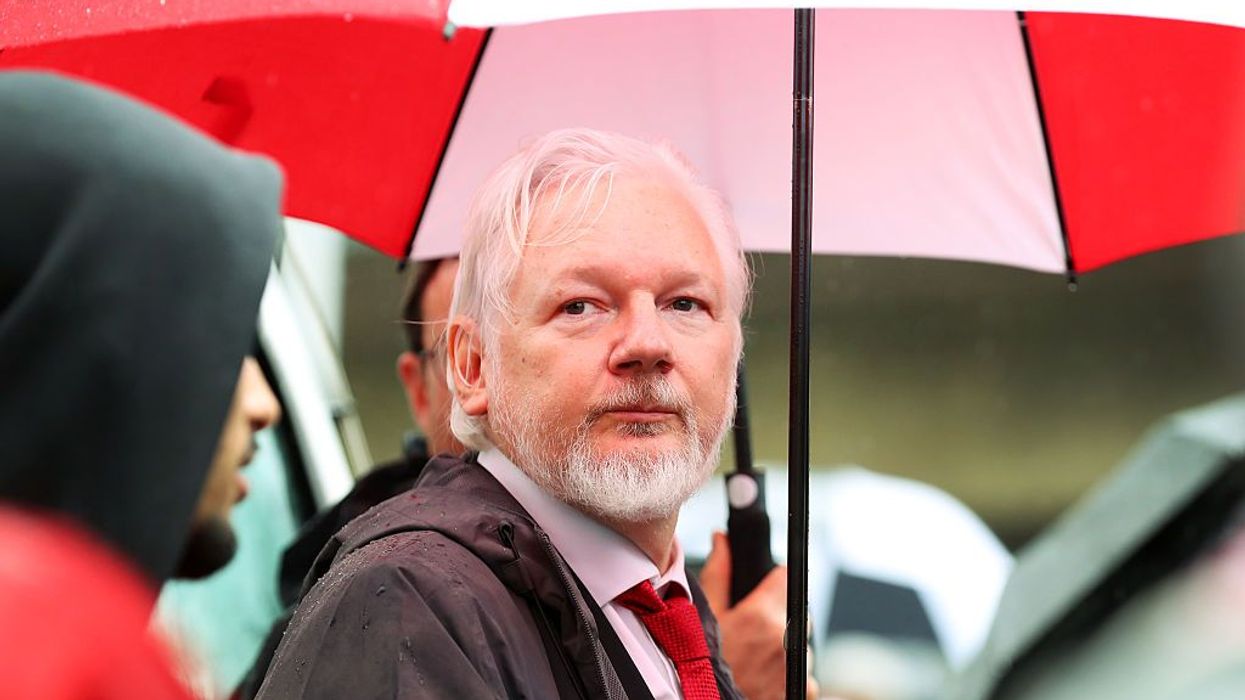
"Alfred Nobel's endowment for peace cannot be spent on the promotion of war."
WikiLeaks founder Julian Assange on Wednesday filed a complaint against the Nobel Foundation to stop its planned payouts to Venezuelan opposition leader and 2025 Nobel Peace Prize winner María Corina Machado, who has backed US President Donald Trump's campaign of military aggression against her own country.
According to a press release that WikiLeaks posted to X, Assange's lawsuit seeks to block Machado from obtaining over USD $1 million she's due to receive from the Nobel Foundation as winner of this year's Peace Prize.
The complaint notes that Alfred Nobel's will states that the Peace Prize named after him should only be awarded to those who have "conferred the greatest benefit to humankind” by doing “the most or the best work for fraternity between nations, for the abolition or reduction of standing armies, and for the holding and promotion of peace congresses."
In an interview that aired on Sunday on CBS News’ “Face the Nation,” Machado praised Trump’s policies of tightening economic sanctions and seizing Venezuelan oil tankers, acts of aggression that appear to go against Nobel's stated declaration that the Peace Prize winner must promote "fraternity between nations."
“Look, I absolutely support President Trump’s strategy, and we, the Venezuelan people, are very grateful to him and to his administration, because I believe he is a champion of freedom in this hemisphere,” Machado told CBS News.
Trump’s campaign against Venezuela has not only included sanctions and the seizing of an oil tanker, but a series of bombings of purported drug trafficking vessels that many legal experts consider to be acts of murder.
In his complaint, Assange claims that Machado's gushing praise of Trump in the wake of his illegal boat-bombing campaign is enough to justify the Nobel Foundation freezing its disbursements to the Venezuelan politician.
"Alfred Nobel's endowment for peace cannot be spent on the promotion of war," Assange states, adding that "Machado has continued to incite the Trump Administration to pursue its escalatory path" against her own country.
The complaint also argues that there's a risk that funds awarded to Machado will be "diverted from their charitable purpose to facilitate aggression, crimes against humanity, and war crimes."
Were this to happen, the complaint alleges, it would violate Sweden's obligations under Article 25(3)(c) of the Rome Statute, which states that anyone who "aids, abets, or otherwise assists" in the commission of a war crime shall be subject to prosecution under the International Criminal Court.
Trump in recent days has ramped up his aggressive actions against Venezuela, and on Tuesday night he announced a "total and complete blockade" of all "sanctioned oil tankers" seeking to enter and leave the country.
“Venezuela is completely surrounded by the largest Armada ever assembled in the History of South America,” Trump wrote in a Truth Social post. “It will only get bigger, and the shock to them will be like nothing they have ever seen before.”

"The 'Nobel Peace Prize' continues thanking the US for the maximum pressure against her own country," said one critic.
Venezuelan opposition leader María Corina Machado, the winner of the 2025 Nobel Peace Prize, is taking criticism for lending support to US President Donald Trump's campaign of military aggression against her own country.
In an interview that aired on Sunday on CBS News' "Face the Nation," Machado praised Trump's policies of tightening economic sanctions and seizing oil tankers that had been docked at Venezuelan ports.
“Look, I absolutely support President Trump’s strategy, and we, the Venezuelan people, are very grateful to him and to his administration, because I believe he is a champion of freedom in this hemisphere," Machado told CBS News.
Machado elaborated that she supported Trump's actions because the Maduro government was "not a conventional dictatorship," but "a very complex criminal structure that has turned Venezuela into a safe haven of international crime and terrorist activities."
Trump's campaign against Venezuela has not only included sanctions and the seizing of an oil tanker, but a series of bombings of purported drug-trafficking vessels that many legal experts consider to be acts of murder.
Trump has also said that he would soon authorize strikes against purported drug traffickers on Venezuelan soil, even though he has received no congressional authorization to conduct such an operation against a sovereign nation.
Machado's embrace of Trump as he potentially positions the US to launch a regime-change war in Venezuela drew swift criticism from opponents of American imperialism.
SussexBylines columnist Ross McNally questioned whether someone who is going on the record to support military aggression against her own country was really the right choice to win the Nobel Peace Prize.
"The Nobel Committee's decision to give the Peace Prize to Machado is bizarre for several reasons," he explained. "Firstly, its description of Machado’s ‘tireless work promoting democratic rights’ ignores the fact that she supported the attempted coup against democratically elected President Hugo Chávez in 2002... Alongside her encouragement for Trump’s military escalation, this jars somewhat with the Committee’s description."
The Machado interview was also criticized by Venezuelan journalist Madelein Garcia, who argued in a post on X that it was ironic to see that "the 'Nobel Peace Prize' continues thanking the US for the maximum pressure against her own country."
Going Underground host Afshin Rattansi also excoriated the Nobel Committee for overlooking Machado's support of militarism when it decided to award her a prize intended for peacemakers.
"Nobel Farce Prize Winner Maria Corina Machado is not a freedom fighter, she’s a CIA asset and de facto spokeswoman for US corporations," he wrote. "Here she is smiling gleefully at the prospect of selling $1.7 trillion of infrastructure and resources should the US carry out regime change in Venezuela and install her in Miraflores, promising 'we have a massive privatisation program waiting for you.'"

"No peace prize for warmongers," said one of the banners displayed by demonstrators, who derided Machado's support for President Donald Trump's regime change push in Venezuela.
As President Donald Trump issued new threats of a possible ground invasion in Venezuela, protesters gathered outside the Norwegian Nobel Institute in Oslo on Tuesday to protest the awarding of the prestigious peace prize to right-wing opposition leader Maria Corina Machado, whom they described as an ally to US regime change efforts.
“This year’s Nobel Prize winner has not distanced herself from the interventions and the attacks we are seeing in the Caribbean, and we are stating that this clearly breaks with Alfred Nobel’s will," said Lina Alvarez Reyes, the information adviser for the Norwegian Solidarity Committee for Latin America, one of the groups that organized the protests.
Machado's daughter delivered a speech accepting the award on her behalf on Wednesday. The 58-year-old engineer was unable to attend the ceremony in person due to a decade-long travel ban imposed by Venezuelan authorities under the government of President Nicolás Maduro.
Via her daughter, Machado said that receiving the award "reminds the world that democracy is essential to peace... And more than anything, what we Venezuelans can offer the world is the lesson forged through this long and difficult journey: that to have a democracy, we must be willing to fight for freedom."
But the protesters who gathered outside the previous day argue that Machado—who dedicated her acceptance of the award in part to Trump and has reportedly worked behind the scenes to pressure Washington to ramp up military and financial pressure on Venezuela—is not a beacon of democracy, but a tool of imperialist control.
As Venezuelan-American activist Michelle Ellner wrote in Common Dreams in October after Machado received the award:
She worked hand in hand with Washington to justify regime change, using her platform to demand foreign military intervention to “liberate” Venezuela through force.
She cheered on Donald Trump’s threats of invasion and his naval deployments in the Caribbean, a show of force that risks igniting regional war under the pretext of “combating narco-trafficking.” While Trump sent warships and froze assets, Machado stood ready to serve as his local proxy, promising to deliver Venezuela’s sovereignty on a silver platter.
She pushed for the US sanctions that strangled the economy, knowing exactly who would pay the price: the poor, the sick, the working class.
The protesters outside the Nobel Institute on Tuesday felt similarly: "No peace prize for warmongers," read one banner. "US hands off Latin America," read another.
The protest came on the same day Trump told reporters that an attack on the mainland of Venezuela was coming soon: “We’re gonna hit ‘em on land very soon, too,” the president said after months of extrajudicial bombings of vessels in the Caribbean that the administration has alleged with scant evidence are carrying drugs.
On the same day that Machado received the award in absentia, US warplanes were seen circling over the Gulf of Venezuela. Later, in what Bloomberg described as a "serious escalation," the US seized an oil tanker off the nation's coast.
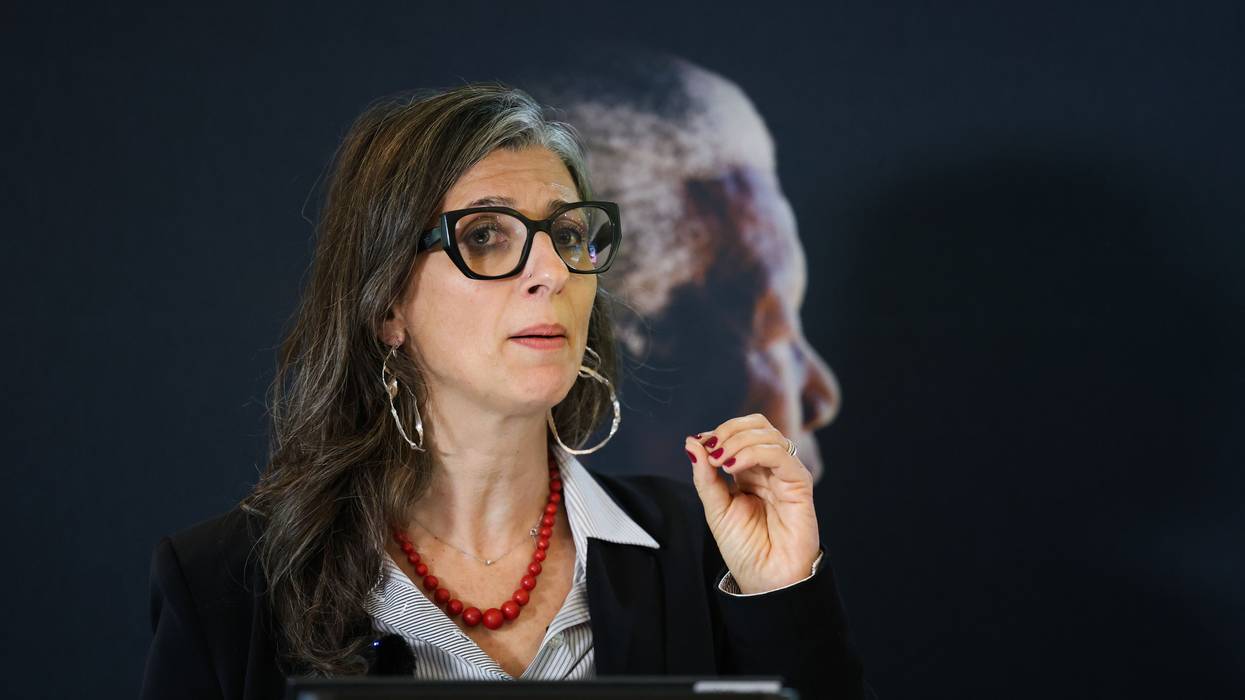
An alternative to the Nobel Peace Prize honors those who truly align with Alfred Nobel's original will and celebrates their achievements.
The annual Nobel Peace Prize ceremony takes place on December 10 in Oslo, Norway. In a symbol of Western hypocrisy, the 2025 Nobel Peace Prize was controversially awarded to María Corina Machado, the leader of Venezuela's hard-line right-wing opposition. Coupled with US President Donald Trump's contentious nomination and the awards' declining credibility, it's time we examine the merits and effectiveness of the once-prestigious award.
The late Fredrik S. Heffermehl, a Norwegian lawyer and author, long championed a critical examination of the Nobel Peace Prize and its alignment with Alfred Nobel's original will— "...the person who has done the most or the best work for fraternity between nations and for the abolition or reduction of standing armies as well as for the holding and promotion of peace congresses."
In 2014, he established the Swedish peace organisation, Lay Down Your Arms, which fights against war and armaments, and annually honors a '"champion for peace." The 2025 recipient is United Nations Special Rapporteur on the Occupied Palestinian Territories Francesca Albanese.
Criticisms of the Nobel Peace Prize have grown louder in recent years as politics seem to have hijacked the award's subjectivity. As if to exemplify this exact point, just take Trump's shameless campaign for the 2025 award.
As of 2021, only 33 recipients have qualified under Nobel's founding principles in the 120 years since its founding. The further the award has drifted from peace, the more it has lost its former prestige and, more importantly, its ability to foster long-lasting, sustainable peace.
If the Nobel Prize is losing its credibility, it also loses the impact it can have on world peace.
There are many instances in which laureates are champions of noble causes that, while commendable, are not directly aligned with peace but rather with human rights, democracy, the environment, or sustainability. In the worst cases, recipients were former war makers, and the prize was either politically motivated or awarded prematurely. Controversial Nobel Peace Prize laureates over the years include Henry Kissinger, Menachem Begin, Yasser Arafat, Barack Obama, and Abiy Ahmed.
The increasing Eurocentricity is another point of debate, as a disproportionate number of laureates hail from Europe and North America. The award seems to support Western values and power structures over those from the Global South. Evidence of gender bias is also very apparent, as the peace efforts of women have historically been massively underrepresented. By 2025, only 16% of the individual Nobel Peace Prize recipients were women.
Nobel's wish was that his prizes go to those who have demonstrated the "greatest benefit on mankind." Nobel Peace laureates who stand out for their remarkable contributions to creating a more peaceful world include the International Committee of the Red Cross, Martin Luther King Jr., the Dalai Lama, Nelson Mandela and F.W. de Klerk, IPPNW, Campaign against Landmines and Jody Williams, Médecins Sans Frontières, United Nations and Kofi Annan, Martti Ahtisaari, ICAN, and Nihon Hidankyo.
Established in 2024, this alternative to the Nobel Peace Prize honors those who truly align with Alfred Nobel's original will and celebrates their achievements.
The first-ever recipient in 2024 was David Swanson. He is an American author, activist, and journalist, prominently known for his work in the anti-war movement with World Beyond War. He is the co-founder, executive director, and board member of this global organization dedicated to ending war and establishing just and sustainable peace.
Throughout the now two-year war, which has resulted in the death of more than 70,000 Palestinians, Albanese has been one of the most outspoken advocates for Palestinian rights.
This year, the award goes to Francesca Albanese, who "has forcefully and unwaveringly worked against Israel's full-scale war on the occupied Palestinian territories, in particular Israel's ongoing genocide against the Palestinian people."
Albanese has tirelessly pushed for nations to implement an embargo on arms sales to Israel, put an end to all trade agreements, ensure accountability for war crimes, and complete Israeli withdrawal from occupied territories. She highlights the world's responsibility to stop arming, funding, and profiting from Israel's atrocities in Gaza.
Throughout the now two-year war, which has resulted in the death of more than 70,000 Palestinians, Albanese has been one of the most outspoken advocates for Palestinian rights. The Israeli onslaught on Gaza has resulted in 2.2 million people enduring emergency levels of food insecurity and left more than 170,000 injured, many with life-changing wounds.
Heffermehl's advocacy for a return to Nobel's original criteria has sparked international debate. His work questioned whether political and commercial interests have skewed the selection process. By bringing greater transparency to the criteria and selection process, Heffermehl sought to ensure that the Nobel Peace Prize upholds both its founder's legacy and continues to serve as a meaningful catalyst for lasting global peace.
Summarized in his book, The Nobel Peace Prize: What Nobel Really Wanted, Heffermehl argued that the prize has frequently deviated from Nobel's original criteria to reward those dedicated to disarmament, demilitarization, peace negotiations, mediation, peace journalism, and conflict resolution.
In his career, he held respected positions as vice president of the International Peace Bureau (IPB) and of the International Association of Lawyers Against Nuclear Arms (IALANA). He also led the Norwegian Peace Council from 1985 to 2000, and authored multiple globally celebrated books on peace.
The Nobel Peace Prize has become a political prize and is too often given to champions of democracy, the environment, or human rights. In order to celebrate true champions of peace, we must return to Alfred Nobel's original intention for the prize.
Members of the Norwegian Nobel Committee who are responsible for selecting Nobel Peace Prize laureates are selected by the Norwegian Parliament. More often than not, they are former politicians of major parties, or if not, they are closely associated with them. Let's not forget that Norway is a founding member of NATO and is closely associated with the EU and its ideologies.
This is not just about reputation and status; if the Nobel Prize is losing its credibility, it also loses the impact it can have on world peace. We must ensure that, first and foremost, lasting sustainable peace remains the primary goal of this prestigious award.
In the words of Fredrik Heffermehl, "Peace is not just a dream, but a possibility within our grasp."
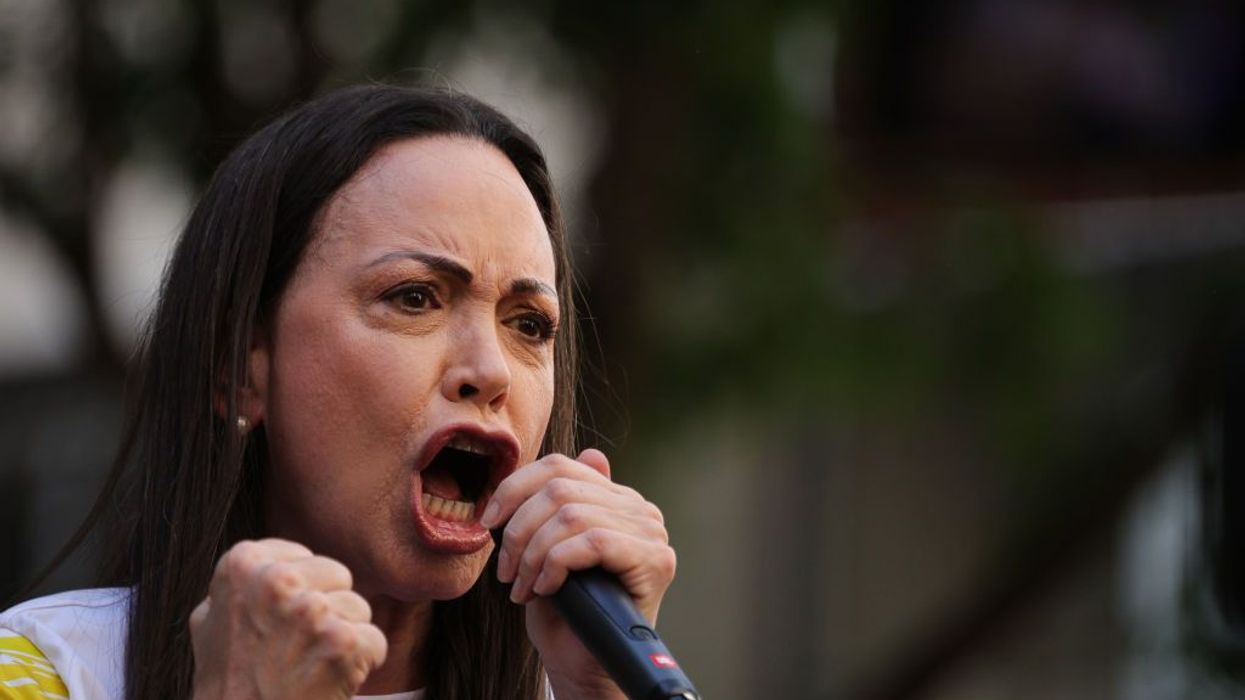
The Nobel Peace Prize has long lost any credibility when it comes to upholding actual peace. With Machado’s award, it followed a recent tradition of aligning itself with a violent and repressive Western foreign policy.
The awarding of the 2025 Nobel Peace Prize to Venezuelan far-right leader María Corina Machado took nearly everyone by surprise (with the exception of insiders who apparently used advance knowledge to profit on betting markets—New York Times, 10/10/25).
The Nobel Committee justified the award on the basis of Machado’s “tireless work promoting democratic rights” and “her struggle to achieve a just and peaceful transition from dictatorship to democracy.” However, Machado’s track record paints a very different picture (Sovereign Media, 10/11/25; Venezuelanalysis, 7/8/24).
Rather than scrutinize the opposition politician’s credentials, the media establishment seized the opportunity to whitewash the most unpeaceful elements in her background in order to advance its cynical pro–regime change agenda targeting Venezuela’s socialist government (FAIR.org, 2/12/25, 1/11/23, 6/13/22, 4/15/20). Not coincidentally, Machado’s award coincided with an escalation of US military threats against Venezuela, meaning that corporate pundits used a “peace” prize as a platform for war propaganda.
The Nobel Prize meant corporate outlets had to give their readers an idea of Machado’s political trajectory. And though some had profile pieces (Reuters, 10/10/25; New York Times, 10/10/25), there was a concerted effort to conceal the most unsavory elements. The Financial Times (10/10/25) euphemistically stated that Machado “enter[ed] politics in opposition to Hugo Chávez”—president of Venezuela from 1999 through 2013—while the Guardian (10/10/25) summed up that she has been “involved in politics for more than two decades.”
No establishment outlet mentioned Machado’s first relevant political action: supporting the short-lived April 2002 coup against the Chávez government, and signing the infamous “Carmona Decree.” In one fell swoop, this decree did away with all democratically elected institutions, annulled the 1999 Constitution, and established a de facto dictatorship headed by the leader of Venezuela’s corporate business lobby. Machado later denied signing the decree, though her name appeared on a list published by Venezuelan newspaper El Nacional.
Looking past the undemocratic debut, establishment journalists instead started the story with the mid-2002 creation of Súmate, calling it an NGO dedicated to election monitoring or transparency (Bloomberg, 10/10/25; Washington Post, 10/10/25; Reuters, 10/10/25; New York Times, 10/10/25). Yet they did not mention that this alleged quest to safeguard democracy was funded by the US, or that the opposition made unfounded fraud claims after failing to unseat Chávez in a 2004 recall referendum (Venezuelanalysis, 8/21/04, 9/9/04).
Machado’s second act was also the antithesis of peace and democracy, as the opposition politician led the 2014 “La Salida” (“The Exit”) campaign of street violence to overthrow the Nicolás Maduro administration, leaving dozens dead. That same year, in order to denounce the Venezuelan government, she acted as an “alternate ambassador” for Panama at a meeting of the Organization of American States (BBC, 3/25/15). The stunt led to Machado losing her parliamentary seat.
Yet instead of scrutinizing the new laureate’s less-than-peaceful actions, corporate outlets chose to ignore or misrepresent them as “denouncing the regime’s abuses” (Washington Post, 10/10/25), “participating in anti-regime protests” (New York Times, 10/10/25) or “allegations she’d tried to foment a coup” (Bloomberg, 10/10/25). Only the Associated Press (10/10/25) offered a minimal concession that the Machado-led “anti-government protests…at times turned violent.”
Another key aspect of the opposition operator’s political career has been outspoken advocacy for US sanctions, which have caused economic devastation and led to tens of thousands of deaths (CEPR, 4/25/19). But Western media ignored Machado’s lobbying for collective punishment of the Venezuelan people—with the New York Times (10/16/25) a notable exception.
The US-backed figure has also made no secret of her plans to repress her political opponents. Machado is on the record making thinly veiled threats to “eradicate socialism,” and pledging to “neutralize” destabilizing groups should she eventually take power. Factoring in the Venezuelan far right’s history of racist violence (Venezuelanalysis, 3/28/14, 7/30/17), it is not unreasonable to predict a dirty war against Chavistas if Machado ever reached Miraflores.
The reporting on the Nobel Peace Prize plainly described Machado as belonging to the Venezuelan opposition, but few outlets bothered to disclose her political views, apart from euphemistically labeling her a “conservative” (New York Times, 10/10/25; Guardian, 10/10/25) or a supporter of “economic liberalism” (New York Times, 10/16/25; Reuters, 10/10/25).
Machado has heaped praise on far-right former presidents Álvaro Uribe of Colombia, who was responsible for serious human rights violations, and Brazil’s Jair Bolsonaro, who tried to foment a coup.
In February, Machado sent a video message during a “Patriots for Europe” summit, calling for far-right leaders’ support and openly referring to them as “allies.” The high-profile gathering featured neo-fascist parties like Spain’s Vox, Italy’s Lega and France’s Rassemblement National (RN). The same media establishment that paints the likes of Hungary’s Viktor Orban as a threat to democracy (Guardian, 2/7/25; NPR, 4/22/25) chose to ignore Machado’s quite open alignment with his politics.
But more damning is the complete erasure of Machado’s outspoken support for Israel, even amidst the recent genocide. Venezuela’s far-right leader has repeatedly praised Israel’s defense of “Western values” and “freedom,” while her party established an alliance with Benjamin Netanyahu’s Likud in 2020. In 2018, Machado penned a letter to the Israeli prime minister, asking him to lead a foreign intervention to “dismantle the criminal Venezuelan regime.”
At a time when the US/Israeli genocide in Palestine has sparked outrage around the world, no corporate outlet found it relevant to mention that this year’s “peace” laureate did not utter a single word of condemnation. On the contrary, according to Netanyahu himself, Machado told the prime minister she “appreciates” his “resolute” actions in a recent congratulatory phone call. Unsurprisingly, only Reuters (10/17/25) briefly reported on the Nobel laureate’s war criminal ally.
The media establishment’s careful whitewashing of Machado’s undemocratic past and genocidal allies is particularly damning, given the present context of a US military buildup and overt threats against Venezuela. One of the US-backed politician’s most persistent habits has been calling for a foreign intervention against her country (Sovereign Media, 10/11/25).
In the wake of her peace prize, Machado has wasted no time in lobbying for violent regime change. In a BBC interview (10/11/25), she argued that Venezuela needs to be “liberated” via a “coordination of internal and external forces,” an expression she also used in an interview with El País (10/10/25).
Borrowing a page from US administration’s book of redefining concepts such as “imminent threat” or “civilian,” Machado bombastically claimed that the Maduro government “has declared a war” against the Venezuelan people, and urged Trump to help her side “win” this war (BBC, 10/11/25; Infobae, 10/11/25; CNN, 10/15/25). The opposition leader has latched onto the administration’s “narcoterrorism” fairy tale that has been debunked over the years (FAIR.org, 9/24/19; Venezuelanalysis, 9/2/25), just like she supported the White House’s Tren de Aragua narrative, even if it meant a gruesome crackdown against Venezuelan migrants.
Machado has gone as far as to cheerlead the Trump administration extrajudicially executing her fellow citizens, arguing that the lethal US strikes in the Caribbean, which have killed at least 30 people, are “saving lives, not only Venezuelan lives, but also life of American people” (Daily Beast, 10/10/25).
But it is not just Machado using her new platform to promote US military intervention. The Washington Post editorial board (10/10/25) openly expressed that US interests would be “better served” with a “reliable American partner” like Machado. True to form, the Wall Street Journal (10/10/25, 10/12/25) also used Machado’s award to double down on calls for Trump to bomb Venezuela in the name of “freedom” and “democracy.”
The warmonger lineup was complete with the New York Times’ Bret Stephens (10/10/25), who never needs excuses to endorse the murder of Venezuelans in the name of US interests (FAIR.org, 2/12/25). In this case, Stephens claimed that regime change is the only option to address the “catastrophe of Chavismo,” even if it means “full-scale military confrontation.”
The Nobel Peace Prize has long lost any credibility when it comes to upholding actual peace. With Machado’s award, it followed a recent tradition of aligning itself with Western foreign policy. And even more predictable was the corporate media seizing the opportunity to advance its war and regime-change propaganda against Venezuela.
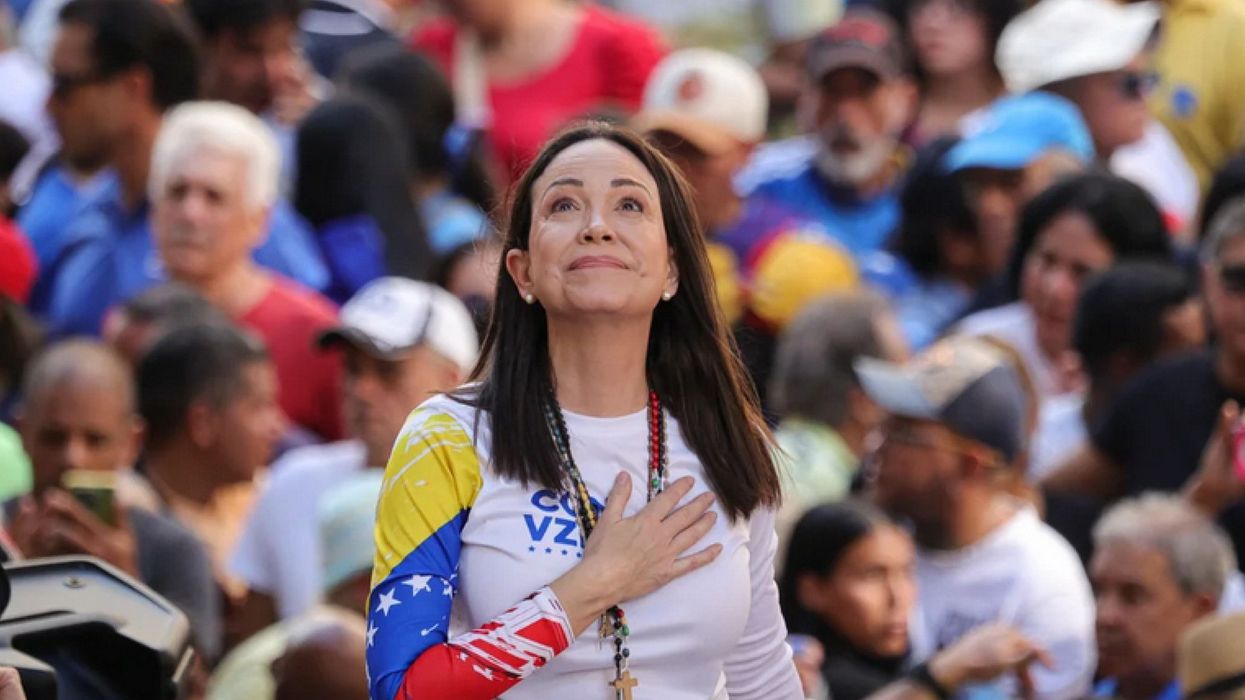
The opposition’s proposed total economic surrender to US corporate interests would doom Venezuela to the same conditions that led to Chavez’s rise to power.
The United Nations General Assembly, held in late September, offered a stark panorama of competing global visions. US President Donald Trump’s address was a characteristically bombastic, comically terrifying display of imperial nostalgia and hate-filled paranoia, including claims that climate change is a con and that London is no longer London because of Muslim immigration and “sharia law.”
In contrast, Colombia’s Gustavo Petro, Brazil’s Luiz Inácio Lula da Silva, and Chile’s Gabriel Boric each used their time on the international stage to defend democracy and humanism, take action against climate change, and oppose rising global authoritarianism.
Meanwhile, the Venezuelan opposition, led by former presidential candidate María Corina Machado, the far-right extremist who just won the Nobel Peace Prize, used the UN General Assembly (UNGA) as a lobbying platform, courting the Trump administration and sympathetic foreign governments to support a coup to depose President Nicolás Maduro. She has been part of multiple calls for US interventions in Venezuela, including to, in her words, secure the "total asphyxiation of the Venezuelan economy."
The opposition organized demonstrations in front of the Secretariat Building to denounce Maduro and call for the world to intervene. Pedro de Mendonça, Press Director for Machado’s campaign, hosted a protest saying, “Maduro is not the legitimate president of Venezuela, but the head of the Cartel of the Suns and the Tren de Aragua.” Mendonça called for “a free Venezuela and a secure West” through an “international coalition.” This is as direct a call for intervention as you could get. Machado retweeted it.
Machado has been a central figure to the Venezuelan opposition for more than two decades, helping push the opposition much farther to the right.
She says she models herself on Margaret Thatcher and Ronald Reagan, and has championed “Popular Capitalism,” a philosophy pioneered by dictator Augusto Pinochet in Chile, seeking to privatize all sectors of the state, and would give priority to American oil, gas, and mining companies in “free Venezuela.”
She has herself met with American oil executives during her campaign. Her proximity to the US is crystal clear; she has previously worked with the US Agency for International Development, the National Endowment for Democracy, and the International Republican Institute in Venezuela, and served as a Yale World Fellow. She was quite close to the George W. Bush administration during this period.
Machado was also part of the 2002 coup attempt against Hugo Chávez, signing the Carmona Decree to suspend the constitution, dissolve the National Assembly, and appoint oligarch Pedro Carmona as president. The coup collapsed within 48 hours due to immense popular backlash (some anti-coup protesters were also killed in the process).
This kind of rhetoric by the Trump administration, echoed by the Machado camp, has helped legally justify actual military operations on both American and foreign soil.
Parallel to the UNGA sessions, representatives of the opposition allegedly met with members of the Trump administration, while Machado herself and prominent opposition figures saturated social media with calls for a global movement to remove Maduro.
During the UNGA, Juan Guaidó, the former opposition leader whom the US was pretending was the legitimate president of Venezuela, also met with Trump administration officials to lobby for more “counter-narcotics” operations in Venezuela and to depose Maduro. Machado and Guaidó have recently labeled the Venezuelan government “criminal” and “illegitimate,” and Maduro a “drug trafficker and terrorist.” Dozens of tweets, press statements, and interviews echoed the same talking points during the event; and urged the world to end his “regime.” To an American audience, this all sounds eerily familiar. It’s no coincidence that the Trump administration has merged the War on Drugs with the War on Terror. This is why calling Maduro a “narco-terrorist” is so dangerous (and wrong), and can open the door to more military action by the US.
Despite what the opposition wants to portray, these protests are not organic, and neither has been the US response. In fact, many of them are rooted in American energy and defense profits, and backed by hawkish think tanks. They circulate these postures within their circles to give an allure of a global movement, but most Americans and Venezuelans oppose US military involvement in Venezuela.
The allegations that Maduro heads the “Cartel of the Suns” (debunked by the very InSight Crime that receives State Department funding, as well as several Latin American governments) serve as a cudgel against any measured approach to dealing with Venezuela, reminiscent of how any opposition to intervention in the Middle East post-9/11 was met with accusations of support for terrorism.
Never mind the fact that Venezuela is nowhere near the most important drug trafficking port in Latin America, that the War on Drugs doesn’t work, that the US is allied with bigger drug-supplying countries, or that this all comes from the fact that the US can’t decrease its own demand for drugs.
Earlier this year, in February, the Trump administration officially designated Tren de Aragua (TDA) as an international terrorist organization, claiming it operates with support from the Maduro government. Secretary of State Marco Rubio, one of Washington’s most vocal Venezuela hawks, has himself called Maduro a narco-terrorist and an illegitimate dictator, and has long lobbied for regime change. Attorney General Pam Bondi has also echoed these claims, as have many other key members of the Trump administration.
This kind of rhetoric by the Trump administration, echoed by the Machado camp, has helped legally justify actual military operations on both American and foreign soil, including a series of drone strikes against fishing boats, which, yes, are war crimes.
The Trump administration has cited alleged TDA ties (without much evidence) to carry out deportations of Venezuelan migrants, with the deportation advertised by Homeland Security through cruel and disgusting meme videos they share on social media. Machado and her ilk have helped make all of this a reality.
We also have to remember that all of this is not in the name of democracy or protecting against drug trafficking. The Trump administration is invested in dismantling American democracy at home and supporting tyrants abroad. Until two seconds ago, the Trump administration was signing numerous deals for cheap oil and for deportation flights with Maduro, the very dictator it now wants to depose.
The US has a long history of supporting drug traffickers when it serves their interests. This includes the Contras and the far-right Paramilitaries in Colombia, now the largest drug traffickers in South America. The American security state has shown no interest whatsoever in pursuing actual solutions to the drug crisis, including decreasing demand, making supply less appealing by providing better ways of life, improving safe supply, or drug legalization.
The opposition’s proposed total economic surrender to US corporate interests would doom Venezuela to the same conditions that led to Chavez’s rise to power.
This is about protecting power and profits, including the profits of big oil, gas, and mining companies (Venezuela has some of the world’s largest reserves in all), and those of the military-industrial complex. A full coup would be a disaster and another bloody coup added to the United States’ long history of calamitous military interventions in Latin America.
As Venezuelan-American, I know exactly what Machado represents: the smiling face of Washington’s regime-change machine, the polished spokesperson for sanctions, privatization, and foreign intervention dressed up as democracy.
When I saw the headline "Maria Corina Machado Wins the Nobel Peace Prize," I almost laughed at the absurdity. But I didn’t, because there’s nothing funny about rewarding someone whose politics have brought so much suffering. Anyone who knows what she stands for knows there’s nothing remotely peaceful about her politics.
If this is what counts as “peace” in 2025, then the prize itself has lost every ounce of credibility. I’m Venezuelan-American, and I know exactly what Machado represents. She’s the smiling face of Washington’s regime-change machine, the polished spokesperson for sanctions, privatization, and foreign intervention dressed up as democracy.
Machado’s politics are steeped in violence. She has called for foreign intervention, even appealing directly to Israel Prime Minister Benjamin Netanyahu, the architect of Gaza’s annihilation, to help “liberate” Venezuela with bombs under the banner of “freedom.” She has demanded sanctions, that silent form of warfare whose effects—as studies in The Lancet and other journals have shown —have killed more people than war, cutting off medicine, food, and energy to entire populations.
Machado has spent her entire political life promoting division, eroding Venezuela’s sovereignty, and denying its people the right to live with dignity.
Machado isn’t a symbol of peace or progress. She is part of a global alliance between fascism, Zionism, and neoliberalism, an axis that justifies domination in the language of democracy and peace.
This is who Maria Corina Machado really is:
Machado was also one of the political architects of La Salida, the 2014 opposition campaign that called for escalated protests, including guarimba tactics. Those weren’t “peaceful protests” as the foreign press claimed; they were organized barricades meant to paralyze the country and force the government’s fall. Streets were blocked with burning trash and barbed wire, buses carrying workers were torched, and people suspected of being Chavista were beaten or killed. Even ambulances and doctors were attacked. Some Cuban medical brigades were nearly burned alive. Public buildings, food trucks, and schools were destroyed. Entire neighborhoods were held hostage by fear while opposition leaders like Machado cheered from the sidelines and called it “resistance.”
She praises Trump’s “decisive action” against what she calls a “criminal enterprise,” aligning herself with the same man who cages migrant children and tears families apart under ICE’s watch, while Venezuelan mothers search for their children disappeared by US migration policies.
If Henry Kissinger could win a Peace Prize, why not María Corina Machado? Maybe next year they’ll give one to the Gaza Humanitarian Foundation for “compassion under occupation.”
Machado isn’t a symbol of peace or progress. She is part of a global alliance between fascism, Zionism, and neoliberalism, an axis that justifies domination in the language of democracy and peace. In Venezuela, that alliance has meant coups, sanctions, and privatization. In Gaza, it means genocide and the erasure of a people. The ideology is the same: a belief that some lives are disposable, that sovereignty is negotiable, and that violence can be sold as order.
If Henry Kissinger could win a Peace Prize, why not María Corina Machado? Maybe next year they’ll give one to the Gaza Humanitarian Foundation for “compassion under occupation.”
Every time this award is handed to an architect of violence disguised as diplomacy, it spits in the face of those who actually fight for peace: the Palestinian medics digging bodies from rubble, the journalists risking their lives in Gaza to document the truth and the humanitarian workers of the Flotilla sailing to break the siege and deliver aid to starving children in Gaza, with nothing but courage and conviction.
But real peace is not negotiated in boardrooms or awarded on stages. Real peace is built by women organizing food networks during blockades, by Indigenous communities defending rivers from extraction, by workers who refuse to be starved into obedience, by Venezuelan mothers mobilizing to demand the return of children seized under U.S. ICE and migration policies and by nations that choose sovereignty over servitude.
That’s the peace Venezuela, Cuba, Palestine, and every nation of the Global South deserves.