SUBSCRIBE TO OUR FREE NEWSLETTER
Daily news & progressive opinion—funded by the people, not the corporations—delivered straight to your inbox.
5
#000000
#FFFFFF
To donate by check, phone, or other method, see our More Ways to Give page.
Daily news & progressive opinion—funded by the people, not the corporations—delivered straight to your inbox.
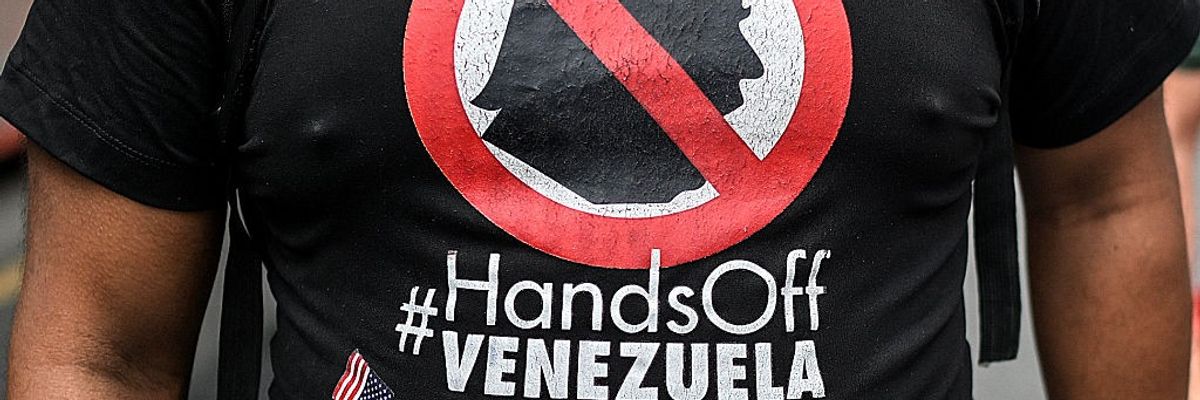
A t-shirt depicting US President Donald Trump that reads 'Hands off Venezuela' is seen while supporters of Venezuela's President Nicolas Maduro take part in a protest against the reward imposed by the US President, in Caracas on August 11, 2025.
"These aggressive policies seek to extend US dominance in Latin America, no matter the human cost," CodePink said.
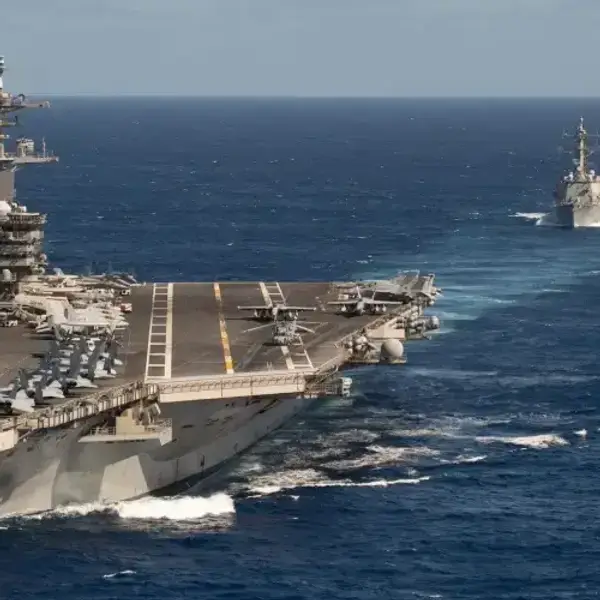
The White House's announcement Wednesday that it had deployed three warships to the coast of Venezuela has raised fears among antiwar and human rights advocates of the US becoming embroiled in another potential "regime change" quagmire.
In recent weeks, the Trump administration has accused Venezuelan President Nicolás Maduro of being one of the world's largest traffickers of illegal narcotics and of leading the cocaine trafficking gang Cartel de los Soles.
In 2020, Maduro was charged with narco-terrorism and conspiracy to import cocaine into the US, with the first Trump administration promising a $15 million reward for his arrest. The Biden administration increased that bounty to $25 million before Trump, earlier this month, doubled it to $50 million.
Trump also expanded the litany of accusations against Maduro, alleging that he is the kingpin of Mexico's Sinaloa cartel, an allegation that Mexican President Claudia Sheinbaum says there is no evidence to support.
Even before Maduro's indictment, however, Trump had long sought to oust him from power. During his first term, he repeatedly suggested that the US should invade Venezuela to take Maduro out—an idea that his top aides rebuffed.
Trump instead dramatically escalated sanctions on Venezuela, which many studies have shown contributed to the nation's historic economic crisis. His former Secretary of State Mike Pompeo explicitly acknowledged that the goal of these sanctions was to push the Venezuelan people to topple Maduro.
In 2023, following his first presidency, Trump lamented at a rally that the US had to purchase oil from Venezuela, saying that if he were in charge, "We would have taken [Venezuela] over; we would have gotten to all that oil; it would have been right next door."
The exact objective of Trump's destroyers, which are expected to arrive on the Venezuelan coast as soon as Sunday, remains unclear. But the Venezuelan government and others in the region have perceived Trump's threats as a serious provocation.
On Monday, Maduro said he would mobilize 4.5 million militia members following what he called "the renewal of extravagant, bizarre, and outlandish threats" from Trump. After the announcement of approaching warships, those militias began to be deployed throughout the country.
Colombian President Gustavo Petro issued a harsh warning to Trump following the news.
"The gringos are mad if they think invading Venezuela will solve their problem," he said. "They are dragging Venezuela into a Syria-like situation, with the problem that they are dragging Colombia too."
The American antiwar group CodePink condemned the deployment of ships as a "reckless escalation" that "dangerously militarizes the Caribbean and brings our region closer to war."
The group argues that Venezuela's role in drug trafficking is being overblown to justify an invasion. They note that the US's own internal assessments of global drug trafficking have not identified Venezuela as a primary transit country. They also cite the UN's latest World Drug Report, which did not find Venezuela to be a central node of the drug trade.
The Washington Office on Latin America, a DC-based human rights group, has warned that a regime change war would likely be a catastrophe on par with the invasion of Iraq two decades prior.
"The 'victorious' US military would likely find itself governing an impoverished country with broken institutions, trying to hand over power to an opposition weakened by repression and exile, and probably facing an insurgency made up of regime diehards, criminal groups, and even Colombian guerrillas," they said. "There is no evidence that this approach would lead to a democratic transition in Venezuela."
"These aggressive policies seek to extend US dominance in Latin America, no matter the human cost," CodePink said. "The people of Venezuela, like the people of the United States, deserve peace, dignity, and sovereignty, not threats, blockades, and warships."
Dear Common Dreams reader, It’s been nearly 30 years since I co-founded Common Dreams with my late wife, Lina Newhouser. We had the radical notion that journalism should serve the public good, not corporate profits. It was clear to us from the outset what it would take to build such a project. No paid advertisements. No corporate sponsors. No millionaire publisher telling us what to think or do. Many people said we wouldn't last a year, but we proved those doubters wrong. Together with a tremendous team of journalists and dedicated staff, we built an independent media outlet free from the constraints of profits and corporate control. Our mission has always been simple: To inform. To inspire. To ignite change for the common good. Building Common Dreams was not easy. Our survival was never guaranteed. When you take on the most powerful forces—Wall Street greed, fossil fuel industry destruction, Big Tech lobbyists, and uber-rich oligarchs who have spent billions upon billions rigging the economy and democracy in their favor—the only bulwark you have is supporters who believe in your work. But here’s the urgent message from me today. It's never been this bad out there. And it's never been this hard to keep us going. At the very moment Common Dreams is most needed, the threats we face are intensifying. We need your support now more than ever. We don't accept corporate advertising and never will. We don't have a paywall because we don't think people should be blocked from critical news based on their ability to pay. Everything we do is funded by the donations of readers like you. When everyone does the little they can afford, we are strong. But if that support retreats or dries up, so do we. Will you donate now to make sure Common Dreams not only survives but thrives? —Craig Brown, Co-founder |
The White House's announcement Wednesday that it had deployed three warships to the coast of Venezuela has raised fears among antiwar and human rights advocates of the US becoming embroiled in another potential "regime change" quagmire.
In recent weeks, the Trump administration has accused Venezuelan President Nicolás Maduro of being one of the world's largest traffickers of illegal narcotics and of leading the cocaine trafficking gang Cartel de los Soles.
In 2020, Maduro was charged with narco-terrorism and conspiracy to import cocaine into the US, with the first Trump administration promising a $15 million reward for his arrest. The Biden administration increased that bounty to $25 million before Trump, earlier this month, doubled it to $50 million.
Trump also expanded the litany of accusations against Maduro, alleging that he is the kingpin of Mexico's Sinaloa cartel, an allegation that Mexican President Claudia Sheinbaum says there is no evidence to support.
Even before Maduro's indictment, however, Trump had long sought to oust him from power. During his first term, he repeatedly suggested that the US should invade Venezuela to take Maduro out—an idea that his top aides rebuffed.
Trump instead dramatically escalated sanctions on Venezuela, which many studies have shown contributed to the nation's historic economic crisis. His former Secretary of State Mike Pompeo explicitly acknowledged that the goal of these sanctions was to push the Venezuelan people to topple Maduro.
In 2023, following his first presidency, Trump lamented at a rally that the US had to purchase oil from Venezuela, saying that if he were in charge, "We would have taken [Venezuela] over; we would have gotten to all that oil; it would have been right next door."
The exact objective of Trump's destroyers, which are expected to arrive on the Venezuelan coast as soon as Sunday, remains unclear. But the Venezuelan government and others in the region have perceived Trump's threats as a serious provocation.
On Monday, Maduro said he would mobilize 4.5 million militia members following what he called "the renewal of extravagant, bizarre, and outlandish threats" from Trump. After the announcement of approaching warships, those militias began to be deployed throughout the country.
Colombian President Gustavo Petro issued a harsh warning to Trump following the news.
"The gringos are mad if they think invading Venezuela will solve their problem," he said. "They are dragging Venezuela into a Syria-like situation, with the problem that they are dragging Colombia too."
The American antiwar group CodePink condemned the deployment of ships as a "reckless escalation" that "dangerously militarizes the Caribbean and brings our region closer to war."
The group argues that Venezuela's role in drug trafficking is being overblown to justify an invasion. They note that the US's own internal assessments of global drug trafficking have not identified Venezuela as a primary transit country. They also cite the UN's latest World Drug Report, which did not find Venezuela to be a central node of the drug trade.
The Washington Office on Latin America, a DC-based human rights group, has warned that a regime change war would likely be a catastrophe on par with the invasion of Iraq two decades prior.
"The 'victorious' US military would likely find itself governing an impoverished country with broken institutions, trying to hand over power to an opposition weakened by repression and exile, and probably facing an insurgency made up of regime diehards, criminal groups, and even Colombian guerrillas," they said. "There is no evidence that this approach would lead to a democratic transition in Venezuela."
"These aggressive policies seek to extend US dominance in Latin America, no matter the human cost," CodePink said. "The people of Venezuela, like the people of the United States, deserve peace, dignity, and sovereignty, not threats, blockades, and warships."
The White House's announcement Wednesday that it had deployed three warships to the coast of Venezuela has raised fears among antiwar and human rights advocates of the US becoming embroiled in another potential "regime change" quagmire.
In recent weeks, the Trump administration has accused Venezuelan President Nicolás Maduro of being one of the world's largest traffickers of illegal narcotics and of leading the cocaine trafficking gang Cartel de los Soles.
In 2020, Maduro was charged with narco-terrorism and conspiracy to import cocaine into the US, with the first Trump administration promising a $15 million reward for his arrest. The Biden administration increased that bounty to $25 million before Trump, earlier this month, doubled it to $50 million.
Trump also expanded the litany of accusations against Maduro, alleging that he is the kingpin of Mexico's Sinaloa cartel, an allegation that Mexican President Claudia Sheinbaum says there is no evidence to support.
Even before Maduro's indictment, however, Trump had long sought to oust him from power. During his first term, he repeatedly suggested that the US should invade Venezuela to take Maduro out—an idea that his top aides rebuffed.
Trump instead dramatically escalated sanctions on Venezuela, which many studies have shown contributed to the nation's historic economic crisis. His former Secretary of State Mike Pompeo explicitly acknowledged that the goal of these sanctions was to push the Venezuelan people to topple Maduro.
In 2023, following his first presidency, Trump lamented at a rally that the US had to purchase oil from Venezuela, saying that if he were in charge, "We would have taken [Venezuela] over; we would have gotten to all that oil; it would have been right next door."
The exact objective of Trump's destroyers, which are expected to arrive on the Venezuelan coast as soon as Sunday, remains unclear. But the Venezuelan government and others in the region have perceived Trump's threats as a serious provocation.
On Monday, Maduro said he would mobilize 4.5 million militia members following what he called "the renewal of extravagant, bizarre, and outlandish threats" from Trump. After the announcement of approaching warships, those militias began to be deployed throughout the country.
Colombian President Gustavo Petro issued a harsh warning to Trump following the news.
"The gringos are mad if they think invading Venezuela will solve their problem," he said. "They are dragging Venezuela into a Syria-like situation, with the problem that they are dragging Colombia too."
The American antiwar group CodePink condemned the deployment of ships as a "reckless escalation" that "dangerously militarizes the Caribbean and brings our region closer to war."
The group argues that Venezuela's role in drug trafficking is being overblown to justify an invasion. They note that the US's own internal assessments of global drug trafficking have not identified Venezuela as a primary transit country. They also cite the UN's latest World Drug Report, which did not find Venezuela to be a central node of the drug trade.
The Washington Office on Latin America, a DC-based human rights group, has warned that a regime change war would likely be a catastrophe on par with the invasion of Iraq two decades prior.
"The 'victorious' US military would likely find itself governing an impoverished country with broken institutions, trying to hand over power to an opposition weakened by repression and exile, and probably facing an insurgency made up of regime diehards, criminal groups, and even Colombian guerrillas," they said. "There is no evidence that this approach would lead to a democratic transition in Venezuela."
"These aggressive policies seek to extend US dominance in Latin America, no matter the human cost," CodePink said. "The people of Venezuela, like the people of the United States, deserve peace, dignity, and sovereignty, not threats, blockades, and warships."