
SUBSCRIBE TO OUR FREE NEWSLETTER
Daily news & progressive opinion—funded by the people, not the corporations—delivered straight to your inbox.
5
#000000
#FFFFFF
To donate by check, phone, or other method, see our More Ways to Give page.


Daily news & progressive opinion—funded by the people, not the corporations—delivered straight to your inbox.
The companies avoided more than $26.7 billion in income taxes last year, enough to give free school lunches to every child in America.
Dozens of America's most profitable corporations avoided paying any federal income taxes in 2025, according to an analysis out on Tuesday from the Institute on Taxation and Economic Policy.
The 88 companies—which include Tesla, Southwest Airlines, Live Nation, Palantir, Citigroup, and many others listed in the S&P 500—brought in a collective $105 billion in pretax income last year.
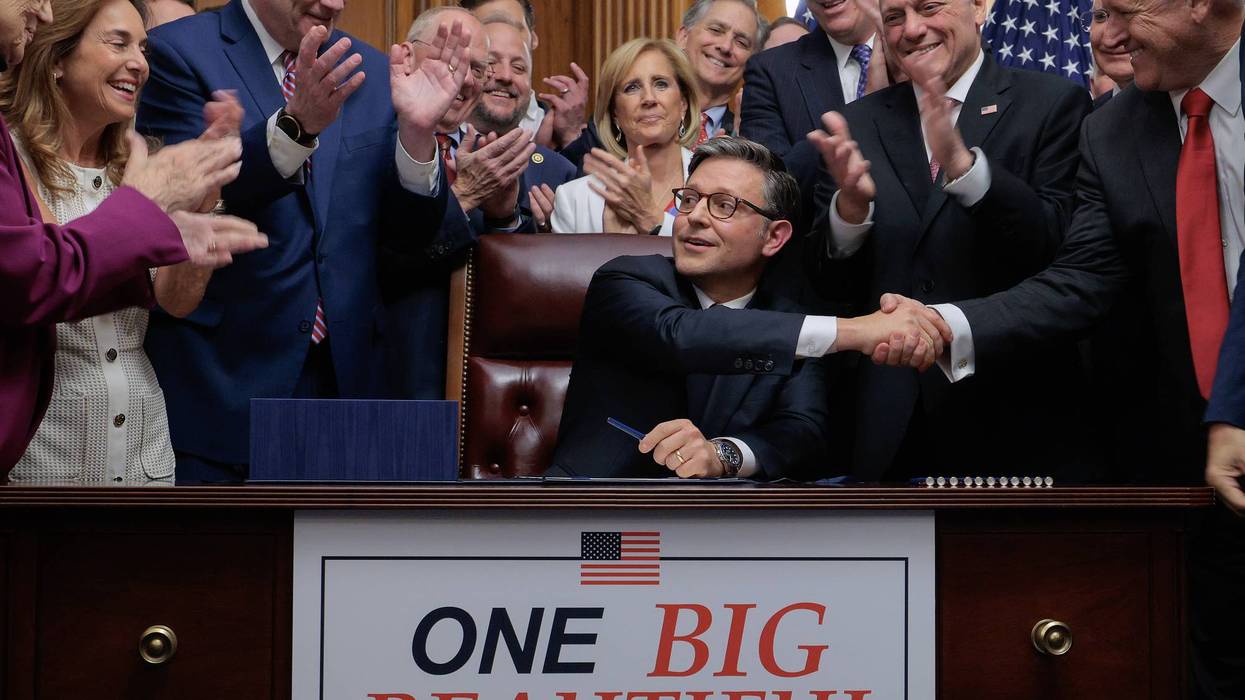
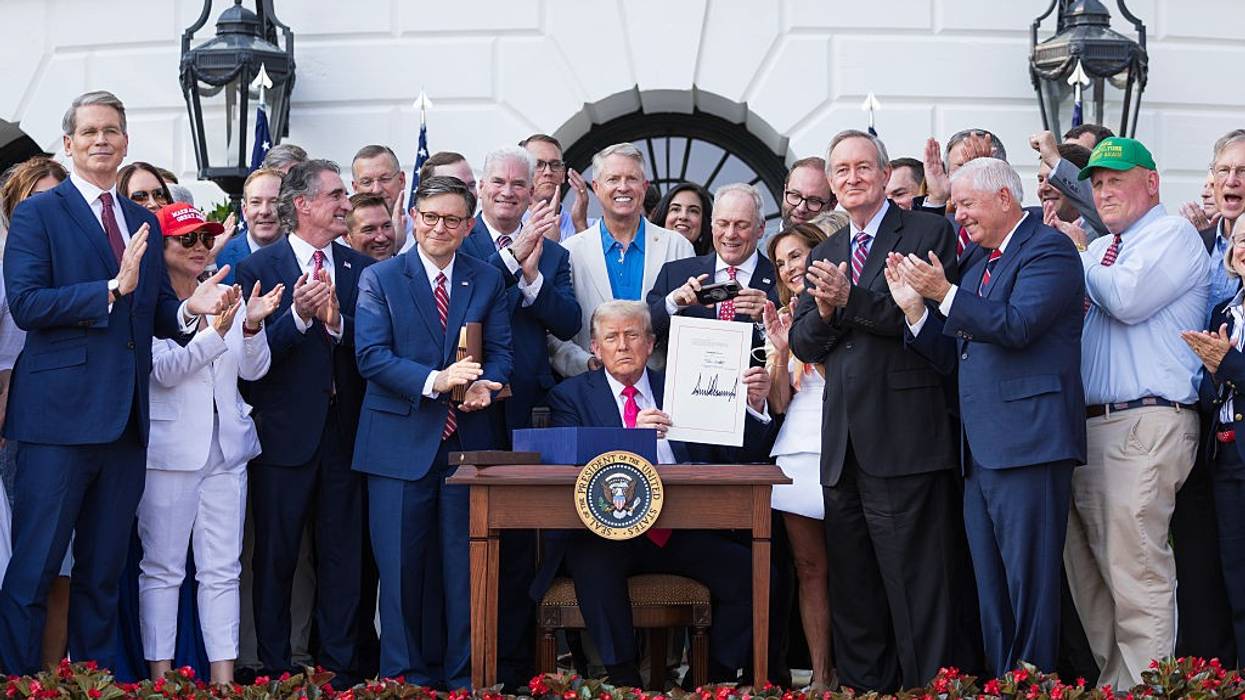
ITEP found that 2025 saw a spike in corporate tax avoidance, enabled in part by new loopholes created by the One Big Beautiful Bill Act signed by President Donald Trump and by his 2017 Tax Cuts and Jobs Act, which reduced the corporate tax rate to 21% from its previous 35%.
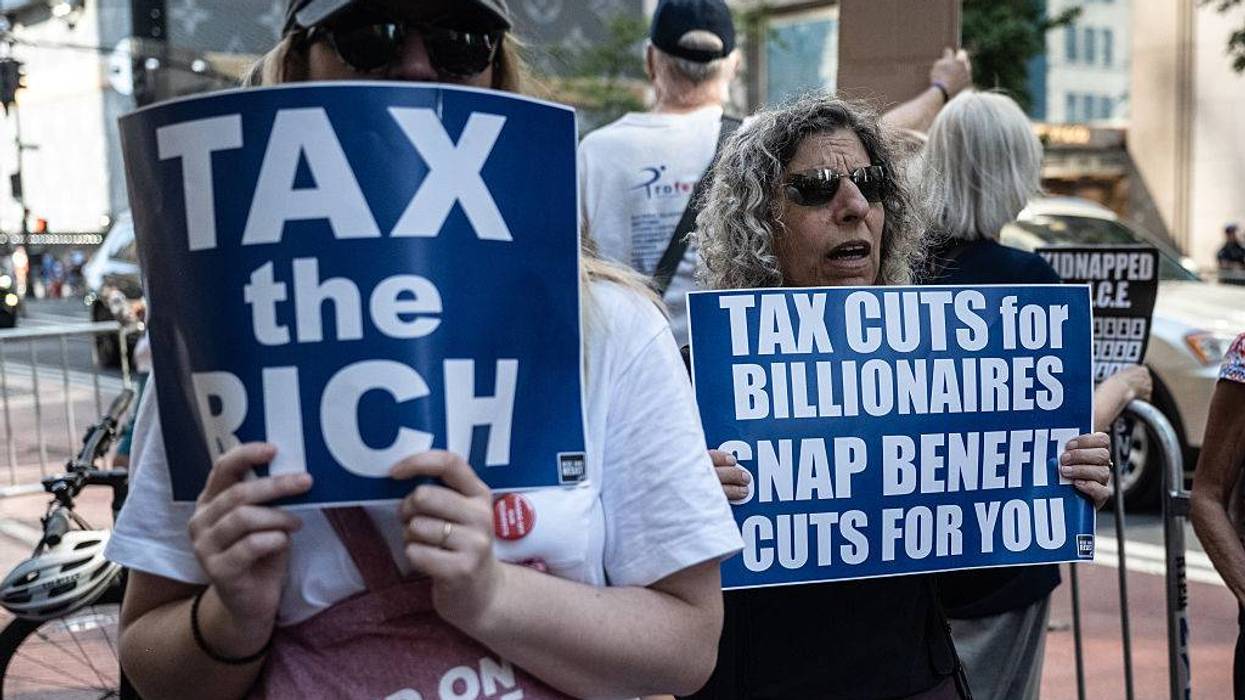
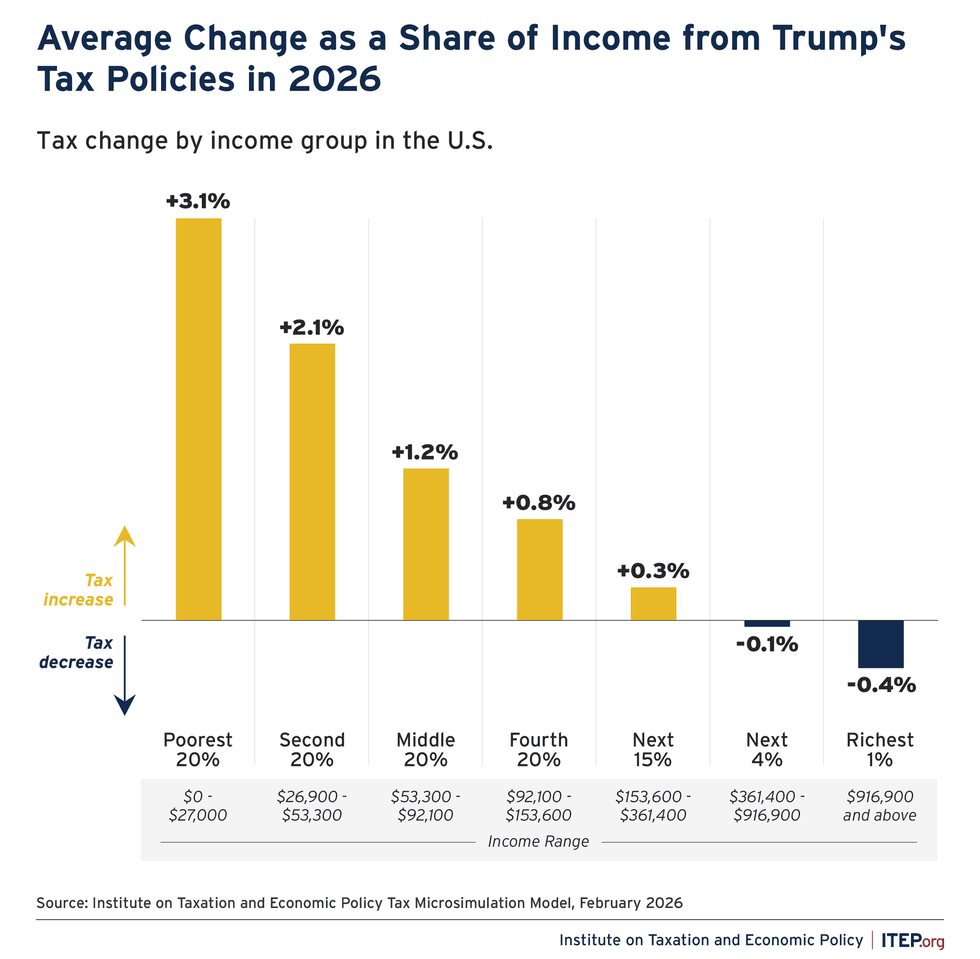
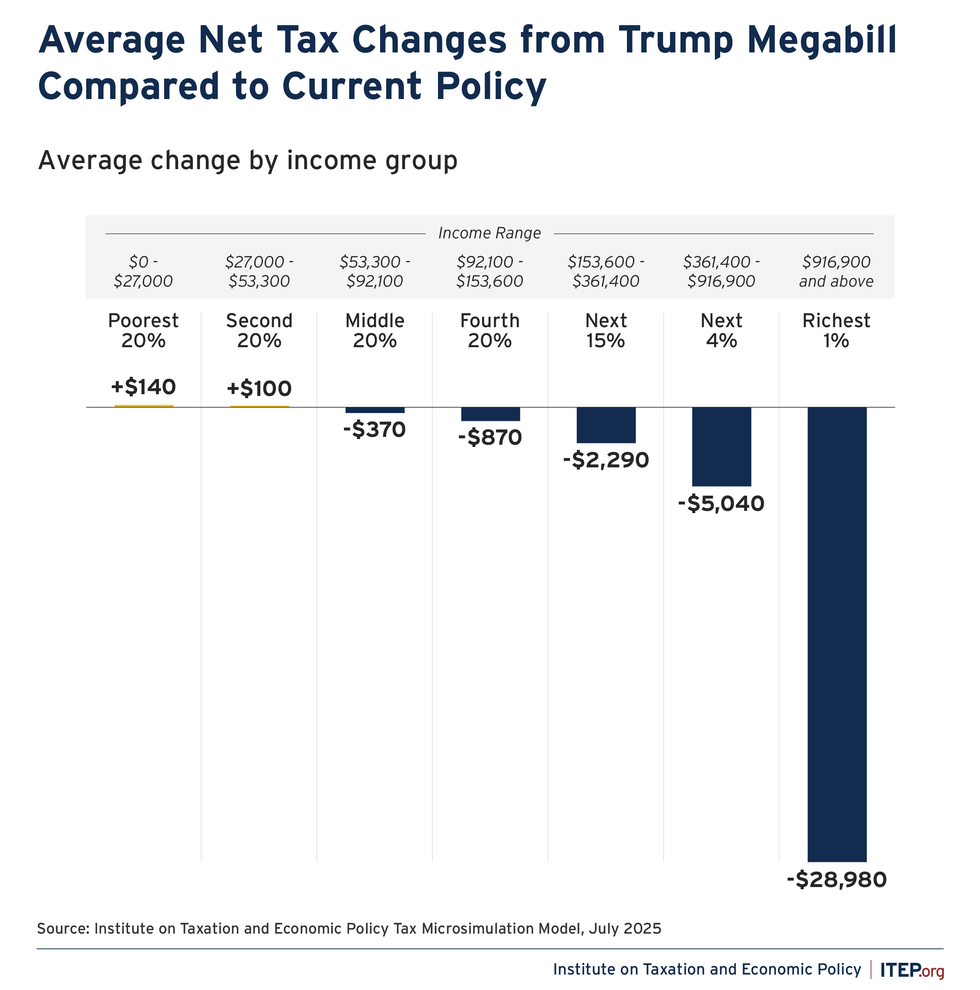
The One Big Beautiful Bill Act is expected to hand the wealthiest 1% of Americans $117 billion in tax cuts this year, while those in the bottom 95% are set to pay more in taxes while facing across-the-board cuts to social safety net programs like Medicaid and the Supplemental Nutrition Assistance Program.
It also allowed multimillion- and billion-dollar corporations to find new ways to avoid paying taxes. More than half of the tax-avoiders listed in the report used a provision in the new tax law allowing companies to immediately write off capital investments, reducing their collective taxes by $11.4 billion.
Pharmaceutical and tech companies, meanwhile, were able to take advantage of tax write-offs for research and development, exempting them from approximately another $4.4 billion.
In total, the corporate tax avoidance documented in 2025 by the researchers helped to rob the public coffers of yet another $26.7 billion, enough to give every public school student a free lunch for a year, according to a University of Missouri analysis of the National School Lunch Program.
The researchers said that the full scale of corporate tax avoidance remains unclear, since corporate tax returns are not publicly available. Some companies were also excluded because they are not part of the S&P 500 or have not yet reported their 2025 taxes.
“These findings are not isolated cases—they reflect systemic deficiencies in the corporate tax code,” said Amy Hanauer, the executive director for ITEP. “Without meaningful reform, profitable corporations will continue to pay less than their fair share.”
"Unfortunately, it could get worse," the analysis warns, pointing to lobbying for "indexing capital gains for inflation—which would be a benefit hugely skewed to the wealthy."
Just over a week away from Tax Day in the United States, a think tank on Monday released an analysis highlighting how most Americans will see their taxes go up this year, while the wealthy will see substantial cuts, thanks to "a mix of legislative action and illegal executive actions" from the Republican-controlled Congress and President Donald Trump.
"The president, in concert with Congress, has dramatically increased tariff taxes, enacted large tax cuts that primarily benefit the well-off and corporations, dramatically curtailed IRS enforcement, and issued legally problematic regulations," states the Institute on Taxation and Economic Policy (ITEP) report, referring to the Internal Revenue Service.
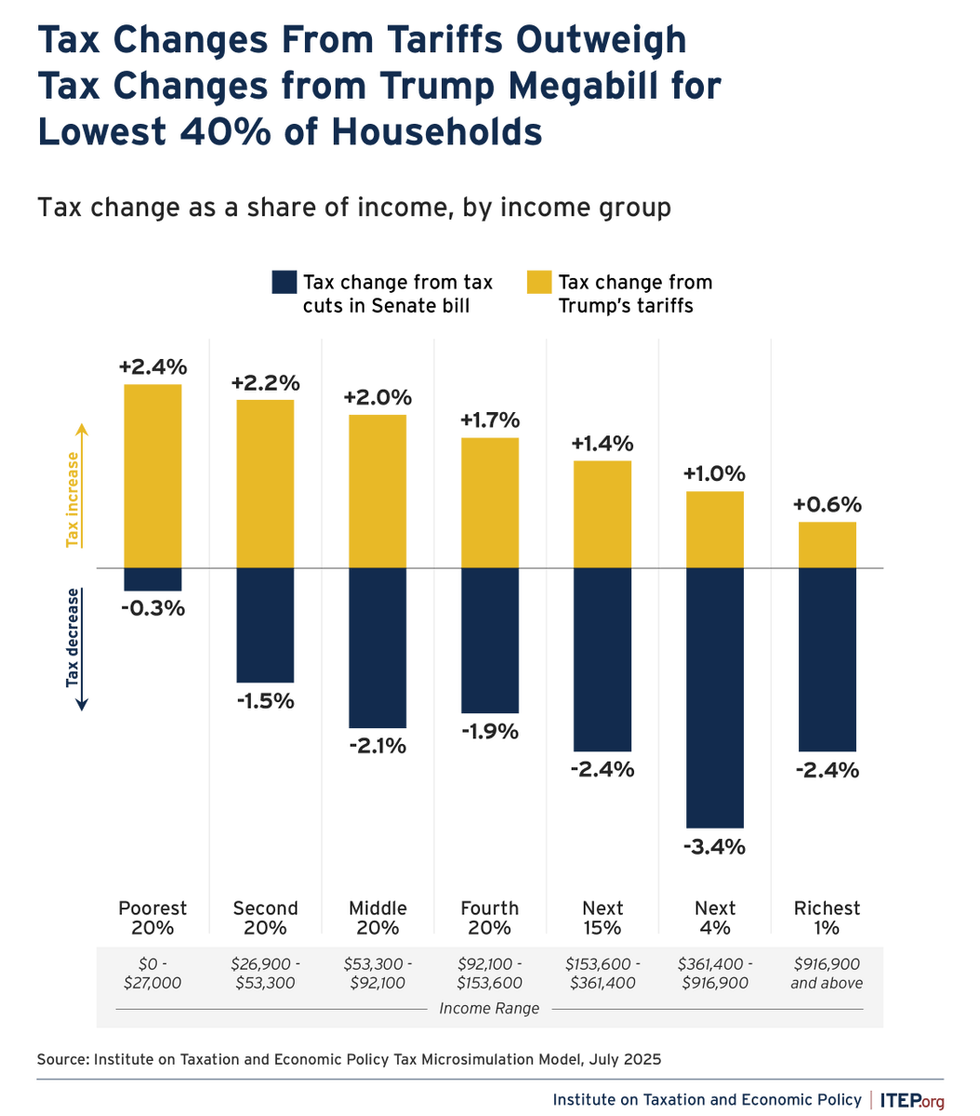
The bottom 95% of Americans will generally see higher taxes, according to report author Michael Ettlinger, a senior fellow at ITEP and the University of New Hampshire's Carsey School of Public Policy. The middle 60% will see an average increase of $900—though that estimate tops $1,000 for taxpayers in Alaska, Florida, Georgia, Idaho, Nebraska, North Carolina, South Dakota, Texas, Utah, Vermont, and Wyoming.
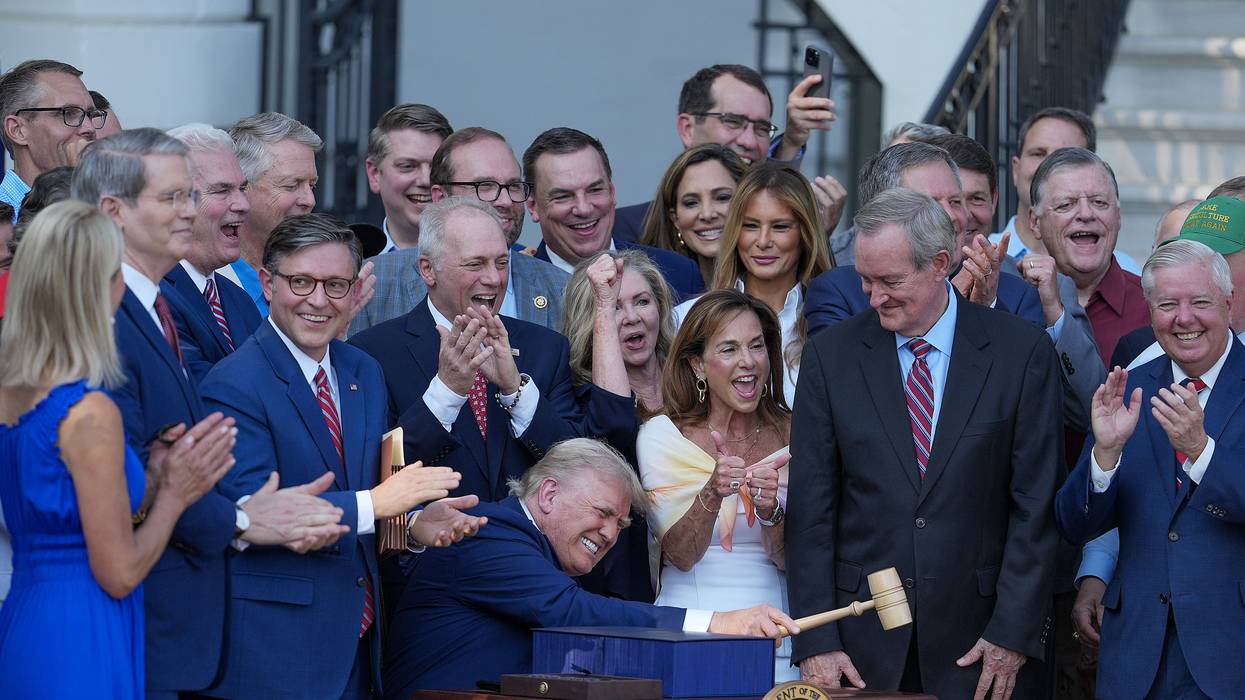
The primary drivers of tax hikes for working people are Trump's tariffs—which his administration continues to pursue despite a major setback at the US Supreme Court—and the so-called One Big Beautiful Bill Act (OBBBA), the budget reconciliation package that congressional Republicans passed and the president signed last summer.
The OBBBA slashed programs for the working class, including food assistance and Medicaid, and failed to extend Affordable Care Act premium tax credits that helped people afford health insurance. The Republican package is also expected to give the wealthiest 1% of Americans $1 trillion in tax cuts while adding $4.6 trillion to the federal deficit over the next decade.
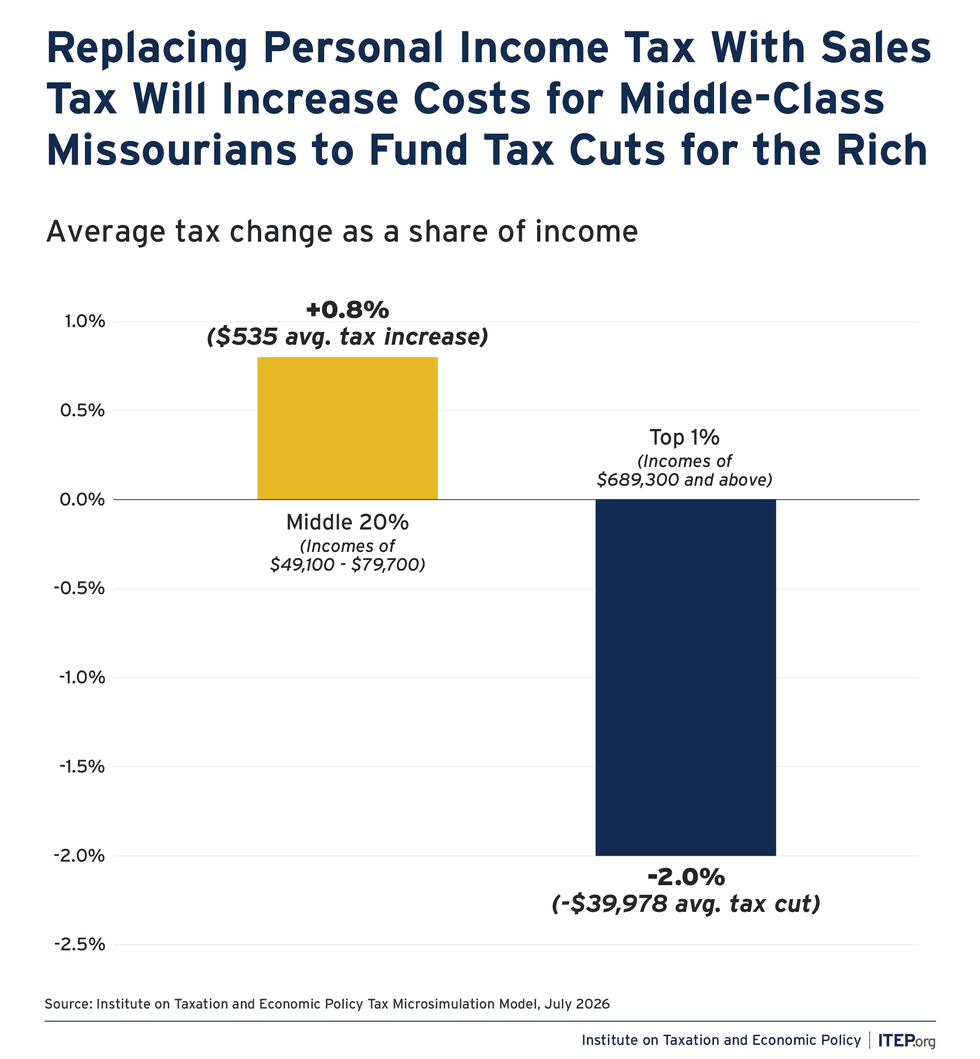
This year alone, "the highest-income 20% get a $380 billion tax cut, with $117 billion going to the richest 1% alone," Ettlinger detailed. "To put the $117 billion going to the top 1% in 2026 in perspective, it is more than the federal government will spend in 2026 on the combined budgets of the Department of Education, Department of Transportation, Department of Justice, the State Department, the National Aeronautics and Space Administration, the Environmental Protection Agency, the National Endowment for the Humanities, and the National Endowment for the Arts."
"Or, put in another context, that $117 billion could buy every Major League Baseball team (all of them together) or pay for the combined cost of every wedding in the country for a year, as we described in July, along with other comparisons," he added.

Ettlinger pointed out that "the wealthiest have also saved many billions with the elimination of more than $40 billion over 10 years in IRS tax enforcement funding that was aimed specifically at cracking down on tax evasion by the wealthy. The Trump administration has also, administratively, strangled IRS enforcement initiatives targeted at high-wealth tax sheltering."
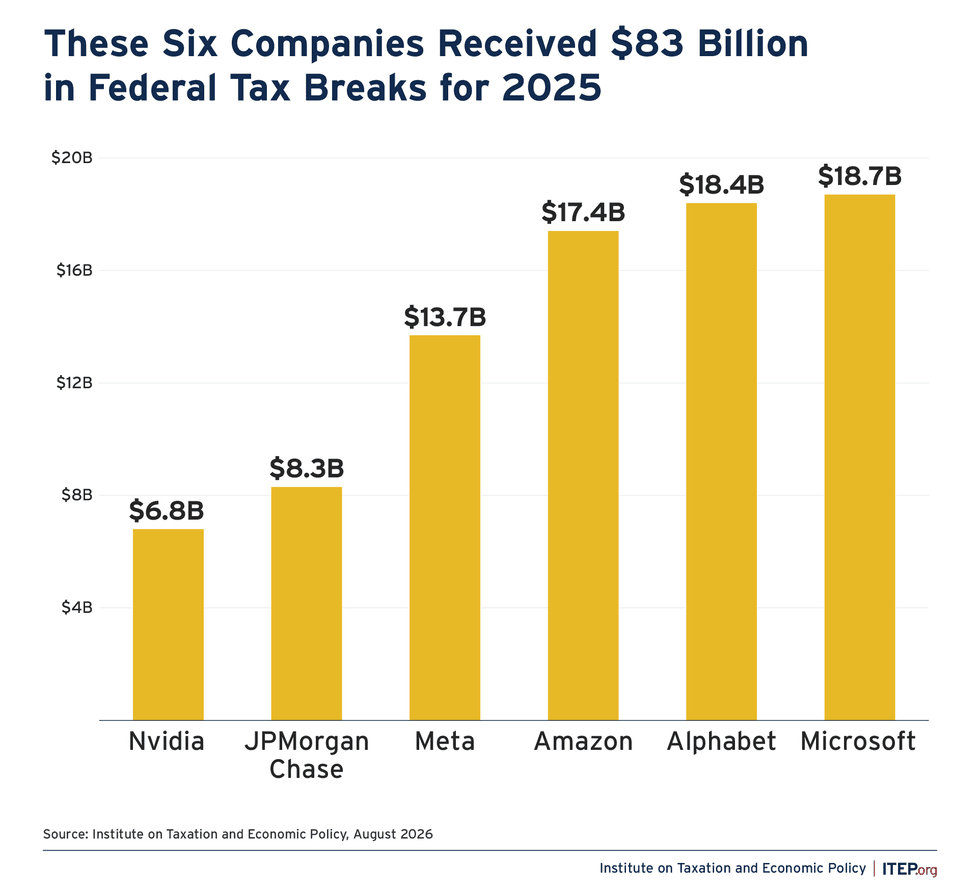
The expert also noted that the "OBBBA included large tax cuts for corporations, and the administration has added on to the benefits of these tax cuts with legally doubtful regulatory changes." For example, some major companies had an effective federal income tax rate of 0% in 2025, including Chenier Energy, LiveNation, Peter Thiel's Palantir, Elon Musk's Tesla, and Yum! Brands, whose subsidiaries include the fast food chains KFC, Pizza Hut, and Taco Bell.
Jeff Bezos' Amazon had an effective tax rate of 1.4%. For Meta, the parent company of Facebook, Instagram, and WhatsApp, it was 3.6%. Alphabet, the company behind Google, had an 8% rate. Ettlinger stressed that "these companies' ultralow tax bills are just the tip of the iceberg of what has been done to business taxes in the first year of President Trump's second term. From OBBBA alone, corporations and other businesses will pay $234 billion less in 2026 and $1.7 trillion less over 10 years."
It's not just rich Americans who are benefiting from Trump and his party's policies. As Ettlinger explained: "A total of $32 billion in tax savings from OBBBA will go offshore in 2026. Many foreign shareholders are likely to end up paying zero US corporate tax despite benefiting from the US economy and the role of the government in sustaining it."
The report concludes with a warning: "Unfortunately, it could get worse. The administration is being heavily lobbied to add to its unlawful regulatory record by indexing capital gains for inflation—which would be a benefit hugely skewed to the wealthy. In addition, the congressional Republican Study Committee has a tax plan that would, likewise, be of substantial benefit to those with the highest income and wealth."
Early last month, Sens. Ted Cruz (R-Texas) and Tim Scott (R-SC) sent a letter urging Treasury Secretary Scott Bessent to make the change to federal tax on capital gains, or the profits from selling investments, including bonds, real estate, and stocks.
"Ted Cruz is asking the Treasury Department to break the law to give another round of tax breaks to the ultrarich," Senate Finance Committee Ranking Member Ron Wyden (D-Ore.) responded at the time. "These guys can’t help themselves."
The head of the Institute on Taxation and Economic Policy praised state policymakers for "listening to the demands of the people to create a less regressive state tax system."
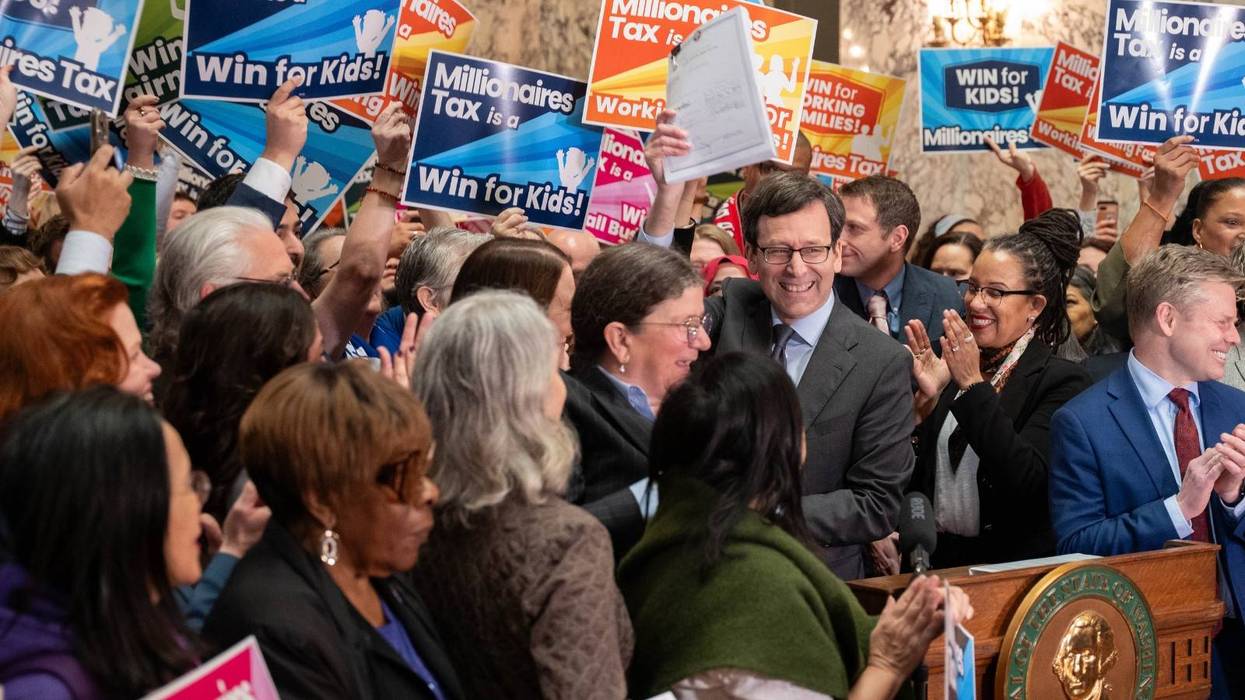
While nearby California prepares for a November vote to tax the ultrarich, Democratic Washington Gov. Bob Ferguson on Monday signed state legislation that creates a tax on income over $1 million in a single year.
"Adoption of the historic Millionaires' Tax makes our tax system more fair, and means free meals for K-12 students, the largest tax break in state history for small businesses, eliminating the sales tax for baby diapers, and sending a check to nearly 500,000 working families to make life more affordable," Ferguson highlighted in a statement.
Senate Bill 6346, sponsored by state Sen. Jamie Pedersen (D-43), was delivered to the governor earlier this month after passing the upper chamber 27-21. In the Washington House of Representatives, where the companion bill was led by Rep. Joe Fitzgibbon (D-34), it was approved 51-46.
"With this bill, we're going to begin to right a historic wrong that has plagued our state for nearly 100 years, and made our tax system one of the worst and most regressive in the entire country," said Pedersen. "We've asked Washington's working families for far too long to shoulder far too much of the tax burden for the things we care about, and we have not asked enough of our wealthiest neighbors. The Millionaires' Tax represents hope and change for people in communities like mine, and across the state."
Bloomberg reported Monday that before adopting the law, which "applies a 9.9% levy on the roughly 30,000 taxpayers in the state who make more than $1 million a year," Washington was one of just nine states without an income tax
Washington lawmakers previously "made progress in recent years by creating and later enhancing their capital gains excise tax," but its "tax structure has been woefully unequal, ranking as the second-most regressive state and local tax system in the country," according to the Institute on Taxation and Economic Policy (ITEP).
"Inequality is at a historic high and billionaires are walking away with ever-larger shares of our country’s collective wealth," ITEP executive director Amy Hanauer said in a Monday statement. "With those in charge at the federal level passing policies that only make this worse, it is incumbent upon states to come up with solutions. It is inspiring to see Washington listening to the demands of the people to create a less regressive state tax system."
Washington Gov. Bob Ferguson has officially signed into law a new tax on millionaires.The 9.9% tax on income above $1 million is projected to raise up to $3 billion in 2029 after it takes effect in 2028.That money will go towards public education, child care, and expanding the state's EITC.
— ITEP (@itep.org) March 30, 2026 at 1:25 PM
Last year, congressional Republicans and President Donald Trump used the GOP's narrow majorities to pass a budget package, the One Big Beautiful Bill Act, that provided the rich with more tax breaks while slashing programs for working families, such as Medicaid and the Supplemental Nutrition Assistance Program (SNAP).
Ferguson signed Washington's bill as Republicans in Congress prepare for this year's budget package, which they aim to pass ahead of the November midterm elections, and other states and localities consider measures to tax the rich and use the revenue to better serve the working class.
As historian Lawrence Wittner detailed in an opinion piece for Common Dreams last week, "Campaigns for state tax-the-rich legislation are flourishing in California, Colorado, New York, Oregon, Rhode Island, Texas, and Virginia, and have already succeeded in getting such legislation adopted in Massachusetts and Washington."
US Sen. Bernie Sanders (I-Vt.) headed to New York City on Sunday to boost an effort by NYC's newly elected mayor, Zohran Mamdani, to pressure Democratic Gov. Kathy Hochul to raise taxes on the rich. He addressed a rally at Lehman College in the Bronx.
"The people of the city, the people of this state, the people of this country, they do not want to see our kids go hungry," Sanders said. "They do not want people to sleep out on the street or lack healthcare. They want the very rich to start paying their fair share of taxes."
At the federal level, Sanders and Rep. Ro Khanna (D-Calif.) earlier this month introduced the Make Billionaires Pay Their Fair Share Act. They were followed last week by Sen. Elizabeth Warren (D-Mass.) and Reps. Pramila Jayapal (D-Wash.) and Brendan Boyle (D-Pa.), lead sponsors of the Ultra-Millionaire Tax Act. However, neither bill is expected to get through the current Congress.
Washington makes history today! Gov. Bob Ferguson just signed the Millionaires Tax into law!For too long, the wealthiest few have paid a smaller share while working families carried the load.
[image or embed]
— Washington State Democrats (@wadems.org) March 30, 2026 at 1:28 PM
Like in Washington, DC, efforts to tax the rich are still facing pushback in Washington state. After Ferguson's signature, Citizen Action Defense Fund announced its intention to sue, with executive director Jackson Maynard declaring that "since lawmakers and the governor have chosen to ignore both the constitution and decades of settled case law, we will act."
According to KUOW, during the bill signing event in Olympia that featured remarks from not only the governor but also the bill sponsors, a small business owner, and a tech executive, Ferguson acknowledged that "there's going to be a public conversation around this in the days and weeks and months ahead, as there should be of something of this historic nature."
"Putting front and center those perspectives you just heard, I think, will be critical," he asserted, "because when Washingtonians hear the benefits that flow to working families, to businesses large and small, to kids in schools with those free meals, for childcare services for thousands of Washington families, it's going to make a huge, huge difference."