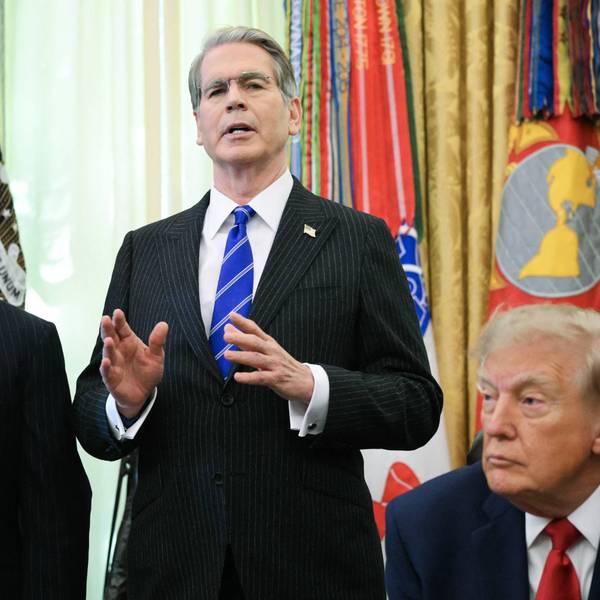


Sen. Ted Cruz (R-Texas) arrives via the subway in the basement of the U.S. Capitol ahead of a vote on January 14, 2026 in Washington, DC.
‘These Guys Can’t Help Themselves’: Cruz Pushes $200 Billion Capital Gains Tax Cut Without OK From Congress
Republican senators said they were seeking to end an "unfair inflation tax on everyday Americans." But nearly all the benefits of their proposal would go to the wealthiest 1%.
Two leading Republicans are pushing for the Trump administration to issue another $200 billion tax cut, primarily to the wealthiest Americans, without congressional approval.
The Washington Post reported Tuesday that Sens. Ted Cruz (R-Texas) and Tim Scott (R-SC) sent a letter to Treasury Secretary Scott Bessent urging him to use executive authority to lower the federal tax on capital gains—the profits from selling stocks, bonds, real estate, and other investments.
The senators have proposed that capital gains taxes should be “indexed for inflation." As the Post explained:
The plan pushed by Cruz and Scott has been sought by conservatives for many years. Under current law, an investor who bought $100 worth of stock in 1990 and sold it today for $300 would currently owe capital gains taxes on the full $200 in profit. But the $100 investment in 1990 would be worth roughly $230 in today’s dollars after accounting for inflation. Under the Cruz-Scott proposal, the investor would only owe taxes on that $70, rather than the full $200.
The senators called on Bessent to "eliminate" this "unfair inflation tax on everyday Americans."
According to Federal Reserve data from 2025, the richest 1% of Americans owned about half of all stocks, while the poorest 50% owned only 1%.
Republicans' so-called One Big Beautiful Bill Act (OBBBA), which enacted massive cuts to social programs like Medicaid and the Supplemental Nutrition Assistance Program (SNAP) last summer, is already estimated to funnel more than $1 trillion to the top 1% of earners over the next 10 years, according to the Institute on Taxation and Economic Policy.
It is unclear whether Bessent would even have the power to change how gains are taxed without an act of Congress, or if Bessent has any interest in doing so. But the vast majority of the benefits from Cruz and Scott's proposal, if enacted, would likely go to the rich as well.
When the Trump administration first considered indexing capital gains taxes to inflation back in 2018, the Penn Wharton Budget Model projected that 63% of the benefits would flow to the richest 0.1%—those making tens of millions per year—while 86% would go to the top 1%.
Those in the bottom 90% of earners would see just over 2% of the overall benefits, with those in the bottom half receiving basically nothing.
According to the Post, the senators view lowering capital gains taxes as part of a GOP bid to "improve its economic approval rating with voters ahead of the 2026 midterm elections," in which the party is expected to take a walloping, according to current polls.
Voters have not responded kindly to previous bills that handed lavish tax breaks to the rich. At the time of its passage, the OBBBA was one of the least popular pieces of legislation in modern history, with several polls showing nearly a 2-to-1 disapproval rating.
But Cruz and Scott are pushing for this policy change despite the public revulsion and the fact that the Department of Justice has previously ruled that the Treasury Department can't make policy without Congress' approval.
"Ted Cruz is asking the Treasury Department to break the law to give another round of tax breaks to the ultrarich," remarked Sen. Ron Wyden (D-Ore.), the ranking member of the Senate Finance Committee. "These guys can't help themselves."
We are at a crossroads
This country and this world are at a monumental crossroads. In a few short weeks, US voters will have an opportunity to beat back the forces of fascism and confront the billionaires who are rigging the economy, our media system, and our democracy, making it increasingly impossible for ordinary people to get by. We’re not just talking about the election. We’re talking about what must be done once these fascist elements are vanquished from power. We need a bolder set of solutions than what either major party has so far been willing to offer and a working-class movement ready to fight like hell for it. Trump didn't emerge from nowhere. The conditions that fueled MAGA authoritarianism were created by decades of radical neoliberal economic policies and a corrupt political system dominated by corporate interests. They slashed taxes on the super-rich, promising that the benefits would trickle down. They said giveaways to the corporate titans would make life more affordable for the rest of us. It was all bullshit. And when a bitter, betrayed populace searches for someone to blame, right-wing demagogues have little trouble finding scapegoats. People know when they're being lied to, but you won't hear any of this from the corporate media. Only independent journalism—powered and funded by people who believe in building a better world—can deliver truly trustworthy daily news. Our Fall Campaign is underway, and we need your help. To power our newsroom through the rest of the year, we need to raise $125,000 by midnight on October 31. So if you share our vision, please contribute whatever you can to sustain our work. |
Two leading Republicans are pushing for the Trump administration to issue another $200 billion tax cut, primarily to the wealthiest Americans, without congressional approval.
The Washington Post reported Tuesday that Sens. Ted Cruz (R-Texas) and Tim Scott (R-SC) sent a letter to Treasury Secretary Scott Bessent urging him to use executive authority to lower the federal tax on capital gains—the profits from selling stocks, bonds, real estate, and other investments.
The senators have proposed that capital gains taxes should be “indexed for inflation." As the Post explained:
The plan pushed by Cruz and Scott has been sought by conservatives for many years. Under current law, an investor who bought $100 worth of stock in 1990 and sold it today for $300 would currently owe capital gains taxes on the full $200 in profit. But the $100 investment in 1990 would be worth roughly $230 in today’s dollars after accounting for inflation. Under the Cruz-Scott proposal, the investor would only owe taxes on that $70, rather than the full $200.
The senators called on Bessent to "eliminate" this "unfair inflation tax on everyday Americans."
According to Federal Reserve data from 2025, the richest 1% of Americans owned about half of all stocks, while the poorest 50% owned only 1%.
Republicans' so-called One Big Beautiful Bill Act (OBBBA), which enacted massive cuts to social programs like Medicaid and the Supplemental Nutrition Assistance Program (SNAP) last summer, is already estimated to funnel more than $1 trillion to the top 1% of earners over the next 10 years, according to the Institute on Taxation and Economic Policy.
It is unclear whether Bessent would even have the power to change how gains are taxed without an act of Congress, or if Bessent has any interest in doing so. But the vast majority of the benefits from Cruz and Scott's proposal, if enacted, would likely go to the rich as well.
When the Trump administration first considered indexing capital gains taxes to inflation back in 2018, the Penn Wharton Budget Model projected that 63% of the benefits would flow to the richest 0.1%—those making tens of millions per year—while 86% would go to the top 1%.
Those in the bottom 90% of earners would see just over 2% of the overall benefits, with those in the bottom half receiving basically nothing.
According to the Post, the senators view lowering capital gains taxes as part of a GOP bid to "improve its economic approval rating with voters ahead of the 2026 midterm elections," in which the party is expected to take a walloping, according to current polls.
Voters have not responded kindly to previous bills that handed lavish tax breaks to the rich. At the time of its passage, the OBBBA was one of the least popular pieces of legislation in modern history, with several polls showing nearly a 2-to-1 disapproval rating.
But Cruz and Scott are pushing for this policy change despite the public revulsion and the fact that the Department of Justice has previously ruled that the Treasury Department can't make policy without Congress' approval.
"Ted Cruz is asking the Treasury Department to break the law to give another round of tax breaks to the ultrarich," remarked Sen. Ron Wyden (D-Ore.), the ranking member of the Senate Finance Committee. "These guys can't help themselves."
Two leading Republicans are pushing for the Trump administration to issue another $200 billion tax cut, primarily to the wealthiest Americans, without congressional approval.
The Washington Post reported Tuesday that Sens. Ted Cruz (R-Texas) and Tim Scott (R-SC) sent a letter to Treasury Secretary Scott Bessent urging him to use executive authority to lower the federal tax on capital gains—the profits from selling stocks, bonds, real estate, and other investments.
The senators have proposed that capital gains taxes should be “indexed for inflation." As the Post explained:
The plan pushed by Cruz and Scott has been sought by conservatives for many years. Under current law, an investor who bought $100 worth of stock in 1990 and sold it today for $300 would currently owe capital gains taxes on the full $200 in profit. But the $100 investment in 1990 would be worth roughly $230 in today’s dollars after accounting for inflation. Under the Cruz-Scott proposal, the investor would only owe taxes on that $70, rather than the full $200.
The senators called on Bessent to "eliminate" this "unfair inflation tax on everyday Americans."
According to Federal Reserve data from 2025, the richest 1% of Americans owned about half of all stocks, while the poorest 50% owned only 1%.
Republicans' so-called One Big Beautiful Bill Act (OBBBA), which enacted massive cuts to social programs like Medicaid and the Supplemental Nutrition Assistance Program (SNAP) last summer, is already estimated to funnel more than $1 trillion to the top 1% of earners over the next 10 years, according to the Institute on Taxation and Economic Policy.
It is unclear whether Bessent would even have the power to change how gains are taxed without an act of Congress, or if Bessent has any interest in doing so. But the vast majority of the benefits from Cruz and Scott's proposal, if enacted, would likely go to the rich as well.
When the Trump administration first considered indexing capital gains taxes to inflation back in 2018, the Penn Wharton Budget Model projected that 63% of the benefits would flow to the richest 0.1%—those making tens of millions per year—while 86% would go to the top 1%.
Those in the bottom 90% of earners would see just over 2% of the overall benefits, with those in the bottom half receiving basically nothing.
According to the Post, the senators view lowering capital gains taxes as part of a GOP bid to "improve its economic approval rating with voters ahead of the 2026 midterm elections," in which the party is expected to take a walloping, according to current polls.
Voters have not responded kindly to previous bills that handed lavish tax breaks to the rich. At the time of its passage, the OBBBA was one of the least popular pieces of legislation in modern history, with several polls showing nearly a 2-to-1 disapproval rating.
But Cruz and Scott are pushing for this policy change despite the public revulsion and the fact that the Department of Justice has previously ruled that the Treasury Department can't make policy without Congress' approval.
"Ted Cruz is asking the Treasury Department to break the law to give another round of tax breaks to the ultrarich," remarked Sen. Ron Wyden (D-Ore.), the ranking member of the Senate Finance Committee. "These guys can't help themselves."