SUBSCRIBE TO OUR FREE NEWSLETTER
Daily news & progressive opinion—funded by the people, not the corporations—delivered straight to your inbox.
5
#000000
#FFFFFF
To donate by check, phone, or other method, see our More Ways to Give page.
Daily news & progressive opinion—funded by the people, not the corporations—delivered straight to your inbox.
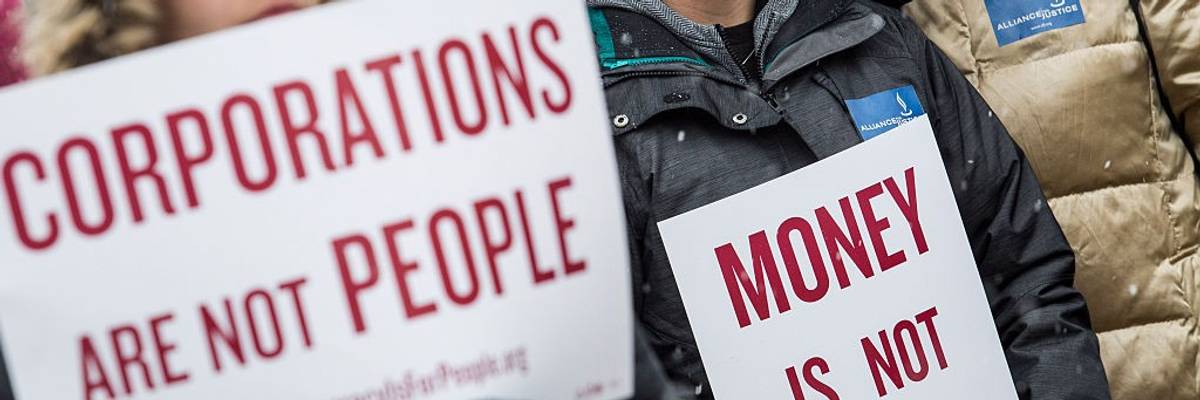
Protesters rally against corporate personhood and money in politics in Washington, DC on January 21, 2015.
Delaware is home to more corporations than people. Human people, that is, as under longstanding state law and the US Supreme Court's infamous 2010 ruling, corporations are people, too.
A judge in Delaware—a state with more registered business entities than people—ruled Monday in favor of a small town that allows corporations to vote in local elections.
Delaware Superior Court Judge Craig Karsnitz ruled that the town of Fenwick Island, population 400, did not violate the state Constitution by permitting business entities—which make up 12% of the town's "population"—to vote in municipal elections, as case plaintiff the ACLU of Delaware had claimed.
"What is a 'person?' When one cuts to the heart of this case, that is the question," Karsnitz wrote to open his 20-page ruling.
‼️‼️Delaware Superior Court upholds a municipal ordinance allowing individuals to cast votes on behalf of LLCs, trusts, and corporations in local elections against a challenge that the ordinance constitutes unlawful vote dilution for real persons under the state constitution. aboutblaw.com/blQg
[image or embed]
— Anthony Michael Kreis (@anthonymkreis.bsky.social) May 27, 2026 at 1:46 PM
"According to the law, a person is anyone or anything that can initiate and be subject to legal proceedings. By this conception, any adult, corporation, or institution is a person, but a minor is not a person, a fetus is not a person, and a humanoid robot... is not a person," the ruling continues. "This highlights that legal personhood is dependent solely on legal recognition."
The judge noted that in 2008, the Delaware General Assembly amended Fenwick Island's charter "to expand its voter registration rolls to allow individuals to cast votes on behalf of trusts, limited liability companies, partnerships, and corporations that own property in Fenwick."
"Today, the overwhelming majority of legal entity property owners in Fenwick registered to vote, and on whose behalf votes are cast, are trusts," Karsnitz added.
"I appreciate that Plaintiff may disagree with Delaware’s policy of authorizing certain municipalities to allow voting on behalf of entity property owners," the judge wrote.
"Visions of faceless large corporations, or even HAL, controlling a small town are frightening and the stuff of science fiction," he continued," referring to the malevolent artificial intelligence-powered computer in Stanley Kubrick's 1968 film version of Arthur C. Clarke's 2001: A Space Odyssey. "However, Plaintiff has not demonstrated that this policy violates the principle of one person/entity/one vote."
"Plaintiff points to no other persuasive independent authority than the Elections Clause of the Delaware Constitution itself," Karsnitz concluded. "And matters of policy are appropriately left to legislative bodies, not the courts."
Fenwick Island Mayor Natalie Magdeburger told Reuters earlier this year that "a property owner who pays taxes and is subject to our ordinances should have a say in who represents them on our Town Council."
Meanwhile, the ACLU of Delaware contends that "with over 2 million business entities incorporated in Delaware–roughly double the amount of actual people living in the state–the people of Delaware risk having their voices drowned out when towns like Fenwick Island allow corporate voting."
Karsnitz's ruling does not mention Citizens United v. Federal Election Commission, the 2010 US Supreme Court decision affirming that political spending by corporations, nonprofit organizations, labor unions, and other groups is a form of free speech protected by the 1st Amendment that government cannot restrict. The decision ushered in the era of super PACs—which can raise unlimited amounts of money to spend on campaigns—and secret spending on elections with so-called “dark money.”
While Delaware's corporate personhood laws long predate Citizens United, numerous critics of Monday's ruling referred to the case, including the progressive legal advocacy group Demand Justice.
"Corporations aren't people," the group asserted on X. "They don't have kids in local schools, they don't drink the water, they can’t be jailed for crimes, and they shouldn't get a vote."
Some compared Hawaii, where Democratic Gov. Josh Green recently signed legislation clarifying that corporations are not people, with Delaware.
"Hawaii made a move to rein in Citizens United," writer Van Dennis posted on X, "and Delaware responded, "The fuck you are."
This country and this world are at a monumental crossroads. US voters have an opportunity to beat back the forces of fascism and confront the billionaires who are rigging the economy, our media system, and our democracy, making it increasingly impossible for ordinary people to get by. We’re not just talking about the election. We’re talking about what must be done once these fascist elements are vanquished from power. We need a bolder set of solutions than what either major party has so far been willing to offer and a working-class movement ready to fight like hell for it. Trump didn't emerge from nowhere. The conditions that fueled MAGA authoritarianism were created by decades of radical neoliberal economic policies and a corrupt political system dominated by corporate interests. They slashed taxes on the super-rich, promising that the benefits would trickle down. They said giveaways to the corporate titans would make life more affordable for the rest of us. It was all bullshit. And when a bitter, betrayed populace searches for someone to blame, right-wing demagogues have little trouble finding scapegoats. People know when they're being lied to, but you won't hear any of this from the corporate media. Only independent journalism—powered and funded by people who believe in building a better world—can deliver truly trustworthy daily news. If you share our vision, please contribute whatever you can to sustain our work. |
A judge in Delaware—a state with more registered business entities than people—ruled Monday in favor of a small town that allows corporations to vote in local elections.
Delaware Superior Court Judge Craig Karsnitz ruled that the town of Fenwick Island, population 400, did not violate the state Constitution by permitting business entities—which make up 12% of the town's "population"—to vote in municipal elections, as case plaintiff the ACLU of Delaware had claimed.
"What is a 'person?' When one cuts to the heart of this case, that is the question," Karsnitz wrote to open his 20-page ruling.
‼️‼️Delaware Superior Court upholds a municipal ordinance allowing individuals to cast votes on behalf of LLCs, trusts, and corporations in local elections against a challenge that the ordinance constitutes unlawful vote dilution for real persons under the state constitution. aboutblaw.com/blQg
[image or embed]
— Anthony Michael Kreis (@anthonymkreis.bsky.social) May 27, 2026 at 1:46 PM
"According to the law, a person is anyone or anything that can initiate and be subject to legal proceedings. By this conception, any adult, corporation, or institution is a person, but a minor is not a person, a fetus is not a person, and a humanoid robot... is not a person," the ruling continues. "This highlights that legal personhood is dependent solely on legal recognition."
The judge noted that in 2008, the Delaware General Assembly amended Fenwick Island's charter "to expand its voter registration rolls to allow individuals to cast votes on behalf of trusts, limited liability companies, partnerships, and corporations that own property in Fenwick."
"Today, the overwhelming majority of legal entity property owners in Fenwick registered to vote, and on whose behalf votes are cast, are trusts," Karsnitz added.
"I appreciate that Plaintiff may disagree with Delaware’s policy of authorizing certain municipalities to allow voting on behalf of entity property owners," the judge wrote.
"Visions of faceless large corporations, or even HAL, controlling a small town are frightening and the stuff of science fiction," he continued," referring to the malevolent artificial intelligence-powered computer in Stanley Kubrick's 1968 film version of Arthur C. Clarke's 2001: A Space Odyssey. "However, Plaintiff has not demonstrated that this policy violates the principle of one person/entity/one vote."
"Plaintiff points to no other persuasive independent authority than the Elections Clause of the Delaware Constitution itself," Karsnitz concluded. "And matters of policy are appropriately left to legislative bodies, not the courts."
Fenwick Island Mayor Natalie Magdeburger told Reuters earlier this year that "a property owner who pays taxes and is subject to our ordinances should have a say in who represents them on our Town Council."
Meanwhile, the ACLU of Delaware contends that "with over 2 million business entities incorporated in Delaware–roughly double the amount of actual people living in the state–the people of Delaware risk having their voices drowned out when towns like Fenwick Island allow corporate voting."
Karsnitz's ruling does not mention Citizens United v. Federal Election Commission, the 2010 US Supreme Court decision affirming that political spending by corporations, nonprofit organizations, labor unions, and other groups is a form of free speech protected by the 1st Amendment that government cannot restrict. The decision ushered in the era of super PACs—which can raise unlimited amounts of money to spend on campaigns—and secret spending on elections with so-called “dark money.”
While Delaware's corporate personhood laws long predate Citizens United, numerous critics of Monday's ruling referred to the case, including the progressive legal advocacy group Demand Justice.
"Corporations aren't people," the group asserted on X. "They don't have kids in local schools, they don't drink the water, they can’t be jailed for crimes, and they shouldn't get a vote."
Some compared Hawaii, where Democratic Gov. Josh Green recently signed legislation clarifying that corporations are not people, with Delaware.
"Hawaii made a move to rein in Citizens United," writer Van Dennis posted on X, "and Delaware responded, "The fuck you are."