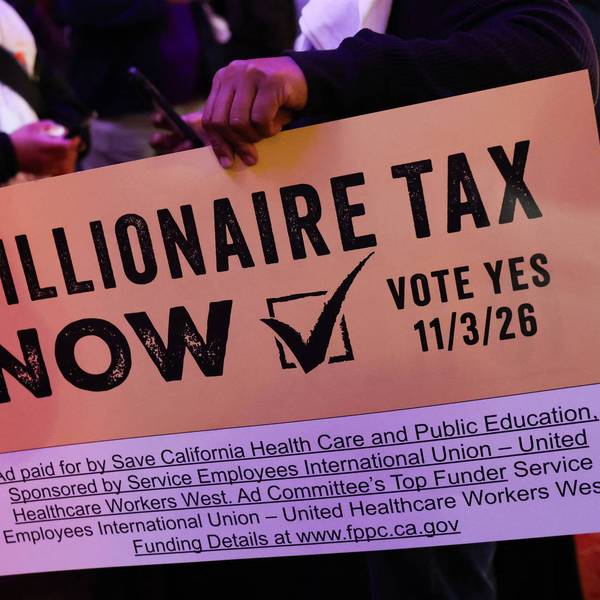

An activist holds a sign during a "Rally to Say No to Tax Breaks for Billionaires and Corporations" at the Upper Senate Park on Capitol Hill on April 10, 2025 in Washington, DC.
Billionaires' Tax Filings Agree With AOC. They Don't "Earn" Their Billions.
Elon Musk would need to work 58 times longer than the age of the universe to "earn" his wealth.
Rep. Alexandria Ocasio-Cortez (D-NY) kicked off a storm when she said in a podcast interview last week that a person cannot “earn” a billion dollars.
Republican Sen. Ted Cruz of Texas responded by saying that the statement was “bizarrely foolish” and then pointed to the worst possible example he could think of to counter Ocasio-Cortez’s point: mega-billionaire Elon Musk.
In the eyes of the US government, and specifically the IRS, there’s no question about it. Elon Musk did not “earn” his wealth. Otherwise, he’d be paying a tax rate at least 17 times greater than he is—and generating a tax bill bigger than the GDP of Nevada.
Unless you’re immortal, Ocasio-Cortez is indeed correct that it’s impossible to earn a billion dollars.
The average US worker, earning $64,505 a year, would have to work over 15,500 years to “earn” a billion dollars. Want to be as rich as Elon Musk? You’d have to work 41 times longer than humans existed—over 12 million years.
But what if you are Elon Musk? How long would it you take then? A billion years to earn a billion dollars, and 800 billion years to earn $800 billion—so, 58 times longer than the existence of the known universe.
Now that’s bizarre.
The average US worker, earning $64,505 a year, would have to work over 15,500 years to “earn” a billion dollars. Want to be as rich as Elon Musk? You’d have to work 41 times longer than humans existed—over 12 million years.
Elon Musk—like Mark Zuckerburg, Larry Elison and many of the world’s other richest men—only “earns” $1 a year. He is what's known as a $1 CEO because he gets paid an annual salary of $1.
What most people don’t realize when we talk about wealth and wealth taxes is that we’re talking about two types of wealth. There’s earned wealth, which is when you get paid for you what you do (eg salaries, wages, etc). And then there’s collected wealth, which is when you get paid for what you own—eg dividends for owning stocks or rent money for owning real estate.
Most people primarily rely on earned wealth for a living. Billionaires on the other hand, their wealth is almost entirely collected wealth.
And that matters, because collected wealth tends to grow a lot faster than earned wealth, but more importantly, because governments tend to tax collected wealth a lot less than earned wealth.
In fact, billionaires very often deliberately reshuffle their wealth around into collected types of wealth specifically to underreport what they “earn” to the IRS and pay less income tax. It’s why Elon Musk can be the world’s richest man on an annual salary of $1. It’s why he and Jeff Bezos have been able to pay zero income taxes in some years while topping the Forbes richest people's list. It's also why Bezos was able to receive a family tax credit for families earning less than $100,000 a year.
But it gets even more bizarre.
Many billionaires aren’t just not earning much, they’re hopelessly in debt—apparently. Many of them are actually living off huge loans that they don’t expect to pay off in their lifetimes. It’s a scheme called “Buy, Borrow, Die.”
Taking their tax allergies to the extreme, rather than selling assets to get the money they need to actually pay for things, some billionaires take out loans against their assets instead. This way, they don’t have to pay the taxes that would have applied if they sold their assets, plus they get to hold on to the assets which can become worth even more over time. And because the money they get this way is technically loan money, it doesn’t count as earned income—and so they can continue to underreport their “earnings” to the IRS and underpay tax.
It might come as a shock to Sen Cruz, but many US billionaires, like his example Elon Musk, have done all they can to “earn” as little to none of their wealth, and some have even gone so far as to “indebt” their billions instead.
But why should we care about any of this?
Because it’s this two-tier tax system that gives special treatment to collected wealth over earned wealth that has allowed the extreme wealth of super-rich individuals to quadruple since the 1980s.
The rise of extreme wealth is directly linked to lower economic productivity, to more households going into debt, and to people living shorter lives. A G20 report co-authored by winner of the Nobel prize for economics Joseph Stiglitz warns that extreme wealth is a threat to democracy.
What makes wealth taxes so powerful—and so opposed by a vocal minority among the superrich—isn’t just the huge sums of public funds they can bring in. It’s that by specifically taxing collected wealth, wealth taxes directly challenge this two-tier tax system. It’s about protecting economies, people and planet from the harms of extreme wealth.
Whether you’re a wealth earner or a wealth collector, we all have an equal responsibility to pitch in our fair share.
We are at a crossroads
This country and this world are at a monumental crossroads. In a few short weeks, US voters will have an opportunity to beat back the forces of fascism and confront the billionaires who are rigging the economy, our media system, and our democracy, making it increasingly impossible for ordinary people to get by. We’re not just talking about the election. We’re talking about what must be done once these fascist elements are vanquished from power. We need a bolder set of solutions than what either major party has so far been willing to offer and a working-class movement ready to fight like hell for it. Trump didn't emerge from nowhere. The conditions that fueled MAGA authoritarianism were created by decades of radical neoliberal economic policies and a corrupt political system dominated by corporate interests. They slashed taxes on the super-rich, promising that the benefits would trickle down. They said giveaways to the corporate titans would make life more affordable for the rest of us. It was all bullshit. And when a bitter, betrayed populace searches for someone to blame, right-wing demagogues have little trouble finding scapegoats. People know when they're being lied to, but you won't hear any of this from the corporate media. Only independent journalism—powered and funded by people who believe in building a better world—can deliver truly trustworthy daily news. Our Fall Campaign is underway, and we need your help. To power our newsroom through the rest of the year, we need to raise $125,000 by midnight on October 31. So if you share our vision, please contribute whatever you can to sustain our work. |
Rep. Alexandria Ocasio-Cortez (D-NY) kicked off a storm when she said in a podcast interview last week that a person cannot “earn” a billion dollars.
Republican Sen. Ted Cruz of Texas responded by saying that the statement was “bizarrely foolish” and then pointed to the worst possible example he could think of to counter Ocasio-Cortez’s point: mega-billionaire Elon Musk.
In the eyes of the US government, and specifically the IRS, there’s no question about it. Elon Musk did not “earn” his wealth. Otherwise, he’d be paying a tax rate at least 17 times greater than he is—and generating a tax bill bigger than the GDP of Nevada.
Unless you’re immortal, Ocasio-Cortez is indeed correct that it’s impossible to earn a billion dollars.
The average US worker, earning $64,505 a year, would have to work over 15,500 years to “earn” a billion dollars. Want to be as rich as Elon Musk? You’d have to work 41 times longer than humans existed—over 12 million years.
But what if you are Elon Musk? How long would it you take then? A billion years to earn a billion dollars, and 800 billion years to earn $800 billion—so, 58 times longer than the existence of the known universe.
Now that’s bizarre.
The average US worker, earning $64,505 a year, would have to work over 15,500 years to “earn” a billion dollars. Want to be as rich as Elon Musk? You’d have to work 41 times longer than humans existed—over 12 million years.
Elon Musk—like Mark Zuckerburg, Larry Elison and many of the world’s other richest men—only “earns” $1 a year. He is what's known as a $1 CEO because he gets paid an annual salary of $1.
What most people don’t realize when we talk about wealth and wealth taxes is that we’re talking about two types of wealth. There’s earned wealth, which is when you get paid for you what you do (eg salaries, wages, etc). And then there’s collected wealth, which is when you get paid for what you own—eg dividends for owning stocks or rent money for owning real estate.
Most people primarily rely on earned wealth for a living. Billionaires on the other hand, their wealth is almost entirely collected wealth.
And that matters, because collected wealth tends to grow a lot faster than earned wealth, but more importantly, because governments tend to tax collected wealth a lot less than earned wealth.
In fact, billionaires very often deliberately reshuffle their wealth around into collected types of wealth specifically to underreport what they “earn” to the IRS and pay less income tax. It’s why Elon Musk can be the world’s richest man on an annual salary of $1. It’s why he and Jeff Bezos have been able to pay zero income taxes in some years while topping the Forbes richest people's list. It's also why Bezos was able to receive a family tax credit for families earning less than $100,000 a year.
But it gets even more bizarre.
Many billionaires aren’t just not earning much, they’re hopelessly in debt—apparently. Many of them are actually living off huge loans that they don’t expect to pay off in their lifetimes. It’s a scheme called “Buy, Borrow, Die.”
Taking their tax allergies to the extreme, rather than selling assets to get the money they need to actually pay for things, some billionaires take out loans against their assets instead. This way, they don’t have to pay the taxes that would have applied if they sold their assets, plus they get to hold on to the assets which can become worth even more over time. And because the money they get this way is technically loan money, it doesn’t count as earned income—and so they can continue to underreport their “earnings” to the IRS and underpay tax.
It might come as a shock to Sen Cruz, but many US billionaires, like his example Elon Musk, have done all they can to “earn” as little to none of their wealth, and some have even gone so far as to “indebt” their billions instead.
But why should we care about any of this?
Because it’s this two-tier tax system that gives special treatment to collected wealth over earned wealth that has allowed the extreme wealth of super-rich individuals to quadruple since the 1980s.
The rise of extreme wealth is directly linked to lower economic productivity, to more households going into debt, and to people living shorter lives. A G20 report co-authored by winner of the Nobel prize for economics Joseph Stiglitz warns that extreme wealth is a threat to democracy.
What makes wealth taxes so powerful—and so opposed by a vocal minority among the superrich—isn’t just the huge sums of public funds they can bring in. It’s that by specifically taxing collected wealth, wealth taxes directly challenge this two-tier tax system. It’s about protecting economies, people and planet from the harms of extreme wealth.
Whether you’re a wealth earner or a wealth collector, we all have an equal responsibility to pitch in our fair share.
- 500 Richest People Gained Record $2.2 Trillion in 2025, Fueling Calls for Wealth Tax ›
- Global System 'Rigged for the Wealthy' Delivers World With 'More Billionaires Than Ever' ›
- Oxfam Shows US Billionaires Almost a Third Richer Today Than When Covid Hit ›
- 'A New Aristocracy': Billionaire Wealth Surged by $2 Trillion Last Year ›
- Wealth of Global Billionaires Surged by $10 Billion Per Day in January ›
Rep. Alexandria Ocasio-Cortez (D-NY) kicked off a storm when she said in a podcast interview last week that a person cannot “earn” a billion dollars.
Republican Sen. Ted Cruz of Texas responded by saying that the statement was “bizarrely foolish” and then pointed to the worst possible example he could think of to counter Ocasio-Cortez’s point: mega-billionaire Elon Musk.
In the eyes of the US government, and specifically the IRS, there’s no question about it. Elon Musk did not “earn” his wealth. Otherwise, he’d be paying a tax rate at least 17 times greater than he is—and generating a tax bill bigger than the GDP of Nevada.
Unless you’re immortal, Ocasio-Cortez is indeed correct that it’s impossible to earn a billion dollars.
The average US worker, earning $64,505 a year, would have to work over 15,500 years to “earn” a billion dollars. Want to be as rich as Elon Musk? You’d have to work 41 times longer than humans existed—over 12 million years.
But what if you are Elon Musk? How long would it you take then? A billion years to earn a billion dollars, and 800 billion years to earn $800 billion—so, 58 times longer than the existence of the known universe.
Now that’s bizarre.
The average US worker, earning $64,505 a year, would have to work over 15,500 years to “earn” a billion dollars. Want to be as rich as Elon Musk? You’d have to work 41 times longer than humans existed—over 12 million years.
Elon Musk—like Mark Zuckerburg, Larry Elison and many of the world’s other richest men—only “earns” $1 a year. He is what's known as a $1 CEO because he gets paid an annual salary of $1.
What most people don’t realize when we talk about wealth and wealth taxes is that we’re talking about two types of wealth. There’s earned wealth, which is when you get paid for you what you do (eg salaries, wages, etc). And then there’s collected wealth, which is when you get paid for what you own—eg dividends for owning stocks or rent money for owning real estate.
Most people primarily rely on earned wealth for a living. Billionaires on the other hand, their wealth is almost entirely collected wealth.
And that matters, because collected wealth tends to grow a lot faster than earned wealth, but more importantly, because governments tend to tax collected wealth a lot less than earned wealth.
In fact, billionaires very often deliberately reshuffle their wealth around into collected types of wealth specifically to underreport what they “earn” to the IRS and pay less income tax. It’s why Elon Musk can be the world’s richest man on an annual salary of $1. It’s why he and Jeff Bezos have been able to pay zero income taxes in some years while topping the Forbes richest people's list. It's also why Bezos was able to receive a family tax credit for families earning less than $100,000 a year.
But it gets even more bizarre.
Many billionaires aren’t just not earning much, they’re hopelessly in debt—apparently. Many of them are actually living off huge loans that they don’t expect to pay off in their lifetimes. It’s a scheme called “Buy, Borrow, Die.”
Taking their tax allergies to the extreme, rather than selling assets to get the money they need to actually pay for things, some billionaires take out loans against their assets instead. This way, they don’t have to pay the taxes that would have applied if they sold their assets, plus they get to hold on to the assets which can become worth even more over time. And because the money they get this way is technically loan money, it doesn’t count as earned income—and so they can continue to underreport their “earnings” to the IRS and underpay tax.
It might come as a shock to Sen Cruz, but many US billionaires, like his example Elon Musk, have done all they can to “earn” as little to none of their wealth, and some have even gone so far as to “indebt” their billions instead.
But why should we care about any of this?
Because it’s this two-tier tax system that gives special treatment to collected wealth over earned wealth that has allowed the extreme wealth of super-rich individuals to quadruple since the 1980s.
The rise of extreme wealth is directly linked to lower economic productivity, to more households going into debt, and to people living shorter lives. A G20 report co-authored by winner of the Nobel prize for economics Joseph Stiglitz warns that extreme wealth is a threat to democracy.
What makes wealth taxes so powerful—and so opposed by a vocal minority among the superrich—isn’t just the huge sums of public funds they can bring in. It’s that by specifically taxing collected wealth, wealth taxes directly challenge this two-tier tax system. It’s about protecting economies, people and planet from the harms of extreme wealth.
Whether you’re a wealth earner or a wealth collector, we all have an equal responsibility to pitch in our fair share.
- 500 Richest People Gained Record $2.2 Trillion in 2025, Fueling Calls for Wealth Tax ›
- Global System 'Rigged for the Wealthy' Delivers World With 'More Billionaires Than Ever' ›
- Oxfam Shows US Billionaires Almost a Third Richer Today Than When Covid Hit ›
- 'A New Aristocracy': Billionaire Wealth Surged by $2 Trillion Last Year ›
- Wealth of Global Billionaires Surged by $10 Billion Per Day in January ›