SUBSCRIBE TO OUR FREE NEWSLETTER
Daily news & progressive opinion—funded by the people, not the corporations—delivered straight to your inbox.
5
#000000
#FFFFFF
To donate by check, phone, or other method, see our More Ways to Give page.
Daily news & progressive opinion—funded by the people, not the corporations—delivered straight to your inbox.
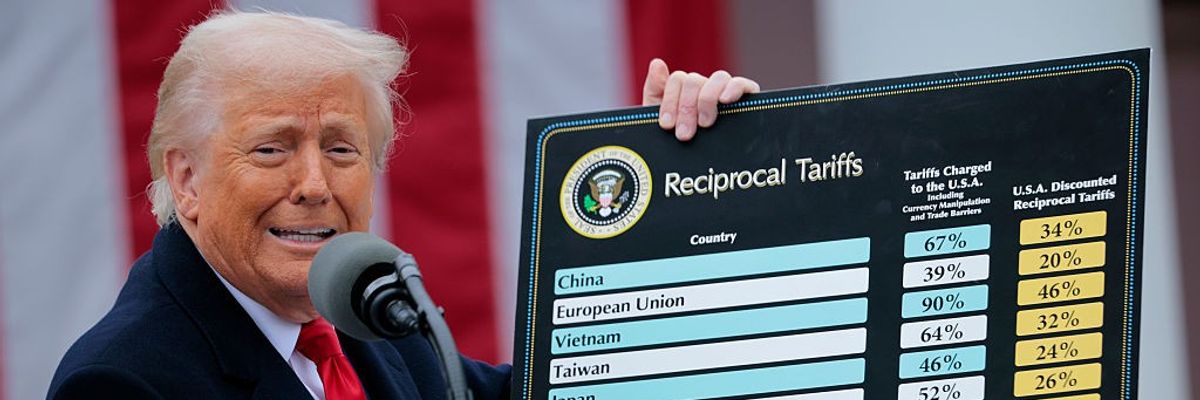
President Donald Trump holds up a chart of "reciprocal tariffs" while speaking during a trade announcement on April 2, 2025 in Washington, DC.
"If it was possible for Trump to have spent the last 14 months on the golf course, we would be in a better place," said one expert.
Thursday marks the one-year anniversary of President Donald Trump unleashing a sweeping package of global tariffs on imported products, which has prompted many critics to reflect on how much economic damage the president has caused.
The Tax Foundation on Monday published an analysis examining the promises Trump made about the benefits of the tariffs, including a claim that "jobs and factories will come roaring back," as foreign investments would pour in.
This particular promise, the Tax Foundation found, has completely failed to materialize.
"Foreign direct investment (FDI) into the United States has seen no such dramatic spikes," the Tax Foundation explained. "In 2025, FDI totaled $288.4 billion—more than an order of magnitude smaller than President Trump’s claims. Total FDI in 2025 was below the prior 10 years’ average of $320.7 billion and lower than the annual totals in 2021, 2022, 2023, and 2024 ($405.5 billion, $338.4 billion, $297.4 billion, and $292.3 billion, respectively)."
The analysis also found manufacturing jobs continued to decline after the tariffs went into effect, with a net 89,000 jobs lost between April 2025 and February 2026.
Dario Perkins, head of global research at the consultancy TS Lombard, said in an interview with The Guardian that Trump's chaotic tariff scheme, which was ruled unconstitutional by the US Supreme Court in February, was a signal to foreign firms that they should avoid making investments in the country for the foreseeable future.
"If you think that discouraging investors from buying assets in the US is a victory, then you don’t believe in a growing economy," Perkins explained. "If it was possible for Trump to have spent the last 14 months on the golf course, we would be in a better place."
Russ Mould, investment director of the British stockbroker AJ Bell, wrote in a Monday research note flagged by CNBC that Trump's tariffs have caused global investors to shy away from pouring money into the US, instead seeking nations with more stable economic policies.
"Investors do seem to have thought carefully about where to allocate capital in a post-liberation day world, and one where presidential social media posts carry heft politically, economically and militarily,” Mould wrote. "The US stock market may have bounced back strongly from the liberation day low, but it has not been the first destination of choice... In other words, it is no longer a case of America first and the rest nowhere."
Nigel Green, CEO of deVere Group, told CNBC that Trump's trade war chaos had dented America's image as a financial safe haven.
"Investors are no longer treating the US as a uniform opportunity; they’re picking sectors that align with policy tailwinds and avoiding those exposed to trade disruption,” Green explained. "Liberation day accelerated a bifurcation in markets. On one side, companies aligned with domestic production, AI and energy security are attracting capital. On the other, globally exposed firms with complex supply chains are facing higher scrutiny and, in some cases, valuation compression."
Groundwork Collaborative on Thursday released a fact sheet about the Trump tariffs that highlighted how the president has used international trade policy to boost his own finances.
"Tariff policy has been used as leverage to secure favorable treatment for Trump’s personal business interests, such as a Trump-linked golf development," explained Groundwork Collaborative. "Trump turned U.S. trade policy into a transactional system, using tariff leverage to help Trump-linked and -favored business ventures win special treatment from foreign governments rather than prioritizing fixes to help balance US trade and help US workers."
In a Thursday social media post, the Democratic Party marked the one-year anniversary of Trump's tariffs by counting ways they had made the US economy weaker.
"One year ago, Trump announced sweeping tariffs that completely fucked the economy," the party wrote. "Since then: Americans have faced 1+ million layoffs; inflation has soared; the job market is the weakest it’s been in decades. Trump's economy is a complete failure."
Dear Common Dreams reader, It’s been nearly 30 years since I co-founded Common Dreams with my late wife, Lina Newhouser. We had the radical notion that journalism should serve the public good, not corporate profits. It was clear to us from the outset what it would take to build such a project. No paid advertisements. No corporate sponsors. No millionaire publisher telling us what to think or do. Many people said we wouldn't last a year, but we proved those doubters wrong. Together with a tremendous team of journalists and dedicated staff, we built an independent media outlet free from the constraints of profits and corporate control. Our mission has always been simple: To inform. To inspire. To ignite change for the common good. Building Common Dreams was not easy. Our survival was never guaranteed. When you take on the most powerful forces—Wall Street greed, fossil fuel industry destruction, Big Tech lobbyists, and uber-rich oligarchs who have spent billions upon billions rigging the economy and democracy in their favor—the only bulwark you have is supporters who believe in your work. But here’s the urgent message from me today. It's never been this bad out there. And it's never been this hard to keep us going. At the very moment Common Dreams is most needed, the threats we face are intensifying. We need your support now more than ever. We don't accept corporate advertising and never will. We don't have a paywall because we don't think people should be blocked from critical news based on their ability to pay. Everything we do is funded by the donations of readers like you. When everyone does the little they can afford, we are strong. But if that support retreats or dries up, so do we. Will you donate now to make sure Common Dreams not only survives but thrives? —Craig Brown, Co-founder |
Thursday marks the one-year anniversary of President Donald Trump unleashing a sweeping package of global tariffs on imported products, which has prompted many critics to reflect on how much economic damage the president has caused.
The Tax Foundation on Monday published an analysis examining the promises Trump made about the benefits of the tariffs, including a claim that "jobs and factories will come roaring back," as foreign investments would pour in.
This particular promise, the Tax Foundation found, has completely failed to materialize.
"Foreign direct investment (FDI) into the United States has seen no such dramatic spikes," the Tax Foundation explained. "In 2025, FDI totaled $288.4 billion—more than an order of magnitude smaller than President Trump’s claims. Total FDI in 2025 was below the prior 10 years’ average of $320.7 billion and lower than the annual totals in 2021, 2022, 2023, and 2024 ($405.5 billion, $338.4 billion, $297.4 billion, and $292.3 billion, respectively)."
The analysis also found manufacturing jobs continued to decline after the tariffs went into effect, with a net 89,000 jobs lost between April 2025 and February 2026.
Dario Perkins, head of global research at the consultancy TS Lombard, said in an interview with The Guardian that Trump's chaotic tariff scheme, which was ruled unconstitutional by the US Supreme Court in February, was a signal to foreign firms that they should avoid making investments in the country for the foreseeable future.
"If you think that discouraging investors from buying assets in the US is a victory, then you don’t believe in a growing economy," Perkins explained. "If it was possible for Trump to have spent the last 14 months on the golf course, we would be in a better place."
Russ Mould, investment director of the British stockbroker AJ Bell, wrote in a Monday research note flagged by CNBC that Trump's tariffs have caused global investors to shy away from pouring money into the US, instead seeking nations with more stable economic policies.
"Investors do seem to have thought carefully about where to allocate capital in a post-liberation day world, and one where presidential social media posts carry heft politically, economically and militarily,” Mould wrote. "The US stock market may have bounced back strongly from the liberation day low, but it has not been the first destination of choice... In other words, it is no longer a case of America first and the rest nowhere."
Nigel Green, CEO of deVere Group, told CNBC that Trump's trade war chaos had dented America's image as a financial safe haven.
"Investors are no longer treating the US as a uniform opportunity; they’re picking sectors that align with policy tailwinds and avoiding those exposed to trade disruption,” Green explained. "Liberation day accelerated a bifurcation in markets. On one side, companies aligned with domestic production, AI and energy security are attracting capital. On the other, globally exposed firms with complex supply chains are facing higher scrutiny and, in some cases, valuation compression."
Groundwork Collaborative on Thursday released a fact sheet about the Trump tariffs that highlighted how the president has used international trade policy to boost his own finances.
"Tariff policy has been used as leverage to secure favorable treatment for Trump’s personal business interests, such as a Trump-linked golf development," explained Groundwork Collaborative. "Trump turned U.S. trade policy into a transactional system, using tariff leverage to help Trump-linked and -favored business ventures win special treatment from foreign governments rather than prioritizing fixes to help balance US trade and help US workers."
In a Thursday social media post, the Democratic Party marked the one-year anniversary of Trump's tariffs by counting ways they had made the US economy weaker.
"One year ago, Trump announced sweeping tariffs that completely fucked the economy," the party wrote. "Since then: Americans have faced 1+ million layoffs; inflation has soared; the job market is the weakest it’s been in decades. Trump's economy is a complete failure."
Thursday marks the one-year anniversary of President Donald Trump unleashing a sweeping package of global tariffs on imported products, which has prompted many critics to reflect on how much economic damage the president has caused.
The Tax Foundation on Monday published an analysis examining the promises Trump made about the benefits of the tariffs, including a claim that "jobs and factories will come roaring back," as foreign investments would pour in.
This particular promise, the Tax Foundation found, has completely failed to materialize.
"Foreign direct investment (FDI) into the United States has seen no such dramatic spikes," the Tax Foundation explained. "In 2025, FDI totaled $288.4 billion—more than an order of magnitude smaller than President Trump’s claims. Total FDI in 2025 was below the prior 10 years’ average of $320.7 billion and lower than the annual totals in 2021, 2022, 2023, and 2024 ($405.5 billion, $338.4 billion, $297.4 billion, and $292.3 billion, respectively)."
The analysis also found manufacturing jobs continued to decline after the tariffs went into effect, with a net 89,000 jobs lost between April 2025 and February 2026.
Dario Perkins, head of global research at the consultancy TS Lombard, said in an interview with The Guardian that Trump's chaotic tariff scheme, which was ruled unconstitutional by the US Supreme Court in February, was a signal to foreign firms that they should avoid making investments in the country for the foreseeable future.
"If you think that discouraging investors from buying assets in the US is a victory, then you don’t believe in a growing economy," Perkins explained. "If it was possible for Trump to have spent the last 14 months on the golf course, we would be in a better place."
Russ Mould, investment director of the British stockbroker AJ Bell, wrote in a Monday research note flagged by CNBC that Trump's tariffs have caused global investors to shy away from pouring money into the US, instead seeking nations with more stable economic policies.
"Investors do seem to have thought carefully about where to allocate capital in a post-liberation day world, and one where presidential social media posts carry heft politically, economically and militarily,” Mould wrote. "The US stock market may have bounced back strongly from the liberation day low, but it has not been the first destination of choice... In other words, it is no longer a case of America first and the rest nowhere."
Nigel Green, CEO of deVere Group, told CNBC that Trump's trade war chaos had dented America's image as a financial safe haven.
"Investors are no longer treating the US as a uniform opportunity; they’re picking sectors that align with policy tailwinds and avoiding those exposed to trade disruption,” Green explained. "Liberation day accelerated a bifurcation in markets. On one side, companies aligned with domestic production, AI and energy security are attracting capital. On the other, globally exposed firms with complex supply chains are facing higher scrutiny and, in some cases, valuation compression."
Groundwork Collaborative on Thursday released a fact sheet about the Trump tariffs that highlighted how the president has used international trade policy to boost his own finances.
"Tariff policy has been used as leverage to secure favorable treatment for Trump’s personal business interests, such as a Trump-linked golf development," explained Groundwork Collaborative. "Trump turned U.S. trade policy into a transactional system, using tariff leverage to help Trump-linked and -favored business ventures win special treatment from foreign governments rather than prioritizing fixes to help balance US trade and help US workers."
In a Thursday social media post, the Democratic Party marked the one-year anniversary of Trump's tariffs by counting ways they had made the US economy weaker.
"One year ago, Trump announced sweeping tariffs that completely fucked the economy," the party wrote. "Since then: Americans have faced 1+ million layoffs; inflation has soared; the job market is the weakest it’s been in decades. Trump's economy is a complete failure."