
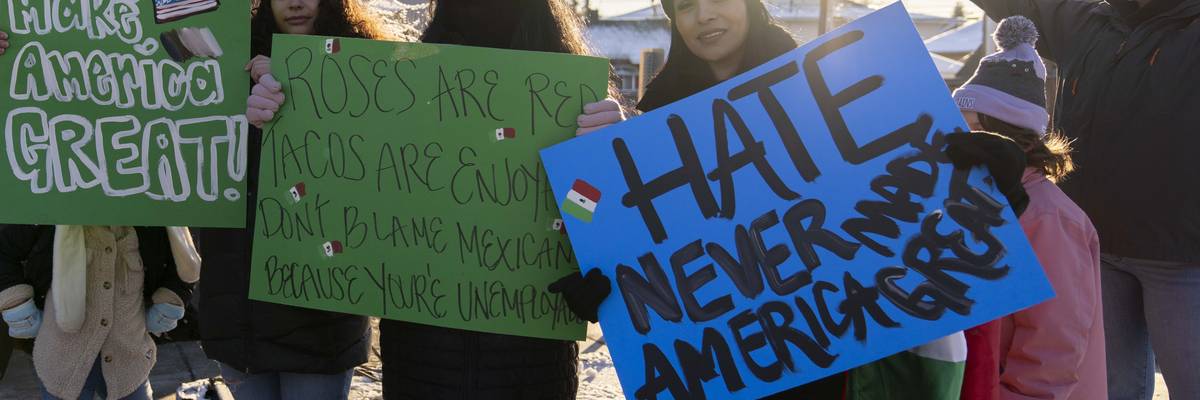
Demonstrators gather outside the U.S. Department of Homeland Security building to protest against deportations in Anchorage, Alaska on February 9, 2025.
'A Moral Stain on All of Us': Outrage Over US Deportees at Panama Jungle Camp
Nearly 100 asylum-seekers are being held in a sweltering camp with "fenced cages," one woman reported.
An Iranian Christian woman who is one of nearly 100 people being held in a detention camp in Panama after being deported by the Trump administration described the site as looking "like a zoo" on Wednesday, with "fenced cages" and little sustenance provided by authorities.
"They gave us a stale piece of bread," Artemis Ghasemzadeh told The New York Times before officials reportedly confiscated the deported asylum-seekers' phones. "We are sitting on the floor."
The Times reported that eight children are among the asylum-seekers being held in the camp, called San Vicente.
Ghasemzadeh was one of about 300 people who were sent to Panama on a deportation flight earlier this week—first to be locked in rooms at the Decapolis Hotel in downtown Panama City, and then, in the case of about a third of the migrants, to be loaded onto buses headed for the camp near the Darién jungle.
At the hotel, the United Nations International Organization for Migration (IOM) met with the asylum-seekers, none of whom have criminal records, according to Panamanian officials—despite the Trump administration's repeated claims that people who have committed violent crimes will be prioritized for its wide-scale deportation operation.
"There is no world in which this is acceptable."
Officials confiscated the asylum-seekers' passports after they arrived at the hotel. At least one person attempted suicide while locked in the hotel, and another broke his leg while trying to escape.
"There is no world in which this is acceptable," said Elizabeth Dickinson, a senior analyst with the International Crisis Group, of the migrants' deportation and detention.
The IOM offered to coordinate flights to the migrants' home countries, but Ghasemzadeh, other Iranian Christians in the group, and some of the other people said they risk retribution—including possibly being put to death—if they return to the countries they left in order to seek asylum in the United States.
The BBC reported that 171 of the migrants—who came to the U.S. from India, China, Uzbekistan, Iran, Vietnam, Turkey, Nepal, Pakistan, Afghanistan, and Sri Lanka—agreed to be sent back to their home countries.
A local attorney seeking to provide some of the refugees with legal counsel, journalists, and aid groups have been blocked from speaking with the detained people and from seeing the conditions at San Vicente, the Times reported.
Times reporters gained information from two of the migrants who shared their locations using their cellphones, but Ghasemzadeh informed them Wednesday morning that officials at San Vicente were confiscating the phones.
"Please try to help us," she told the reporters after describing the camp as being extremely hot and "overrun with cats and dogs."
The treatment of the refugees, said Gillian Branstetter of the ACLU, is "a moral stain on all of us."
Panama's national security minister, Frank Ábrego, told a local news program Wednesday that the asylum-seekers are being held "for their own protection."
The Trump administration, which has arrested at least 41,169 people in its deportation raids, applied intense pressure to the Panamanian government to convince officials there to detain people who couldn't be deported to their home countries.
The government agreed Panama would be a "bridge" country for deportation flights after Secretary of State Marco Rubio visited the country, which followed Trump's threats to use military force to "recover" U.S. control of the Panama Canal.
In Panama, it is illegal to detain people for more than 24 hours without a court order.
On Thursday, a deportation flight is set to arrive in Costa Rica with 200 people from Central Asia and India. Costa Rica has also agreed to be a "bridge" country for Trump's deportation operation.
The news of the conditions in which the deported people are being detained came a day after the White House posted an "ASMR" video featuring the sounds of Trump's anti-immigration operation: the jangling of chains, locking of handcuffs around people's wrists, and steps taken by refugees as they board flights.
"ASMR, or autonomous sensory meridian response, is the pleasurable tingling some people experience in response to certain stimuli, often sound. There are millions of social media videos dedicated to the genre," wrote Natasha Lennard at The Intercept. "For the Trump administration, that pleasure is derived from the sounds of human bondage and racist exclusion."
"To me, the sound was a clarion call," she continued. "The thundering of a fascist machine that demands people of conscience stand up to gum up its works, that the clink of those chains should be silenced with blockages and blockades."
We are at a crossroads
This country and this world are at a monumental crossroads. In a few short weeks, US voters will have an opportunity to beat back the forces of fascism and confront the billionaires who are rigging the economy, our media system, and our democracy, making it increasingly impossible for ordinary people to get by. We’re not just talking about the election. We’re talking about what must be done once these fascist elements are vanquished from power. We need a bolder set of solutions than what either major party has so far been willing to offer and a working-class movement ready to fight like hell for it. Trump didn't emerge from nowhere. The conditions that fueled MAGA authoritarianism were created by decades of radical neoliberal economic policies and a corrupt political system dominated by corporate interests. They slashed taxes on the super-rich, promising that the benefits would trickle down. They said giveaways to the corporate titans would make life more affordable for the rest of us. It was all bullshit. And when a bitter, betrayed populace searches for someone to blame, right-wing demagogues have little trouble finding scapegoats. People know when they're being lied to, but you won't hear any of this from the corporate media. Only independent journalism—powered and funded by people who believe in building a better world—can deliver truly trustworthy daily news. Our Fall Campaign is underway, and we need your help. To power our newsroom through the rest of the year, we need to raise $125,000 by midnight on October 31. So if you share our vision, please contribute whatever you can to sustain our work. |
An Iranian Christian woman who is one of nearly 100 people being held in a detention camp in Panama after being deported by the Trump administration described the site as looking "like a zoo" on Wednesday, with "fenced cages" and little sustenance provided by authorities.
"They gave us a stale piece of bread," Artemis Ghasemzadeh told The New York Times before officials reportedly confiscated the deported asylum-seekers' phones. "We are sitting on the floor."
The Times reported that eight children are among the asylum-seekers being held in the camp, called San Vicente.
Ghasemzadeh was one of about 300 people who were sent to Panama on a deportation flight earlier this week—first to be locked in rooms at the Decapolis Hotel in downtown Panama City, and then, in the case of about a third of the migrants, to be loaded onto buses headed for the camp near the Darién jungle.
At the hotel, the United Nations International Organization for Migration (IOM) met with the asylum-seekers, none of whom have criminal records, according to Panamanian officials—despite the Trump administration's repeated claims that people who have committed violent crimes will be prioritized for its wide-scale deportation operation.
"There is no world in which this is acceptable."
Officials confiscated the asylum-seekers' passports after they arrived at the hotel. At least one person attempted suicide while locked in the hotel, and another broke his leg while trying to escape.
"There is no world in which this is acceptable," said Elizabeth Dickinson, a senior analyst with the International Crisis Group, of the migrants' deportation and detention.
The IOM offered to coordinate flights to the migrants' home countries, but Ghasemzadeh, other Iranian Christians in the group, and some of the other people said they risk retribution—including possibly being put to death—if they return to the countries they left in order to seek asylum in the United States.
The BBC reported that 171 of the migrants—who came to the U.S. from India, China, Uzbekistan, Iran, Vietnam, Turkey, Nepal, Pakistan, Afghanistan, and Sri Lanka—agreed to be sent back to their home countries.
A local attorney seeking to provide some of the refugees with legal counsel, journalists, and aid groups have been blocked from speaking with the detained people and from seeing the conditions at San Vicente, the Times reported.
Times reporters gained information from two of the migrants who shared their locations using their cellphones, but Ghasemzadeh informed them Wednesday morning that officials at San Vicente were confiscating the phones.
"Please try to help us," she told the reporters after describing the camp as being extremely hot and "overrun with cats and dogs."
The treatment of the refugees, said Gillian Branstetter of the ACLU, is "a moral stain on all of us."
Panama's national security minister, Frank Ábrego, told a local news program Wednesday that the asylum-seekers are being held "for their own protection."
The Trump administration, which has arrested at least 41,169 people in its deportation raids, applied intense pressure to the Panamanian government to convince officials there to detain people who couldn't be deported to their home countries.
The government agreed Panama would be a "bridge" country for deportation flights after Secretary of State Marco Rubio visited the country, which followed Trump's threats to use military force to "recover" U.S. control of the Panama Canal.
In Panama, it is illegal to detain people for more than 24 hours without a court order.
On Thursday, a deportation flight is set to arrive in Costa Rica with 200 people from Central Asia and India. Costa Rica has also agreed to be a "bridge" country for Trump's deportation operation.
The news of the conditions in which the deported people are being detained came a day after the White House posted an "ASMR" video featuring the sounds of Trump's anti-immigration operation: the jangling of chains, locking of handcuffs around people's wrists, and steps taken by refugees as they board flights.
"ASMR, or autonomous sensory meridian response, is the pleasurable tingling some people experience in response to certain stimuli, often sound. There are millions of social media videos dedicated to the genre," wrote Natasha Lennard at The Intercept. "For the Trump administration, that pleasure is derived from the sounds of human bondage and racist exclusion."
"To me, the sound was a clarion call," she continued. "The thundering of a fascist machine that demands people of conscience stand up to gum up its works, that the clink of those chains should be silenced with blockages and blockades."
- Trump Won't Rule Out Military Force to Seize Control of Panama Canal, Greenland ›
- Opinion | Understanding How Trump Is Building His Mass Deportation Machine—So We Can Halt It | Common Dreams ›
- Opinion | All They Will Call You Will be ‘Deportees’ | Common Dreams ›
- Opinion | The Big Bad Trump Refugee Machine | Common Dreams ›
- Opinion | Airplanes Are Today’s Deportation Trains; How Can We Slow Them Down? | Common Dreams ›
An Iranian Christian woman who is one of nearly 100 people being held in a detention camp in Panama after being deported by the Trump administration described the site as looking "like a zoo" on Wednesday, with "fenced cages" and little sustenance provided by authorities.
"They gave us a stale piece of bread," Artemis Ghasemzadeh told The New York Times before officials reportedly confiscated the deported asylum-seekers' phones. "We are sitting on the floor."
The Times reported that eight children are among the asylum-seekers being held in the camp, called San Vicente.
Ghasemzadeh was one of about 300 people who were sent to Panama on a deportation flight earlier this week—first to be locked in rooms at the Decapolis Hotel in downtown Panama City, and then, in the case of about a third of the migrants, to be loaded onto buses headed for the camp near the Darién jungle.
At the hotel, the United Nations International Organization for Migration (IOM) met with the asylum-seekers, none of whom have criminal records, according to Panamanian officials—despite the Trump administration's repeated claims that people who have committed violent crimes will be prioritized for its wide-scale deportation operation.
"There is no world in which this is acceptable."
Officials confiscated the asylum-seekers' passports after they arrived at the hotel. At least one person attempted suicide while locked in the hotel, and another broke his leg while trying to escape.
"There is no world in which this is acceptable," said Elizabeth Dickinson, a senior analyst with the International Crisis Group, of the migrants' deportation and detention.
The IOM offered to coordinate flights to the migrants' home countries, but Ghasemzadeh, other Iranian Christians in the group, and some of the other people said they risk retribution—including possibly being put to death—if they return to the countries they left in order to seek asylum in the United States.
The BBC reported that 171 of the migrants—who came to the U.S. from India, China, Uzbekistan, Iran, Vietnam, Turkey, Nepal, Pakistan, Afghanistan, and Sri Lanka—agreed to be sent back to their home countries.
A local attorney seeking to provide some of the refugees with legal counsel, journalists, and aid groups have been blocked from speaking with the detained people and from seeing the conditions at San Vicente, the Times reported.
Times reporters gained information from two of the migrants who shared their locations using their cellphones, but Ghasemzadeh informed them Wednesday morning that officials at San Vicente were confiscating the phones.
"Please try to help us," she told the reporters after describing the camp as being extremely hot and "overrun with cats and dogs."
The treatment of the refugees, said Gillian Branstetter of the ACLU, is "a moral stain on all of us."
Panama's national security minister, Frank Ábrego, told a local news program Wednesday that the asylum-seekers are being held "for their own protection."
The Trump administration, which has arrested at least 41,169 people in its deportation raids, applied intense pressure to the Panamanian government to convince officials there to detain people who couldn't be deported to their home countries.
The government agreed Panama would be a "bridge" country for deportation flights after Secretary of State Marco Rubio visited the country, which followed Trump's threats to use military force to "recover" U.S. control of the Panama Canal.
In Panama, it is illegal to detain people for more than 24 hours without a court order.
On Thursday, a deportation flight is set to arrive in Costa Rica with 200 people from Central Asia and India. Costa Rica has also agreed to be a "bridge" country for Trump's deportation operation.
The news of the conditions in which the deported people are being detained came a day after the White House posted an "ASMR" video featuring the sounds of Trump's anti-immigration operation: the jangling of chains, locking of handcuffs around people's wrists, and steps taken by refugees as they board flights.
"ASMR, or autonomous sensory meridian response, is the pleasurable tingling some people experience in response to certain stimuli, often sound. There are millions of social media videos dedicated to the genre," wrote Natasha Lennard at The Intercept. "For the Trump administration, that pleasure is derived from the sounds of human bondage and racist exclusion."
"To me, the sound was a clarion call," she continued. "The thundering of a fascist machine that demands people of conscience stand up to gum up its works, that the clink of those chains should be silenced with blockages and blockades."
- Trump Won't Rule Out Military Force to Seize Control of Panama Canal, Greenland ›
- Opinion | Understanding How Trump Is Building His Mass Deportation Machine—So We Can Halt It | Common Dreams ›
- Opinion | All They Will Call You Will be ‘Deportees’ | Common Dreams ›
- Opinion | The Big Bad Trump Refugee Machine | Common Dreams ›
- Opinion | Airplanes Are Today’s Deportation Trains; How Can We Slow Them Down? | Common Dreams ›