SUBSCRIBE TO OUR FREE NEWSLETTER
Daily news & progressive opinion—funded by the people, not the corporations—delivered straight to your inbox.
5
#000000
#FFFFFF
To donate by check, phone, or other method, see our More Ways to Give page.
Daily news & progressive opinion—funded by the people, not the corporations—delivered straight to your inbox.
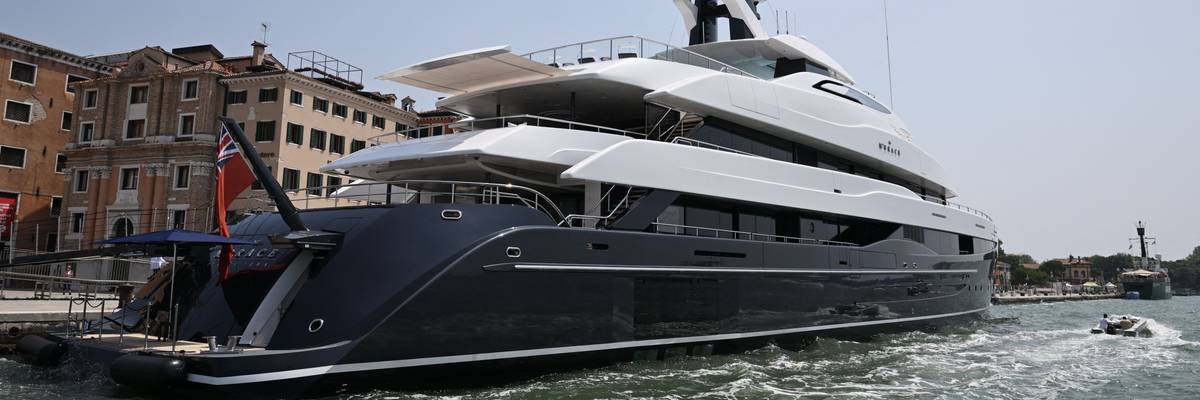
This picture taken on June 22, 2025 shows a 74-metre luxury yacht moored in Venice, Italy.
"Inequality is a crisis in need of concerted action," said Nobel Prize-winning economist Joseph Stiglitz.
A panel of experts convened by South Africa's president warned Tuesday that the world is facing an "inequality emergency" as the richest people on the planet capture a disproportionate share of new wealth and prepare to pass it down to their heirs—perpetuating the chasm between economic elites and everyone else.
The panel, led by Nobel Prize-winning economist Joseph Stiglitz, notes in a new report that over $70 trillion in wealth will be passed down to heirs over the next decade. In the next 30 years, the panel estimates, 1,000 billionaires will transfer more than $5.2 trillion to their heirs mostly untaxed.
"Inequality is one of the most urgent concerns in the world today, generating many other problems in economies, societies, polities and the environment," states the report, published ahead of the G20 meetings in Johannesburg at the end of the month.
Joining Stiglitz on the panel, formally called the Extraordinary Committee of Independent Experts on Global Inequality, were Adriana Abdenur of Brazil, Winnie Byanyima of Uganda, Jayati Ghosh of India, and Imraan Valodia and Wanga Zembe-Mkabile of South Africa.
"Inequality is not a given; combating it is necessary and possible," the experts wrote. "Inequality results from policy choices that reflect ethical attitudes and morals, as well as economic trade-offs. It is not just a matter of concern for individual countries, but a global concern that should be on the international agenda—and therefore the G20's."
Since 2000, the global 1% has captured more than 40% of all new wealth while the bottom half of humanity saw its wealth grow by just 1%, according to the new report. More than 80% of countries—accounting for roughly 90% of the global population—have high levels of income inequality, which undermines social cohesion, economic functioning, and democratic institutions nationally and worldwide.
The panel recommends a broad scope of policy changes to tackle runaway income and wealth inequality, from ensuring the fair taxation of multinational corporations and ultra-rich individuals, to antitrust policies that reduce corporate concentration, to major investments in public services.
The experts also called for the creation of an International Panel on Inequality—inspired by the Intergovernmental Panel on Climate Change (IPCC)—"to support governments and multilateral agencies with authoritative assessments and analyses of inequality" that would "empower policymaking."
"The committee's work showed us that inequality is a crisis in need of concerted action," Stiglitz said Tuesday. "The necessary step to taking this action is for policymakers, political leaders, the private sector, journalists and academia to have accurate and timely information and analysis of the inequality crisis. This is why our recommendation above all is for a new International Panel on Inequality."
"It would learn from the remarkable job the IPCC has done for climate change, bringing together technical expertise worldwide to track inequality and assess what is driving it," he added.
Dear Common Dreams reader, It’s been nearly 30 years since I co-founded Common Dreams with my late wife, Lina Newhouser. We had the radical notion that journalism should serve the public good, not corporate profits. It was clear to us from the outset what it would take to build such a project. No paid advertisements. No corporate sponsors. No millionaire publisher telling us what to think or do. Many people said we wouldn't last a year, but we proved those doubters wrong. Together with a tremendous team of journalists and dedicated staff, we built an independent media outlet free from the constraints of profits and corporate control. Our mission has always been simple: To inform. To inspire. To ignite change for the common good. Building Common Dreams was not easy. Our survival was never guaranteed. When you take on the most powerful forces—Wall Street greed, fossil fuel industry destruction, Big Tech lobbyists, and uber-rich oligarchs who have spent billions upon billions rigging the economy and democracy in their favor—the only bulwark you have is supporters who believe in your work. But here’s the urgent message from me today. It's never been this bad out there. And it's never been this hard to keep us going. At the very moment Common Dreams is most needed, the threats we face are intensifying. We need your support now more than ever. We don't accept corporate advertising and never will. We don't have a paywall because we don't think people should be blocked from critical news based on their ability to pay. Everything we do is funded by the donations of readers like you. When everyone does the little they can afford, we are strong. But if that support retreats or dries up, so do we. Will you donate now to make sure Common Dreams not only survives but thrives? —Craig Brown, Co-founder |
A panel of experts convened by South Africa's president warned Tuesday that the world is facing an "inequality emergency" as the richest people on the planet capture a disproportionate share of new wealth and prepare to pass it down to their heirs—perpetuating the chasm between economic elites and everyone else.
The panel, led by Nobel Prize-winning economist Joseph Stiglitz, notes in a new report that over $70 trillion in wealth will be passed down to heirs over the next decade. In the next 30 years, the panel estimates, 1,000 billionaires will transfer more than $5.2 trillion to their heirs mostly untaxed.
"Inequality is one of the most urgent concerns in the world today, generating many other problems in economies, societies, polities and the environment," states the report, published ahead of the G20 meetings in Johannesburg at the end of the month.
Joining Stiglitz on the panel, formally called the Extraordinary Committee of Independent Experts on Global Inequality, were Adriana Abdenur of Brazil, Winnie Byanyima of Uganda, Jayati Ghosh of India, and Imraan Valodia and Wanga Zembe-Mkabile of South Africa.
"Inequality is not a given; combating it is necessary and possible," the experts wrote. "Inequality results from policy choices that reflect ethical attitudes and morals, as well as economic trade-offs. It is not just a matter of concern for individual countries, but a global concern that should be on the international agenda—and therefore the G20's."
Since 2000, the global 1% has captured more than 40% of all new wealth while the bottom half of humanity saw its wealth grow by just 1%, according to the new report. More than 80% of countries—accounting for roughly 90% of the global population—have high levels of income inequality, which undermines social cohesion, economic functioning, and democratic institutions nationally and worldwide.
The panel recommends a broad scope of policy changes to tackle runaway income and wealth inequality, from ensuring the fair taxation of multinational corporations and ultra-rich individuals, to antitrust policies that reduce corporate concentration, to major investments in public services.
The experts also called for the creation of an International Panel on Inequality—inspired by the Intergovernmental Panel on Climate Change (IPCC)—"to support governments and multilateral agencies with authoritative assessments and analyses of inequality" that would "empower policymaking."
"The committee's work showed us that inequality is a crisis in need of concerted action," Stiglitz said Tuesday. "The necessary step to taking this action is for policymakers, political leaders, the private sector, journalists and academia to have accurate and timely information and analysis of the inequality crisis. This is why our recommendation above all is for a new International Panel on Inequality."
"It would learn from the remarkable job the IPCC has done for climate change, bringing together technical expertise worldwide to track inequality and assess what is driving it," he added.
A panel of experts convened by South Africa's president warned Tuesday that the world is facing an "inequality emergency" as the richest people on the planet capture a disproportionate share of new wealth and prepare to pass it down to their heirs—perpetuating the chasm between economic elites and everyone else.
The panel, led by Nobel Prize-winning economist Joseph Stiglitz, notes in a new report that over $70 trillion in wealth will be passed down to heirs over the next decade. In the next 30 years, the panel estimates, 1,000 billionaires will transfer more than $5.2 trillion to their heirs mostly untaxed.
"Inequality is one of the most urgent concerns in the world today, generating many other problems in economies, societies, polities and the environment," states the report, published ahead of the G20 meetings in Johannesburg at the end of the month.
Joining Stiglitz on the panel, formally called the Extraordinary Committee of Independent Experts on Global Inequality, were Adriana Abdenur of Brazil, Winnie Byanyima of Uganda, Jayati Ghosh of India, and Imraan Valodia and Wanga Zembe-Mkabile of South Africa.
"Inequality is not a given; combating it is necessary and possible," the experts wrote. "Inequality results from policy choices that reflect ethical attitudes and morals, as well as economic trade-offs. It is not just a matter of concern for individual countries, but a global concern that should be on the international agenda—and therefore the G20's."
Since 2000, the global 1% has captured more than 40% of all new wealth while the bottom half of humanity saw its wealth grow by just 1%, according to the new report. More than 80% of countries—accounting for roughly 90% of the global population—have high levels of income inequality, which undermines social cohesion, economic functioning, and democratic institutions nationally and worldwide.
The panel recommends a broad scope of policy changes to tackle runaway income and wealth inequality, from ensuring the fair taxation of multinational corporations and ultra-rich individuals, to antitrust policies that reduce corporate concentration, to major investments in public services.
The experts also called for the creation of an International Panel on Inequality—inspired by the Intergovernmental Panel on Climate Change (IPCC)—"to support governments and multilateral agencies with authoritative assessments and analyses of inequality" that would "empower policymaking."
"The committee's work showed us that inequality is a crisis in need of concerted action," Stiglitz said Tuesday. "The necessary step to taking this action is for policymakers, political leaders, the private sector, journalists and academia to have accurate and timely information and analysis of the inequality crisis. This is why our recommendation above all is for a new International Panel on Inequality."
"It would learn from the remarkable job the IPCC has done for climate change, bringing together technical expertise worldwide to track inequality and assess what is driving it," he added.