SUBSCRIBE TO OUR FREE NEWSLETTER
Daily news & progressive opinion—funded by the people, not the corporations—delivered straight to your inbox.
5
#000000
#FFFFFF
To donate by check, phone, or other method, see our More Ways to Give page.
Daily news & progressive opinion—funded by the people, not the corporations—delivered straight to your inbox.
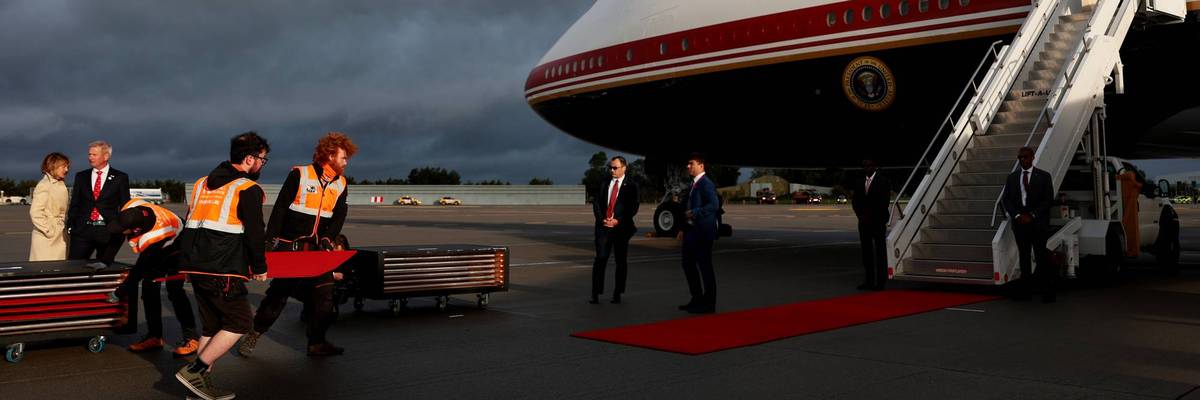
Ground staff lay out a red carpet as Air Force One ferrying U.S. President Donald Trump arrives at Dublin Airport on September 12, 2026 in Dublin, Ireland.
Sadly, it seems that humanity never learns lessons from its dark past.
How do we explain the rise and normalization of fascism in Germany and the United States? How important are the upcoming midterm elections? And what may happen if the Democrats sweep the midterm elections? Can the Democratic Party offer a vision for the future beyond a return to the pre-Trump status quo? Political scientist, political economist, author, and journalist C. J. Polychroniou shares provocative thoughts on these questions in an interview with French-Greek independent journalist and writer Alexandra Boutri.
Alexandra Boutri: In a recent essay on German state elections, you hinted that Germany, once considered the economic engine of Europe, is now in the midst of a systemic crisis. What’s going on there? How did fascism become normalized again in Germany?
C. J. Polychroniou: Let me start by briefly addressing the point you made about Germany’s status as the powerhouse of Europe because economics is a big part of the story behind the meteoric rise of the fascist Alternative for Germany (AfD) party. Germany’s second so-called Wirtschaftswunder (economic miracle), which kicked off in the early years of the new millennium, was aided by the creation of a currency regime that was “made in Germany.” The euro not only created stability for the German economy due to lack of exchange fluctuations but allowed it to gain huge competitiveness against other members of the eurozone. German competitiveness increased overnight by nearly 20 percent, while competitiveness in other European countries declined. Germany’s euro partners absorbed over 40 percent of its exports. In the process, huge imbalances emerged within the eurozone as Germany built an enormous trade surplus while individual countries within the EU, particularly the southern European nations, run huge deficits and saw their debt levels explode.
The situation in the US is even more dramatic because the fascists are already in power...
It’s important to remember that not only was Germany running a budget deficit prior to the implementation of the euro regime but was derided as the sick man of Europe because of its consistently sluggish economy. Nonetheless, it wasn’t just the new currency regime that greatly contributed to Germany’s economic recovery and subsequent emergence as Europe’s powerhouse. The Social Democratic government of Gerhard Schröder (1998-2005) implemented a series of major labor and welfare reforms inspired by the philosophy of austerity and fiscal conservatism in order to intensify Germany’s export-oriented growth model after reunification.
In sum, the so-called German economic miracle depended on the promotion of neoliberal policies (wage suppression and putting an end to the social market economy) and reliance on an export-led growth model. The primary beneficiaries of this “economic miracle” were German industrialists and financiers. Net real wages in Germany remained stagnant, poverty increased, and domestic investment collapsed.
Enter the AfD. It was founded in 2013 by some conservative German academics, journalists, and politicians who were concerned with the direction of their country’s economy. They were against the euro and opposed the bailout of European indebted countries such as Greece. Many years earlier, four renegade professors (Wilhelm Hankel, Karl Albrecht Schachtschneider, Joachim Starbatty, and Wilhelm Nolling) had actually launched a legal challenge in Germany’s Federal Constitutional Court against the adoption of the euro. I spoke to professor Joachim Starbatty at the start of the euro debt crisis. His position was clear and straightforward. Rightly or wrongly, he felt that a monetary union could survive only if economic competitiveness among all member states moved in the same direction and if the different governments implemented sustainable fiscal policies.
The AfD started out as a eurosceptic party but began campaigning on an anti-immigration platform soon after its founding, mainly in reaction to then Chancellor Merkel’s decision to open Germany’s borders and welcome more than 1 million refugees and asylum seekers. Its leaders realized that there were a lot of disgruntled voters out there who felt that the establishment parties are incapable of addressing the country’s many interlocking crises and that scapegoating can be used to bring people together from different socioeconomic groups by creating a common enemy.
The AfD capitalizes on economic and cultural anxieties, just like Hitler did in the 1930s. As a new report by legal experts has found, the AfD is a very extreme political party, “working systematically to undermine Germany’s free democratic order.” And what should be of particular concern is that the success this party is enjoying so far is indeed comparable to the rise of the Nazis. True enough, the AfD is particularly strong in the former east Germany which still lags behind west Germany, but it has already emerged as the most popular party in the country. Hence, to continue speaking of a surge on the part of fascism in Germany is an understatement.
Now, Germany’s export-oriented growth model seems to have run its course. It’s facing mounting pressure from China’s own export power. Growth has been stagnant for the past several years. The slight increase in domestic gross product that the German economy experienced in the second quarter of 2026 cannot conceal the fact that German trade deficit with China continues to grow. To turn things around, shockingly enough, Chancellor Merz, who is the most unpopular chancellor in the country’s postwar history, has called on Germans to work longer hours, citing Greece, a country whose labor market is characterized by low wages while employers can enforce 13-hour work days, a model. As far as the small wage increases that have taken place over the last few years are concerned, they are “simply too low” to keep pace with rising costs.
The question about how fascism became normalized again is not difficult to answer. It became normalized again in Germany and throughout Europe in the same way that Trump normalized racism and fascist tendencies in the United States, namely by integrating extremist rhetoric and policies into mainstream political culture. Harsh, inhumane immigration policies have become laws while the line between security and surveillance is gone in today’s so-called democratic societies. Laws are now used not for the purpose of defending democracy and freedom of speech but in order to suppress dissent. Genocide has unfolded before our eyes, but opposition to it can result in penalties, institutional punishment, and arrests. Even universities, allegedly a bedrock for democracy, are violating “basic free speech, association, and assembly rights.”
Western capitalist polities have rolled out the red carpet for fascism. Indeed, it would seem that humanity never learns lessons from its dark past. The far right has gone from antisemitism (it supports Israel but remains antisemitic) to Islamophobia and there is a significant rise in xenophobia not just throughout Europe but all across the world. Meanwhile, the president of the most powerful nation in history threatens another country (Iran) with total annihilation. The West has entered again the age of monsters.
Alexandra Boutri: With the 2026 midterm elections in the US fast approaching, and which may be the most consequential in the history of the country, isn’t it the case that the United States is also experiencing massive systemic failures?
C. J. Polychroniou: No question about it. While there are striking differences between Germany and the United States on many levels, both countries face enormous economic challenges and real threats from domestic political forces with extreme, anti-democratic beliefs. On that note, I would say that the situation in the US is even more dramatic because the fascists are already in power, you have a mentally militarized society, and the system of checks and balances simply isn’t working. Formally, AfD’s leaders reject political violence to attain the party’s goals, while Trump has repeatedly stoked violence. But here I should add that the MAGA crowd is even more extremist than AfD’s supporters. In the meantime, wealth inequality in the United States has reached an all-time high, and the tech giants are building a dystopia.
Alexandra Boutri: What’s your own sense about the upcoming midterms? How important are they, and what will they mean?
C. J. Polychroniou: As far as midterm elections go, I think you are absolutely right when you stated earlier that they may be the most consequential in the history of the country. The president’s party usually loses House seats in midterm elections, so there is a good chance that the Democrats will control the chamber come November. There are several key races that will determine who controls the Senate, but the Democrats are clear favorites. However, it may all come down to independent voters. Also, I hope that Hispanics will turn their backs on the GOP. One of the things that Democrats and progressives in general in the US have failed to realize is how socially conservative the new immigrants that have come to the United States are. Unlike the huge waves of European immigrants that arrived in the United States between the late 1890s and 1950s and led to support for the Democratic Party because they carried with them progressive and even radical ideas about politics and society, the new immigrants that have been coming to the US since the 1980s (over 80% are from Latin America and Asia) are overwhelmingly conservative and religious.
But there is a deeper concern here about the midterm elections, which is that Trump will interfere by trying to deny people their voting rights, having federal officials seize ballots, and even declaring results void with false allegations of voter fraud. It is also conceivable that he may demand from Republicans that they refuse to swear in newly elected Democrats in the House of Representatives.
Alexandra Boutri: As far as I can see, the problem is that the leadership of the Democratic Party lacks courage and has no vision for the future. For the establishment Democrats, the perfect outcome would be a return to the pre-Trump status quo. Am I wrong in thinking that way?
C. J. Polychroniou: No, you are not wrong. The current leadership of the Democratic Party is simply hopeless. As was the previous one, and the one before that, and so on. And the left-wing of the party can only do so much. The Democrats need bold, courageous, visionary leadership that is willing to embrace a truly progressive socioeconomic agenda and reject militarism. What is quite disconcerting about a party that claims to fight on behalf of American workers is how shallow and inconsistent its policy agenda is when it comes to meaningful change.
The current leadership of the Democratic Party is simply hopeless.
The ruling Labour Party under the leadership of Andy Burnham has promised a “new direction” for Britain by adopting bold reforms on key areas that affect the well-being of its citizens. They range from changes to economic policy, improving public services, transferring power from Westminster to communities, and combating the threats of global warming. I don’t know if Burnham will be able to deliver and restore Labour’s fortunes, but the early signs are quite encouraging. The Democrats should move in a similar direction if Trumpism is to be defeated.
On that note, it is uplifting to see that the Political Economy Research Institute (PERI) at the University of Massachusetts at Amherst has launched Game Changers: Economic Policies for a Working America. The project is initiated and directed by PERI’s co-director Gerald Epstein and represents a bold intellectual undertaking for putting an end to the madness of free market fundamentalism by creating an alternative economic setting with “rules that first and foremost protect the well-being of American workers.”
Alexandra Boutri: You said above that this is the time of monsters. So, what is to be done?
C. J. Polychroniou: I said this is the age of monsters. “Now is the time of monsters” is a quote widely attributed to Italian Marxist intellectual Antonio Gramsci. The problem is that Gramsci never used those words in Prison Notebooks. What he actually wrote was “In this interregnum a great variety of morbid symptoms appear.” Moreover, and this is even less known, the statement had nothing to do with the rise of fascism but, rather, with developments inside the Italian Communist Party!
What is to be done in an age of monsters? I will paraphrase Albert Camus and say that “in a world of conflict, in a world of victims and executioners,” it is the moral duty of thinking and decent people everywhere, irrespective of their political preferences and ideological affiliations, race, ethnicity, and national origin, “not to be on the side of the executioners.”
Dear Common Dreams reader, It’s been nearly 30 years since I co-founded Common Dreams with my late wife, Lina Newhouser. We had the radical notion that journalism should serve the public good, not corporate profits. It was clear to us from the outset what it would take to build such a project. No paid advertisements. No corporate sponsors. No millionaire publisher telling us what to think or do. Many people said we wouldn't last a year, but we proved those doubters wrong. Together with a tremendous team of journalists and dedicated staff, we built an independent media outlet free from the constraints of profits and corporate control. Our mission has always been simple: To inform. To inspire. To ignite change for the common good. Building Common Dreams was not easy. Our survival was never guaranteed. When you take on the most powerful forces—Wall Street greed, fossil fuel industry destruction, Big Tech lobbyists, and uber-rich oligarchs who have spent billions upon billions rigging the economy and democracy in their favor—the only bulwark you have is supporters who believe in your work. But here’s the urgent message from me today. It's never been this bad out there. And it's never been this hard to keep us going. At the very moment Common Dreams is most needed, the threats we face are intensifying. We need your support now more than ever. We don't accept corporate advertising and never will. We don't have a paywall because we don't think people should be blocked from critical news based on their ability to pay. Everything we do is funded by the donations of readers like you. When everyone does the little they can afford, we are strong. But if that support retreats or dries up, so do we. Will you donate now to make sure Common Dreams not only survives but thrives? —Craig Brown, Co-founder |
How do we explain the rise and normalization of fascism in Germany and the United States? How important are the upcoming midterm elections? And what may happen if the Democrats sweep the midterm elections? Can the Democratic Party offer a vision for the future beyond a return to the pre-Trump status quo? Political scientist, political economist, author, and journalist C. J. Polychroniou shares provocative thoughts on these questions in an interview with French-Greek independent journalist and writer Alexandra Boutri.
Alexandra Boutri: In a recent essay on German state elections, you hinted that Germany, once considered the economic engine of Europe, is now in the midst of a systemic crisis. What’s going on there? How did fascism become normalized again in Germany?
C. J. Polychroniou: Let me start by briefly addressing the point you made about Germany’s status as the powerhouse of Europe because economics is a big part of the story behind the meteoric rise of the fascist Alternative for Germany (AfD) party. Germany’s second so-called Wirtschaftswunder (economic miracle), which kicked off in the early years of the new millennium, was aided by the creation of a currency regime that was “made in Germany.” The euro not only created stability for the German economy due to lack of exchange fluctuations but allowed it to gain huge competitiveness against other members of the eurozone. German competitiveness increased overnight by nearly 20 percent, while competitiveness in other European countries declined. Germany’s euro partners absorbed over 40 percent of its exports. In the process, huge imbalances emerged within the eurozone as Germany built an enormous trade surplus while individual countries within the EU, particularly the southern European nations, run huge deficits and saw their debt levels explode.
The situation in the US is even more dramatic because the fascists are already in power...
It’s important to remember that not only was Germany running a budget deficit prior to the implementation of the euro regime but was derided as the sick man of Europe because of its consistently sluggish economy. Nonetheless, it wasn’t just the new currency regime that greatly contributed to Germany’s economic recovery and subsequent emergence as Europe’s powerhouse. The Social Democratic government of Gerhard Schröder (1998-2005) implemented a series of major labor and welfare reforms inspired by the philosophy of austerity and fiscal conservatism in order to intensify Germany’s export-oriented growth model after reunification.
In sum, the so-called German economic miracle depended on the promotion of neoliberal policies (wage suppression and putting an end to the social market economy) and reliance on an export-led growth model. The primary beneficiaries of this “economic miracle” were German industrialists and financiers. Net real wages in Germany remained stagnant, poverty increased, and domestic investment collapsed.
Enter the AfD. It was founded in 2013 by some conservative German academics, journalists, and politicians who were concerned with the direction of their country’s economy. They were against the euro and opposed the bailout of European indebted countries such as Greece. Many years earlier, four renegade professors (Wilhelm Hankel, Karl Albrecht Schachtschneider, Joachim Starbatty, and Wilhelm Nolling) had actually launched a legal challenge in Germany’s Federal Constitutional Court against the adoption of the euro. I spoke to professor Joachim Starbatty at the start of the euro debt crisis. His position was clear and straightforward. Rightly or wrongly, he felt that a monetary union could survive only if economic competitiveness among all member states moved in the same direction and if the different governments implemented sustainable fiscal policies.
The AfD started out as a eurosceptic party but began campaigning on an anti-immigration platform soon after its founding, mainly in reaction to then Chancellor Merkel’s decision to open Germany’s borders and welcome more than 1 million refugees and asylum seekers. Its leaders realized that there were a lot of disgruntled voters out there who felt that the establishment parties are incapable of addressing the country’s many interlocking crises and that scapegoating can be used to bring people together from different socioeconomic groups by creating a common enemy.
The AfD capitalizes on economic and cultural anxieties, just like Hitler did in the 1930s. As a new report by legal experts has found, the AfD is a very extreme political party, “working systematically to undermine Germany’s free democratic order.” And what should be of particular concern is that the success this party is enjoying so far is indeed comparable to the rise of the Nazis. True enough, the AfD is particularly strong in the former east Germany which still lags behind west Germany, but it has already emerged as the most popular party in the country. Hence, to continue speaking of a surge on the part of fascism in Germany is an understatement.
Now, Germany’s export-oriented growth model seems to have run its course. It’s facing mounting pressure from China’s own export power. Growth has been stagnant for the past several years. The slight increase in domestic gross product that the German economy experienced in the second quarter of 2026 cannot conceal the fact that German trade deficit with China continues to grow. To turn things around, shockingly enough, Chancellor Merz, who is the most unpopular chancellor in the country’s postwar history, has called on Germans to work longer hours, citing Greece, a country whose labor market is characterized by low wages while employers can enforce 13-hour work days, a model. As far as the small wage increases that have taken place over the last few years are concerned, they are “simply too low” to keep pace with rising costs.
The question about how fascism became normalized again is not difficult to answer. It became normalized again in Germany and throughout Europe in the same way that Trump normalized racism and fascist tendencies in the United States, namely by integrating extremist rhetoric and policies into mainstream political culture. Harsh, inhumane immigration policies have become laws while the line between security and surveillance is gone in today’s so-called democratic societies. Laws are now used not for the purpose of defending democracy and freedom of speech but in order to suppress dissent. Genocide has unfolded before our eyes, but opposition to it can result in penalties, institutional punishment, and arrests. Even universities, allegedly a bedrock for democracy, are violating “basic free speech, association, and assembly rights.”
Western capitalist polities have rolled out the red carpet for fascism. Indeed, it would seem that humanity never learns lessons from its dark past. The far right has gone from antisemitism (it supports Israel but remains antisemitic) to Islamophobia and there is a significant rise in xenophobia not just throughout Europe but all across the world. Meanwhile, the president of the most powerful nation in history threatens another country (Iran) with total annihilation. The West has entered again the age of monsters.
Alexandra Boutri: With the 2026 midterm elections in the US fast approaching, and which may be the most consequential in the history of the country, isn’t it the case that the United States is also experiencing massive systemic failures?
C. J. Polychroniou: No question about it. While there are striking differences between Germany and the United States on many levels, both countries face enormous economic challenges and real threats from domestic political forces with extreme, anti-democratic beliefs. On that note, I would say that the situation in the US is even more dramatic because the fascists are already in power, you have a mentally militarized society, and the system of checks and balances simply isn’t working. Formally, AfD’s leaders reject political violence to attain the party’s goals, while Trump has repeatedly stoked violence. But here I should add that the MAGA crowd is even more extremist than AfD’s supporters. In the meantime, wealth inequality in the United States has reached an all-time high, and the tech giants are building a dystopia.
Alexandra Boutri: What’s your own sense about the upcoming midterms? How important are they, and what will they mean?
C. J. Polychroniou: As far as midterm elections go, I think you are absolutely right when you stated earlier that they may be the most consequential in the history of the country. The president’s party usually loses House seats in midterm elections, so there is a good chance that the Democrats will control the chamber come November. There are several key races that will determine who controls the Senate, but the Democrats are clear favorites. However, it may all come down to independent voters. Also, I hope that Hispanics will turn their backs on the GOP. One of the things that Democrats and progressives in general in the US have failed to realize is how socially conservative the new immigrants that have come to the United States are. Unlike the huge waves of European immigrants that arrived in the United States between the late 1890s and 1950s and led to support for the Democratic Party because they carried with them progressive and even radical ideas about politics and society, the new immigrants that have been coming to the US since the 1980s (over 80% are from Latin America and Asia) are overwhelmingly conservative and religious.
But there is a deeper concern here about the midterm elections, which is that Trump will interfere by trying to deny people their voting rights, having federal officials seize ballots, and even declaring results void with false allegations of voter fraud. It is also conceivable that he may demand from Republicans that they refuse to swear in newly elected Democrats in the House of Representatives.
Alexandra Boutri: As far as I can see, the problem is that the leadership of the Democratic Party lacks courage and has no vision for the future. For the establishment Democrats, the perfect outcome would be a return to the pre-Trump status quo. Am I wrong in thinking that way?
C. J. Polychroniou: No, you are not wrong. The current leadership of the Democratic Party is simply hopeless. As was the previous one, and the one before that, and so on. And the left-wing of the party can only do so much. The Democrats need bold, courageous, visionary leadership that is willing to embrace a truly progressive socioeconomic agenda and reject militarism. What is quite disconcerting about a party that claims to fight on behalf of American workers is how shallow and inconsistent its policy agenda is when it comes to meaningful change.
The current leadership of the Democratic Party is simply hopeless.
The ruling Labour Party under the leadership of Andy Burnham has promised a “new direction” for Britain by adopting bold reforms on key areas that affect the well-being of its citizens. They range from changes to economic policy, improving public services, transferring power from Westminster to communities, and combating the threats of global warming. I don’t know if Burnham will be able to deliver and restore Labour’s fortunes, but the early signs are quite encouraging. The Democrats should move in a similar direction if Trumpism is to be defeated.
On that note, it is uplifting to see that the Political Economy Research Institute (PERI) at the University of Massachusetts at Amherst has launched Game Changers: Economic Policies for a Working America. The project is initiated and directed by PERI’s co-director Gerald Epstein and represents a bold intellectual undertaking for putting an end to the madness of free market fundamentalism by creating an alternative economic setting with “rules that first and foremost protect the well-being of American workers.”
Alexandra Boutri: You said above that this is the time of monsters. So, what is to be done?
C. J. Polychroniou: I said this is the age of monsters. “Now is the time of monsters” is a quote widely attributed to Italian Marxist intellectual Antonio Gramsci. The problem is that Gramsci never used those words in Prison Notebooks. What he actually wrote was “In this interregnum a great variety of morbid symptoms appear.” Moreover, and this is even less known, the statement had nothing to do with the rise of fascism but, rather, with developments inside the Italian Communist Party!
What is to be done in an age of monsters? I will paraphrase Albert Camus and say that “in a world of conflict, in a world of victims and executioners,” it is the moral duty of thinking and decent people everywhere, irrespective of their political preferences and ideological affiliations, race, ethnicity, and national origin, “not to be on the side of the executioners.”
How do we explain the rise and normalization of fascism in Germany and the United States? How important are the upcoming midterm elections? And what may happen if the Democrats sweep the midterm elections? Can the Democratic Party offer a vision for the future beyond a return to the pre-Trump status quo? Political scientist, political economist, author, and journalist C. J. Polychroniou shares provocative thoughts on these questions in an interview with French-Greek independent journalist and writer Alexandra Boutri.
Alexandra Boutri: In a recent essay on German state elections, you hinted that Germany, once considered the economic engine of Europe, is now in the midst of a systemic crisis. What’s going on there? How did fascism become normalized again in Germany?
C. J. Polychroniou: Let me start by briefly addressing the point you made about Germany’s status as the powerhouse of Europe because economics is a big part of the story behind the meteoric rise of the fascist Alternative for Germany (AfD) party. Germany’s second so-called Wirtschaftswunder (economic miracle), which kicked off in the early years of the new millennium, was aided by the creation of a currency regime that was “made in Germany.” The euro not only created stability for the German economy due to lack of exchange fluctuations but allowed it to gain huge competitiveness against other members of the eurozone. German competitiveness increased overnight by nearly 20 percent, while competitiveness in other European countries declined. Germany’s euro partners absorbed over 40 percent of its exports. In the process, huge imbalances emerged within the eurozone as Germany built an enormous trade surplus while individual countries within the EU, particularly the southern European nations, run huge deficits and saw their debt levels explode.
The situation in the US is even more dramatic because the fascists are already in power...
It’s important to remember that not only was Germany running a budget deficit prior to the implementation of the euro regime but was derided as the sick man of Europe because of its consistently sluggish economy. Nonetheless, it wasn’t just the new currency regime that greatly contributed to Germany’s economic recovery and subsequent emergence as Europe’s powerhouse. The Social Democratic government of Gerhard Schröder (1998-2005) implemented a series of major labor and welfare reforms inspired by the philosophy of austerity and fiscal conservatism in order to intensify Germany’s export-oriented growth model after reunification.
In sum, the so-called German economic miracle depended on the promotion of neoliberal policies (wage suppression and putting an end to the social market economy) and reliance on an export-led growth model. The primary beneficiaries of this “economic miracle” were German industrialists and financiers. Net real wages in Germany remained stagnant, poverty increased, and domestic investment collapsed.
Enter the AfD. It was founded in 2013 by some conservative German academics, journalists, and politicians who were concerned with the direction of their country’s economy. They were against the euro and opposed the bailout of European indebted countries such as Greece. Many years earlier, four renegade professors (Wilhelm Hankel, Karl Albrecht Schachtschneider, Joachim Starbatty, and Wilhelm Nolling) had actually launched a legal challenge in Germany’s Federal Constitutional Court against the adoption of the euro. I spoke to professor Joachim Starbatty at the start of the euro debt crisis. His position was clear and straightforward. Rightly or wrongly, he felt that a monetary union could survive only if economic competitiveness among all member states moved in the same direction and if the different governments implemented sustainable fiscal policies.
The AfD started out as a eurosceptic party but began campaigning on an anti-immigration platform soon after its founding, mainly in reaction to then Chancellor Merkel’s decision to open Germany’s borders and welcome more than 1 million refugees and asylum seekers. Its leaders realized that there were a lot of disgruntled voters out there who felt that the establishment parties are incapable of addressing the country’s many interlocking crises and that scapegoating can be used to bring people together from different socioeconomic groups by creating a common enemy.
The AfD capitalizes on economic and cultural anxieties, just like Hitler did in the 1930s. As a new report by legal experts has found, the AfD is a very extreme political party, “working systematically to undermine Germany’s free democratic order.” And what should be of particular concern is that the success this party is enjoying so far is indeed comparable to the rise of the Nazis. True enough, the AfD is particularly strong in the former east Germany which still lags behind west Germany, but it has already emerged as the most popular party in the country. Hence, to continue speaking of a surge on the part of fascism in Germany is an understatement.
Now, Germany’s export-oriented growth model seems to have run its course. It’s facing mounting pressure from China’s own export power. Growth has been stagnant for the past several years. The slight increase in domestic gross product that the German economy experienced in the second quarter of 2026 cannot conceal the fact that German trade deficit with China continues to grow. To turn things around, shockingly enough, Chancellor Merz, who is the most unpopular chancellor in the country’s postwar history, has called on Germans to work longer hours, citing Greece, a country whose labor market is characterized by low wages while employers can enforce 13-hour work days, a model. As far as the small wage increases that have taken place over the last few years are concerned, they are “simply too low” to keep pace with rising costs.
The question about how fascism became normalized again is not difficult to answer. It became normalized again in Germany and throughout Europe in the same way that Trump normalized racism and fascist tendencies in the United States, namely by integrating extremist rhetoric and policies into mainstream political culture. Harsh, inhumane immigration policies have become laws while the line between security and surveillance is gone in today’s so-called democratic societies. Laws are now used not for the purpose of defending democracy and freedom of speech but in order to suppress dissent. Genocide has unfolded before our eyes, but opposition to it can result in penalties, institutional punishment, and arrests. Even universities, allegedly a bedrock for democracy, are violating “basic free speech, association, and assembly rights.”
Western capitalist polities have rolled out the red carpet for fascism. Indeed, it would seem that humanity never learns lessons from its dark past. The far right has gone from antisemitism (it supports Israel but remains antisemitic) to Islamophobia and there is a significant rise in xenophobia not just throughout Europe but all across the world. Meanwhile, the president of the most powerful nation in history threatens another country (Iran) with total annihilation. The West has entered again the age of monsters.
Alexandra Boutri: With the 2026 midterm elections in the US fast approaching, and which may be the most consequential in the history of the country, isn’t it the case that the United States is also experiencing massive systemic failures?
C. J. Polychroniou: No question about it. While there are striking differences between Germany and the United States on many levels, both countries face enormous economic challenges and real threats from domestic political forces with extreme, anti-democratic beliefs. On that note, I would say that the situation in the US is even more dramatic because the fascists are already in power, you have a mentally militarized society, and the system of checks and balances simply isn’t working. Formally, AfD’s leaders reject political violence to attain the party’s goals, while Trump has repeatedly stoked violence. But here I should add that the MAGA crowd is even more extremist than AfD’s supporters. In the meantime, wealth inequality in the United States has reached an all-time high, and the tech giants are building a dystopia.
Alexandra Boutri: What’s your own sense about the upcoming midterms? How important are they, and what will they mean?
C. J. Polychroniou: As far as midterm elections go, I think you are absolutely right when you stated earlier that they may be the most consequential in the history of the country. The president’s party usually loses House seats in midterm elections, so there is a good chance that the Democrats will control the chamber come November. There are several key races that will determine who controls the Senate, but the Democrats are clear favorites. However, it may all come down to independent voters. Also, I hope that Hispanics will turn their backs on the GOP. One of the things that Democrats and progressives in general in the US have failed to realize is how socially conservative the new immigrants that have come to the United States are. Unlike the huge waves of European immigrants that arrived in the United States between the late 1890s and 1950s and led to support for the Democratic Party because they carried with them progressive and even radical ideas about politics and society, the new immigrants that have been coming to the US since the 1980s (over 80% are from Latin America and Asia) are overwhelmingly conservative and religious.
But there is a deeper concern here about the midterm elections, which is that Trump will interfere by trying to deny people their voting rights, having federal officials seize ballots, and even declaring results void with false allegations of voter fraud. It is also conceivable that he may demand from Republicans that they refuse to swear in newly elected Democrats in the House of Representatives.
Alexandra Boutri: As far as I can see, the problem is that the leadership of the Democratic Party lacks courage and has no vision for the future. For the establishment Democrats, the perfect outcome would be a return to the pre-Trump status quo. Am I wrong in thinking that way?
C. J. Polychroniou: No, you are not wrong. The current leadership of the Democratic Party is simply hopeless. As was the previous one, and the one before that, and so on. And the left-wing of the party can only do so much. The Democrats need bold, courageous, visionary leadership that is willing to embrace a truly progressive socioeconomic agenda and reject militarism. What is quite disconcerting about a party that claims to fight on behalf of American workers is how shallow and inconsistent its policy agenda is when it comes to meaningful change.
The current leadership of the Democratic Party is simply hopeless.
The ruling Labour Party under the leadership of Andy Burnham has promised a “new direction” for Britain by adopting bold reforms on key areas that affect the well-being of its citizens. They range from changes to economic policy, improving public services, transferring power from Westminster to communities, and combating the threats of global warming. I don’t know if Burnham will be able to deliver and restore Labour’s fortunes, but the early signs are quite encouraging. The Democrats should move in a similar direction if Trumpism is to be defeated.
On that note, it is uplifting to see that the Political Economy Research Institute (PERI) at the University of Massachusetts at Amherst has launched Game Changers: Economic Policies for a Working America. The project is initiated and directed by PERI’s co-director Gerald Epstein and represents a bold intellectual undertaking for putting an end to the madness of free market fundamentalism by creating an alternative economic setting with “rules that first and foremost protect the well-being of American workers.”
Alexandra Boutri: You said above that this is the time of monsters. So, what is to be done?
C. J. Polychroniou: I said this is the age of monsters. “Now is the time of monsters” is a quote widely attributed to Italian Marxist intellectual Antonio Gramsci. The problem is that Gramsci never used those words in Prison Notebooks. What he actually wrote was “In this interregnum a great variety of morbid symptoms appear.” Moreover, and this is even less known, the statement had nothing to do with the rise of fascism but, rather, with developments inside the Italian Communist Party!
What is to be done in an age of monsters? I will paraphrase Albert Camus and say that “in a world of conflict, in a world of victims and executioners,” it is the moral duty of thinking and decent people everywhere, irrespective of their political preferences and ideological affiliations, race, ethnicity, and national origin, “not to be on the side of the executioners.”