SUBSCRIBE TO OUR FREE NEWSLETTER
Daily news & progressive opinion—funded by the people, not the corporations—delivered straight to your inbox.
5
#000000
#FFFFFF
To donate by check, phone, or other method, see our More Ways to Give page.
Daily news & progressive opinion—funded by the people, not the corporations—delivered straight to your inbox.
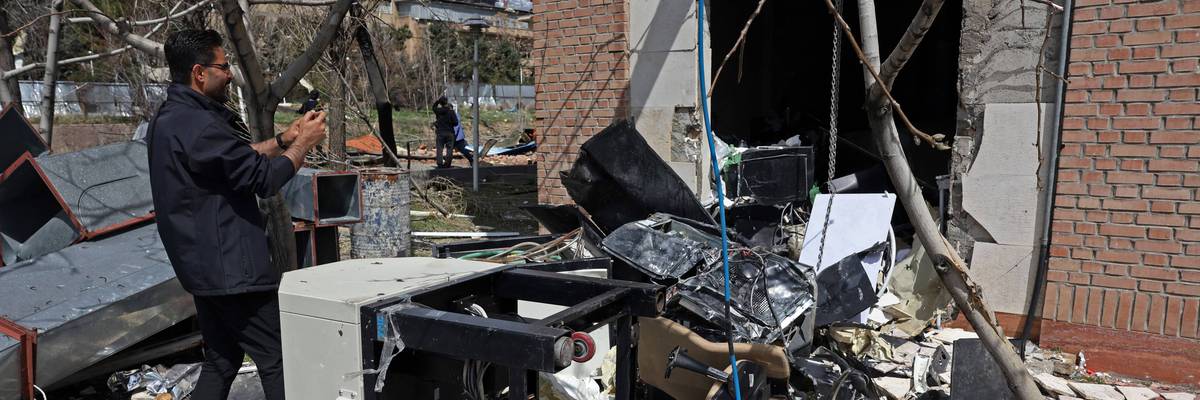
A man takes pictures of the destroyed study equipments lying amid the debris of a damaged building of the Shahid Beheshti University following a strike in Tehran on April 4, 2026.
As Trump's approval ratings crater due to his war on Iran, there may never have been a time in US history so ripe for an attack on military spending and militarism.
Forget about Ancient Sparta, Attila the Hun, Hernán Cortés, Julius Ceasar, Alexander the Great, Adolf Hitler, and all of the conquerors that terrified the world with colonial aspirations and a psychopathic lust for blood. None of these ever imagined a $1.5 trillion military budget. President Donald Trump requested that grotesque figure, but don’t give him the kudos—our “fois gras” military machine is a US tradition that predates us all.
The US war machine has scaled Orwellian heights to achieve a virtual blank check to spend on death. For we, stateside, have built a culture entirely at the service of warfare, with myths, stories, and platitudes hardwired into the brains of 349 million people extolling war, not as a necessity, but as ritual, as cleansing, as meditation, and as redemption. We are bombing schools and hospitals to secure the rapture, for the war industry in the apocalyptic end times has been tasked with the creation of biblical events. A recent Huffpost piece by Brandi Buchman quotes US soldiers’ allegations of lunatic fringe Evangelical propaganda from haranguing superiors:
They (US soldiers) are promised a 200-mile-long river that is four-and-a-half feet deep filled with nothing but the blood that their weaponized version of Jesus will spill at the Battle of Armageddon.
Thus, war in the Middle East has morphed from the sterile narrative of fighting for freedom and democracy, to the more spectacular notion that US military force has been mobilized to serve Christian prophecy. A military budget cannot achieve the pinnacle of a trillion dollars without a highly evolved story telling industry to prime the population to either enthusiastically back each aggressive nationalistic paroxysm of violence, or to (at the very least) passively capitulate. Think of the advent of apocalyptic biblical warfare as a means of addictive escalation—the nation has gone from coffee and cigarettes to cocaine and crystal meth.
No other era has been forced to see war with the unflinching clarity that this moment demands.
The war propaganda machine in the US is a ceaseless, multifaceted contraption that includes legacy media, the educational system, and the entertainment industry. A nation does not eviscerate tens of millions of “enemy” civilians without first laying a meticulous foundation of brainwashing. I can run the tapes backward to a moment in my own childhood, riveted to the black and white TV absorbing the 1955 Disneyfied tale of Davey Crockett at “The Alamo.” There is Davey outsmarting a gambler, beating up an “Indian,” and bringing both along as conscripts to fight for an Independent Texas. Crockett met his end at the Alamo, but the manner of his death will never be resolved. Did he surrender to Mexican forces (and face execution) or did he die fighting to the death, wielding his exhausted rifle like a club, and falling from a bullet while standing on a hill comprised of Mexican corpses? Of course, the Disney version has Davey Crockett swinging his rifle madly against a vast onslaught of faceless Mexican soldiers as the background song plays out:
The story books say they were all cut low.
But the truth of it is that this just ain’t so,
The spirits will live and their legends grow,
so long as we remember the Alamo.
The film ends with the inscription: “March, 6, 1836, Liberty and Independence Forever.”
Regarding the Alamo, Raul Ramos wrote (in the context of the 2019 effort to remove confederate monuments):
It’s not that the Spanish-built presidio should be demolished or stashed away in some remote museum. The story of the Alamo should be widely studied—but it should be the real history, the one that intersects with and embodies the nation’s history of enforcing a racial order through violence, and the campaigns of white supremacy and slavery that accompanied America’s expansion. The Alamo’s history and myth belong to a war that was inspired, in part, by the drive for slavery, and by a belief in the superiority of whites and their divine right to conquer lands. The Alamo is where the campaign of southern slavery and Native American genocide migrated west and expressed itself in the demonization of Mexicans. It came to symbolize belonging, or, more accurately, defining who belongs and who doesn’t. Rather than being remembered for its historical context, the Alamo represents a litmus test for entry into participation and membership in civic society: Accept the dominant myth, or be marginalized.
The Alamo became a rallying cry, a foundational component of the emerging concept of “manifest destiny”—the ideological core of the most expansive colonial settler state in all of history. But for me it is personal—Davey Crocket at The Alamo inducted me into US war culture at the age of 7. I had my faux coon skin cap, my “smoke gun” that emitted a loud crack and a puff of smoke. The cocking mechanism on this “toy” sometimes snapped shut violently, and many children endured a trip to the ER to have a few stitches to repair a bloody thumb. I remember that well 71 years later.
Every child in the US has a story of this sort, a rendezvous with military propaganda (disguised as amusement) at a defenseless early age. War is implanted into our fragile subconscious at the very dawn of our awareness. But we are not largely destined to embrace warrior culture in the sense of the mythical Davey Crockett, but, rather, we have been trained to get out of the way. American warfare since Vietnam has aspired to be fought by gadgets that attack civilians from the sky. For most of us military patriotism means politely deferring to veterans with a muttered, “Thank you for your service.” We who do not enlist balance personal fear with the idea that war participation manifests the purest virtue.
Vietnam exposed a quiet ambivalence in public opinion—the American people have no stomach for massive body counts of US soldiers, and yet poll after poll reveals an atavistic longing for military strength. A Gallup poll taken last February showed that 64% of respondents felt that it was important for the US to have the most powerful military on Earth. While the US military budget is larger than the combined military budgets of the next nine highest spending nations, Gallup polling seldom shows more than a third of people complaining that spending is too high.
The public is little more than a shadow of the media culture. In 2014 William A. Galston lamented about President Barack Obama’s minor military funding cuts in a piece posted on The Brookings Institute (a centrist, Democratic Party-adjacent think tank) website. Sen. Bernie Sanders’ (I-Vt.) recent proposal to cut military spending by a token 10% fell 88-11 in a Senate vote in which both parties reflexively succumbed to orthodox US jingoism. War is not a partisan issue. We all come together to praise and feed the military. US political performance art might be seen as a slavish competition to grovel before the war industry.
There is, however, a new and sudden trickle of hope—Trump’s ham-fisted version of imperialism allows for the public to witness the unflattering inner machinery, the leaking guts of the wounded military organism. The ongoing war in Iran offers something brand new—a nation with a $9 billion military budget has just thrashed a country with a trillion dollar war budget. The US defeat at the hands of Iran is unprecedented—while the US hasn’t won a significant war in 80 years, we have never suffered a defeat with comparable financial consequences. The Iran war, according to Reuters, has a disapproval rating of a staggering 63% of the electorate. The economic fallout from the bungled attack on Iran threatens to escalate to the point of financial collapse in future months. We all live within walking distance of a filling station offering $6 diesel—and that runaway price will almost certainly expand and double, threatening to strangle the US commercial transport system. Mass hunger looms.
We also have American Israel Public Affairs Committee approval ratings at an all-time low and Trump’s approval ratings at catastrophic and utter decline—ostensibly due to his war in Iran. There may never have been a time in US history so ripe for an attack on military spending and militarism.
War once had such an esteemed role in human progress that even the peaceful transcendentalist, Ralph Waldo Emerson, could not wholly dismiss its virtues:
The student of history acquiesces the more readily in this copious bloodshed of the early annals, bloodshed in God’s name too, when be learns that it is a temporary and preparatory state, and does actively forward the culture of man. War educates the senses, calls into action the will, perfects the physical constitution, brings men into such swift and close collision in critical moments that man measures man. On its own scale, on the virtues it loves, it endures no counterfeit, but shakes the whole society, until every atom falls into the place its specific gravity assigns it.
Emerson believed that war would become obsolete, but I doubt that anyone from the mid 19th century could have imagined that war would one day be the cornerstone of societal and biological collapse. No other era has been forced to see war with the unflinching clarity that this moment demands.
War elevates the need for oil and oil demands war. The oil industry, the military-industrial complex, Big Tech, and mass media have all been structurally conjoined at the intersection of war. War is where capitalist profits interface with mass psychology.
But the gig is up. Public opinion has shifted as Trump and his goons have driven the war machine off of a cliff.
Climate sustainability abides no compromise with war. We are on the cusp of extinction, and war is the primary driver. The US, under Trump, has taken war out of the closet and decoupled it from its patriotic slogans and jingoistic habits. It’s all about the oil, stupid. War has followed the magnet of fossil fuels unerringly to the Middle East. And to compound the predicament, war is environmentally filthy, annually burning more fossil fuels in aggregate than most nations. The US military coughs as much CO2 into the atmosphere yearly as the nation of Portugal. War is also the gauge of our fossil fuel addiction, for US leaders have spent decades murdering millions to procure it.
We all have our psychological histories, our childhood encounters with Disney’s Alamo, with the domino theory, with Saddam Hussein’s invisible weapons of mass destruction. We have reverentially gawked at our father’s and grandfather’s WWII uniforms hanging in the attic, but we all need to thank Trump for creating history’s most transparent war machine. The US military needs to be gutted, cut out like a metastasizing lesion. The patient heaves at death’s door. Do we merely watch?
Dear Common Dreams reader, It’s been nearly 30 years since I co-founded Common Dreams with my late wife, Lina Newhouser. We had the radical notion that journalism should serve the public good, not corporate profits. It was clear to us from the outset what it would take to build such a project. No paid advertisements. No corporate sponsors. No millionaire publisher telling us what to think or do. Many people said we wouldn't last a year, but we proved those doubters wrong. Together with a tremendous team of journalists and dedicated staff, we built an independent media outlet free from the constraints of profits and corporate control. Our mission has always been simple: To inform. To inspire. To ignite change for the common good. Building Common Dreams was not easy. Our survival was never guaranteed. When you take on the most powerful forces—Wall Street greed, fossil fuel industry destruction, Big Tech lobbyists, and uber-rich oligarchs who have spent billions upon billions rigging the economy and democracy in their favor—the only bulwark you have is supporters who believe in your work. But here’s the urgent message from me today. It's never been this bad out there. And it's never been this hard to keep us going. At the very moment Common Dreams is most needed, the threats we face are intensifying. We need your support now more than ever. We don't accept corporate advertising and never will. We don't have a paywall because we don't think people should be blocked from critical news based on their ability to pay. Everything we do is funded by the donations of readers like you. When everyone does the little they can afford, we are strong. But if that support retreats or dries up, so do we. Will you donate now to make sure Common Dreams not only survives but thrives? —Craig Brown, Co-founder |
Forget about Ancient Sparta, Attila the Hun, Hernán Cortés, Julius Ceasar, Alexander the Great, Adolf Hitler, and all of the conquerors that terrified the world with colonial aspirations and a psychopathic lust for blood. None of these ever imagined a $1.5 trillion military budget. President Donald Trump requested that grotesque figure, but don’t give him the kudos—our “fois gras” military machine is a US tradition that predates us all.
The US war machine has scaled Orwellian heights to achieve a virtual blank check to spend on death. For we, stateside, have built a culture entirely at the service of warfare, with myths, stories, and platitudes hardwired into the brains of 349 million people extolling war, not as a necessity, but as ritual, as cleansing, as meditation, and as redemption. We are bombing schools and hospitals to secure the rapture, for the war industry in the apocalyptic end times has been tasked with the creation of biblical events. A recent Huffpost piece by Brandi Buchman quotes US soldiers’ allegations of lunatic fringe Evangelical propaganda from haranguing superiors:
They (US soldiers) are promised a 200-mile-long river that is four-and-a-half feet deep filled with nothing but the blood that their weaponized version of Jesus will spill at the Battle of Armageddon.
Thus, war in the Middle East has morphed from the sterile narrative of fighting for freedom and democracy, to the more spectacular notion that US military force has been mobilized to serve Christian prophecy. A military budget cannot achieve the pinnacle of a trillion dollars without a highly evolved story telling industry to prime the population to either enthusiastically back each aggressive nationalistic paroxysm of violence, or to (at the very least) passively capitulate. Think of the advent of apocalyptic biblical warfare as a means of addictive escalation—the nation has gone from coffee and cigarettes to cocaine and crystal meth.
No other era has been forced to see war with the unflinching clarity that this moment demands.
The war propaganda machine in the US is a ceaseless, multifaceted contraption that includes legacy media, the educational system, and the entertainment industry. A nation does not eviscerate tens of millions of “enemy” civilians without first laying a meticulous foundation of brainwashing. I can run the tapes backward to a moment in my own childhood, riveted to the black and white TV absorbing the 1955 Disneyfied tale of Davey Crockett at “The Alamo.” There is Davey outsmarting a gambler, beating up an “Indian,” and bringing both along as conscripts to fight for an Independent Texas. Crockett met his end at the Alamo, but the manner of his death will never be resolved. Did he surrender to Mexican forces (and face execution) or did he die fighting to the death, wielding his exhausted rifle like a club, and falling from a bullet while standing on a hill comprised of Mexican corpses? Of course, the Disney version has Davey Crockett swinging his rifle madly against a vast onslaught of faceless Mexican soldiers as the background song plays out:
The story books say they were all cut low.
But the truth of it is that this just ain’t so,
The spirits will live and their legends grow,
so long as we remember the Alamo.
The film ends with the inscription: “March, 6, 1836, Liberty and Independence Forever.”
Regarding the Alamo, Raul Ramos wrote (in the context of the 2019 effort to remove confederate monuments):
It’s not that the Spanish-built presidio should be demolished or stashed away in some remote museum. The story of the Alamo should be widely studied—but it should be the real history, the one that intersects with and embodies the nation’s history of enforcing a racial order through violence, and the campaigns of white supremacy and slavery that accompanied America’s expansion. The Alamo’s history and myth belong to a war that was inspired, in part, by the drive for slavery, and by a belief in the superiority of whites and their divine right to conquer lands. The Alamo is where the campaign of southern slavery and Native American genocide migrated west and expressed itself in the demonization of Mexicans. It came to symbolize belonging, or, more accurately, defining who belongs and who doesn’t. Rather than being remembered for its historical context, the Alamo represents a litmus test for entry into participation and membership in civic society: Accept the dominant myth, or be marginalized.
The Alamo became a rallying cry, a foundational component of the emerging concept of “manifest destiny”—the ideological core of the most expansive colonial settler state in all of history. But for me it is personal—Davey Crocket at The Alamo inducted me into US war culture at the age of 7. I had my faux coon skin cap, my “smoke gun” that emitted a loud crack and a puff of smoke. The cocking mechanism on this “toy” sometimes snapped shut violently, and many children endured a trip to the ER to have a few stitches to repair a bloody thumb. I remember that well 71 years later.
Every child in the US has a story of this sort, a rendezvous with military propaganda (disguised as amusement) at a defenseless early age. War is implanted into our fragile subconscious at the very dawn of our awareness. But we are not largely destined to embrace warrior culture in the sense of the mythical Davey Crockett, but, rather, we have been trained to get out of the way. American warfare since Vietnam has aspired to be fought by gadgets that attack civilians from the sky. For most of us military patriotism means politely deferring to veterans with a muttered, “Thank you for your service.” We who do not enlist balance personal fear with the idea that war participation manifests the purest virtue.
Vietnam exposed a quiet ambivalence in public opinion—the American people have no stomach for massive body counts of US soldiers, and yet poll after poll reveals an atavistic longing for military strength. A Gallup poll taken last February showed that 64% of respondents felt that it was important for the US to have the most powerful military on Earth. While the US military budget is larger than the combined military budgets of the next nine highest spending nations, Gallup polling seldom shows more than a third of people complaining that spending is too high.
The public is little more than a shadow of the media culture. In 2014 William A. Galston lamented about President Barack Obama’s minor military funding cuts in a piece posted on The Brookings Institute (a centrist, Democratic Party-adjacent think tank) website. Sen. Bernie Sanders’ (I-Vt.) recent proposal to cut military spending by a token 10% fell 88-11 in a Senate vote in which both parties reflexively succumbed to orthodox US jingoism. War is not a partisan issue. We all come together to praise and feed the military. US political performance art might be seen as a slavish competition to grovel before the war industry.
There is, however, a new and sudden trickle of hope—Trump’s ham-fisted version of imperialism allows for the public to witness the unflattering inner machinery, the leaking guts of the wounded military organism. The ongoing war in Iran offers something brand new—a nation with a $9 billion military budget has just thrashed a country with a trillion dollar war budget. The US defeat at the hands of Iran is unprecedented—while the US hasn’t won a significant war in 80 years, we have never suffered a defeat with comparable financial consequences. The Iran war, according to Reuters, has a disapproval rating of a staggering 63% of the electorate. The economic fallout from the bungled attack on Iran threatens to escalate to the point of financial collapse in future months. We all live within walking distance of a filling station offering $6 diesel—and that runaway price will almost certainly expand and double, threatening to strangle the US commercial transport system. Mass hunger looms.
We also have American Israel Public Affairs Committee approval ratings at an all-time low and Trump’s approval ratings at catastrophic and utter decline—ostensibly due to his war in Iran. There may never have been a time in US history so ripe for an attack on military spending and militarism.
War once had such an esteemed role in human progress that even the peaceful transcendentalist, Ralph Waldo Emerson, could not wholly dismiss its virtues:
The student of history acquiesces the more readily in this copious bloodshed of the early annals, bloodshed in God’s name too, when be learns that it is a temporary and preparatory state, and does actively forward the culture of man. War educates the senses, calls into action the will, perfects the physical constitution, brings men into such swift and close collision in critical moments that man measures man. On its own scale, on the virtues it loves, it endures no counterfeit, but shakes the whole society, until every atom falls into the place its specific gravity assigns it.
Emerson believed that war would become obsolete, but I doubt that anyone from the mid 19th century could have imagined that war would one day be the cornerstone of societal and biological collapse. No other era has been forced to see war with the unflinching clarity that this moment demands.
War elevates the need for oil and oil demands war. The oil industry, the military-industrial complex, Big Tech, and mass media have all been structurally conjoined at the intersection of war. War is where capitalist profits interface with mass psychology.
But the gig is up. Public opinion has shifted as Trump and his goons have driven the war machine off of a cliff.
Climate sustainability abides no compromise with war. We are on the cusp of extinction, and war is the primary driver. The US, under Trump, has taken war out of the closet and decoupled it from its patriotic slogans and jingoistic habits. It’s all about the oil, stupid. War has followed the magnet of fossil fuels unerringly to the Middle East. And to compound the predicament, war is environmentally filthy, annually burning more fossil fuels in aggregate than most nations. The US military coughs as much CO2 into the atmosphere yearly as the nation of Portugal. War is also the gauge of our fossil fuel addiction, for US leaders have spent decades murdering millions to procure it.
We all have our psychological histories, our childhood encounters with Disney’s Alamo, with the domino theory, with Saddam Hussein’s invisible weapons of mass destruction. We have reverentially gawked at our father’s and grandfather’s WWII uniforms hanging in the attic, but we all need to thank Trump for creating history’s most transparent war machine. The US military needs to be gutted, cut out like a metastasizing lesion. The patient heaves at death’s door. Do we merely watch?
Forget about Ancient Sparta, Attila the Hun, Hernán Cortés, Julius Ceasar, Alexander the Great, Adolf Hitler, and all of the conquerors that terrified the world with colonial aspirations and a psychopathic lust for blood. None of these ever imagined a $1.5 trillion military budget. President Donald Trump requested that grotesque figure, but don’t give him the kudos—our “fois gras” military machine is a US tradition that predates us all.
The US war machine has scaled Orwellian heights to achieve a virtual blank check to spend on death. For we, stateside, have built a culture entirely at the service of warfare, with myths, stories, and platitudes hardwired into the brains of 349 million people extolling war, not as a necessity, but as ritual, as cleansing, as meditation, and as redemption. We are bombing schools and hospitals to secure the rapture, for the war industry in the apocalyptic end times has been tasked with the creation of biblical events. A recent Huffpost piece by Brandi Buchman quotes US soldiers’ allegations of lunatic fringe Evangelical propaganda from haranguing superiors:
They (US soldiers) are promised a 200-mile-long river that is four-and-a-half feet deep filled with nothing but the blood that their weaponized version of Jesus will spill at the Battle of Armageddon.
Thus, war in the Middle East has morphed from the sterile narrative of fighting for freedom and democracy, to the more spectacular notion that US military force has been mobilized to serve Christian prophecy. A military budget cannot achieve the pinnacle of a trillion dollars without a highly evolved story telling industry to prime the population to either enthusiastically back each aggressive nationalistic paroxysm of violence, or to (at the very least) passively capitulate. Think of the advent of apocalyptic biblical warfare as a means of addictive escalation—the nation has gone from coffee and cigarettes to cocaine and crystal meth.
No other era has been forced to see war with the unflinching clarity that this moment demands.
The war propaganda machine in the US is a ceaseless, multifaceted contraption that includes legacy media, the educational system, and the entertainment industry. A nation does not eviscerate tens of millions of “enemy” civilians without first laying a meticulous foundation of brainwashing. I can run the tapes backward to a moment in my own childhood, riveted to the black and white TV absorbing the 1955 Disneyfied tale of Davey Crockett at “The Alamo.” There is Davey outsmarting a gambler, beating up an “Indian,” and bringing both along as conscripts to fight for an Independent Texas. Crockett met his end at the Alamo, but the manner of his death will never be resolved. Did he surrender to Mexican forces (and face execution) or did he die fighting to the death, wielding his exhausted rifle like a club, and falling from a bullet while standing on a hill comprised of Mexican corpses? Of course, the Disney version has Davey Crockett swinging his rifle madly against a vast onslaught of faceless Mexican soldiers as the background song plays out:
The story books say they were all cut low.
But the truth of it is that this just ain’t so,
The spirits will live and their legends grow,
so long as we remember the Alamo.
The film ends with the inscription: “March, 6, 1836, Liberty and Independence Forever.”
Regarding the Alamo, Raul Ramos wrote (in the context of the 2019 effort to remove confederate monuments):
It’s not that the Spanish-built presidio should be demolished or stashed away in some remote museum. The story of the Alamo should be widely studied—but it should be the real history, the one that intersects with and embodies the nation’s history of enforcing a racial order through violence, and the campaigns of white supremacy and slavery that accompanied America’s expansion. The Alamo’s history and myth belong to a war that was inspired, in part, by the drive for slavery, and by a belief in the superiority of whites and their divine right to conquer lands. The Alamo is where the campaign of southern slavery and Native American genocide migrated west and expressed itself in the demonization of Mexicans. It came to symbolize belonging, or, more accurately, defining who belongs and who doesn’t. Rather than being remembered for its historical context, the Alamo represents a litmus test for entry into participation and membership in civic society: Accept the dominant myth, or be marginalized.
The Alamo became a rallying cry, a foundational component of the emerging concept of “manifest destiny”—the ideological core of the most expansive colonial settler state in all of history. But for me it is personal—Davey Crocket at The Alamo inducted me into US war culture at the age of 7. I had my faux coon skin cap, my “smoke gun” that emitted a loud crack and a puff of smoke. The cocking mechanism on this “toy” sometimes snapped shut violently, and many children endured a trip to the ER to have a few stitches to repair a bloody thumb. I remember that well 71 years later.
Every child in the US has a story of this sort, a rendezvous with military propaganda (disguised as amusement) at a defenseless early age. War is implanted into our fragile subconscious at the very dawn of our awareness. But we are not largely destined to embrace warrior culture in the sense of the mythical Davey Crockett, but, rather, we have been trained to get out of the way. American warfare since Vietnam has aspired to be fought by gadgets that attack civilians from the sky. For most of us military patriotism means politely deferring to veterans with a muttered, “Thank you for your service.” We who do not enlist balance personal fear with the idea that war participation manifests the purest virtue.
Vietnam exposed a quiet ambivalence in public opinion—the American people have no stomach for massive body counts of US soldiers, and yet poll after poll reveals an atavistic longing for military strength. A Gallup poll taken last February showed that 64% of respondents felt that it was important for the US to have the most powerful military on Earth. While the US military budget is larger than the combined military budgets of the next nine highest spending nations, Gallup polling seldom shows more than a third of people complaining that spending is too high.
The public is little more than a shadow of the media culture. In 2014 William A. Galston lamented about President Barack Obama’s minor military funding cuts in a piece posted on The Brookings Institute (a centrist, Democratic Party-adjacent think tank) website. Sen. Bernie Sanders’ (I-Vt.) recent proposal to cut military spending by a token 10% fell 88-11 in a Senate vote in which both parties reflexively succumbed to orthodox US jingoism. War is not a partisan issue. We all come together to praise and feed the military. US political performance art might be seen as a slavish competition to grovel before the war industry.
There is, however, a new and sudden trickle of hope—Trump’s ham-fisted version of imperialism allows for the public to witness the unflattering inner machinery, the leaking guts of the wounded military organism. The ongoing war in Iran offers something brand new—a nation with a $9 billion military budget has just thrashed a country with a trillion dollar war budget. The US defeat at the hands of Iran is unprecedented—while the US hasn’t won a significant war in 80 years, we have never suffered a defeat with comparable financial consequences. The Iran war, according to Reuters, has a disapproval rating of a staggering 63% of the electorate. The economic fallout from the bungled attack on Iran threatens to escalate to the point of financial collapse in future months. We all live within walking distance of a filling station offering $6 diesel—and that runaway price will almost certainly expand and double, threatening to strangle the US commercial transport system. Mass hunger looms.
We also have American Israel Public Affairs Committee approval ratings at an all-time low and Trump’s approval ratings at catastrophic and utter decline—ostensibly due to his war in Iran. There may never have been a time in US history so ripe for an attack on military spending and militarism.
War once had such an esteemed role in human progress that even the peaceful transcendentalist, Ralph Waldo Emerson, could not wholly dismiss its virtues:
The student of history acquiesces the more readily in this copious bloodshed of the early annals, bloodshed in God’s name too, when be learns that it is a temporary and preparatory state, and does actively forward the culture of man. War educates the senses, calls into action the will, perfects the physical constitution, brings men into such swift and close collision in critical moments that man measures man. On its own scale, on the virtues it loves, it endures no counterfeit, but shakes the whole society, until every atom falls into the place its specific gravity assigns it.
Emerson believed that war would become obsolete, but I doubt that anyone from the mid 19th century could have imagined that war would one day be the cornerstone of societal and biological collapse. No other era has been forced to see war with the unflinching clarity that this moment demands.
War elevates the need for oil and oil demands war. The oil industry, the military-industrial complex, Big Tech, and mass media have all been structurally conjoined at the intersection of war. War is where capitalist profits interface with mass psychology.
But the gig is up. Public opinion has shifted as Trump and his goons have driven the war machine off of a cliff.
Climate sustainability abides no compromise with war. We are on the cusp of extinction, and war is the primary driver. The US, under Trump, has taken war out of the closet and decoupled it from its patriotic slogans and jingoistic habits. It’s all about the oil, stupid. War has followed the magnet of fossil fuels unerringly to the Middle East. And to compound the predicament, war is environmentally filthy, annually burning more fossil fuels in aggregate than most nations. The US military coughs as much CO2 into the atmosphere yearly as the nation of Portugal. War is also the gauge of our fossil fuel addiction, for US leaders have spent decades murdering millions to procure it.
We all have our psychological histories, our childhood encounters with Disney’s Alamo, with the domino theory, with Saddam Hussein’s invisible weapons of mass destruction. We have reverentially gawked at our father’s and grandfather’s WWII uniforms hanging in the attic, but we all need to thank Trump for creating history’s most transparent war machine. The US military needs to be gutted, cut out like a metastasizing lesion. The patient heaves at death’s door. Do we merely watch?