SUBSCRIBE TO OUR FREE NEWSLETTER
Daily news & progressive opinion—funded by the people, not the corporations—delivered straight to your inbox.
5
#000000
#FFFFFF
To donate by check, phone, or other method, see our More Ways to Give page.
Daily news & progressive opinion—funded by the people, not the corporations—delivered straight to your inbox.
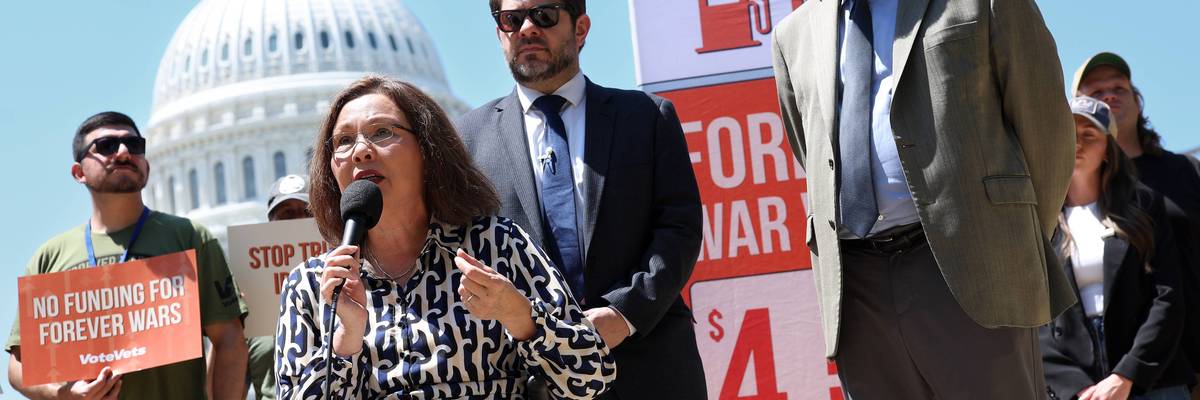
US Sen. Tammy Duckworth (D-Ill.), joined by Sen. Ruben Gallego (D-Ariz.), Sen. Tim Kaine (D-Va.), and members of VoteVets, participates in a press conference on the Iran war and its impact on gas prices outside of the US Capitol on May 20, 2026 in Washington, DC.
The Iran conflict is testing whether Congress can still meaningfully constrain presidential war making—and what powers future presidents may inherit.
On August 18, President Donald Trump said no talks with Iran were underway or scheduled, while the US naval blockade remained in force and Tehran insisted the Strait of Hormuz would stay closed until Washington met the terms of the June interim agreement. The impasse sharpens the most consequential question surrounding Trump’s legacy: not whether he wins or loses this war, but whether he leaves behind expanded presidential power, weakened constitutional checks on war making, and a diminished commitment to a rules-based international order. A president can leave office. A war can outlive him.
That is increasingly the danger confronting the United States. Trump’s confrontation with Iran has evolved from a military campaign into a constitutional and institutional test: Can an American president initiate and sustain major hostilities without explicit congressional authorization, and can Congress still meaningfully restrain him once the fighting has begun? The answer will shape far more than the remainder of Trump’s presidency. It will establish a precedent for every administration that follows.
The central issue is therefore not simply Trump’s foreign policy. It is the emergence of unchecked presidential power in the conduct of war. The United States entered the Iran conflict without a specific congressional authorization. Since then, the administration has advanced expansive interpretations of executive authority while Congress has struggled to reassert its constitutional prerogatives. The War Powers Resolution remains an important, if imperfect, mechanism for limiting the executive branch’s ability to sustain hostilities without congressional consent.
The danger becomes particularly acute when an administration can redefine the status of a conflict without ending the underlying military posture. The War Powers framework was designed to prevent presidents from converting temporary military action into an open-ended commitment: Absent congressional authorization, the law generally requires the president to terminate the use of US armed forces after 60 days. Yet the Trump administration has challenged the idea that this statutory clock should operate as an automatic constraint on presidential authority.
If lawmakers fail to reassert their authority, Trump’s most consequential legacy may be the normalization of a presidency capable of committing the United States to war without meaningful congressional authorization and leaving later administrations to deal with the consequences.
That creates a dangerous precedent. If a president can initiate hostilities, characterize them as limited or defensive, reinterpret the statutory clock, and then continue military operations without explicit authorization, the constitutional allocation of war powers becomes increasingly theoretical. The consequences are no longer hypothetical.
Congress has repeatedly attempted to invoke its war powers over Iran. In June, the House passed a measure directing the president to remove US forces from hostilities with Iran, and the Senate later adopted it. In July, the House again approved a war-powers resolution by 214-208, while the Senate rejected its own measure, 47-49. These votes expose the political problem: Congress is being asked to choose between institutional loyalty to the presidency and constitutional loyalty to the republic. For Republican lawmakers, the choice is especially consequential. Allowing a Republican president to expand executive authority without meaningful resistance establishes powers that a future Democratic president—or another Republican—could inherit in very different circumstances.
The question, therefore, is not whether Congress likes Trump. It is whether Congress is willing to allow presidential power to become self-expanding. Trump’s legacy also extends beyond the domestic constitutional order. His approach has placed pressure on the foundations of the liberal international system: predictable alliances, institutional constraints, multilateral diplomacy, and the assumption that American power operates within rules rather than merely according to presidential preference.
The Iran conflict demonstrates the problem with extraordinary clarity. The June agreement was intended to extend a ceasefire and create a pathway toward a permanent settlement, including negotiations over Iran’s nuclear program. That framework has effectively collapsed. Trump has ruled out extending it; the confrontation around the Strait of Hormuz continues; and he has threatened military action against Oman, a US partner involved in efforts surrounding the strait. A mechanism meant to create a pathway out of war has become another stage in an unresolved confrontation.
Washington has even declared that it can maintain its naval blockade of Iran indefinitely. This is how wars acquire a life of their own. Once forces are deployed, enemies mobilize, allies become involved, economic interests are affected, and political credibility becomes attached to the outcome, withdrawal grows more difficult. The president who starts the war may eventually discover that ending it is politically more dangerous than continuing it.
And the president who inherits it may discover that he has inherited not merely a conflict, but an entire strategic architecture: deployed forces, military commitments, sanctions regimes, regional alliances, adversaries with incentives to retaliate, and political expectations that make disengagement appear equivalent to defeat.
Trump may therefore leave office, but the war may remain. This is the deeper paradox of his “America First” approach. A doctrine supposedly designed to reduce unnecessary foreign entanglements can instead produce new and potentially durable ones. The more Washington relies on military coercion without a clearly defined political end state, the more difficult it becomes to determine what victory actually means—and therefore what conditions would permit the United States to leave.
The consequences for American democracy are equally serious. Democracy does not depend solely on elections. It depends on institutions capable of constraining whoever wins those elections. If Congress becomes unwilling or unable to prevent reckless escalation without congressional consent, then the constitutional system has lost one of its most important safeguards.
This is why the current confrontation should not be reduced to a partisan dispute between Democrats and Republicans. The real issue is whether the United States still believes that war is a national decision rather than a presidential prerogative. Congress must therefore make a choice that transcends Trump himself: party loyalty or constitutional patriotism.
Republican lawmakers who defend Trump’s authority today should consider what they are actually defending. They are not merely protecting the foreign policy of one president. They are helping define the permissible scope of presidential power for decades to come. Once extraordinary powers become precedent, they rarely remain confined to the circumstances in which they were created.
The United States has survived presidents with radically different visions of executive authority. What allows the constitutional system to survive them is the willingness of institutions to impose limits on presidential power. If lawmakers fail to reassert their authority, Trump’s most consequential legacy may be the normalization of a presidency capable of committing the United States to war without meaningful congressional authorization and leaving later administrations to deal with the consequences. Trump will eventually leave the White House. The precedent he creates may not.
Dear Common Dreams reader, It’s been nearly 30 years since I co-founded Common Dreams with my late wife, Lina Newhouser. We had the radical notion that journalism should serve the public good, not corporate profits. It was clear to us from the outset what it would take to build such a project. No paid advertisements. No corporate sponsors. No millionaire publisher telling us what to think or do. Many people said we wouldn't last a year, but we proved those doubters wrong. Together with a tremendous team of journalists and dedicated staff, we built an independent media outlet free from the constraints of profits and corporate control. Our mission has always been simple: To inform. To inspire. To ignite change for the common good. Building Common Dreams was not easy. Our survival was never guaranteed. When you take on the most powerful forces—Wall Street greed, fossil fuel industry destruction, Big Tech lobbyists, and uber-rich oligarchs who have spent billions upon billions rigging the economy and democracy in their favor—the only bulwark you have is supporters who believe in your work. But here’s the urgent message from me today. It's never been this bad out there. And it's never been this hard to keep us going. At the very moment Common Dreams is most needed, the threats we face are intensifying. We need your support now more than ever. We don't accept corporate advertising and never will. We don't have a paywall because we don't think people should be blocked from critical news based on their ability to pay. Everything we do is funded by the donations of readers like you. When everyone does the little they can afford, we are strong. But if that support retreats or dries up, so do we. Will you donate now to make sure Common Dreams not only survives but thrives? —Craig Brown, Co-founder |
On August 18, President Donald Trump said no talks with Iran were underway or scheduled, while the US naval blockade remained in force and Tehran insisted the Strait of Hormuz would stay closed until Washington met the terms of the June interim agreement. The impasse sharpens the most consequential question surrounding Trump’s legacy: not whether he wins or loses this war, but whether he leaves behind expanded presidential power, weakened constitutional checks on war making, and a diminished commitment to a rules-based international order. A president can leave office. A war can outlive him.
That is increasingly the danger confronting the United States. Trump’s confrontation with Iran has evolved from a military campaign into a constitutional and institutional test: Can an American president initiate and sustain major hostilities without explicit congressional authorization, and can Congress still meaningfully restrain him once the fighting has begun? The answer will shape far more than the remainder of Trump’s presidency. It will establish a precedent for every administration that follows.
The central issue is therefore not simply Trump’s foreign policy. It is the emergence of unchecked presidential power in the conduct of war. The United States entered the Iran conflict without a specific congressional authorization. Since then, the administration has advanced expansive interpretations of executive authority while Congress has struggled to reassert its constitutional prerogatives. The War Powers Resolution remains an important, if imperfect, mechanism for limiting the executive branch’s ability to sustain hostilities without congressional consent.
The danger becomes particularly acute when an administration can redefine the status of a conflict without ending the underlying military posture. The War Powers framework was designed to prevent presidents from converting temporary military action into an open-ended commitment: Absent congressional authorization, the law generally requires the president to terminate the use of US armed forces after 60 days. Yet the Trump administration has challenged the idea that this statutory clock should operate as an automatic constraint on presidential authority.
If lawmakers fail to reassert their authority, Trump’s most consequential legacy may be the normalization of a presidency capable of committing the United States to war without meaningful congressional authorization and leaving later administrations to deal with the consequences.
That creates a dangerous precedent. If a president can initiate hostilities, characterize them as limited or defensive, reinterpret the statutory clock, and then continue military operations without explicit authorization, the constitutional allocation of war powers becomes increasingly theoretical. The consequences are no longer hypothetical.
Congress has repeatedly attempted to invoke its war powers over Iran. In June, the House passed a measure directing the president to remove US forces from hostilities with Iran, and the Senate later adopted it. In July, the House again approved a war-powers resolution by 214-208, while the Senate rejected its own measure, 47-49. These votes expose the political problem: Congress is being asked to choose between institutional loyalty to the presidency and constitutional loyalty to the republic. For Republican lawmakers, the choice is especially consequential. Allowing a Republican president to expand executive authority without meaningful resistance establishes powers that a future Democratic president—or another Republican—could inherit in very different circumstances.
The question, therefore, is not whether Congress likes Trump. It is whether Congress is willing to allow presidential power to become self-expanding. Trump’s legacy also extends beyond the domestic constitutional order. His approach has placed pressure on the foundations of the liberal international system: predictable alliances, institutional constraints, multilateral diplomacy, and the assumption that American power operates within rules rather than merely according to presidential preference.
The Iran conflict demonstrates the problem with extraordinary clarity. The June agreement was intended to extend a ceasefire and create a pathway toward a permanent settlement, including negotiations over Iran’s nuclear program. That framework has effectively collapsed. Trump has ruled out extending it; the confrontation around the Strait of Hormuz continues; and he has threatened military action against Oman, a US partner involved in efforts surrounding the strait. A mechanism meant to create a pathway out of war has become another stage in an unresolved confrontation.
Washington has even declared that it can maintain its naval blockade of Iran indefinitely. This is how wars acquire a life of their own. Once forces are deployed, enemies mobilize, allies become involved, economic interests are affected, and political credibility becomes attached to the outcome, withdrawal grows more difficult. The president who starts the war may eventually discover that ending it is politically more dangerous than continuing it.
And the president who inherits it may discover that he has inherited not merely a conflict, but an entire strategic architecture: deployed forces, military commitments, sanctions regimes, regional alliances, adversaries with incentives to retaliate, and political expectations that make disengagement appear equivalent to defeat.
Trump may therefore leave office, but the war may remain. This is the deeper paradox of his “America First” approach. A doctrine supposedly designed to reduce unnecessary foreign entanglements can instead produce new and potentially durable ones. The more Washington relies on military coercion without a clearly defined political end state, the more difficult it becomes to determine what victory actually means—and therefore what conditions would permit the United States to leave.
The consequences for American democracy are equally serious. Democracy does not depend solely on elections. It depends on institutions capable of constraining whoever wins those elections. If Congress becomes unwilling or unable to prevent reckless escalation without congressional consent, then the constitutional system has lost one of its most important safeguards.
This is why the current confrontation should not be reduced to a partisan dispute between Democrats and Republicans. The real issue is whether the United States still believes that war is a national decision rather than a presidential prerogative. Congress must therefore make a choice that transcends Trump himself: party loyalty or constitutional patriotism.
Republican lawmakers who defend Trump’s authority today should consider what they are actually defending. They are not merely protecting the foreign policy of one president. They are helping define the permissible scope of presidential power for decades to come. Once extraordinary powers become precedent, they rarely remain confined to the circumstances in which they were created.
The United States has survived presidents with radically different visions of executive authority. What allows the constitutional system to survive them is the willingness of institutions to impose limits on presidential power. If lawmakers fail to reassert their authority, Trump’s most consequential legacy may be the normalization of a presidency capable of committing the United States to war without meaningful congressional authorization and leaving later administrations to deal with the consequences. Trump will eventually leave the White House. The precedent he creates may not.
On August 18, President Donald Trump said no talks with Iran were underway or scheduled, while the US naval blockade remained in force and Tehran insisted the Strait of Hormuz would stay closed until Washington met the terms of the June interim agreement. The impasse sharpens the most consequential question surrounding Trump’s legacy: not whether he wins or loses this war, but whether he leaves behind expanded presidential power, weakened constitutional checks on war making, and a diminished commitment to a rules-based international order. A president can leave office. A war can outlive him.
That is increasingly the danger confronting the United States. Trump’s confrontation with Iran has evolved from a military campaign into a constitutional and institutional test: Can an American president initiate and sustain major hostilities without explicit congressional authorization, and can Congress still meaningfully restrain him once the fighting has begun? The answer will shape far more than the remainder of Trump’s presidency. It will establish a precedent for every administration that follows.
The central issue is therefore not simply Trump’s foreign policy. It is the emergence of unchecked presidential power in the conduct of war. The United States entered the Iran conflict without a specific congressional authorization. Since then, the administration has advanced expansive interpretations of executive authority while Congress has struggled to reassert its constitutional prerogatives. The War Powers Resolution remains an important, if imperfect, mechanism for limiting the executive branch’s ability to sustain hostilities without congressional consent.
The danger becomes particularly acute when an administration can redefine the status of a conflict without ending the underlying military posture. The War Powers framework was designed to prevent presidents from converting temporary military action into an open-ended commitment: Absent congressional authorization, the law generally requires the president to terminate the use of US armed forces after 60 days. Yet the Trump administration has challenged the idea that this statutory clock should operate as an automatic constraint on presidential authority.
If lawmakers fail to reassert their authority, Trump’s most consequential legacy may be the normalization of a presidency capable of committing the United States to war without meaningful congressional authorization and leaving later administrations to deal with the consequences.
That creates a dangerous precedent. If a president can initiate hostilities, characterize them as limited or defensive, reinterpret the statutory clock, and then continue military operations without explicit authorization, the constitutional allocation of war powers becomes increasingly theoretical. The consequences are no longer hypothetical.
Congress has repeatedly attempted to invoke its war powers over Iran. In June, the House passed a measure directing the president to remove US forces from hostilities with Iran, and the Senate later adopted it. In July, the House again approved a war-powers resolution by 214-208, while the Senate rejected its own measure, 47-49. These votes expose the political problem: Congress is being asked to choose between institutional loyalty to the presidency and constitutional loyalty to the republic. For Republican lawmakers, the choice is especially consequential. Allowing a Republican president to expand executive authority without meaningful resistance establishes powers that a future Democratic president—or another Republican—could inherit in very different circumstances.
The question, therefore, is not whether Congress likes Trump. It is whether Congress is willing to allow presidential power to become self-expanding. Trump’s legacy also extends beyond the domestic constitutional order. His approach has placed pressure on the foundations of the liberal international system: predictable alliances, institutional constraints, multilateral diplomacy, and the assumption that American power operates within rules rather than merely according to presidential preference.
The Iran conflict demonstrates the problem with extraordinary clarity. The June agreement was intended to extend a ceasefire and create a pathway toward a permanent settlement, including negotiations over Iran’s nuclear program. That framework has effectively collapsed. Trump has ruled out extending it; the confrontation around the Strait of Hormuz continues; and he has threatened military action against Oman, a US partner involved in efforts surrounding the strait. A mechanism meant to create a pathway out of war has become another stage in an unresolved confrontation.
Washington has even declared that it can maintain its naval blockade of Iran indefinitely. This is how wars acquire a life of their own. Once forces are deployed, enemies mobilize, allies become involved, economic interests are affected, and political credibility becomes attached to the outcome, withdrawal grows more difficult. The president who starts the war may eventually discover that ending it is politically more dangerous than continuing it.
And the president who inherits it may discover that he has inherited not merely a conflict, but an entire strategic architecture: deployed forces, military commitments, sanctions regimes, regional alliances, adversaries with incentives to retaliate, and political expectations that make disengagement appear equivalent to defeat.
Trump may therefore leave office, but the war may remain. This is the deeper paradox of his “America First” approach. A doctrine supposedly designed to reduce unnecessary foreign entanglements can instead produce new and potentially durable ones. The more Washington relies on military coercion without a clearly defined political end state, the more difficult it becomes to determine what victory actually means—and therefore what conditions would permit the United States to leave.
The consequences for American democracy are equally serious. Democracy does not depend solely on elections. It depends on institutions capable of constraining whoever wins those elections. If Congress becomes unwilling or unable to prevent reckless escalation without congressional consent, then the constitutional system has lost one of its most important safeguards.
This is why the current confrontation should not be reduced to a partisan dispute between Democrats and Republicans. The real issue is whether the United States still believes that war is a national decision rather than a presidential prerogative. Congress must therefore make a choice that transcends Trump himself: party loyalty or constitutional patriotism.
Republican lawmakers who defend Trump’s authority today should consider what they are actually defending. They are not merely protecting the foreign policy of one president. They are helping define the permissible scope of presidential power for decades to come. Once extraordinary powers become precedent, they rarely remain confined to the circumstances in which they were created.
The United States has survived presidents with radically different visions of executive authority. What allows the constitutional system to survive them is the willingness of institutions to impose limits on presidential power. If lawmakers fail to reassert their authority, Trump’s most consequential legacy may be the normalization of a presidency capable of committing the United States to war without meaningful congressional authorization and leaving later administrations to deal with the consequences. Trump will eventually leave the White House. The precedent he creates may not.