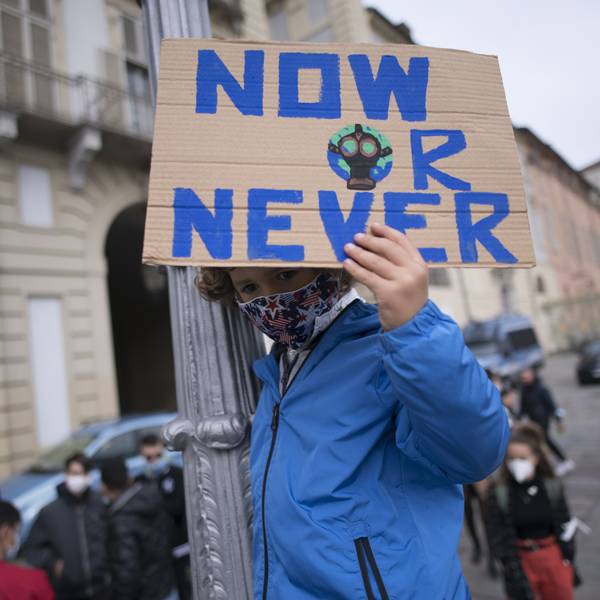

I woke up this Earth Day morning in Santa Barbara, California—which is appropriate, since the offshore oil spill here in 1969 was one of the galvanizing events for the first Earth Day 56 years ago. People got mad, they squawked, and government began to listen. We should never forget what they accomplished—in 18 months Congress had adopted the suite of laws (Clean Air Act, Clean Water Act, Environmental Protection Agency, etc) that the Trump administration is still trying to gut. And within five years those laws had begun to work. The air is far cleaner than it was, thanks to them. You can swim in far more lakes and rivers, thanks to them. Because they got loud.
We face a more complicated moment today, of course. The ecological crisis of our time is not caused by something going wrong—an engine spewing small amounts of carbon monoxide into the air—and not easily fixed by adding a catalytic converter to the tailpipe. Global warming is the result of things going as they’re supposed to: A “clean-burning” engine emits just water vapor, and lots and lots and lots of carbon dioxide. But that CO2 traps heat, and is now warming the planet disastrously. To fix it we have to replace an energy system that runs on fossil fuels with another that runs primarily on the sun. And we have to do it fast.
I flew here Tuesday, and for my carbon sins got a clear-sky view of pretty much the entire western United States. It was, as always, majestic—to fly above the Grand Canyon is to glimpse deep time. But it was also almost unbelievably sad. I’ve been telling you that this was the hottest winter, by far, in the history of the West. But to see it is different. I flew over peaks where I’ve glissaded down snowfields in June, and there was not an inch of snow to be seen. Lake Mead from above looked like a bathtub with the plug open. Sere brown and tawny withered gold as far as you could see, and with it the scary promise of what will come this summer, the smoke that will rise and the flames that will burn orange against the night.
Temperatures are higher than they’ve ever been, even before El Niño breaks above our heads this summer. And yet we’re talking very little about climate change in our national conversation. There are many reasons for that—the most obvious is that the constant psychic assault from the president leaves so little room to think about anything else. But there’s also been a concerted effort among Democrats and some of their environmental allies to stay away from the topic on the grounds that it will distract from or undercut messages about “affordability” which are supposed to be the ticket to electoral success in the fall.
If they think he’s got tariffs wrong, and the war wrong, and immigration wrong, and pretty much everything else wrong, why would they think he had the science of climate right?
I’m committed to that electoral success—my calendar for the months ahead is mostly red districts, where Third Act is busy trying to move the needle with older voters. And I understand the concerns, but I think they’re basically wrong, and that talking straightforwardly about the climate crisis is both politically useful, and an excellent way to take on affordability. And I also think that human beings just need to be discussing the single biggest thing happening on planet Earth, especially since we’re causing it.
The so-called “climate hushing” among Democrats is a product of political consultants looking at polling data. As Claire Barber explained in an excellent essay last month:
The Searchlight Institute, a Democratic think tank run by veteran Democratic political strategist Adam Jentleson that opened its doors in 2025, made waves with its focus on shifting Democratic messaging away from progressive causes, like climate and LGBTQ issues. The think tank is pointed in its stance on climate messaging. A report released in the fall reads, “The First Rule About Solving Climate Change: Don’t Say Climate Change.”
“While battleground voters overwhelmingly agree climate change is a problem, addressing it is not a priority for them,” the report said. Similar to the American Mind Survey, Searchlight found that a majority of Americans believe that climate change is a problem, but rank it below other key issues, like affordability. Searchlight also found high partisan (Democratic) association with the terms “climate” and “climate change” and suggested jettisoning mentions of both altogether.
The phenomenon really dates, I think, from the 2024 presidential campaign, and Vice President Kamala Harris’ abbreviated run for the White House. Climate campaigners were perfectly happy to shut up during that run for an obvious reason: President Joe Biden had given them, in the Inflation Reduction Act (IRA), most of what DC could provide: a massive infusion of funds for the energy transition we require. The job was to pull Harris across the finish line so that her administration could continue the work well underway with the IRA. We failed at that: Her message, on the politics of joy and the dangers of Donald Trump, ran aground on frustrations with inflation. Climate played no discernible part in the election; I’m not sure any issue played a part in the election, save a kind of general kvetchy grumpiness, and a sense that normal people were being squeezed.
In the wake of their defeat, Democrats have seized on “bread and butter issues,” and left supposed culture war clashes behind. That’s come at a real cost. Corporations, feeling only pressure from the right, have backslid dramatically on their climate commitments. (The Big Tech guys, who just a couple of years ago were noisily pledging they’d go net zero, are currently planning gas-fired data centers that Wired reports today will produce more emissions than midsized European countries). And journalists are, not surprisingly, wandering away from the whole area: The wonderful Amy Westervelt yesterday described a dour meeting of environmental reporters where, among other things, she learned that not just The Washington Post but also Reuters was laying off its climate desk:
Meanwhile, funders of climate journalism are largely folding, too, opting to back comms projects instead or simply stay away from anything as "controversial" as climate and journalism altogether. The cowardice is breathtaking.
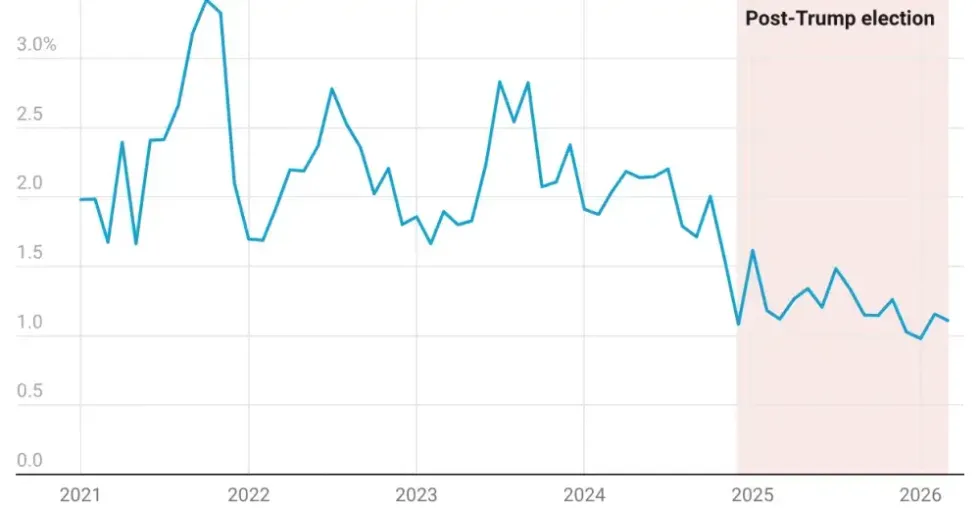
As the media watchdogs at FAIR make clear, this decline in coverage is very real:
Our research has found that online news coverage of climate change has been trending down. A search of the term “climate change” in Media Cloud’s US–National dataset, which indexes 248 online outlets, found that there was almost 32% less climate coverage in 2025 than 2024.
This trend is similar in TV news. A recent Media Matters (3/4/26) study found that climate coverage on major US commercial broadcast TV networks was down 35% in 2025.
In fact, they even put the decline on a chart. Powerpoint time!
What’s interesting about all this is that it’s not being driven by some change in the basic underlying politics of climate. New polling data makes clear that Americans are as concerned about climate change as they ever have been. Gallup last week reported that:
Americans’ concern about global warming or climate change remains elevated compared with what it had been prior to 2017. At least 4 in 10 US adults have expressed “a great deal” of concern about the matter throughout the past decade (except for a 39% reading in 2023). Between 2009 and 2016, worry was typically in the low-to-mid 30% range but dropped to as low as 25% in 2011.
Currently, 44% of US adults worry a great deal about global warming or climate change, among the highest in the full trend since 1989, along with 46% measured in 2020 and 45% in 2017.
And another series of Earth Day polls made the numbers even clearer. Americans, in increasing numbers, think that our environment is getting worse, and that government should be doing much more about it. Gallup again:
Americans’ assessments of the environment are particularly bleak ahead of Earth Day, as a record-low 35% offer a positive rating of the environment’s quality and two-thirds say it is worsening.
More than 3 in 5 US adults, 63%, think the government is not doing enough to protect the environment, and most believe environmental protection should be prioritized over economic growth (58%) and development of US energy sources (57%).
The key data point here, for political thinkers, is that the increase in worry about the environment is being driven by independent voters, precisely the people who will determine how the midterms go.
And it doesn’t surprise me a bit. It’s not as if the president or his oil-soaked cabinet has made some convincing new case about the climate. He just blusters on about the “green new scam” and insists, as he did last week, that the “planet is cooling.” By this point, Americans have decided he’s an idiot—his approval ratings are now dropping into the mid and even low 30s. If they think he’s got tariffs wrong, and the war wrong, and immigration wrong, and pretty much everything else wrong, why would they think he had the science of climate right?
So, especially as the climate disasters of this hot summer start to mount, and as the El Niño starts to scare people anew, I’d spend some time if I were campaigning making fun of the president on this score. I’d show that clip of him insisting the planet is cooling. It makes Republicans, who have supported him down the line in Congress on energy issues, look like idiots too.
But of course I’d couple it with a full-on assault about affordability, leaning not into the price of eggs, but the price of gas, utilities, and insurance. The first is tied to the war, but they are all three also about the folly of continuing to rely on our current energy system. All you have to say is: A quick move to clean energy drives down prices. If I were preparing ads for congresspeople, I’d definitely have one about how a solarized Australia will, in June, start providing electricity free for three hours every afternoon to all its citizens. Talk about affordability!
One problem with keeping quiet about climate is that it leads people to think that they’re alone in their fears. Here’s an interesting survey from last month fronm the folks at EcoAmerica:
Most Americans are concerned about climate change, but they don’t think most others share that concern. That quiet misunderstanding is one of the biggest barriers to climate action in the United States… The findings point to a striking paradox: While many Americans trust the information they encounter and are concerned about climate change, they believe others are far less concerned and less able to recognize accurate information.
I think some politicians are starting to recognize the possibilities here. Sheldon Whitehouse of Rhode Island, venerable campaigner for climate action (with a particular focus on insurance) this winter tweeted out a memorable thread:
There’s a thing out there called a “climate husher.” Anyone who cares about what fossil fuel pollution is doing to Earth’s natural systems needs to ignore these so-called “climate hushers” —people who think Dems should stop talking about climate.
In an electorate focused on costs, 65% say climate change is raising their costs. Climate-driven hikes in home insurance are the top economic issue in many places. By 74-10, voters want companies to pay for the harm their pollution causes.
{Poll-chasing analysts] ignore the "leadership lack loop." When leaders don’t talk about something, enthusiasm falls among voters. In politics, you can often make your own wind, or you can make your own doldrums.
Last, they ignore that this is a fight in which there are real and dangerous villains. Our climate peril didn’t “happen,” it was done—by fraud and corruption.
The fossil fuel climate denial fraud operation and the fossil fuel dark money corruption operation are villainous. It’s evil stuff. Villains need to be fought. Plus, it’s a better story with villains. And true.
I’m pretty sure he’s right. Look, at Third Act we too are focusing a lot of our messaging on the Republican attack on democracy. But we can talk about a couple of things at once. And you can only have a working democracy on a working planet.
Happy Earth Day, all!
I woke up this Earth Day morning in Santa Barbara, California—which is appropriate, since the offshore oil spill here in 1969 was one of the galvanizing events for the first Earth Day 56 years ago. People got mad, they squawked, and government began to listen. We should never forget what they accomplished—in 18 months Congress had adopted the suite of laws (Clean Air Act, Clean Water Act, Environmental Protection Agency, etc) that the Trump administration is still trying to gut. And within five years those laws had begun to work. The air is far cleaner than it was, thanks to them. You can swim in far more lakes and rivers, thanks to them. Because they got loud.
We face a more complicated moment today, of course. The ecological crisis of our time is not caused by something going wrong—an engine spewing small amounts of carbon monoxide into the air—and not easily fixed by adding a catalytic converter to the tailpipe. Global warming is the result of things going as they’re supposed to: A “clean-burning” engine emits just water vapor, and lots and lots and lots of carbon dioxide. But that CO2 traps heat, and is now warming the planet disastrously. To fix it we have to replace an energy system that runs on fossil fuels with another that runs primarily on the sun. And we have to do it fast.
I flew here Tuesday, and for my carbon sins got a clear-sky view of pretty much the entire western United States. It was, as always, majestic—to fly above the Grand Canyon is to glimpse deep time. But it was also almost unbelievably sad. I’ve been telling you that this was the hottest winter, by far, in the history of the West. But to see it is different. I flew over peaks where I’ve glissaded down snowfields in June, and there was not an inch of snow to be seen. Lake Mead from above looked like a bathtub with the plug open. Sere brown and tawny withered gold as far as you could see, and with it the scary promise of what will come this summer, the smoke that will rise and the flames that will burn orange against the night.
Temperatures are higher than they’ve ever been, even before El Niño breaks above our heads this summer. And yet we’re talking very little about climate change in our national conversation. There are many reasons for that—the most obvious is that the constant psychic assault from the president leaves so little room to think about anything else. But there’s also been a concerted effort among Democrats and some of their environmental allies to stay away from the topic on the grounds that it will distract from or undercut messages about “affordability” which are supposed to be the ticket to electoral success in the fall.
If they think he’s got tariffs wrong, and the war wrong, and immigration wrong, and pretty much everything else wrong, why would they think he had the science of climate right?
I’m committed to that electoral success—my calendar for the months ahead is mostly red districts, where Third Act is busy trying to move the needle with older voters. And I understand the concerns, but I think they’re basically wrong, and that talking straightforwardly about the climate crisis is both politically useful, and an excellent way to take on affordability. And I also think that human beings just need to be discussing the single biggest thing happening on planet Earth, especially since we’re causing it.
The so-called “climate hushing” among Democrats is a product of political consultants looking at polling data. As Claire Barber explained in an excellent essay last month:
The Searchlight Institute, a Democratic think tank run by veteran Democratic political strategist Adam Jentleson that opened its doors in 2025, made waves with its focus on shifting Democratic messaging away from progressive causes, like climate and LGBTQ issues. The think tank is pointed in its stance on climate messaging. A report released in the fall reads, “The First Rule About Solving Climate Change: Don’t Say Climate Change.”
“While battleground voters overwhelmingly agree climate change is a problem, addressing it is not a priority for them,” the report said. Similar to the American Mind Survey, Searchlight found that a majority of Americans believe that climate change is a problem, but rank it below other key issues, like affordability. Searchlight also found high partisan (Democratic) association with the terms “climate” and “climate change” and suggested jettisoning mentions of both altogether.
The phenomenon really dates, I think, from the 2024 presidential campaign, and Vice President Kamala Harris’ abbreviated run for the White House. Climate campaigners were perfectly happy to shut up during that run for an obvious reason: President Joe Biden had given them, in the Inflation Reduction Act (IRA), most of what DC could provide: a massive infusion of funds for the energy transition we require. The job was to pull Harris across the finish line so that her administration could continue the work well underway with the IRA. We failed at that: Her message, on the politics of joy and the dangers of Donald Trump, ran aground on frustrations with inflation. Climate played no discernible part in the election; I’m not sure any issue played a part in the election, save a kind of general kvetchy grumpiness, and a sense that normal people were being squeezed.
In the wake of their defeat, Democrats have seized on “bread and butter issues,” and left supposed culture war clashes behind. That’s come at a real cost. Corporations, feeling only pressure from the right, have backslid dramatically on their climate commitments. (The Big Tech guys, who just a couple of years ago were noisily pledging they’d go net zero, are currently planning gas-fired data centers that Wired reports today will produce more emissions than midsized European countries). And journalists are, not surprisingly, wandering away from the whole area: The wonderful Amy Westervelt yesterday described a dour meeting of environmental reporters where, among other things, she learned that not just The Washington Post but also Reuters was laying off its climate desk:
Meanwhile, funders of climate journalism are largely folding, too, opting to back comms projects instead or simply stay away from anything as "controversial" as climate and journalism altogether. The cowardice is breathtaking.
As the media watchdogs at FAIR make clear, this decline in coverage is very real:
Our research has found that online news coverage of climate change has been trending down. A search of the term “climate change” in Media Cloud’s US–National dataset, which indexes 248 online outlets, found that there was almost 32% less climate coverage in 2025 than 2024.
This trend is similar in TV news. A recent Media Matters (3/4/26) study found that climate coverage on major US commercial broadcast TV networks was down 35% in 2025.
In fact, they even put the decline on a chart. Powerpoint time!
What’s interesting about all this is that it’s not being driven by some change in the basic underlying politics of climate. New polling data makes clear that Americans are as concerned about climate change as they ever have been. Gallup last week reported that:
Americans’ concern about global warming or climate change remains elevated compared with what it had been prior to 2017. At least 4 in 10 US adults have expressed “a great deal” of concern about the matter throughout the past decade (except for a 39% reading in 2023). Between 2009 and 2016, worry was typically in the low-to-mid 30% range but dropped to as low as 25% in 2011.
Currently, 44% of US adults worry a great deal about global warming or climate change, among the highest in the full trend since 1989, along with 46% measured in 2020 and 45% in 2017.
And another series of Earth Day polls made the numbers even clearer. Americans, in increasing numbers, think that our environment is getting worse, and that government should be doing much more about it. Gallup again:
Americans’ assessments of the environment are particularly bleak ahead of Earth Day, as a record-low 35% offer a positive rating of the environment’s quality and two-thirds say it is worsening.
More than 3 in 5 US adults, 63%, think the government is not doing enough to protect the environment, and most believe environmental protection should be prioritized over economic growth (58%) and development of US energy sources (57%).
The key data point here, for political thinkers, is that the increase in worry about the environment is being driven by independent voters, precisely the people who will determine how the midterms go.
And it doesn’t surprise me a bit. It’s not as if the president or his oil-soaked cabinet has made some convincing new case about the climate. He just blusters on about the “green new scam” and insists, as he did last week, that the “planet is cooling.” By this point, Americans have decided he’s an idiot—his approval ratings are now dropping into the mid and even low 30s. If they think he’s got tariffs wrong, and the war wrong, and immigration wrong, and pretty much everything else wrong, why would they think he had the science of climate right?
So, especially as the climate disasters of this hot summer start to mount, and as the El Niño starts to scare people anew, I’d spend some time if I were campaigning making fun of the president on this score. I’d show that clip of him insisting the planet is cooling. It makes Republicans, who have supported him down the line in Congress on energy issues, look like idiots too.
But of course I’d couple it with a full-on assault about affordability, leaning not into the price of eggs, but the price of gas, utilities, and insurance. The first is tied to the war, but they are all three also about the folly of continuing to rely on our current energy system. All you have to say is: A quick move to clean energy drives down prices. If I were preparing ads for congresspeople, I’d definitely have one about how a solarized Australia will, in June, start providing electricity free for three hours every afternoon to all its citizens. Talk about affordability!
One problem with keeping quiet about climate is that it leads people to think that they’re alone in their fears. Here’s an interesting survey from last month fronm the folks at EcoAmerica:
Most Americans are concerned about climate change, but they don’t think most others share that concern. That quiet misunderstanding is one of the biggest barriers to climate action in the United States… The findings point to a striking paradox: While many Americans trust the information they encounter and are concerned about climate change, they believe others are far less concerned and less able to recognize accurate information.
I think some politicians are starting to recognize the possibilities here. Sheldon Whitehouse of Rhode Island, venerable campaigner for climate action (with a particular focus on insurance) this winter tweeted out a memorable thread:
There’s a thing out there called a “climate husher.” Anyone who cares about what fossil fuel pollution is doing to Earth’s natural systems needs to ignore these so-called “climate hushers” —people who think Dems should stop talking about climate.
In an electorate focused on costs, 65% say climate change is raising their costs. Climate-driven hikes in home insurance are the top economic issue in many places. By 74-10, voters want companies to pay for the harm their pollution causes.
{Poll-chasing analysts] ignore the "leadership lack loop." When leaders don’t talk about something, enthusiasm falls among voters. In politics, you can often make your own wind, or you can make your own doldrums.
Last, they ignore that this is a fight in which there are real and dangerous villains. Our climate peril didn’t “happen,” it was done—by fraud and corruption.
The fossil fuel climate denial fraud operation and the fossil fuel dark money corruption operation are villainous. It’s evil stuff. Villains need to be fought. Plus, it’s a better story with villains. And true.
I’m pretty sure he’s right. Look, at Third Act we too are focusing a lot of our messaging on the Republican attack on democracy. But we can talk about a couple of things at once. And you can only have a working democracy on a working planet.
Happy Earth Day, all!
- Transforming the Climate Conversation This Earth Day ›
- The 89%: New Media Collaboration Calls Attention to 'Climate Change's Silent Majority' ›
- Carbon Capture: What We Don't Talk About When We Talk About Climate Change ›
- Are Progressives in Denial About Climate Change? ›
- The Climate Crisis Is About to Usher in a World We Haven't Seen Before ›
- Greta Thunberg Explains Why Hope Cannot Save Planet But Bold Climate Action Still Can ›
- Opinion | We're Choking on Smoke—Where Do We Go From Here? | Common Dreams ›
- Opinion | Backsliding on Climate Could Cost Not Only Elections But Lives | Common Dreams ›
I woke up this Earth Day morning in Santa Barbara, California—which is appropriate, since the offshore oil spill here in 1969 was one of the galvanizing events for the first Earth Day 56 years ago. People got mad, they squawked, and government began to listen. We should never forget what they accomplished—in 18 months Congress had adopted the suite of laws (Clean Air Act, Clean Water Act, Environmental Protection Agency, etc) that the Trump administration is still trying to gut. And within five years those laws had begun to work. The air is far cleaner than it was, thanks to them. You can swim in far more lakes and rivers, thanks to them. Because they got loud.
We face a more complicated moment today, of course. The ecological crisis of our time is not caused by something going wrong—an engine spewing small amounts of carbon monoxide into the air—and not easily fixed by adding a catalytic converter to the tailpipe. Global warming is the result of things going as they’re supposed to: A “clean-burning” engine emits just water vapor, and lots and lots and lots of carbon dioxide. But that CO2 traps heat, and is now warming the planet disastrously. To fix it we have to replace an energy system that runs on fossil fuels with another that runs primarily on the sun. And we have to do it fast.
I flew here Tuesday, and for my carbon sins got a clear-sky view of pretty much the entire western United States. It was, as always, majestic—to fly above the Grand Canyon is to glimpse deep time. But it was also almost unbelievably sad. I’ve been telling you that this was the hottest winter, by far, in the history of the West. But to see it is different. I flew over peaks where I’ve glissaded down snowfields in June, and there was not an inch of snow to be seen. Lake Mead from above looked like a bathtub with the plug open. Sere brown and tawny withered gold as far as you could see, and with it the scary promise of what will come this summer, the smoke that will rise and the flames that will burn orange against the night.
Temperatures are higher than they’ve ever been, even before El Niño breaks above our heads this summer. And yet we’re talking very little about climate change in our national conversation. There are many reasons for that—the most obvious is that the constant psychic assault from the president leaves so little room to think about anything else. But there’s also been a concerted effort among Democrats and some of their environmental allies to stay away from the topic on the grounds that it will distract from or undercut messages about “affordability” which are supposed to be the ticket to electoral success in the fall.
If they think he’s got tariffs wrong, and the war wrong, and immigration wrong, and pretty much everything else wrong, why would they think he had the science of climate right?
I’m committed to that electoral success—my calendar for the months ahead is mostly red districts, where Third Act is busy trying to move the needle with older voters. And I understand the concerns, but I think they’re basically wrong, and that talking straightforwardly about the climate crisis is both politically useful, and an excellent way to take on affordability. And I also think that human beings just need to be discussing the single biggest thing happening on planet Earth, especially since we’re causing it.
The so-called “climate hushing” among Democrats is a product of political consultants looking at polling data. As Claire Barber explained in an excellent essay last month:
The Searchlight Institute, a Democratic think tank run by veteran Democratic political strategist Adam Jentleson that opened its doors in 2025, made waves with its focus on shifting Democratic messaging away from progressive causes, like climate and LGBTQ issues. The think tank is pointed in its stance on climate messaging. A report released in the fall reads, “The First Rule About Solving Climate Change: Don’t Say Climate Change.”
“While battleground voters overwhelmingly agree climate change is a problem, addressing it is not a priority for them,” the report said. Similar to the American Mind Survey, Searchlight found that a majority of Americans believe that climate change is a problem, but rank it below other key issues, like affordability. Searchlight also found high partisan (Democratic) association with the terms “climate” and “climate change” and suggested jettisoning mentions of both altogether.
The phenomenon really dates, I think, from the 2024 presidential campaign, and Vice President Kamala Harris’ abbreviated run for the White House. Climate campaigners were perfectly happy to shut up during that run for an obvious reason: President Joe Biden had given them, in the Inflation Reduction Act (IRA), most of what DC could provide: a massive infusion of funds for the energy transition we require. The job was to pull Harris across the finish line so that her administration could continue the work well underway with the IRA. We failed at that: Her message, on the politics of joy and the dangers of Donald Trump, ran aground on frustrations with inflation. Climate played no discernible part in the election; I’m not sure any issue played a part in the election, save a kind of general kvetchy grumpiness, and a sense that normal people were being squeezed.
In the wake of their defeat, Democrats have seized on “bread and butter issues,” and left supposed culture war clashes behind. That’s come at a real cost. Corporations, feeling only pressure from the right, have backslid dramatically on their climate commitments. (The Big Tech guys, who just a couple of years ago were noisily pledging they’d go net zero, are currently planning gas-fired data centers that Wired reports today will produce more emissions than midsized European countries). And journalists are, not surprisingly, wandering away from the whole area: The wonderful Amy Westervelt yesterday described a dour meeting of environmental reporters where, among other things, she learned that not just The Washington Post but also Reuters was laying off its climate desk:
Meanwhile, funders of climate journalism are largely folding, too, opting to back comms projects instead or simply stay away from anything as "controversial" as climate and journalism altogether. The cowardice is breathtaking.
As the media watchdogs at FAIR make clear, this decline in coverage is very real:
Our research has found that online news coverage of climate change has been trending down. A search of the term “climate change” in Media Cloud’s US–National dataset, which indexes 248 online outlets, found that there was almost 32% less climate coverage in 2025 than 2024.
This trend is similar in TV news. A recent Media Matters (3/4/26) study found that climate coverage on major US commercial broadcast TV networks was down 35% in 2025.
In fact, they even put the decline on a chart. Powerpoint time!
What’s interesting about all this is that it’s not being driven by some change in the basic underlying politics of climate. New polling data makes clear that Americans are as concerned about climate change as they ever have been. Gallup last week reported that:
Americans’ concern about global warming or climate change remains elevated compared with what it had been prior to 2017. At least 4 in 10 US adults have expressed “a great deal” of concern about the matter throughout the past decade (except for a 39% reading in 2023). Between 2009 and 2016, worry was typically in the low-to-mid 30% range but dropped to as low as 25% in 2011.
Currently, 44% of US adults worry a great deal about global warming or climate change, among the highest in the full trend since 1989, along with 46% measured in 2020 and 45% in 2017.
And another series of Earth Day polls made the numbers even clearer. Americans, in increasing numbers, think that our environment is getting worse, and that government should be doing much more about it. Gallup again:
Americans’ assessments of the environment are particularly bleak ahead of Earth Day, as a record-low 35% offer a positive rating of the environment’s quality and two-thirds say it is worsening.
More than 3 in 5 US adults, 63%, think the government is not doing enough to protect the environment, and most believe environmental protection should be prioritized over economic growth (58%) and development of US energy sources (57%).
The key data point here, for political thinkers, is that the increase in worry about the environment is being driven by independent voters, precisely the people who will determine how the midterms go.
And it doesn’t surprise me a bit. It’s not as if the president or his oil-soaked cabinet has made some convincing new case about the climate. He just blusters on about the “green new scam” and insists, as he did last week, that the “planet is cooling.” By this point, Americans have decided he’s an idiot—his approval ratings are now dropping into the mid and even low 30s. If they think he’s got tariffs wrong, and the war wrong, and immigration wrong, and pretty much everything else wrong, why would they think he had the science of climate right?
So, especially as the climate disasters of this hot summer start to mount, and as the El Niño starts to scare people anew, I’d spend some time if I were campaigning making fun of the president on this score. I’d show that clip of him insisting the planet is cooling. It makes Republicans, who have supported him down the line in Congress on energy issues, look like idiots too.
But of course I’d couple it with a full-on assault about affordability, leaning not into the price of eggs, but the price of gas, utilities, and insurance. The first is tied to the war, but they are all three also about the folly of continuing to rely on our current energy system. All you have to say is: A quick move to clean energy drives down prices. If I were preparing ads for congresspeople, I’d definitely have one about how a solarized Australia will, in June, start providing electricity free for three hours every afternoon to all its citizens. Talk about affordability!
One problem with keeping quiet about climate is that it leads people to think that they’re alone in their fears. Here’s an interesting survey from last month fronm the folks at EcoAmerica:
Most Americans are concerned about climate change, but they don’t think most others share that concern. That quiet misunderstanding is one of the biggest barriers to climate action in the United States… The findings point to a striking paradox: While many Americans trust the information they encounter and are concerned about climate change, they believe others are far less concerned and less able to recognize accurate information.
I think some politicians are starting to recognize the possibilities here. Sheldon Whitehouse of Rhode Island, venerable campaigner for climate action (with a particular focus on insurance) this winter tweeted out a memorable thread:
There’s a thing out there called a “climate husher.” Anyone who cares about what fossil fuel pollution is doing to Earth’s natural systems needs to ignore these so-called “climate hushers” —people who think Dems should stop talking about climate.
In an electorate focused on costs, 65% say climate change is raising their costs. Climate-driven hikes in home insurance are the top economic issue in many places. By 74-10, voters want companies to pay for the harm their pollution causes.
{Poll-chasing analysts] ignore the "leadership lack loop." When leaders don’t talk about something, enthusiasm falls among voters. In politics, you can often make your own wind, or you can make your own doldrums.
Last, they ignore that this is a fight in which there are real and dangerous villains. Our climate peril didn’t “happen,” it was done—by fraud and corruption.
The fossil fuel climate denial fraud operation and the fossil fuel dark money corruption operation are villainous. It’s evil stuff. Villains need to be fought. Plus, it’s a better story with villains. And true.
I’m pretty sure he’s right. Look, at Third Act we too are focusing a lot of our messaging on the Republican attack on democracy. But we can talk about a couple of things at once. And you can only have a working democracy on a working planet.
Happy Earth Day, all!
- Transforming the Climate Conversation This Earth Day ›
- The 89%: New Media Collaboration Calls Attention to 'Climate Change's Silent Majority' ›
- Carbon Capture: What We Don't Talk About When We Talk About Climate Change ›
- Are Progressives in Denial About Climate Change? ›
- The Climate Crisis Is About to Usher in a World We Haven't Seen Before ›
- Greta Thunberg Explains Why Hope Cannot Save Planet But Bold Climate Action Still Can ›
- Opinion | We're Choking on Smoke—Where Do We Go From Here? | Common Dreams ›
- Opinion | Backsliding on Climate Could Cost Not Only Elections But Lives | Common Dreams ›