

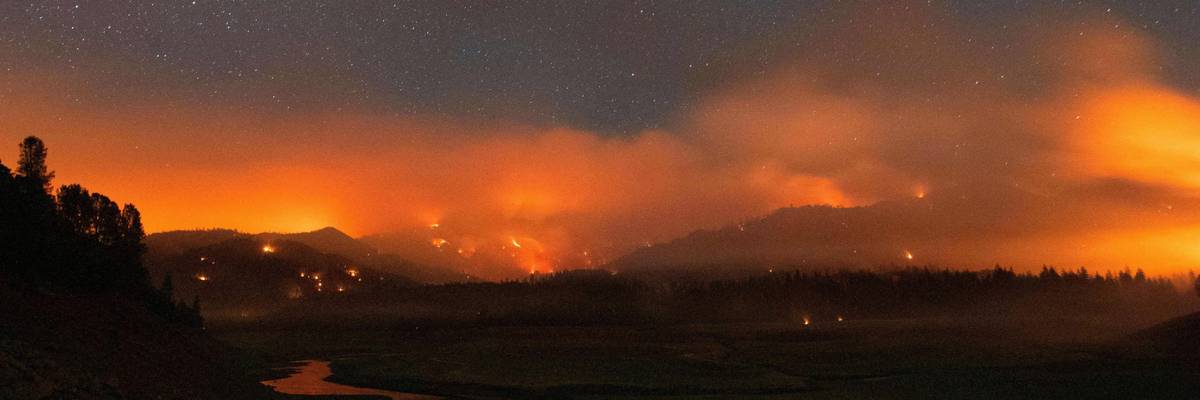
In this long exposure photograph, flames surround a drought-stricken Shasta Lake during the "Salt fire" in Lakehead, California early on July 2, 2021, as firefighters battle nearly a dozen wildfires in the region following a heatwave and multiple lightning strikes.
Backsliding on Climate Could Cost Not Only Elections But Lives
Economic populism goes hand in hand with a clean energy transition.
Temperatures are soaring globally, and wildfire smoke just blanketed much of North America for the second time in a few years. This summer’s heat will likely make this year the hottest ever, and that heat is costing lives. It’s no surprise that concern about climate change among Americans is at one of its highest points since 1989.
But despite the fact that climate change and extreme heat are posing a threat to the health and well-being of Americans, neither major party is offering a serious policy response.
Republicans have become the official party of climate change denial. The Trump administration and its GOP allies in Congress have aggressively attacked renewable energy while boosting fossil fuels. Meanwhile many Democrats have become increasingly silent about climate, leaving voters concerned about the issue with no major political party to represent their values and interests.
In fact, The New York Times recently found that many Democratic candidates are backtracking on their previous opposition to the oil and gas industries. “With voters worried about spiking gas prices and inflation, some of the party’s leaders argue that they should stop trying to throttle oil and gas, which heat the planet when burned,” the paper reported.
Voters recognize that public investments in clean energy, public transit, and other climate-friendly policies ultimately save them money.
This messaging could cost lives and elections.
As a young voter, I saw this sense of abandonment play out in real time. I remember walking proudly around my campus all day in 2024 wearing an “I voted” sticker. I had voted early by mail, as had many of my classmates—or so I thought. What I came to realize throughout the day was that many of my classmates had yet to vote—and had no plan to.
Voting can be time consuming, frustrating, and often unnecessarily complicated. Barriers to voting are even more intimidating when you’re voting for the first time. For these reasons and more, many young people only make the effort to vote if they feel candidates will strongly advocate for the issues they care about.
On my campus, students are given access to all kinds of information about how and why to vote, and they’re given ample time and opportunity to do so. If students with access to so many resources on voting aren’t voting, how can we expect young people in parts of the country where there are larger barriers to voting to turn out en masse?
Over half of voters aged 18-29 didn’t vote in the 2024 presidential election, and 77% of young voters didn’t vote in the 2022 midterms. The 2026 midterm races are already tight, which could make the failure to address climate change a recipe for political as well as ecological disaster.
There’s no contradiction between having a serious climate policy and being responsive to voter concerns about rising costs. Progressive populists like Zohran Mamdani in New York, Janeese Lewis George in Washington, DC, and Melat Kiros in Denver, among others, have all proven that climate-friendly economic populism can be effective at increasing voter turnout, especially among young people.
Economic populism goes hand in hand with a transition to green energy, as 90% of renewable energy is now cheaper than fossil fuels. Voters recognize that public investments in clean energy, public transit, and other climate-friendly policies ultimately save them money.
In New York, one of Mamdani’s core promises—Free, Fast Buses—was proof of this. In DC, a core component of Lewis George’s campaign was affordable energy for all, with a focus on expanding community and government solar to cut electric bills. In Denver, Kiros also campaigned on combining economic and environmental issues with her support of a Green New Deal.
These recent victories owed much to the young people who powered their campaigns. It was also overwhelmingly young people who organized the 75,000 person March To End Fossil Fuels in 2023 and organized 500,000 people around the US against fossil fuels in 2019.
These examples suggest young people aren’t apathetic—they’re just not being heard. They will power campaigns that support a transition to green energy. But they won’t make an effort for those who enable the fossil fuel industry or talk out of both sides of their mouths on the issue.
Now is the time to push for a future with cheaper, greener energy for all. It is not the time to backslide on fossil fuels.
We are at a crossroads
This country and this world are at a monumental crossroads. In a few short weeks, US voters will have an opportunity to beat back the forces of fascism and confront the billionaires who are rigging the economy, our media system, and our democracy, making it increasingly impossible for ordinary people to get by. We’re not just talking about the election. We’re talking about what must be done once these fascist elements are vanquished from power. We need a bolder set of solutions than what either major party has so far been willing to offer and a working-class movement ready to fight like hell for it. Trump didn't emerge from nowhere. The conditions that fueled MAGA authoritarianism were created by decades of radical neoliberal economic policies and a corrupt political system dominated by corporate interests. They slashed taxes on the super-rich, promising that the benefits would trickle down. They said giveaways to the corporate titans would make life more affordable for the rest of us. It was all bullshit. And when a bitter, betrayed populace searches for someone to blame, right-wing demagogues have little trouble finding scapegoats. People know when they're being lied to, but you won't hear any of this from the corporate media. Only independent journalism—powered and funded by people who believe in building a better world—can deliver truly trustworthy daily news. Our Fall Campaign is underway, and we need your help. To power our newsroom through the rest of the year, we need to raise $125,000 by midnight on October 31. So if you share our vision, please contribute whatever you can to sustain our work. |
Temperatures are soaring globally, and wildfire smoke just blanketed much of North America for the second time in a few years. This summer’s heat will likely make this year the hottest ever, and that heat is costing lives. It’s no surprise that concern about climate change among Americans is at one of its highest points since 1989.
But despite the fact that climate change and extreme heat are posing a threat to the health and well-being of Americans, neither major party is offering a serious policy response.
Republicans have become the official party of climate change denial. The Trump administration and its GOP allies in Congress have aggressively attacked renewable energy while boosting fossil fuels. Meanwhile many Democrats have become increasingly silent about climate, leaving voters concerned about the issue with no major political party to represent their values and interests.
In fact, The New York Times recently found that many Democratic candidates are backtracking on their previous opposition to the oil and gas industries. “With voters worried about spiking gas prices and inflation, some of the party’s leaders argue that they should stop trying to throttle oil and gas, which heat the planet when burned,” the paper reported.
Voters recognize that public investments in clean energy, public transit, and other climate-friendly policies ultimately save them money.
This messaging could cost lives and elections.
As a young voter, I saw this sense of abandonment play out in real time. I remember walking proudly around my campus all day in 2024 wearing an “I voted” sticker. I had voted early by mail, as had many of my classmates—or so I thought. What I came to realize throughout the day was that many of my classmates had yet to vote—and had no plan to.
Voting can be time consuming, frustrating, and often unnecessarily complicated. Barriers to voting are even more intimidating when you’re voting for the first time. For these reasons and more, many young people only make the effort to vote if they feel candidates will strongly advocate for the issues they care about.
On my campus, students are given access to all kinds of information about how and why to vote, and they’re given ample time and opportunity to do so. If students with access to so many resources on voting aren’t voting, how can we expect young people in parts of the country where there are larger barriers to voting to turn out en masse?
Over half of voters aged 18-29 didn’t vote in the 2024 presidential election, and 77% of young voters didn’t vote in the 2022 midterms. The 2026 midterm races are already tight, which could make the failure to address climate change a recipe for political as well as ecological disaster.
There’s no contradiction between having a serious climate policy and being responsive to voter concerns about rising costs. Progressive populists like Zohran Mamdani in New York, Janeese Lewis George in Washington, DC, and Melat Kiros in Denver, among others, have all proven that climate-friendly economic populism can be effective at increasing voter turnout, especially among young people.
Economic populism goes hand in hand with a transition to green energy, as 90% of renewable energy is now cheaper than fossil fuels. Voters recognize that public investments in clean energy, public transit, and other climate-friendly policies ultimately save them money.
In New York, one of Mamdani’s core promises—Free, Fast Buses—was proof of this. In DC, a core component of Lewis George’s campaign was affordable energy for all, with a focus on expanding community and government solar to cut electric bills. In Denver, Kiros also campaigned on combining economic and environmental issues with her support of a Green New Deal.
These recent victories owed much to the young people who powered their campaigns. It was also overwhelmingly young people who organized the 75,000 person March To End Fossil Fuels in 2023 and organized 500,000 people around the US against fossil fuels in 2019.
These examples suggest young people aren’t apathetic—they’re just not being heard. They will power campaigns that support a transition to green energy. But they won’t make an effort for those who enable the fossil fuel industry or talk out of both sides of their mouths on the issue.
Now is the time to push for a future with cheaper, greener energy for all. It is not the time to backslide on fossil fuels.
- Green Groups Blast G7 'Addiction to Fossil Fuels' After Statement From Climate Ministers ›
- This Earth Day and Every Day, We Need to Talk About Climate ›
- Climate Action in Healthcare—No Capes Required ›
- Global Energy Report Offers Choice for Humanity: Renewable Transition or 'Dystopian Future' Pushed by Trump ›
- Democratic Leaders Are Repressing Their People to Protect the Status Quo ›
Temperatures are soaring globally, and wildfire smoke just blanketed much of North America for the second time in a few years. This summer’s heat will likely make this year the hottest ever, and that heat is costing lives. It’s no surprise that concern about climate change among Americans is at one of its highest points since 1989.
But despite the fact that climate change and extreme heat are posing a threat to the health and well-being of Americans, neither major party is offering a serious policy response.
Republicans have become the official party of climate change denial. The Trump administration and its GOP allies in Congress have aggressively attacked renewable energy while boosting fossil fuels. Meanwhile many Democrats have become increasingly silent about climate, leaving voters concerned about the issue with no major political party to represent their values and interests.
In fact, The New York Times recently found that many Democratic candidates are backtracking on their previous opposition to the oil and gas industries. “With voters worried about spiking gas prices and inflation, some of the party’s leaders argue that they should stop trying to throttle oil and gas, which heat the planet when burned,” the paper reported.
Voters recognize that public investments in clean energy, public transit, and other climate-friendly policies ultimately save them money.
This messaging could cost lives and elections.
As a young voter, I saw this sense of abandonment play out in real time. I remember walking proudly around my campus all day in 2024 wearing an “I voted” sticker. I had voted early by mail, as had many of my classmates—or so I thought. What I came to realize throughout the day was that many of my classmates had yet to vote—and had no plan to.
Voting can be time consuming, frustrating, and often unnecessarily complicated. Barriers to voting are even more intimidating when you’re voting for the first time. For these reasons and more, many young people only make the effort to vote if they feel candidates will strongly advocate for the issues they care about.
On my campus, students are given access to all kinds of information about how and why to vote, and they’re given ample time and opportunity to do so. If students with access to so many resources on voting aren’t voting, how can we expect young people in parts of the country where there are larger barriers to voting to turn out en masse?
Over half of voters aged 18-29 didn’t vote in the 2024 presidential election, and 77% of young voters didn’t vote in the 2022 midterms. The 2026 midterm races are already tight, which could make the failure to address climate change a recipe for political as well as ecological disaster.
There’s no contradiction between having a serious climate policy and being responsive to voter concerns about rising costs. Progressive populists like Zohran Mamdani in New York, Janeese Lewis George in Washington, DC, and Melat Kiros in Denver, among others, have all proven that climate-friendly economic populism can be effective at increasing voter turnout, especially among young people.
Economic populism goes hand in hand with a transition to green energy, as 90% of renewable energy is now cheaper than fossil fuels. Voters recognize that public investments in clean energy, public transit, and other climate-friendly policies ultimately save them money.
In New York, one of Mamdani’s core promises—Free, Fast Buses—was proof of this. In DC, a core component of Lewis George’s campaign was affordable energy for all, with a focus on expanding community and government solar to cut electric bills. In Denver, Kiros also campaigned on combining economic and environmental issues with her support of a Green New Deal.
These recent victories owed much to the young people who powered their campaigns. It was also overwhelmingly young people who organized the 75,000 person March To End Fossil Fuels in 2023 and organized 500,000 people around the US against fossil fuels in 2019.
These examples suggest young people aren’t apathetic—they’re just not being heard. They will power campaigns that support a transition to green energy. But they won’t make an effort for those who enable the fossil fuel industry or talk out of both sides of their mouths on the issue.
Now is the time to push for a future with cheaper, greener energy for all. It is not the time to backslide on fossil fuels.
- Green Groups Blast G7 'Addiction to Fossil Fuels' After Statement From Climate Ministers ›
- This Earth Day and Every Day, We Need to Talk About Climate ›
- Climate Action in Healthcare—No Capes Required ›
- Global Energy Report Offers Choice for Humanity: Renewable Transition or 'Dystopian Future' Pushed by Trump ›
- Democratic Leaders Are Repressing Their People to Protect the Status Quo ›