SUBSCRIBE TO OUR FREE NEWSLETTER
Daily news & progressive opinion—funded by the people, not the corporations—delivered straight to your inbox.
5
#000000
#FFFFFF
To donate by check, phone, or other method, see our More Ways to Give page.
Daily news & progressive opinion—funded by the people, not the corporations—delivered straight to your inbox.
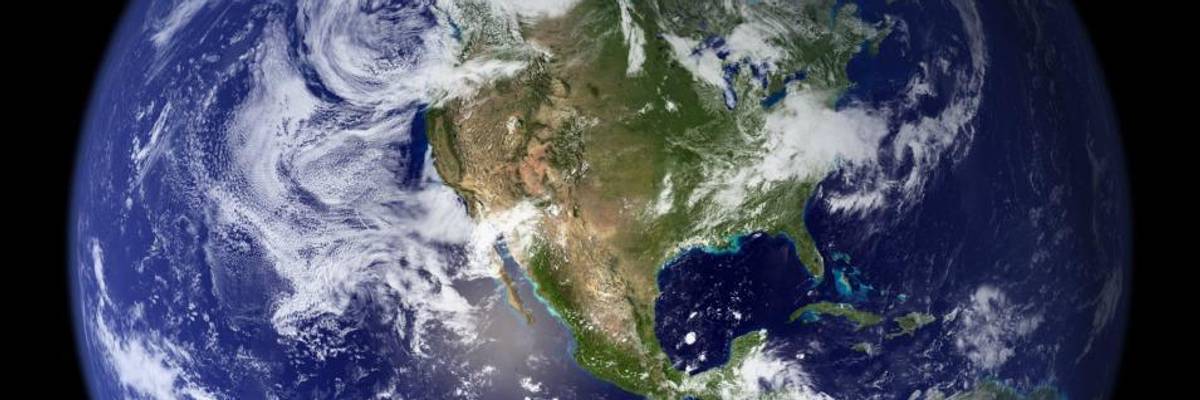
The Earth is seen from space.
We must find a middle ground between the temptation to deny there is a problem and despair that there are no solutions.
On this 54th Anniversary of America's first Earth Day celebration, it is a time to reflect on how we moved from a consensus on the urgent need for environmental protection across the country to woefully underestimating the need for action about climate change.
A recent study shows that most Europeans and Americans acknowledge that the climate is warming and that a warming planet will likely hurt humankind. At the same time, there is a distortion of the scientific consensus about the data, which leads to a tendency among the public to underestimate the urgency of the situation. This misunderstanding comes from an inaccurate belief that scientists do not agree about the human-caused nature of the crisis. Fossil fuel industry advocates and media outlets often characterize the scientific debate as mixed when the consensus among scientists is well above 97%.
Let's face it. There is overwhelming scientific agreement, and many members of the public agree.
We do this by moving away from arguments about the scientific consensus and focusing on local problems and solutions.
Humans also tend to have "Earth blindness," that is, we do not appreciate the life support systems that the natural environment provides us with daily. This explains, in part, why people in democratic societies with the freedom to demonstrate are not engaging in large-scale protests. It also seems that more visible and immediate events, such as Covid-19 and conflicts and war, push the long-range danger aside. What a difference from the 1970s—when the environmental movement was on par with student protests in many countries, the anti-war protests, and fighting for women's rights in the United States and other countries!
We can take comfort in the fact that most people across many countries think that a warming climate is not good for humanity. Since most people are aware of the climate situation, the time is now to transform the conversation.
We do this by moving away from arguments about the scientific consensus and focusing on local problems and solutions. Some of the best climate mitigation in this country is happening in communities and municipalities. These efforts include building resilient infrastructure—such as designing energy-efficient buildings—and investing in renewable energy, converting public vehicle fleets to electric, and investing in water conservation and reuse, recycling, and plastic waste reduction, and much, much more. These investments and designs may not be perfect, but they are an important start in creating more climate-friendly spaces for people to live in.
We must also focus efforts throughout higher education and other sectors. My institution, Fielding Graduate University, continues its ecological justice work throughout the world. During 2023's Ecological and Social Justice Service Year, our community members participated in a beach cleanup in Santa Barbara, volunteered at their local nonprofit organizations, and advocated for sustainable solutions in their communities.
Current students and alums continue to study ecological worldviews, conservation, sustainability, and more through their theses and dissertations. Many who wish to advocate for the environment think that only substantial action will achieve anything. While substantial change is certainly necessary, consistent small actions can lead to meaningful, lasting change. We can join in-person or virtual global witnessing groups to share our environmental crisis reflections and action plans. We can tweak our business practices, improve production processes to decrease emissions, decrease our footprint, and advocate at governmental and other levels.
On this Earth Day, I encourage you to reflect upon how your actions can take root in the interests of our environment. It is our responsibility to leave the Earth better than we found it. We must find a middle ground between the temptation to deny there is a problem and despair that there are no solutions. From an acknowledgment of the reality of the climate crisis, we can continue our transformative path to positively affect the Earth for the benefit of generations to come.
Dear Common Dreams reader, It’s been nearly 30 years since I co-founded Common Dreams with my late wife, Lina Newhouser. We had the radical notion that journalism should serve the public good, not corporate profits. It was clear to us from the outset what it would take to build such a project. No paid advertisements. No corporate sponsors. No millionaire publisher telling us what to think or do. Many people said we wouldn't last a year, but we proved those doubters wrong. Together with a tremendous team of journalists and dedicated staff, we built an independent media outlet free from the constraints of profits and corporate control. Our mission has always been simple: To inform. To inspire. To ignite change for the common good. Building Common Dreams was not easy. Our survival was never guaranteed. When you take on the most powerful forces—Wall Street greed, fossil fuel industry destruction, Big Tech lobbyists, and uber-rich oligarchs who have spent billions upon billions rigging the economy and democracy in their favor—the only bulwark you have is supporters who believe in your work. But here’s the urgent message from me today. It's never been this bad out there. And it's never been this hard to keep us going. At the very moment Common Dreams is most needed, the threats we face are intensifying. We need your support now more than ever. We don't accept corporate advertising and never will. We don't have a paywall because we don't think people should be blocked from critical news based on their ability to pay. Everything we do is funded by the donations of readers like you. When everyone does the little they can afford, we are strong. But if that support retreats or dries up, so do we. Will you donate now to make sure Common Dreams not only survives but thrives? —Craig Brown, Co-founder |
On this 54th Anniversary of America's first Earth Day celebration, it is a time to reflect on how we moved from a consensus on the urgent need for environmental protection across the country to woefully underestimating the need for action about climate change.
A recent study shows that most Europeans and Americans acknowledge that the climate is warming and that a warming planet will likely hurt humankind. At the same time, there is a distortion of the scientific consensus about the data, which leads to a tendency among the public to underestimate the urgency of the situation. This misunderstanding comes from an inaccurate belief that scientists do not agree about the human-caused nature of the crisis. Fossil fuel industry advocates and media outlets often characterize the scientific debate as mixed when the consensus among scientists is well above 97%.
Let's face it. There is overwhelming scientific agreement, and many members of the public agree.
We do this by moving away from arguments about the scientific consensus and focusing on local problems and solutions.
Humans also tend to have "Earth blindness," that is, we do not appreciate the life support systems that the natural environment provides us with daily. This explains, in part, why people in democratic societies with the freedom to demonstrate are not engaging in large-scale protests. It also seems that more visible and immediate events, such as Covid-19 and conflicts and war, push the long-range danger aside. What a difference from the 1970s—when the environmental movement was on par with student protests in many countries, the anti-war protests, and fighting for women's rights in the United States and other countries!
We can take comfort in the fact that most people across many countries think that a warming climate is not good for humanity. Since most people are aware of the climate situation, the time is now to transform the conversation.
We do this by moving away from arguments about the scientific consensus and focusing on local problems and solutions. Some of the best climate mitigation in this country is happening in communities and municipalities. These efforts include building resilient infrastructure—such as designing energy-efficient buildings—and investing in renewable energy, converting public vehicle fleets to electric, and investing in water conservation and reuse, recycling, and plastic waste reduction, and much, much more. These investments and designs may not be perfect, but they are an important start in creating more climate-friendly spaces for people to live in.
We must also focus efforts throughout higher education and other sectors. My institution, Fielding Graduate University, continues its ecological justice work throughout the world. During 2023's Ecological and Social Justice Service Year, our community members participated in a beach cleanup in Santa Barbara, volunteered at their local nonprofit organizations, and advocated for sustainable solutions in their communities.
Current students and alums continue to study ecological worldviews, conservation, sustainability, and more through their theses and dissertations. Many who wish to advocate for the environment think that only substantial action will achieve anything. While substantial change is certainly necessary, consistent small actions can lead to meaningful, lasting change. We can join in-person or virtual global witnessing groups to share our environmental crisis reflections and action plans. We can tweak our business practices, improve production processes to decrease emissions, decrease our footprint, and advocate at governmental and other levels.
On this Earth Day, I encourage you to reflect upon how your actions can take root in the interests of our environment. It is our responsibility to leave the Earth better than we found it. We must find a middle ground between the temptation to deny there is a problem and despair that there are no solutions. From an acknowledgment of the reality of the climate crisis, we can continue our transformative path to positively affect the Earth for the benefit of generations to come.
On this 54th Anniversary of America's first Earth Day celebration, it is a time to reflect on how we moved from a consensus on the urgent need for environmental protection across the country to woefully underestimating the need for action about climate change.
A recent study shows that most Europeans and Americans acknowledge that the climate is warming and that a warming planet will likely hurt humankind. At the same time, there is a distortion of the scientific consensus about the data, which leads to a tendency among the public to underestimate the urgency of the situation. This misunderstanding comes from an inaccurate belief that scientists do not agree about the human-caused nature of the crisis. Fossil fuel industry advocates and media outlets often characterize the scientific debate as mixed when the consensus among scientists is well above 97%.
Let's face it. There is overwhelming scientific agreement, and many members of the public agree.
We do this by moving away from arguments about the scientific consensus and focusing on local problems and solutions.
Humans also tend to have "Earth blindness," that is, we do not appreciate the life support systems that the natural environment provides us with daily. This explains, in part, why people in democratic societies with the freedom to demonstrate are not engaging in large-scale protests. It also seems that more visible and immediate events, such as Covid-19 and conflicts and war, push the long-range danger aside. What a difference from the 1970s—when the environmental movement was on par with student protests in many countries, the anti-war protests, and fighting for women's rights in the United States and other countries!
We can take comfort in the fact that most people across many countries think that a warming climate is not good for humanity. Since most people are aware of the climate situation, the time is now to transform the conversation.
We do this by moving away from arguments about the scientific consensus and focusing on local problems and solutions. Some of the best climate mitigation in this country is happening in communities and municipalities. These efforts include building resilient infrastructure—such as designing energy-efficient buildings—and investing in renewable energy, converting public vehicle fleets to electric, and investing in water conservation and reuse, recycling, and plastic waste reduction, and much, much more. These investments and designs may not be perfect, but they are an important start in creating more climate-friendly spaces for people to live in.
We must also focus efforts throughout higher education and other sectors. My institution, Fielding Graduate University, continues its ecological justice work throughout the world. During 2023's Ecological and Social Justice Service Year, our community members participated in a beach cleanup in Santa Barbara, volunteered at their local nonprofit organizations, and advocated for sustainable solutions in their communities.
Current students and alums continue to study ecological worldviews, conservation, sustainability, and more through their theses and dissertations. Many who wish to advocate for the environment think that only substantial action will achieve anything. While substantial change is certainly necessary, consistent small actions can lead to meaningful, lasting change. We can join in-person or virtual global witnessing groups to share our environmental crisis reflections and action plans. We can tweak our business practices, improve production processes to decrease emissions, decrease our footprint, and advocate at governmental and other levels.
On this Earth Day, I encourage you to reflect upon how your actions can take root in the interests of our environment. It is our responsibility to leave the Earth better than we found it. We must find a middle ground between the temptation to deny there is a problem and despair that there are no solutions. From an acknowledgment of the reality of the climate crisis, we can continue our transformative path to positively affect the Earth for the benefit of generations to come.