

SUBSCRIBE TO OUR FREE NEWSLETTER
Daily news & progressive opinion—funded by the people, not the corporations—delivered straight to your inbox.
5
#000000
#FFFFFF
To donate by check, phone, or other method, see our More Ways to Give page.
Daily news & progressive opinion—funded by the people, not the corporations—delivered straight to your inbox.
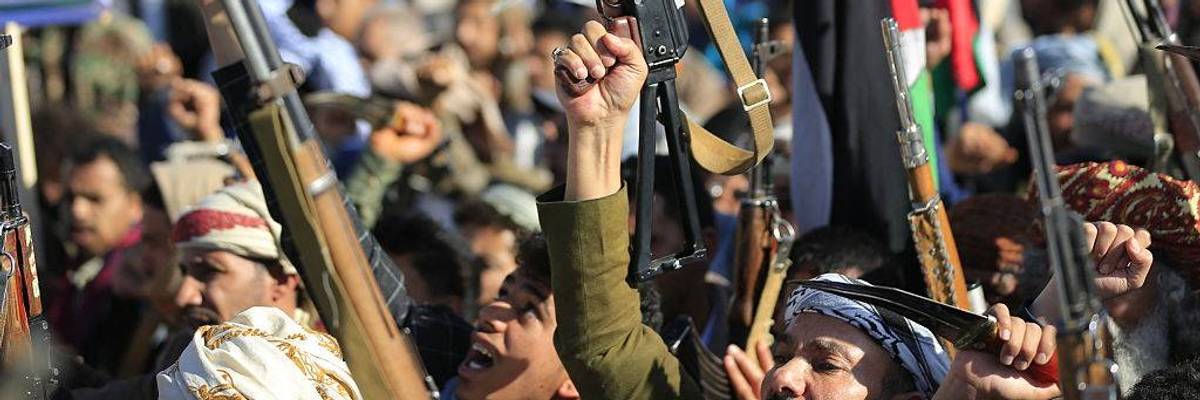
Members of Ansar Allah brandish their weapons as they rally in solidarity with Iran and Lebanon, amid the US-Israeli war with Iran, in the Yemeni capital Sana’a on March 27, 2026.
Recognition of Ansar Allah as the legitimate interim or transitional government of Yemen would be an important step to align the international response with the reality on the ground and with the Yemeni people’s desperate need for peace and self-determination.
The Trump administration came perilously close to launching another bombing campaign against Yemen this weekend. According to a September 20 New York Times report, US commanders had approved their targets, American troops were loading bombs onto warplanes, and an attack on Yemen's Ansar Allah forces was about to begin when President Donald Trump abruptly reversed course.
For two weeks, Saudi Crown Prince Mohammed bin Salman had been pleading with Trump to intervene as Ansar Allah (Houthi) forces swept through Saudi-backed forces’ positions along Yemen's Red Sea coast. Trump initially resisted, but after another urgent call from the Saudi crown prince, he instructed the Pentagon to prepare for airstrikes. By Sunday, he had changed his mind again, at least temporarily.
The New York Times reported that many of Trump's closest advisers opposed joining the Saudi war. US military officials also questioned whether renewed bombing would accomplish anything, given that Ansar Allah had withstood more than 1,000 US strikes during a seven-week campaign in 2025. That operation consumed roughly $1 billion in munitions and other military resources in its first month alone.
It is simply wrong, legally and morally, to claim that a collection of Ansar Allah’s opponents holed up in Aden and hotels in Saudi Arabia are the legitimate government of Yemen, and that the government that has run the country and defended it against a decade of outside aggression is illegitimate.
Meanwhile, Ansar Allah has assured Washington that it does not intend to attack American ships. US officials recently met Ansar Allah representatives in Oman in an effort to preserve that agreement. A new American bombing campaign could undo those diplomatic gains and threaten shipping through the Bab al-Mandab Strait just as the Strait of Hormuz remains severely disrupted.
The crisis spawned by the US war on Iran spread to this dangerous new front on July 13, when the 2022 ceasefire between Saudi Arabia and the de facto Ansar Allah government in Yemen was shattered by a Saudi missile strike on the airport in Sana’a, Yemen’s capital.
The Saudi attack was designed to prevent the landing of an Iranian Mahan Air civilian plane carrying passengers returning from the funeral of Iran’s assassinated Supreme Leader Ali Khamenei in Tehran. The flight was forced to divert to Hodeidah, 140 miles away on the Red Sea coast.
Yemen’s Ansar Allah forces retaliated by attacking the Saudi airport at Abha, near the Yemeni border, with missiles and drones. Since then, hostilities have escalated dramatically.
Ansar Allah forces have captured the strategic port city of Mocha and the remainder of the Red Sea coast from Saudi-backed forces. They are still fighting to consolidate control of the Kahbub mountains that overlook the approaches to the Bab el-Mandeb Strait between the Red Sea and the Gulf of Aden, but they are already preventing Saudi ships from sailing through the Red Sea.
The Saudis have responded with hundreds of air strikes on Yemen. Ansar Allah, in turn, has attacked Saudi airbases and oil infrastructure with missiles and drones. Either the Yemenis or their allies in Iraq struck pumping stations on Saudi Arabia’s East-West Pipeline, which was the Saudis’ best alternative to the Strait of Hormuz as a route for their oil exports, shutting down the pumping stations, and full operation of the pipeline, for at least a month.
The United States has dispatched an estimated 200 additional troops to Saudi Arabia to provide intelligence and targeting expertise for Saudi airstrikes, using programs like Palantir’s Maven AI system, which the US and Israel also use in Gaza, and which US officials now admit was used in the massacre at the Minab girls’ school in Iran in February.
The US State Department has also approved a $5 billion weapons sale that would provide Saudi Arabia with 5,000 2,000-pound bombs and 5,000 500-pound bombs, along with JDAM guidance kits and fuses. This comes in addition to a planned $24 billion sale of 48 F-35 fighter jets to the Saudis and follows record US arms sales to Saudi Arabia for $110 billion in 2018 and $142 billion in 2025.
Congress has not yet consented to these latest Saudi arms sales that can only mean more death and devastation for the people of Yemen. Sen. Ed Markey (D-Mass.), backed by Sens. Jeff Merkley (D-Ore.) and Bernie Sanders (I-Vt.), has filed a Joint Resolution of Disapproval that can stop the sale if it receives enough votes. Here’s a link to ask your senators to support it.
US support for Saudi Arabia’s war on Yemen is based on US recognition of the Saudi-based Presidential Leadership Council (PLC), chaired by Rashad al-Alimi, as the government of Yemen. The council was created in 2022 after former Yemeni president Abdrabbuh Mansour Hadi resigned, following the United Nations-brokered truce.
But the renewed war raises a fundamental question: Why is the United States still treating a Saudi-based council as the legitimate government of Yemen, while refusing to recognize the government that actually controls the capital and governs most of the country’s population?
Since 2015, international recognition of Saudi-backed governments-in-exile has served to justify a decade of war and economic strangulation against 80% of Yemenis who live in the area governed by Ansar Allah, including Sana’a, the capital.
Between 2015 and 2022, with full US support, Saudi Arabia and its allies dropped over 69,000 bombs and missiles on Yemen, including thousands on civilian targets, killing at least 8,983 civilians, according to Iona Craig’s Yemen Data Project. By the end of 2021, the UN estimated that the war, blockade, and resulting humanitarian crisis had caused 377,000 deaths.
So how did Yemen end up in such a frightful predicament? How can the United States, other countries, and even the UN continue to recognize exile governments that have supported bombarding and starving their own people for over a decade?
The roots lie in Yemen’s failed political transition after the Arab Spring. In 2011, a mostly peaceful uprising brought down Yemen’s corrupt, repressive, US-backed president, Ali Abdullah Saleh. His vice president, Hadi, was appointed to a two-year term as interim president in 2012. Ansar Allah, based in Saada in north Yemen, played a leading role in the uprising against Saleh and participated in the National Dialogue that was supposed to guide the transition.
But Hadi failed to organize the planned election by February 2014. His term was extended for another year, but the transition again stalled. That’s when Ansar Allah moved south from its base in Saada, combining popular protests over fuel prices and the stalled political transition with an armed advance toward Sana’a. Its fighters entered the capital in September 2014, defeating government forces. Ansar Allah was subsequently granted seats in a UN-approved interim government under President Hadi.
But the power-sharing arrangement quickly broke down. Tensions between Ansar Allah and Hadi’s government escalated over the drafting of a new constitution and the division of political power. In January 2015, Ansar Allah seized the presidential palace, and Hadi resigned and retired to his home in Aden. Ansar Allah formed a ruling council to fill the vacuum.
However, a month later, with support from Saudi Arabia, Hadi rescinded his resignation and tried to reclaim the presidency. A few days later, he fled from Aden to Riyadh, the capital of Saudi Arabia, and, in March, 2015, the Saudis attacked Yemen, with US support. This led to a devastating seven-year-long bombing campaign, with other Arab countries sometimesproviding warplanes and ground forces. But the Saudis failed to restore Hadi to power or to capture the most populated parts of the country.
Both Hadi’s claim to the presidency and Saudi Arabia’s military intervention on his behalf lacked legitimacy from the outset. The Saudi assault on Yemen was not approved by the UN Security Council, making it a violation of the UN Charter’s prohibition on the use of military force.
As the Saudi-led, US-backed war raged on, splits appeared in both the anti-Houthi forces and the countries backing them. The UAE backed a separatist Southern Transitional Council (STC) in Aden, whose goal was an independent South Yemen.
The UAE finally withdrew its forces at the end of 2025, and the Saudi-based PLC defeated the STC in Aden. But Saudi-funded mercenaries, mostly from Sudan, and eight disparate Yemeni groups that still hold territory in the south and east, had neither the strength nor the unity to resist Ansar Allah’s offensive along the Red Sea coast.
Ansar Allah, by contrast, has grown stronger. Skilled Yemeni engineers have learned to manufacture missiles and drones, using parts imported mainly from China, and its forces have fought successful wars to defend Yemen from its enemies and exert control over shipping in the Red Sea, despite heavy US bombing campaigns in 2024 under Joe Biden and 2025 under Trump.
They have also gained global support for their defense of Palestinians when they launched missiles and drones at Israel and disrupted Red Sea shipping during Israel’s genocide in Gaza.
Ansar Allah is now a well-established, and seemingly popular, nationalist government. This reality contradicts the Western assertion that they are simply an Iranian proxy.
In fact, Ansar Allah is deeply rooted in Yemen itself, emerging from the Zaydi religious and ethnic group of northern Yemen whose Imams ruled Yemen for centuries.
Zaydis currently make up between 35% and 45% of Yemen’s population, and have historically co-existed peacefully with their Sunni neighbors. It is simply wrong, legally and morally, to claim that a collection of Ansar Allah’s opponents holed up in Aden and hotels in Saudi Arabia are the legitimate government of Yemen, and that the government that has run the country and defended it against a decade of outside aggression is illegitimate.
As the UN General Assembly meets in New York this week, world leaders have a chance to address this injustice and its catastrophic impact on the long-suffering people of Yemen. China and other countries have long called for a political settlement. In 2018, 63 US Senators voted to withdraw US support for the war after the Saudis murdered journalist Jamal Khashoggi. And in 2022, the UN successfully brokered a ceasefire that prevented large-scale hostilities for several years.
UN officials and world leaders should use this occasion to work for a diplomatic solution.
Recognition of Ansar Allah as the legitimate interim or transitional government of Yemen would be an important step to align the international response with the reality on the ground and with the Yemeni people’s desperate need for peace and self-determination.
At the very least, it is high time for the United States, the United Nations, and the media to stop referring to a self-appointed gang of Saudi collaborators as Yemen’s “internationally recognized government.”
Dear Common Dreams reader, It’s been nearly 30 years since I co-founded Common Dreams with my late wife, Lina Newhouser. We had the radical notion that journalism should serve the public good, not corporate profits. It was clear to us from the outset what it would take to build such a project. No paid advertisements. No corporate sponsors. No millionaire publisher telling us what to think or do. Many people said we wouldn't last a year, but we proved those doubters wrong. Together with a tremendous team of journalists and dedicated staff, we built an independent media outlet free from the constraints of profits and corporate control. Our mission has always been simple: To inform. To inspire. To ignite change for the common good. Building Common Dreams was not easy. Our survival was never guaranteed. When you take on the most powerful forces—Wall Street greed, fossil fuel industry destruction, Big Tech lobbyists, and uber-rich oligarchs who have spent billions upon billions rigging the economy and democracy in their favor—the only bulwark you have is supporters who believe in your work. But here’s the urgent message from me today. It's never been this bad out there. And it's never been this hard to keep us going. At the very moment Common Dreams is most needed, the threats we face are intensifying. We need your support now more than ever. We don't accept corporate advertising and never will. We don't have a paywall because we don't think people should be blocked from critical news based on their ability to pay. Everything we do is funded by the donations of readers like you. When everyone does the little they can afford, we are strong. But if that support retreats or dries up, so do we. Will you donate now to make sure Common Dreams not only survives but thrives? —Craig Brown, Co-founder |
The Trump administration came perilously close to launching another bombing campaign against Yemen this weekend. According to a September 20 New York Times report, US commanders had approved their targets, American troops were loading bombs onto warplanes, and an attack on Yemen's Ansar Allah forces was about to begin when President Donald Trump abruptly reversed course.
For two weeks, Saudi Crown Prince Mohammed bin Salman had been pleading with Trump to intervene as Ansar Allah (Houthi) forces swept through Saudi-backed forces’ positions along Yemen's Red Sea coast. Trump initially resisted, but after another urgent call from the Saudi crown prince, he instructed the Pentagon to prepare for airstrikes. By Sunday, he had changed his mind again, at least temporarily.
The New York Times reported that many of Trump's closest advisers opposed joining the Saudi war. US military officials also questioned whether renewed bombing would accomplish anything, given that Ansar Allah had withstood more than 1,000 US strikes during a seven-week campaign in 2025. That operation consumed roughly $1 billion in munitions and other military resources in its first month alone.
It is simply wrong, legally and morally, to claim that a collection of Ansar Allah’s opponents holed up in Aden and hotels in Saudi Arabia are the legitimate government of Yemen, and that the government that has run the country and defended it against a decade of outside aggression is illegitimate.
Meanwhile, Ansar Allah has assured Washington that it does not intend to attack American ships. US officials recently met Ansar Allah representatives in Oman in an effort to preserve that agreement. A new American bombing campaign could undo those diplomatic gains and threaten shipping through the Bab al-Mandab Strait just as the Strait of Hormuz remains severely disrupted.
The crisis spawned by the US war on Iran spread to this dangerous new front on July 13, when the 2022 ceasefire between Saudi Arabia and the de facto Ansar Allah government in Yemen was shattered by a Saudi missile strike on the airport in Sana’a, Yemen’s capital.
The Saudi attack was designed to prevent the landing of an Iranian Mahan Air civilian plane carrying passengers returning from the funeral of Iran’s assassinated Supreme Leader Ali Khamenei in Tehran. The flight was forced to divert to Hodeidah, 140 miles away on the Red Sea coast.
Yemen’s Ansar Allah forces retaliated by attacking the Saudi airport at Abha, near the Yemeni border, with missiles and drones. Since then, hostilities have escalated dramatically.
Ansar Allah forces have captured the strategic port city of Mocha and the remainder of the Red Sea coast from Saudi-backed forces. They are still fighting to consolidate control of the Kahbub mountains that overlook the approaches to the Bab el-Mandeb Strait between the Red Sea and the Gulf of Aden, but they are already preventing Saudi ships from sailing through the Red Sea.
The Saudis have responded with hundreds of air strikes on Yemen. Ansar Allah, in turn, has attacked Saudi airbases and oil infrastructure with missiles and drones. Either the Yemenis or their allies in Iraq struck pumping stations on Saudi Arabia’s East-West Pipeline, which was the Saudis’ best alternative to the Strait of Hormuz as a route for their oil exports, shutting down the pumping stations, and full operation of the pipeline, for at least a month.
The United States has dispatched an estimated 200 additional troops to Saudi Arabia to provide intelligence and targeting expertise for Saudi airstrikes, using programs like Palantir’s Maven AI system, which the US and Israel also use in Gaza, and which US officials now admit was used in the massacre at the Minab girls’ school in Iran in February.
The US State Department has also approved a $5 billion weapons sale that would provide Saudi Arabia with 5,000 2,000-pound bombs and 5,000 500-pound bombs, along with JDAM guidance kits and fuses. This comes in addition to a planned $24 billion sale of 48 F-35 fighter jets to the Saudis and follows record US arms sales to Saudi Arabia for $110 billion in 2018 and $142 billion in 2025.
Congress has not yet consented to these latest Saudi arms sales that can only mean more death and devastation for the people of Yemen. Sen. Ed Markey (D-Mass.), backed by Sens. Jeff Merkley (D-Ore.) and Bernie Sanders (I-Vt.), has filed a Joint Resolution of Disapproval that can stop the sale if it receives enough votes. Here’s a link to ask your senators to support it.
US support for Saudi Arabia’s war on Yemen is based on US recognition of the Saudi-based Presidential Leadership Council (PLC), chaired by Rashad al-Alimi, as the government of Yemen. The council was created in 2022 after former Yemeni president Abdrabbuh Mansour Hadi resigned, following the United Nations-brokered truce.
But the renewed war raises a fundamental question: Why is the United States still treating a Saudi-based council as the legitimate government of Yemen, while refusing to recognize the government that actually controls the capital and governs most of the country’s population?
Since 2015, international recognition of Saudi-backed governments-in-exile has served to justify a decade of war and economic strangulation against 80% of Yemenis who live in the area governed by Ansar Allah, including Sana’a, the capital.
Between 2015 and 2022, with full US support, Saudi Arabia and its allies dropped over 69,000 bombs and missiles on Yemen, including thousands on civilian targets, killing at least 8,983 civilians, according to Iona Craig’s Yemen Data Project. By the end of 2021, the UN estimated that the war, blockade, and resulting humanitarian crisis had caused 377,000 deaths.
So how did Yemen end up in such a frightful predicament? How can the United States, other countries, and even the UN continue to recognize exile governments that have supported bombarding and starving their own people for over a decade?
The roots lie in Yemen’s failed political transition after the Arab Spring. In 2011, a mostly peaceful uprising brought down Yemen’s corrupt, repressive, US-backed president, Ali Abdullah Saleh. His vice president, Hadi, was appointed to a two-year term as interim president in 2012. Ansar Allah, based in Saada in north Yemen, played a leading role in the uprising against Saleh and participated in the National Dialogue that was supposed to guide the transition.
But Hadi failed to organize the planned election by February 2014. His term was extended for another year, but the transition again stalled. That’s when Ansar Allah moved south from its base in Saada, combining popular protests over fuel prices and the stalled political transition with an armed advance toward Sana’a. Its fighters entered the capital in September 2014, defeating government forces. Ansar Allah was subsequently granted seats in a UN-approved interim government under President Hadi.
But the power-sharing arrangement quickly broke down. Tensions between Ansar Allah and Hadi’s government escalated over the drafting of a new constitution and the division of political power. In January 2015, Ansar Allah seized the presidential palace, and Hadi resigned and retired to his home in Aden. Ansar Allah formed a ruling council to fill the vacuum.
However, a month later, with support from Saudi Arabia, Hadi rescinded his resignation and tried to reclaim the presidency. A few days later, he fled from Aden to Riyadh, the capital of Saudi Arabia, and, in March, 2015, the Saudis attacked Yemen, with US support. This led to a devastating seven-year-long bombing campaign, with other Arab countries sometimesproviding warplanes and ground forces. But the Saudis failed to restore Hadi to power or to capture the most populated parts of the country.
Both Hadi’s claim to the presidency and Saudi Arabia’s military intervention on his behalf lacked legitimacy from the outset. The Saudi assault on Yemen was not approved by the UN Security Council, making it a violation of the UN Charter’s prohibition on the use of military force.
As the Saudi-led, US-backed war raged on, splits appeared in both the anti-Houthi forces and the countries backing them. The UAE backed a separatist Southern Transitional Council (STC) in Aden, whose goal was an independent South Yemen.
The UAE finally withdrew its forces at the end of 2025, and the Saudi-based PLC defeated the STC in Aden. But Saudi-funded mercenaries, mostly from Sudan, and eight disparate Yemeni groups that still hold territory in the south and east, had neither the strength nor the unity to resist Ansar Allah’s offensive along the Red Sea coast.
Ansar Allah, by contrast, has grown stronger. Skilled Yemeni engineers have learned to manufacture missiles and drones, using parts imported mainly from China, and its forces have fought successful wars to defend Yemen from its enemies and exert control over shipping in the Red Sea, despite heavy US bombing campaigns in 2024 under Joe Biden and 2025 under Trump.
They have also gained global support for their defense of Palestinians when they launched missiles and drones at Israel and disrupted Red Sea shipping during Israel’s genocide in Gaza.
Ansar Allah is now a well-established, and seemingly popular, nationalist government. This reality contradicts the Western assertion that they are simply an Iranian proxy.
In fact, Ansar Allah is deeply rooted in Yemen itself, emerging from the Zaydi religious and ethnic group of northern Yemen whose Imams ruled Yemen for centuries.
Zaydis currently make up between 35% and 45% of Yemen’s population, and have historically co-existed peacefully with their Sunni neighbors. It is simply wrong, legally and morally, to claim that a collection of Ansar Allah’s opponents holed up in Aden and hotels in Saudi Arabia are the legitimate government of Yemen, and that the government that has run the country and defended it against a decade of outside aggression is illegitimate.
As the UN General Assembly meets in New York this week, world leaders have a chance to address this injustice and its catastrophic impact on the long-suffering people of Yemen. China and other countries have long called for a political settlement. In 2018, 63 US Senators voted to withdraw US support for the war after the Saudis murdered journalist Jamal Khashoggi. And in 2022, the UN successfully brokered a ceasefire that prevented large-scale hostilities for several years.
UN officials and world leaders should use this occasion to work for a diplomatic solution.
Recognition of Ansar Allah as the legitimate interim or transitional government of Yemen would be an important step to align the international response with the reality on the ground and with the Yemeni people’s desperate need for peace and self-determination.
At the very least, it is high time for the United States, the United Nations, and the media to stop referring to a self-appointed gang of Saudi collaborators as Yemen’s “internationally recognized government.”
The Trump administration came perilously close to launching another bombing campaign against Yemen this weekend. According to a September 20 New York Times report, US commanders had approved their targets, American troops were loading bombs onto warplanes, and an attack on Yemen's Ansar Allah forces was about to begin when President Donald Trump abruptly reversed course.
For two weeks, Saudi Crown Prince Mohammed bin Salman had been pleading with Trump to intervene as Ansar Allah (Houthi) forces swept through Saudi-backed forces’ positions along Yemen's Red Sea coast. Trump initially resisted, but after another urgent call from the Saudi crown prince, he instructed the Pentagon to prepare for airstrikes. By Sunday, he had changed his mind again, at least temporarily.
The New York Times reported that many of Trump's closest advisers opposed joining the Saudi war. US military officials also questioned whether renewed bombing would accomplish anything, given that Ansar Allah had withstood more than 1,000 US strikes during a seven-week campaign in 2025. That operation consumed roughly $1 billion in munitions and other military resources in its first month alone.
It is simply wrong, legally and morally, to claim that a collection of Ansar Allah’s opponents holed up in Aden and hotels in Saudi Arabia are the legitimate government of Yemen, and that the government that has run the country and defended it against a decade of outside aggression is illegitimate.
Meanwhile, Ansar Allah has assured Washington that it does not intend to attack American ships. US officials recently met Ansar Allah representatives in Oman in an effort to preserve that agreement. A new American bombing campaign could undo those diplomatic gains and threaten shipping through the Bab al-Mandab Strait just as the Strait of Hormuz remains severely disrupted.
The crisis spawned by the US war on Iran spread to this dangerous new front on July 13, when the 2022 ceasefire between Saudi Arabia and the de facto Ansar Allah government in Yemen was shattered by a Saudi missile strike on the airport in Sana’a, Yemen’s capital.
The Saudi attack was designed to prevent the landing of an Iranian Mahan Air civilian plane carrying passengers returning from the funeral of Iran’s assassinated Supreme Leader Ali Khamenei in Tehran. The flight was forced to divert to Hodeidah, 140 miles away on the Red Sea coast.
Yemen’s Ansar Allah forces retaliated by attacking the Saudi airport at Abha, near the Yemeni border, with missiles and drones. Since then, hostilities have escalated dramatically.
Ansar Allah forces have captured the strategic port city of Mocha and the remainder of the Red Sea coast from Saudi-backed forces. They are still fighting to consolidate control of the Kahbub mountains that overlook the approaches to the Bab el-Mandeb Strait between the Red Sea and the Gulf of Aden, but they are already preventing Saudi ships from sailing through the Red Sea.
The Saudis have responded with hundreds of air strikes on Yemen. Ansar Allah, in turn, has attacked Saudi airbases and oil infrastructure with missiles and drones. Either the Yemenis or their allies in Iraq struck pumping stations on Saudi Arabia’s East-West Pipeline, which was the Saudis’ best alternative to the Strait of Hormuz as a route for their oil exports, shutting down the pumping stations, and full operation of the pipeline, for at least a month.
The United States has dispatched an estimated 200 additional troops to Saudi Arabia to provide intelligence and targeting expertise for Saudi airstrikes, using programs like Palantir’s Maven AI system, which the US and Israel also use in Gaza, and which US officials now admit was used in the massacre at the Minab girls’ school in Iran in February.
The US State Department has also approved a $5 billion weapons sale that would provide Saudi Arabia with 5,000 2,000-pound bombs and 5,000 500-pound bombs, along with JDAM guidance kits and fuses. This comes in addition to a planned $24 billion sale of 48 F-35 fighter jets to the Saudis and follows record US arms sales to Saudi Arabia for $110 billion in 2018 and $142 billion in 2025.
Congress has not yet consented to these latest Saudi arms sales that can only mean more death and devastation for the people of Yemen. Sen. Ed Markey (D-Mass.), backed by Sens. Jeff Merkley (D-Ore.) and Bernie Sanders (I-Vt.), has filed a Joint Resolution of Disapproval that can stop the sale if it receives enough votes. Here’s a link to ask your senators to support it.
US support for Saudi Arabia’s war on Yemen is based on US recognition of the Saudi-based Presidential Leadership Council (PLC), chaired by Rashad al-Alimi, as the government of Yemen. The council was created in 2022 after former Yemeni president Abdrabbuh Mansour Hadi resigned, following the United Nations-brokered truce.
But the renewed war raises a fundamental question: Why is the United States still treating a Saudi-based council as the legitimate government of Yemen, while refusing to recognize the government that actually controls the capital and governs most of the country’s population?
Since 2015, international recognition of Saudi-backed governments-in-exile has served to justify a decade of war and economic strangulation against 80% of Yemenis who live in the area governed by Ansar Allah, including Sana’a, the capital.
Between 2015 and 2022, with full US support, Saudi Arabia and its allies dropped over 69,000 bombs and missiles on Yemen, including thousands on civilian targets, killing at least 8,983 civilians, according to Iona Craig’s Yemen Data Project. By the end of 2021, the UN estimated that the war, blockade, and resulting humanitarian crisis had caused 377,000 deaths.
So how did Yemen end up in such a frightful predicament? How can the United States, other countries, and even the UN continue to recognize exile governments that have supported bombarding and starving their own people for over a decade?
The roots lie in Yemen’s failed political transition after the Arab Spring. In 2011, a mostly peaceful uprising brought down Yemen’s corrupt, repressive, US-backed president, Ali Abdullah Saleh. His vice president, Hadi, was appointed to a two-year term as interim president in 2012. Ansar Allah, based in Saada in north Yemen, played a leading role in the uprising against Saleh and participated in the National Dialogue that was supposed to guide the transition.
But Hadi failed to organize the planned election by February 2014. His term was extended for another year, but the transition again stalled. That’s when Ansar Allah moved south from its base in Saada, combining popular protests over fuel prices and the stalled political transition with an armed advance toward Sana’a. Its fighters entered the capital in September 2014, defeating government forces. Ansar Allah was subsequently granted seats in a UN-approved interim government under President Hadi.
But the power-sharing arrangement quickly broke down. Tensions between Ansar Allah and Hadi’s government escalated over the drafting of a new constitution and the division of political power. In January 2015, Ansar Allah seized the presidential palace, and Hadi resigned and retired to his home in Aden. Ansar Allah formed a ruling council to fill the vacuum.
However, a month later, with support from Saudi Arabia, Hadi rescinded his resignation and tried to reclaim the presidency. A few days later, he fled from Aden to Riyadh, the capital of Saudi Arabia, and, in March, 2015, the Saudis attacked Yemen, with US support. This led to a devastating seven-year-long bombing campaign, with other Arab countries sometimesproviding warplanes and ground forces. But the Saudis failed to restore Hadi to power or to capture the most populated parts of the country.
Both Hadi’s claim to the presidency and Saudi Arabia’s military intervention on his behalf lacked legitimacy from the outset. The Saudi assault on Yemen was not approved by the UN Security Council, making it a violation of the UN Charter’s prohibition on the use of military force.
As the Saudi-led, US-backed war raged on, splits appeared in both the anti-Houthi forces and the countries backing them. The UAE backed a separatist Southern Transitional Council (STC) in Aden, whose goal was an independent South Yemen.
The UAE finally withdrew its forces at the end of 2025, and the Saudi-based PLC defeated the STC in Aden. But Saudi-funded mercenaries, mostly from Sudan, and eight disparate Yemeni groups that still hold territory in the south and east, had neither the strength nor the unity to resist Ansar Allah’s offensive along the Red Sea coast.
Ansar Allah, by contrast, has grown stronger. Skilled Yemeni engineers have learned to manufacture missiles and drones, using parts imported mainly from China, and its forces have fought successful wars to defend Yemen from its enemies and exert control over shipping in the Red Sea, despite heavy US bombing campaigns in 2024 under Joe Biden and 2025 under Trump.
They have also gained global support for their defense of Palestinians when they launched missiles and drones at Israel and disrupted Red Sea shipping during Israel’s genocide in Gaza.
Ansar Allah is now a well-established, and seemingly popular, nationalist government. This reality contradicts the Western assertion that they are simply an Iranian proxy.
In fact, Ansar Allah is deeply rooted in Yemen itself, emerging from the Zaydi religious and ethnic group of northern Yemen whose Imams ruled Yemen for centuries.
Zaydis currently make up between 35% and 45% of Yemen’s population, and have historically co-existed peacefully with their Sunni neighbors. It is simply wrong, legally and morally, to claim that a collection of Ansar Allah’s opponents holed up in Aden and hotels in Saudi Arabia are the legitimate government of Yemen, and that the government that has run the country and defended it against a decade of outside aggression is illegitimate.
As the UN General Assembly meets in New York this week, world leaders have a chance to address this injustice and its catastrophic impact on the long-suffering people of Yemen. China and other countries have long called for a political settlement. In 2018, 63 US Senators voted to withdraw US support for the war after the Saudis murdered journalist Jamal Khashoggi. And in 2022, the UN successfully brokered a ceasefire that prevented large-scale hostilities for several years.
UN officials and world leaders should use this occasion to work for a diplomatic solution.
Recognition of Ansar Allah as the legitimate interim or transitional government of Yemen would be an important step to align the international response with the reality on the ground and with the Yemeni people’s desperate need for peace and self-determination.
At the very least, it is high time for the United States, the United Nations, and the media to stop referring to a self-appointed gang of Saudi collaborators as Yemen’s “internationally recognized government.”

