5
#000000
#FFFFFF
To donate by check, phone, or other method, see our More Ways to Give page.
Daily news & progressive opinion—funded by the people, not the corporations—delivered straight to your inbox.
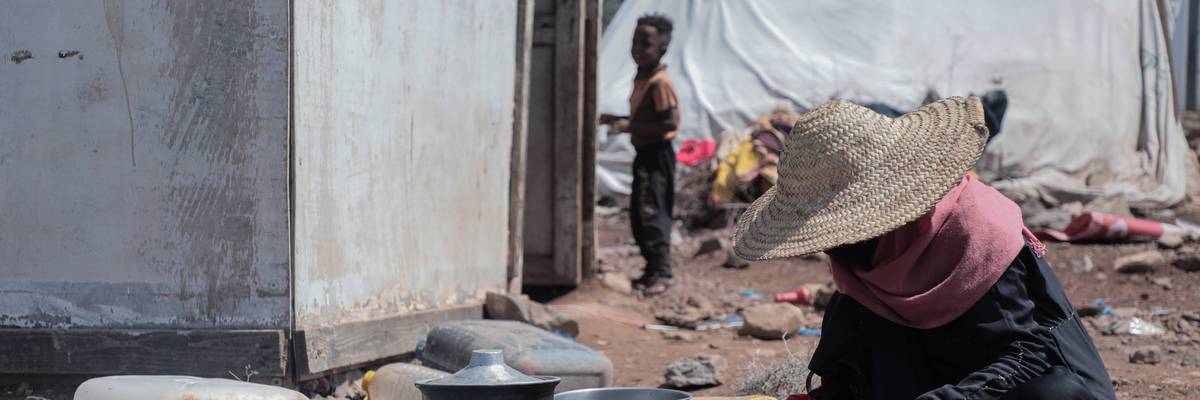
A woman cooks as displaced Yemeni civilians live at temporary shelters in the Bani Omar area of southern Taiz, Yemen, on September 10, 2026, after fleeing escalating armed clashes between government forces and Iran-backed Houthi rebels in the Al-Wazi'iyah district.
"Behind every number is a family who's lost everything," said a top UN official. "Many have been displaced multiple times."
The United Nations agency for migration issues said Sunday that 85,818 Yemeni people have been forcibly displaced in recent days by renewed fighting between Houthi forces and the Saudi-backed government as the Houthis seized control of the Bab al-Mandeb Strait, a key waterway for global oil shipping.
More than 2,000 people fled to Djibouti in recent days, and more are expected to arrive as fighting continues to escalate along the western coast of Yemen and Taiz province, near the port city of Mocha, which the Iran-allied Houthis seized from government forces on Thursday.
Nearly 56,000 people have been forced to leave their homes in Taiz, where heavy ground fighting and counterattacks have been taking place.
Abdusattor Esoev, chief of the International Organization for Migration (IOM) in Yemen, told Al Jazeera that the capture of Mocha, where the UN has maintained a strong infrastructure in recent years, has caused difficulty for aid agencies trying to reach people in need of food, water, medicines, and other humanitarian aid.
"Behind every number is a family who's lost everything," saidd Amy Pope, director general of IOM. "Many have been displaced multiple times. People are crossing the sea with nothing because they have no other choice left. Yemen is a country torn by poverty and conflict, and it cannot carry this crisis alone."
Pope called on donor countries to rapidly scale up support for Yemenis arriving in Djibouti and for 5.2 million people who have been internally displaced in Yemen over 12 years of conflict since the Houthis seized the country's capital, Sanaa, in 2014.
More than 900 people have been killed in this month's escalation, Al Jazeera reported.
A UN-brokered truce in 2022 temporarily halted major battles.
In July, the Houthis declared a blockade on Saudi ships in the Red Sea, which Saudi Arabia had been using to ship oil due to Iran's effective blockade in the Strait of Hormuz—a retaliatory measure Iran took in response to the war that the Trump administration and Israeli Prime Minister Benjamin Netanyahu began in February.
As Common Dreams reported last week, the Houthis see the war being perpetrated by President Donald Trump as a "golden opportunity" to advance against the Saudi-backed Yemeni government.
The Houthis also launched missile and drone strikes on southern Saudi Arabia in recent days.
Mohammed al-Basha, founder and lead analyst of the Basha Report Risk Advisory, told Al Jazeera that Saudi Arabia is likely providing air support to the Yemeni government forces and is under pressure to launch a wider military campaign.
Trump reportedly refused a request from Saudi Arabia to launch airstrikes against the Houthis last week, and said Saturday that the Houthis had reached out to Washington, asking the Trump administration not to intervene in the conflict.
The renewed conflict in Yemen has sparked intensified calls for the White House to end its war on Iran, which has also led to casualties across the Middle East, including in Lebanon.
A woman named Aman Murshed told Al Jazeera on Saturday that her family, including five children, has been displaced in a refugee camp for five years in Taiz, and they were forced to flee again this past week.
“The last four years were calm, and our hopes of returning home grew stronger," she said at the al-Malika camp in al-Maafer district in Taiz. "But suddenly, fighting erupted near our camp three days ago, and we found ourselves fleeing again toward an unknown destination. The only priority was to carry the children and flee as quickly as possible, because any delay could mean death. It was around 5:00 am, and there were no cars in the camp or the surrounding area since it is on the front line. So, we walked for more than two kilometers until we found a pick-up truck that brought us to this camp for free.”
Mohammed Ali, a journalist in Taiz, told Al Jazeera that "the broader US-Iran conflict effectively brought an end to the 2022 truce, as the Houthis have been attempting to advance to take control of the Bab al-Mandeb strait to serve Iran’s agenda."
“The warring sides are escalating, but it is civilians who pay the price," he said. "A single visit to one of the camps for displaced families is enough to see the severe toll this escalation has taken on the Yemeni people.”
Dear Common Dreams reader, It’s been nearly 30 years since I co-founded Common Dreams with my late wife, Lina Newhouser. We had the radical notion that journalism should serve the public good, not corporate profits. It was clear to us from the outset what it would take to build such a project. No paid advertisements. No corporate sponsors. No millionaire publisher telling us what to think or do. Many people said we wouldn't last a year, but we proved those doubters wrong. Together with a tremendous team of journalists and dedicated staff, we built an independent media outlet free from the constraints of profits and corporate control. Our mission has always been simple: To inform. To inspire. To ignite change for the common good. Building Common Dreams was not easy. Our survival was never guaranteed. When you take on the most powerful forces—Wall Street greed, fossil fuel industry destruction, Big Tech lobbyists, and uber-rich oligarchs who have spent billions upon billions rigging the economy and democracy in their favor—the only bulwark you have is supporters who believe in your work. But here’s the urgent message from me today. It's never been this bad out there. And it's never been this hard to keep us going. At the very moment Common Dreams is most needed, the threats we face are intensifying. We need your support now more than ever. We don't accept corporate advertising and never will. We don't have a paywall because we don't think people should be blocked from critical news based on their ability to pay. Everything we do is funded by the donations of readers like you. When everyone does the little they can afford, we are strong. But if that support retreats or dries up, so do we. Will you donate now to make sure Common Dreams not only survives but thrives? —Craig Brown, Co-founder |
The United Nations agency for migration issues said Sunday that 85,818 Yemeni people have been forcibly displaced in recent days by renewed fighting between Houthi forces and the Saudi-backed government as the Houthis seized control of the Bab al-Mandeb Strait, a key waterway for global oil shipping.
More than 2,000 people fled to Djibouti in recent days, and more are expected to arrive as fighting continues to escalate along the western coast of Yemen and Taiz province, near the port city of Mocha, which the Iran-allied Houthis seized from government forces on Thursday.
Nearly 56,000 people have been forced to leave their homes in Taiz, where heavy ground fighting and counterattacks have been taking place.
Abdusattor Esoev, chief of the International Organization for Migration (IOM) in Yemen, told Al Jazeera that the capture of Mocha, where the UN has maintained a strong infrastructure in recent years, has caused difficulty for aid agencies trying to reach people in need of food, water, medicines, and other humanitarian aid.
"Behind every number is a family who's lost everything," saidd Amy Pope, director general of IOM. "Many have been displaced multiple times. People are crossing the sea with nothing because they have no other choice left. Yemen is a country torn by poverty and conflict, and it cannot carry this crisis alone."
Pope called on donor countries to rapidly scale up support for Yemenis arriving in Djibouti and for 5.2 million people who have been internally displaced in Yemen over 12 years of conflict since the Houthis seized the country's capital, Sanaa, in 2014.
More than 900 people have been killed in this month's escalation, Al Jazeera reported.
A UN-brokered truce in 2022 temporarily halted major battles.
In July, the Houthis declared a blockade on Saudi ships in the Red Sea, which Saudi Arabia had been using to ship oil due to Iran's effective blockade in the Strait of Hormuz—a retaliatory measure Iran took in response to the war that the Trump administration and Israeli Prime Minister Benjamin Netanyahu began in February.
As Common Dreams reported last week, the Houthis see the war being perpetrated by President Donald Trump as a "golden opportunity" to advance against the Saudi-backed Yemeni government.
The Houthis also launched missile and drone strikes on southern Saudi Arabia in recent days.
Mohammed al-Basha, founder and lead analyst of the Basha Report Risk Advisory, told Al Jazeera that Saudi Arabia is likely providing air support to the Yemeni government forces and is under pressure to launch a wider military campaign.
Trump reportedly refused a request from Saudi Arabia to launch airstrikes against the Houthis last week, and said Saturday that the Houthis had reached out to Washington, asking the Trump administration not to intervene in the conflict.
The renewed conflict in Yemen has sparked intensified calls for the White House to end its war on Iran, which has also led to casualties across the Middle East, including in Lebanon.
A woman named Aman Murshed told Al Jazeera on Saturday that her family, including five children, has been displaced in a refugee camp for five years in Taiz, and they were forced to flee again this past week.
“The last four years were calm, and our hopes of returning home grew stronger," she said at the al-Malika camp in al-Maafer district in Taiz. "But suddenly, fighting erupted near our camp three days ago, and we found ourselves fleeing again toward an unknown destination. The only priority was to carry the children and flee as quickly as possible, because any delay could mean death. It was around 5:00 am, and there were no cars in the camp or the surrounding area since it is on the front line. So, we walked for more than two kilometers until we found a pick-up truck that brought us to this camp for free.”
Mohammed Ali, a journalist in Taiz, told Al Jazeera that "the broader US-Iran conflict effectively brought an end to the 2022 truce, as the Houthis have been attempting to advance to take control of the Bab al-Mandeb strait to serve Iran’s agenda."
“The warring sides are escalating, but it is civilians who pay the price," he said. "A single visit to one of the camps for displaced families is enough to see the severe toll this escalation has taken on the Yemeni people.”
The United Nations agency for migration issues said Sunday that 85,818 Yemeni people have been forcibly displaced in recent days by renewed fighting between Houthi forces and the Saudi-backed government as the Houthis seized control of the Bab al-Mandeb Strait, a key waterway for global oil shipping.
More than 2,000 people fled to Djibouti in recent days, and more are expected to arrive as fighting continues to escalate along the western coast of Yemen and Taiz province, near the port city of Mocha, which the Iran-allied Houthis seized from government forces on Thursday.
Nearly 56,000 people have been forced to leave their homes in Taiz, where heavy ground fighting and counterattacks have been taking place.
Abdusattor Esoev, chief of the International Organization for Migration (IOM) in Yemen, told Al Jazeera that the capture of Mocha, where the UN has maintained a strong infrastructure in recent years, has caused difficulty for aid agencies trying to reach people in need of food, water, medicines, and other humanitarian aid.
"Behind every number is a family who's lost everything," saidd Amy Pope, director general of IOM. "Many have been displaced multiple times. People are crossing the sea with nothing because they have no other choice left. Yemen is a country torn by poverty and conflict, and it cannot carry this crisis alone."
Pope called on donor countries to rapidly scale up support for Yemenis arriving in Djibouti and for 5.2 million people who have been internally displaced in Yemen over 12 years of conflict since the Houthis seized the country's capital, Sanaa, in 2014.
More than 900 people have been killed in this month's escalation, Al Jazeera reported.
A UN-brokered truce in 2022 temporarily halted major battles.
In July, the Houthis declared a blockade on Saudi ships in the Red Sea, which Saudi Arabia had been using to ship oil due to Iran's effective blockade in the Strait of Hormuz—a retaliatory measure Iran took in response to the war that the Trump administration and Israeli Prime Minister Benjamin Netanyahu began in February.
As Common Dreams reported last week, the Houthis see the war being perpetrated by President Donald Trump as a "golden opportunity" to advance against the Saudi-backed Yemeni government.
The Houthis also launched missile and drone strikes on southern Saudi Arabia in recent days.
Mohammed al-Basha, founder and lead analyst of the Basha Report Risk Advisory, told Al Jazeera that Saudi Arabia is likely providing air support to the Yemeni government forces and is under pressure to launch a wider military campaign.
Trump reportedly refused a request from Saudi Arabia to launch airstrikes against the Houthis last week, and said Saturday that the Houthis had reached out to Washington, asking the Trump administration not to intervene in the conflict.
The renewed conflict in Yemen has sparked intensified calls for the White House to end its war on Iran, which has also led to casualties across the Middle East, including in Lebanon.
A woman named Aman Murshed told Al Jazeera on Saturday that her family, including five children, has been displaced in a refugee camp for five years in Taiz, and they were forced to flee again this past week.
“The last four years were calm, and our hopes of returning home grew stronger," she said at the al-Malika camp in al-Maafer district in Taiz. "But suddenly, fighting erupted near our camp three days ago, and we found ourselves fleeing again toward an unknown destination. The only priority was to carry the children and flee as quickly as possible, because any delay could mean death. It was around 5:00 am, and there were no cars in the camp or the surrounding area since it is on the front line. So, we walked for more than two kilometers until we found a pick-up truck that brought us to this camp for free.”
Mohammed Ali, a journalist in Taiz, told Al Jazeera that "the broader US-Iran conflict effectively brought an end to the 2022 truce, as the Houthis have been attempting to advance to take control of the Bab al-Mandeb strait to serve Iran’s agenda."
“The warring sides are escalating, but it is civilians who pay the price," he said. "A single visit to one of the camps for displaced families is enough to see the severe toll this escalation has taken on the Yemeni people.”