
RECOMMENDED...

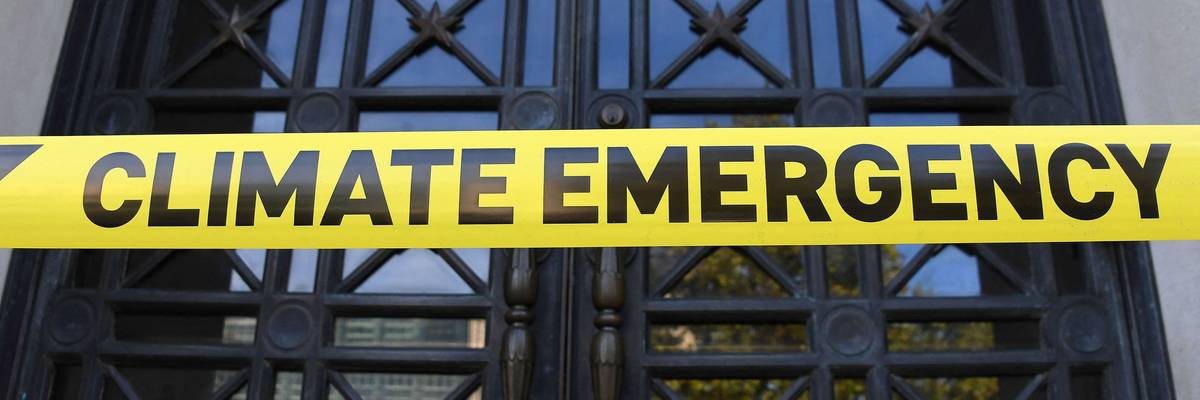
"Climate Emergency" yellow tape hangs outside the entrance of the Department of Interior during a protest by activists against fossil fuels on October 14, 2021, in Washington, DC.
(Photo by Olivier Doulery/ AFP via Getty Images)
We're on the Verge of Exceeding 1.5°C of Warming, But It's Not Too Late for Action
With the mounting economic and human toll of climate disasters and the benefits of affordable, renewable energy so clear and urgent, there is still space for genuine progress and alignment at COP30—and world leaders must seize it!
Oct 28, 2025
Nations will soon be gathering in Belém, Brazil for the annual United Nations climate “conference of the parties”—COP30—against a backdrop of incredibly challenging geopolitical and climate realities. Grossly insufficient action from world leaders has already resulted in worsening climate extreme events and has put the crucial, science-informed goal of limiting global warming to 1.5°C above preindustrial levels out of reach. As I write this, Jamaica, Cuba, the Bahamas, Haiti, and the Dominican Republic are bracing for the monster Hurricane Melissa—the most recent example of the deadly and costly damages from the fossil-fueled climate crisis.
Political headwinds—including the Trump administration’s attacks on climate science and clean energy policies in the United States—and the fossil fuel industry’s continued deception and obstruction are conspiring to make this a very fraught moment for climate action. Yet, with the mounting economic and human toll of climate disasters and the benefits of affordable, renewable energy so clear and urgent, there is still space for genuine progress and alignment at COP30—and world leaders must seize it!
The Significance of a Brazilian COP
The significance of this COP taking place in Brazil, a COP that should forefront the rights of Indigenous communities and the protection of the Amazon forest, cannot be overstated. Across the world, frontline communities bearing a disproportionate toll of climate impacts need solutions that prioritize their needs—not the profits of big polluters and billionaires seeking to evade their responsibility for driving the climate crisis. Unfortunately, the complicated logistics and high accommodation costs for this COP are already creating concerns about inclusivity, especially for those with fewer resources.
The COP Presidency’s Global Mutirão is a bracing call to action. COP30 President André Corrêa do Lago and CEO Ana Toni have laid out a strong vision for a focus on implementation of actions to address climate change, not just a list of future aspirations. They have been engaged in diplomacy all year, bilaterally and multilaterally, to try to lay the groundwork for consensus at COP30 even in the face of geopolitical tensions.
My colleagues and I will be on the ground in Belém, shining a light on the latest science and what it means for decision-makers, people, and the planet as we fight for climate justice alongside civil society representatives from Brazil and across the world. You can follow along with our blog series on COP30.
Breaching 1.5°C of Global Warming Is Alarming, Enraging, and Heartbreaking
UN Secretary General Antonio Guterres’ stark remarks on the 1.5°C climate goal, made at the 75th anniversary of the World Meteorological Organization (WMO) last week, hit hard: “…one thing is already clear: we will not be able to contain the global warming below 1.5°C in the next few years. The overshooting is now inevitable, which means that we are going to have a period, bigger or smaller, with higher or lower intensity, above 1.5°C in the years to come.”
Unfortunately, Secretary General Guterres has simply confirmed what several Intergovernmental Panel on Climate Change scientists, Union of Concerned Scientists scientists, and many others have been sounding the alarm about since the IPCC’s Sixth Assessment Report was released.
Ten years after securing the Paris Agreement, the fact that the world is now on the verge of exceeding 1.5°C of warming on a long-term basis—after already surpassing it temporarily for a full year in 2024—was not inevitable. It is an absolutely enraging, shameful, and heartbreaking consequence of continued delays and obstruction of ambitious action. The fault lies entirely with gutless, self-interested political leaders—especially those from richer, high-emitting nations—and the fossil fuel industry, which has continued to brazenly and shamelessly prioritize its profits over the planet.
No country—not even the United States—can stop global climate action AND it will take a lot of countries acting together to tackle this problem at the scale and with the urgency required.
Breaching 1.5°C will undoubtedly unleash further damaging and irreversible climate harms on the world, but it is not a cliff edge. Climate impacts unfold and accelerate on a continuum, and even now, at about 1.3°C of global warming, we are—and have been—seeing profound harms to people and the planet.
Our response now—because humans still have agency over this dire problem we have caused—will make a crucial difference in the extent of the harms to come and what we can do to prepare for them. How much past 1.5°C temperatures overshoot, and how long that overshoot lasts, will depend crucially on our emissions choices. Those factors will make a tremendous difference for the magnitude of impacts like climate-driven extreme heat in the future. We must also ramp up our investments in resilience to help prepare people for graver threats as temperatures increase.
But some planetary boundaries, once crossed, can set off feedback loops in Earth systems that we will not be able to control. For example, some impacts, like the further irreversible loss of land-based ice, can set off additional multi-century accelerating sea-level rise beyond what is currently locked in, and that cannot be turned back once it gets going even if we manage to bring temperatures back down after overshooting 1.5°C.
The choices our political leaders make now—including at COP30—will determine the future we leave to our children and grandchildren. Those choices include prioritizing actions to:
- Sharply curtail heat-trapping emissions, phase out fossil fuels, and drive toward net negative heat-trapping emissions;
- Invest in climate resilience;
- Share the burdens and opportunities of climate action equitably;
- Secure justice for people on the frontlines of the climate crisis; and
- Demand accountability for fossil fuel companies and others who have contributed the most to the climate crisis.
Latest Science and Data Show Climate Action Is Far Offtrack
Despite all the loud alarm bells, most indicators continue to show a world far offtrack. Data from a recent report from the World Meteorological Organization (WMO) show that global carbon dioxide emissions were at an all-time high in 2024, with the biggest increase from 2023 to 2024 since modern measurements began. In addition to emissions from burning fossil fuels, a strikingly anomalous factor in 2024 was the high levels of emissions from wildfires in North and South America, including in Bolivia, Brazil, and Canada. Meanwhile, the Production Gap Report shows that nations’ fossil fuel production plans are on track to be twice as much in 2030 as would be consistent with a 1.5°C pathway. And countries’ current emission reduction commitments (aka Nationally Determined Contributions or NDCs) are collectively well short of Paris Agreement-aligned goals.
The 2025 NDC Synthesis report and the forthcoming 2025 UN Environment Programme Emissions Gap report further underscore these realities and highlight the very real risk that without immediate action the world could be on track for a global average temperature increase of more than 2.5°C, even approaching 3°C above preindustrial levels. A 3°C world would be catastrophic—with unrelenting extreme heatwaves, major coastal cities inundated by rising seas, food and water shortages, loss of coral reefs and die-back of tropical forests, harms to human health and other disastrous impacts. Meanwhile, the forthcoming 2025 Adaptation Gap report, themed "Running on Empty," will highlight the huge shortfall in investments in resilience to help frontline communities cope with climate impacts already locked in due to heat-trapping emissions primarily from richer nations.
Together, these reports form a dismal assessment of political leaders who are still not acting in line with what science or equity shows is necessary, despite years of high-minded promises and even as people are enduring crushing climate impacts.
Seven Things to Watch at COP30
While the context for COP30 is daunting, and the process of negotiations ahead is likely to be frustrating, global cooperation is absolutely essential to solve this challenge. There are no shortcuts around that. Every country must have a role, a responsibility, and a voice—no matter how big or small, or how powerful or not they are. That said, richer nations and major emitters of heat-trapping emissions have unique responsibilities to act boldly.
Here are seven things I’ll be watching for:
- Will nations remain steadfast in their commitment to the Paris Agreement? At the UN climate summit in September in New York it was clear that nearly every nation recognizes the utmost importance of the Paris Agreement goals for their self-interest and the global collective interest to limit dangerous climate change. The Trump administration, which has shamefully announced its intention to withdraw the United States from the Paris Agreement for the second time, is an isolated rogue actor, acting against the interests of the American people. At COP30, will the BRICS nations, the European Union countries, and others step up to fill the leadership vacuum and drive forward ambitious climate action? Many US states, subnational governments, and businesses also remain committed and will be in Brazil to show the other face of the US.
- How will countries’ emissions reduction commitments (aka NDCs) stack up collectively? So far, the NDC announcements have been a real mixed bag and collectively the announcements have fallen well short of what’s needed. The UN’s NDC Synthesis Report underscores the huge gap in ambition, with most major emitting countries still far off course in terms of their emissions trajectories, putting the world at risk of over 2.5°C of warming. Many countries have yet to even announce their updated NDCs. Closing that ambition gap will require rapid implementation, transparent progress tracking, and stronger accountability mechanisms before 2030.
- How much progress will be made on transitioning away from fossil fuels, tripling renewables, and doubling energy efficiency by 2030? Renewable energy progress—especially propelled by China and India, among others—is cause of optimism. Renewable energy is not just ramping up but actually displacing fossil fuels, and now that momentum must be accelerated. However, coal, oil, and gas are simply not being phased out fast enough, despite countries’ commitments to transition away from fossil fuels made at COP28.
- Will there be any breakthroughs on climate finance? Last year’s COP in Baku, billed as the climate finance COP, ended in deep disappointment and a breakdown of trust between richer nations and lower income nations because of the paltry finance pledges offered. This year, it will be critical to rebuild that trust, including sending a strong signal about a plan for provision of finance for both cutting emissions and for adaptation—the latter of which has long left behind and is an urgent priority for developing nations.
- Will there be an ambitious, fair agreement on safeguarding tropical forest ecosystems? Fittingly, this Brazilian COP taking place in the Amazon must prioritize a strong agreement to help protect tropical forests, a crucial aspect of climate action, centering the needs and perspectives of the people and other species who live in and depend on them. Negotiations on the Tropical Forest Forever Facility will be keenly watched as a barometer of success at COP30.
- Will COP outcomes be protected from interference from fossil fuel interests? Petrostates and increasingly large numbers of fossil fuel company lobbyists have worked behind the scenes and publicly to co-opt the UN COP space and water down global climate agreements that they see as a threat to their profits. Their lies and disinformation about climate science and renewable energy are a significant obstacle to progress and must be called out and resisted.
- Will civil society voices, especially the voices of Indigenous Peoples, get a fair hearing? While civil society representatives do not have a seat at the negotiating table, our voices as observer groups in the broader COP space are crucial to remind political leaders of who they are supposed to be serving (not fossil fuel executives and billionaires!) and that they must prioritize fairness and science in their deliberations. Through engagement with country negotiators, side events, press conferences, and public demonstrations, we will work to register our views loudly and clearly.
What Will It Take for COP30 to Be Successful?
The 10 years since the world secured the historic Paris Agreement have been a time of both incredible progress in renewable energy and worsening climate impacts, illuminating who the real climate champions are and who are the obstacles. COP30’s success depends on whether countries can rise above narrow self-interest and recommit to ambitious action. It depends on whether a shifting world order can unlock progress and leadership from new quarters. It depends on isolating the Trump administration and resisting its anti-science rhetoric and actions, as well as its efforts to upend multilateral diplomacy to solve global challenges.
I am going to Brazil in sober mind frame, deeply worried about the increasingly authoritarian Trump administration. But much as the US is an outsize actor on the global stage, this international climate meeting with 190+ countries is also a reminder of the wider world and each country’s vital place in it. The 1.5°C goal is enshrined in the Paris Agreement because of the bravery of small island nations that carried the refrain of "1.5 to stay alive" at COP21 in 2015. Vanuatu and a group of small island nations led a heroic effort to secure a landmark advisory opinion from the International Court of Justice this year, affirming states’ legal obligations to address climate change. Meanwhile, renewable energy is taking off around the world because it is now the cheapest form of electricity in most places. No country—not even the United States—can stop global climate action AND it will take a lot of countries acting together to tackle this problem at the scale and with the urgency required.
In Belém, I know I will find inspiration and courage from the global climate justice movement, from Indigenous Peoples who have stood firm to defend their lands and communities in the face of brutal attacks, and from passionate young people who are the planet’s future. I know I will come back reenergized for the right and necessary fight here at home
An Urgent Message From Our Co-Founder
Dear Common Dreams reader, It’s been nearly 30 years since I co-founded Common Dreams with my late wife, Lina Newhouser. We had the radical notion that journalism should serve the public good, not corporate profits. It was clear to us from the outset what it would take to build such a project. No paid advertisements. No corporate sponsors. No millionaire publisher telling us what to think or do. Many people said we wouldn't last a year, but we proved those doubters wrong. Together with a tremendous team of journalists and dedicated staff, we built an independent media outlet free from the constraints of profits and corporate control. Our mission has always been simple: To inform. To inspire. To ignite change for the common good. Building Common Dreams was not easy. Our survival was never guaranteed. When you take on the most powerful forces—Wall Street greed, fossil fuel industry destruction, Big Tech lobbyists, and uber-rich oligarchs who have spent billions upon billions rigging the economy and democracy in their favor—the only bulwark you have is supporters who believe in your work. But here’s the urgent message from me today. It's never been this bad out there. And it's never been this hard to keep us going. At the very moment Common Dreams is most needed, the threats we face are intensifying. We need your support now more than ever. We don't accept corporate advertising and never will. We don't have a paywall because we don't think people should be blocked from critical news based on their ability to pay. Everything we do is funded by the donations of readers like you. When everyone does the little they can afford, we are strong. But if that support retreats or dries up, so do we. Will you donate now to make sure Common Dreams not only survives but thrives? —Craig Brown, Co-founder |
© 2023 Union of Concerned Scientists
Rachel Cleetus is the policy director with the Climate and Energy program at the Union of Concerned Scientists.
Nations will soon be gathering in Belém, Brazil for the annual United Nations climate “conference of the parties”—COP30—against a backdrop of incredibly challenging geopolitical and climate realities. Grossly insufficient action from world leaders has already resulted in worsening climate extreme events and has put the crucial, science-informed goal of limiting global warming to 1.5°C above preindustrial levels out of reach. As I write this, Jamaica, Cuba, the Bahamas, Haiti, and the Dominican Republic are bracing for the monster Hurricane Melissa—the most recent example of the deadly and costly damages from the fossil-fueled climate crisis.
Political headwinds—including the Trump administration’s attacks on climate science and clean energy policies in the United States—and the fossil fuel industry’s continued deception and obstruction are conspiring to make this a very fraught moment for climate action. Yet, with the mounting economic and human toll of climate disasters and the benefits of affordable, renewable energy so clear and urgent, there is still space for genuine progress and alignment at COP30—and world leaders must seize it!
The Significance of a Brazilian COP
The significance of this COP taking place in Brazil, a COP that should forefront the rights of Indigenous communities and the protection of the Amazon forest, cannot be overstated. Across the world, frontline communities bearing a disproportionate toll of climate impacts need solutions that prioritize their needs—not the profits of big polluters and billionaires seeking to evade their responsibility for driving the climate crisis. Unfortunately, the complicated logistics and high accommodation costs for this COP are already creating concerns about inclusivity, especially for those with fewer resources.
The COP Presidency’s Global Mutirão is a bracing call to action. COP30 President André Corrêa do Lago and CEO Ana Toni have laid out a strong vision for a focus on implementation of actions to address climate change, not just a list of future aspirations. They have been engaged in diplomacy all year, bilaterally and multilaterally, to try to lay the groundwork for consensus at COP30 even in the face of geopolitical tensions.
My colleagues and I will be on the ground in Belém, shining a light on the latest science and what it means for decision-makers, people, and the planet as we fight for climate justice alongside civil society representatives from Brazil and across the world. You can follow along with our blog series on COP30.
Breaching 1.5°C of Global Warming Is Alarming, Enraging, and Heartbreaking
UN Secretary General Antonio Guterres’ stark remarks on the 1.5°C climate goal, made at the 75th anniversary of the World Meteorological Organization (WMO) last week, hit hard: “…one thing is already clear: we will not be able to contain the global warming below 1.5°C in the next few years. The overshooting is now inevitable, which means that we are going to have a period, bigger or smaller, with higher or lower intensity, above 1.5°C in the years to come.”
Unfortunately, Secretary General Guterres has simply confirmed what several Intergovernmental Panel on Climate Change scientists, Union of Concerned Scientists scientists, and many others have been sounding the alarm about since the IPCC’s Sixth Assessment Report was released.
Ten years after securing the Paris Agreement, the fact that the world is now on the verge of exceeding 1.5°C of warming on a long-term basis—after already surpassing it temporarily for a full year in 2024—was not inevitable. It is an absolutely enraging, shameful, and heartbreaking consequence of continued delays and obstruction of ambitious action. The fault lies entirely with gutless, self-interested political leaders—especially those from richer, high-emitting nations—and the fossil fuel industry, which has continued to brazenly and shamelessly prioritize its profits over the planet.
No country—not even the United States—can stop global climate action AND it will take a lot of countries acting together to tackle this problem at the scale and with the urgency required.
Breaching 1.5°C will undoubtedly unleash further damaging and irreversible climate harms on the world, but it is not a cliff edge. Climate impacts unfold and accelerate on a continuum, and even now, at about 1.3°C of global warming, we are—and have been—seeing profound harms to people and the planet.
Our response now—because humans still have agency over this dire problem we have caused—will make a crucial difference in the extent of the harms to come and what we can do to prepare for them. How much past 1.5°C temperatures overshoot, and how long that overshoot lasts, will depend crucially on our emissions choices. Those factors will make a tremendous difference for the magnitude of impacts like climate-driven extreme heat in the future. We must also ramp up our investments in resilience to help prepare people for graver threats as temperatures increase.
But some planetary boundaries, once crossed, can set off feedback loops in Earth systems that we will not be able to control. For example, some impacts, like the further irreversible loss of land-based ice, can set off additional multi-century accelerating sea-level rise beyond what is currently locked in, and that cannot be turned back once it gets going even if we manage to bring temperatures back down after overshooting 1.5°C.
The choices our political leaders make now—including at COP30—will determine the future we leave to our children and grandchildren. Those choices include prioritizing actions to:
- Sharply curtail heat-trapping emissions, phase out fossil fuels, and drive toward net negative heat-trapping emissions;
- Invest in climate resilience;
- Share the burdens and opportunities of climate action equitably;
- Secure justice for people on the frontlines of the climate crisis; and
- Demand accountability for fossil fuel companies and others who have contributed the most to the climate crisis.
Latest Science and Data Show Climate Action Is Far Offtrack
Despite all the loud alarm bells, most indicators continue to show a world far offtrack. Data from a recent report from the World Meteorological Organization (WMO) show that global carbon dioxide emissions were at an all-time high in 2024, with the biggest increase from 2023 to 2024 since modern measurements began. In addition to emissions from burning fossil fuels, a strikingly anomalous factor in 2024 was the high levels of emissions from wildfires in North and South America, including in Bolivia, Brazil, and Canada. Meanwhile, the Production Gap Report shows that nations’ fossil fuel production plans are on track to be twice as much in 2030 as would be consistent with a 1.5°C pathway. And countries’ current emission reduction commitments (aka Nationally Determined Contributions or NDCs) are collectively well short of Paris Agreement-aligned goals.
The 2025 NDC Synthesis report and the forthcoming 2025 UN Environment Programme Emissions Gap report further underscore these realities and highlight the very real risk that without immediate action the world could be on track for a global average temperature increase of more than 2.5°C, even approaching 3°C above preindustrial levels. A 3°C world would be catastrophic—with unrelenting extreme heatwaves, major coastal cities inundated by rising seas, food and water shortages, loss of coral reefs and die-back of tropical forests, harms to human health and other disastrous impacts. Meanwhile, the forthcoming 2025 Adaptation Gap report, themed "Running on Empty," will highlight the huge shortfall in investments in resilience to help frontline communities cope with climate impacts already locked in due to heat-trapping emissions primarily from richer nations.
Together, these reports form a dismal assessment of political leaders who are still not acting in line with what science or equity shows is necessary, despite years of high-minded promises and even as people are enduring crushing climate impacts.
Seven Things to Watch at COP30
While the context for COP30 is daunting, and the process of negotiations ahead is likely to be frustrating, global cooperation is absolutely essential to solve this challenge. There are no shortcuts around that. Every country must have a role, a responsibility, and a voice—no matter how big or small, or how powerful or not they are. That said, richer nations and major emitters of heat-trapping emissions have unique responsibilities to act boldly.
Here are seven things I’ll be watching for:
- Will nations remain steadfast in their commitment to the Paris Agreement? At the UN climate summit in September in New York it was clear that nearly every nation recognizes the utmost importance of the Paris Agreement goals for their self-interest and the global collective interest to limit dangerous climate change. The Trump administration, which has shamefully announced its intention to withdraw the United States from the Paris Agreement for the second time, is an isolated rogue actor, acting against the interests of the American people. At COP30, will the BRICS nations, the European Union countries, and others step up to fill the leadership vacuum and drive forward ambitious climate action? Many US states, subnational governments, and businesses also remain committed and will be in Brazil to show the other face of the US.
- How will countries’ emissions reduction commitments (aka NDCs) stack up collectively? So far, the NDC announcements have been a real mixed bag and collectively the announcements have fallen well short of what’s needed. The UN’s NDC Synthesis Report underscores the huge gap in ambition, with most major emitting countries still far off course in terms of their emissions trajectories, putting the world at risk of over 2.5°C of warming. Many countries have yet to even announce their updated NDCs. Closing that ambition gap will require rapid implementation, transparent progress tracking, and stronger accountability mechanisms before 2030.
- How much progress will be made on transitioning away from fossil fuels, tripling renewables, and doubling energy efficiency by 2030? Renewable energy progress—especially propelled by China and India, among others—is cause of optimism. Renewable energy is not just ramping up but actually displacing fossil fuels, and now that momentum must be accelerated. However, coal, oil, and gas are simply not being phased out fast enough, despite countries’ commitments to transition away from fossil fuels made at COP28.
- Will there be any breakthroughs on climate finance? Last year’s COP in Baku, billed as the climate finance COP, ended in deep disappointment and a breakdown of trust between richer nations and lower income nations because of the paltry finance pledges offered. This year, it will be critical to rebuild that trust, including sending a strong signal about a plan for provision of finance for both cutting emissions and for adaptation—the latter of which has long left behind and is an urgent priority for developing nations.
- Will there be an ambitious, fair agreement on safeguarding tropical forest ecosystems? Fittingly, this Brazilian COP taking place in the Amazon must prioritize a strong agreement to help protect tropical forests, a crucial aspect of climate action, centering the needs and perspectives of the people and other species who live in and depend on them. Negotiations on the Tropical Forest Forever Facility will be keenly watched as a barometer of success at COP30.
- Will COP outcomes be protected from interference from fossil fuel interests? Petrostates and increasingly large numbers of fossil fuel company lobbyists have worked behind the scenes and publicly to co-opt the UN COP space and water down global climate agreements that they see as a threat to their profits. Their lies and disinformation about climate science and renewable energy are a significant obstacle to progress and must be called out and resisted.
- Will civil society voices, especially the voices of Indigenous Peoples, get a fair hearing? While civil society representatives do not have a seat at the negotiating table, our voices as observer groups in the broader COP space are crucial to remind political leaders of who they are supposed to be serving (not fossil fuel executives and billionaires!) and that they must prioritize fairness and science in their deliberations. Through engagement with country negotiators, side events, press conferences, and public demonstrations, we will work to register our views loudly and clearly.
What Will It Take for COP30 to Be Successful?
The 10 years since the world secured the historic Paris Agreement have been a time of both incredible progress in renewable energy and worsening climate impacts, illuminating who the real climate champions are and who are the obstacles. COP30’s success depends on whether countries can rise above narrow self-interest and recommit to ambitious action. It depends on whether a shifting world order can unlock progress and leadership from new quarters. It depends on isolating the Trump administration and resisting its anti-science rhetoric and actions, as well as its efforts to upend multilateral diplomacy to solve global challenges.
I am going to Brazil in sober mind frame, deeply worried about the increasingly authoritarian Trump administration. But much as the US is an outsize actor on the global stage, this international climate meeting with 190+ countries is also a reminder of the wider world and each country’s vital place in it. The 1.5°C goal is enshrined in the Paris Agreement because of the bravery of small island nations that carried the refrain of "1.5 to stay alive" at COP21 in 2015. Vanuatu and a group of small island nations led a heroic effort to secure a landmark advisory opinion from the International Court of Justice this year, affirming states’ legal obligations to address climate change. Meanwhile, renewable energy is taking off around the world because it is now the cheapest form of electricity in most places. No country—not even the United States—can stop global climate action AND it will take a lot of countries acting together to tackle this problem at the scale and with the urgency required.
In Belém, I know I will find inspiration and courage from the global climate justice movement, from Indigenous Peoples who have stood firm to defend their lands and communities in the face of brutal attacks, and from passionate young people who are the planet’s future. I know I will come back reenergized for the right and necessary fight here at home
From Your Site Articles
- 'Not a Single Global Indicator Is on Track' to Reverse Deforestation by 2030: Analysis ›
- Shell Slammed for 'Planet-Wrecking' Profits as Temperatures Soar to New Heights ›
- Rising Seas From Fossil Fuels Threaten Inland Migration 'Never Witnessed in Modern Civilization' ›
- '1.5ºC Is Dead': Climate Movement Holds Funeral for Paris Agreement Target ›
- Keep Fossil Fuels in the Ground. Everything Else Is Just Talk ›
- Ahead of COP30, UN Report Shows 1.5°C Will Be Breached as Countries Pledge Just 10% Emissions Cut ›
- Calling Climate Change a 'Public Health Crisis,' Open Letter Urges Action at COP30 | Common Dreams ›
- Nations' Climate Plans Could Cause 2.5°C of Warming, Imperiling 'Livable Future' | Common Dreams ›
- Opinion | COP30: 'A Real Opening for Quicker Progress' | Common Dreams ›
- UN Climate Chief: Refusal to Halt Planetary Destruction Will 'Never, Ever Be Forgiven' | Common Dreams ›
- Fear of ‘Corporate Capture’ at COP30 as Record 1,600+ Fossil Fuel Lobbyists Swarm | Common Dreams ›
- 50,000 March in Brazil to Celebrate Death of Fossil Fuel Industry at COP30 | Common Dreams ›
- Opinion | At COP30, Progress on Public Finance Is Critical for a Fair Fossil Fuel Phaseout | Common Dreams ›
- Opinion | COP30 Shows How Corporate Power Is Derailing Climate Justice | Common Dreams ›
- Opinion | Who Will Prevail at COP30? Climate Firefighters or Climate Arsonists? | Common Dreams ›
- Climate Talks End With 'Empty Deal' That Fails on Forests, Finance, and Fossil Fuels | Common Dreams ›
- Opinion | The ‘COP of Truth’ Just Normalized a New Kind of Climate Denialism | Common Dreams ›
- Opinion | Clean Energy Bright Spots in a Trump-Clouded Year | Common Dreams ›
- UN Chief: 2025 Was 'Profoundly Challenging Year for International Cooperation' | Common Dreams ›
- Opinion | We're All on One Planet; Let's Act Like It | Common Dreams ›
- 'The US Is Becoming a Pariah': Trump Officially Ditches Paris Agreement, Again | Common Dreams ›
- Opinion | How Climate Denial Greased Trump's Assent to Fibber-in-Chief | Common Dreams ›
- Opinion | Frontline Groups Have the Solutions to the Climate Crisis, Not Corporate Profiteers | Common Dreams ›
Rachel Cleetus is the policy director with the Climate and Energy program at the Union of Concerned Scientists.
Nations will soon be gathering in Belém, Brazil for the annual United Nations climate “conference of the parties”—COP30—against a backdrop of incredibly challenging geopolitical and climate realities. Grossly insufficient action from world leaders has already resulted in worsening climate extreme events and has put the crucial, science-informed goal of limiting global warming to 1.5°C above preindustrial levels out of reach. As I write this, Jamaica, Cuba, the Bahamas, Haiti, and the Dominican Republic are bracing for the monster Hurricane Melissa—the most recent example of the deadly and costly damages from the fossil-fueled climate crisis.
Political headwinds—including the Trump administration’s attacks on climate science and clean energy policies in the United States—and the fossil fuel industry’s continued deception and obstruction are conspiring to make this a very fraught moment for climate action. Yet, with the mounting economic and human toll of climate disasters and the benefits of affordable, renewable energy so clear and urgent, there is still space for genuine progress and alignment at COP30—and world leaders must seize it!
The Significance of a Brazilian COP
The significance of this COP taking place in Brazil, a COP that should forefront the rights of Indigenous communities and the protection of the Amazon forest, cannot be overstated. Across the world, frontline communities bearing a disproportionate toll of climate impacts need solutions that prioritize their needs—not the profits of big polluters and billionaires seeking to evade their responsibility for driving the climate crisis. Unfortunately, the complicated logistics and high accommodation costs for this COP are already creating concerns about inclusivity, especially for those with fewer resources.
The COP Presidency’s Global Mutirão is a bracing call to action. COP30 President André Corrêa do Lago and CEO Ana Toni have laid out a strong vision for a focus on implementation of actions to address climate change, not just a list of future aspirations. They have been engaged in diplomacy all year, bilaterally and multilaterally, to try to lay the groundwork for consensus at COP30 even in the face of geopolitical tensions.
My colleagues and I will be on the ground in Belém, shining a light on the latest science and what it means for decision-makers, people, and the planet as we fight for climate justice alongside civil society representatives from Brazil and across the world. You can follow along with our blog series on COP30.
Breaching 1.5°C of Global Warming Is Alarming, Enraging, and Heartbreaking
UN Secretary General Antonio Guterres’ stark remarks on the 1.5°C climate goal, made at the 75th anniversary of the World Meteorological Organization (WMO) last week, hit hard: “…one thing is already clear: we will not be able to contain the global warming below 1.5°C in the next few years. The overshooting is now inevitable, which means that we are going to have a period, bigger or smaller, with higher or lower intensity, above 1.5°C in the years to come.”
Unfortunately, Secretary General Guterres has simply confirmed what several Intergovernmental Panel on Climate Change scientists, Union of Concerned Scientists scientists, and many others have been sounding the alarm about since the IPCC’s Sixth Assessment Report was released.
Ten years after securing the Paris Agreement, the fact that the world is now on the verge of exceeding 1.5°C of warming on a long-term basis—after already surpassing it temporarily for a full year in 2024—was not inevitable. It is an absolutely enraging, shameful, and heartbreaking consequence of continued delays and obstruction of ambitious action. The fault lies entirely with gutless, self-interested political leaders—especially those from richer, high-emitting nations—and the fossil fuel industry, which has continued to brazenly and shamelessly prioritize its profits over the planet.
No country—not even the United States—can stop global climate action AND it will take a lot of countries acting together to tackle this problem at the scale and with the urgency required.
Breaching 1.5°C will undoubtedly unleash further damaging and irreversible climate harms on the world, but it is not a cliff edge. Climate impacts unfold and accelerate on a continuum, and even now, at about 1.3°C of global warming, we are—and have been—seeing profound harms to people and the planet.
Our response now—because humans still have agency over this dire problem we have caused—will make a crucial difference in the extent of the harms to come and what we can do to prepare for them. How much past 1.5°C temperatures overshoot, and how long that overshoot lasts, will depend crucially on our emissions choices. Those factors will make a tremendous difference for the magnitude of impacts like climate-driven extreme heat in the future. We must also ramp up our investments in resilience to help prepare people for graver threats as temperatures increase.
But some planetary boundaries, once crossed, can set off feedback loops in Earth systems that we will not be able to control. For example, some impacts, like the further irreversible loss of land-based ice, can set off additional multi-century accelerating sea-level rise beyond what is currently locked in, and that cannot be turned back once it gets going even if we manage to bring temperatures back down after overshooting 1.5°C.
The choices our political leaders make now—including at COP30—will determine the future we leave to our children and grandchildren. Those choices include prioritizing actions to:
- Sharply curtail heat-trapping emissions, phase out fossil fuels, and drive toward net negative heat-trapping emissions;
- Invest in climate resilience;
- Share the burdens and opportunities of climate action equitably;
- Secure justice for people on the frontlines of the climate crisis; and
- Demand accountability for fossil fuel companies and others who have contributed the most to the climate crisis.
Latest Science and Data Show Climate Action Is Far Offtrack
Despite all the loud alarm bells, most indicators continue to show a world far offtrack. Data from a recent report from the World Meteorological Organization (WMO) show that global carbon dioxide emissions were at an all-time high in 2024, with the biggest increase from 2023 to 2024 since modern measurements began. In addition to emissions from burning fossil fuels, a strikingly anomalous factor in 2024 was the high levels of emissions from wildfires in North and South America, including in Bolivia, Brazil, and Canada. Meanwhile, the Production Gap Report shows that nations’ fossil fuel production plans are on track to be twice as much in 2030 as would be consistent with a 1.5°C pathway. And countries’ current emission reduction commitments (aka Nationally Determined Contributions or NDCs) are collectively well short of Paris Agreement-aligned goals.
The 2025 NDC Synthesis report and the forthcoming 2025 UN Environment Programme Emissions Gap report further underscore these realities and highlight the very real risk that without immediate action the world could be on track for a global average temperature increase of more than 2.5°C, even approaching 3°C above preindustrial levels. A 3°C world would be catastrophic—with unrelenting extreme heatwaves, major coastal cities inundated by rising seas, food and water shortages, loss of coral reefs and die-back of tropical forests, harms to human health and other disastrous impacts. Meanwhile, the forthcoming 2025 Adaptation Gap report, themed "Running on Empty," will highlight the huge shortfall in investments in resilience to help frontline communities cope with climate impacts already locked in due to heat-trapping emissions primarily from richer nations.
Together, these reports form a dismal assessment of political leaders who are still not acting in line with what science or equity shows is necessary, despite years of high-minded promises and even as people are enduring crushing climate impacts.
Seven Things to Watch at COP30
While the context for COP30 is daunting, and the process of negotiations ahead is likely to be frustrating, global cooperation is absolutely essential to solve this challenge. There are no shortcuts around that. Every country must have a role, a responsibility, and a voice—no matter how big or small, or how powerful or not they are. That said, richer nations and major emitters of heat-trapping emissions have unique responsibilities to act boldly.
Here are seven things I’ll be watching for:
- Will nations remain steadfast in their commitment to the Paris Agreement? At the UN climate summit in September in New York it was clear that nearly every nation recognizes the utmost importance of the Paris Agreement goals for their self-interest and the global collective interest to limit dangerous climate change. The Trump administration, which has shamefully announced its intention to withdraw the United States from the Paris Agreement for the second time, is an isolated rogue actor, acting against the interests of the American people. At COP30, will the BRICS nations, the European Union countries, and others step up to fill the leadership vacuum and drive forward ambitious climate action? Many US states, subnational governments, and businesses also remain committed and will be in Brazil to show the other face of the US.
- How will countries’ emissions reduction commitments (aka NDCs) stack up collectively? So far, the NDC announcements have been a real mixed bag and collectively the announcements have fallen well short of what’s needed. The UN’s NDC Synthesis Report underscores the huge gap in ambition, with most major emitting countries still far off course in terms of their emissions trajectories, putting the world at risk of over 2.5°C of warming. Many countries have yet to even announce their updated NDCs. Closing that ambition gap will require rapid implementation, transparent progress tracking, and stronger accountability mechanisms before 2030.
- How much progress will be made on transitioning away from fossil fuels, tripling renewables, and doubling energy efficiency by 2030? Renewable energy progress—especially propelled by China and India, among others—is cause of optimism. Renewable energy is not just ramping up but actually displacing fossil fuels, and now that momentum must be accelerated. However, coal, oil, and gas are simply not being phased out fast enough, despite countries’ commitments to transition away from fossil fuels made at COP28.
- Will there be any breakthroughs on climate finance? Last year’s COP in Baku, billed as the climate finance COP, ended in deep disappointment and a breakdown of trust between richer nations and lower income nations because of the paltry finance pledges offered. This year, it will be critical to rebuild that trust, including sending a strong signal about a plan for provision of finance for both cutting emissions and for adaptation—the latter of which has long left behind and is an urgent priority for developing nations.
- Will there be an ambitious, fair agreement on safeguarding tropical forest ecosystems? Fittingly, this Brazilian COP taking place in the Amazon must prioritize a strong agreement to help protect tropical forests, a crucial aspect of climate action, centering the needs and perspectives of the people and other species who live in and depend on them. Negotiations on the Tropical Forest Forever Facility will be keenly watched as a barometer of success at COP30.
- Will COP outcomes be protected from interference from fossil fuel interests? Petrostates and increasingly large numbers of fossil fuel company lobbyists have worked behind the scenes and publicly to co-opt the UN COP space and water down global climate agreements that they see as a threat to their profits. Their lies and disinformation about climate science and renewable energy are a significant obstacle to progress and must be called out and resisted.
- Will civil society voices, especially the voices of Indigenous Peoples, get a fair hearing? While civil society representatives do not have a seat at the negotiating table, our voices as observer groups in the broader COP space are crucial to remind political leaders of who they are supposed to be serving (not fossil fuel executives and billionaires!) and that they must prioritize fairness and science in their deliberations. Through engagement with country negotiators, side events, press conferences, and public demonstrations, we will work to register our views loudly and clearly.
What Will It Take for COP30 to Be Successful?
The 10 years since the world secured the historic Paris Agreement have been a time of both incredible progress in renewable energy and worsening climate impacts, illuminating who the real climate champions are and who are the obstacles. COP30’s success depends on whether countries can rise above narrow self-interest and recommit to ambitious action. It depends on whether a shifting world order can unlock progress and leadership from new quarters. It depends on isolating the Trump administration and resisting its anti-science rhetoric and actions, as well as its efforts to upend multilateral diplomacy to solve global challenges.
I am going to Brazil in sober mind frame, deeply worried about the increasingly authoritarian Trump administration. But much as the US is an outsize actor on the global stage, this international climate meeting with 190+ countries is also a reminder of the wider world and each country’s vital place in it. The 1.5°C goal is enshrined in the Paris Agreement because of the bravery of small island nations that carried the refrain of "1.5 to stay alive" at COP21 in 2015. Vanuatu and a group of small island nations led a heroic effort to secure a landmark advisory opinion from the International Court of Justice this year, affirming states’ legal obligations to address climate change. Meanwhile, renewable energy is taking off around the world because it is now the cheapest form of electricity in most places. No country—not even the United States—can stop global climate action AND it will take a lot of countries acting together to tackle this problem at the scale and with the urgency required.
In Belém, I know I will find inspiration and courage from the global climate justice movement, from Indigenous Peoples who have stood firm to defend their lands and communities in the face of brutal attacks, and from passionate young people who are the planet’s future. I know I will come back reenergized for the right and necessary fight here at home
From Your Site Articles
- 'Not a Single Global Indicator Is on Track' to Reverse Deforestation by 2030: Analysis ›
- Shell Slammed for 'Planet-Wrecking' Profits as Temperatures Soar to New Heights ›
- Rising Seas From Fossil Fuels Threaten Inland Migration 'Never Witnessed in Modern Civilization' ›
- '1.5ºC Is Dead': Climate Movement Holds Funeral for Paris Agreement Target ›
- Keep Fossil Fuels in the Ground. Everything Else Is Just Talk ›
- Ahead of COP30, UN Report Shows 1.5°C Will Be Breached as Countries Pledge Just 10% Emissions Cut ›
- Calling Climate Change a 'Public Health Crisis,' Open Letter Urges Action at COP30 | Common Dreams ›
- Nations' Climate Plans Could Cause 2.5°C of Warming, Imperiling 'Livable Future' | Common Dreams ›
- Opinion | COP30: 'A Real Opening for Quicker Progress' | Common Dreams ›
- UN Climate Chief: Refusal to Halt Planetary Destruction Will 'Never, Ever Be Forgiven' | Common Dreams ›
- Fear of ‘Corporate Capture’ at COP30 as Record 1,600+ Fossil Fuel Lobbyists Swarm | Common Dreams ›
- 50,000 March in Brazil to Celebrate Death of Fossil Fuel Industry at COP30 | Common Dreams ›
- Opinion | At COP30, Progress on Public Finance Is Critical for a Fair Fossil Fuel Phaseout | Common Dreams ›
- Opinion | COP30 Shows How Corporate Power Is Derailing Climate Justice | Common Dreams ›
- Opinion | Who Will Prevail at COP30? Climate Firefighters or Climate Arsonists? | Common Dreams ›
- Climate Talks End With 'Empty Deal' That Fails on Forests, Finance, and Fossil Fuels | Common Dreams ›
- Opinion | The ‘COP of Truth’ Just Normalized a New Kind of Climate Denialism | Common Dreams ›
- Opinion | Clean Energy Bright Spots in a Trump-Clouded Year | Common Dreams ›
- UN Chief: 2025 Was 'Profoundly Challenging Year for International Cooperation' | Common Dreams ›
- Opinion | We're All on One Planet; Let's Act Like It | Common Dreams ›
- 'The US Is Becoming a Pariah': Trump Officially Ditches Paris Agreement, Again | Common Dreams ›
- Opinion | How Climate Denial Greased Trump's Assent to Fibber-in-Chief | Common Dreams ›
- Opinion | Frontline Groups Have the Solutions to the Climate Crisis, Not Corporate Profiteers | Common Dreams ›
We've had enough. The 1% own and operate the corporate media. They are doing everything they can to defend the status quo, squash dissent and protect the wealthy and the powerful. The Common Dreams media model is different. We cover the news that matters to the 99%. Our mission? To inform. To inspire. To ignite change for the common good. How? Nonprofit. Independent. Reader-supported. Free to read. Free to republish. Free to share. With no advertising. No paywalls. No selling of your data. Thousands of small donations fund our newsroom and allow us to continue publishing. Can you chip in? We can't do it without you. Thank you.
To inform. To inspire. To ignite change for the common good.
News & Opinion
Trending
Common Dreams, Inc. Founded 1997. Registered 501(c3) Non-Profit
Privacy Policy